Reviewed by Tara Sullivan · Updated August 2026 · 12 min read
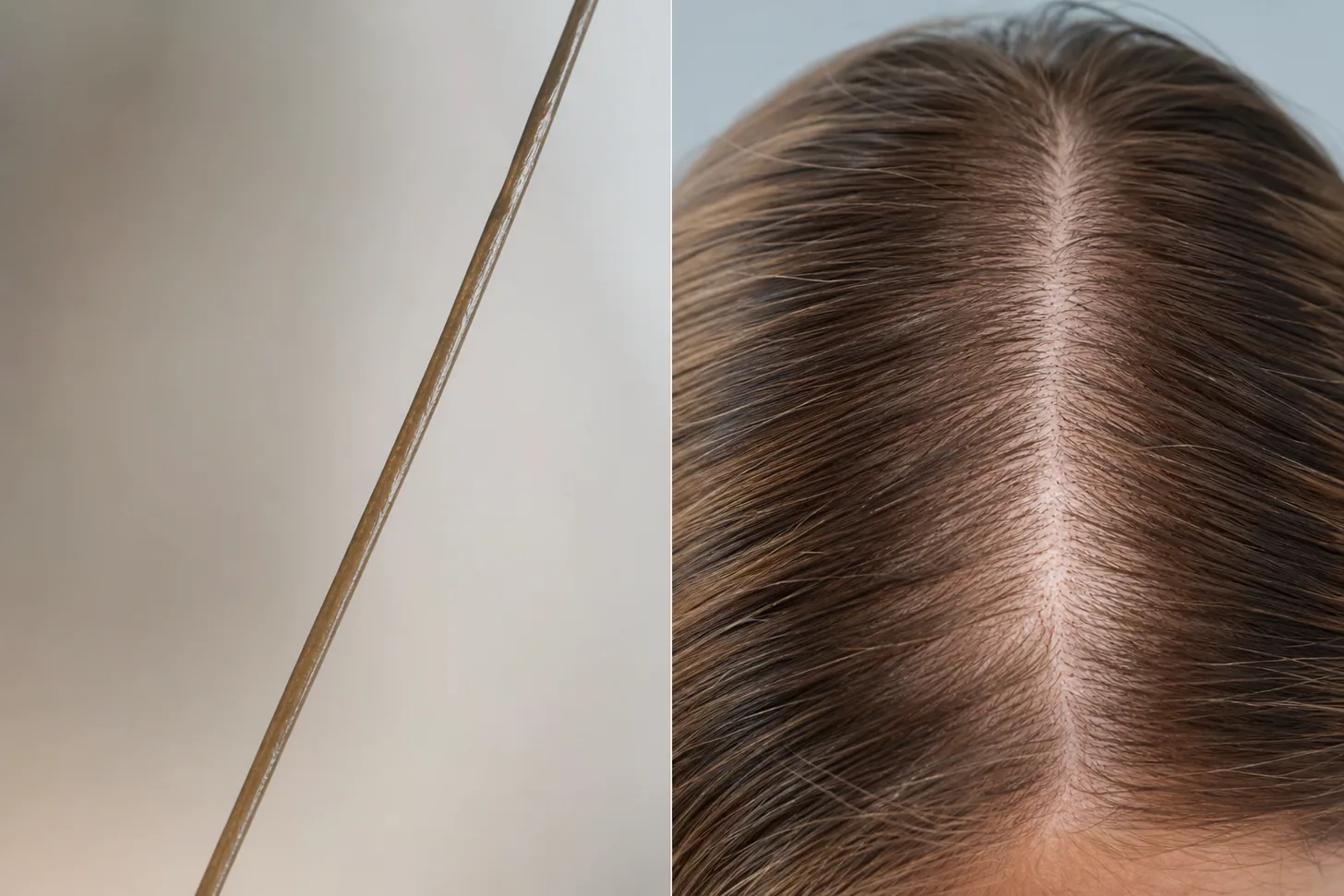
A haircut cannot give you more hair. What it decides is how much hair you look like you have — and those are two genuinely different things that almost every page on this subject blurs together. Fullness is read by the eye from three cues: whether there's a solid edge where your hair ends, whether the silhouette has height at the top, and how much scalp shows in ordinary overhead light.
All three are things a pair of scissors controls completely. Strand diameter and follicle count are not. Below are twelve shapes that manage those three cues well on fine hair, grouped by length so you can start from what you're actually willing to cut off, plus the four that work against you and the exact sentences that get the right one built.
If you want to know whether layers belong in your version of this, that turns on your density rather than your strand size, and volumizing haircuts for fine and thin hair settles it with a self-test first.
The bottom line is the part of a haircut that reads as density — it's the only place a stranger sees all your ends at once.
What a haircut can change, and what it can't
Worth separating properly, because the gap between the two is where most disappointment lives.
It cannot change strand diameter. Fine hair is fine because of the width of each individual strand, which is set by genetics and hormones and not by anything that happens in a salon chair. No cut, no product and no technique makes an individual hair thicker.
If you're not sure whether your issue is strand width or how much hair you have, fine hair versus thin hair is the distinction to get straight first — they need opposite haircuts and people mix them up constantly.
It cannot change how many hairs you have. Density is follicle count. A cut redistributes the hair you own; it doesn't recruit more.
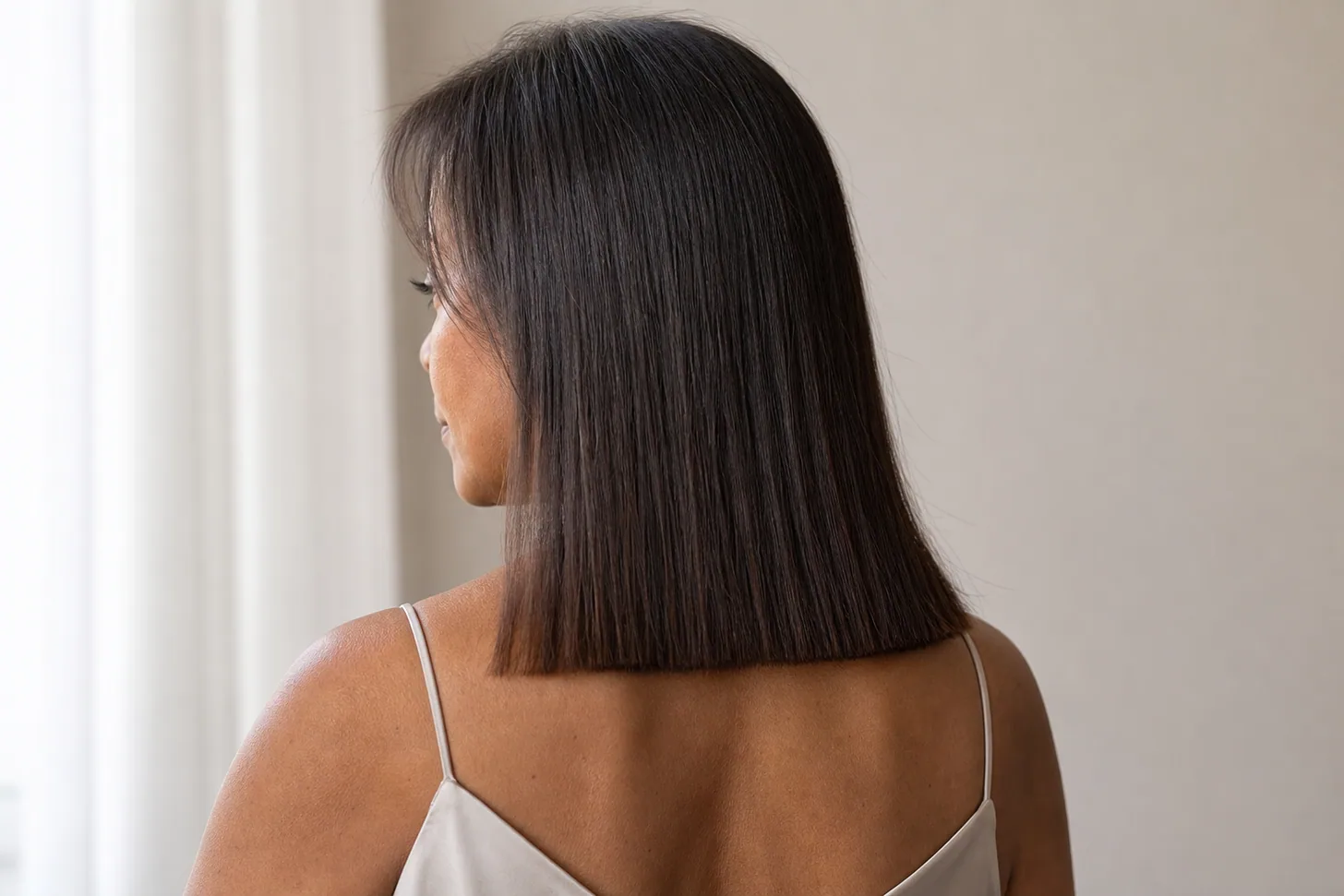
What it does change is where the eye finds an edge. Hair reads as thick at the point where the ends stop. One clean line of ends at the same length looks like a solid mass. The same hair tapered to different lengths looks like a fade into nothing. This is the largest lever available and it costs nothing.
It changes the height of the silhouette. A shape whose outline starts at the top of the head reads fuller than one whose outline starts at the ears, regardless of what's inside it.
And it changes how much of your scalp is visible. Shorter hair sits at a wider angle from the head instead of lying down flat on it, which covers the part line and the crown better than length does.
That's the whole mechanism. Three visual cues, all of them structural, all of them a cutting decision. Which is genuinely good news, because it means one appointment buys you months of it rather than fifteen minutes each morning.
Chair-side note
The most common version of this conversation goes: someone sits down, says "I want it to look thicker", and I ask what they've been doing so far. Almost always the answer is a shelf of volumizing products and no change to the cut in two years. And the thing is, the products aren't the wrong idea — they're just the smallest of the three levers, and they're the one you have to pull again every single morning.
If your hair looks thin partly because it's long, one-length, six months past a trim and hanging with all its weight on the roots, no mousse on earth is going to out-argue that. I'd rather someone came in twice a year and let the cut carry it. It's cheaper, and it works on the days you don't have twenty minutes.
SB
— Simone Baptiste, Senior Stylist
The four cutting decisions that do the work
Every shape further down is a different combination of these four. Knowing which is which lets you judge a haircut you're offered rather than trusting the name it's given. The single most reliable of those mechanisms gets its own page: blunt cuts for thin hair, including the length at which it stops working.
1. A solid perimeter. The hemline is the single highest-return decision in a fine-hair cut. Blunt, or close to blunt, means every hair in the bottom section ends at the same place, so the eye reads mass rather than tapering.
This is why a plain blunt bob out-performs a much more sophisticated layered shape on low-density hair, and it's the part you have to actively protect — "softening the ends so it doesn't look heavy" is the most common way a good fine-hair cut gets undone at the last minute.
2. Shorter length. Two effects at once. Less weight hanging off the roots means the hair lifts away from the scalp instead of being dragged onto it, and the same quantity of hair concentrated into a smaller outline reads denser per square inch. Chin to collarbone is the band where both effects are strongest without losing coverage.
3. Height built high, not length removed low. Where a shape needs volume, it needs it in a band across the crown and upper back — built by graduation or by short internal layers no longer than three or four inches. What it does not need is weight taken out of the ends, which is what happens when "volume" gets translated as "layers" without anyone specifying where. Layers on fine hair is the long version of that distinction.
4. Point cutting, never a razor and never thinning shears. A razor tapers each strand to a fine point, so on hair that's already fine the last inch goes transparent.
Thinning shears remove hair from the middle of a section, which is a reasonable idea on dense hair and a ruinous one when the ends are already sparse. Point cutting — scissors held vertically, taking small notches — softens a line without removing meaningful weight. Cutting techniques for fine hair covers what each tool actually does.
Decision
What it does to how full hair reads
Verdict on fine hair
Blunt or near-blunt perimeter
Ends stack at one length; the eye reads a solid mass
The core move — protect it in the chair
Going to chin–collarbone length
Less weight on the roots, denser silhouette per square inch
Reliable; the highest-percentage length band
Graduation at the back
Stacks weight into a band, gives the shape height
Yes — kept above the ears
Short internal crown layers
Lifts the top so the outline starts higher
Yes — three to four inches, point-cut
Face-framing at cheekbone or jaw
Adds visible movement at the front without opening the bulk
Yes, and it grows out cleanly
Heavy all-over layering
Removes weight from the ends; triangle silhouette
Only on high-density fine hair
Razor-cut ends
Tapers each strand to a point; ends read sheer
No
Thinning shears through the lengths
Removes hair from inside a section with none to spare
No — say so out loud
Very long, one length, untrimmed
Maximum root drag, maximum wear on the ends
The hardest brief on this page
Twelve shapes that read thicker, by length
Grouped by how much you're willing to cut off, because that's the real constraint. Within each band the mechanism doesn't change — pick on lifestyle and how much drying you'll genuinely do.
Short: chin and above
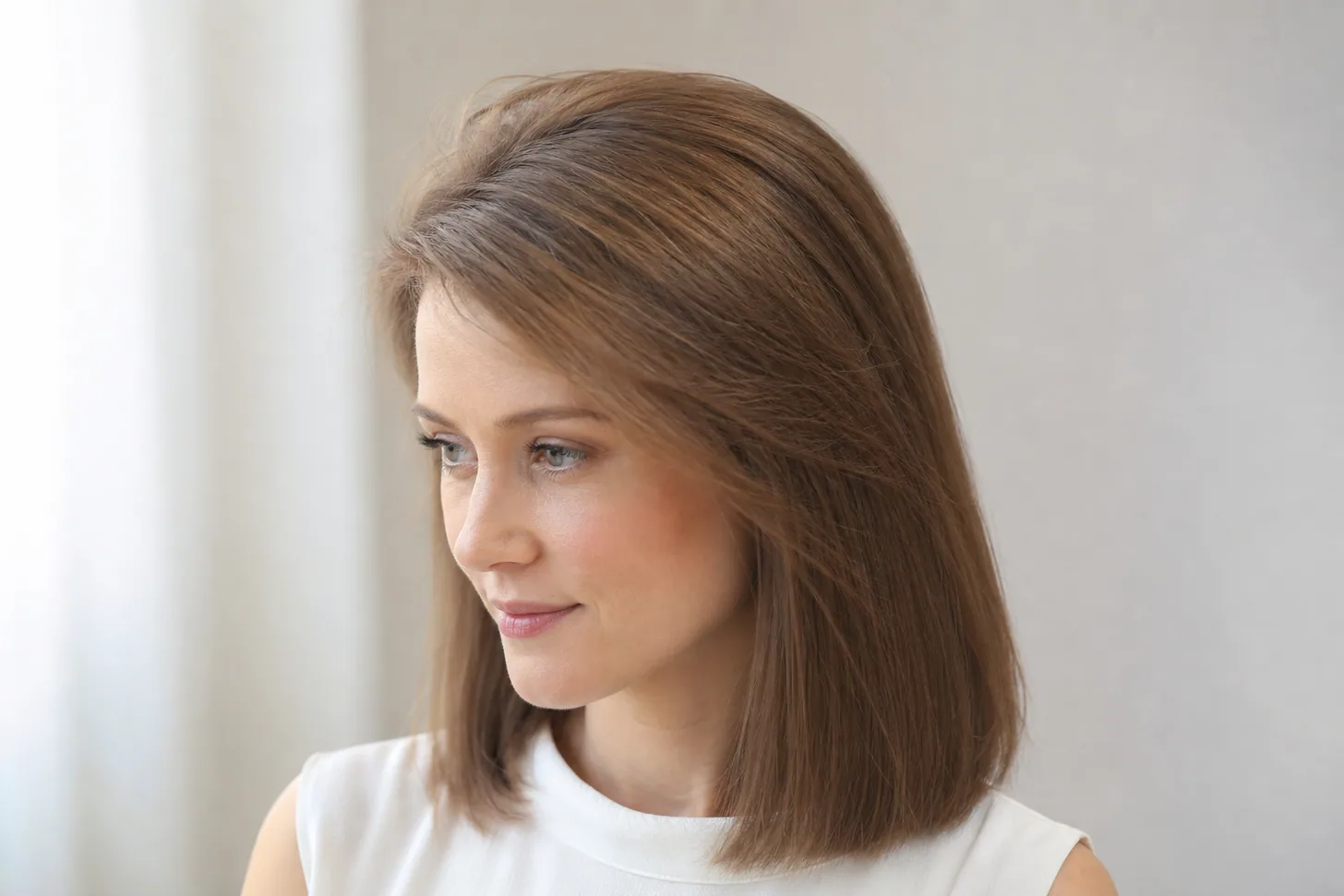
Blunt chin-length bob on fine straight hair with a heavy solid hemline and no visible layering
1
The blunt chin-length bob
The most dependable shape on this page and the one I reach for when someone's density is genuinely low. Every hair ends at the same point along the jaw, which gives the eye one thick edge instead of a gradient, and at chin length there's almost no weight left to drag the roots down. It asks very little at home — a rough dry with your fingers is usually enough. The trade is movement: this is a shape, not a swish, and if you want your hair to move you'll need the version at number two. Bob haircuts by face shape covers which jaw lengths suit which features.
French bob on fine hair with a soft fringe and a blunt jaw-length perimeter
2
The French bob with a fringe
Same blunt perimeter, plus a fringe — and the fringe is doing structural work rather than decorative work. It fills the front hairline, which is the area that shows scalp first and photographs worst, and it shortens the visible face so the hair around it reads as a fuller frame. This is the shape I suggest most often to someone whose part has widened but whose density is otherwise fine. Honest cost: a fringe on fine hair needs attention most mornings and gets greasy faster than the rest of your head. The French bob on fine hair and bangs for fine hair both go further.
Graduated stacked bob on fine hair, rear three-quarter view with built-up fullness at the back of the head
3
The graduated bob with a stacked back
The blunt bob's more ambitious sibling: the perimeter stays solid but the sections above it are cut progressively shorter so they pile up and build height across the back of the head. That height is what stops a bob reading as a flat curtain from behind, and it's the difference between a cut that looks good in the mirror and one that looks good in other people's photographs. It needs a round brush at the back to sit properly. If your back view collapses no matter what you do, haircuts for a flat back of the head explains why, and stacked bobs on fine hair has the full build.
Textured pixie on fine hair with a lifted crown and a close nape
4
The pixie with a lifted crown
Going properly short is the most direct move available, because with almost no length left there's nothing pulling the roots down and the shape is cut in rather than styled in each morning. The version that works keeps deliberate height and texture through the top and takes the nape and sides in close underneath, so the head reads as a full shape by contrast. The version that doesn't is the flat, uniform crop, which follows the skull exactly and shows every bit of it. One honest warning below in the caveat block — a pixie is unforgiving of a thinning crown. Pixie cuts for fine hair has the range.
Mid-length: jaw to collarbone
Statistically the sweet spot. Long enough to cover the scalp, short enough that the weight isn't working against you.
Collarbone-length lob on fine hair with a strong blunt hemline and soft face-framing at the cheekbone
5
The blunt lob with face-framing only
If one cut on this page is going to suit the most people, it's this one. The length sits at or just above the collarbone with a solid bottom line, and the only shaping is two pieces at the front starting around the cheekbone. Nothing is layered through the body of the hair, so the perimeter stays thick, but the face-framing supplies enough movement that it doesn't read as a slab. It also grows out without a stage where you hate it, which very few shapes can claim. The lob for fine hair and face-framing layers cover each half.
Shoulder-grazing cut on fine hair with a blunt hemline turned under at the ends
6
The shoulder-grazing cut, turned under
A one-length shape cut to sit exactly at the shoulder, dried with the ends bevelled slightly under. The turn-under matters more than it sounds: ends curving inward gather the hemline into a visible line, while ends flicking outward fan apart and expose gaps. Anyone who has grown their hair to shoulder length and watched it start flicking in four directions knows the failure mode — the fix is usually half an inch shorter, not more layers. Best on fine straight to slightly wavy hair; on fine wavy hair the bevel wants a little help from a brush.
Layered bob on fine hair with soft internal layers above a solid perimeter and a rounded silhouette
7
The layered bob with the weight kept low
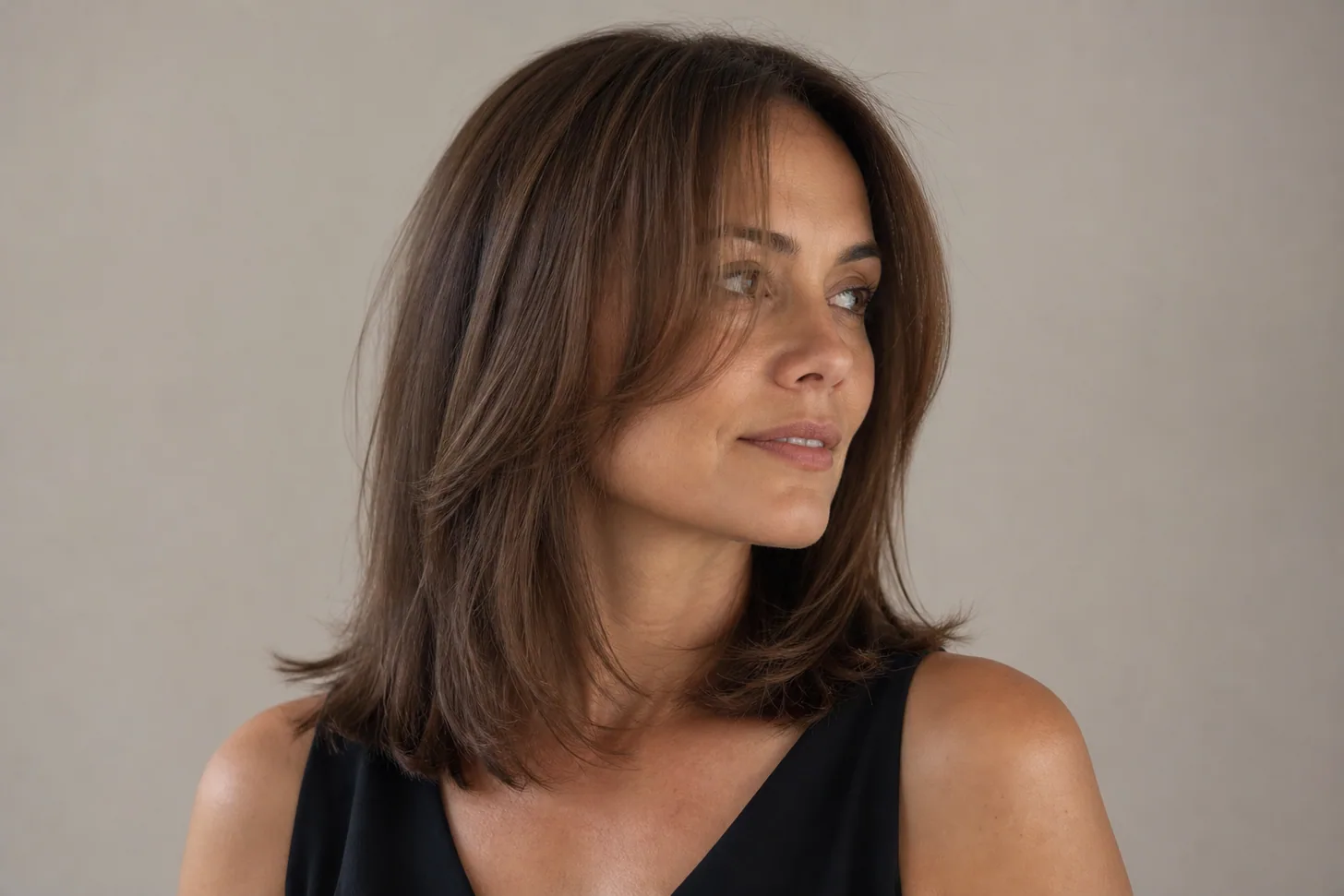
The compromise shape, and worth understanding precisely because it's the one most often cut badly. The rule is that no layer finishes below the level of your mouth. Everything above that line can be softened for shape; everything below stays untouched so the hemline holds. Cut that way it gives you body without costing you the edge. Cut with the layers running down into the length, it becomes the see-through version and there's no styling fix. Say the sentence out loud: layers above the mouth, nothing below. Layered bobs for fine hair has the detail.
Medium-length blunt cut on fine hair with a deep side part creating fullness at the crown
8
The mid-length blunt cut with a deep side part
Same cut as number five, one styling decision different — and it's a decision the cut has to accommodate, so it belongs here rather than in a styling guide. Moving the part two or three inches off centre pushes a mass of hair across the top of the head, which builds height at the root and covers a widening centre part in the same move. For it to hold, the cut needs a fraction more length on the heavy side. Mention it in the chair; a stylist cutting for a centre part will balance the two sides evenly and the whole effect disappears. Where to part fine hair covers the switch.
Long: past the collarbone
The hardest brief, and the one where the standard advice does the most damage. All four of these follow the same rule — the shaping happens above the ears, and the ends are left alone.
Long fine hair cut to one length with a heavy blunt hemline just below the collarbone
9
Long, one length, cut just below the collarbone
The most under-recommended shape for fine hair that wants to stay long, mostly because it sounds like no haircut at all. It's the opposite: it's a haircut that spends all of its budget on the hemline. Kept just past the collarbone rather than at mid-back, the length is short enough that the ends haven't been through two years of wear, and one clean line across the back reads as more hair than a layered version of the same head. Requires the eight-to-ten-week trim to stay honest.
Long fine hair with invisible ghost layers high in the back and a solid hemline
10
Long hair with ghost layers only
For anyone who finds number nine too static. Ghost layers are internal layers cut high and blended so thoroughly that you can't see where they start — they remove a little weight from underneath the top sections so the hair lifts, without touching the outline at all. It's the only kind of layering I'll do on long fine hair without asking about density first, because by design it doesn't cost you any ends. Ask for it by name; "invisible layers" also works. Ghost layers on fine hair is the full method.
Butterfly cut on fine hair with shorter front layers framing the face over long one-length lengths
11
The butterfly cut, kept front-loaded
A long shape built from two lengths — short front pieces that stop somewhere around the chin, over long lengths that stay one length underneath. On fine hair it works precisely because the two sections are separate: the short front creates visible volume around the face where everyone looks, while the back keeps its full weight and its solid line. It falls apart when a stylist blends the two into a continuous layered shape, which is the mainstream version and the wrong one here. The butterfly cut on fine hair covers the split.
Long fine hair with a curtain fringe parting at the centre and a blunt hemline below
12
Long hair with a curtain fringe doing the volume
The last option for long fine hair, and a genuinely clever one: leave the length completely alone and put all the shaping into a curtain fringe at the front. Two pieces from around the cheekbone, parted in the middle and swept back, add height at the hairline and movement at eye level while the body of the hair keeps every hair it has. It's the highest-impact change you can make without losing a single inch of length. Daily cost is real — a fringe wants three minutes most mornings. Curtain bangs for fine and thin hair has the maintenance verdict in full. The most disconnected member of this family is the mullet, which builds the illusion through silhouette rather than through weight.
Haircuts for thinning hair: when the density is changing, not just low
Everything above is written for hair that has always been fine or thin. A large share of the people reading it are looking for haircuts for thinning hair, which is a different situation with the same twelve answers and three extra rules.
Thin is a stable fact about how many strands you have. Thinning is a change — the ponytail that has shrunk over a year, the part that is wider than it was, the crown that shows in overhead light when it did not.
The cutting decisions that make thin hair read thicker work on thinning hair too, because the mechanism is the same: where the eye finds an edge, how high the silhouette starts, how much scalp shows. What changes is which shapes to favour and what to do alongside the cut.
Cut for the hair you will have in six months, not the hair you have today. A shape that depends on the crown carrying weight — the pixie with the lifted top, a heavily graduated back — is the right shape for stable low density and the wrong one for a crown that is actively losing it, because as the density drops the shape exposes exactly the area it was meant to fill.
The shapes that degrade gracefully are the ones whose fullness lives in the perimeter: the blunt chin-length bob, the French bob, the blunt lob with face-framing only. They read the same at month six as they did on day one, and they can be shortened without changing character. If you are between the two, choose the shape whose failure mode you can live with.
The crown and the part take priority over the ends. On stable thin hair the hemline is the highest-return decision. On thinning hair in women, loss concentrates at the crown and along the part — the pattern of female pattern hair loss and of most diffuse shedding — so the top of the head is where the cut earns its keep.
That means a deep side part rather than a centre one, height built above the ears, and a fringe or face-frame that moves the eye forward and down.
Cuts for a thinning crown works through the fourteen shapes built specifically for that zone, and where to part fine hair covers the single cheapest change on this list. For hair that is thinning on top rather than all over, the non-cut answers — root powder, fibers, a topper — are in how to make thin hair look thicker, and they combine with any shape here.
Find out why before you decide how short. A haircut for thinning hair is a good idea at any stage, but it is not the appointment that matters most. Shedding that began over weeks — after an illness, a birth, a change of medication, a stressful season — is usually a telogen effluvium and resolves on its own, in which case a dramatic cut is a decision made at the worst possible moment.
A part that has widened slowly over years is more likely female pattern loss, which responds to treatment better the earlier it starts. Fine hair or thinning? walks through telling the two apart, and diffuse thinning covers the front-versus-back check that separates a shed from a pattern. Have the cut, by all means — a blunt bob makes a thinning head look better the same afternoon — but book the dermatologist in the same week.
One more distinction the search results blur. "Hairstyles for thinning hair" returns pages for men as often as for women, and the advice does not transfer: male pattern loss recedes at the temples and crown and is cut with clippers, while female thinning spreads across the top under an intact hairline and is cut with a perimeter.
This page and the crown page are written for the second pattern. For older women in particular, where thinning and finer strands arrive together, the age galleries — fine hair over 60 and mature fine hair — apply the same rules with the maintenance reality built in.
The exact words to bring to the salon
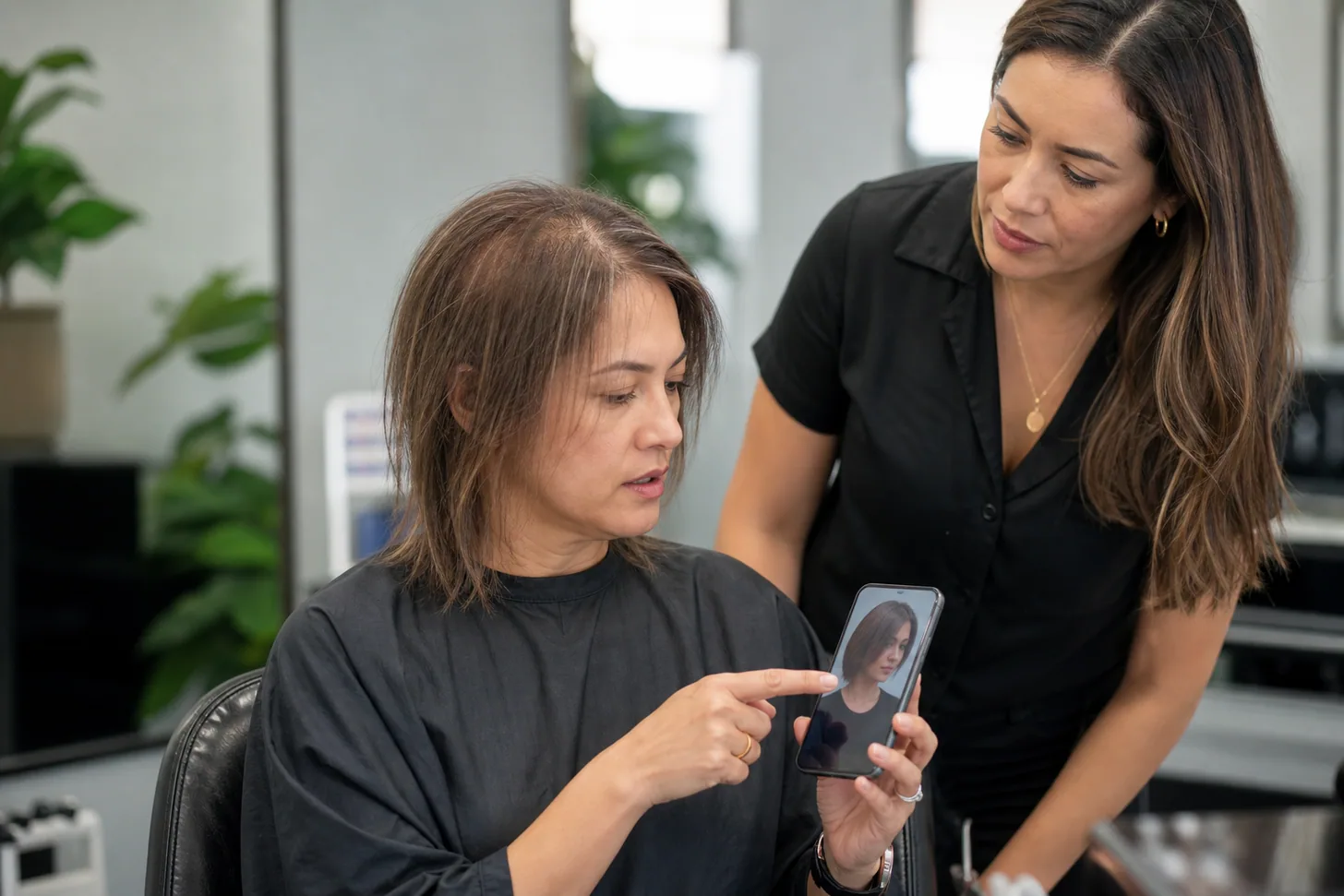
"I want it to look thicker" is heard as "layers" a large share of the time, because layers are the reflex answer to any request involving fullness. These sentences don't leave room for that translation.
"I'd like the bottom line kept blunt and solid — that's the part that makes it look thick to me."Protects the hemline before anyone starts softening it.
"Any shaping above the ears, please. Nothing through the ends."The single sentence that separates a good fine-hair cut from a bad one.
"No thinning shears and no razor — my hair goes see-through at the ends."Say it out loud rather than hoping. You can't undo it afterwards.
"Can we point-cut anything you're softening?"Gives your stylist the technique instead of just the prohibition.
"I part it deeply on this side, so please cut it for that part."Only if it's true — but if it is, it changes the cut.
Here's the thing nobody tells you about the blunt hemline: it has a shelf life, and it's shorter than you think. A blunt line is only blunt while every hair in it is still the length it was cut to. Ends wear, split and taper on their own, so by about week twelve the line has quietly turned into a soft gradient and the hair reads thinner — with exactly the same amount of hair on your head as the day you loved it.
I've had people come back convinced they'd started losing hair in the three months since their last appointment, and what they'd actually lost was the edge. Half an inch off, and the thickness comes back in fifteen minutes. It's the least glamorous advice on this page and probably the most useful.
SB
— Simone Baptiste, Senior Stylist
When a haircut isn't the thing to fix
You can see scalp through the top when you look down at a photo.That's a coverage problem rather than a shape problem, and it has its own answers — thinning on top and cuts for a thinning crown.
Your part has been widening over months.Worth establishing whether this is fine hair or thinning hair before choosing a cut — fine or thinning? walks through it, and a thinning hairline is the front-of-head version.
Your hair is fine but there's a lot of it.Most of this page still applies, but the layering verdict flips — fine hair with high density is written for you specifically.
You've had a sudden change rather than a gradual one.Shedding that started over weeks is a different question from hair that's always been fine — the hair growth cycle explains what's normal, and it's worth a doctor's visit rather than a salon one.
FAQ
The single most reliable answer is a cut with a strong, unbroken bottom line somewhere between the chin and the collarbone — a blunt bob, a French bob, or a lob with a solid hemline. That perimeter is the part of a haircut that actually reads as density, because it's the only place a stranger sees all of your ends stacked together at once. Everything else is a refinement on top of it: height built at the crown so the silhouette starts higher, and length kept short enough that the weight isn't dragging the roots flat. What doesn't work is the answer most often given — all-over layering. Layers can help, but only on hair with enough density to spare, and most people asking this question don't have it.
Usually yes, for two reasons that compound. Shorter hair weighs less, so the roots aren't pulled flat by the length hanging off them — you get lift for free. And a short cut concentrates the same amount of hair into a smaller silhouette, which matters because the eye reads density as hair-per-square-inch rather than as total volume. The same head of hair spread over a shoulder-length shape looks sparser than it does packed into a chin-length one. The honest limit is that very short cuts stop hiding the scalp: a pixie is excellent on fine hair with normal density and unforgiving of a thinning crown or a widening part, because there's no length left to lie over it.
Both — and which one you get depends on your density rather than on how fine your strands are. Fine hair with a lot of it genuinely gains from layers, because there's enough bulk that removing some creates movement without creating gaps. Fine hair with little of it loses, because every layer is weight taken from a perimeter that was already see-through, and the result is the stringy tapered ends fine-haired readers describe over and over. That distinction almost never appears in the advice you'll read, which is why the same question gets opposite answers everywhere. Volumizing haircuts for fine and thin hair has the self-test that tells you which you are.
For most fine hair, yes — blunt is the safer default, because it makes the one promise fine hair needs, which is that the ends stay solid. The trade-off is real: a completely blunt cut can hang flat and heavy with no movement, and on fine straight hair that can read as a limp curtain rather than as thickness. The version that works keeps the perimeter blunt and adds a small amount of soft, point-cut internal layering above it — enough to give the hair somewhere to move, not enough to open up the ends. Choosing between the two extremes with no other information, blunt beats over-layered on fine hair almost every time.
Chin to collarbone, and the reason is mechanical rather than fashionable. Above the chin you start losing the ability to cover the scalp; below the collarbone the weight of the length flattens the roots and the ends have been through months of wear before they're ever cut. Inside that band the hair is short enough to hold lift and long enough to have a visible, solid hemline. That doesn't make long hair impossible on fine hair — it makes it more work, and it moves the shaping up above the ears where it can't cost you ends. Long hairstyles for fine hair covers doing it well.
No. A haircut can't change strand diameter and can't change the number of follicles on your head, and any page suggesting otherwise is selling you something. What a haircut changes is how full your hair reads — where the eye finds a solid edge, where the silhouette has height, how much scalp shows in ordinary light. That isn't a consolation prize; it's most of what people mean when they say someone's hair looks thick. But it's worth being precise about, because the disappointment people feel six weeks after a haircut usually traces back to having been promised the first thing and given the second.
Four, in rough order of damage. Razor-cut layers, which taper every strand to a point and leave the last inch of fine hair transparent. Thinning or texturizing shears through the ends, which remove hair from inside a section that had none to spare. Heavy all-over layering on long hair, which produces the triangle silhouette — flat at the top, fanned and see-through at the bottom. And very long one-length hair, which is maximum weight on the roots plus maximum wear on the ends. None of these are bad haircuts in general; they're bad on low-density hair specifically.
Every eight to ten weeks for a shape with a blunt perimeter, closer to five or six for anything short and graduated. On fine hair the illusion lives almost entirely in the bottom line, and a blunt line stops being blunt fairly quickly — ends wear unevenly, split, and taper on their own. A cut that looked dense the day you had it and looks sparse three months later usually hasn't lost any hair; it's lost its edge. If you're growing length out, a light dusting of the ends on schedule keeps the perimeter solid while still gaining length, which is the compromise most people don't realize is available. How often to trim fine hair has the schedule.
For women, a shape whose fullness lives in the perimeter rather than the crown: a blunt chin-length bob, a French bob, or a blunt lob with face-framing only, worn with a deep side part. Those shapes read thick because every end stops at the same line, and they keep reading thick as density changes, because they do not depend on the crown carrying weight. Pair the cut with a side part that moves the exposed line off the thinnest area, and keep length off the roots so what remains is not pulled flat. If the thinning is concentrated at the crown, the cuts built specifically for that zone put height above the ears and move the eye forward with a fringe. Whatever the shape, get the cause looked at in the same week — a haircut improves how thinning hair looks, not why it is thinning.
Shorter, usually, but not necessarily short. The case for taking length off is mechanical: long hair hangs its weight from roots that are already struggling to lift, and its ends have been through months of wear before they are cut, so long thinning hair reads sparser than the same amount of hair at the collarbone or chin. The case against a very short crop is that the shortest cuts rely on the crown for their shape, and on actively thinning hair the crown is the area most likely to give way. The band that works for most women is chin to collarbone with a solid hemline, which lifts the roots, keeps the ends dense, and can be shortened later without changing the look. Go shorter than that when the crown is stable and the hairline is intact.
The ones that either expose the top of the head or pull on it. A centre part draws a straight line through the area where female thinning shows first, and a slicked-back or scraped-back style reduces the silhouette to the shape of the skull, where any difference in density is total. Long one-length hair hangs its weight from the roots and flattens them. Razor-cut or heavily thinned layers taper the ends to nothing. And tight ponytails, buns, braids or clip-in pieces load tension onto a hairline and crown that are already thinning, which over time becomes a second cause of loss rather than a cover for the first. Favour a deep side part, a solid hemline, height built above the ears, and styles that need no elastic.
Eleven years cutting fine hair. Simone's rule for making fine hair read thicker: spend the whole budget on the bottom line, and do the shaping above the ears.
Images in this article are AI-generated illustrations, not photographs of real clients or results. See our image policy.
Results vary with hair type, density, and growth patterns. This guide is educational and not a substitute for an in-person consultation with a licensed stylist.
Get the good hair intel
One honest, stylist-written guide in your inbox each week. No hype.

 SB
SB