Reviewed by Dr. Rachel Kimura, MD · Updated September 2026 · 13 min read
A relaxer does not make a fine strand any thinner. It makes it weaker, permanently, and that single fact decides every cut on this page. Relaxed fine hair is fine hair with its safety margin removed — the same width, the same density, and a strand that snaps where natural hair would bend — so the shape has to do three jobs at once: carry less weight, keep a solid edge cut where the hair is still healthy, and build height in with scissors, because relaxed hair lies flat and will not build it on its own.
That is why the relaxed pixie and the blunt relaxed bob keep coming back for thin hair, and why the thinning shears that stylists reach for on dense relaxed hair are the one thing to refuse.
Below are 14 short shapes and set styles for relaxed, fine or thin hair — pixies with the height cut into the crown, bobs that keep their perimeter, low-heat sets that add body without a flat iron, and the transition shapes for when the relaxed length itself has become the problem — plus the touch-up schedule a fine strand can actually afford, and what the research says about relaxers and health.
If you wear your coils natural rather than relaxed, our gallery for fine 4C and coily hair is the companion to this one, and if you have not yet worked out whether you are dealing with fine strands or low density, do that first — it changes which of these shapes you want.
Chair-side note
The relaxed-hair clients who worry me most are not the ones with damage you can see. They are the ones whose hair looks smooth and fine and behaves itself, who have been on a six-week touch-up schedule for years, and who tell me their ponytail has been "getting smaller" while their part looks the same.
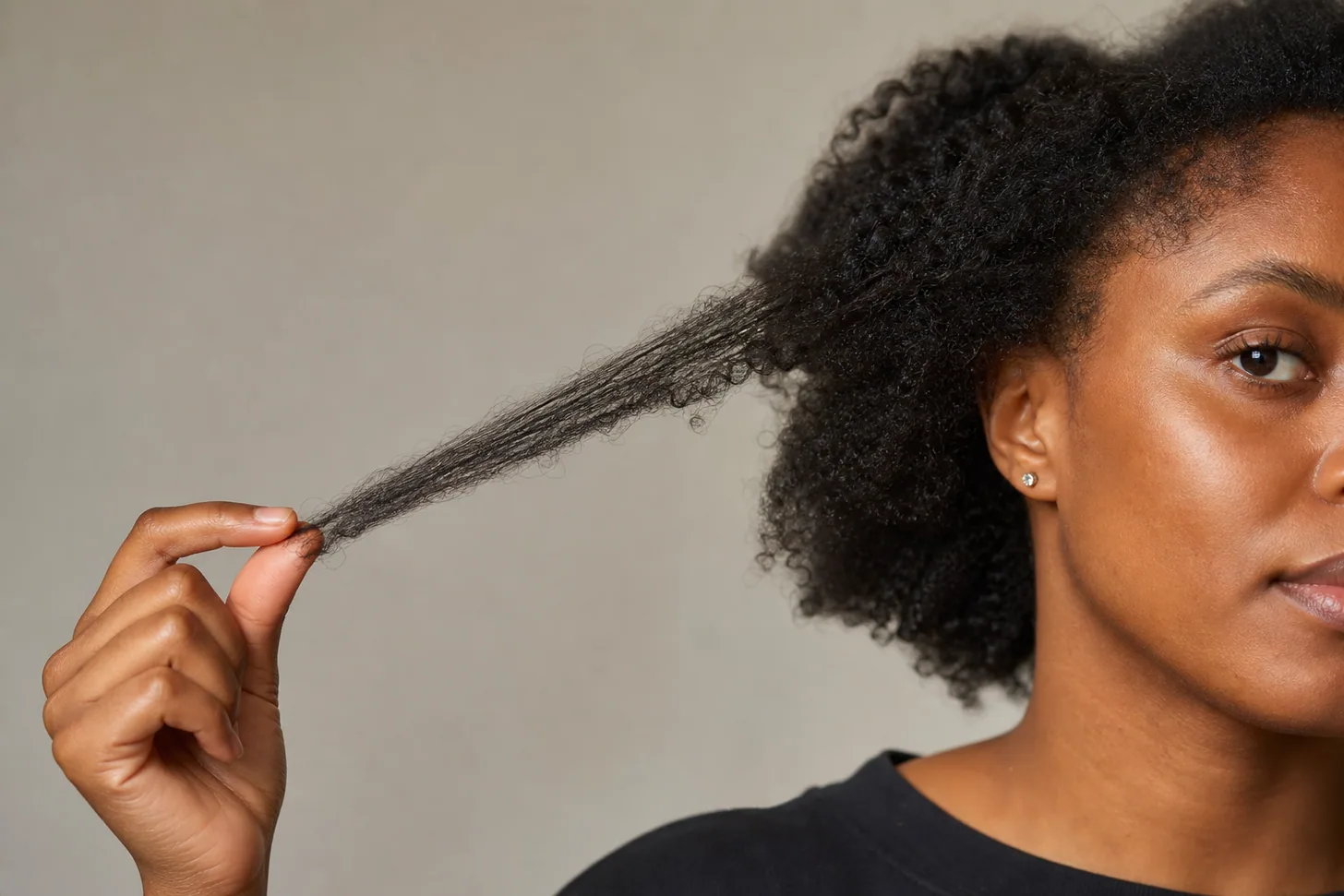
When I take a section and run it between two fingers, I feel exactly where each touch-up landed — a slightly rougher ring every inch and a half — and when I pull very gently on the ends, the hair gives before I expect it to.
That is not thinning. That is a fine strand that has been asked to hold the same weight with less strength, and the cut is the fastest way I have to take the weight off it. Nearly everything on this page is a version of that one move.
SB
— Simone Baptiste, Senior Stylist
Why relaxed fine hair needs its own cut brief
Start with what a relaxer actually does, because the cut follows from it. Whether it is a lye formula (sodium hydroxide), a no-lye formula (guanidine hydroxide) or the milder thioglycolate type often sold for fine or color-treated hair, a relaxer works by breaking the disulfide bonds that hold the strand in its coiled shape and re-forming them with the hair pulled straight. The change is permanent, which is the whole appeal, and it is also the whole problem: those bonds were doing structural work.
When Khumalo and colleagues analysed the amino acids in natural and relaxed hair, they found cystine — the sulfur-bearing amino acid those bonds are made of — was lower in every relaxed sample, and that in the older lengths of relaxed hair, and in relaxed hair that had already turned brittle, cystine sat at the levels seen in trichothiodystrophy, a genetic disorder whose defining feature is hair that breaks. Their conclusion was plain: relaxers are associated with reduced cystine "consistent with fragile damaged hair."
Now put that on a fine strand. Fine hair has less cortex than medium or coarse hair to begin with, so it has less structure to lose and reaches the breaking point sooner. It also has less mass to hide the consequences: a coarse relaxed strand that frays still reads as hair, while a fine one that frays reads as nothing at all.
That is why the relaxed-hair experience of "my hair got thin" is so often breakage rather than loss. In a questionnaire study of 90 women who had relaxed their hair more than once, Shetty and colleagues recorded some adverse effect in 95.56% of them, with hair loss reported by 47% and "thinning and weakening of hair" by 40%.
It is a small self-reported sample from one campus, so treat the exact figures loosely — but the ranking is consistent with what shows up in the chair, and "thinning and weakening" is the phrase to hold onto, because on fine hair those are the same event.
The place it happens is specific. Every touch-up creates a line of demarcation where the new growth, still coiled, meets the previously relaxed length, now straight. Two textures meeting in one strand is a stress point, and it is also exactly where the next application tends to overlap, so the junction gets processed twice.
A woman on a six-week schedule with an inch of growth a month is carrying a new stress ring every inch and a half along every strand.
The longer the hair, the more rings it carries and the more weight hangs from each one. Cut it short and you have removed most of the rings and most of the load in a single appointment — which is the first of the three rules below and the reason this page is a short gallery rather than a long one.
The second rule is about where the edge goes. Everything this site argues about blunt cuts for fine hair still holds on relaxed hair: the eye reads density at the point where the ends stop, so a solid perimeter is the highest-return decision in the cut.
But relaxed ends are also the oldest, most-processed hair on the head, and a blunt line cut through hair that is already splitting turns back into a soft, see-through gradient within weeks. So the perimeter goes where the hair is still healthy, not where you wanted the length to be, even if that costs an inch you were hoping to keep.
The third rule is the one that separates this page from every other fine-hair gallery on the site: relaxed hair lies flat and smooth, so it has none of the natural lift that a wave or a coil supplies for free. Height has to be cut in — a crown left longer and shaped to stand — rather than styled in every morning with heat the strand can no longer afford.
One scope note. This page is about the shape of relaxed fine hair and the schedule that supports it. It is not a care routine, and it is not the case for or against relaxing, which is a decision that belongs to you and, given the research covered further down, one worth making with the facts in front of you.
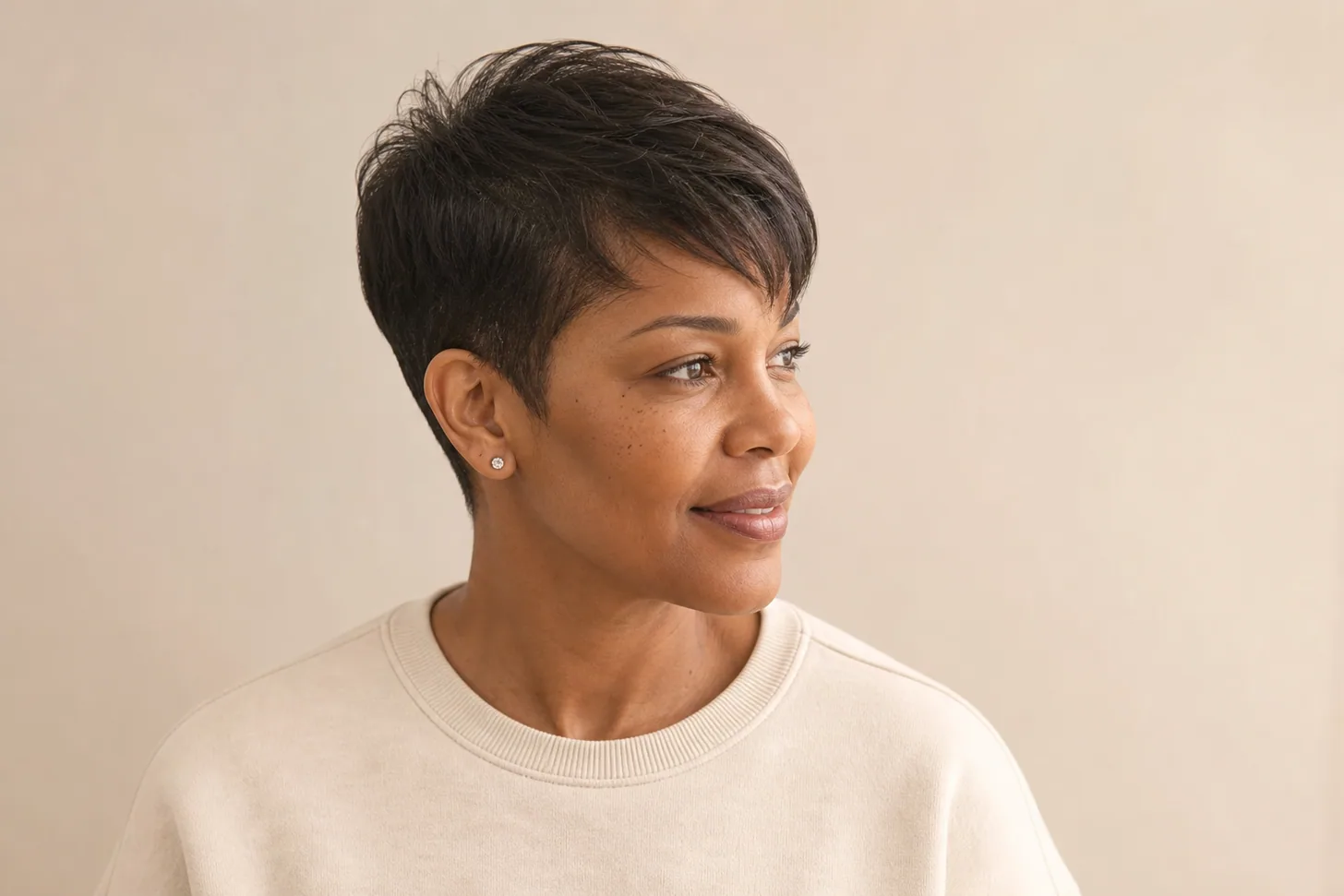
The relaxed pixie is what most people searching this topic are picturing, and it earns the reputation. It keeps the hair in a small silhouette, so the same strands read denser; it takes the sparse temple and nape zones out of the outline; and it removes nearly every line of demarcation from the head in one cut.
The condition is the one in the lead: because relaxed hair lies flat, the lift has to be built into the crown by the cut, not asked of the hair.
lifted-crown relaxed pixie on fine, low-density hair — crown left longer and shaped to stand, sides tapered close, sleek smooth finish, Black woman in her 40s
1
The Lifted-Crown Relaxed Pixie
The crown is left an inch or two longer than the sides and cut in graduated lengths that stand away from the head, so the silhouette starts high even when the hair is wrapped flat overnight. Everything below the crown tapers close, which removes the temples — where fine hair is finest on most people — from the outline entirely. Ask for the top to be "cut to lift" rather than "layered," because layering scattered through a relaxed pixie produces separated, stringy pieces rather than height.
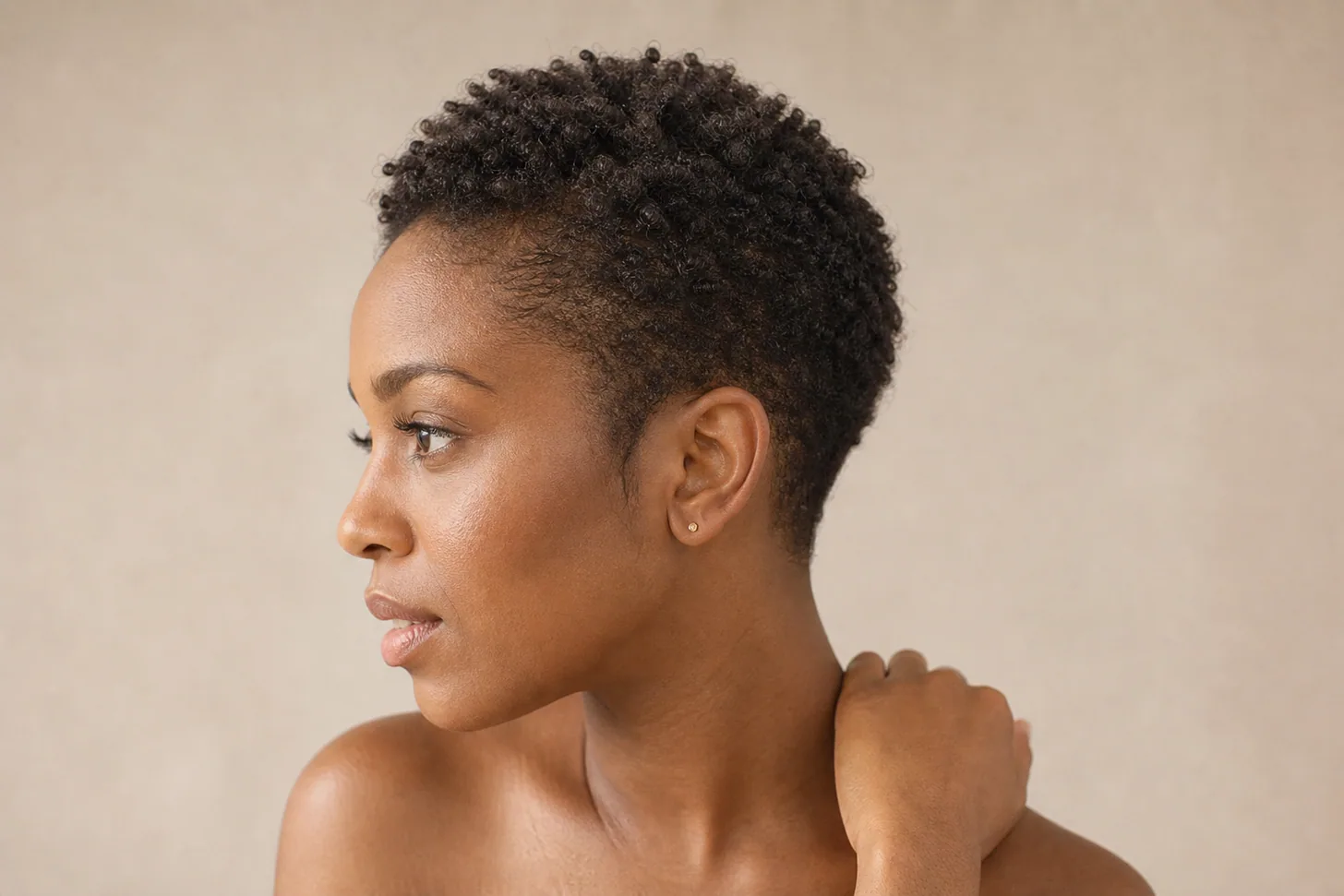
tapered relaxed pixie on thin hair with a clean faded nape and a smooth, slightly longer top swept forward, Black woman with deep skin
2
The Tapered Pixie With a Clean Nape
Sides and nape graduate down to almost nothing while the top keeps a smooth, forward-swept length. On thin relaxed hair the taper solves a real problem rather than hiding one: the nape is often the first place relaxed hair breaks, from collar friction and from being the section most likely to be overlapped at a touch-up. Cutting it close turns a sparse zone into a design line and means there is nothing left there to break.
asymmetric relaxed pixie with one longer side sweeping across the forehead and the other side cropped short, fine dark hair, Black woman in her 30s
3
The Asymmetric Pixie With a Long Side
One side is cropped, the other carries a longer sweep across the forehead, and all the visible length is concentrated on one side of the head where it reads as one dense piece. This is the pixie for a hairline that is thinner on one side than the other — the long side covers it, the short side makes the contrast look deliberate. Keep the long sweep to a single solid section rather than feathering it, or the ends go transparent within a month.
short relaxed pixie with molded finger waves along the sides set with gel and no heat, smooth longer top, glossy finish, Black woman with medium-deep skin
4
The Pixie With Molded Sides
The sides are set wet with a light gel and molded into soft waves that dry in place, while the top stays smooth and lifted — a finish that reads polished and adds visual texture to hair that has none of its own. It is also one of the few decorative finishes that costs the hair nothing: no heat, no tension, and the gel rinses out. Use a gel that dries hard rather than a pomade, because anything oily on fine relaxed hair flattens it and will not hold the pattern.
long relaxed pixie-bob on fine thin hair, ear-length with a solid blunt edge and a lifted crown, smooth and glossy, Black woman in her 50s
5
The Long Pixie-Bob
Ear-length all round with a blunt edge and the crown lifted, this is the shape for anyone who wants the low weight of a pixie without giving up the ability to tuck it behind an ear. The solid perimeter does the density work; the length is short enough to carry at most one line of demarcation. It also grows out into a chin-length bob rather than into shapelessness, which makes it the right first cut if you are coming down from length gradually — our guide to pixie cuts for fine hair covers the grow-out stages.
Relaxed bobs: the blunt line is the whole point
Relaxed hair is the texture the blunt bob was made for. Smooth, straight and glossy, it shows off a solid perimeter better than any natural texture does, and that perimeter is where the eye reads density. The trade is that the same smoothness shows every flaw in the line — so these bobs are cut where the hair is still healthy, trimmed on a shorter cycle than most people expect, and never thinned.
blunt chin-length relaxed bob on fine hair, perimeter perfectly solid and even, center part, glossy straight finish, Black woman in her 30s
6
The Blunt Chin-Length Bob
One length, chin-grazing, every end stopping at the same line. Nothing on the site makes fine hair read denser than this, and on relaxed hair the smooth finish shows the line at its best. The rule is that the line is cut at the healthiest length available, even if that is a little shorter than planned: a blunt bob through splitting ends is a soft, see-through bob within six weeks. Ask for point-cutting to be kept to a minimum and for thinning shears to stay in the drawer.
graduated relaxed bob with a rounded stacked back and longer front, smooth fine hair, side view showing the built-up crown, Black woman in her 40s
7
The Graduated Bob With a Rounded Back
The back is built up in short, stacked graduation so the crown carries height the hair would never produce on its own, and the front falls a little longer toward the chin. Graduation is not layering: the ends still form a continuous line, just one that climbs toward the nape, so the density illusion holds. It is the bob for someone whose crown is the flattest part of the head — which on relaxed fine hair is nearly everyone. Expect to have the back re-shaped every six to eight weeks to keep the curve.
jaw-length relaxed bob with a deep side part and the heavy side sweeping across the forehead, fine dark hair, sleek finish, Black woman with deep skin in her 30s
8
The Jaw-Length Bob With a Deep Side Part
Moving the part well off center puts most of the hair on one side, where it stacks into a single dense sweep, and the lift comes from the hair having to travel over the crown to get there. It is the cheapest volume available on relaxed hair — no product, no heat — and it also shifts the exposed part line away from the crown, where relaxed fine hair tends to show scalp first. Cut for the part you actually wear, and say so before the cut begins, because a bob cut for a center part falls unevenly worn to the side.
chin-length relaxed bob with the ends flipped outward from a roller set, smooth body through the lengths, fine hair, Black woman in her 50s
9
The Flipped-Ends Bob
A chin bob set on medium rollers so the ends turn outward and the lengths carry a soft bend, which widens the silhouette at exactly the point where a straight relaxed bob narrows. The bend is set as the hair cools, which relaxed fine hair holds unusually well, and it needs no iron. The flip also disguises the first signs of wear at the perimeter, so it buys an extra week or two between trims. Keep the rollers medium rather than small — small rollers on fine relaxed hair make ringlets, not body.
chin-length relaxed bob with a soft side-swept fringe blending into the length, fine hair, glossy dark finish, Black woman in her 40s
10
The Bob With a Side-Swept Fringe
A fringe cut to sweep sideways from a deep part brings density forward to the part of the head everyone looks at, and on relaxed hair it lies smoothly enough to read as one solid piece rather than as strands. The honesty note: a fringe is cut from the hairline, and the hairline is where relaxed hair under any tension thins first. Check the front density before committing, and if the edges are already sparse, take entry 8 instead and let the side sweep do the same job from further back.
Set styles that give relaxed fine hair body without heat
A set is not a haircut, but on relaxed fine hair it belongs in a gallery of shapes, because it is how most of these cuts are worn between wash days and it is the alternative to the flat iron the strand can no longer afford.
Every set works on the same mechanism: hair takes the shape it cools in. Relaxed hair holds that shape well, and fine hair sets fast. The full mechanism is in heatless volume for fine hair; these three are the versions that suit a short relaxed cut.
wrap set on a chin-length relaxed bob — hair combed smoothly around the head in one direction and secured under a silk scarf, fine hair, Black woman at a bathroom mirror
11
The Wrap Set
Damp hair is combed smoothly around the head in one direction, secured under a scarf, and left to dry — then unwrapped into a bob that is straight, glossy and gently rounded at the ends with no heat at all. On relaxed fine hair this is the daily-wear method that costs the strand nothing, and it also stretches a fresh press or a salon set by days. Use a light setting lotion rather than a cream, keep any oil to a drop on the very ends, and wrap on hair that is damp rather than wet so it dries overnight.
roller set on short relaxed fine hair with large magnetic rollers at the crown, hair damp with setting lotion, Black woman in her 40s, bathroom setting
12
The Roller Set for Body
Large rollers at the crown and medium rollers through the sides, set on damp hair with a light lotion and dried under a hood or overnight, give a relaxed bob or long pixie a full day of body that no product produces on its own. The size matters more than anything: large rollers lift, small rollers curl, and on fine hair the curl reads as texture rather than fullness. The tool specifics — and why magnetic or foam beat velcro on a strand this fragile — are in our guide to hair rollers for fine hair.
pin-curl set on a short relaxed pixie, small flat coils pinned against the head with metal clips, hair still damp, Black woman with deep skin
13
The Pin-Curl Set
Small sections wound flat against the head and pinned, then brushed out into soft waves once dry, the pin curl is the set for hair too short to take a roller. On a relaxed pixie it turns the flat top into a soft, lifted wave that lasts two or three days, and it is gentle enough to do nightly. Wind the curls in the direction you want the hair to fall, use flat clips rather than bobby pins so nothing drags, and brush out with a soft bristle brush — a paddle brush flattens the wave you just built.
When the relaxed length is the problem
Sometimes the honest answer is that the relaxed hair has done what relaxed fine hair eventually does, and the cut is about getting it off the head safely. That is not a failure and it is not the big chop by another name — it is the same shape logic as everything above, applied to two textures at once.
transitioning cut on fine hair — short tapered sides showing natural coily regrowth, with the last of the smooth relaxed length kept only on the longer top, Black woman in her 30s
14
The Grown-Out Taper
The sides and nape are tapered down to the natural regrowth, so the two textures meet only on the top, where the remaining relaxed length is worn smooth and lifted while the coils come in underneath. Each trim takes a little more of the relaxed length off the top until the taper is all natural — usually four to six months for a pixie, without ever going shorter than you chose to. It is the transition shape that keeps a finished outline the whole way through. When the last of the relaxed hair is gone, the shapes built around shrinkage take over: they are in our gallery for fine coily hair.
The relaxer schedule a fine strand can afford
Most of what protects relaxed fine hair happens at the touch-up, not in the shower, and the standard schedule was written for hair with more strength to spare. Five changes, in order of how much they matter.
Stretch the interval to ten or twelve weeks, or longer. The six-to-eight-week schedule maximises the number of demarcation lines per strand and the number of times each one can be overlapped. Fine hair does better with fewer applications a year, full stop. The regrowth in between is manageable on a short cut — a wrap set smooths the two textures together — and it is far harder on long hair, which is another argument for the length on this page.
New growth only. The relaxer goes on the regrowth and stops at the line of demarcation. Ask for the previously relaxed length to be based with a protective conditioner or a barrier cream before the bowl comes out, so any drift does not process it again. If a stylist "smooths it through to the ends to even it out," that is the sentence that costs you the ends.
Mild or regular strength, never super. Super formulas are built for coarse, resistant hair. A fine strand processes faster, so it needs less time and a weaker formula, and it should come out of the chair with some bend still in it rather than bone straight. Under-processed relaxed fine hair is stronger than fully processed relaxed fine hair, every time.
Consider a texlax. Leaving a relaxer on for less than the full processing time loosens the coil without straightening it, which keeps more of the strand's structure intact and leaves the hair with a little natural body that fine hair can use. The trade is a less uniform result and a texture that needs a set to look finished. For fine hair that is worth it.
One chemical service at a time. The American Academy of Dermatology's guidance for anyone concerned about damage is to have only one service — a coloring, a relaxer, or a perm — and to add more time between touch-ups. If you color as well, keep the two services weeks apart, keep the color to deposit rather than lift, and tell each stylist about the other before anything is mixed. Our guide to whether color thins fine hair covers what a lifting color does to a strand that has already been processed once.
Heat and tension: the two things relaxed fine hair cannot afford twice
The relaxer has already spent the strand's strength once. Heat and tension each spend it again, and on relaxed fine hair they are the two habits that turn a good cut into breakage.
Heat. Relaxed hair is usually worn smooth, which pushes people toward a daily flat iron, and a daily flat iron on hair that has already lost cystine is how the last two inches disappear. The sets in entries 11 to 13 exist to make the iron occasional rather than routine.
When you do use one, everything in our flat iron guide for fine hair applies with the stakes raised: the bottom of the temperature range, one slow pass rather than three fast ones, a light mist heat protectant on fully dry hair, and never on the same day as a touch-up.
Blow-drying is gentler than ironing if the airflow is kept moving and the nozzle stays off the hair; the round-brush method in how to blow-dry fine hair works on relaxed hair with the heat setting turned down a notch.
Tension. The American Academy of Dermatology lists tight ponytails, buns, cornrows, braids and weaves as hairstyles that can cause traction alopecia, and notes the hair can stop growing back once the pulling has gone on long enough. Relaxed fine hair is the worst case for that mechanism: the load lands on a strand with less tensile reserve than natural hair, at a hairline that is finest on almost everyone.
So the protective styles that suit natural fine coils — sized carefully — are not a safe default on relaxed hair, and a weave or a sew-in on a relaxed, fine head is the single combination most associated with a receding hairline. If your edges have already thinned, read what a thinning hairline actually means before any style that pulls, and treat the short cuts above as the low-tension option they are: nothing on this page needs an elastic.
There is a third habit worth naming, which is handling. Relaxed fine hair tangles less than natural hair, which tempts people to comb it more casually. Use a wide-tooth comb on wet hair, a soft bristle brush on dry hair, and stop when you meet resistance rather than pulling through it; the breakage-versus-shedding test in why fine hair breaks is the fastest way to find out whether the hair you see in the sink is snapping or falling.
What the research says about relaxers and health
This is a haircut page, and this section is here because the medical reviewer on the byline would not sign it off without one. In 2022, researchers at the National Institute of Environmental Health Sciences published results from the Sister Study, a prospective cohort of 33,947 women followed for an average of 10.9 years.
Women who reported using hair straightening products — straighteners, relaxers or pressing products — in the previous year had a higher rate of uterine cancer than women who never used them (hazard ratio 1.80), and the association was stronger for frequent users, defined as more than four times a year (hazard ratio 2.55).
Use of hair dye, permanents and body waves showed no such association. The authors describe theirs as the first epidemiologic evidence of the link, say the finding needs to be replicated in other populations, and note that they could not identify which chemicals in the products might be responsible.
Two honest readings of that. Uterine cancer is uncommon, so a doubling of a small risk is still a small absolute risk, and a single cohort study is not proof of cause. But the study is large, prospective and well conducted, and the dose pattern — more use, more risk — is the shape that tends to hold up.
What it means for the decision on this page is that the touch-up interval is not only a hair-strength variable. The frequency the study flagged, more than four applications a year, is exactly where a six-to-eight-week schedule lands, and a ten-to-twelve-week schedule does not.
Whether to relax at all is your call, and this site is not going to make it for you; if you do, stretching the interval is the one change that serves the hair and the wider question at the same time. If you have questions about your own risk, they belong with a doctor rather than a stylist.
What to ask your stylist
Relaxed-hair salons are efficient, and efficiency is where fine hair gets processed like everyone else's. These sentences interrupt that in the right places:
"New growth only, please — and can you base the relaxed length before you start?" The sentence that saves the ends. Say it before the bowl is mixed.
"Mild strength, and I'd rather it came out with a little bend than bone straight." Sets the formula and the processing time in one line, and gives your stylist permission to stop early.
"Cut the line where the hair is healthy, even if that's shorter than I said." Protects the perimeter that does the density work.
"Please build the height into the crown with scissors — no thinning shears, no razor." Relaxed fine hair has no strength to spare through the ends, and a lifted crown is a cut, not a styling instruction.
"Can we set it rather than iron it today?" Most relaxed-hair salons are excellent at a roller or wrap set, and it is the kinder finish on a fresh touch-up.
"How much of this should I take off next time?" A stylist who answers with a plan for the ends over the next three visits is thinking about the strand rather than the appointment.
The honest upkeep picture
Short relaxed cuts are low-effort daily and high-frequency in the salon: a pixie needs re-shaping every five to six weeks to keep the outline, a graduated bob every six to eight, and a blunt bob every six to eight as well, because the smooth finish shows perimeter wear that texture would hide.
That is a shorter trim cycle than the same cuts on natural hair, and it is the trade for wearing the hair straight. The touch-up, on the schedule above, falls roughly every second trim. Daily time is genuinely low — a wrap set the night before and two minutes in the morning — provided the iron stays in the drawer most days.
The grow-out is the part to plan for. A relaxed pixie grown toward a bob passes through a stage around weeks eight to twelve where the crown lies flat and the sides stick out, which on relaxed hair cannot be disguised with texture; a roller set or a molded side (entry 4) carries it.
Growing out the relaxer itself is a longer project — six months to a year for a short cut — and the grown-out taper in entry 14 is the shape that keeps it finished throughout. If you are doing that, our guide to how often to trim fine hair has the honest arithmetic on how much relaxed length comes off per visit.
When these rules bend
Your relaxed hair is fine but there is a lot of it. High density gives you back some weight to play with: a little interior shaping below the crown stops a blunt bob reading as a solid block, and longer intervals between trims are fine. Still no thinning shears — the strand is still relaxed — but "cut it where it's healthy" becomes less strict. Our guide to fine hair with high density is written for you.
You wear it natural, or you are past the transition. Then shrinkage rather than fragility is the fact that organises the cut, and the shapes are different. Start at cuts and styles for fine coily hair.
Your hair is pressed or silk-pressed rather than relaxed. Heat straightening is temporary and does not remove cystine the way a relaxer does, so most of these shapes work with the heat rules tightened rather than the chemical ones. Fine natural hair covers pressing on fine coils honestly.
The hair is coming out at the root rather than snapping along the length. Whole hairs with a small white bulb, a widening part, more scalp at the crown — that is a density question rather than a relaxer question, and no cut on this page answers it. Fine hair or thinning? walks through telling them apart.
Your scalp burns, scabs or stays tender after a touch-up. Chemical burns to the scalp are an injury, not a normal part of the service, and repeated ones are associated with scarring. Stop, see a board-certified dermatologist, and do not relax again until the scalp has been assessed.
FAQ
A pixie with the height cut into the crown and the sides tapered close, or a blunt chin-length bob with the perimeter kept solid. Both work for the same reason: relaxed hair lies flat and smooth, so it has nowhere to hide a thin spot, and the shape has to create the fullness that texture would otherwise provide. The pixie does it with a lifted crown and by removing the sparse temple and nape zones from the outline; the bob does it with a single dense line of ends. Whichever you pick, ask for scissors only and no thinning shears — relaxed fine hair has already lost strength and cannot spare more from the ends.
Not in diameter — a relaxer does not change how wide each strand is, and it does not change how many follicles you have. What it changes is strength. The chemical permanently breaks and re-forms the bonds that give the strand its structure, and analysis of relaxed hair finds cystine at levels normally seen in a genetic hair-fragility disorder. So relaxed fine hair snaps more easily, and breakage is what most people mean when they say relaxing made their hair thin: the ends shorten and thin out from the middle of the ponytail rather than from the scalp. If your part is widening or your scalp is more visible at the crown, that is a density change and a separate question worth having looked at.
Less often than the standard six-to-eight-week touch-up schedule. Ten to twelve weeks is a realistic floor for fine strands, and longer is better if you can manage the two textures at the root. Every touch-up is a chance for the chemical to overlap onto hair that has already been processed, and overlap is where relaxed fine hair breaks. Ask for the relaxer to be applied to the new growth only, with the previously relaxed length based in a protective conditioner, and choose a mild or regular strength rather than a super formula. A shorter cut makes a longer interval easier to live with, because there is less relaxed length for the regrowth to fight against.
They are one of the best shapes available, with one condition: the height has to be cut in rather than styled in. On thin hair a relaxed pixie works because it keeps the hair in a small silhouette, so the same number of strands reads denser, and because tapering the sides removes the temples and nape — the places fine hair is finest on most people — from the outline entirely. What it cannot do is rely on the hair to stand up on its own, because relaxed hair lies flat. Ask for the crown left longer and shaped to lift, and expect a re-shape every five to six weeks to keep the outline crisp.
Three things, in order of how much they do. First, the cut: a solid perimeter, a lifted crown, and length taken off wherever it hangs sparse. Second, a set instead of an iron — a roller set or a pin-curl set builds body as the hair cools, which relaxed fine hair holds well, and it adds no heat to hair that has already been chemically processed. Third, placement of product: nothing conditioning above the ears, a light mousse or setting lotion at the roots before the set, and oil only on the last inch of the ends. What does not help is more relaxer, more heat, or thinning shears — all three remove the thing you are trying to keep.
Find out what kind of thinning it is first, because the answer is different. If the hair is shortening and thinning from the ends — a ponytail that has narrowed in the middle, short broken pieces standing up along the length — that is breakage, and the relaxer is a likely contributor; stretching touch-ups, cutting to the healthy length and taking heat and tension out of the routine will usually turn it around. If the part is widening, the crown shows more scalp, or the hairline has moved back, that is a density change at the follicle, and stopping the relaxer will not on its own reverse it. In that case a board-certified dermatologist is the right next appointment, and a relaxer decision can wait until you know the cause.
Not in the same appointment, and ideally not in the same month. The American Academy of Dermatology's guidance for anyone worried about damage is to have only one chemical service — a coloring, a relaxer, or a perm — and to leave more time between touch-ups. Each service breaks and re-forms bonds inside the strand, and fine hair has less cortex to absorb two rounds of that. If you want both, space them at least two weeks apart, keep the color to a deposit-only gloss or a demi-permanent rather than a lift, and tell each stylist about the other service before the bowl comes out. A root shadow or low-contrast dimension, which lowers the contrast between hair and scalp, does more for the look of density than a full color change anyway.
They are different chemistry and different commitments. A relaxer permanently breaks the disulfide bonds in the strand and re-forms them straight, so the change is irreversible and the hair has to grow out. A keratin or smoothing treatment coats the hair and relaxes its bend temporarily, wearing off over weeks to a few months, but many of those formulas release formaldehyde when heated and the smoothing effect flattens fine hair. Neither is gentle on a fine strand. If your goal is smoother, more manageable fine hair without permanent change, a texlax — a relaxer left on for less time so the coil is loosened rather than straightened — keeps more of the strand's strength than a full relaxer does, and a set does the rest.
Eleven years behind the chair, specializing in short shapes and fine-hair texture. Simone runs a section of relaxed hair between two fingers before she cuts it, because the touch-up history she can feel decides where the healthy length ends far more reliably than the mirror does.
This article is for general education and is not medical advice. If you are experiencing sudden or patchy hair loss, scalp burns or sores after a chemical service, or other concerning symptoms, see a board-certified dermatologist.
Results vary with hair type, density, and growth patterns. This guide is educational and not a substitute for an in-person consultation with a licensed stylist.
Hairstyle images in this guide are AI-generated illustrations, not photos of real clients or results. See our image policy.
Get the good hair intel
One honest, stylist-written guide in your inbox each week. No hype.

 SB
SB