Almost every piece of hair advice you'll ever be given rests on one fact that nobody bothers to state: hair does not grow continuously, and your head is not one thing. It's roughly a hundred thousand follicles, each running its own multi-year cycle on its own schedule, entirely out of step with its neighbors. At this moment some of yours are growing, a few are shutting down, and about one in eight is resting and will release its hair whether or not anything is wrong.
Once that's clear, four things that felt inexplicable stop being mysterious: why a shed shows up months after whatever caused it, why every product and treatment says "give it three to six months", why counting hairs in the shower tells you almost nothing, and why a heavy shed is usually not the same thing as losing your hair. This is the mechanism underneath all of it, with the numbers sourced — and what it means specifically when your hair is fine.
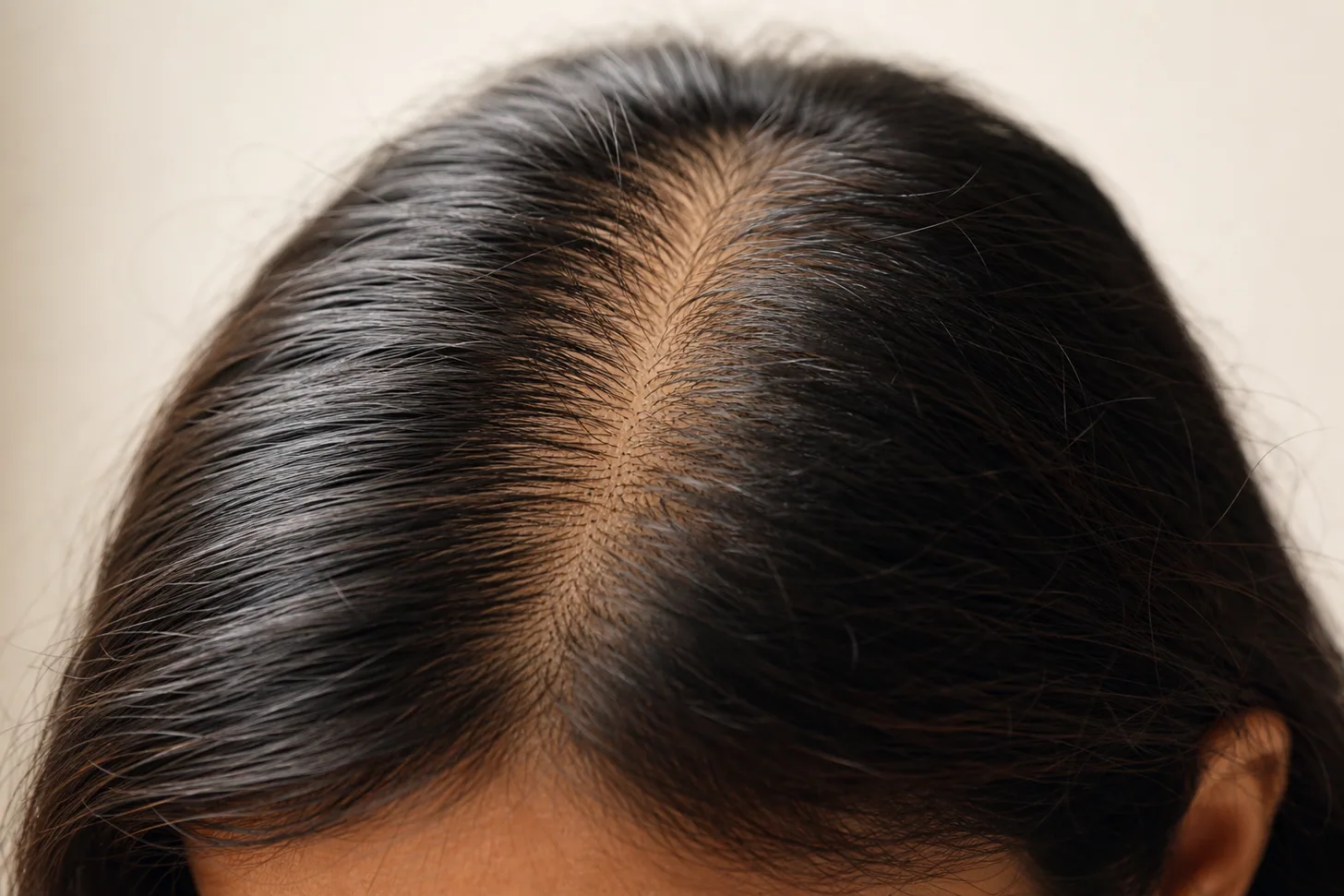
Those short upright hairs along the part aren't breakage. They're the cycle running on schedule.
Read that last clause again, because it's the one that reframes everything. A hair on your head can sit finished, attached and doing nothing for the better part of a year before it comes out. The hair in your brush this morning may have stopped growing last autumn.
Phase
What the follicle is doing
How long, on the scalp
What you notice
Anagen (growth)
Actively building the fiber
Several years
Your hair, getting longer — about 1 cm a month
Catagen (transition)
Regressing, shutting production down
A few weeks
Nothing at all
Telogen (rest)
Dormant; hair attached but finished
Up to nearly a year
Nothing, until it's released
Release
Old hair pushed out, new anagen begins
A moment
The hair in the drain, the brush, the pillow
Regrowth
New fiber emerging from the same follicle
3 cm by month three
Short upright hairs along the part
Two things follow immediately. First, shedding is not a malfunction — it's the last step of a normal cycle, and a scalp that never shed would be a scalp that never renewed. Second, you cannot read your scalp's state from one day, because what you're seeing is the tail end of processes that started at wildly different times.
The number everyone quotes — and why it isn't a diagnosis
When the accepted range spans a fourfold difference, that's telling you about the instrument rather than about your hair. Daily shed counts are genuinely difficult to measure and naturally uneven. Hair released over three days without washing all arrives at once on wash day, so a wash-day count is not comparable to a Tuesday count.
Wearing your hair up holds shed hairs in place until you take it down. Brushing more collects more. The count is also floor-dependent, in the sense that a dark tiled bathroom shows you every hair and a beige carpet shows you none.
So use the 50-to-100 figure the way it deserves to be used: as a rough sanity check that you are not, in fact, in a category of your own — not as a test you pass or fail on a given morning.
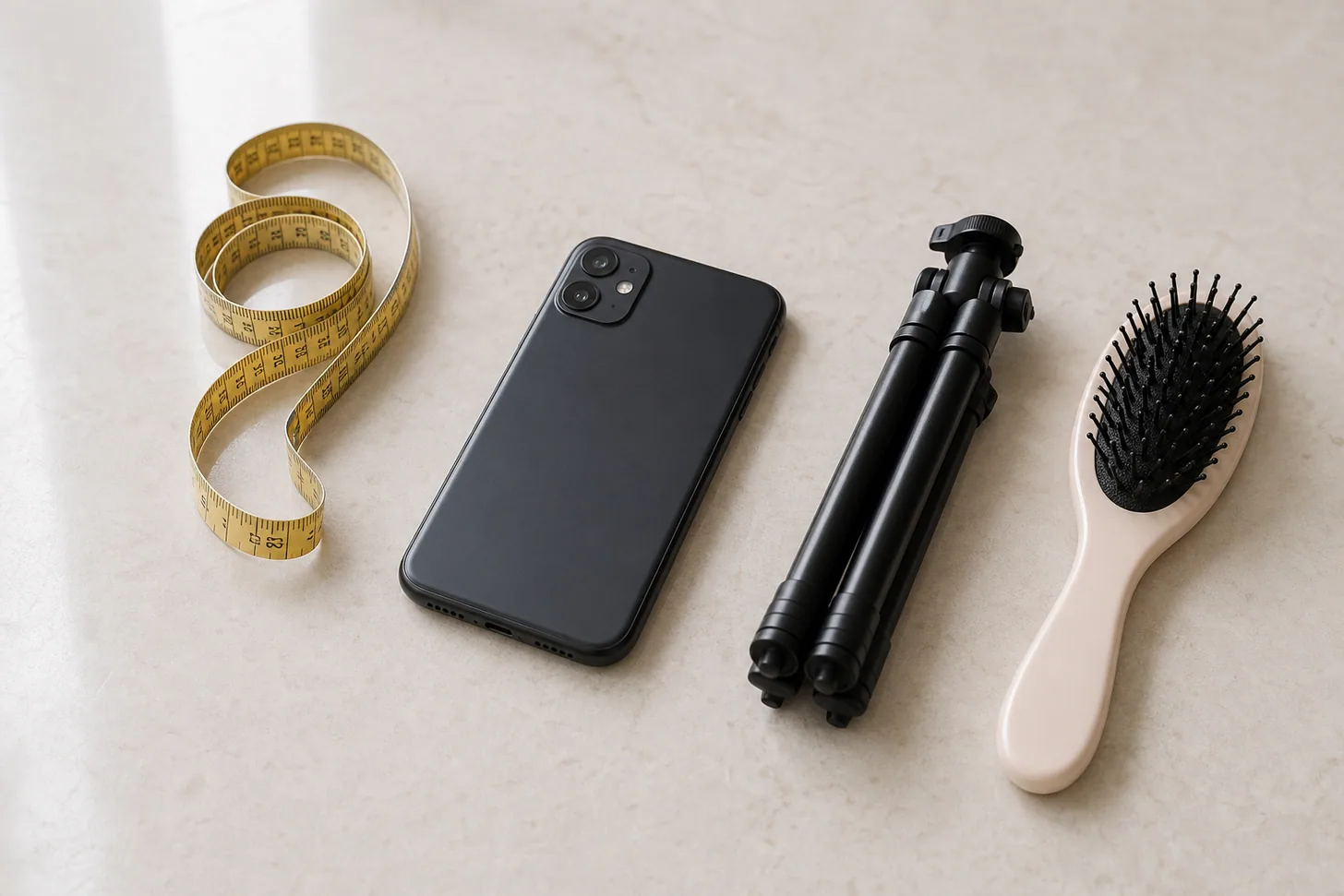
What actually carries information is direction over months, and whether the hair that stays is changing. How to track hair progress properly is the practical method, and it's built around photographs and a measurement rather than a count.
Chair-side note
The single most useful thing I do in a consultation about shedding is take out a calendar. Not a scalp camera, not a product — a calendar. Because the woman in the chair is almost always describing this week, and the answer is almost always somewhere in March. I ask about the last four months specifically: any illness with a fever, any surgery or general anaesthetic, any big weight change, any medication started or stopped, anything genuinely awful.
Perhaps two-thirds of the time something surfaces that she had never connected to her hair, because in her mind it was over and dealt with. The relief in the room when the timeline lines up is enormous, and it isn't false relief — knowing the cause is behind you also tells you roughly when it stops. What it doesn't do is speed anything up, which is the part nobody wants to hear.
MH
— Megan Holloway, Editor-in-Chief
The delay is the whole story
A physical or physiological stress doesn't pull hair out. It pushes a batch of follicles out of anagen early and into rest — and rest has to run before the hair is released. That gap is why the shed feels like it comes from nowhere.
So the correct question when you notice a shed is not "what changed this week". It's what happened two to four months ago. Practically, that means going back through a calendar rather than through your bathroom shelf — and it explains why so many people conclude a new shampoo caused their shedding when the shampoo simply arrived at the same time as a shed that was already in motion.
The same delay runs in reverse, and this is the good news half. Once the trigger has passed, the AAD describes recovery as the hair regaining "its normal fullness", typically "within six to nine months" — but you won't be able to see it for a good while, because the replacement hairs need length before they contribute anything.
Why "give it three to six months" is honest, not a stall
This site says it on dozens of pages and so does every product on your shelf. Here's the arithmetic behind it, which nobody shows you.
A new hair is one centimeter long after a month. At that length it stands upright at the part and reads as a flyaway, not as coverage. At three months it's about three centimeters, long enough to start lying down among the rest. At six months, six centimeters — now it's genuinely contributing to how full your hair looks. Nothing was slow or ineffective in months one and two; the hair simply wasn't long enough to see.
Then add the front half of the wait. Anything aimed at growth acts on the follicle, not on the hair — the shaft itself is dead protein and no product changes it structurally.
A follicle in the middle of a rest phase can't respond until that rest ends, and rest can run for months. So the honest sequence for any growth-directed treatment is: wait for the follicle to be receptive, wait for the new hair to emerge, then wait for it to reach visible length.
Three to six months isn't a hedge. It's the earliest point at which the question can be answered at all — which also means judging a product at week six is judging nothing, and quitting at week six is the most common reason people conclude that nothing works. Hair-loss treatments ranked by evidence goes through what's actually worth those months; hair supplements covers the category that leans hardest on the delay.
What the cycle means when your hair is fine
Four consequences that are specific to fine hair, and they're the reason this page exists on a fine-hair site rather than a general one.
1. Fineness and the cycle measure different things — and they interact. Fine describes the diameter of each strand. The cycle governs how many strands you have at once (density) and how long they get. You can be fine and dense, or coarse and sparse. Fine vs thin hair untangles the vocabulary; the point here is that a change in your cycle shows up on fine hair sooner, because there was less margin to absorb it.
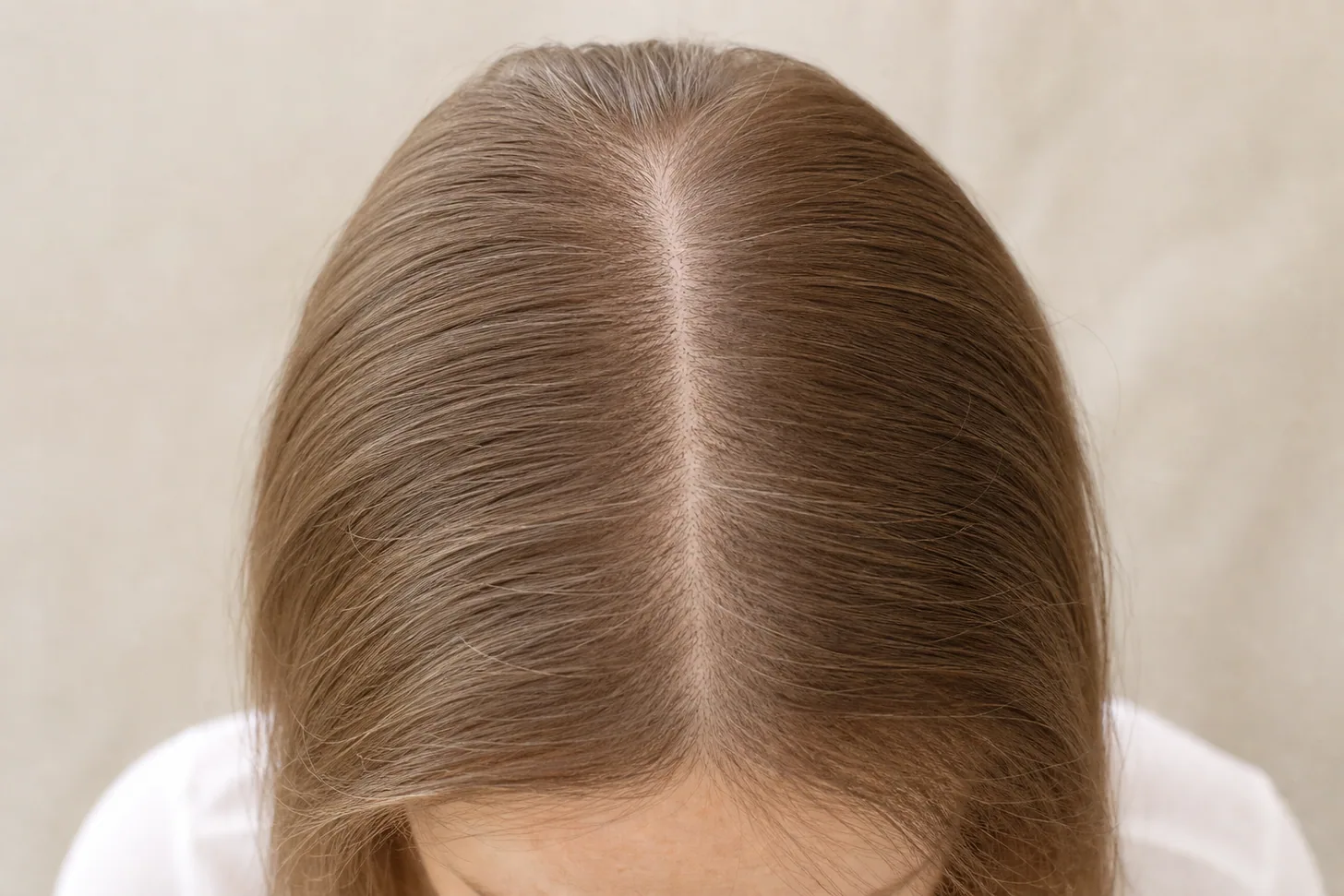
2. Regrowth is nearly invisible on fine hair, which makes recovery feel like failure. A new fine strand at two centimeters is a wisp you can barely see in the mirror even in good light.
On coarse hair, regrowth announces itself as a halo of upright hairs at the part; on fine hair the same regrowth is genuinely hard to spot. This is why photographs beat mirrors for tracking, and why so many women in recovery are convinced nothing is happening when it is.
3. Your maximum length is a cycle question, not a care question. Length equals growth rate multiplied by anagen duration. At about 1 cm a month, a two-year growing phase tops out around 24 cm and a six-year one around 72 cm — both normal, and the difference between those two people is genetic. Why fine hair won't grow past a certain length has the full treatment, including the part you can change.
4. Breakage imitates a cycle problem, and on fine hair it's more common than one. If hairs are snapping mid-shaft, you get less coverage and shorter lengths with a perfectly normal cycle underneath — and it looks identical from the outside.
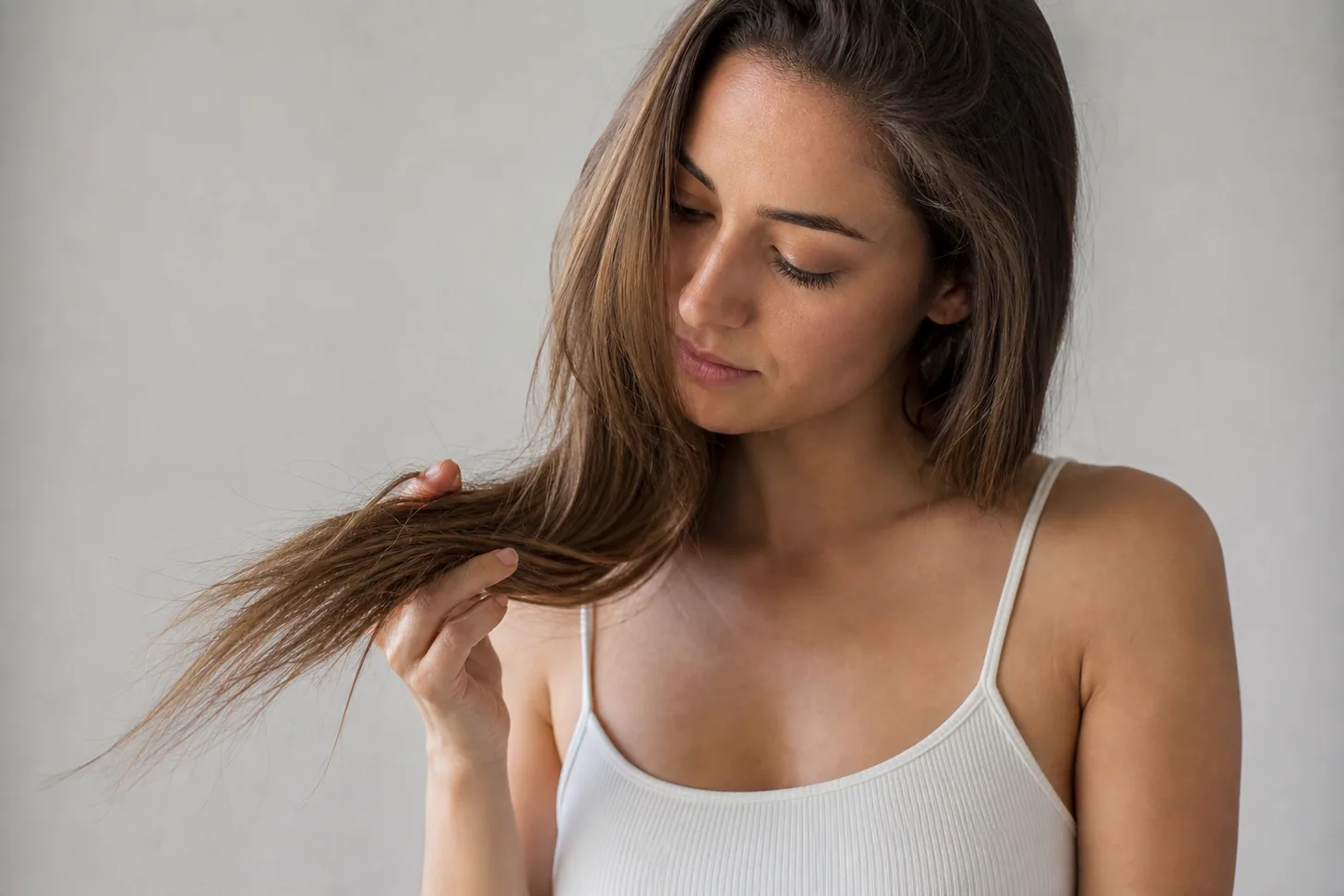
The tell is the hair itself: a shed hair has a small pale bulb at the root end, a broken one is a plain fiber with no bulb, snapped at both ends. Sort a handful on a tissue and you'll know within a minute which problem you have. Breakage on fine hair and why fine hair looks thinner wet both go further.
Chair-side note
Something I've stopped saying: "it's just shedding". It's true and it's useless. What it lands as is your concern is not worth taking seriously, and the person hearing it has usually spent weeks working up to asking.
What I say now is the timeline instead — here's what phase this is, here's roughly when it should stop, here's what I'd expect to see at three months and at six, and here's the specific thing that would make me send you to a dermatologist rather than wait.
Same reassurance, but it comes with dates and an exit condition, so she isn't left holding a vague promise. Nearly everyone can wait out a shed calmly. What nobody can do is wait indefinitely for something with no defined end.
MH
— Megan Holloway, Editor-in-Chief
When the cycle isn't the explanation — see a dermatologist
A round or oval smooth bald patch.That pattern is not a cycle event and needs assessment rather than waiting. See why hair looks thinner on one side for how it differs from styling causes.
Scalp pain, burning, itching, scaling or redness with the shedding.Symptomatic scalp changes the question entirely, and some scarring conditions are time-sensitive.
The shed has run beyond nine months with no trigger you can name.Beyond the usual window for a single-event shed — worth investigating rather than continuing to wait.
The hair that regrows is visibly finer each time.Progressive fineness in the same area points to a different mechanism than a shed. Start at fine or thinning? and thinning on top.
Sudden loss over days rather than a gradual increase over weeks.Rate matters. Fast changes deserve a fast appointment.
Shedding alongside fatigue, weight change, cycle changes or new medication.These point to an internal cause that's treatable once identified — the blood tests worth asking for.
This article is for general education and is not medical advice. If you are experiencing sudden or patchy hair loss, scalp pain, or other concerning symptoms, see a board-certified dermatologist.
FAQ
Three, and only one of them grows anything. StatPearls describes it plainly: the cycle divides into anagen (growth), catagen (transition) and telogen (rest). Anagen is "the active phase in which the hair follicle takes on its onion-like shape and works to produce the hair fiber", and on the scalp it can last several years. Catagen is a short transition lasting a few weeks, during which the follicle undergoes apoptosis-driven regression. Telogen is the resting phase, "in which the hair follicle is dormant, and growth of the hair shaft does not occur". The crucial detail is that every follicle runs this cycle independently, so your scalp holds hairs at every stage at once — about 10 to 15% resting at any moment, and for scalp hair that rest can last close to a year.
The AAD says it's normal to shed between 50 and 100 hairs a day. Worth also knowing: the published figures disagree — a standard physiology reference states that scalp hair is shed at approximately 100 to 200 follicles a day. When the accepted range spans a fourfold difference, that tells you something about the instrument. A single day's count is a poor measurement, because shedding is naturally uneven: it clusters on wash days, on days you brushed more, on days you wore your hair down. What carries information is the direction over months, and whether the hair you keep is getting finer — not the number in the drain on a Tuesday.
Because the event doesn't pull hair out — it pushes follicles out of the growing phase early, and those follicles then have to complete a resting phase before the hair is released. That rest takes weeks to months, so the shed arrives long after the cause has passed. The AAD puts the interval simply: most people notice excessive shedding a few months after the stressful event, and after childbirth it usually peaks about four months after giving birth. This delay is the single most useful fact in the whole subject, because the right question when you notice a shed isn't what changed this week — it's what happened two to four months ago: an illness, a fever, surgery, a crash diet, a major stress, a medication change.
Two reasons stack. First, nothing acts on the hair you already have — a hair shaft is dead protein, so any growth-directed treatment acts on the follicle, and the follicle can only respond within the cycle it's in. Second, arithmetic: scalp hair grows about 0.35 mm a day, 1 cm a month, 15 cm a year. A hair that starts today is about a centimeter long in a month and three centimeters at three months, which is roughly when it's long enough to lie among the rest and contribute to coverage rather than standing up as a wisp. Add the time a follicle spends finishing its rest before it starts at all, and three to six months isn't a marketing hedge — it's the earliest honest answer.
No, and the distinction changes what you should do. In shedding, hairs are released early but the follicles remain able to grow — the medical term is telogen effluvium, and the AAD describes the hair regaining its normal fullness, typically within six to nine months once the trigger passes. In hair loss, something stops the hair from growing: the issue isn't that more hairs fall but that fewer are replaced, or are replaced by progressively finer ones. The practical tell is what happens between events. Shedding is a burst that ends and reverses. Loss is a slow change in the hair that remains — a wider part, finer strands, less coverage in one area — on a timeline of years.
Yes, and it's mostly out of your hands. Maximum length is how long a hair stays in the growing phase multiplied by how fast it grows. At roughly 1 cm a month, a two-year anagen gives about 24 cm before that strand is released; six years gives about 72 cm. Both are normal, and the difference between those two people isn't diet, product or gentle brushing — it's a genetically set duration. What you can influence is whether the hair you grow survives to its full potential length rather than breaking off first, which for fine hair is where nearly all the achievable improvement sits.
Yes, in two compounding ways. The growing phase tends to shorten with age, which lowers the ceiling on length and raises the proportion of follicles resting at any moment, so density thins gradually. Separately, individual follicles can begin producing a finer hair each cycle, which is why the same head can hold roughly the same number of strands and still look and feel thinner. It's also why fine hair reads the change earlier than thick hair does — less margin, so a small shift is visible sooner. This is normal aging rather than disease, but a rapid or one-sided change is worth having assessed.
Not meaningfully, and this is where most of the money in hair care goes. The rate is broadly fixed at around a centimeter a month, and no shampoo, oil, brush or supplement has been shown to make a healthy follicle produce hair faster than its own rate. What is modifiable is the other half of the equation: keeping follicles in the growing phase rather than losing them to an early rest — which is what treating an identified cause does — and reducing breakage so the hair you grow stays on your head. On fine hair that second lever is unusually powerful, because a thinner fiber breaks more readily and the result looks identical to a growth problem.
Fourteen years in fine-hair care, eight of them behind the chair. Megan's first move on any shedding worry isn't a product — it's a calendar, opened at three months ago.
Images in this article are AI-generated illustrations, not photographs of real clients or results. See our image policy.
Results vary with hair type, density, and growth patterns. This guide is educational and not a substitute for an in-person consultation with a licensed stylist.
Get the good hair intel
One honest, stylist-written guide in your inbox each week. No hype.

 MH
MH