Reviewed by Tara Sullivan · Updated July 2026 · 9 min read
Bangs are the most divisive thing you can do to fine hair — and it comes down to one word: weight. A blunt, heavy, straight-across fringe is the classic trap, because it needs a wall of density fine hair doesn't have and steals strands from an already-sparse hairline. But a soft, see-through, piece-y fringe does the opposite: it adds movement and the illusion of fullness right where the eye lands.
Below are 14 stylist-tested fringe styles for fine and thin hair, grouped by type, each with what it actually is, who it flatters, and an honest fine-hair verdict — plus links to our deep-dives on the two most popular kinds and the exact words to bring your stylist.
The honest maintenance verdict, before you scroll
This is the question people actually want answered and almost no gallery answers it, so it goes first. There is no genuinely low-maintenance fringe on fine hair. Anyone telling you otherwise is describing a fringe on someone with more density than you.
Fine hair carries less weight, so a fringe falls out of shape faster; it also sits directly on your forehead all day, absorbing moisturizer, SPF and sweat, so it goes limp hours before the rest of your head does. What varies between fringe types isn't whether you'll style it — it's how many minutes, and how bad day two gets.
Fringe type
Minutes most mornings
What day two looks like
Trim cycle
Curtain bangs
4–6, with a brush or a small round brush
The worst of the group — long enough to go stringy and separate into panels. Most people rewet just the fringe.
4–6 weeks
Side-swept bangs
2–3, mostly just directing it
The most forgiving. The sweep hides limpness because it's already lying flat by design.
3–4 weeks
Wispy bangs
3–4, and easy to overdo
Shows oil fastest of all, because there are so few strands that even a little grease separates them visibly.
2–3 weeks
Full / blunt fringe
5–8, non-negotiable
Doesn't survive it. This is a wash-the-fringe-daily commitment on fine hair.
2–3 weeks
Long, grown-out fringe
1–2, or none if you pin it
Fine — it's blending into your length by this point. See the grow-out timeline.
6–8 weeks
Two things nobody warns you about. First, tucking your fringe behind your ear sets a bend into it — fine hair takes a shape from being held in a position, and an hour tucked back gives you a curve toward the jawline that won't brush out without rewetting. If you're someone who tucks reflexively while concentrating, a curtain fringe will fight you daily.
Second, the fringe is on a different schedule from the rest of your head. Treat it as a separate small head of hair — washed more often, styled independently — and the whole thing becomes manageable. How to style bangs on fine hair is the routine, and it's shorter than you'd think.
None of this is a reason not to get bangs. It's the reason to pick the fringe that matches the mornings you actually have, which is what the rest of this page is for.
Chair-side note
Bangs are the request I get most from fine-haired clients, and also the one I talk people out of most — not out of the fringe, but out of the wrong fringe. Here's the honest version I give in the chair: a fringe can be the best thing you ever did for fine hair or the worst, and the deciding factor is how heavy it is. Fine hair can't carry weight.
Ask it to build a thick, blunt curtain across your forehead and it separates, goes stringy, and shows scalp through the gaps. But cut something soft and see-through — where the fringe is more air than hair — and suddenly there's movement framing your face, your eyes pop, and the whole cut looks fuller. So when we talk bangs, I'm not asking whether you should have them. I'm asking which weight your hair can actually hold.
SB
— Simone Baptiste, Senior Stylist
The types of bangs for thin hair, and how to choose between them
There are really only five fringe types worth considering on fine hair, and they are the five grouped below: curtain, wispy and see-through, side-swept and parted, the full or blunt fringe (which needs care), and the long, grown-out fringe.
Everything else you will see named online — Birkin, bottleneck, baby, feathered, micro — is a variation on one of those five rather than a separate type. If your reason for wanting a fringe is coverage specifically, bangs for thin hair and a big forehead works through the depth trade that decision turns on. Four things decide which one is yours.
Four things decide whether a fringe flatters fine hair. First, weight: fine strands can't support a dense, solid fringe, so the winning styles are cut with softness and separation built in — point-cut, feathered, or sliced so light passes through rather than a blunt block.
Second, your hairline and temples: a fringe is built from the hair at the front of your head, and if that area is already sparse, a wide or deep fringe robs it and makes the sides look thinner — the section should stay narrow and shallow.
Third, face shape: a longer, parted fringe (curtain or side-swept) softens a longer face and suits almost everyone, while a rounder face is flattered by fringe that adds a little height rather than width. And fourth, maintenance reality: any fringe grows into your eyes fast, so plan on a trim every two to three weeks and a somewhat awkward regrowth stretch if you decide to grow it out — how to grow out bangs on fine hair has the real timeline and the five stages.
If you're not sure whether you're working with fine strands or genuinely low density, our guide to telling fine from thin hair helps you plan the cut, and if you're weighing a fringe against a whole new shape, start with choosing a haircut for your face. Face shape narrows the field considerably here; a heart shape in particular does better with some fringe types than others, which our heart-face guide for fine hair sets out.
Curtain bangs: the fine-hair favorite
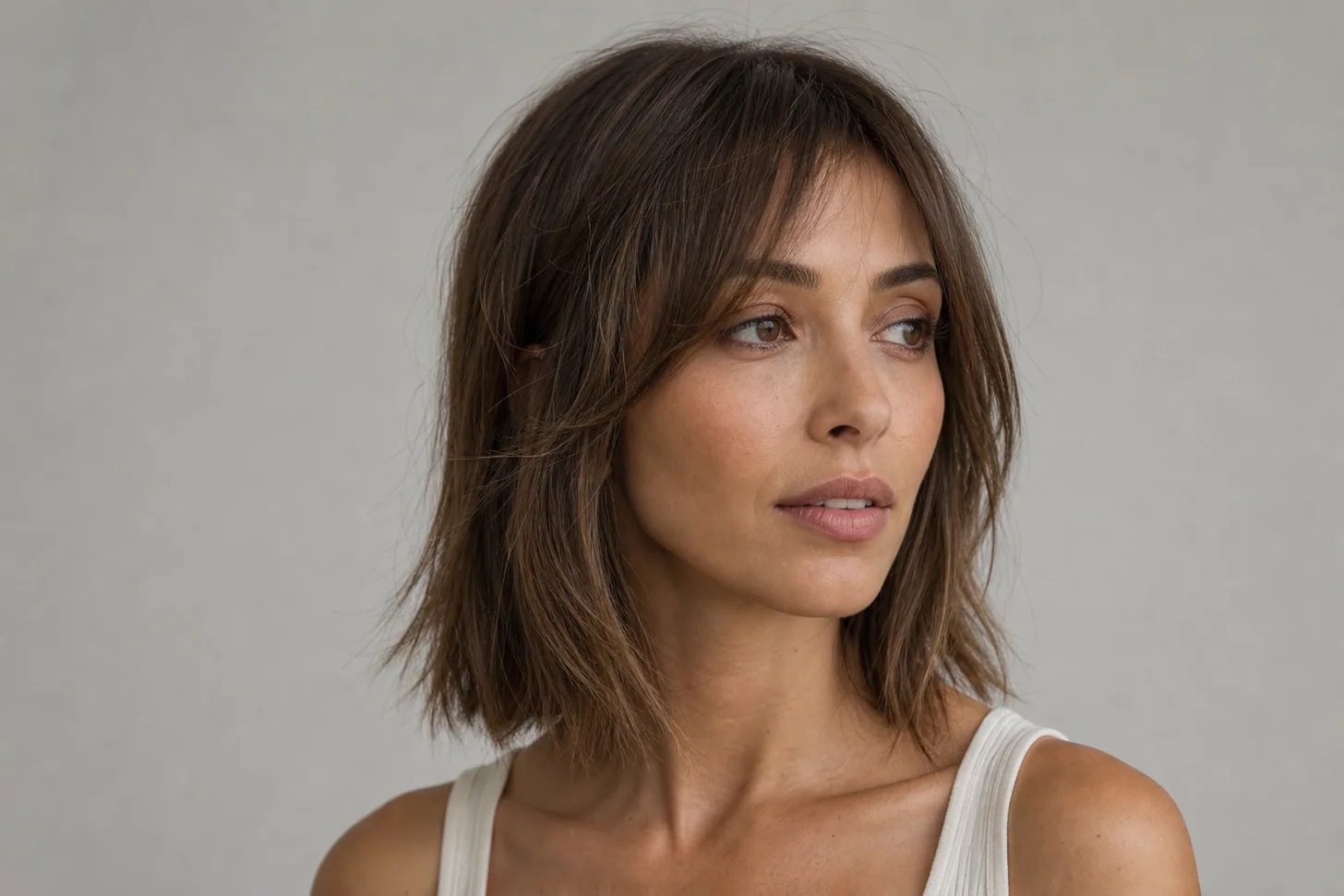
If there's one fringe I recommend to fine hair above all others, it's the curtain bang — longer pieces that part in the middle and sweep away to frame the face, blending into your length so there's no hard line.
It's forgiving on almost every face shape, grows out gracefully, and is built from lighter sections that never demand density. These three cover the range; for the full breakdown, technique, and styling, see our deep-dive on curtain bangs for fine hair.
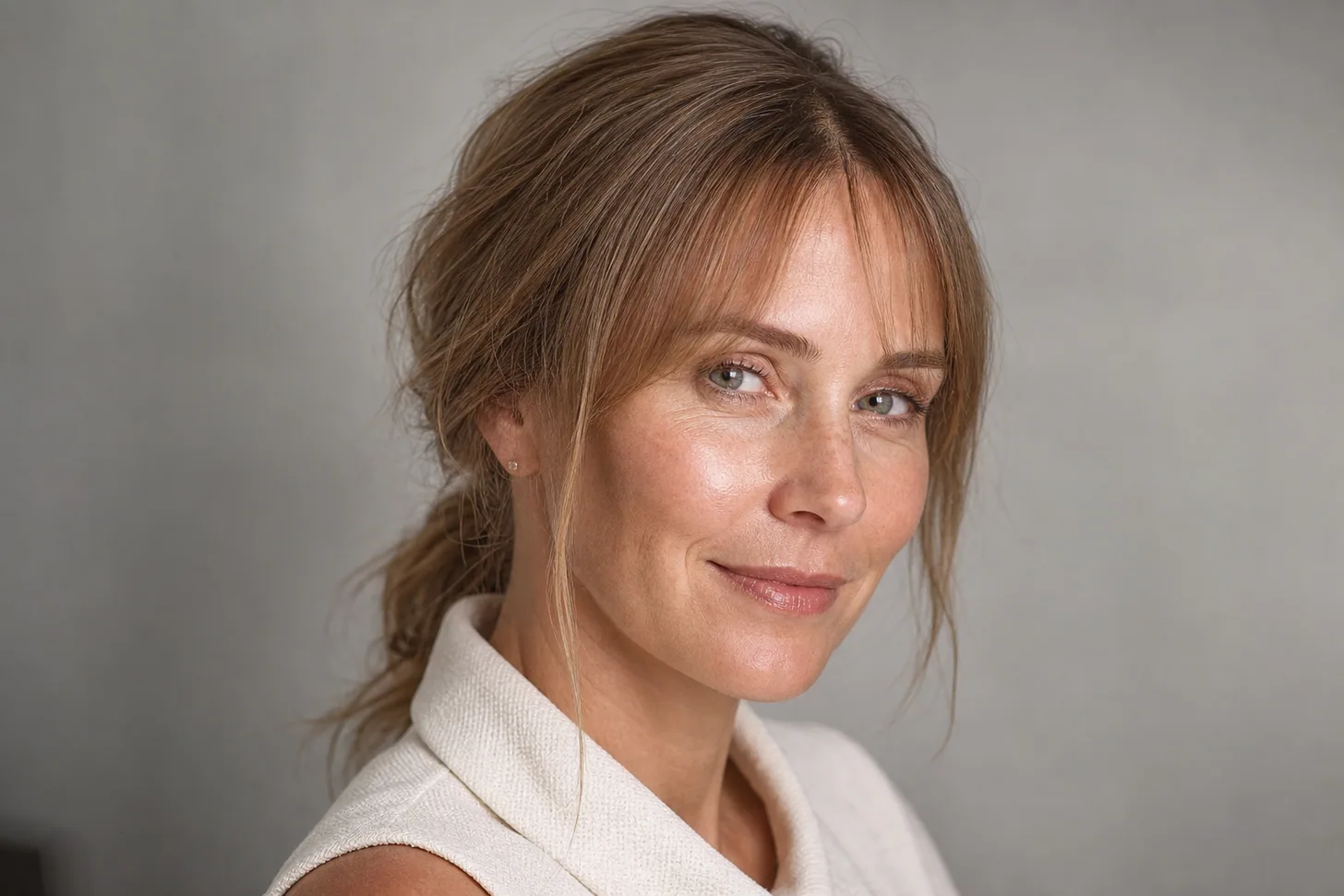
classic curtain bangs parting center and sweeping to cheekbones on fine dark-blonde hair, woman early 30s
1
Classic curtain bangs
The reference version: a center-parted fringe that's shortest at the nose and lengthens as it sweeps out to the cheekbones. On fine hair it works because the pieces are soft and feathered, not solid, so they add face-framing movement without needing density. The most flattering, lowest-risk fringe you can ask for.
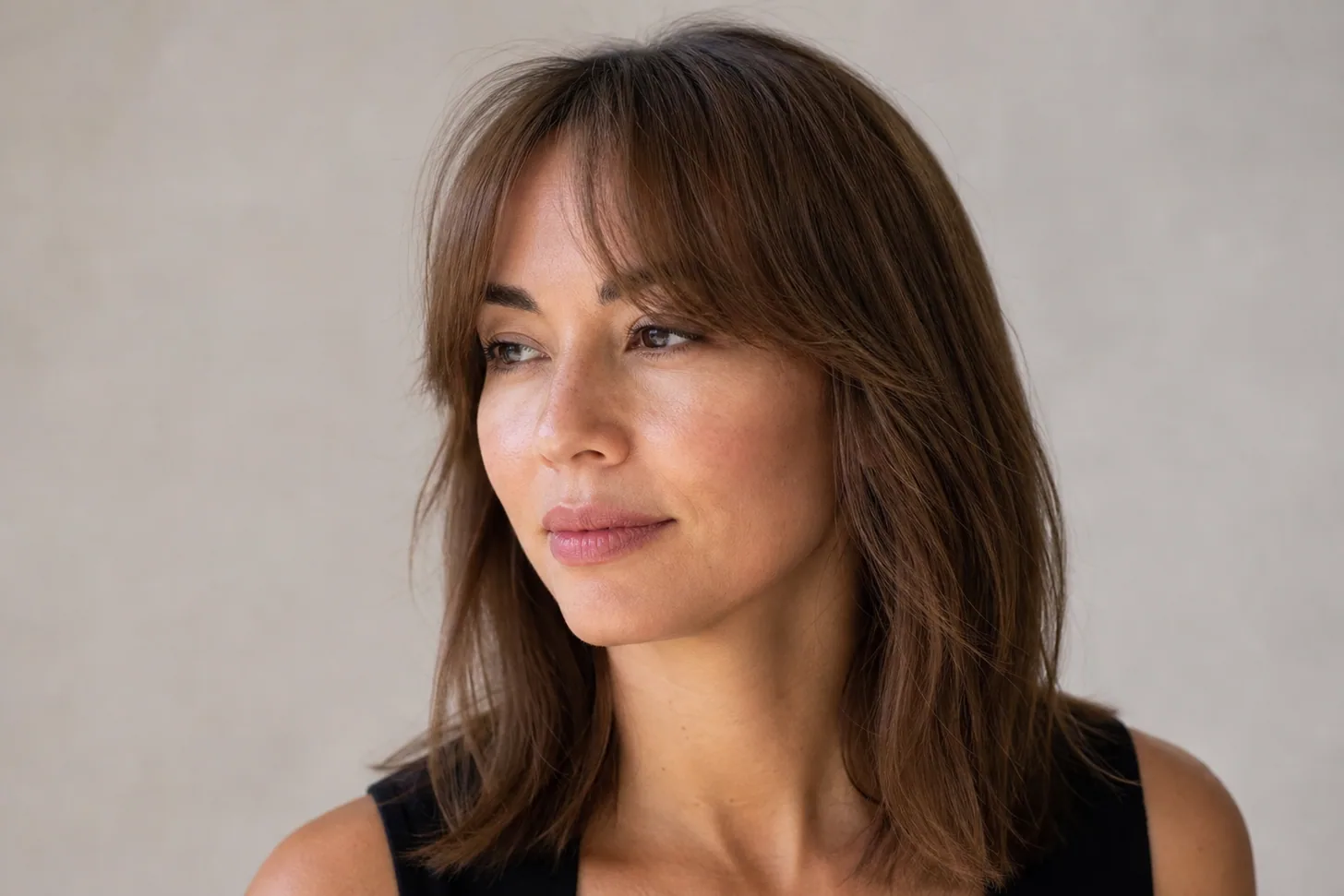
long grown-out curtain bangs blending into layers at the jaw on fine chestnut hair, woman late 40s
2
Long grown-out curtain bangs
A longer take that hits the jaw and melts into your face-framing layers, so there's barely a line between fringe and length. It's the easiest fringe to live with — no awkward regrowth stage — and it lifts the front of a style without commitment. Ideal if you want the softening effect but hate frequent trims.
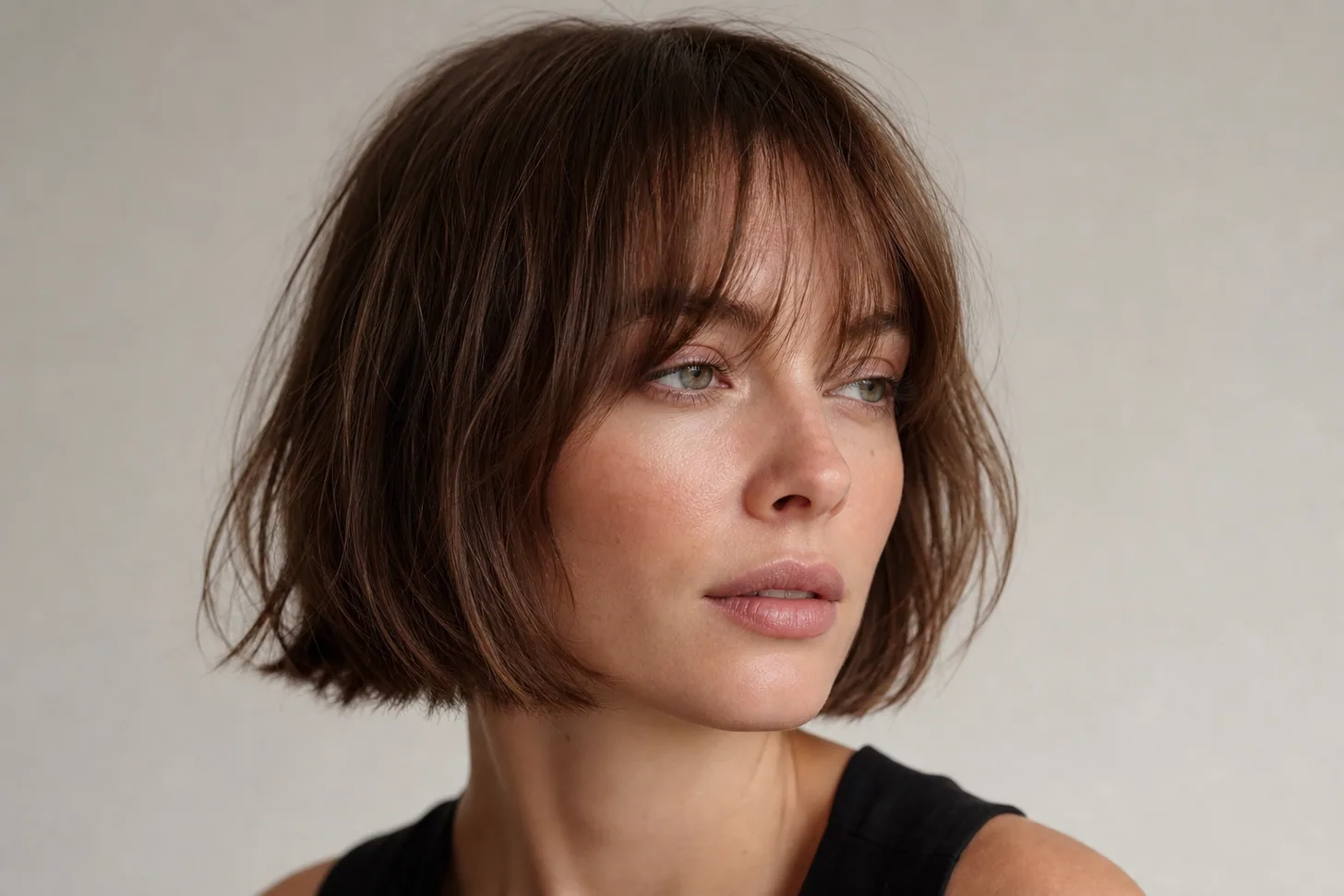
chin-length bob with soft curtain bangs framing the face on fine ash-brown hair, woman mid 30s
3
Curtain bangs on a bob
Pair curtain bangs with a blunt-ended bob and you get the best of both: dense-looking ends for body, soft fringe for framing. The fringe breaks up the front so the bob never looks heavy or helmet-like. A go-to combination that reads polished and modern on fine hair — see how the curtain-bang deep-dive styles it.
Wispy & see-through fringes
Wispy bangs are the airiest fringe there is — short, feathery pieces with deliberate gaps that let skin show through. Counterintuitive as it sounds, that see-through quality is exactly why they flatter fine hair: they add a soft frame and a youthful softness without ever asking for density. These three keep things light. Our full guide to wispy bangs for fine hair covers cutting and styling them in detail.
airy wispy fringe sitting just below the brows with visible separation on fine honey-blonde hair, woman early 30s
4
Wispy fringe
Short, feathery, and full of gaps by design — this fringe sits around the brows and reads as delicate rather than heavy. The built-in separation means fine hair never looks like it's straining to fill a solid line. Soft, youthful, and one of the most flattering choices for a rounder or heart-shaped face.
feathered fringe with long tapered ends blending into face-framing pieces on fine light-brown hair, woman late 30s
5
Feathered fringe
A wispy fringe taken slightly longer, with the ends feathered so they taper to fine points and drift into the face-framing pieces. The tapering is what sells it on fine hair — no blunt edge to expose thinness, just soft movement. A gentle, low-drama option that grows out kindly, and the entry point to the feather cut if you want the same finish through the rest of the cut.
very short baby micro fringe cut light and piece-y above the brows on fine dark-brown hair, woman early 40s
6
Baby micro wisps (done light)
Baby bangs sit high above the brows and usually need density — but cut light and piece-y instead of blunt, they become a fun, editorial option even on fine hair. The trick is keeping them thin and separated, never a solid band. A bold pick for a strong-featured face; ask your stylist to go airy.
Side-swept & parted fringes
When the goal is to cover a thinning temple, soften a forehead, or grow a fringe out without pain, side-swept and parted styles are the answer. They sweep across in one diagonal sheet, so they use less hair than a full fringe and disguise sparseness at the front.
These three are the most practical fringes for fine hair that's thinner at the temples, and the full range — plus the sectioning depth that decides whether it works — is in side-swept bangs for fine hair.
soft side-swept fringe sweeping across the forehead to one temple on fine golden-brown hair, woman mid 40s
7
Soft side-swept fringe
A fringe cut and styled to sweep diagonally across the forehead and tuck toward one temple. Because it lies in one direction, it covers a sparse temple and softens the hairline without needing much hair. The most face-flattering, forgiving fringe for fine hair that thins at the front.
deep side part with a long sweeping fringe adding root lift on fine silver-gray hair, woman early 50s
8
Deep side-swept sweep
A dramatic deep part with a long fringe swept over the fuller side — the part alone adds root height, and the sweep covers more scalp. It's a no-fuss way to add lift and coverage at once, and a favorite for fine, maturing hair; our mature fine-hair guide leans on this trick often.
soft parted birkin-style fringe with a gentle gap at the center on fine caramel hair, woman late 30s
9
Soft parted Birkin fringe
A longer, gently parted fringe in the Jane Birkin mold — full-looking from a distance but soft and see-through up close, with a natural break at the center. It splits the difference between a full fringe and a curtain bang. A relaxed, undone shape that never looks over-styled on fine hair.
Fringes to approach with care on fine hair
Not every fringe is a friend to fine hair. These two are the ones I flag most honestly in the chair — not because you can't ever wear them, but because the classic version fights fine hair, and there's almost always a lighter alternative that gives the same vibe without the letdown.
heavy blunt straight-across fringe showing gaps and scalp on fine dark-brown hair, woman early 30s
10
Heavy blunt straight-across fringe — approach with care
The classic trap. A true blunt fringe needs a solid wall of density to read as intentional; on fine hair it separates, goes stringy, and shows scalp through the gaps — and it steals hair from an already-sparse hairline. If you love the look, ask for a soft, point-cut version that reads blunt from across the room but lets light through up close.
thick arched seventies-style fringe struggling to hold shape on fine auburn hair, woman late 40s
11
Thick arched '70s fringe — approach with care
The full, arched, feathered-back fringe of the '70s relies on volume and body to hold its rounded shape — exactly what fine hair struggles to produce, so it tends to fall flat and lose the arch by midday. Want the retro feel? A feathered fringe (No. 5) or a soft Birkin (No. 9) gives the same era without the weight.
Bangs by length & cut
A fringe changes depending on what it's attached to. These three show how bangs pair with the cuts fine hair wears most — from the shortest crop to real length — so you can picture the whole look, not just the forehead.
textured pixie with a soft wispy fringe lifting the crown on fine ash-blonde hair, woman early 40s
12
Fringe on a pixie
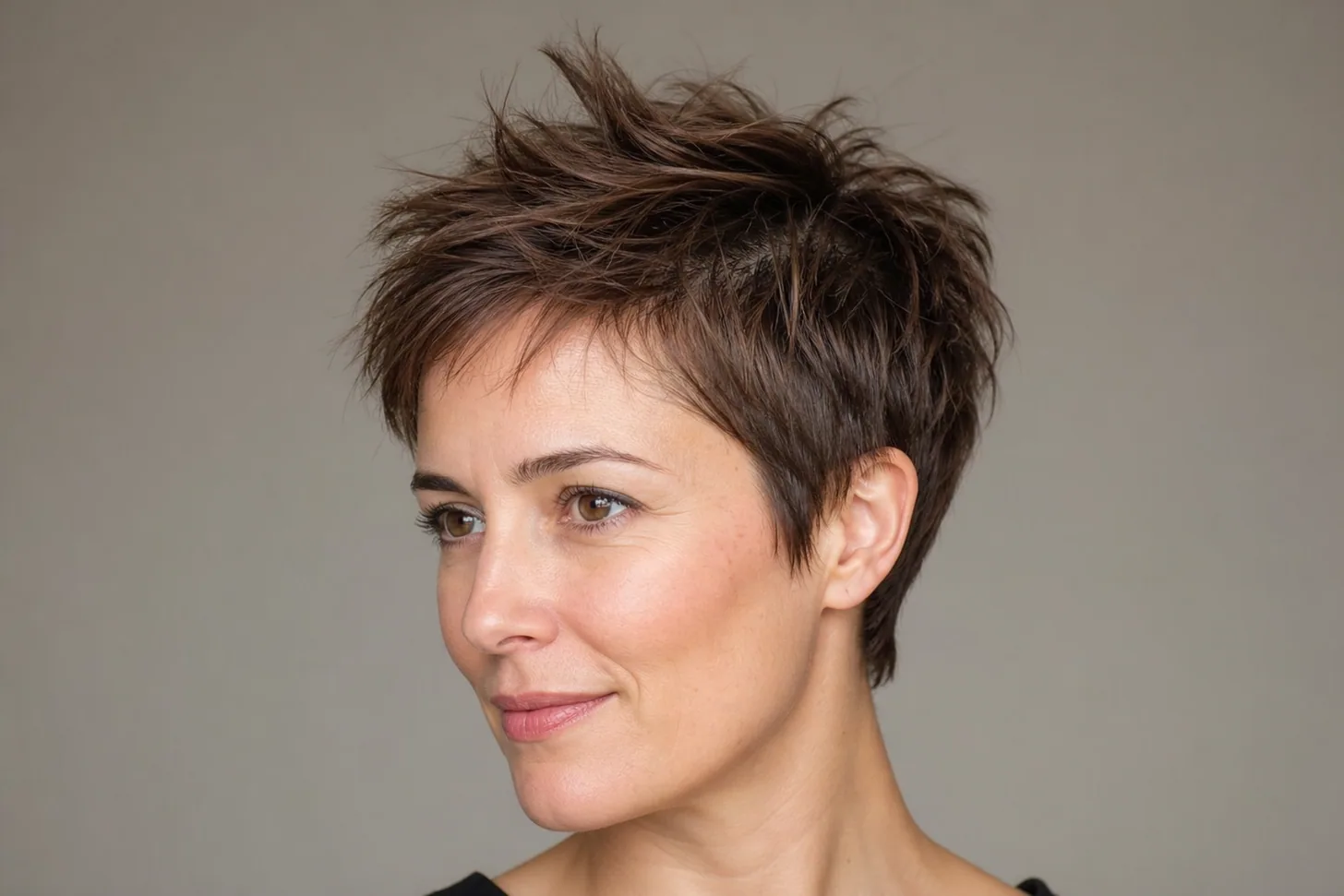
A soft, wispy fringe turns a short crop from severe to sweet, breaking up the forehead and adding a piece-y front. On a pixie for fine hair the fringe should stay light and textured so it lifts rather than flattens. One of the most charming, low-effort ways to wear bangs short.
chin-length french bob with a wispy fringe and dense ends on fine espresso-brown hair, woman mid 30s
13
Fringe on a French bob
The French bob was made for a fringe — a short, chic bob topped with a soft, slightly undone fringe that keeps the whole thing feeling effortless. The blunt ends give body while the airy bangs stay light. A timeless pairing that flatters fine hair and never tries too hard.
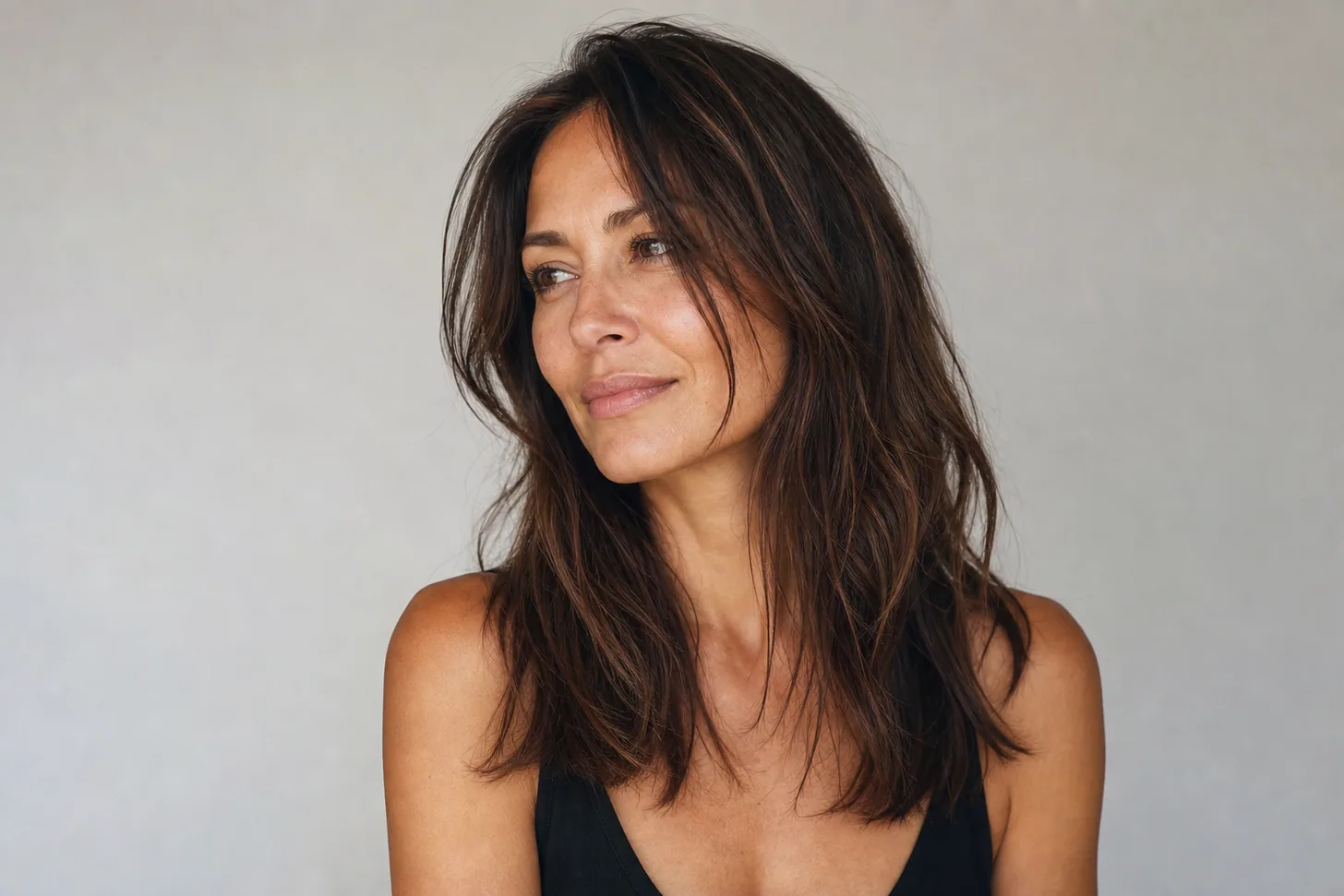
long layered hair with long curtain bangs framing the cheekbones on fine strawberry-blonde hair, woman late 30s
14
Fringe on long hair
On longer fine hair, a long curtain or side-swept fringe adds the face-framing interest that length alone can lack, drawing the eye up to the face instead of down to thin ends. Keep it soft and blended into your layers so it moves with the length. The easiest way to refresh long hair without losing it.
How to keep fine bangs from going flat, greasy, or stringy
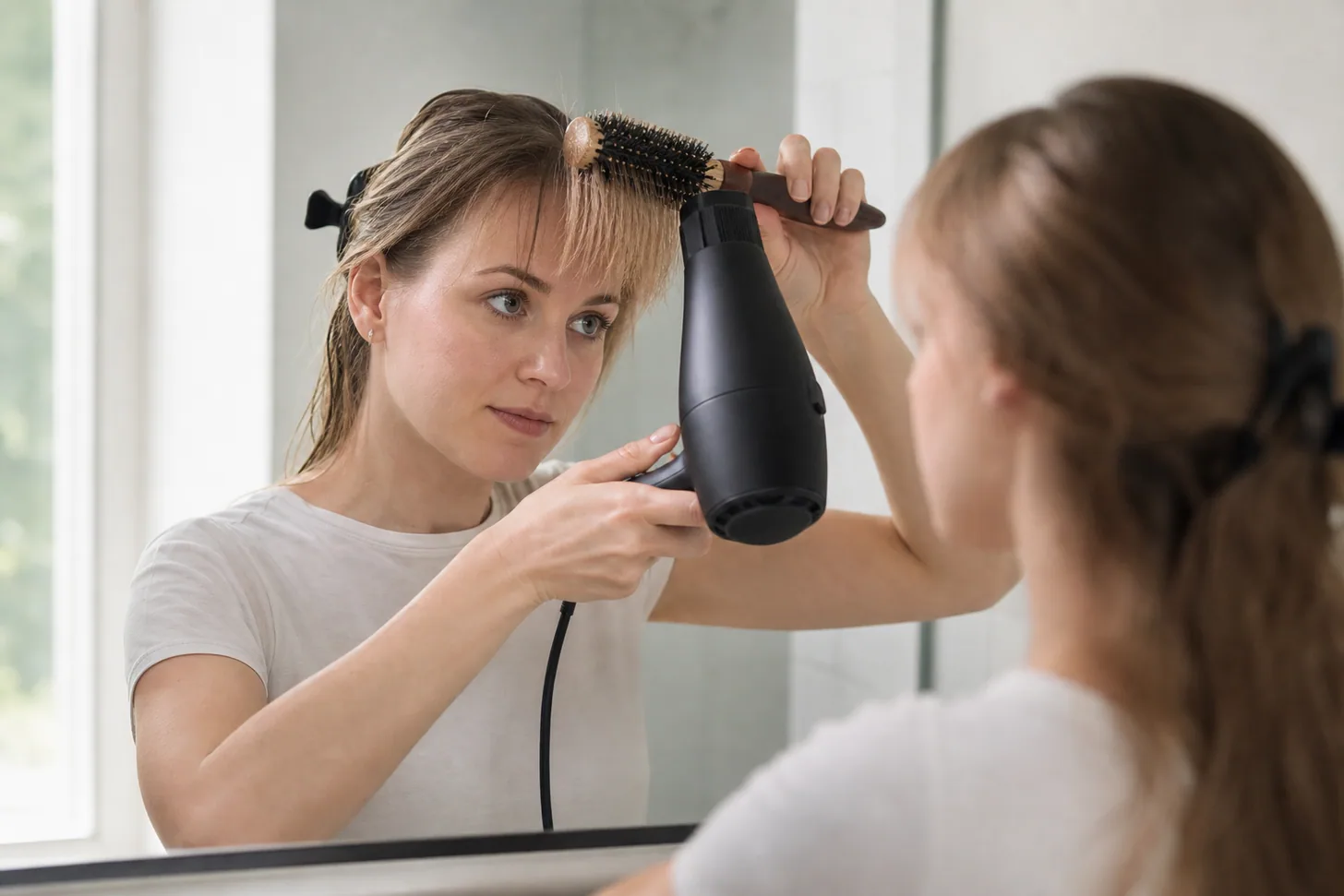
A fringe sits against your forehead all day, so it's the first part of fine hair to go oily, flat, and stringy — often by lunchtime. The fix is a little routine just for the bangs: after washing, blow-dry the fringe first, while the rest is still damp, using a small round brush to lift it at the root and set the direction before it dries flat.
Skip oils and heavy serums on the fringe entirely — they're what turn it greasy fastest — and use only a light root product or a whisper of texture spray for separation. Between washes, a small amount of dry shampoo worked into the roots of the fringe revives it in seconds without touching the rest of your hair.
And resist the urge to keep touching it — the oils from your hands are half the reason a fine fringe goes limp. The full daily version — washing just the fringe, the drying order, and why your skincare is half the problem — is in the two-minute fringe routine. For more on the fundamentals, our guide to styling fine hair ties it all together.
Chair-side note
Here's the one I wish more people knew: cut fine bangs on dry hair, or at least check them dry before you leave. Wet hair stretches, and fine hair stretches a lot — so a fringe cut wet springs up shorter than expected the moment it dries, which is how people end up with bangs an inch higher than they wanted.
A good stylist cuts your fringe, dries it, then refines it dry to see exactly where it falls. If you trim your own between visits, do it on dry hair, snip into the ends vertically rather than straight across, and take less than you think — the fringe is one of the very few jobs on the safe list in cutting fine hair at home. You can always take more; you can't put it back.
SB
— Simone Baptiste, Senior Stylist
What to ask your stylist
The wording matters more with a fringe than almost any other cut, because "bangs" can mean a dozen different weights. Say: "I have fine hair, so I want a soft, see-through fringe — please point-cut it rather than cutting it blunt, so light passes through and it doesn't look sparse."
To protect your hairline, add: "Keep the fringe section narrow and shallow, and don't take too much from my temples — I don't want the sides to look thinner." If you're unsure which type suits you, ask: "Would curtain or side-swept bangs work better for my face shape and how thin my hairline is?" And to plan the upkeep: "How often will this need trimming, and do you do free fringe trims between cuts?"
A stylist who cuts a lot of fine hair will nod at every one of these. And if a tall forehead is what sent you looking for a fringe, bring the depth measurement from bangs for thin hair and a big forehead.
When bangs may not be your best move
Your hairline is very sparse or receding at the temples. A fringe is built from exactly that hair, so it can leave the front looking thinner — a side-swept sweep is gentler, but check the cause of the thinning first.
You have oily skin and can't commit to washing or refreshing the fringe daily. Fine bangs sit on your forehead and go greasy fastest; if daily upkeep isn't realistic, they'll frustrate you.
You're not willing to trim every two to three weeks. A fringe grows into your eyes quickly; without regular trims it stops flattering fast. Longer curtain bangs are the most forgiving if trims are a stretch.
You have a strong cowlick at the fringe line. A cowlick can push a blunt or wispy fringe up and out; a longer, side-swept shape worked with the growth pattern behaves far better. Cowlicks on fine hair explains why length is the only thing that overrules a whorl.
You're noticing genuine thinning, not just fine strands. A fringe is a styling choice, not a fix — see our honest guide to fine hair versus thinning and talk to your doctor if the change is recent.
FAQ
Soft, see-through fringes are best: curtain bangs, wispy bangs, and side-swept fringes all work because they're built from lighter sections that don't need much density to look right. Curtain bangs are the most forgiving all-rounder — they part in the middle and blend into your length, so they suit almost every face shape and grow out without an awkward stage. Wispy bangs are the airiest option and read as youthful. The rule with fine hair is simple: choose a fringe cut for softness and separation, not for coverage, and ask for it to be point-cut rather than blunt so light passes through it.
It depends entirely on the type of fringe. A soft, piece-y, see-through fringe makes fine hair look thicker, because the separation and movement trick the eye into reading more strands than are actually there and add interest around the face. A heavy, blunt, straight-across fringe does the opposite — it demands a wall of density fine hair doesn't have, so it looks sparse and gappy and reveals the scalp. It also pulls hair from the hairline into the fringe, thinning an area that's often already fine. Choose the fringe for its lightness and it flatters; choose it for coverage and it backfires.
Both are excellent on fine hair, and the choice comes down to how much commitment and face-framing you want. Curtain bangs are longer, sweep away from a center part, and are the easiest to grow out — the lowest-maintenance and most flattering choice for most people. Wispy bangs are shorter and airier, sitting closer to the brows for a softer, more youthful frame, but they need trimming a little more often because they're shorter. If you're new to fringe or unsure, start with curtain bangs; if you want the lightest, most delicate look and don't mind the upkeep, wispy bangs are worth it.
Bangs don't cause hair loss, but a fringe that's cut too wide or too deep takes hair from your hairline and temples to build it — and on fine hair, where the hairline is often already sparse, that can leave the rest looking thinner. The fix is technique: ask your stylist to keep the fringe section narrow and shallow so it doesn't rob the sides, and to leave the very edge of your hairline out. Constant tight pulling of a fringe back into ponytails can stress delicate hairline hairs over time, so if you grow bangs out, pin them gently rather than yanking them tight.
A fringe grows into your eyes faster than you expect — most people need a bang trim every two to three weeks to keep it sitting right, whether that's a quick salon visit or a careful trim at home. Curtain bangs and longer side-swept fringes are the most forgiving because they blend into your length, so you can stretch them to three or four weeks. Shorter wispy and blunt fringes show growth soonest. Many salons offer free fringe trims between cuts, so ask — it's the single biggest factor in whether a fringe stays flattering or starts to annoy you.
Rarely, and it's the fringe I steer fine-haired clients away from most. A true blunt, heavy, straight-across fringe needs a solid band of density to look intentional; on fine hair it tends to separate, go stringy, and show scalp through the gaps, and it exposes how sparse the hairline is. If you love the blunt look, ask for a soft, airy version instead — a fringe that reads blunt from a distance but is point-cut and lightly textured up close so light passes through it. That gives you the shape without the density the real thing demands, and it's far kinder to fine hair.
Eleven years behind the chair, specializing in short shapes and fine-hair texture. Simone believes the best fringe is the one that's more air than hair.
Results vary with hair type, density, and growth patterns. This guide is educational and not a substitute for an in-person consultation with a licensed stylist.
Hairstyle images in this guide are AI-generated illustrations, not photos of real clients or results. See our image policy.
Get the good hair intel
One honest, stylist-written guide in your inbox each week. No hype.

 SB
SB