Reviewed by Tara Sullivan · Updated August 2026 · 12 min read
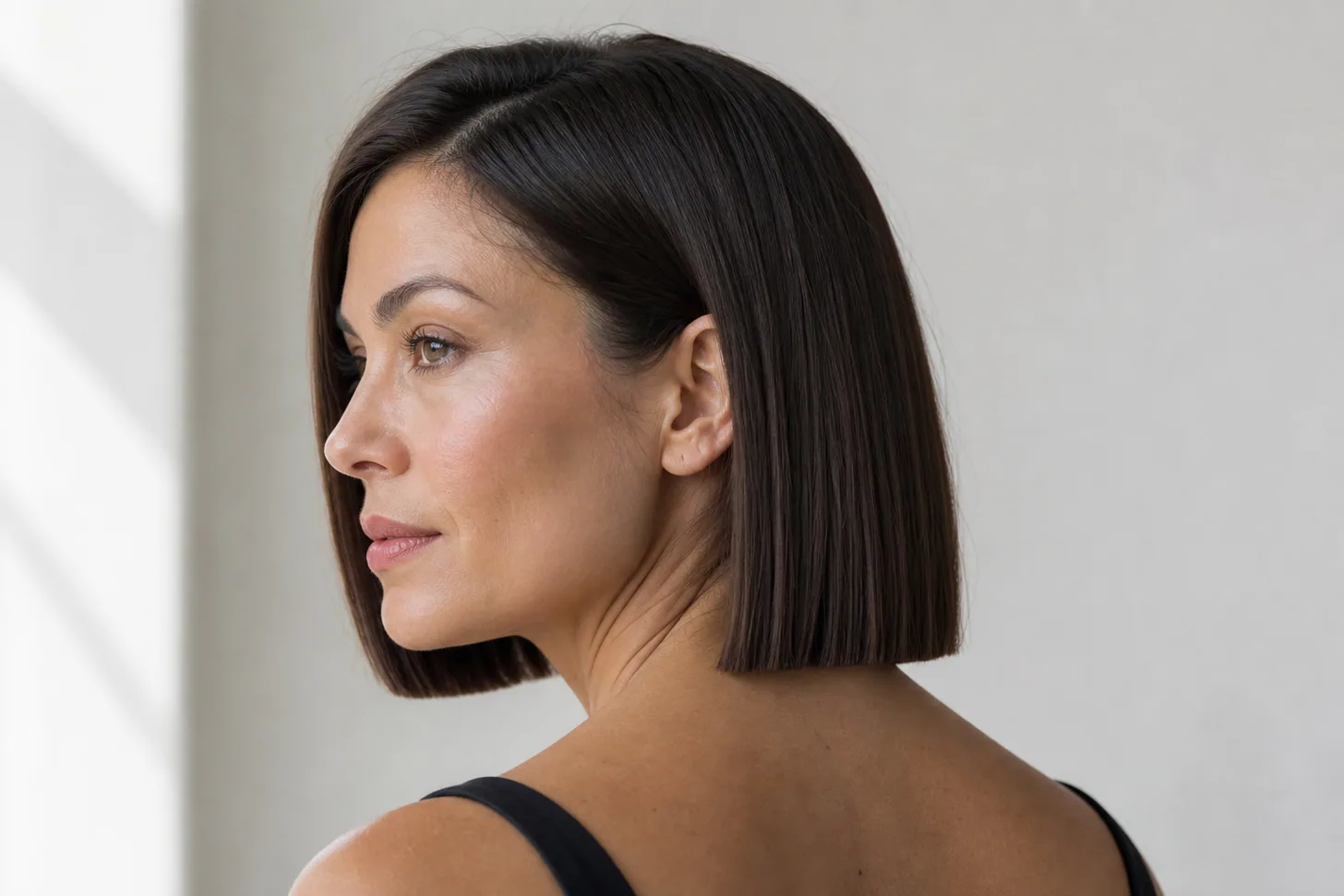
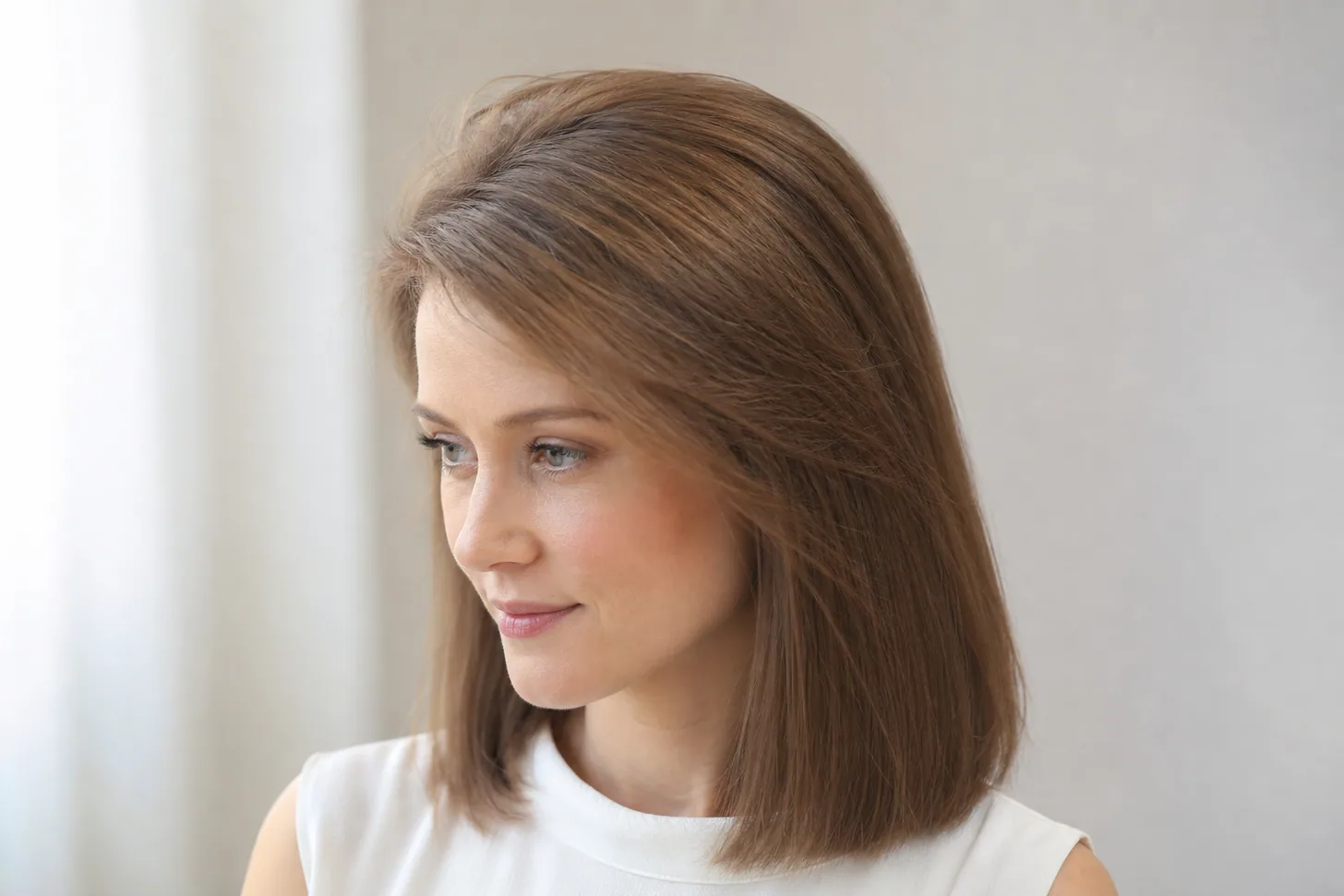
"Get a blunt cut" is the most-repeated piece of advice given to thin hair, and it is right about half the time. A blunt line does exactly one thing: it concentrates every remaining bit of weight at the outer edge of the haircut.
That single effect produces two opposite results at once — the bottom of your hair looks denser, and the top of your head gets pulled flatter. Which one you actually notice in the mirror depends almost entirely on how much length is doing the pulling.
Short blunt hair gets the density and pays nothing for it. Long blunt hair gets the density and pays for it with the roots, which is the version people describe as a limp mop. This page finds the crossover, gives you eight blunt shapes that sit on the right side of it, and is honest about the situations where blunt is simply the wrong instruction.
If the question you are really asking is whether to be layered at all, that one is decided on density rather than length and lives in volumizing haircuts for thin hair. And if you want the dense edge without the ruler-straight line, the choppy bob is the compromise.
The entire argument for blunt, in one edge: the bottom of the hair is the densest part of the haircut, not the thinnest.
What a blunt cut actually does — and the second thing nobody mentions
Two words get used interchangeably here and they are not the same. One-length describes the shape: every section finishing at the same place, no layers cut in. Blunt describes the finish on the ends: cut straight across with the scissors closed, so each strand is severed at a right angle instead of tapered.
Most people asking for a blunt cut want both, and it is worth saying both out loud, because a stylist can give you one without the other and often will. Cutting techniques for fine hair has the full vocabulary if you want to arrive fluent.
The reason blunt is prescribed for thin hair is genuinely sound. Tapered ends — whether from point cutting, a razor, or three months of ordinary wear — finish in scattered strands of different lengths, so the last inch of the hair is visibly less dense than the rest.
On fine hair that last inch is the part everyone sees, and it is the part that reads as see-through. A blunt cut stops every strand at the same line. The bottom of your hair becomes the densest part of the haircut rather than the thinnest, and that is a real optical gain that costs you nothing and needs no styling.
Here is the part that gets left out. Weight at the perimeter does not just sit there looking dense — it hangs. Every strand is a small load on its own follicle, and the longer the strand the more load it applies.
Root lift is the first thing thin hair loses and the last thing any product reliably gives back, so the amount of weight pulling on your roots is not a minor variable. A blunt cut maximises perimeter weight by definition; that is the whole technique. Which means the same decision that makes your ends look fuller makes your roots lie flatter, and the two effects scale in opposite directions as you add length.
So blunt is not a good or bad idea for thin hair. It is a trade with a crossover point, and the crossover is a length.
Chair-side note
The consultation that tells you everything goes like this. Someone sits down with long, one-length hair and says it looks thin and lifeless, and could I put some layers in. I lift the whole length off her shoulders with my hand and hold it there, and the top of her head visibly rises — you can watch it happen in the mirror, it takes about a second. Then I let go and it drops flat again.
That is not layering. That is just the weight. Nine times out of ten what she needs is four inches off the bottom with the line kept exactly as blunt as it already is, and she leaves with more volume than any layered version of the same haircut would have given her. The instinct to fix flat hair by cutting into it is almost always aimed at the wrong end of the strand.
SB
— Simone Baptiste, Senior Stylist
The length crossover — where blunt stops helping
Stand in front of a mirror and use your own face as the ruler. These bands are where the trade changes character, and they are consistent enough across heads to plan around.
Ear to chin— blunt is close to unbeatable. There is almost no length applying load, so you get the dense edge for free. This is the band where thin hair looks its best and it is not a close contest.
Chin to jaw— still strongly positive. Enough weight to hold a clean line, not enough to flatten the crown. If you want one recommendation from this page, it is a blunt cut somewhere in this band.
Jaw to collarbone— the crossover. Blunt still helps, but you now need something working against the root drag: a fringe, crown layers, or a rough-dry with your head upside down. Blunt on its own starts to look heavy here.
Collarbone to mid-back— blunt is now costing you more than it returns. The edge looks dense and the head looks flat, and the flatness is the thing people notice first.
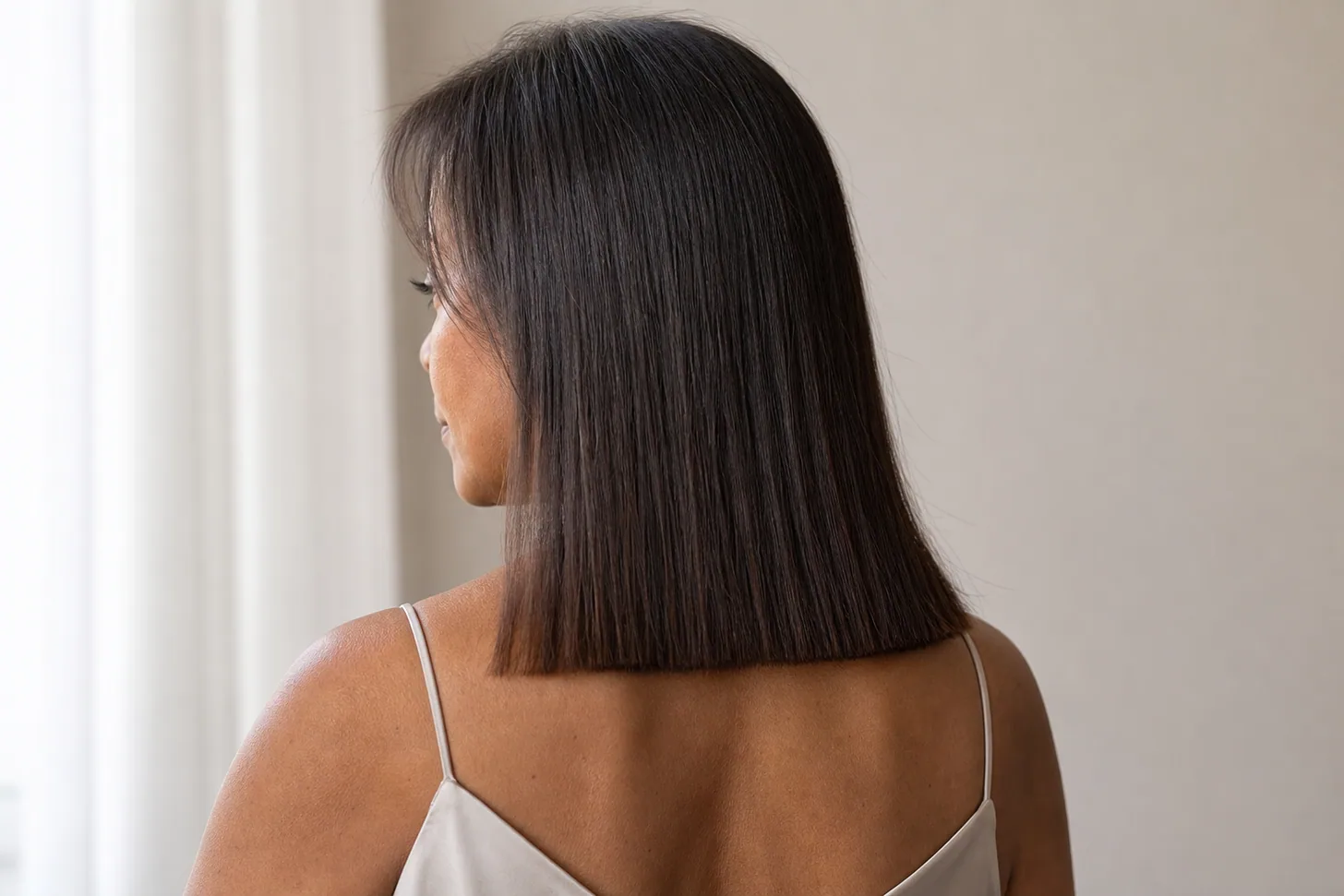
Past mid-back— a fully blunt line on thin hair at this length reads as a narrow vertical curtain with a hard bottom edge, and the edge emphasises how little width there is above it. This is the limp mop, and it is a shape problem rather than a hair problem.
Two things move the crossover. Density moves it down — if you have fine strands but plenty of them, you can carry blunt several inches longer before the roots give up, and fine hair when you have a lot of it covers that group specifically.
Wave moves it down too, because a bend in the strand shortens the effective load and supplies its own lift. Straight, fine, sparse hair has the highest crossover of anyone, which is unfair and worth knowing.
None of this is an argument for going short if you do not want to. It is an argument for knowing what you are buying. Long hairstyles for fine hair is built around keeping the length and finding the lift somewhere else. The opposite decision — deliberately irregular ends rather than a hard line — is worked through in the choppy bob for fine hair.
Eight blunt cuts that work on thin hair
Ordered roughly short to long, so you can find your own band. Every one of these keeps the perimeter genuinely blunt — the differences are in what else the haircut is doing to buy back root lift. For the opposite finish done safely, with the taper kept above the bottom line, see the feather cut on fine hair.
Blunt French bob on fine hair cut to the middle of the cheekbone with a heavy straight fringe
1
The French bob, cut short and left heavy
The shortest genuinely blunt shape and the one that flatters fine hair most reliably. It finishes somewhere between the ear and the jaw, with a full fringe and no shaping of any kind in between. At this length the hair weighs almost nothing, so you keep every bit of edge density and pay no root tax at all — and the fringe adds height at the front hairline for free. The catch is that it is a strong haircut and it wants a six-week cycle. The French bob on fine hair is the full treatment.
Blunt chin-length bob on fine hair with a razor-sharp horizontal bottom line and no layers
2
The blunt chin-length bob
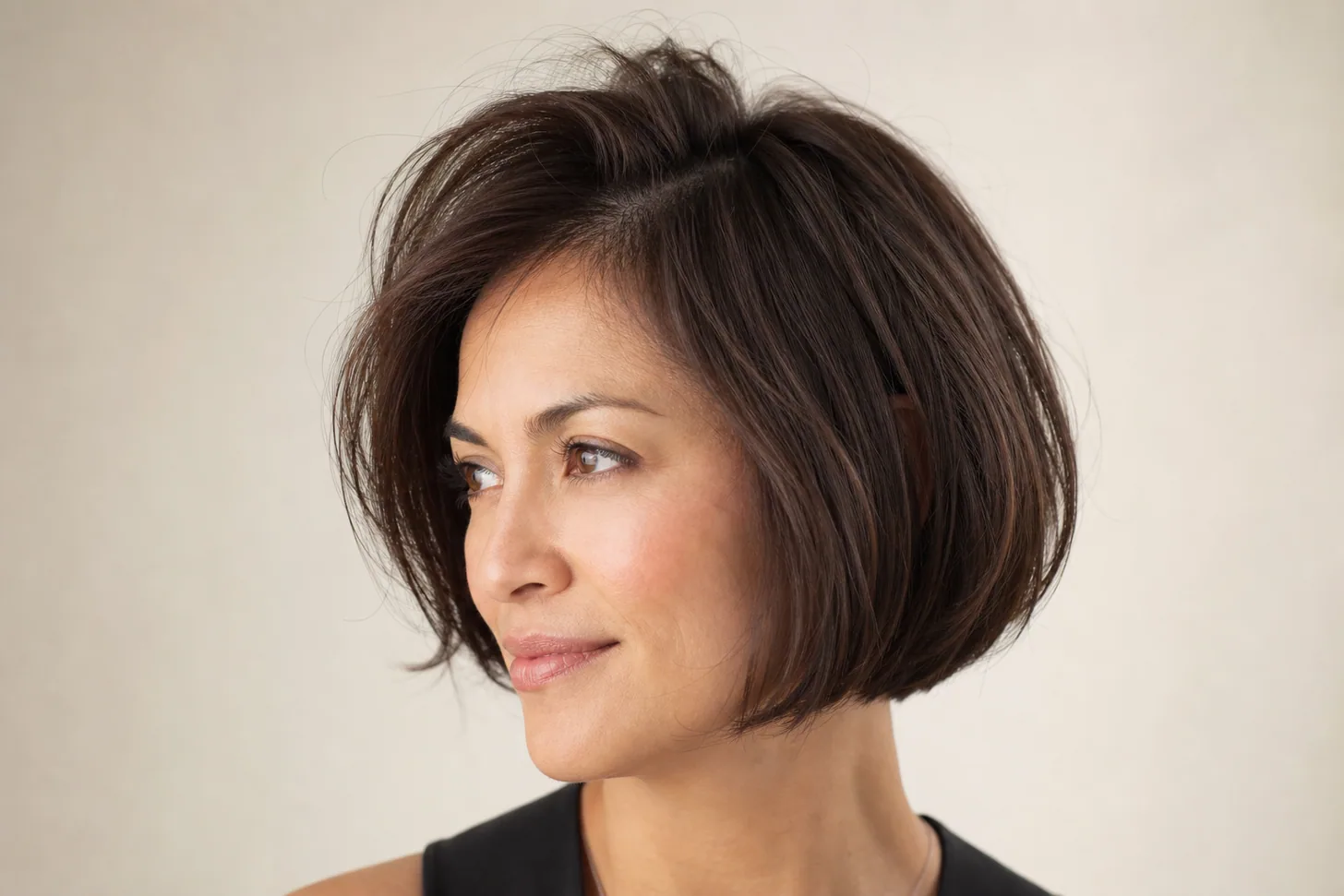
If there is a single default answer for fine hair on this whole site, it is this one. Chin length, one length, cut dead straight across, nothing else done to it. The line sits at the widest part of the jaw so the hair reads as a solid shape rather than a hanging curtain, and there is still not enough weight to flatten anything. It is the most-requested cut I do and the one that produces the fewest disappointed second appointments. The bob gallery has the variations by face shape.
Blunt bob on fine hair with subtle graduation stacked at the back lifting the nape
3
Blunt at the front, graduated at the back
Worth separating graduation from layering, because they do opposite things. Layering removes weight from within the length; graduation stacks sections at increasing lengths so the hair piles onto itself and builds outward. That means you can keep a fully blunt front and bottom line while the back lifts — added bulk, nothing removed. This is the highest-value thing scissors can do to sparse hair and almost nobody asks for it by name. Stacked bobs on fine hair goes deeper.
Blunt jaw-length bob on fine hair with soft face-framing pieces breaking the front line
4
Blunt with the front two sections point-cut
For anyone who wants the density but finds true blunt too severe against their face. The whole haircut stays one length and one line; the only softening is on the two sections that fall beside your cheeks, point-cut a few millimetres to break the hard horizontal. It costs you nothing structurally because those pieces were never carrying the shape, and it changes how the cut reads from the front entirely. Face-framing layers is the larger version if you want more.
Blunt collarbone lob on fine hair with three inches of soft layering at the crown only
5
The blunt lob with crown layers only
The cut for the crossover band, and the one to ask for if you want length past the jaw without the flat top. Everything below the level of your mouth stays one blunt length; above it, three or four inches of soft point-cut layering at the crown lets the short pieces stand up instead of lying down onto the skull. Because they finish well above the ears they cost you no perimeter and are invisible when the hair is down. The lob for fine hair covers the length itself.
Blunt shoulder-length cut on fine hair with a full curtain fringe adding height at the hairline
6
Blunt to the shoulder, with the fringe doing the lifting
The other way to solve the crossover: leave the length completely alone and put the entire intervention at the front. A fringe with some weight in it can be dried up and back off the hairline, building visible height exactly where people look, while the rest of the hair stays one untouched blunt line. Highest impact available at zero cost to the perimeter — the trade is daily rather than structural, because a fringe on fine hair wants a few minutes most mornings. Bangs for fine and thin hair has the maintenance verdicts by type.
Blunt one-length cut on fine hair worn tucked behind one ear with a deep side parting
7
Blunt one-length, worn off a deep side part
Not a different haircut so much as a different way of wearing the same one, and it moves the crossover by an inch or two on its own. A deep side parting forces the hair to cross over the top of the head rather than falling straight down from it, which builds height at the parting and hides the widest scalp exposure. Blunt suits this better than layers do, because a solid line holds the sweep instead of splintering into pieces. Where to part fine hair has the mechanics.
Long blunt cut on fine wavy hair cut dry with squared-off ends and natural bend
8
Long blunt, cut dry, on fine wavy hair
The one version of long blunt I will cut on thin hair without caveats — because wave supplies the lift that the length is taking away. It has to be cut dry, section by section, with each piece squared off individually rather than one straight line ruled across the whole head; a wet blunt line on wavy hair springs up unevenly and finishes as a shelf. Done properly you get dense ends and a silhouette with actual width. Fine wavy hair covers the cutting rules in detail.
When blunt goes wrong: the limp mop, and the three reasons
The failure has a distinctive look — flat across the top of the head, narrow through the sides, and a hard horizontal edge at the bottom that draws attention to how little width there is above it. It almost always has one of three causes, and only one of them is the haircut's fault.
Too much length, which is the common one.You are past the crossover and the perimeter weight is winning. The fix is four inches, not layers — and it is worth trying the free version first by holding the length up in the mirror to see what the crown does.
Blunt everywhere, including the top.A cut with no shaping anywhere follows the skull exactly, and the human skull is flat above the ears. Three inches of crown layering fixes this without touching the perimeter — see ghost layers for the long-hair version.
It is not the cut, it is the finish.Blunt hair air-dried flat to the head will look like this regardless of length. If it looks better in the salon than at home, the haircut is fine and the drying is the variable — root volume for fine hair is the routine.
The reason this failure feels so much worse than a bad layered cut is that it is more visible, not that it is more serious. It is also, unusually, fixable in one appointment rather than three months — you can always take more off.
That runs the opposite way from over-thinned hair, where the mistake cannot be cut out at all and you are waiting on growth at roughly "1 cm/month". If you have to guess wrong in one direction, guess blunt.
What to ask your stylist
The risk with this request is not being refused — it is being given a heavier haircut than you meant, because "blunt" and "solid" get heard as the same word. These six sentences separate them.
"Blunt perimeter, soft interior."The whole brief in three words. Dense edge, no helmet.
"No thinning shears and no razor anywhere."Both undo the one thing you came in for. Fine strands taper to nothing on a razor regardless of density.
"Nothing shorter than my mouth."The single most practical rule for keeping layers useful and harmless at the same time.
"Can we cut it dry so I can see the line?"Especially with any wave. Wet hair lies to you about length and about where a blunt line will actually sit.
Point to a landmark instead of naming inches.Jaw, collarbone, top of the shoulder. Inches mean different things wet and dry, and the crossover is a landmark question.
"How will this look at six weeks?"A fair question and a revealing one — a blunt line degrades faster than a layered one, and you want that on the table before you commit to the cycle.
I have a small confession about why blunt gets recommended so relentlessly for fine hair, and it is not entirely about optics. It is also the most forgiving cut to live with. A blunt line has one job and it either holds or it does not; you can see instantly whether it needs a trim.
Layered fine hair fails gradually and invisibly — it looks slightly worse every week for two months and most people cannot name what changed, they just quietly stop wearing it down.
So when I am cutting for someone who tells me she has no styling routine and no interest in acquiring one, I go blunt and I go shorter than she asked, every time. It is not the most exciting haircut in the book. It is the one she is still happy with in October.
SB
— Simone Baptiste, Senior Stylist
When a blunt cut isn't your cut
You have fine strands and a lot of them.Blunt on high-density fine hair builds a solid triangle that sits out at the bottom. You are the group layers were invented for — start at volumizing haircuts and read Track A.
You will not commit to a six-to-eight-week cycle.A blunt line is only blunt while it is fresh. If that is unrealistic, ask for a softened perimeter that degrades gracefully — low-maintenance cuts for fine hair is built around this constraint.
Your scalp shows at the crown.Blunt does nothing for the top of the head and slightly worsens it by adding weight. Coverage for thinning on top is the right starting point, and the cut is the second question.
Your hair is fine and curly.A wet blunt line on curls finishes shorter and blockier than anyone intends, and shrinkage makes it unpredictable. Thin curly hair covers dry cutting properly.
You are growing out a short cut.Forcing a blunt line through the awkward stage means cutting off the progress every six weeks. Growing out short fine hair has a better sequence.
Your hair looks fine in the morning and flat by lunchtime.That is a hold problem, not a shape problem, and no cut fixes it. Why fine hair won't hold a style is the mechanism.
FAQ
Above the collarbone, yes — it is probably the most reliable cut for thin hair there is. A blunt line keeps every strand at full length right to the tip, so the bottom edge is the densest part of the haircut rather than the thinnest, and that edge is what the eye reads as fullness. Below the collarbone the same cut turns against you, because the extra length is dead weight hanging on the roots and no amount of edge density makes up for a head of hair lying flat to the scalp. The honest answer isn't yes or no, it's a length: excellent at the chin, very good at the jaw, good at the collarbone, and progressively worse after that.
One-length describes the shape — every section finishing at the same place, no layers cut in. Blunt describes the finish on the ends — cut straight across with the scissors closed, so each strand is severed at a right angle rather than tapered. You can have one without the other: a one-length cut can be point-cut on the ends, which softens the line and quietly removes weight, and a layered cut can have a blunt perimeter, which is the compromise most fine hair actually wants. When someone with thin hair asks for a blunt cut they almost always mean both at once, so it's worth saying both in the chair. Cutting techniques for fine hair has the full vocabulary.
It makes the ends look thicker, which isn't quite the same thing but is usually what people mean. Tapered or point-cut ends finish in scattered strands of different lengths, so the last inch is visibly less dense than the rest and reads as see-through. A blunt cut stops all of it at one line, so the bottom of the hair is as dense as the middle. That's a real optical gain and it costs nothing to maintain. What it doesn't do is add volume at the root, and on longer hair it actively works against root lift. If your complaint is thin ends, blunt is the fix. If your complaint is flat hair, blunt alone isn't — see haircuts that look thicker for the wider set.
You can, and plenty of people do, but go in knowing the trade. Past the collarbone the weight of the hair pulls the roots down, and thin hair has the least root lift to lose. The result is the shape people describe as a limp mop — flat top, narrow silhouette, and a hard bottom edge that emphasises how little width there is above it. If you want to keep the length, the fix isn't to abandon blunt but to stop it being the only thing in the haircut: keep the perimeter blunt, add three or four inches of soft layering at the crown only, and let the front pieces break the vertical line.
For most fine hair at bob length, yes — though the honest version depends on your density. Fine strands and not many of them: the blunt bob wins clearly, because layers remove weight you can't spare and open up the ends. Fine strands but a lot of them: a layered bob is genuinely better, because the removed weight gives dense hair somewhere to move instead of sitting as a solid triangle. It's the same density split that decides the layers question generally, and it's worth measuring before you choose rather than after. The layered bob on fine hair is the other side of this.
Every six to eight weeks if you want the line to stay sharp, which is more often than a layered cut of the same length. A blunt cut has nowhere to hide: its whole effect comes from one clean horizontal line, and hair grows at roughly a centimetre a month, unevenly enough across the head that the line goes soft within two months. A layered cut absorbs the same growth invisibly because it never had a single line to lose. If a six-week cycle isn't realistic, ask for the perimeter cut a shade softer than true blunt so it degrades gracefully rather than looking neglected.
It needs modifying rather than avoiding. A blunt line cut on wet wavy hair springs up unevenly as it dries and can finish looking like a shelf, because the wave lifts some sections more than others. The version that works is cut dry, section by section, with each piece squared off individually instead of one straight line ruled across the head — you get the density at the ends without the shelf. On fine curly hair the same principle holds and the stakes are higher, since a wet blunt line on curls almost always ends up shorter and blockier than intended. Dry cutting fine hair explains why.
Say you want the perimeter blunt and the interior soft, then name the two things you don't want: no thinning shears anywhere, and no layers below the level of your mouth. That combination gives you the dense edge without the solid helmet, and it's a normal request most stylists will cut happily. Bring the length as a physical landmark rather than a measurement — point to your jaw or collarbone — because inches mean different things wet and dry. If heaviness is the specific worry, ask for the front two sections to be point-cut only; that breaks the line where it's visible without touching the back.
Eleven years cutting fine hair. Simone will take four inches off the bottom before she cuts a single layer in, because one of those decisions is reversible and the other one isn't.
Images in this article are AI-generated illustrations, not photographs of real clients or results. See our image policy.
Results vary with hair type, density, and growth patterns. This guide is educational and not a substitute for an in-person consultation with a licensed stylist.
Get the good hair intel
One honest, stylist-written guide in your inbox each week. No hype.

 SB
SB