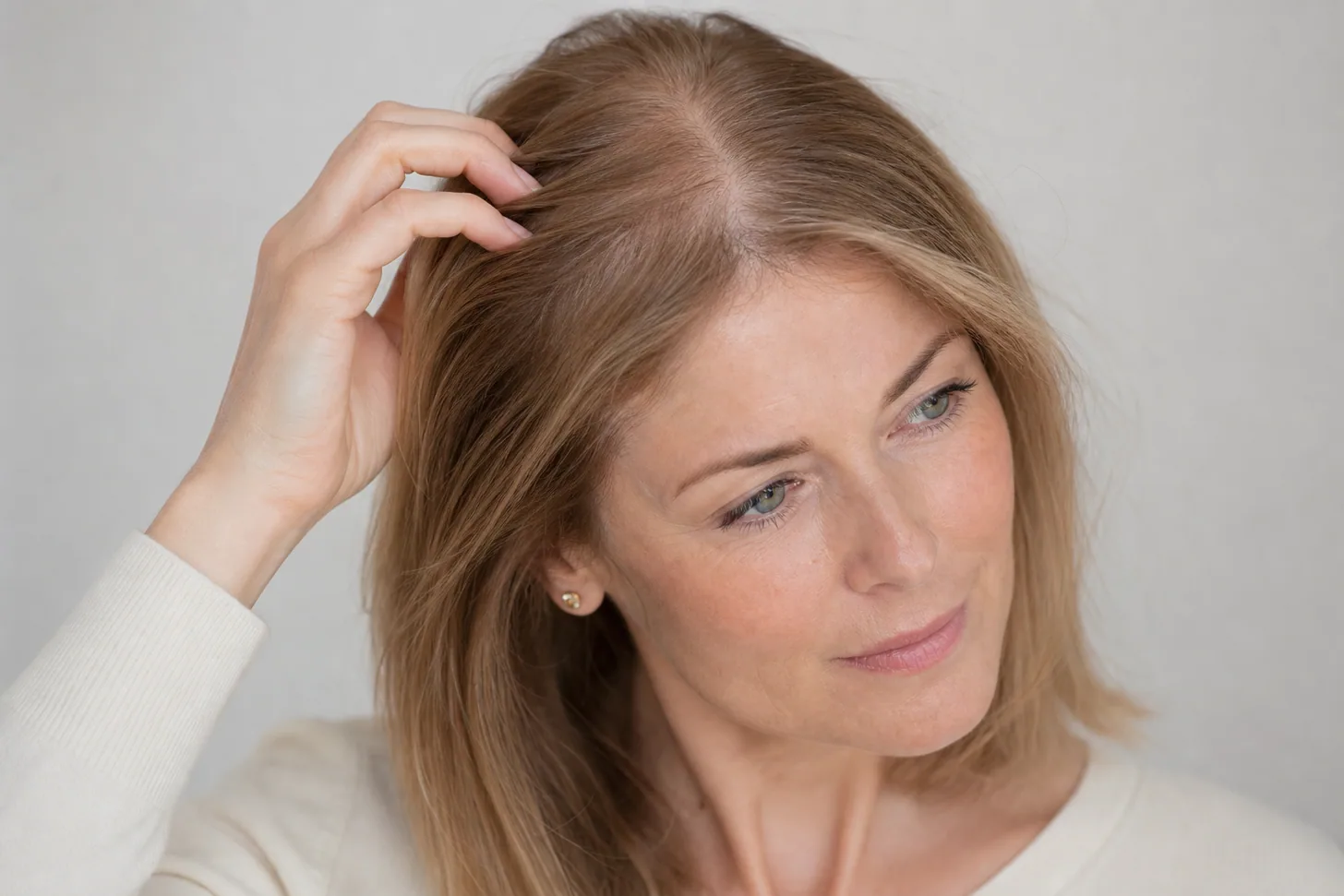
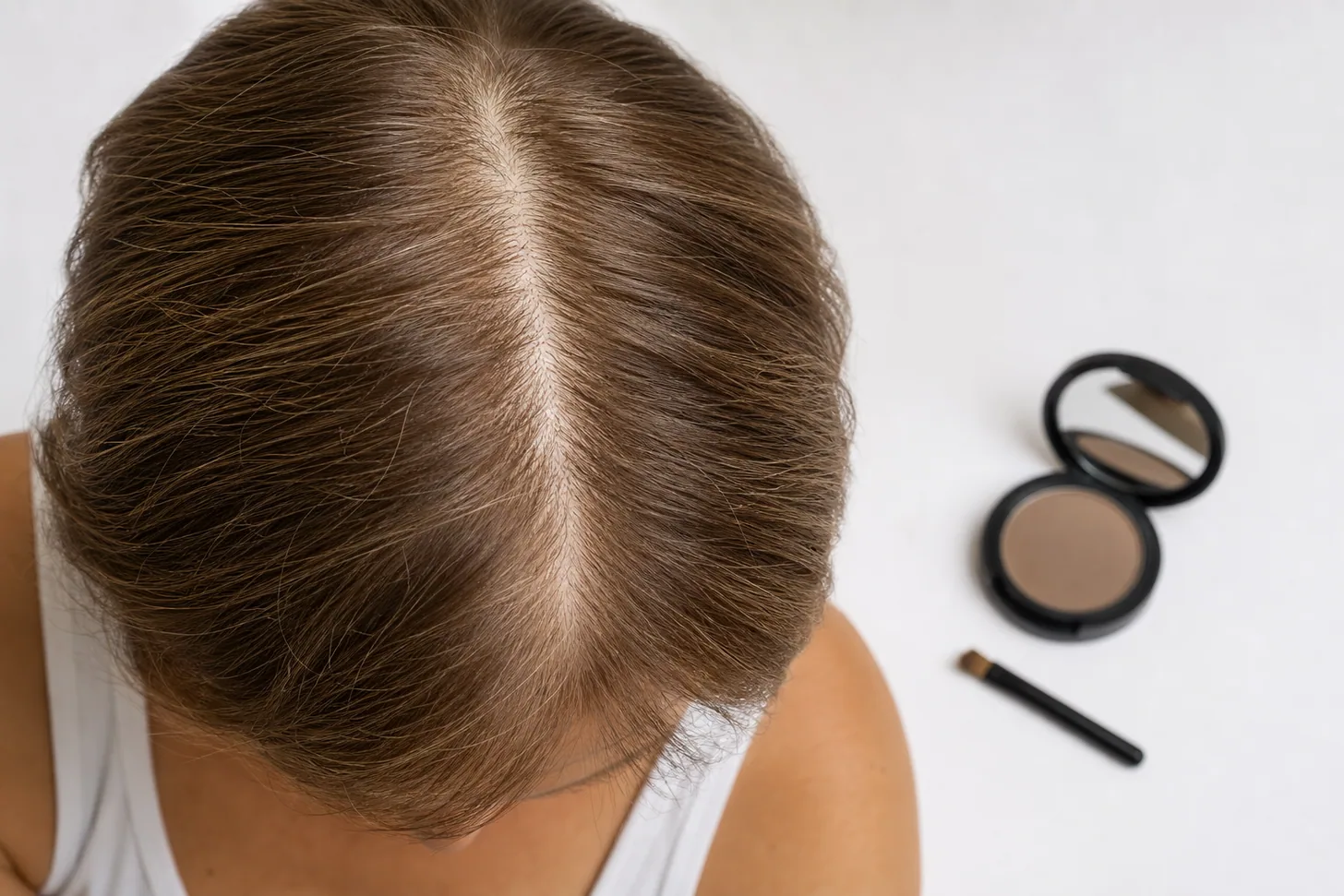
A haircut cannot add density. What it can do — and this is not a small thing — is decide how much scalp is visible and where the eye lands. Three levers do almost all of that work, and none of them is about fashion. Length: long hair is heavy, weight pulls the crown flat against the skin, and hair lying flat shows what's underneath it, so taking length off makes the same density cover more.
Parting: a straight part is a deliberate strip of exposed scalp drawn across the exact place you'd rather nobody looked. Layers, in the right place: short internal pieces at the crown give the surface hair something to stand on instead of lying down.
Below are 14 cuts built on those three levers, plus the color and styling decisions that do more than most cuts, and the honest caveat: this is coverage, and coverage is worth having — but the AAD notes that "Treatment delivers the best results when started at the first sign of hair loss", so the cut and the appointment are two halves of one plan.
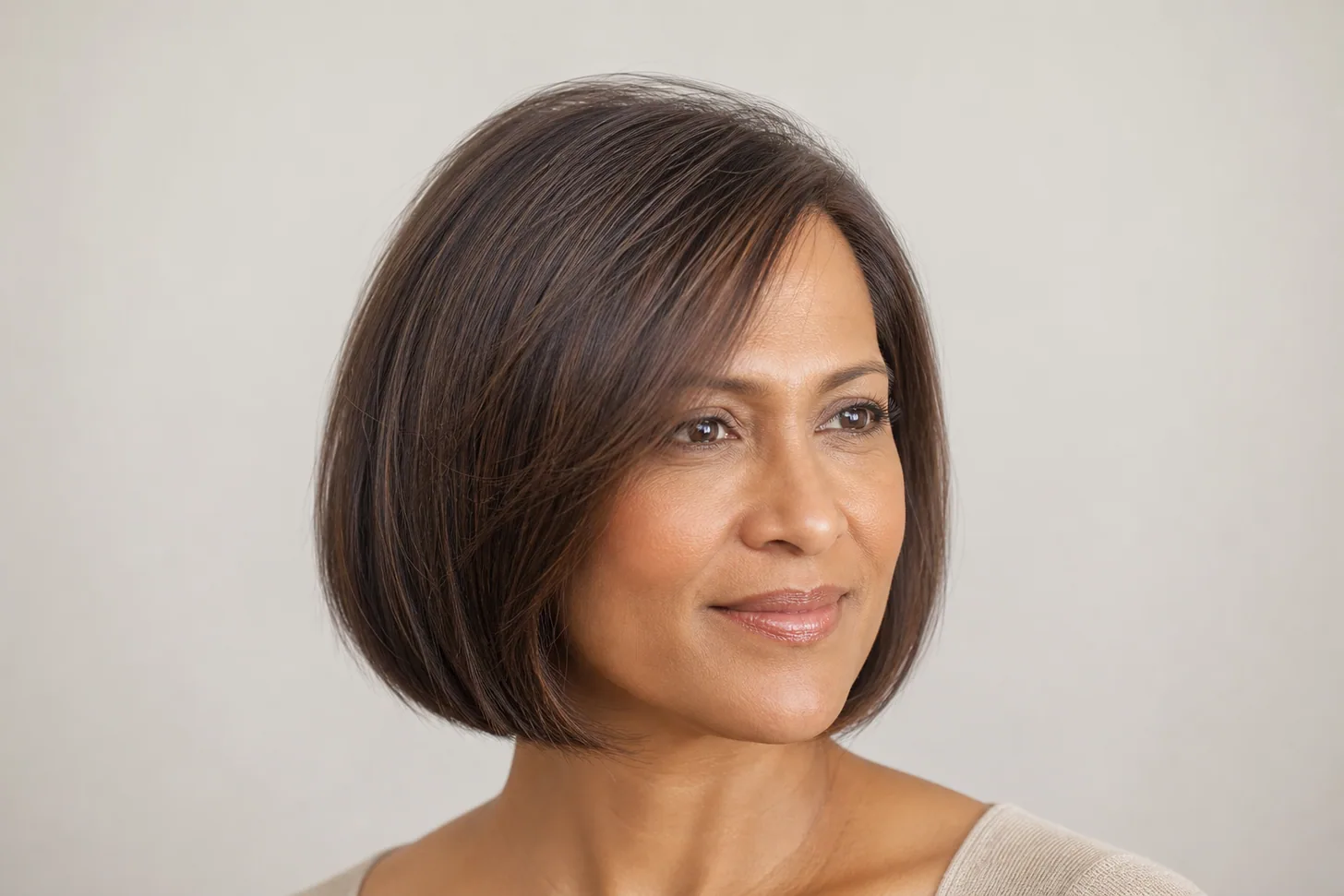
Shorter, lifted at the crown, and no straight parting line — the three levers in one shape.
The three levers a cut actually has
Before the gallery, the mechanism — because once you understand it you can judge any cut you're offered rather than trusting a photo.
Lever one: weight. Hair has mass, and mass pulls downward. At the crown, where hair grows more or less straight up out of the scalp before falling, that pull is what flattens the top section against the skin. Flat hair covers less scalp than the same hair standing slightly away from it. This is why length is the first conversation: not because long hair is unflattering, but because it is heavier, and the crown is where the weight is felt.
Lever two: the parting. A part is a line of deliberately exposed scalp. On a full head it reads as a neat line; on a sparse crown it reads as the widest, palest thing in the photograph. Nothing else on this page is as cheap or as effective as changing it, and it costs nothing.
Lever three: internal support. A short section cut inside the shape at the crown, hidden underneath the surface hair, props the top layer up. That's the only place on a fine head where taking hair away makes it look like there's more of it — and it's the entire case for internal layers here.
Layers taken off the outline do the reverse, because the perimeter is the only place fine hair still reads as solid. Do layers help or hurt fine hair? is the fuller version.
If you're not yet sure whether what you're seeing is lifelong fine hair or a real change in density, fine hair or thinning? separates them — and the answer changes what you should do next. It also changes what to buy: best shampoo for thinning hair covers the wash, and why it is step three rather than step one.
Chair-side note
The first thing I do for a client worried about her crown isn't cut anything. I get her to sit under the salon lights, then hand her the mirror and show her the same section under the window instead. The difference is startling — overhead light comes straight down onto the part and lights up the scalp, and almost every mirror women use to worry about their hair has a light directly above it.
That's not a trick to make her feel better; it's information. It tells us how much of what she's seeing is density and how much is lighting, and it stops us cutting for a problem that's partly the bathroom. Then we do the real test, which is a photo of her part under the same window, so there's something to compare against in three months.
And I say the same thing every time: I can make this show less, and I can't make it grow. Both halves are true and she deserves both. The front edge works on a different set of levers, because it is a line rather than an area — cuts for a receding hairline and thinning temples covers those.
SB
— Simone Baptiste, Senior Stylist
Shapes that put weight over the crown
All five take length off and put support underneath the top section. They're listed roughly from most conservative to boldest.
Woman with a chin-length blunt bob on fine hair, strong perimeter, visible lift at the crown
1
The chin-length blunt bob with crown layers
The most reliable cut on this page and the one I recommend most often. The blunt perimeter at the jaw gives you a solid outline the eye reads as thickness, and taking the length up to the chin removes enough weight that the crown stops being dragged flat. The layers are short, internal and invisible — three or four inches at the crown, point-cut and blended so nothing sticks up. Ask for exactly that: blunt at the jaw, weight out from inside at the crown only.
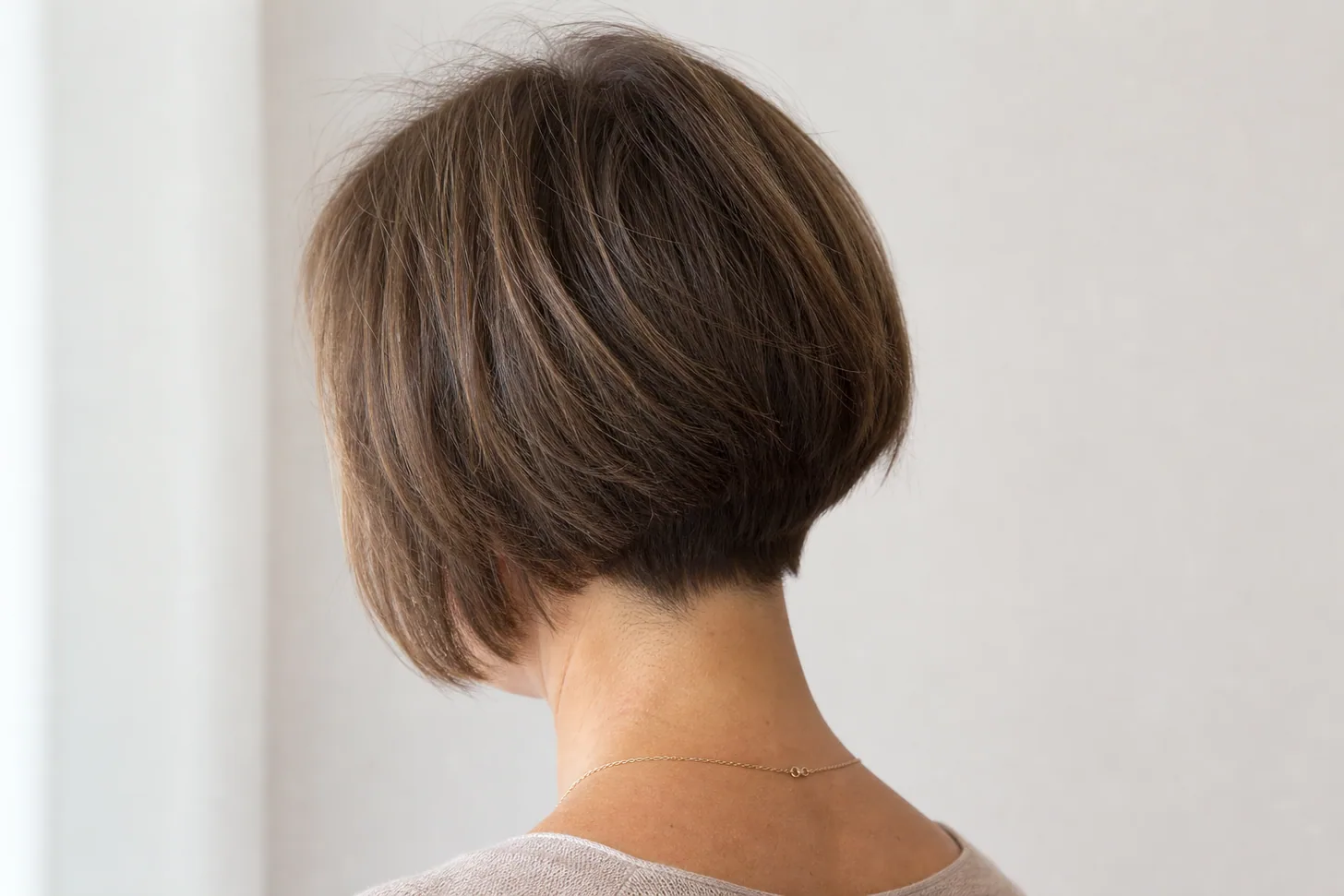
Woman with a softly graduated bob on fine hair, fullness stacked at the back of the head
2
The softly graduated bob
Graduation stacks hair on top of hair rather than removing any, which builds genuine height through the back and upper crown. It's one of the very few techniques that makes fine hair look like there's more of it, and it costs no density to get. Keep it soft rather than steep — a stacked shape can read bulky and is much harder to grow out. See the stacked bob for thin hair for the stronger version of the same idea.
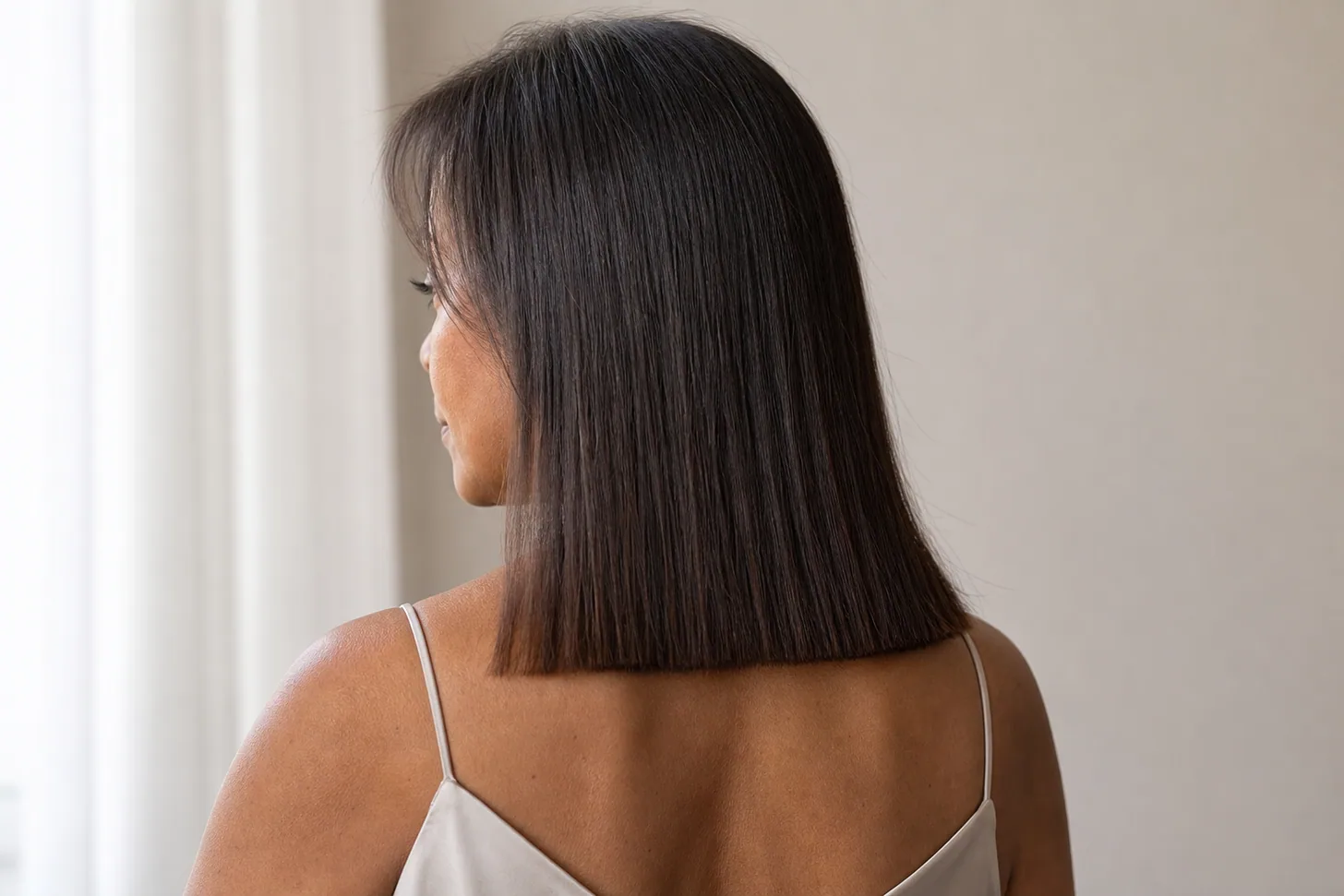
Woman with a collarbone lob on fine hair with hidden internal crown layers and blunt ends
3
The collarbone lob, if you're not ready to go shorter
The compromise length, and an honest one. At the collarbone the weight is manageable, the perimeter can stay blunt, and internal crown layers still have room to work. It won't lift a crown as effectively as a chin-length bob, but it's a real improvement on anything past the shoulder blade and it's a change most people are willing to actually make. More at the lob for fine hair.
Woman with a short textured crop on fine hair with height built through the top section
4
The short textured crop with height on top
The most effective shape here, and the one people arrive at after trying everything else. At this length there's essentially no weight left to flatten the crown, so the top stands up on its own with almost no product. The trade-off is honest: short hair shows the shape of your head, so it needs a good cut and a stylist who'll check it dry. Very short haircuts for fine hair has the range.
Woman with a pixie on fine hair, longer on top and swept back, tighter through the sides
5
The pixie with a deliberately longer top
Not a uniformly short pixie — one cut with the top section kept noticeably longer than the sides, so there's enough hair up there to sweep across and cover. Length on top is coverage; length at the sides is just weight. This is the version to ask for if your sides and back are still dense and the sparseness is confined to the crown. Pixie cuts for fine hair covers the variations.
Parting and framing that break up the exposed line
These four cost nothing and several of them aren't cuts at all. Start here before you book anything.
Close-up of a zigzag parting on fine light-brown hair, no continuous line of scalp visible
6
The zigzag part
The highest-return sixty seconds in this article. Instead of combing a straight line, use the tail of a comb to zigzag along the parting, so hair from each side interlocks and there's no continuous strip of scalp anywhere. It takes a minute, costs nothing, and does more for a widening part than most haircuts. Do it on dry hair, then leave it alone.
Woman with fine hair swept back off the face with no defined parting, soft volume at the front
7
No part at all — the pushed-back front
The most effective of the parting options and the one that needs the most commitment. The whole front section goes back off the face with no defined line anywhere, which means there is simply no exposed strip to see. It needs a root product and a two-minute dry to hold, and it suits shorter shapes better than long ones. Worth trying on a weekend before you decide.
Woman with fine hair in a deep side part, hair swept across the crown for coverage
8
The moved side part
Shift the part an inch or two to the side of where it has always fallen. Two things happen at once: fresh hair lies across the old widened line, and hair that has fallen the same way for years has to stand up to get to its new position, which adds lift for free. Don't go too deep — a hard side part on fine hair can leave the other side looking sparse. How to part fine hair covers where it should sit.
Woman with fine hair and a soft curtain fringe framing the face, drawing the eye downward
9
A soft curtain fringe to move the eye
A fringe works here by relocating attention: it gives the face a focal point at eye level, so the gaze stops travelling upward to the part. A curtain shape takes far less hair than a blunt fringe and grows back into the length without an awkward stage. The condition is that it has to come from hair you can spare — if the front of your crown is the sparsest area, taking a fringe from it makes the thin place thinner. Curtain bangs on fine hair has the brief.
Color and texture, which do more than most cuts
Visible scalp is a contrast problem as much as a density problem — what you actually see is pale skin against darker hair. Narrow that gap and less shows.
Close-up of a fine-hair part with a soft root shadow reducing contrast between scalp and hair
10
A root shadow to close the contrast gap
A softly darker root, or a shadow melted into the length, brings the hair closer to the tone of the scalp exactly where the scalp is visible. Less contrast, less visible gap. It's a small salon service, it grows out without a line, and on a widening part it frequently does more than a haircut. Ask your colorist for it as a coverage decision rather than a fashion one.
Woman with fine hair showing soft low-contrast dimension through the top section
11
Low-contrast dimension instead of bright highlights
Soft, closely-toned pieces through the top make the eye read texture rather than a flat sheet with gaps in it. What works against you is the opposite — bright, high-contrast highlights starting right at the root put maximum contrast exactly where the scalp shows. Keep the contrast gentle and start the color slightly away from the root. Highlights on fine hair covers where they should be placed on a low-density head.
Woman with fine hair with a soft body wave through the crown adding lift and coverage
12
A soft body wave at the crown
Bend in the hair is coverage: a straight strand lies down and shows the gap beside it, while a waved strand sits across its neighbours and closes it. This can be a gentle root perm done only at the crown, or simply a set of self-grip rollers in damp roots every wash day. Try the rollers first — they cost almost nothing and tell you whether the effect is what you want. Perms and body waves for fine hair has the honest picture on the salon version.
Two ways to wear it up without paying for it
Both are built around the same rule: lift the crown before you secure anything, and never pull tight.
Woman with fine hair in a loose half-up style with visible lift and volume at the crown
13
The lifted half-up
Only the top section is secured, and the trick is what happens before you secure it: gently backcomb the crown, then place the section loosely and pull a little slack forward so the top stays domed rather than flattened. Done carelessly a half-up drags the crown flat, which is the opposite of the point. Half-up styles for fine hair has the variations.
Woman with fine hair in a loose low bun with a claw clip and soft volume left at the crown
14
The loose low bun, crown lifted last
A claw clip or a fabric-covered elastic, never a tight band, and the crown eased up with your fingertips after the bun is secured rather than before. The AAD is unambiguous about tension: "If your hairstyle feels painful, the style is too tight." On a crown that's already thinning, that rule isn't optional. Buns for fine hair covers the shapes.
What shows the part, and what hides it
Decision
Makes it show more
Makes it show less
Length
Past the shoulder blade; weight pulls the crown flat
Chin to collarbone; the top stands away from the scalp
Parting
A straight line, in the same place for years
Zigzag, moved, or no part at all
Layers
Taken off the perimeter; razored or thinned
Short, internal, point-cut, at the crown only
Texture
Poker-straight and flat to the head
A soft bend that lets strands cross each other
Color
Bright highlights starting at the root; high contrast
Root shadow, low-contrast dimension
Lighting
Overhead light straight down onto the part
Side or window light — worth knowing before you panic
Product
Anything rich or heavy anywhere near the roots
One light root product; a root-tinting powder on the line
The fastest cosmetic fix on this whole page isn't a cut at all — a tinted root powder dusted along the parting closes the contrast gap in about thirty seconds. Our scalp concealer and root powder picks cover which ones stay put, building fibers are the alternative when the crown is diffusely thin rather than showing one clean line, and coverage for thinning on top is the care-side companion to this gallery.
What a cut can't do — and when to make an appointment
Your part has widened noticeably in under a year.Speed matters diagnostically. That's worth seeing someone about rather than styling around.
The thinning is patchy rather than diffuse, or there are defined bare areas.A different category of problem entirely, and one that needs examining now.
It came with shedding, or with fatigue, weight change or cycle changes.That's a whole-body question — see which blood tests actually matter and take it to a doctor.
Your scalp is sore, itchy, scaly or red where the hair is thinning.Symptoms plus hair loss should be assessed, not covered up.
You're mid-shed after an illness, a birth or a big weight change.Don't make a permanent cutting decision during a temporary shed. Post-partum and weight-loss shedding both resolve — wait for the picture to settle.
FAQ
Something shorter than you currently have, with internal layers at the crown and a parting that isn't a single straight line. Those three things are the whole answer, and they work for a reason that has nothing to do with fashion. Length adds weight, weight pulls the hair at the top of your head flat against the scalp, and hair lying flat shows the scalp underneath it. Take length off and the same amount of hair stands further away from the skin, which closes the gap visually. Short internal layers at the crown give the top section something to sit on. And a straight part is a permanent open line exactly where you least want one. A chin-length blunt bob with crown layers and a soft side part is the single most reliable version.
Usually yes, for two separate reasons, and neither is about age. The first is mechanical: long hair is heavy, and the weight pulls the crown section flat to the scalp, so the same density covers less. The second is where the eye goes — long hair is read from the top down, so someone looking at you reaches your part before your ends, and a flat top next to long lengths creates a contrast the eye reads as thinning even when the density either side is fine. That doesn't mean everyone with a sparse crown has to cut their hair off. It means length has to earn its place: if the crown still holds and you can style it with lift, keep it. If you can see scalp through the part in ordinary daylight, a shorter shape will do more for you than anything else on this page.
Stop using it as a part. A parting is a deliberate straight line of exposed scalp, so on a widening part you're drawing attention to the exact thing you want to hide. Three changes help, in ascending order of effort. Move it — shift the part an inch to one side, which puts fresh hair over the old line and makes the hair stand up rather than lie in its trained direction. Break it — comb a zigzag rather than a straight line, using the tail of a comb, so there's no continuous strip of scalp visible. Or lose it — push the whole front section back with no defined parting at all, which is the most effective and needs the most product. A root-tinting powder along the line is the fastest cosmetic fix on top of any of them.
A soft fringe helps more than people expect, with one condition. What it does is move the eye: it gives the face a focal point lower down, so attention lands on your eyes and brows rather than travelling up to the part, and a curtain or side-swept shape also drops hair over the front hairline where thinning often shows first. The condition is that the fringe has to come from hair you can afford to spend. A full blunt fringe takes a wide section from the front of the crown, which is frequently the sparsest area, and moving hair from a thin place to make a fringe leaves the thin place thinner. A curtain fringe or soft side sweep takes far less and grows back into the length without a stage.
Internal layers at the crown help a great deal. Layers cut into the outline hurt. The distinction is where the hair is removed from. A short section cut inside the shape at the crown, hidden underneath the surface hair, gives the top something to stand on, so the surface layer lifts away from the scalp instead of lying on it — the single most useful thing a stylist can do for a sparse crown with scissors. Layers taken off the perimeter do the opposite, because the outline is the only place fine hair still reads as solid. The words that get the right version are "take the weight out from inside" and "keep my ends blunt", plus point cutting rather than a razor or thinning shears, both of which remove density you can't spare.
It helps more than most people realize, because visible scalp is a contrast problem as much as a density problem. What you see through sparse hair is pale scalp against darker hair, and the greater the difference the more obvious it is. Anything that narrows that gap reduces what shows: a root shadow or slightly darker root brings the hair closer to the scalp tone where the scalp is visible, and soft low-contrast dimension makes the eye read texture rather than a flat sheet with gaps. What works against you is bright, high-contrast highlights starting right at the root — maximum contrast at exactly the wrong place. Very light hair against a pale scalp can also reduce contrast, which is why some colorists take clients lighter rather than darker.
No, and this is worth getting right before you spend money on anything cosmetic. A widening part and thinning at the crown is the classic presentation of female pattern hair loss, and the AAD opens its own patient page with exactly those questions — is your part widening, have you noticed your ponytail is thinner. But several other things produce a similar picture. Diffuse shedding after an illness, a birth, a big weight change or a new medication thins the whole head and shows first where the hair is naturally sparsest, which is the crown. Traction from years of the same tight ponytail thins the front and sides. Breakage looks like thinning but is short broken pieces rather than fewer hairs. They have different answers, and a cut buys time in every case but treats none of them.
No. A cut changes how much scalp shows and where the eye lands — it can do that dramatically — but it doesn't change what's happening at the follicle. Being clear about that isn't pessimism, it's the reason to do both things rather than one. If the thinning is progressive, the useful window is early: the AAD states that treatment delivers the best results when started at the first sign of hair loss, which makes an appointment more valuable the sooner you make it, not less. So the honest plan is to book the cut because it will change how you feel about your hair this month, and book the appointment because it's the half that might change what your hair does next year. People routinely do one and not the other, and it's almost always the cosmetic half they choose. See what a dermatologist can actually do.
Eleven years cutting fine hair. Simone says the same sentence to every client worried about her crown: I can make this show less, and I can't make it grow — and you deserve both halves.
This article is for general education and is not medical advice. A widening part or thinning at the crown can have several causes, and the cuts here are cosmetic coverage rather than treatment. If your part is widening, the loss is patchy, your scalp is sore or the shedding is ongoing, see a board-certified dermatologist.
Images in this article are AI-generated illustrations, not photographs of real clients or results. See our image policy.
Results vary with hair type, density, and growth patterns. This guide is educational and not a substitute for an in-person consultation with a licensed stylist or physician.
Get the good hair intel
One honest, stylist-written guide in your inbox each week. No hype.

 SB
SB