Reviewed by Dr. Rachel Kimura, MD · Updated August 2026 · 11 min read
Fine, coily hair is the combination that gets the worst advice on the internet, and the reason is optical. A tight coil pattern contracts so far when it dries that a modest amount of fine hair fills a large silhouette — so the mirror says "thick," the routine gets built for thick, and fine strands end up carrying butters, oils and sealants sized for a completely different fiber.
Then the hair is limp, dull, and breaking, and the usual conclusion is that it needs more moisture. It needs less weight. Below: how to tell fineness from density when shrinkage is hiding both, why coily hair is genuinely dry and genuinely fragile at the same time, the weight budget that fits a fine strand, and the protective-styling rules that keep a protective style protective.
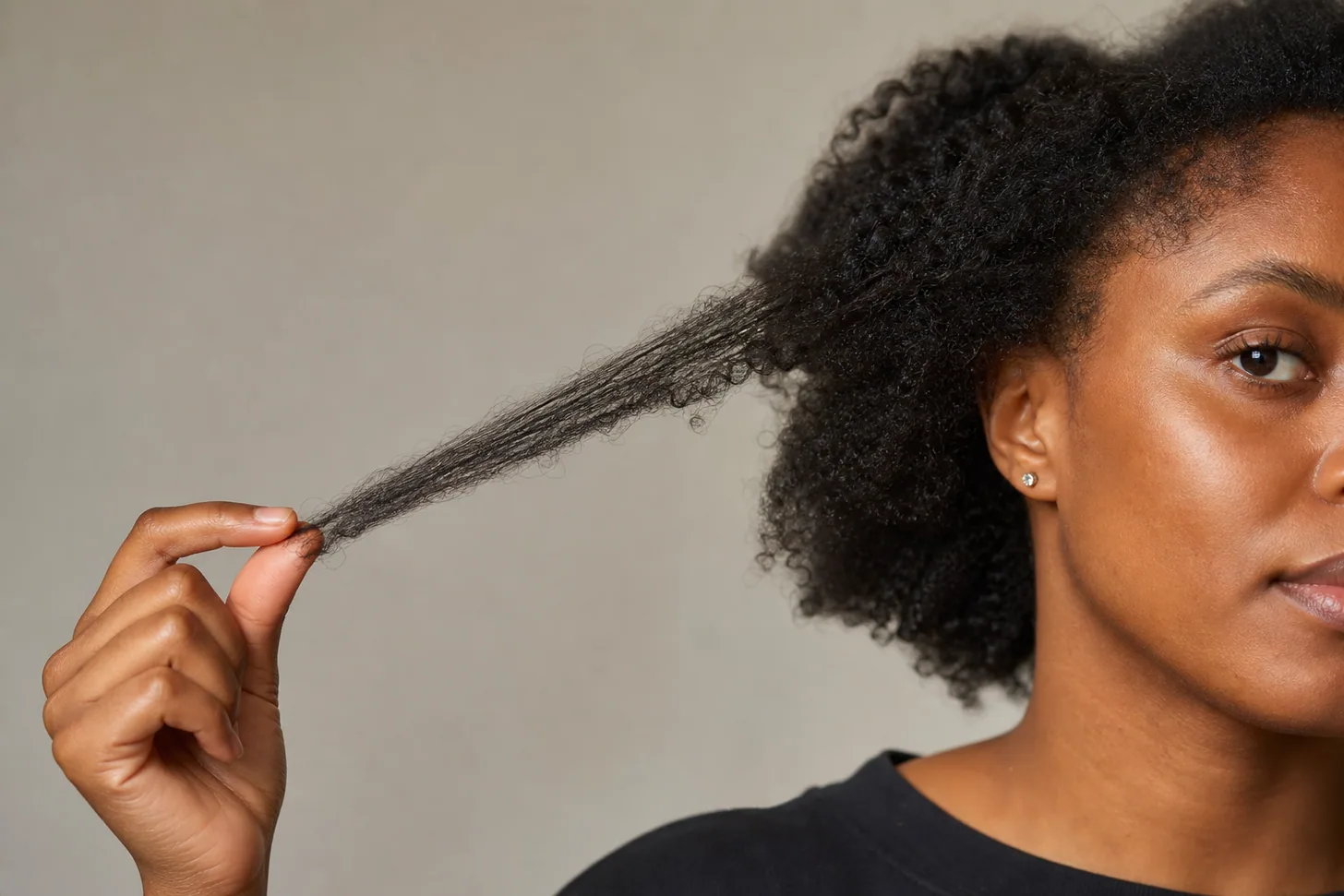
The same hair, stretched and unstretched. Shrinkage is why fine coils get mistaken for thick hair.
Chair-side note
The consultation question I ask before anything else is: "when your hair is soaking wet and you pull a section straight down, how wide is it?" Almost nobody has looked. They have looked at the puff, which is the one view that tells you nothing about how much hair you have.
I have had clients arrive convinced their hair was thick and getting thinner, when in fact it had always been fine and high-shrinkage, and what had changed was the eight ounces of butter now living in it. We washed it out over three weeks and the hair came back up off the scalp. Nothing had grown. It just stopped being held down.
MH
— Megan Holloway, Editor-in-Chief
Fine, thin and coily are three separate measurements
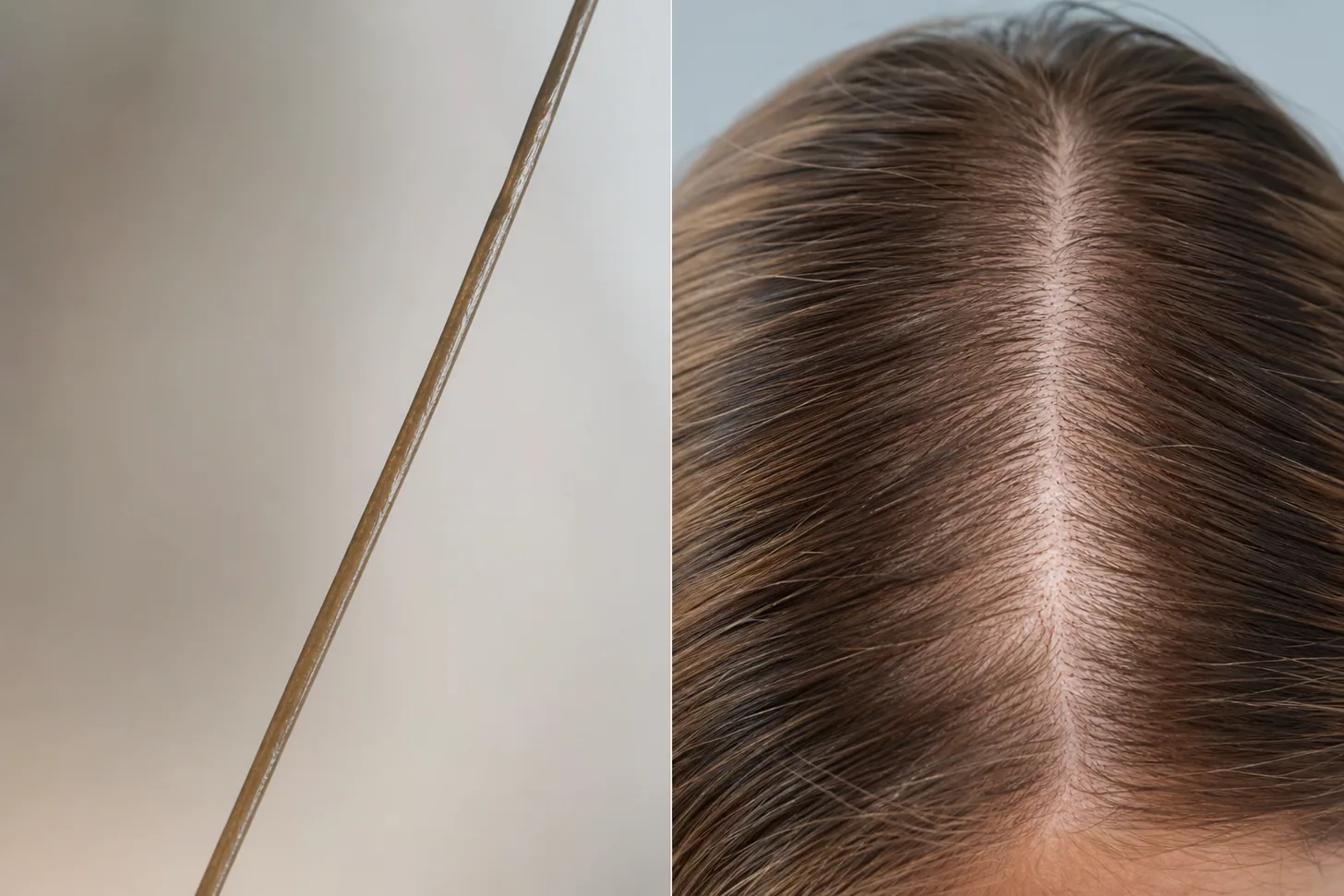
They get used interchangeably and they describe different things. Fine is the diameter of a single strand. Thin — or low density — is how many strands you have per square inch of scalp. Curl pattern is a third axis entirely, and it is independent of both. You can be fine and dense, fine and sparse, coarse and sparse, coarse and dense, at any curl pattern from 2A to 4C.
That matters because almost all type-4 hair advice was written for hair that is coily and coarse, or coily and high-density. On those heads, weight is a feature: a butter gives dense coarse coils the mass they need to clump, lie down and stop frizzing.
On a fine strand the same product is a coat with no one inside it. We cover the underlying distinction in fine hair vs thin hair; here is how the four combinations behave once you add a coil pattern.
Combination
What it looks like
What it needs
Fine + high density
Big puff, full silhouette, but strands feel like thread; tangles constantly
Light products used generously; sectioning is non-negotiable — see high-density fine hair
Fine + low density
Scalp visible through the coils, especially at the crown and parting
Minimum weight, minimum manipulation, styles that don't part the hair narrowly
Coarse + high density
Dense, springy, resists shaping; the classic type-4 product market
Butters and creams as sold; this routine is not for you
Coarse + low density
Individual coils clearly visible and strong, but sparse overall
Weight is fine; coverage and cut do the work
Shrinkage is why fine coils get treated as thick hair
Shrinkage is not damage and not a flaw — it is the coil doing what it does. But it is a measurement problem, because the dry, unstretched view is the least informative one you have, and it is the only one most people ever look at.
Three checks that actually tell you something, all done stretched or wet:
The parting. Part the hair down the middle with your comb and look at the width of the visible scalp line, in the same light, from the same angle. This is the single most useful density measurement you own, and it is the one to photograph every three months.
The gathered circumference. Gather everything into one puff or ponytail and note the circumference at the base. Coils gathered loosely will always read bigger than straight hair, so the number matters only compared to your own past numbers.
The wet look. Soaking wet is the most honest picture of density anyone's hair ever gives — water removes the air the coil pattern is holding. Everyone's hair looks thinner wet, which is exactly why it's diagnostic; the full explanation is in why your hair looks so thin when it's wet.
Then do a strand test for fineness itself. Pull one shed hair taut between two fingers and roll it. If you can barely feel it, it's fine. If it feels like a thread with detectable width, it's medium; if it feels wiry, it's coarse. Do it with five or six hairs from different parts of the head — most people are not one thing all over, and the crown is very often the finest area.
Why fine coily hair is dry and fragile at the same time
Both of these are structural, and knowing the mechanism stops you treating one and worsening the other.
The dryness. A coily strand grows from a curved follicle, and the shaft it produces is elliptical rather than round, with bends along its length.
Dermatology literature on Black women's hair and scalp dermatoses in Anais Brasileiros de Dermatologia notes that this curved structure impairs the normal distribution of natural oils along the shaft — so sebum stays near the scalp instead of travelling to the ends, and the hair reads dry despite entirely normal oil production. It is not that your scalp produces too little. It is that the road is winding.
That has a second consequence people rarely connect: the oil that can't travel down stays where it is. On fine coils that means the root area can feel greasy while the ends feel like straw, in the same week. Adding a heavy sealing oil to the length doesn't fix the ends and it definitely doesn't help the roots.
The fragility. The same paper explains why coily hair breaks more readily: the elliptical shape with flattened, irregular shafts is responsible for lower resistance and higher susceptibility to breakage than round, uniform hair shafts, and the bends themselves are points of weakness.
Now hold that alongside the property that defines fine hair — a strand's resistance to bending falls away extremely steeply as diameter drops, which is why fine hair loops around obstacles rather than pushing past them. Fine plus coily is not the sum of two mild problems. The strand fails at the bends, and there are a lot of bends.
Which points at the real lever: manipulation, not product. Most breakage in fine natural hair happens during detangling, take-down, and re-styling — not during the day. Reducing the number of times you handle the hair is worth more than any bottle in the routine.
The weight budget: what actually goes on fine coils
The standard layering methods — LOC (liquid, oil, cream) and LCO (liquid, cream, oil) — were built for hair that needs sealing. Fine coils need the liquid and one of the other two, not both, and in a fraction of the usual quantity.
Layer
On coarse coils
On fine coils
Liquid — water, leave-in, mist
Essential
Essential, and the layer doing most of the work. Apply to soaking hair, not damp
Cream — moisturiser, curl cream
Generous
One light cream, a quarter of the recommended dose, mid-lengths down
Oil / butter — sealing step
Generous
A few drops of a light oil on ends only — or skip it entirely and use gel instead
Gel or foam — hold
Optional
Often the better sealer: it holds the shape without adding lasting weight
Protein — treatments
Occasional
Occasional and small. Fine hair goes brittle on protein faster than it goes strong
Two rules that do most of the work. First, apply to soaking-wet hair, in sections, and don't touch it again — product spread over water goes much further than product spread over damp hair, which means less of it lands on any one strand. Second, go lighter on the sealer, not heavier. When fine coils feel dry the instinct is to reach for something richer; the correct move is usually more water, more often, and a lighter seal.
A lightweight leave-in refreshed midweek beats a heavy butter applied once. The general principle — that the products marketed at dryness are too heavy for the hair that has it — is the spine of the moisture routine for dry, fine hair, and it applies here with the volume turned up.
Wash day for fine coils
The American Academy of Dermatology's everyday care guidance for Black hair recommends washing once a week or every other week, conditioning at every wash and coating the ends, since those are the oldest and most fragile part of the hair.
Fine coils sit at the weekly end of that range, for a specific reason: a fine strand is saturated by a smaller quantity of product than a coarse one, so build-up arrives sooner and shows up faster — as limp, dull hair that has lost its definition. If your pattern is a curl rather than a coil, the cleanser shortlist differs — see shampoo for fine curly hair.
Detangle before water. On dry or lightly misted hair, with fingers, in four to six sections. Every knot you remove now is a knot that won't be tightened by shampoo. This applies to all fine hair — the reasoning is in how to keep fine hair from tangling.
Cleanse the scalp, not the length. A gentle, low-lather shampoo worked into the scalp with fingertips; the runoff cleans the length adequately. Once a month, use a clarifying shampoo to reset build-up — this is the step fine coils skip most and need most.
Condition every wash, ends first. Concentrate it on the last few inches, leave it for a few minutes, and detangle in the conditioner while the slip is at its maximum.
Rinse cool-ish and blot, don't rub. A cotton T-shirt or microfibre towel, squeezing rather than scrubbing. Rubbing roughs up an already-irregular cuticle.
Style on soaking-wet hair, in sections, then leave it alone. Product goes on section by section while the water is still in there. Then don't touch it while it dries — every handling breaks up the clumps you just made.
Detangling without leaving half of it in the comb
This is where fine natural hair is most often damaged, and the rules are strict because the margin is small.
Fingers first, tool second. Your hands find single-strand knots and shed hairs that a comb will simply drag through.
Never dry, and never with only a mist. Soaking wet, with conditioner in it. Slip is what protects the bends.
Four to six sections, clipped or twisted out of the way. Working the whole head at once guarantees you re-tangle what you just cleared.
Ends up, holding above the tangle. Grip between the knot and the scalp so your hand takes the tension. Then work upward in short passes.
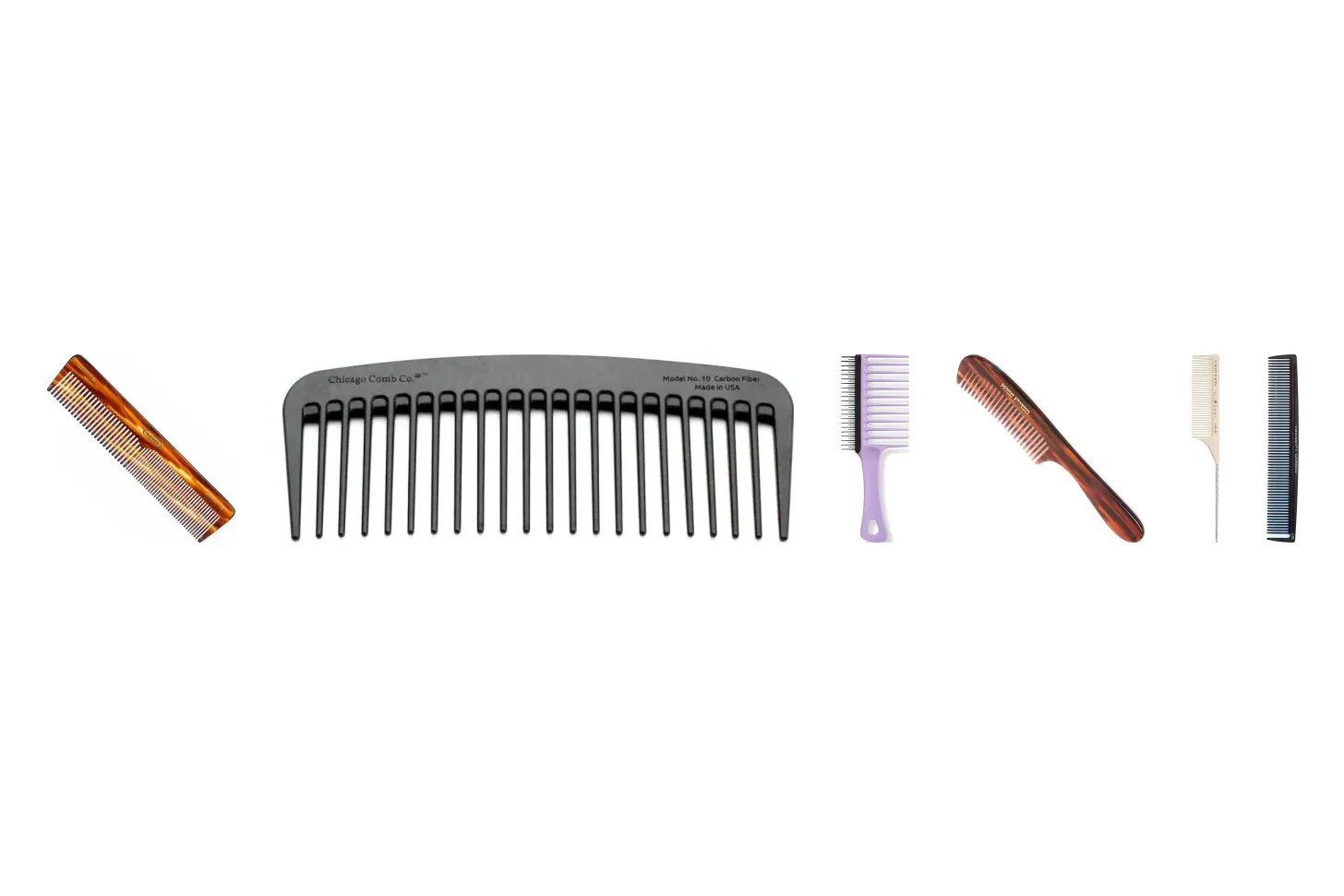
The right tool. A seamless wide-tooth comb, and only after fingers — moulded combs with a ridge down each tooth are exactly wrong for a fine, bent strand. The specifics are in the best comb for fine and thin hair.
Protective styling, honestly
Protective styles genuinely do reduce daily manipulation, which is the main cause of breakage in this hair type — so the idea is sound. But they are the highest-risk item in the routine, not the safest, and fine hair has the smallest margin for getting them wrong. The tension is borne by strands with less tensile reserve, and the hairline, where hair is finest on almost everyone, is the first casualty.
The American Academy of Dermatology's page on hairstyles that pull names cornrows, locs, tight braids, pulled buns and ponytails, extensions and weaves, and tight roller sets as causes of traction alopecia, and is unambiguous about the stakes: when the pulling continues, hair can eventually stop growing, and at that stage it cannot grow back. Caught early, with a change of styling and a dermatologist's help, it usually can.
The rules that keep a protective style protective on fine hair:
Pain is not part of it. The AAD's advice on braids and weaves is plain — if it hurts while it's being done, ask the stylist to stop and redo it, because pain equals damage. Tenderness that evening, or bumps along the parting the next morning, means it was too tight.
Match the section size to your hair, not to the look. Micro-sized braids on fine hair concentrate the load of the extension onto a few dozen fragile strands.
Keep the added weight low. Long, heavy extensions pull for weeks at a time. Shorter and lighter is the fine-hair version of the same style.
Six to eight weeks, then out. Longer than that and the new growth at the base starts matting, and the take-down does more damage than the style saved.
Leave the hairline out. Baby hairs at the front are the finest hair you have and the least able to recover. Let them sit outside the braid.
Vary where the tension sits. Rotate the parting direction and style type between sets so the same follicles aren't loaded every time.
Take it down wet and slow. With conditioner, in sections, over an evening — not dry, in a hurry, before bed.
Between styles, give the hair a week or two of low-tension wear. For softer alternatives that hold on fine hair, braids for fine hair covers the sizing and tension side in more depth.
Heat and silk pressing on fine coils
Fine coils straighten at much lower temperatures than the settings most flat irons default to, and that is the whole opportunity. The AAD's guidance is to use a ceramic tool no more than once a week and at the lowest temperature that achieves the style. On fine hair "lowest that works" is often dramatically lower than 400°F — try the bottom of the dial and work up, rather than starting hot and hoping.
The specific risk with fine coily hair is heat damage that shows up as a curl pattern that loosens and never comes back — a section that dries straight and limp while the rest springs up. That is not reversible, and it is more likely at fine diameters because there is less cortex to absorb the energy.
Always use a heat protectant, always fully dry the hair before an iron touches it, and treat a silk press as an occasional event rather than a maintenance routine. The tool specifics — and why the bottom of the temperature range is the spec that matters — are in the best flat iron for fine and thin hair.
When it isn't fineness
Everything above assumes fine hair behaving like fine hair. Some things are not that, and they are worth separating out because the response is different.
Breakage shows as short, uneven pieces standing up along the length and a ponytail that has thinned in the middle rather than at the base. It's a handling problem, and it responds to the manipulation rules above.
Shedding is whole hairs with a small white bulb at the root. Some of that is normal every day; a sudden increase over weeks is worth a conversation with a doctor.
Thinning is a change in density over months — a widening parting, a smaller puff. Fine hair or thinning? walks through telling them apart, and coverage for thinning on top covers what to do meanwhile.
A small circular patch of hair loss at the crown that spreads outward, sometimes with tenderness or itching, needs a dermatologist rather than a product change. The AAD describes central centrifugal cicatricial alopecia as the most common form of scarring hair loss in women of African descent, usually starting in middle age; it causes permanent loss once follicles scar, and early treatment matters enormously.
Your strands feel wiry or thread-like with real width between your fingers. That's coarse coily hair, and the standard butter-and-seal routine is genuinely built for you. Lightening it will leave you frizzy and undefined.
What you actually want is a shape rather than a routine. This page is wash day and weight; the cut is a separate decision with its own rules, because shrinkage means a coil is shaped shrunken rather than stretched. See cuts and styles for fine coily hair.
You have a lot of fine hair, not a little. High-density fine hair inverts several of these rules — you need more product at the same low weight, and internal layering is a help rather than a risk. Start with high-density fine hair, explained.
The scalp is itching, flaking persistently, sore or bumpy. That's a scalp question before it's a hair question, and it's one for a board-certified dermatologist.
You're relaxing or colouring at the same time as wearing tension styles. Chemical processing plus tension is the combination most associated with traction damage. Space them out and talk to your stylist about sequencing. If you relax, short relaxed hairstyles for thin hair covers the low-tension shapes and the touch-up interval a fine strand can afford.
FAQ
Yes, and it's the single most common misreading in fine natural hair. Fineness is the diameter of one strand; what you see in the mirror is the combined effect of diameter, density and curl pattern, and a tight coil pattern contracts so dramatically when dry that a modest amount of fine hair fills a large silhouette. The honest checks are done stretched or wet: look at the width of your parting, the circumference of a gathered puff, and how the hair looks flattened against the scalp. A big dry puff and a narrow wet section is the fine, coily signature.
Because those two problems have different causes and the usual fix for one worsens the other. Coily hair is genuinely drier: the curved follicle produces an elliptical, bending shaft that stops your natural oils travelling down its length, so the ends stay dry while sebum stays near the scalp. But a fine strand has very little mass to carry a heavy butter or oil, so the products that solve dryness on a coarse coil sit on a fine one as weight. The way out is to deliver moisture as water — a leave-in or mist on soaking-wet hair — and seal with the lightest thing that works, rather than reaching for something richer.
It's more fragile than either variable alone would suggest. Highly curled hair has an elliptical, irregular shaft with points of weakness along its length, which dermatology literature identifies as the reason it resists tension less well than round, uniform shafts. A fine diameter reduces that reserve further, and the strand tends to fail at the bends. The practical consequence is that manipulation, not product, is the main thing to control: detangle less often, only on soaking-wet hair with plenty of slip, in sections, always from the ends up.
The American Academy of Dermatology's guidance for Black hair is once a week or every other week, to avoid product build-up that dries the hair out. Fine coils generally belong at the weekly end of that range rather than the fortnightly end, because a fine strand is overwhelmed by a smaller quantity of product than a coarse one — the same butter that a dense coarse coil absorbs will still be sitting on fine hair five days later, reading as limp and dull. Use a gentle, low-lather cleanser, condition every wash, and clarify roughly once a month.
They can be, but they're the highest-risk item in the routine rather than the safest, and fine hair has the least tolerance for getting it wrong. Tight braids, cornrows, locs, weaves and extensions can cause traction alopecia, and the American Academy of Dermatology is blunt that when the pulling continues, hair can eventually stop growing back. The rules that keep a protective style protective: nothing that hurts during or after styling, sections no smaller than your hair can carry, added weight kept low, six to eight weeks maximum, the hairline left alone, and the tension varied between styles.
Anything led by heavy butters or petrolatum, thick sealing oils used by the spoonful, protein used weekly rather than occasionally, and stacked routines where a leave-in, a cream, an oil and a gel all go on in the same session. None of those are bad products; they're products sized for a coarser strand. Fine coils do better with a water-based leave-in, one light cream applied to soaking-wet hair in sections, and a gel or foam for hold if you want definition — and about a quarter of the dose the instructions suggest.
Fineness is what your strands have always been; thinning is a change in how many of them there are. The way to tell them apart is to compare against yourself over time rather than against anyone else: the width of your parting, the circumference of a gathered ponytail or puff, and the same photograph in the same light every three months. If the crown is widening, if there's a small circular patch of loss at the crown, or if you have scalp pain, tenderness or itching, see a board-certified dermatologist rather than changing products — those can be signs of conditions that respond well to early treatment and poorly to late treatment.
Fourteen years across the chair and the page, specialising in fine-hair care. Megan's view on fine coils is that the hair type is not underserved by products so much as mis-served by portion sizes.
This article is for general education and is not medical advice. If you are experiencing sudden or patchy hair loss, scalp pain, or other concerning symptoms, see a board-certified dermatologist.
Results vary with hair type, density, and growth patterns. This guide is educational and not a substitute for an in-person consultation with a licensed stylist.
Hairstyle images in this guide are AI-generated illustrations, not photos of real clients or results. See our image policy.
Get the good hair intel
One honest, stylist-written guide in your inbox each week. No hype.

 MH
MH