Reviewed by Tara Sullivan · Updated August 2026 · 11 min read
A pair of thinning shears removes somewhere between five and seventy percent of the strands in a section, and the only thing deciding which end of that range you get is the number of teeth on the blade — a number that appears on almost no packaging and gets mentioned in almost no salon. It explains nearly every over-thinning story there is.
This page is the thing this site has told you to refuse on twenty-seven pages without ever explaining: what the tool does, how much each grade actually takes, the three rules that keep fine hair safe when a blender genuinely is the right call, the four narrow jobs where it is, and the sentence to use in the chair when it isn't. If the damage is already done, over-thinned fine hair is the recovery page — this one is about the decision before it.
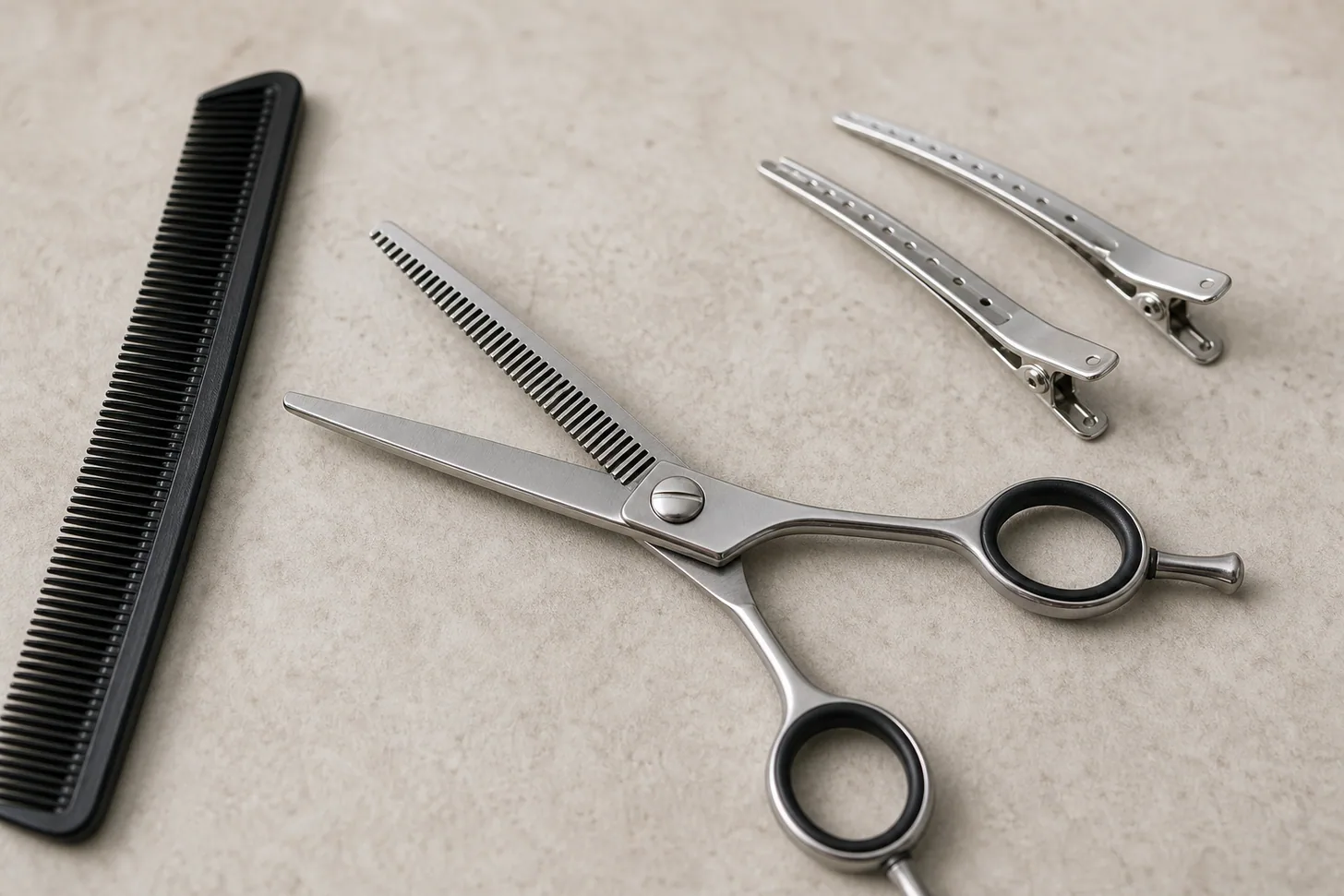
The notched blade is the whole story: only the hairs that fall between the teeth get cut.
Thinning scissors cut a percentage of a section and leave the rest full length
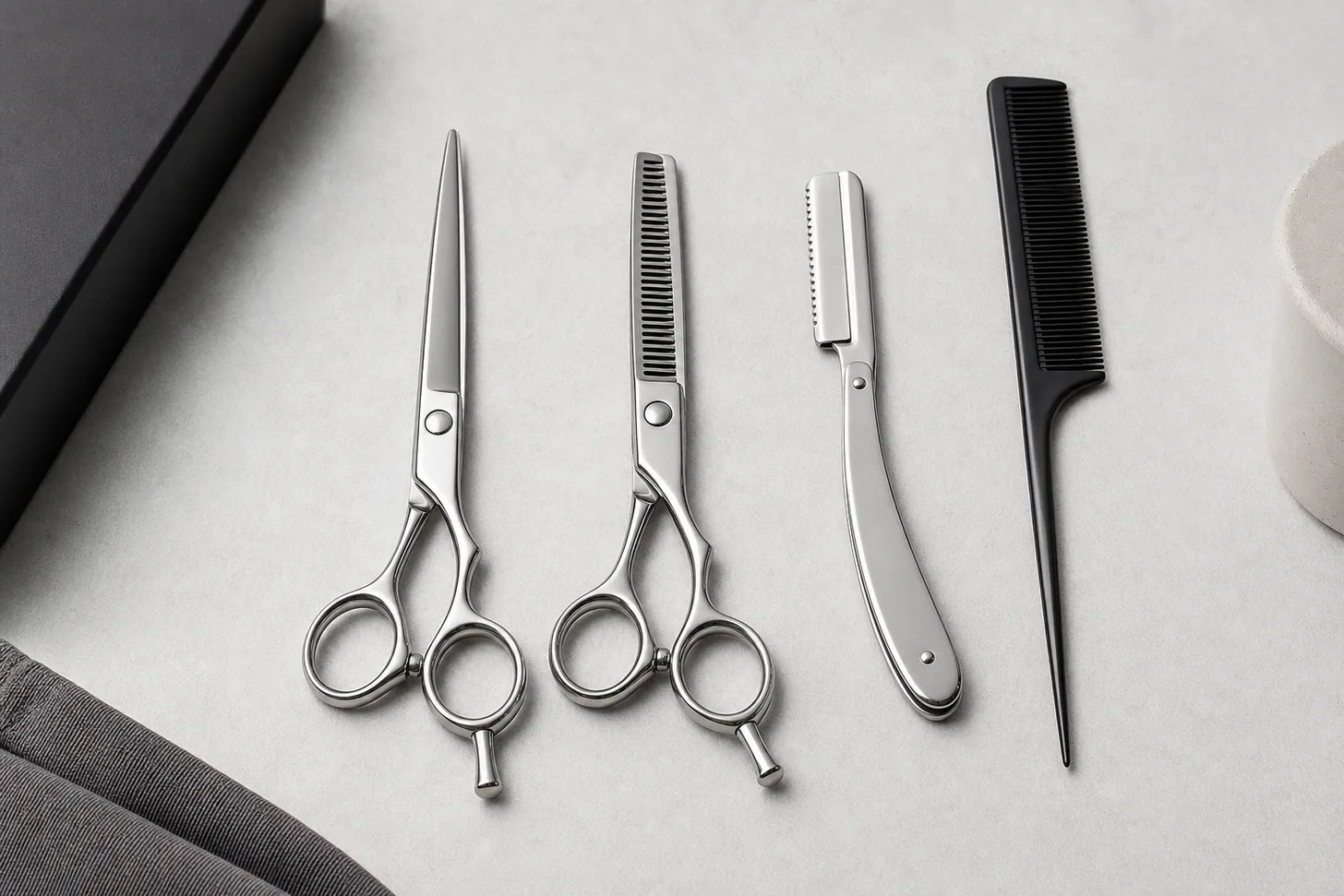
First, a naming point, because it causes real confusion at the counter: thinning scissors and thinning shears are the same tool. "Shears" is the trade word — what they are called in a salon, in a catalogue and on a sharpening invoice — and "scissors" is what everyone else says.
Neither is more correct and no manufacturer distinguishes them. What genuinely does vary between two pairs on the same shelf is the tooth count, and that single number decides how much hair comes out. It is covered in the next section, and it matters far more than what the box calls them.
One blade is a normal cutting edge. The other is notched into teeth. When the shears close, the hairs that happen to sit in the gaps between the teeth get cut; the hairs sitting against the teeth themselves slide through untouched. Close the blades once and you have shortened some fraction of the strands in that section, at whatever height the blades were held, while every other strand keeps its full length.
Two consequences follow, and both matter more on fine hair than anywhere else.
The outline of the haircut does not change.The perimeter is made of full-length strands and they are all still there. This is why nothing looks wrong in the salon mirror, why the client who was over-thinned in February cannot connect it to what she notices in May, and why the technique is so easy to over-apply — there is no visual feedback at the moment it is being done.
The cut strands come back, at the wrong length.A shortened strand is not gone. It regrows from where it was cut and eventually stands up through the surface of the hair above it. On dense hair there is enough weight on top to hold it down. On fine hair there is not, and it reads as a halo of short pieces around the part and crown.
So the correct mental model isn't "the hair gets thinner." It is: a proportion of this section has been converted into short hair that will reappear in three to six months. On a head with plenty of density, that trade buys a cut that sits closer and moves better. On a head without it, you have spent density you didn't have on a problem you didn't have.
Tooth count is close to the entire decision
Ask for "thinning" in a salon or a shop and you may be handed any of four quite different tools. They look similar in a drawer and they remove wildly different amounts. The trade names are no help — thinning, texturizing, blending and chunking get swapped around by manufacturers and stylists alike, so the label on the box is close to useless. The tooth count is not.
Teeth
Usually sold as
Removed per closure
What it's built for
On fine hair
5–10
Chunking shear
50–70%
Visible chunks and dramatic movement in very heavy hair
Read the two ends of that table against each other, because the gap is the point. A fourteen-tooth texturizer takes roughly half the strands in the section. A forty-tooth blender takes about a tenth. Both get called "thinning shears" in ordinary conversation, and one of them is five times the other.
The exact figures shift with tooth width, gap spacing and the angle the blades are held at, so treat the percentages as bands rather than measurements — but the ranking never changes: fewer teeth, more hair gone.
This is also why "she only did a couple of snips" isn't reassuring. Two closures with a ten-tooth chunker can take more density out of a section than fifteen closures with a fine blender. Teeth first, number of closures second.
Chair-side note
I own one pair of blenders and they're forty-four teeth, which most stylists would call almost pointless. That's exactly why I like them: they're slow enough that I can't do real damage before I notice. Early on I used a twenty-eight-tooth pair on a client with fine, low-density hair and I did what everyone does — I couldn't see any change, so I kept going. It looked fine when she left.
She came back in the spring with a crown full of short pieces standing straight up, and I had to explain that I'd done that in January. Now I ask myself one question before the blenders come out of the drawer: can I name the specific place and the specific reason? If the answer is "to take some weight out," they go back in, because that isn't a reason. That's a habit.
SB
— Simone Baptiste, Senior Stylist
Three rules make thinning shears survivable on fine hair
If a blender is coming out at all — in a salon or at your own bathroom mirror — these are the constraints that separate a useful result from a year of grow-out. Placement, quantity, feedback.
Rule one: the blades go in the bottom third, never above the mid-shaft
Height on the strand is the most consequential choice, and it's about grow-out rather than the haircut. A strand cut two inches from the scalp is now a two-inch hair; six months later it's a four-inch hair with nowhere to hide, standing up through everything above it.
A strand cut in the last two inches of a long section stays tucked underneath permanently. Three inches from the scalp is the closest the blades should ever come on long hair, and on anything shorter than shoulder length the mid-shaft is the ceiling.
Two areas are excluded outright regardless of length: within several inches of a part line, and anywhere near a hairline. Both are places where there's no hair above to cover the regrowth, and both are already the most exposed parts of a fine head. If you're wondering whether your part is genuinely widening or just looks it, the part on fine hair works through the difference.
Rule two: one closure per section, then stop and look
The professional rule of thumb is one or two passes per section on any hair type; on fine hair it's one, and often none. Take sections no wider than an inch, hold them out from the head with light tension rather than stretched tight — stretching pulls extra hair into the blades — and close once, at roughly forty-five degrees to the section rather than straight across.
The angle matters because a horizontal closure across a whole section creates a shelf: a visible line where a population of strands all stop at the same height.
Rule three: comb the cut hair out and look at it before doing anything else
This is the step that gets skipped and the one that would prevent most of the damage. Comb the section through and let the cut pieces fall into your hand. That small pile is what has left the section. On fine hair it's usually more than you expected — which is precisely the information the mirror cannot give you, because the outline hasn't moved and the hair still looks identical.
The honest summary of all three: thinning is the one technique where the result is invisible on the day and obvious a season later. Under-doing it costs a ten-minute appointment to do a little more. Over-doing it costs a year. There's no version of this decision where erring toward less is the expensive mistake.
Four jobs on fine hair where a blender genuinely is the right tool
This site tells you to refuse thinning shears on a lot of pages, and that advice is aimed at the default use — a general pass over the head to "take some weight out," which is the version that causes the damage. There are legitimate uses. All of them are small, specific, and done as finish work rather than as part of the cut.
The hard corner where a blunt perimeter meets a face-framing piece.A blunt line is what gives fine hair the appearance of density, so you want to keep it — but the corner where it turns up toward the face can read as a step. Two closures with a fine blender in the last inch soften the join without touching the weight line. Blunt cuts for thin hair covers why that perimeter is worth protecting.
The weight pocket behind the ears.Even fine hair collects a little bulk in the hollow behind the ear, and that's what makes bobs kick outward there instead of hanging. A few closures in the interior of that panel — never on the surface — fix a shape problem no amount of styling solves.
The shelf under a graduated bob.Graduation stacks weight at the occipital bone, and on some heads that stack forms a visible ledge. Blending the underside of the stack is genuinely blending: the removed strands are underneath, covered, and never surface. See the stacked bob on fine hair.
A fringe carrying too much weight to sit.A fringe cut with a full section behind it can be too heavy to fall correctly on a fine head, and the fix is a fraction of the density rather than a shorter cut. This one carries the most risk on the list, because a fringe has nothing above it — done with anything under thirty-eight teeth it produces exactly the spiky regrowth that growing out bangs exists to manage.
What all four share: the operator can say where and why in one sentence, the removed strands end up somewhere covered, and none of it is a pass over the whole head.
If a proposed use doesn't fit that description, the technique fine hair actually wants is point cutting — vertical snips a few millimetres into the very ends, which softens a line without removing density from anywhere along the length. What your stylist is actually doing sets the techniques side by side.
How to use thinning shears on short hair, where the margin is smaller
Short hair is where thinning shears do the most damage per closure, and the reason is arithmetic rather than technique. Rule one asks you to work in the bottom third of the strand. On a strand fifteen inches long, the bottom third is a five-inch zone, safely far from the surface.
On a pixie where the strand is three inches long, the bottom third is one inch — and one inch from the end of a three-inch hair is still close enough to the scalp that the regrowth stands up almost immediately.
There's no way to improve that arithmetic, only ways to work within it:
Fine blenders only — thirty-eight teeth or more.The band that removes 5–15%. On short fine hair a standard twenty-eight-tooth thinning shear takes too much per closure to be correctable.
Interior only, and only where a top layer covers it.Lift the surface layer, work underneath it, drop it back down. Anything done on the surface of a short cut is on display from the day it regrows.
Nothing at the perimeter, the fringe line, or the nape.These are the three places a short cut is read from. They want a clean edge, and a clean edge is what makes short fine hair look deliberate rather than wispy.
Hold the shears along the section, not across it.Vertically, following the length rather than cutting through it, so the cut ends land at staggered heights instead of forming a line.
Honestly though, most short fine-hair cuts want none of this. The softness people are reaching for when they ask for thinning on a pixie comes from point cutting into the ends, which costs no density at all — that's the technique behind almost every cut in pixie cuts for fine and thin hair and very short cuts.
If a short cut looks heavy or helmet-like, the problem is usually the shape rather than the density, and it's fixed by moving the weight line rather than by removing strands.
If you're doing this yourself
Plenty of people bought a pair of thinning shears precisely because they seemed like the safe scissors — you can't take off length by accident. That intuition is exactly backwards. A length mistake grows out uniformly and is fixable at the next trim; a density mistake isn't fixable at all, only waitable. Of the two pairs of scissors you could hold at your own bathroom mirror, the thinning shears are the dangerous ones.
If you're going ahead anyway, the sequence:
Dry, and styled the way you actually wear it.Wet fine hair clumps into ropes and reads as roughly twice the density it has, which is the commonest single reason too much comes out. Wet or dry cutting for fine hair covers why this matters more here than on any other hair type.
Count the teeth on the pair you own before you start.Under thirty, put them away and point-cut instead. Most inexpensive home sets are twenty to twenty-five teeth.
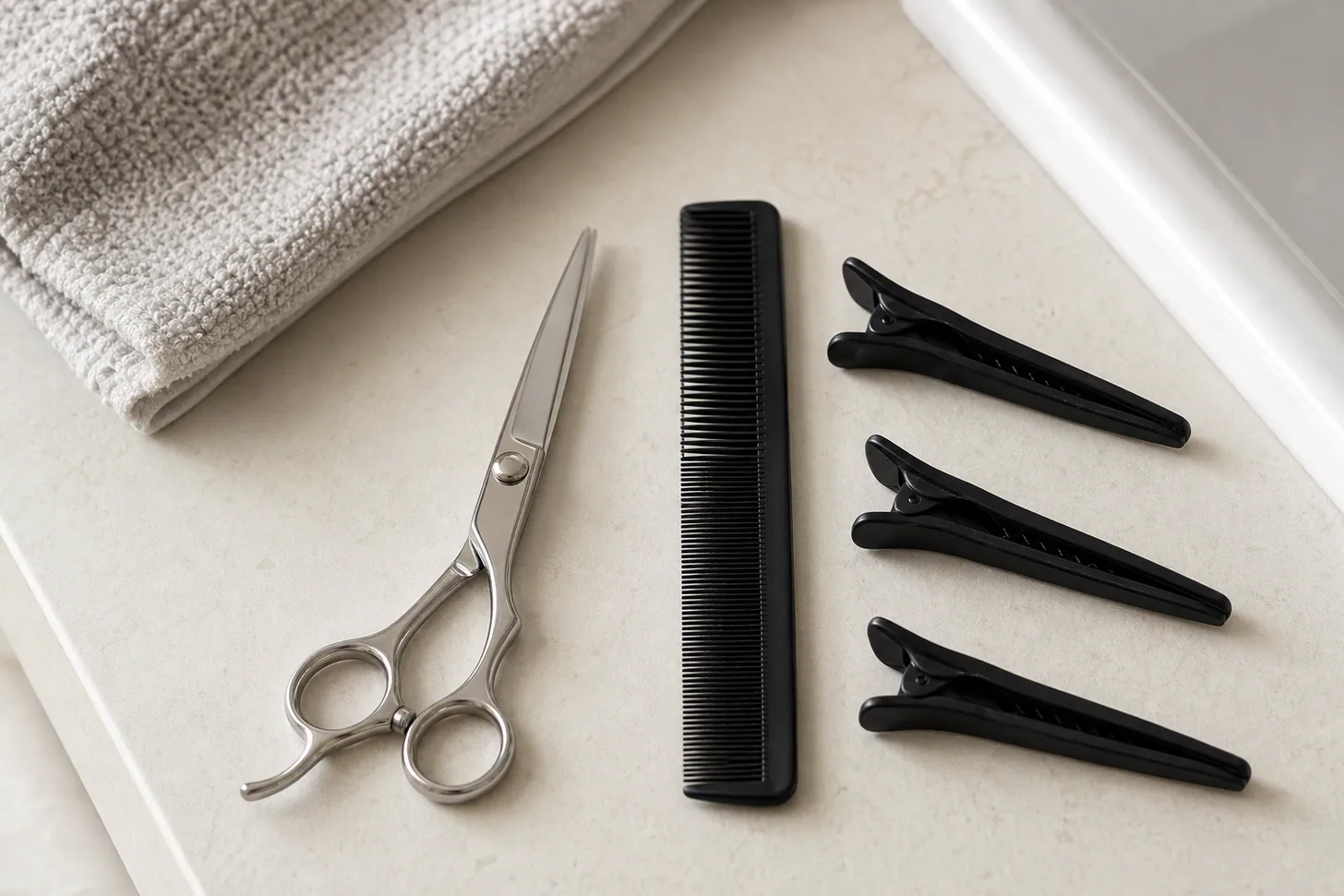
One-inch sections, clipped, working from underneath upward.Starting in the lowest layers means anything you regret is covered by the hair above it.
Bottom third only, one closure, at forty-five degrees.
Comb out and look at the pile in your hand before the next section.
Do half of what you planned, then stop for a fortnight.The result genuinely isn't visible on the day. Waiting two weeks is the only way to judge it, and the appointment you'd need to fix the alternative is one nobody can give you.
The full home-cutting method, including where to make length cuts and how to section, is in cutting fine hair at home.
The sentences that stop it happening in the chair
Almost nobody reaches for blenders out of carelessness. They're the automatic finishing move on a busy day — the thing that happens at the end of every cut without a decision being made about it. Which is precisely why a spoken sentence works so well: it converts a habit into a choice someone has to defend.
Say it at the consultation, before the cape goes on, and give a reason rather than an instruction. A reason can't be filed as a preference and forgotten.
Instead of
Say
Why it lands
"No thinning please"
"My hair's fine and low density, and it's been over-thinned before — it took a year. Please point-cut the ends instead of using thinning shears anywhere."
Names the technique you do want, gives a reason, and attaches a consequence
"Just take some weight out"
"If it feels heavy, I'd rather change where the weight sits than remove density. Can we move the layers up instead?"
Redirects to a shape decision, which is what "heavy" usually is on fine hair
Saying nothing and hoping
"If you think a blender would help in one specific spot, tell me where and why first."
Leaves room for the four legitimate uses while ruling out the automatic pass
"Is that thinning shears?" mid-cut
"How many teeth are those?"
The one question that gets a real answer, because the number is either high or it isn't
If the last one feels confrontational, it reads far less so out loud than it does on the page — it lands as an interested question, and it's the only one in the list that can't be answered vaguely. What to ask your stylist has the rest of the consultation script, and what to do about a bad haircut covers the conversation afterward if it happens anyway.
When thinning shears are the wrong answer entirely
Your hair feels heavy but looks flat.That's a weight-distribution problem, not a density one, and removing strands makes it worse. The fix is where the layers sit — layers on fine hair and why hair goes flat.
The problem is puffiness or frizz rather than bulk.Thinning increases frizz on fine hair, because it multiplies the number of short ends trying to escape the surface. Frizz on fine hair has the actual mechanism.
You have fine strands but a lot of them.This is the one case where the density is genuinely there and blending can be justified — but it's still a shape conversation first. Fine hair but a lot of it explains the type, and fine vs thin vs thick hair sorts out which you actually have before anyone picks up a tool.
Your ends already look see-through.Removing more strands from a section that's already transparent has no upside at any tooth count. That hair needs a blunt line cut above the transparency — see over-thinned fine hair.
You're thinning to make a style hold better.It won't. Hold is a grip-and-product problem, and short cut ends make it worse rather than better — why fine hair won't hold a style.
You're actually shedding.If the density change is recent and you didn't ask anyone to remove anything, this isn't a cutting question at all. Fine hair or thinning? sorts it, and thinning on top covers the pattern.
FAQ
Yes — they are two names for one tool, and no manufacturer distinguishes between them. "Shears" is the professional word, used in salons, supply catalogues and on sharpening invoices; "scissors" is what most people say. Some sellers imply that shears are the larger or more professional version, but that is marketing rather than a real category. The distinction that genuinely matters is a different one, and it is printed on the pair rather than in the name: tooth count. A blender with thirty-eight or more teeth removes roughly 5 to 15 percent of a section per closure; a chunking shear with fourteen to twenty teeth removes 40 to 70 percent. Those two tools are called the same thing and do wildly different amounts of damage to fine hair. Count the teeth before you buy, and before you let anyone use a pair on you.
Four things do almost all the work. Use a high tooth count — thirty or more, which removes about 15–25% of the strands per closure rather than the 40–70% a chunking shear takes. Work on dry, styled hair, because wet fine hair clumps and reads far denser than it is. Place the blades in the bottom third of the section, never above the mid-shaft and never near the scalp, so the cut strands are short enough to hide rather than long enough to stand up through the surface. And close the blades once per section, then comb the cut hair out and look at it before deciding whether that section needs more. The mistake is almost never one bad closure — it's six closures in the same place because nothing appeared to be happening, which is exactly what thinning is supposed to look like on the day.
For general bulk removal, no — fine hair doesn't have bulk to remove, and taking a percentage of the strands out of a section that was already sparse is how you end up with see-through ends. But there are four narrow jobs where a high-tooth blender is genuinely the right tool even on fine hair: softening the hard corner where a blunt perimeter meets a face-framing piece, removing the small weight pocket behind the ears that makes hair kick outward, breaking up the shelf where a graduated bob stacks, and taking a fraction of the density out of a fringe too heavy to sit. All four are small, specific and finish-work. None is a pass over the whole head.
Thirty at the absolute minimum, and 38–46 if you're buying a pair to use on yourself. Tooth count is close to the whole decision, because it determines what percentage of the section is cut in a single closure. A fine blender at 38–46 teeth takes roughly 5–15%. A standard thinning shear at 28–35 takes about 15–25%. A texturizing shear at 12–16 wide notches takes 40–60%, and a chunking shear at 5–10 teeth takes 50–70%. Those last two are built for dense, coarse hair and are the source of most over-thinning stories. If a pair is sold without a stated tooth count, count the teeth before you buy it.
More carefully than on long hair, because the margin for hiding a mistake is much smaller. On long hair a strand cut in the bottom third has several inches above it to disappear under. On a pixie or short bob the whole strand may be three inches, so there's no bottom third to speak of and a closure anywhere leaves a cut end near the surface. The rules: fine blenders only, 38 teeth or more; work exclusively in the interior where the top layers cover what you do; stay away from the perimeter, the nape and the fringe line entirely; and hold the shears vertically along the section rather than across it, so the cut ends stagger instead of landing at one height. Most short fine-hair cuts need no thinning shears at all — point cutting into the ends gives the same softness without removing density.
Tooth count, and therefore how much hair disappears. Thinning shears have many fine, closely spaced teeth — usually 28–40 — and remove a modest percentage of the strands to reduce weight invisibly. Texturizing shears have far fewer and much wider notches, typically 12–16, and remove 40–60% in visible chunks to create movement you can see. Chunking shears go further, with 5–10 teeth removing up to 70%. The trouble is that the names get used interchangeably at the till and in the salon, so asking for thinning and receiving texturizing is entirely possible. Tooth count is the only reliable label.
In the bottom third of the section, at least three inches down from the scalp on long hair, and never above the mid-shaft on anything shorter. The reason is grow-out rather than the cut itself. A strand cut two inches from the scalp is now a two-inch hair, and in a few months it's a four-inch hair standing straight up through your part — the halo of short pieces people describe after a bad thinning. A strand cut in the last two inches of a long section stays hidden underneath. The other placement rule: thinning shears don't belong within several inches of a part line or a hairline in any circumstances, because there's nothing above those areas to cover the regrowth.
No. Nothing done with scissors changes a follicle, and the follicle determines how thick a strand grows. What actually happens is that a blunt-cut end feels wider between the fingers than a tapered one, which is where the impression comes from. Thinning does the opposite of what the myth claims in practical terms: it removes strands from the section for the life of this haircut, and the cut strands take months to return to a length where they contribute to how full the hair looks. If your hair has genuinely stopped reaching the length it used to, that's a change in the growth cycle rather than anything a haircut caused — why fine hair won't grow long covers it.
Say it at the consultation rather than when the shears are already in the section, and give a reason rather than an instruction — a reason can't be misheard as a preference. Something like: my hair's fine and low density, it's been over-thinned before and took a year to grow out, so please point-cut the ends instead of using thinning shears anywhere. If you want to leave room for the legitimate uses, add: if you think a blender would help in one specific place, tell me where and why first. That phrasing works because it doesn't accuse anyone of anything, it names the technique you do want by its correct name, and it turns an automatic finishing habit into a decision someone has to say out loud.
Images in this article are AI-generated illustrations, not photographs of real clients or results. See our image policy.
Results vary with hair type, density, and growth patterns. This guide is educational and not a substitute for an in-person consultation with a licensed stylist.
Get the good hair intel
One honest, stylist-written guide in your inbox each week. No hype.

 SB
SB