Reviewed by Tara Sullivan · Updated August 2026 · 9 min read
You can absolutely have fine hair and a lot of it — fine describes the width of one strand, dense describes how many strands you have, and the two are measured separately. High-density fine hair is the combination almost nobody writes for: a ponytail that fills your fist, a blow-dry that takes half an hour, and roots that are flat again by two in the afternoon.
This guide shows you how to confirm that's what you have, why the standard fine-hair playbook (use less product, skip layers, keep it long) actively works against you, and the six things to do differently.
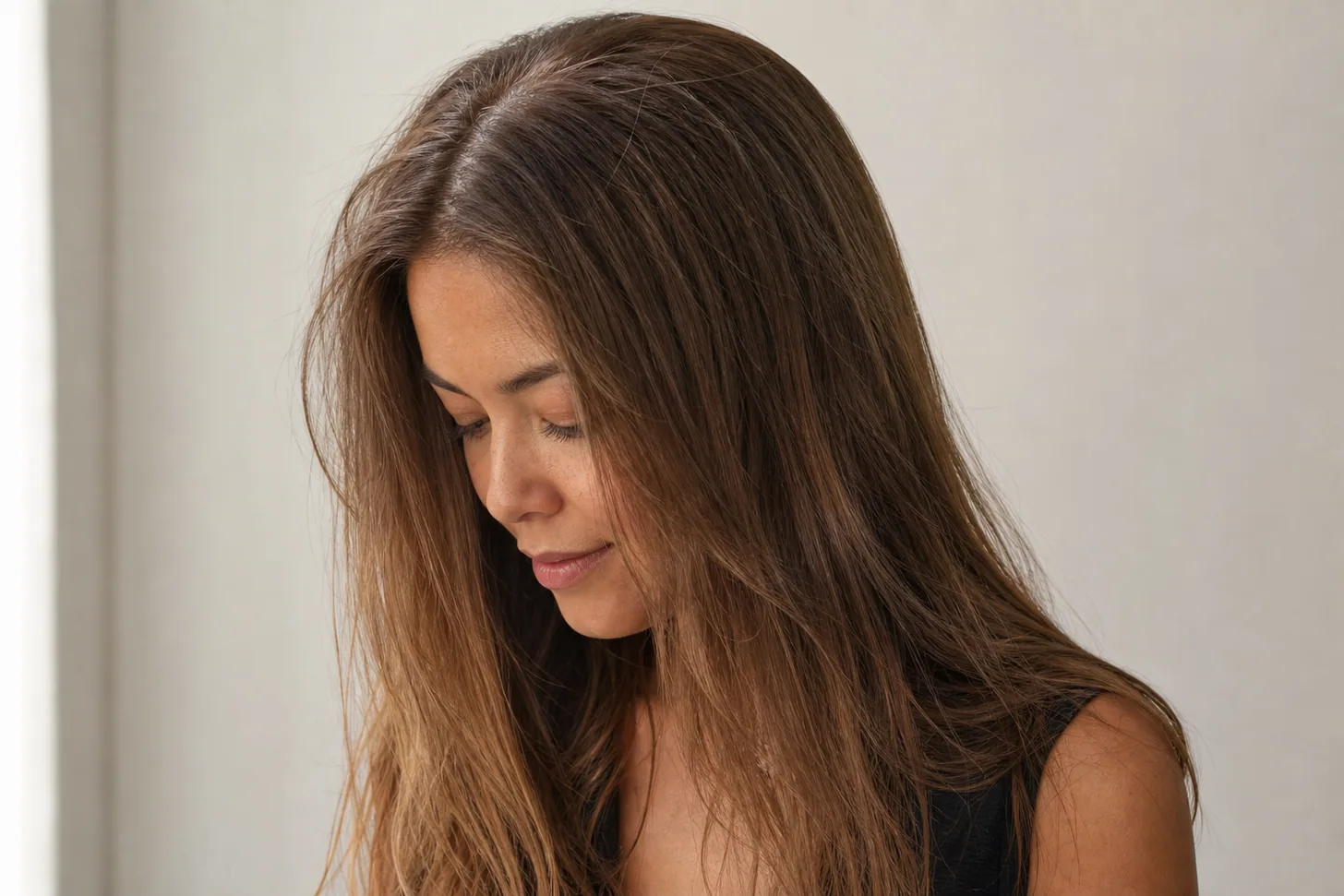
High density, fine strands: full through the lengths, flat at the root.
Chair-side note
This is the client who apologises when she sits down. She says "I know I don't have thin hair, but —" and then describes every fine-hair symptom there is. She's been told for years that her hair is thick, so she's bought products for thick hair, which are built to weigh hair down and calm it, and they have made everything worse.
The moment I explain that she has a great deal of very fine hair, the whole thing clicks. Nothing about her hair was mysterious. She'd just been sorted into the wrong bucket at the shampoo aisle for twenty years.
MH
— Megan Holloway, Editor-in-Chief
Diameter and density are two different measurements
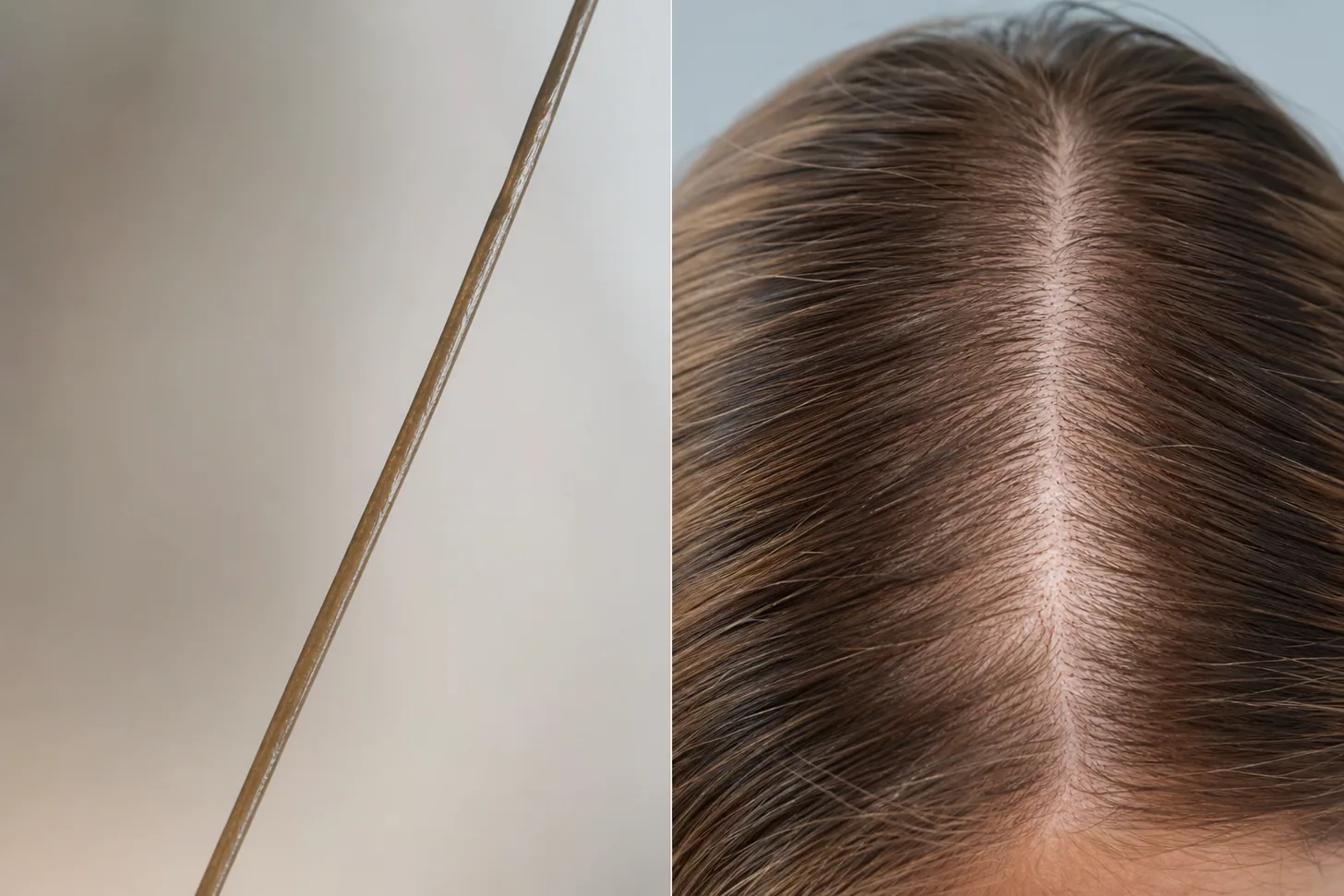
Every conversation about hair "thickness" collapses two separate things into one word, and that's the whole problem. Diameter is how wide a single strand is, measured in micrometres. Density is how many strands grow per square centimetre of scalp. They vary independently — clinicians measuring hair under trichoscopy record them as two distinct variables precisely because one tells you nothing about the other (International Journal of Trichology).
So there are four possible combinations, not two. Fine strands at low density is what most people mean when they say "thin hair." Fine strands at high density is the one that has no name in ordinary conversation, which is why the women who have it spend years being told their hair is thick — by stylists, by their mothers, and by every product label they read.
We cover the base distinction, the whole fine-medium-thick vocabulary and a five-way matrix of the combinations in fine vs thin vs thick hair; this page is about what to do once you know you are in this particular corner.
Combination
What it looks like
The mistake it leads to
Fine + low density
Small ponytail, scalp visible at the part, hair feels weightless
Over-styling to fake fullness; the classic "thin hair" advice fits
Fine + high density
Full ponytail, no scalp showing, but flat roots and a style that drops within hours
Buying products for thick hair, which are formulated to weigh hair down
Coarse + low density
Wiry, springy hair that feels substantial but doesn't cover — see thin but coarse hair
Cutting weight out, which makes coverage worse
Coarse + high density
Genuinely thick hair — heavy, slow to dry, holds a shape
None of the fine-hair rules on this site apply
Three checks that tell you which you have
Do these in daylight, on clean dry hair, before you buy anything else.
The strand test measures diameter
Pull one shed hair from your brush and roll it slowly between your thumb and index finger. If you can barely feel that anything is there, your strands are fine. If it registers as a distinct thread, you're medium or coarse. Do it three or four times with different hairs — the hairs at your temples are naturally finer than the ones at your nape, so one sample isn't a reading.
The ponytail and the part measure density
Gather everything into a ponytail and close your fist around it. Roughly the width of a US quarter or less is low density; noticeably wider than that, where your fingers don't comfortably meet, is high. Then part your hair in the middle in bright light and look at the strip of scalp. A clean thin line is normal density; a widening channel is not, and that's a different conversation — see fine hair or thinning.
Drying time is the tiebreaker
If your strands read as fine but your hair takes over twenty minutes to blow-dry properly, you have density. Drying time tracks total hair mass, not strand width, so this is a surprisingly reliable cross-check. Fine, sparse hair air-dries in an hour; fine, dense hair can still be damp underneath at bedtime.
Why the standard fine-hair playbook backfires here
Almost every piece of fine-hair advice in circulation quietly assumes low density as well. Four of those rules invert when you have a lot of hair.
High-Density Fine Hair Needs More Product, Not Less
The universal fine-hair instruction is to use less of everything, and it comes from the right place — heavy products flatten fine strands. But dose is a function of how much surface you're coating, and you have a great deal of it. A pea of mousse spread across a sparse head is a reasonable dose; spread across yours it coats the top layer and nothing underneath, so the middle of your hair goes unstyled and the top goes over-treated.
Increase the amount and keep the weight low: a light foam or spray, applied in two or three passes through clipped sections rather than one handful raked over the surface. The rule is lighter, more often — not less. Our honest kit for fine hair works from the same weight budget.
Your Hair Has Enough Bulk to Justify Removing Weight
Low-density fine hair usually needs every strand it has, which is why this site is generally wary of layering. High-density fine hair is the exception. Left blunt and all one length, a heavy head of fine hair collects weight at the perimeter and builds a triangle — wide and solid at the bottom, collapsed at the top.
Internal point-cut layers pull that interior bulk out without touching the outline, so the sides sit closer and the crown has room to lift. Whether layers help or hurt fine hair depends almost entirely on this: how much hair there is to redistribute.
What still doesn't work is a razor, or thinning shears anywhere near your ends. A fine strand frays where it's cut on a diagonal, and a fine hair cut short in the middle of the length springs away from the rest — so instead of less bulk you get a halo of flyaways sitting on top of the same bulk.
Weight removal on fine hair is done with point-cutting and slide-cutting on the interior sections, kept well away from the perimeter line.
Root Lift Is Still Your Problem, Density or Not
Volume at the root is a question of stiffness, not quantity. A fine strand has very little bending resistance, so a mass of fine hair sitting on top of your head folds down against the scalp under its own weight no matter how many strands are in it — arguably faster, because there's more weight pressing down.
This is why you can have visibly full hair and still recognise every symptom in why fine hair keeps falling flat. The remedies are the same ones: support at the root while the hair is damp, and letting it cool completely in the shape you want, which is the mechanism behind heatless volume methods.
The Frizz Halo Is Usually Density, Not Damage
Fine, dense hair often has a fuzzy layer standing up around the crown and hairline, and it gets diagnosed as damage and treated with heavy oils and protein masks that flatten everything else. Frequently it isn't damage at all: with a lot of follicles you simply have a lot of hairs at the short end of their growth cycle at any given moment, and a short fine hair has nothing to weigh it down.
The honest fix is a smoothing pass with a light cream on the surface only — not a treatment programme. If it's genuinely rough and the hair also feels dry, how to tame frizz on fine hair separates the two causes.
Decision
Fine + low density
Fine + high density (you)
Product dose
Minimal — a pea, at the roots only
Two to three times that, applied in sections
Product weight
Light
Light — this does not change
Layering
Minimal; keep the perimeter strong
Internal point-cut layers, freely
Best lengths
Chin to collarbone; length thins the ends
Anything, including long — you have the density to carry it
Blow-drying
10 minutes, all at once
Section it, or the middle stays damp
Conditioner
Mid-lengths and ends, sparingly
Mid-lengths and ends, generously; skip the top layer
Main daily complaint
Not enough hair to work with
Flat roots and bulk in the wrong place
The cuts that suit a lot of fine hair
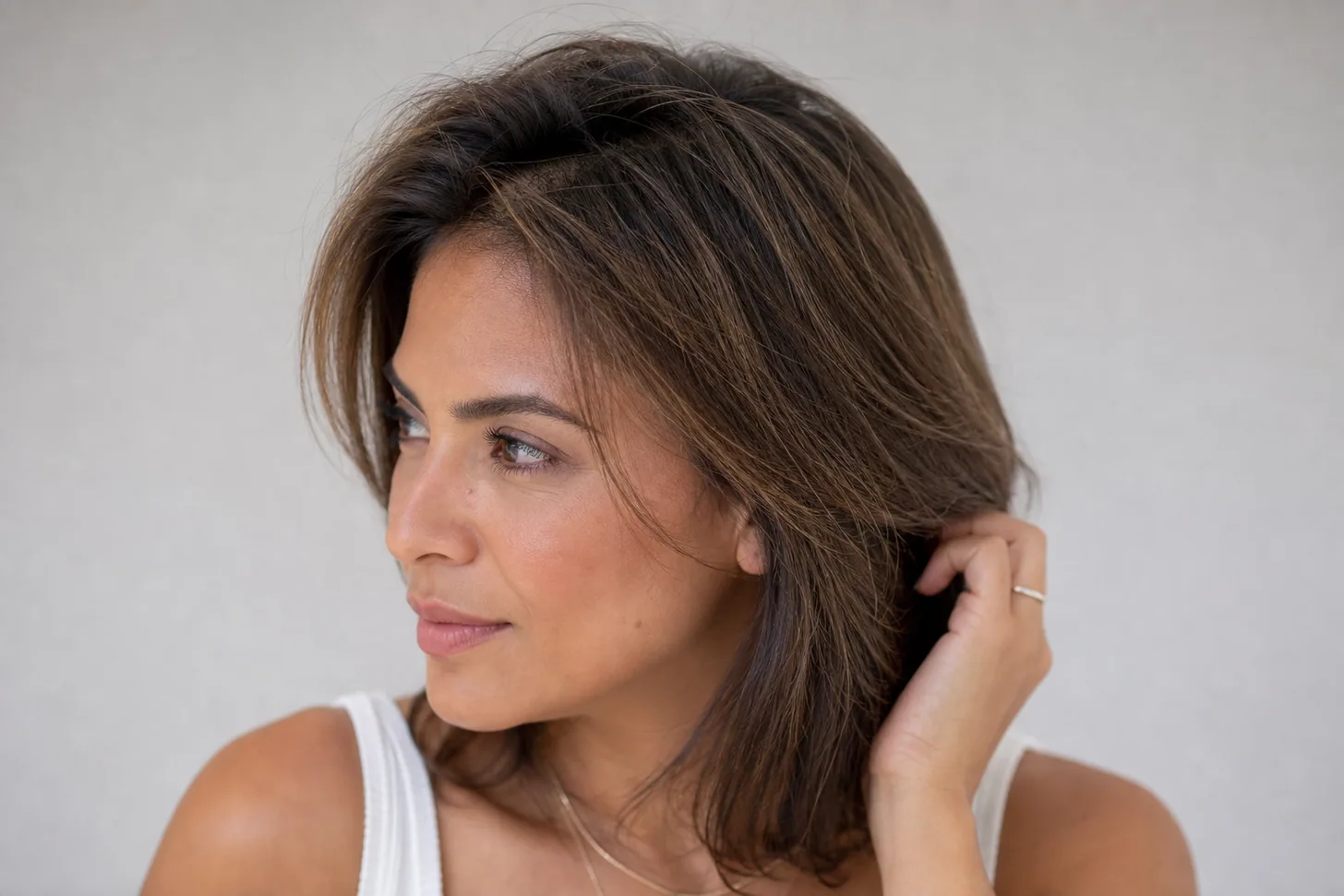
You have more range than the fine-hair rules suggest, and the goal is different: you're moving weight upward rather than manufacturing fullness. Long layers through the interior, a defined perimeter, and no bulk at the widest point of your head.
Shoulder-length shapes are the most forgiving — see medium-length cuts for fine hair — and length is genuinely available to you in a way it isn't for sparse fine hair, provided the interior is thinned properly rather than the ends. The full range sits in the haircuts for fine and thin hair hub.
What to avoid is any shape whose fullness lives at the bottom: a heavy blunt one-length cut at the collarbone, or the wide bottom-heavy bob. Both put your bulk exactly where it reads as a triangle.
This is also the reason you can wear cuts the rest of the fine-hair internet warns against. Shags, wolf cuts and genuinely layered lobs need enough hair behind them to still read as a mass, and you have it — volumizing haircuts for fine and thin hair sets those out as a separate track from the ones written for low density, so you can stop discounting advice that was never aimed at you.
What to ask your stylist
The single most useful sentence you can say is: "My strands are fine but I have a lot of them — can you take weight out of the interior without touching the perimeter line or my ends?" That tells a stylist your diameter, your density, and where the weight-removal is permitted, in one go.
Two follow-ups worth having ready. "Please point-cut or slide-cut the interior rather than using thinning shears" — because thinning shears on fine hair produce flyaways, not softness. And "Keep the perimeter blunt" — a strong outline is what stops a heavy fine head from looking wispy at the bottom. There's a fuller script in the exact words to ask for a fuller-looking haircut.
When this isn't what you have
The part in your hair is visibly widening, or you can see scalp at the crown. That's a density change, not a density type — start with coverage for thinning on top and see a dermatologist if it's progressing.
Your hair feels heavy and looks dull but the ponytail is small. That's usually coating and buildup rather than density — a clarifying wash will tell you within one wash.
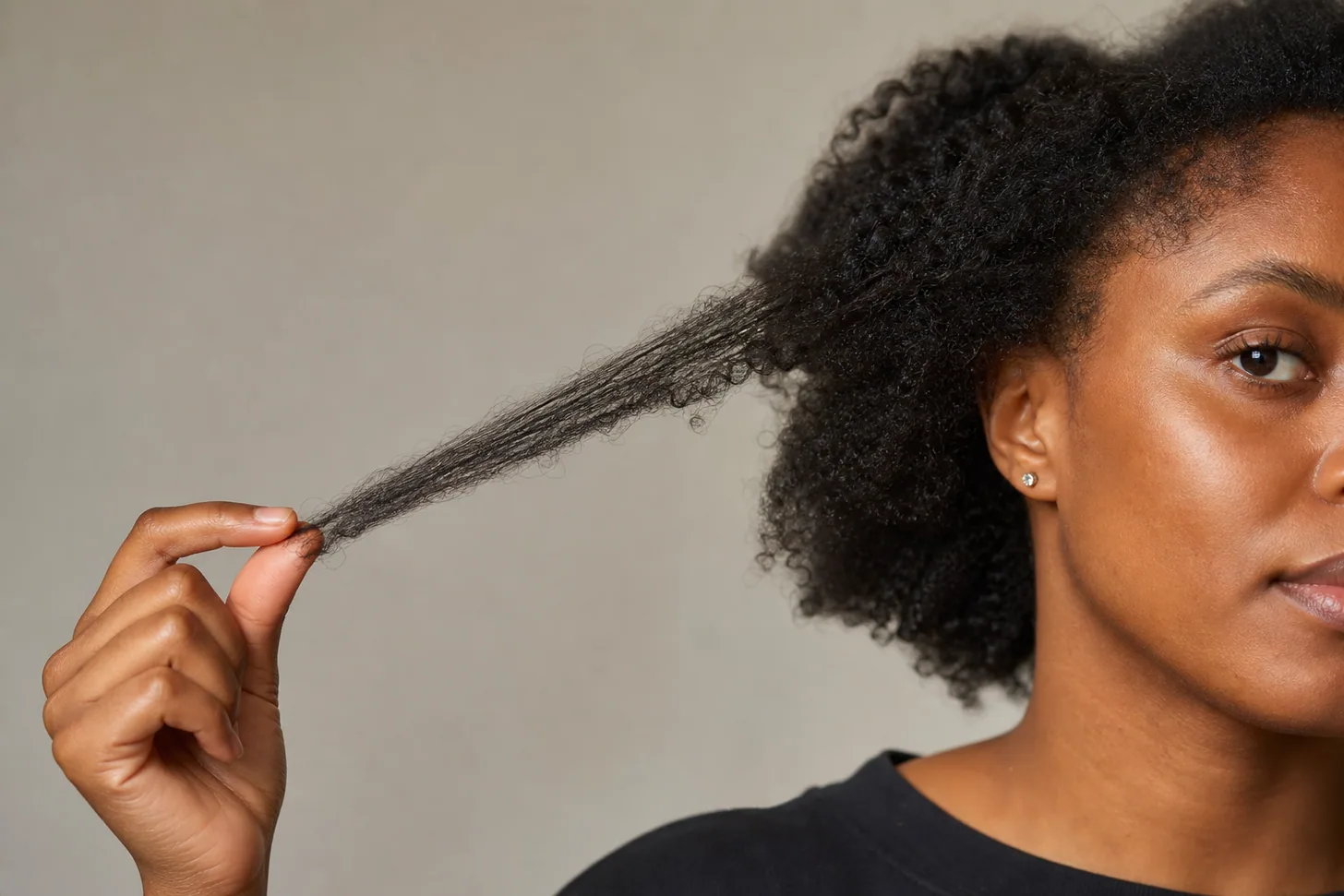
Your strands read as thread-like between your fingers. You have genuinely thick hair, and very little on this site is written for you. The layering advice above still applies; the weight-budget advice does not.
Your hair looks dramatically thinner wet than dry. That's normal for everyone and doesn't diagnose anything — why hair looks so thin when it's wet explains what the wet view does and doesn't tell you.
Yes, and it's common. Fine describes the diameter of one strand; thick or dense describes how many strands are growing on your head. They're separate measurements, and trichologists assess them separately. Fine strands at high density produce hair that fills a ponytail, takes forever to dry, and still goes flat by lunchtime — which is confusing precisely because it doesn't match either stereotype.
Roll a single clean strand between your finger and thumb. If you can barely feel it, it's fine; if it feels like a thread, it's medium or coarse. That's diameter. For density, look at how much scalp shows along your part in bright light, and how thick your ponytail feels in your fist. Diameter tells you how each strand behaves; density tells you how much hair you have to work with. You need both answers to shop correctly.
Because volume at the root is a function of strand stiffness, not strand count. A fine strand has very little bending resistance, so no matter how many of them you have, the mass at the top of your head simply folds down against the scalp under its own weight. High density gives you the fullness through the mid-lengths and ends; it does nothing for root lift. That's why the fix is the same as for any fine hair — root-level support and cooling in shape — even though your hair looks nothing like the stereotype.
Usually yes, and more than low-density fine hair can take. When you have a lot of fine hair, a blunt one-length cut collects weight at the perimeter and creates a triangle that widens at the bottom and flattens at the top. Internal point-cut layers remove that interior bulk without touching the perimeter line, so the shape sits closer at the sides and lifts at the crown. What still doesn't work is a razor or thinning shears near the ends — fine hair frays at a cut edge and the result is a frizz halo, not softness.
More product, but not heavier product. Dose scales with how much surface area you're coating, and you have a great deal of it — a pea of mousse that suits a sparse fine head won't reach past the top layer of yours. Increase the amount and keep the weight low: light foams, sprays, and water-based formulas, applied in two or three passes through sectioned hair rather than one large handful raked over the top.
Because there's a lot of surface area holding water, even though each strand is small. Drying time tracks total hair mass, not strand thickness, so high-density fine hair can take longer to dry than a coarse but sparse head. The practical fix is sectioning: dry the under-layers first, in clips, rather than blowing air at a solid curtain of hair for twenty minutes and cooking the top layer while the middle stays damp.
Yes. A fine strand bends far more easily than a coarse one, so it loops around its neighbours instead of sliding past them — and the more neighbours there are, the more often that happens. Detangling before you wash, working from the ends upward, and containing the hair at night are more effective than adding conditioner, which mostly adds weight. The full method is in how to keep fine hair from tangling.
Rarely, and almost never near the ends. Thinning shears remove strands at random points along the length, and on fine hair the cut ends spring away from the rest and read as frizz and flyaway rather than as reduced bulk. If genuine weight removal is needed, ask for it done with point-cutting or slide-cutting on the interior sections only, well away from the perimeter and at least four inches from the ends.
Fourteen years across the chair and the page, specialising in fine-hair care. Megan spends a good part of every consultation correcting the diameter-versus-density confusion, because almost nobody buys the right products until they've had it explained.
Results vary with hair type, density, and growth patterns. This guide is educational and not a substitute for an in-person consultation with a licensed stylist.
Hairstyle images in this guide are AI-generated illustrations, not photos of real clients or results. See our image policy.
Get the good hair intel
One honest, stylist-written guide in your inbox each week. No hype.

 MH
MH