Reviewed by Tara Sullivan · Updated July 2026 · 8 min read
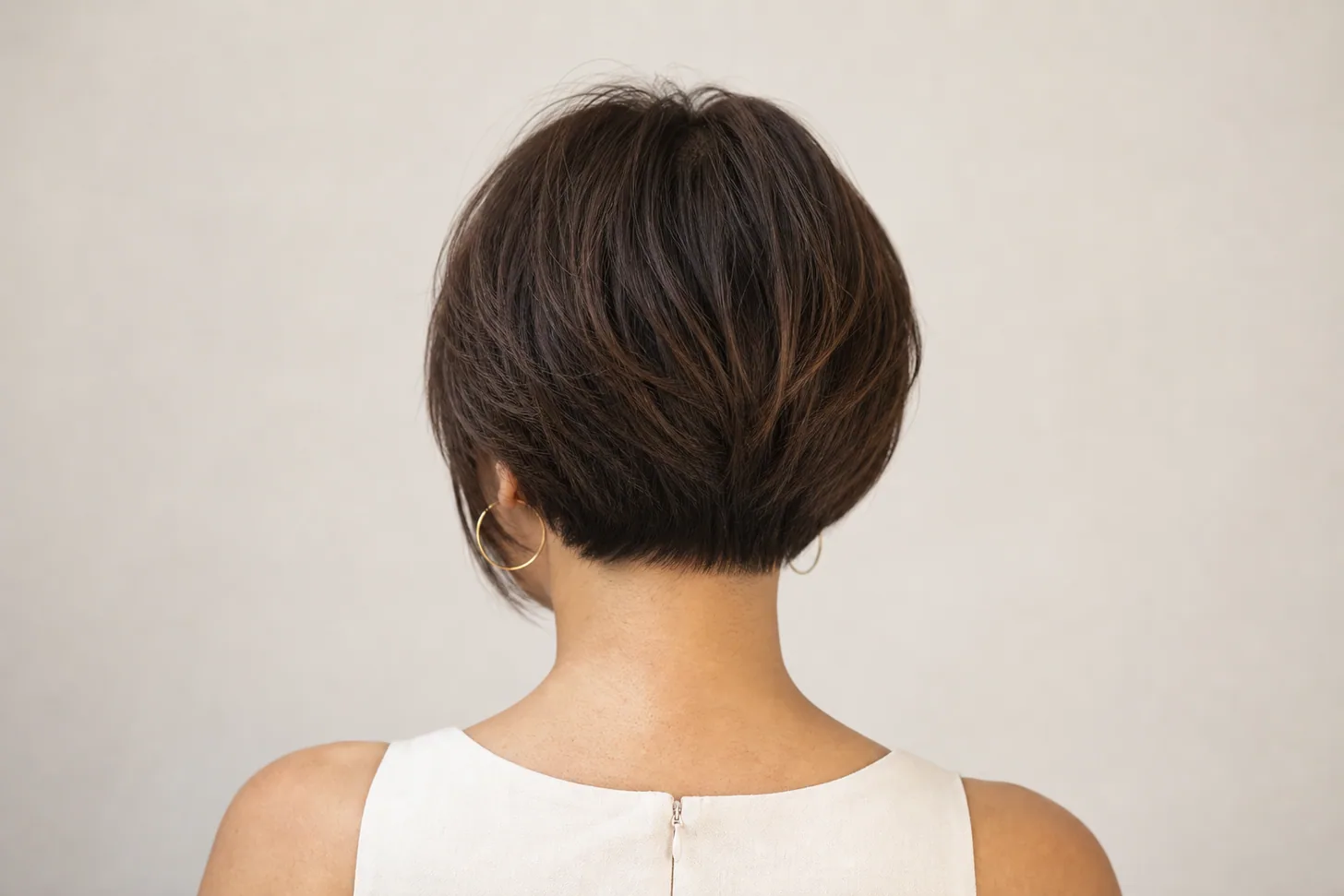
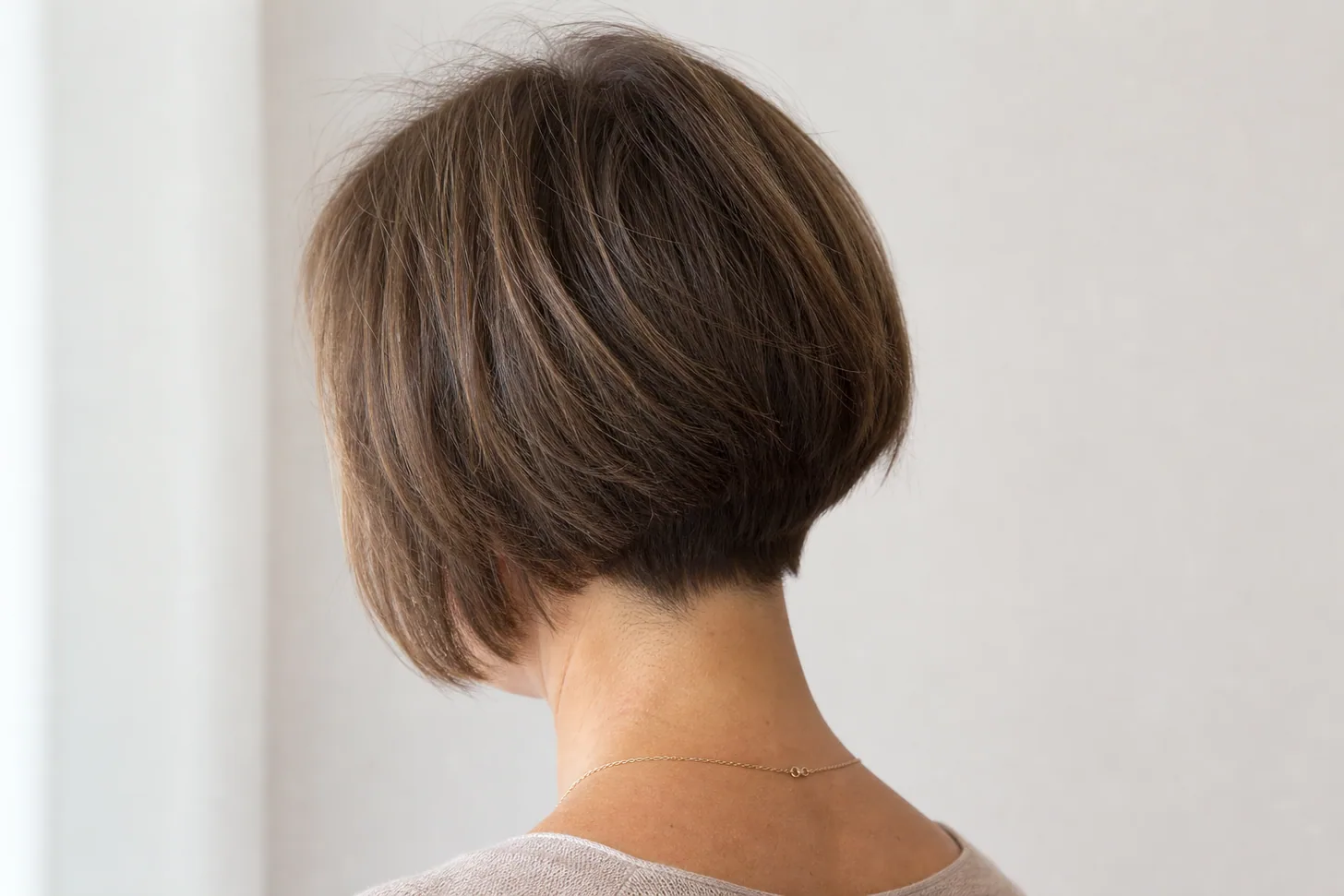
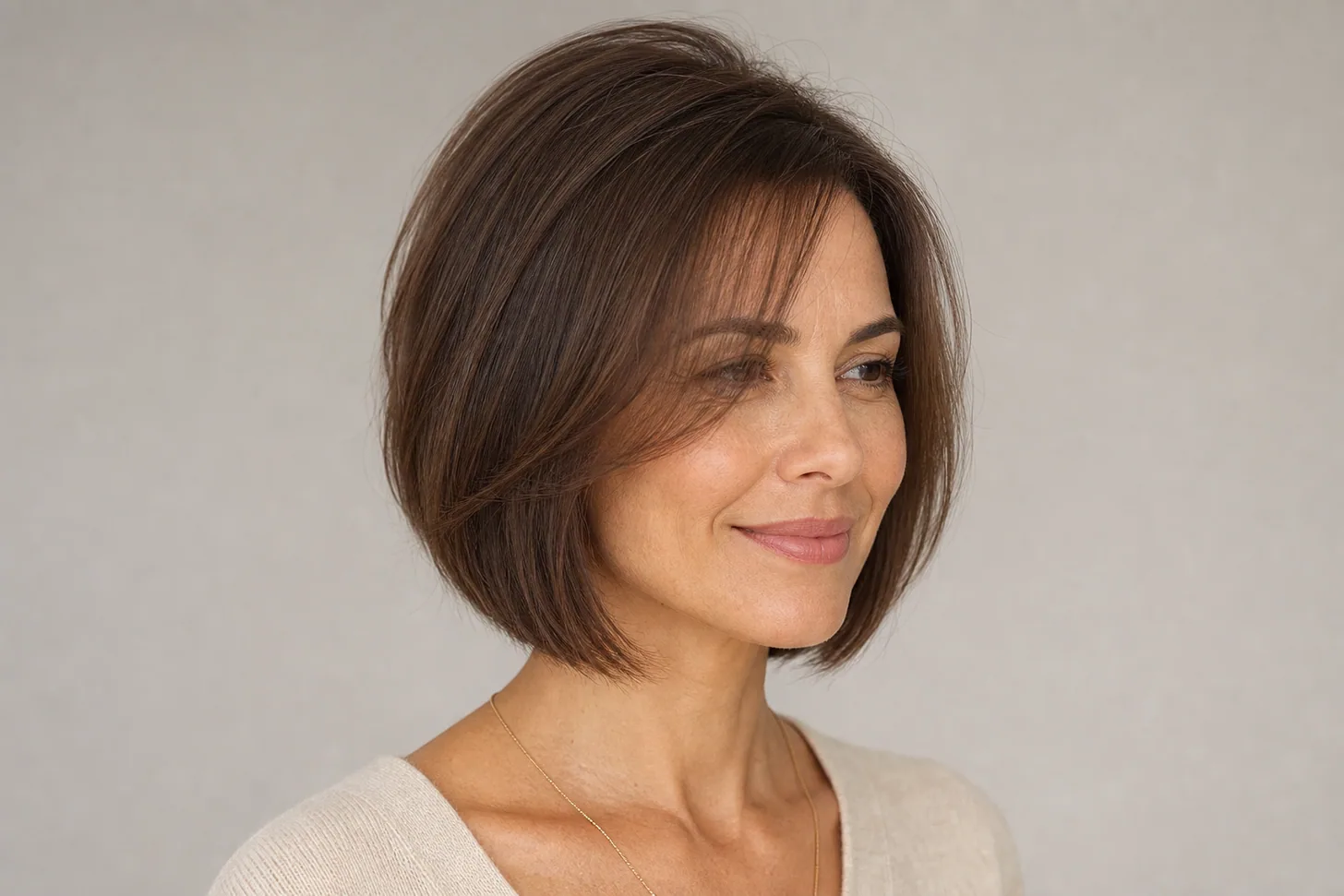
A stacked bob is a bob with short, graduated layers stacked up the back of the head, and it's one of the best bob shapes for fine hair because it builds height and roundness exactly where fine hair falls flattest — the back and lower crown. The volume is cut into the shape, so it holds with far less product than a one-length bob.
The catch is construction: on fine hair the stack must be point-cut, not razored, over a fairly clean perimeter so the ends stay dense. Below are 14 salon-tested stacked bobs for fine hair, from tight and dramatic to soft and grown-in, each with who it suits and the exact words to bring your stylist.
Chair-side note
When a fine-haired client says "my hair goes flat at the back," the stacked bob is the first cut I reach for. The stack — short layers graduated tightly up the back — physically props the hair up off the neck, so you get a rounded shape instead of a limp curtain.
My fine-hair rules: point-cut the graduation so it lifts without thinning, keep the perimeter weight line fairly clean so the ends read dense, and set the height at the occiput, not higher. A stack that sits too high can look boxy on fine hair; a little lower reads modern and full. And always agree on the back view together — that's the part you'll never see and the part that makes the cut.
SB
— Simone Baptiste, Senior Stylist
Why a stacked bob works for fine hair
It does a second job that rarely gets named: it builds a curve where a lot of heads do not have one. If your skull runs close to straight down from the crown to the nape, a one-length bob hangs as a flat panel and a stacked one supplies the missing shape — see haircuts for a flat back of the head.
Fine hair's problem is that it has nothing holding it up — it lies against the head and collapses fastest at the back and crown, the areas you can't see and can't easily reach with a brush. A stacked bob solves that structurally: short layers are graduated in a tight stack up the back, so the hair lifts away from the neck and builds a rounded, full silhouette.
Because that volume is cut into the shape rather than styled in each morning, it survives the day where a blowout on a one-length bob would fall. It sits in the same family as the classic bob for fine hair and the layered bob, but where those spread body through the whole cut, the stacked bob concentrates it at the back — and that placement is precisely what fine hair needs.
The only variable to get right is your density: if you're not sure whether you're working with fine strands, low density, or both, the quick read on telling fine from thin hair tells your stylist how tight to build the stack.
Inverted bob vs stacked bob: which one you are actually asking for
The two names get used for the same photo, and they describe different things. An inverted bob is a silhouette: the perimeter is cut on an angle, shorter at the nape and longer toward the face, so the outline slopes forward. A stacked bob is a structure: short graduated layers built up the back so the shape is rounded and full from behind.
Most inverted bobs are stacked at the back, because the angle leaves the nape short and something has to give it shape — but you can have an angled line with almost no stacking, and a stack with a level, straight-across perimeter.
Inverted bob
Stacked bob
What it describes
The outline — the angle from nape to front
The inside — graduated layers up the back
Seen from
The side
The back
What it does for thin hair
Draws the eye forward along the longer front; keeps the ends dense at the face
Builds the back and crown, where thin hair collapses first
Risk on fine hair
A steep angle exposes the nape and can read severe
Over-graduated or razored stacks go wispy
The usual answer
Both: a soft forward angle with a point-cut stack — entries 2, 3 and 5 below
On Thin Hair, Ask for the Inverted Line and a Soft Stack, Not a Tight One
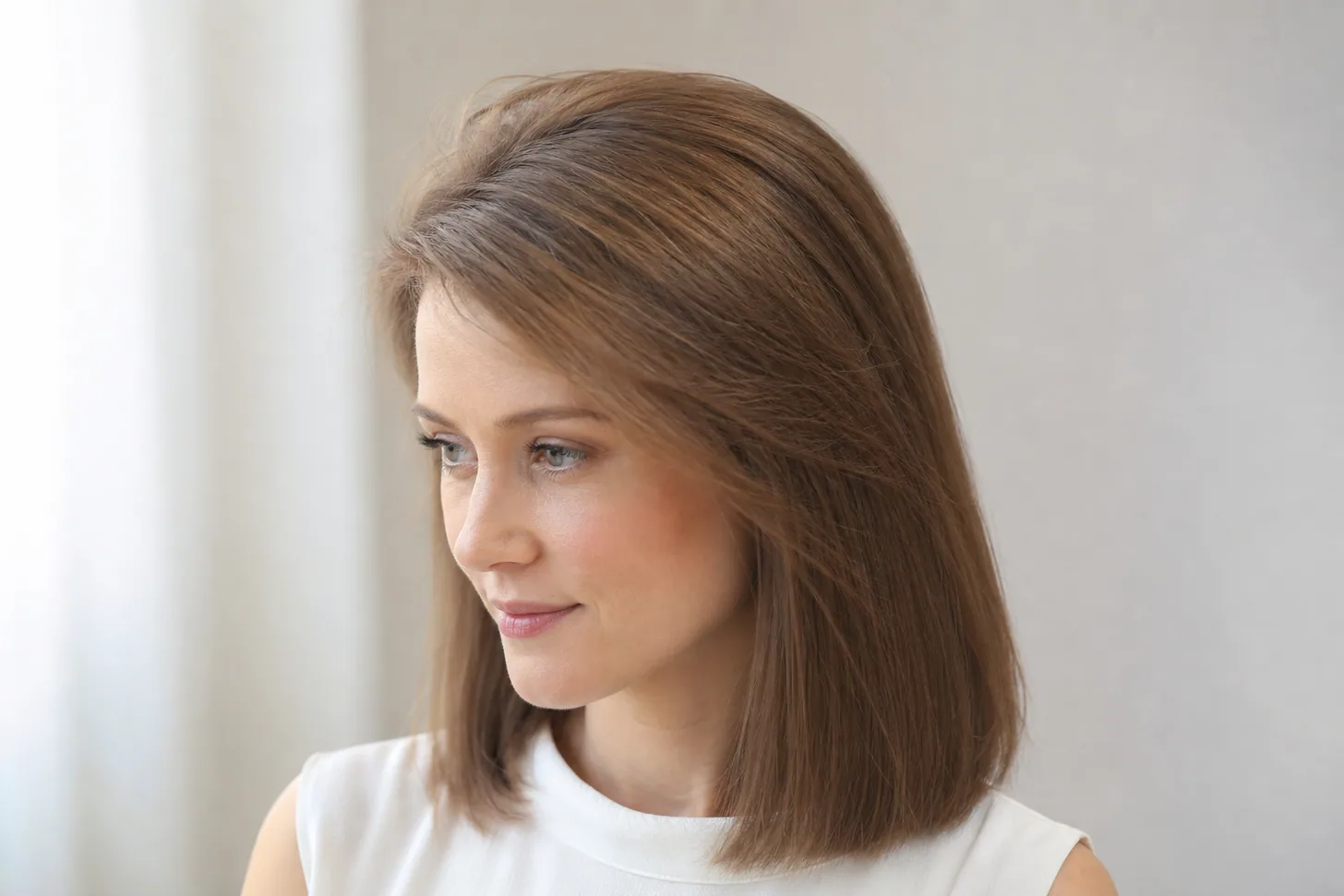
An inverted bob for thin hair works because the angle spends length where it shows — at the jaw and cheekbones — and removes it at the nape, where thin hair hangs limpest. The mistake is letting the stack behind it get too tight.
A steep, heavily graduated stack on low-density hair separates into visible rows and the scalp shows between them. Keep the angle, ask for the graduation to be point-cut and kept moderate, and leave the perimeter a touch heavier than the photo you brought — the words are in what to ask your stylist below.
Classic stacked bobs
Start here for the definitive versions — the graduated stack that defines the cut, adjusted so they read full rather than sparse on fine hair.
classic stacked bob back view with tight graduated layers building crown height on fine hair
1
The classic stacked bob
The template: short layers graduated tightly up the back into a rounded stack, longer at the front. On fine hair the stack does the heavy lifting, building height at the crown that no product can match. Ask for the graduation point-cut and the stack set at the occiput so it reads full, not boxy.
angled stacked bob longer at the front and shorter at the back on fine hair
2
The inverted stacked bob (the angled one)
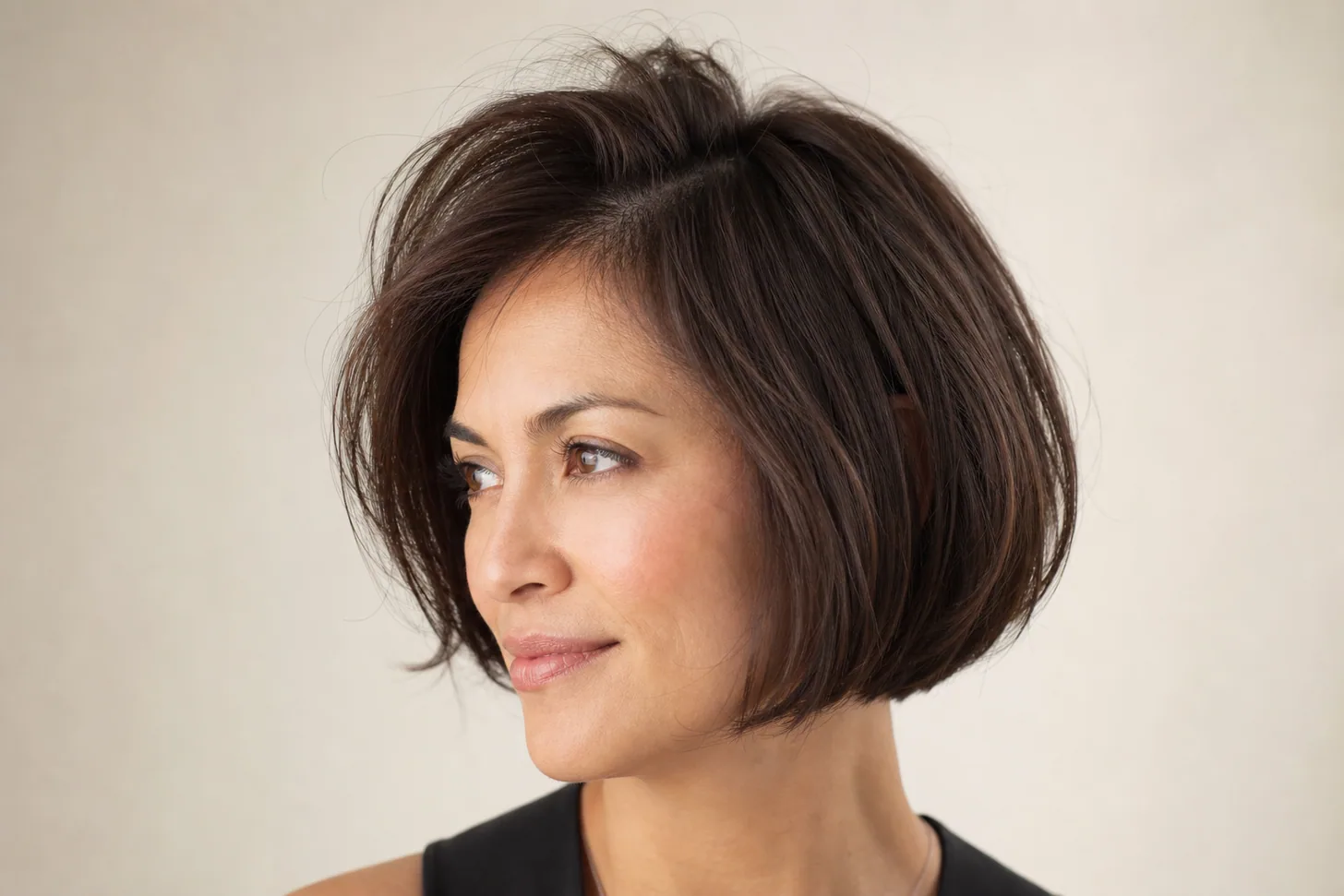
The stack at the back paired with a forward angle, so the front sits longer at the jaw and sweeps down toward the chin. It's the most flattering version for most faces — the length up front frames while the stack builds body behind. A smart pick if you want fullness without going short all over.
A-line stacked bob with a strong forward slope on fine straight hair
3
The A-line stacked bob
A more dramatic slope than the angled version — a shorter, higher stack at the back dropping to a longer point at the front. The steep line is striking on fine straight hair and maximizes back volume. Keep the front length blunt so the whole shape reads dense rather than wispy at the tips.
rounded stacked bob with a soft dome shape at the crown on fine hair
4
The rounded stacked bob
The stack graduated into a soft dome rather than a sharp line, so the back looks curved and full. It's the gentlest classic version and the one I steer softer, more traditional clients toward. The rounded shape flatters fine hair by adding width and height at the crown where density drops off.
Stacked bobs by length
Shorter than everything here, and steeper, sits the wedge — the same stacking idea taken to a close nape and a five-to-seven-week trim cycle.
The stack works from a short, sharp nape up to a longer stacked lob. Here's the shape at each length, and which suits fine hair best.
short stacked bob with a tapered nape and high crown stack on fine hair
5
The short stacked bob
Cut close at the nape with a high, tight stack — the fullest-looking version, because there's the least length to weigh the volume down. It edges toward a pixie at the back and is brilliant on very fine hair where lift is the whole battle. Ask for a clean, tapered nape and the stack set for maximum height.
chin-length stacked bob with graduation at the back on fine straight hair
6
The chin-length stacked bob
The most wearable version — a stack at the back with the front falling to the chin. It's the sweet spot for fine hair: short enough to hold the stacked shape, long enough to frame the face and tuck behind an ear. If you want one stacked bob that works for the office and the weekend, this is it.
stacked lob at collarbone length with soft graduation on fine hair
7
The stacked lob
The stack applied to a longer, collarbone-length lob — softer graduation at the back that builds gentle body without the commitment of going short. It's the version for anyone keeping length who still wants the back to look full. Keep the graduation subtle so the lob doesn't lose its weight at the ends.
stacked bob with a deep side part and swept fringe on fine hair
8
The deep-side-part stacked bob
The stack at the back with a deep side part up top, which lifts the roots on the heavy side and adds instant crown volume. The asymmetry flatters round and square faces and pairs naturally with the stacked shape. A five-second styling trick built into the cut — just part it deep and the height follows.
Stacked bobs with bangs & texture
The stack pairs well with a fringe and with a little texture through the top. These three suit fine hair specifically.
stacked bob with soft curtain bangs framing the face on fine hair
9
The stacked bob with curtain bangs
Soft curtain bangs at the front balance the height of the stack at the back, so the whole shape feels intentional and framed. The bangs add fullness at the hairline while the stack builds it behind. Ask for the fringe point-cut and blended into the front length so it reads airy, not heavy.
stacked bob with wispy see-through bangs on fine hair
10
The stacked bob with wispy bangs
A lighter, see-through fringe for a softer, more youthful front. Because wispy bangs need almost no density to work, they're ideal on fine hair and never expose a thin hairline. Paired with the stack, they keep the whole cut feeling light up front and full behind.
textured piece-y stacked bob with separated ends on fine hair
11
The textured stacked bob
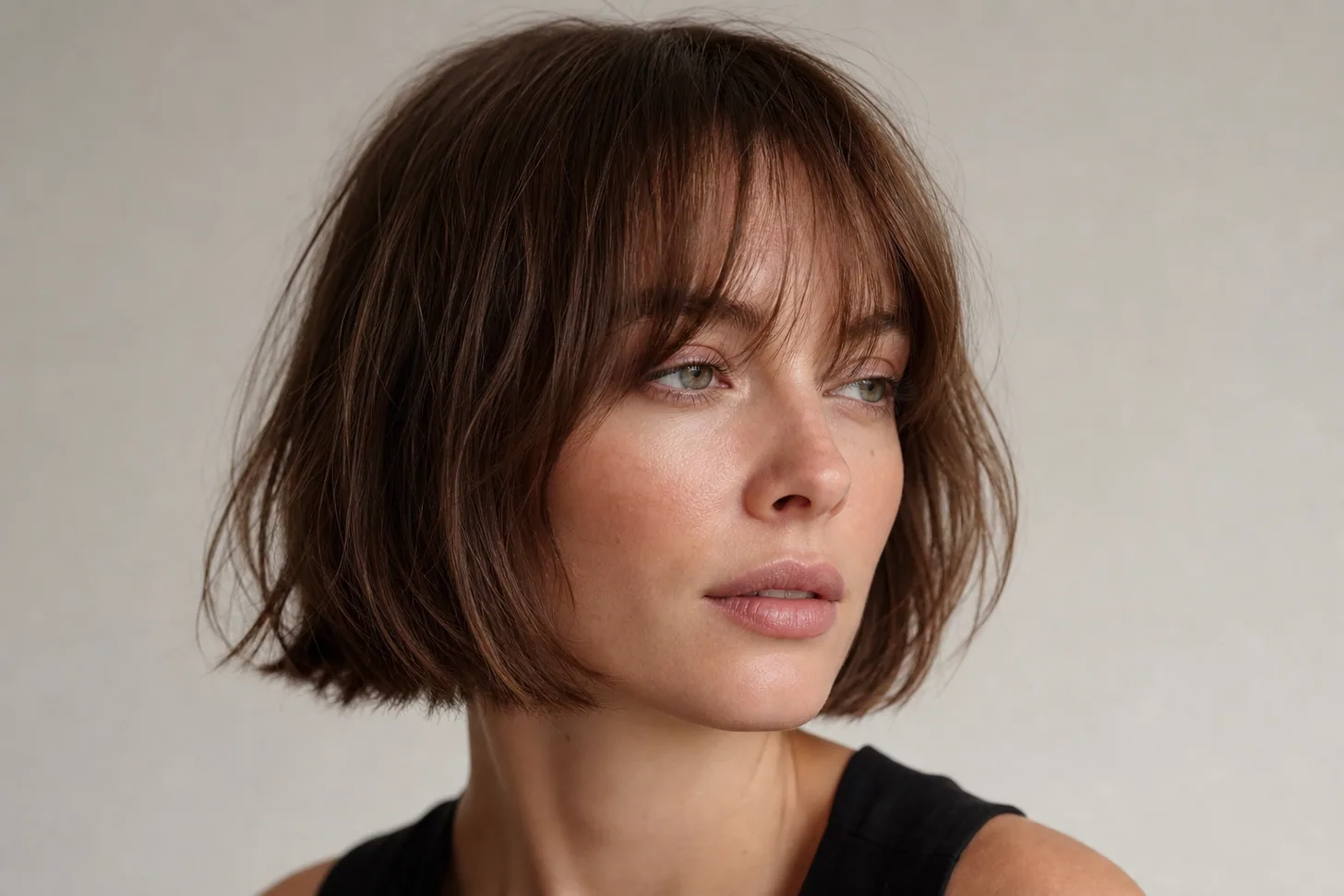
The stacked shape finished with a little point-cut texture through the top layers, so the ends separate and the whole cut looks piece-y and modern. The texture adds a second layer of fake volume on top of the stack. Keep it restrained on very fine hair — a light hand keeps the ends from going wispy. If you want the texture visible at the ends rather than built into the graduation, see the choppy bob on fine hair.
Stacked bobs for mature & gray fine hair
The stacked bob is a favorite after 50 and 60 because it builds body without daily effort. These three work with gray, silver, and softening density.
soft rounded stacked bob on silver-gray fine hair for a mature woman
12
The mature stacked bob
A softly rounded stack that lifts fine hair off the neck without looking severe — the reason it's a go-to on fine hair over 60. The height at the crown counters the flatness that comes with softening density, and it takes minutes to style. Keep the graduation gentle so it stays easy to wear day to day.
stacked bob on salt-and-pepper fine hair with dimensional color
13
The salt-and-pepper stacked bob
The stack lets natural gray show its dimension — the graduated layers catch light and give silver hair movement and depth. It's a low-upkeep way to wear gray with structure. If you're growing out color, the stacked shape hides the demarcation line better than a blunt one-length bob.
grown-out softened stacked bob relaxing into a longer graduated shape on fine hair
14
The grown-out stacked bob
A few months in, the tight stack softens into a longer, looser graduated bob — a gentle way to transition toward a lower-maintenance shape without an awkward stage. The layers lengthen into soft body rather than a hard shelf. Trim the back occasionally to keep some lift, and let the rest grow.
Choose your stacked bob for your face shape
The stacked bob builds width and height at the back and crown, so the front length and angle are what you tune for your face. Use this as a starting point, then confirm with your stylist — the full method is in our guide to finding your face shape.
Balanced proportions carry the classic, angled, or A-line stack equally.
Round
Angled or A-line with length at the front
Longer front sections and crown height lengthen the face; skip an even chin-length stack.
Square
Rounded stacked bob with soft front
A curved stack and soft face-framing round off a strong jaw.
Heart
Chin-length stack with curtain bangs
Width and weight at the jaw balance a wider forehead.
Long / oblong
Chin stack with a fringe
A fringe shortens the face; keep the stack from adding too much height.
What to ask your stylist
The stacked bob lives or dies on the back, so be specific about it — and bring a back-view photo, not just a front one. Say: "I want a stacked bob, but I need it to look full, not thin — please point-cut the graduation instead of razoring it, keep my perimeter weight line fairly clean so my ends stay dense, and set the stack at my occiput rather than higher so it doesn't go boxy."
Then set the front: "Angled to the chin" or "blunt at chin length" tells your stylist how to shape the face-framing. And if your density is low, add: "Keep the graduation gentle — I'd rather have soft body than an aggressive stack that thins my ends." With a stacked bob you can always tighten it next time; you can't add weight back once it's cut.
Chair-side note
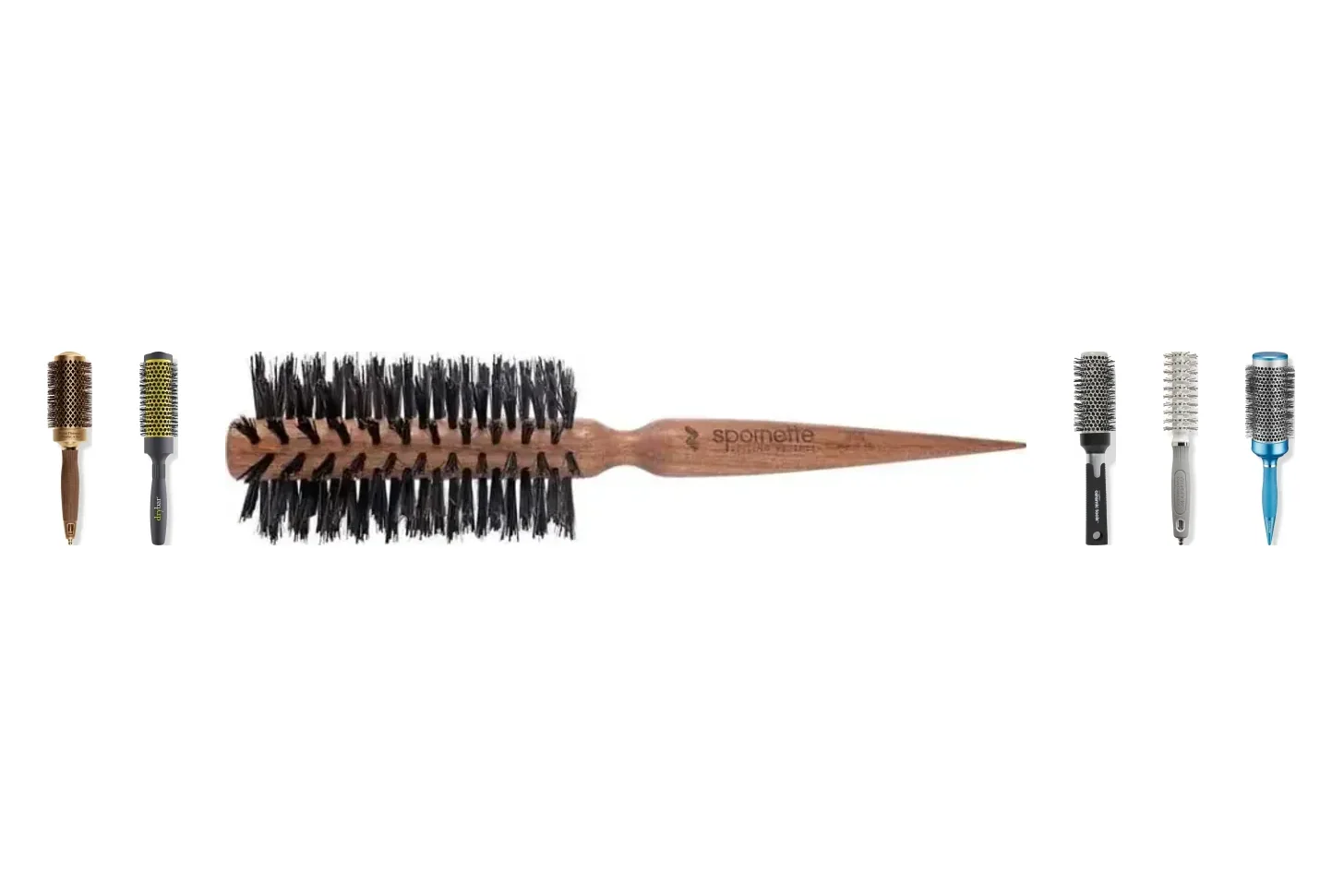
The stacked bob is the rare fine-hair cut where styling is genuinely fast, because the shape holds itself. My routine for clients: a light mist of root lifter at the crown on damp hair, then blow-dry the back with a round brush, rolling the hair up and under to reinforce the stack.
Ninety seconds at the back is all it takes, because you're following a shape that's already there. Skip heavy serums and creams — they flatten the stack and undo the whole point of the cut. A stacked bob wants lift products, not weight.
SB
— Simone Baptiste, Senior Stylist
When a stacked bob may not be your best move
You want the lowest possible maintenance. The graduation softens in six to eight weeks; a blunt bob or a grow-out-friendly cut holds its shape longer between trims.
Very low density through the back — an aggressive stack can leave the graduated ends see-through. Ask for minimal, point-cut graduation over a weightier perimeter, or choose a softer layered bob.
You have a strong natural cowlick at the crown or nape. A tight stack can fight it and stick out; tell your stylist so they can cut around it or soften the graduation.
You're noticing real thinning or scalp showing at the crown. A stack can still help by adding height, but read our honest guide to fine hair versus thinning first so you cut with the right expectations.
FAQ
Yes — a stacked bob is one of the best bob shapes for fine hair, because the whole point of the cut is to build height and roundness at the back of the head. Short, graduated layers are stacked up the back so the hair lifts away from the neck instead of hanging flat, and that stacking reads as density where fine hair usually collapses. The key on fine hair is to keep the layers point-cut rather than razored and to keep the perimeter fairly clean, so the stack builds body without turning the ends wispy. Cut that way, a stacked bob gives fine hair structure and fullness it can't fake with product alone.
A stacked bob is a specific kind of layered bob. In a stacked bob, the layers are short and concentrated at the back of the head and graduate up in a tight stack, building height and a rounded shape at the crown and occiput. A general layered bob spreads layers more evenly through the whole cut for movement and can be any length. Think of it this way: all stacked bobs are layered, but not all layered bobs are stacked. If you want body specifically at the back, you want the stack; if you want movement throughout, you want general layers.
It does, and it's one of the more reliable ways to do it with a cut. Thin hair looks flattest at the back and crown, where it lies against the head. Stacking short graduated layers there pushes the hair up and out, creating a rounded silhouette that the eye reads as fullness. Because the volume is built into the shape, you don't have to work as hard with product to keep it. To protect the effect on thin hair, keep the perimeter weight line fairly solid so the ends stay dense, and ask for point-cut rather than razored graduation.
Because the back is where the whole cut is built. A stacked bob's defining feature — the tight, graduated stack of layers that creates height and a rounded shape — lives at the back and lower crown, which you can't see in a front-facing mirror. When you bring a photo to your stylist, bring a back view, not just a front one, so you're both agreed on how high and how tight the stack should sit. It's the single detail that separates a true stacked bob from an ordinary short bob, so it's worth being specific about.
A stacked bob does most of the styling for you, which is why it suits fine hair. Blow-dry the back with a round brush, directing the hair up and under to reinforce the stacked shape and lift the crown; a mister of root lifter at the roots before you dry sets the height. The front sections can be smoothed under or flicked out to taste. Because the cut carries its own structure, you need far less product than you would on a one-length bob — usually just a little root lift and a light mist of hairspray at the crown to hold the round shape through the day.
A stacked bob needs more upkeep than a blunt bob because the graduation at the back softens as it grows, and the tight stacked shape loosens after six to eight weeks. That's not necessarily bad on fine hair — as it grows it relaxes into a softer, longer graduated bob, which many people like. But if you want to keep the crisp stacked silhouette, plan on a trim roughly every six to eight weeks. If low maintenance is your priority, a softer graduated bob or a blunt bob will hold its shape longer between cuts.
Yes, and it is usually the version of the stacked bob a stylist reaches for on thin hair. The forward angle keeps the length where it reads fullest — around the jaw and cheekbones — and takes it away at the nape, where thin hair hangs flattest. The part to watch is the stack behind the angle: on low-density hair a tight, heavily graduated stack separates into rows and shows scalp between them. Ask for a soft forward angle, moderate point-cut graduation rather than a steep razored stack, and a perimeter kept a little heavier than the reference photo. Cut that way, an inverted bob gives thin hair shape from the side and fullness from the back at once.
Eleven years behind the chair, specializing in short shapes and fine-hair texture. Simone believes the best haircut is the one you can style yourself in ten minutes.
Results vary with hair type, density, and growth patterns. This guide is educational and not a substitute for an in-person consultation with a licensed stylist.
Hairstyle images in this guide are AI-generated illustrations, not photos of real clients or results. See our image policy.
Get the good hair intel
One honest, stylist-written guide in your inbox each week. No hype.

 SB
SB