Reviewed by Tara Sullivan · Updated August 2026 · 10 min read
Start with the good news, because it's the part nobody leads with when you're standing in your bathroom two weeks after a haircut: thinning shears cut hair, not follicles. Your density hasn't changed, nothing about your future hair is different, and every strand that was shortened is growing back from a completely undamaged root.
This is not hair loss and it will not become hair loss. What it is, is a distribution problem — too many strands now ending at too many different lengths, so very few of them reach the perimeter together — and it resolves on a timeline set by biology rather than effort. That timeline is roughly a centimetre a month, which is the frustrating part, and there's exactly one lever that shortens it.
Below: what the notched blade actually does, the four tells that confirm it happened to you, how to distinguish it from breakage and from genuine thinning (they look similar and mean completely different things), the honest grow-out arithmetic, and the interim cut that buys back the look of density now instead of in a year.
See-through ends held to the light: too few strands reaching the perimeter together.
Three tools, three completely different decisions
What follows is enough to work out what was done to your hair. If what you want is the tool itself — how much each grade of shear removes, where the blades belong, the four jobs on fine hair where they're genuinely the right call, and the sentence that stops it happening again — that's a separate page: how to use thinning shears on fine hair.
Most of the confusion here is vocabulary. "Texturizing," "thinning," "layering" and "point cutting" get used interchangeably in the chair, and they are not the same act at all. Two of them are shape decisions and one is a density decision, and on fine hair only the shape decisions are usually safe.
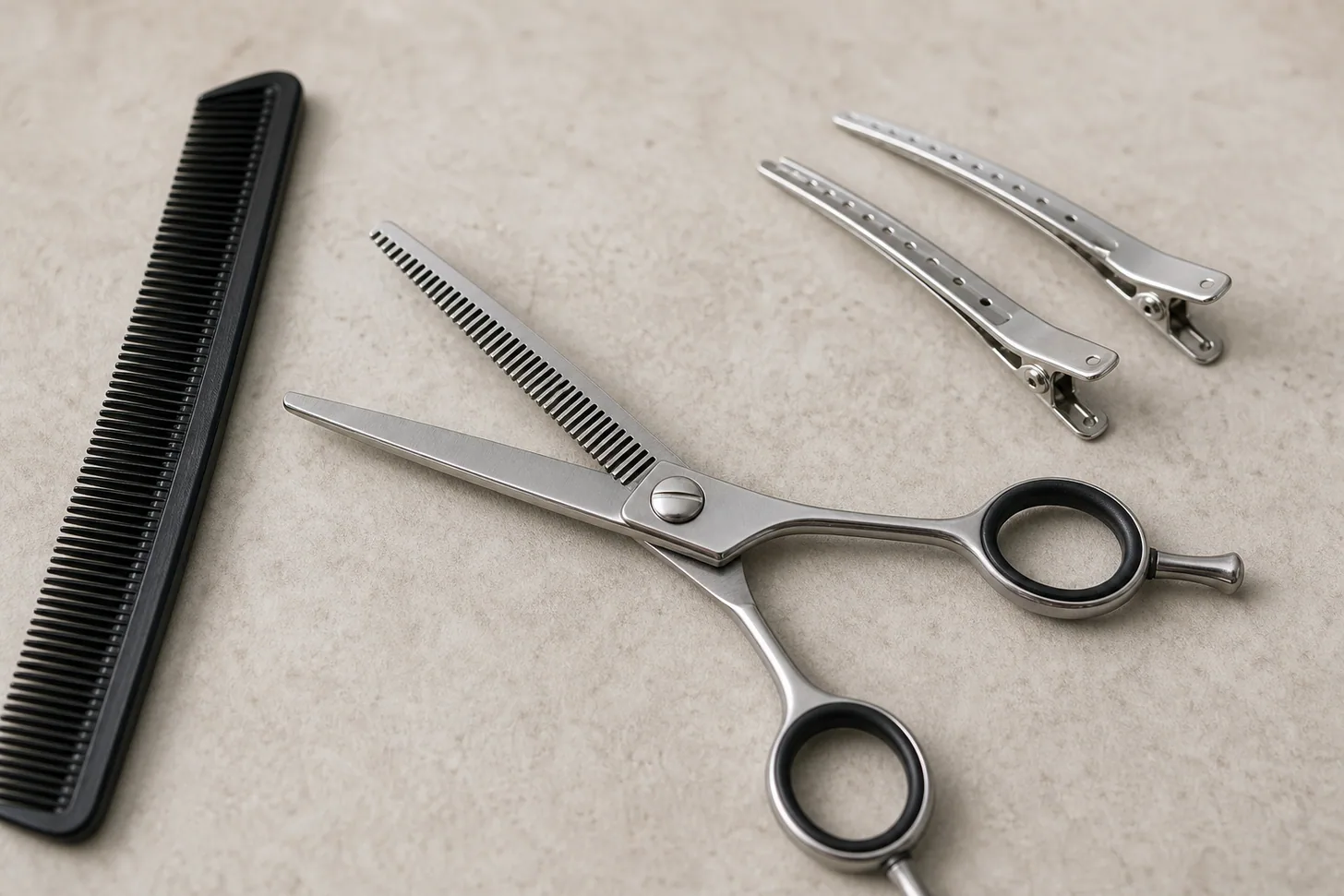
Thinning and texturizing shears remove strands from inside the section
One blade is notched into teeth. When the shears close, only the hairs that fall between the teeth are cut; everything else passes through untouched. So a percentage of the strands in that section get shortened at whatever height along the length the blades were closed, and the rest stay full length.
On dense hair that's the whole point — it removes bulk without altering the outline, so the hair sits closer to the head instead of pyramiding out. On fine hair the identical action removes strands from a section that didn't have many, and leaves a population of short stubs inside the section that will later grow up through the surface. Crucially, the outline doesn't change, which is why nothing looks wrong in the salon mirror.
A razor bevels every strand to a point
Held at an angle and drawn along the section, a razor shaves each strand into a long taper instead of cutting it to a blunt end. On thick, coarse hair that produces beautiful movement and softness.
On fine hair, a strand that was already narrow is tapered to something close to transparent for its last inch — and a tapered end is also structurally the weakest point, which is where the hair-science literature notes that mechanical damage and splitting propagate from.
Point cutting only touches the tips — and it's what fine hair actually wants
Regular shears, held vertically, snipping a few millimetres into the very ends of a section. It softens a blunt line without removing density anywhere along the length. This is the fine-hair-safe way to get "texture" and "movement," and it's the specific thing to ask for by name.
Thinning shears aren't a villain — they're a tool that solves a problem most of my clients don't have. I own a pair. I use them perhaps twice a month, always on someone with genuinely heavy hair, always in the interior, never within four inches of the ends and never near a part line. What goes wrong isn't malice or even bad training; it's habit.
In a busy chair they become the automatic finishing move on every head, and the client who shouldn't have had them can't possibly connect a February appointment to the halo of short pieces she notices in May. If your stylist reaches for them without having said anything about your density, that's the moment to ask — not because they're doing something wrong, but because they may not have decided anything at all.
SB
— Simone Baptiste, Senior Stylist
Four tells that you were over-thinned
The reason this needs a checklist is that the damage is invisible when it's done and obvious three months later, by which point most people have blamed their shampoo, their water, their age, or their hormones.
The ends are see-through against a window. Hold a section up to the light. Healthy fine hair thins gradually toward the tips; over-thinned hair goes from solid to nearly nothing over the last two or three inches, and you can read text through it.
The ponytail is normal at the base and stringy at the tail. Grip it: the circumference where the elastic sits is unchanged — because your density is unchanged — while the last few inches have split into separate wispy strands.
A halo appears at two to four months. The stubs cut inside the sections grow long enough to stand up but not long enough to lie down, so short pieces start sticking up along the part and around the crown. This one is very frequently mistaken for new growth, and read as a good sign.
It looked good in the chair and wrong at the first home wash. A professional blow-dry masks removed density better than anything you'll manage, so the reveal is nearly always three or four days later.
One more, if you were paying attention during the cut: a comb-like tool used repeatedly through the mid-lengths, or a distinctive double-shuffle sound rather than a single clean snip.
Over-thinned, broken, or actually thinning?
These three produce a similar complaint — "my ends are sparse and there are short bits everywhere" — and they mean completely different things. Getting this right decides whether you need patience, a routine change, or a doctor. There is a fourth possibility worth ruling out first: a feather cut taken into the perimeter looks identical to over-thinning and has the same grow-out.
Over-thinned
Breakage
Density loss
How the short pieces end
Cut cleanly — blunt or angled, like a snipped wire
Blunt and often frayed or white-tipped
Tapered to a soft point (that's regrowth)
Where they are
Wherever the shears were closed — usually a band through the mid-lengths, evenly across the head
Random lengths, concentrated where you tie, brush or heat-style
Concentrated at the crown and part; a widening channel
All three at once is entirely possible and fairly common — an over-thinned cut makes ends fragile, fragile ends break, and both are more noticeable if density has genuinely declined. Work through them in that order, because only the third one needs a professional.
The grow-out arithmetic, honestly
Hair grows at roughly 0.35 mm a day — about a centimetre a month, six inches a year — and it does that regardless of what you eat, buy, or massage into your scalp. So the timeline is fixed, and the only honest thing to do is tell you what it is:
Light texturizing at the ends only: two to four months. Barely worth managing; one careful trim absorbs most of it.
Thinning shears through the mid-lengths of shoulder-length hair: six to twelve months for the stubs to reach a length that blends back into the perimeter.
Heavy texturizing or a razor cut on long hair: twelve to twenty-four months. If a stylist has taken a razor through a long, fine head of hair, that's a two-year story and you deserve to hear it stated plainly rather than discover it.
The halo phase — short pieces standing up — runs roughly months two to eight, and is the worst of it visually. It's also the proof that recovery is happening.
Nothing accelerates this. Not supplements, not oils, not scalp devices — the honest version of that whole category is in can you actually grow fine hair thicker?. What you can do is stop losing ground at the other end: the strands that were shortened are now the most fragile ones you have, so heat protection, gentle detangling and a lower iron temperature genuinely do change how much of that new length survives to be useful.
The one lever that works now: cut down to meet it
This is the advice most people don't want and most often end up taking.
Over-thinning leaves you with strands of many different lengths in the same section, so almost nothing reaches the perimeter — which is precisely what "see-through ends" are. You have two routes. Wait for the short strands to grow up to the long ones, which takes the months above and looks sparse the whole way. Or cut the long strands down toward the short ones, which reassembles a perimeter where most strands arrive together and reads as immediately, dramatically thicker.
The second is a real trade: you lose length you didn't choose to lose. But it converts a twelve-month problem into a one-appointment one, and on fine hair a strong blunt perimeter is the most reliable illusion of density there is. Standard destinations, depending on how high the damage goes:
Damage in the last three inches — a blunt trim to just above it. Usually painless.
Damage through the mid-lengths — a lob cut to one strong length, or a layered bob if you want some shape back without re-thinning.
Damage high up, near the crown — a blunt bob is the honest answer, and it's a genuinely good outcome rather than a consolation.
Whichever you choose, the instruction at that appointment is the same and it matters more than the length: one length, blunt perimeter, no further thinning, no razor. A stylist trying to "blend" the damaged pieces by texturizing around them is repeating the original mistake with better intentions.
Chair-side note
The hardest appointment I have is the one where someone arrives holding a photograph of their hair from before, wanting me to make it look like that today. I can't. What I can do is choose which twelve months she has: twelve months of waiting with wispy ends, or one afternoon of losing four inches and then twelve months of growing back hair that looks dense the entire time.
Almost everyone chooses the second once it's put that way, and almost nobody arrives having considered it. If you take one thing from this page, take the question — ask your stylist "if we cut to where the damage stops, where does that land?" You don't have to do it. You should know the number.
SB
— Simone Baptiste, Senior Stylist
Styling through the halo phase
Months two to eight are the ugly middle. A few things genuinely help and a few popular ones make it worse.
Stop separating the ends. Texture sprays, sea salt sprays and dry shampoo taken through the lengths all work by making strands stand apart from each other — which is precisely the effect you're trying to counteract.
Keep them at the roots only, where they still earn their place. Weight at the ends is now your friend: a very small amount of smoothing serum on the last two inches gathers the strands into a line and does more for see-through ends than any volumizer.
Blow-dry the perimeter under. Ends turned slightly under read as a solid line; ends flicking out read as separate wispy strands. This is most of what a salon blow-dry is doing when it hides the problem.
Pin the halo instead of fighting it. Short standing pieces cannot be brushed down — they're too short to have weight. A little hairspray on a clean brush pressed over the crown lays them for a few hours; anything heavier flattens the roots you need.
Skip the trim schedule you had. Trimming every six weeks while growing out over-thinned hair removes the length you're waiting for. Stretch to ten or twelve weeks and take off only what's damaged — see how often to trim fine hair.
The sentence that prevents all of this
Say it before any cutting starts, not after you see a notched blade:
"Please don't use thinning shears or a razor anywhere in this cut — my hair is fine and I need to keep all the weight I have. If you want texture, can you point-cut the ends instead?"
It's a normal request, it names the alternative rather than just refusing, and a good stylist will simply say yes. If you're mid-cut and hear the double-shuffle, stopping to ask is entirely reasonable — I'd far rather be interrupted than have someone leave unhappy and not come back.
The rest of the salon conversation, including what to ask at a consultation, is in what to ask your stylist, and if the damage is already done and you're deciding whether to go back, how to fix a bad haircut on fine hair has the triage and the words for that conversation. And if the cut is happening at your kitchen table, cutting fine hair at home covers which tools to own and which to leave in the shop.
When thinning shears aren't the problem
You have fine strands in high density.Fine and thin are different things. Hair that's fine but genuinely dense can sit in a heavy block and legitimately benefit from careful interior weight removal — see fine but thick hair.
The short pieces taper to a soft point. That's regrowth, not cutting. Good news, and a completely different page: fine hair or thinning?
The ends were see-through before the appointment. Then you're looking at accumulated damage rather than one cut — dry, fine hair and breakage between them cover it.
Your ponytail is genuinely thinner at the base than a year ago. That's density, and no cut fixes it. Start with "I can see my scalp".
It happened at the same appointment as a colour service. Bleach and lightener change how ends behave too — does colour thin fine hair?
You want the wispy, piecey look on purpose. Entirely valid, and a real trend — but it's a maintenance commitment on fine hair, not a low-effort finish.
FAQ
One blade is notched into teeth, so when the shears close only the hairs that fall between the teeth are cut — the rest pass through untouched. The result is that a percentage of the strands in that section are shortened at whatever point along the length the stylist closed the blades, and the remainder are left at full length. On dense hair that's exactly the point: it removes bulk without changing the outline, so the hair sits closer to the head. On fine hair the same action removes strands from a section that had few to begin with, and it leaves short stubs inside the section that later grow up through the surface. The outline stays the same, which is why the damage is invisible in the mirror for the first few weeks.
Four tells, and the more of them you have the clearer it is. The ends look see-through when held up to a window, tapering to almost nothing rather than ending in a line. The ponytail feels normal in your hand at the base but stringy and sparse at the last few inches. A halo of short pieces starts standing up along the part and at the crown roughly two to four months later, as the cut stubs grow long enough to stand but not long enough to lie down. And it looked good in the chair and noticeably worse at the first wash at home, because a professional blow-dry hides removed density better than anything you'll do yourself. If you also felt a comb-like tool used repeatedly through your mid-lengths, that's the tool.
Longer than a haircut mistake feels like it should, because you're waiting on biology rather than on a fix. Human hair grows at roughly 0.35 mm a day, about a centimetre a month or six inches a year, and it grows at that rate regardless of what you eat, buy or apply. If the shears were used through the mid-lengths of shoulder-length hair, expect six to twelve months before the short pieces are long enough to blend back into the length. A heavy razor cut on long hair is realistically a twelve to twenty-four month grow-out. The one thing that shortens it isn't growth at all — it's cutting the rest of the hair closer to the shortest pieces, which trades length for the appearance of density immediately.
No, and the difference is the single most useful thing to understand before your next appointment. Point cutting means holding regular shears vertically and snipping into the very tips of a section, which softens a blunt line by shortening a few millimetres of some strands. It removes weight only at the extreme ends and leaves the density of the section intact. Thinning shears remove whole strands from inside the section at whatever point the blades close, which is a density decision rather than a shape one. Razoring bevels each strand to a fine point along its length. Fine hair generally wants point cutting and generally doesn't want the other two. Asking for internal layers to be point cut rather than thinned is a normal, specific request.
Often yes, and it's the counterintuitive advice most people resist. Over-thinning leaves you with strands of many different lengths in the same section, so the perimeter has very few hairs actually reaching it — which is what see-through ends are. You can wait for the short ones to catch up, which takes months and looks thin the whole time. Or you can cut the long ones down toward the short ones, which rebuilds a perimeter where most strands arrive together and reads as immediately thicker. It costs length you didn't want to lose. It's still usually the faster route to hair that looks dense, and a blunt bob or a strong one-length lob is the standard destination.
No — and this is the reassuring part worth separating from the frustrating part. Thinning shears cut hair; they don't touch the follicle, so nothing about your future hair has changed. Every strand that was shortened is growing back at its normal rate from a completely undamaged root, and your density is exactly what it was before you sat down. That makes this fundamentally different from tension damage or hair loss, where the follicle itself is at stake. What you're living with is a temporary distribution problem: too many strands ending at too many different lengths. It resolves with time in a way that genuine hair loss does not, which is why it's worth confirming which one you're dealing with.
Occasionally, in one specific situation, used by someone who says out loud what they're doing. Fine describes the diameter of each strand and thin describes how many you have, and those are independent — plenty of people have fine strands in genuinely high density. Hair like that can be heavy, sit in a solid block, and legitimately benefit from a small amount of interior weight removal well away from the ends and away from the part. Fine and sparse hair almost never does. The problem is that thinning shears are frequently reached for by habit rather than by assessment, and the consequence lands months later when the client has no way to connect it back. If nobody has told you which of the two you are, that conversation comes before the tool.
Say it plainly, early, and before any cutting starts, because it's far easier to prevent than to discuss afterward: no thinning shears and no razor anywhere in this cut. Add the reason, which makes it land as information rather than distrust — fine hair needs to keep all the weight it has, especially at the ends and along the part. It's a completely normal request and no good stylist takes offence at it. If you see a notched blade or hear the distinctive double-shuffle mid-cut, it's entirely fine to stop and ask what's being done and why. The stylists who react badly to being asked are giving you useful information about whether to rebook.
Eleven years cutting fine hair, and a pair of thinning shears she opens about twice a month. Simone's rule: on fine hair, take weight off the shape, never out of the density.
Results vary with hair type, density, and growth patterns. This guide is educational and not a substitute for an in-person consultation with a licensed stylist.
Hairstyle images in this guide are AI-generated illustrations, not photos of real clients or results. See our image policy.
Get the good hair intel
One honest, stylist-written guide in your inbox each week. No hype.

 SB
SB