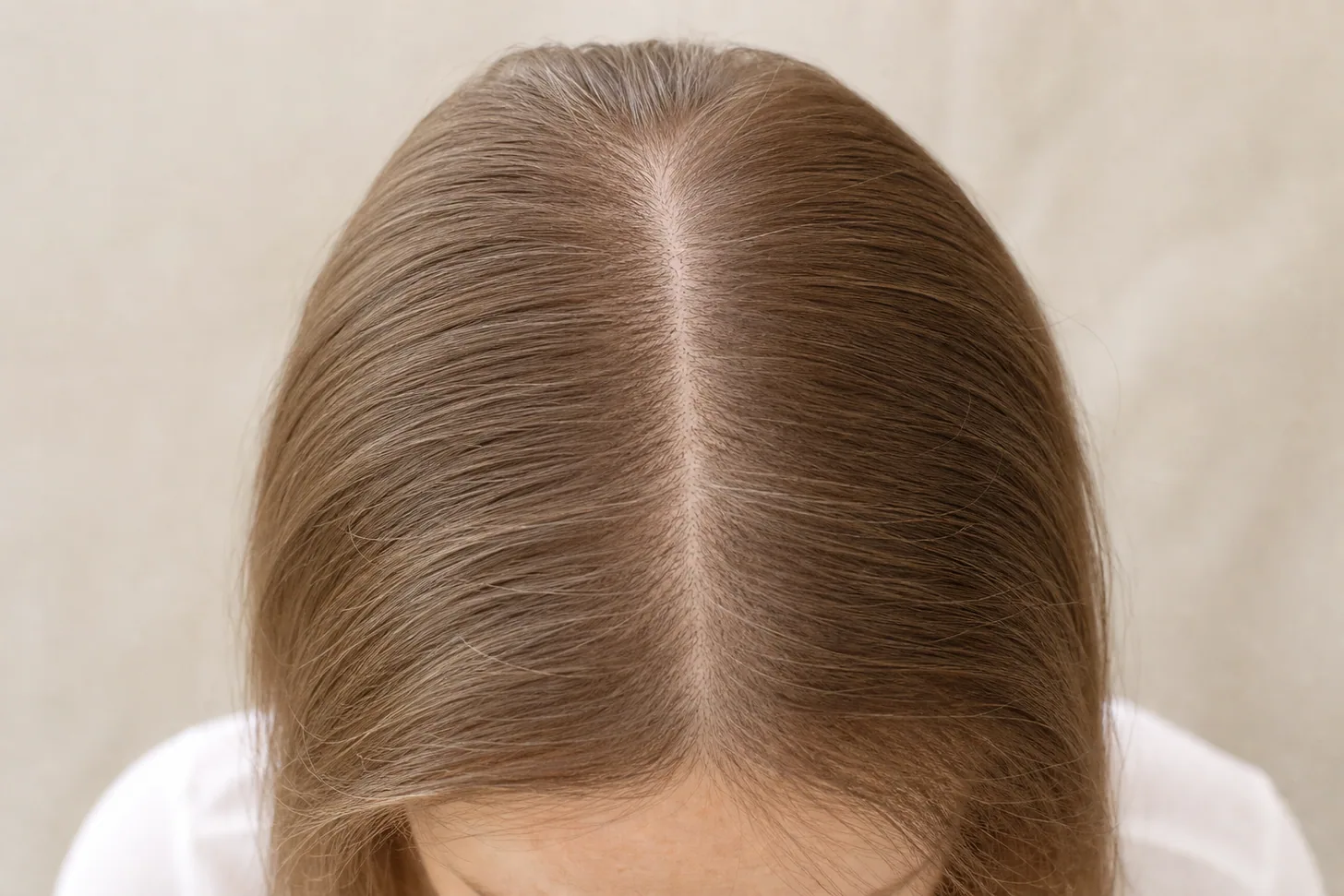
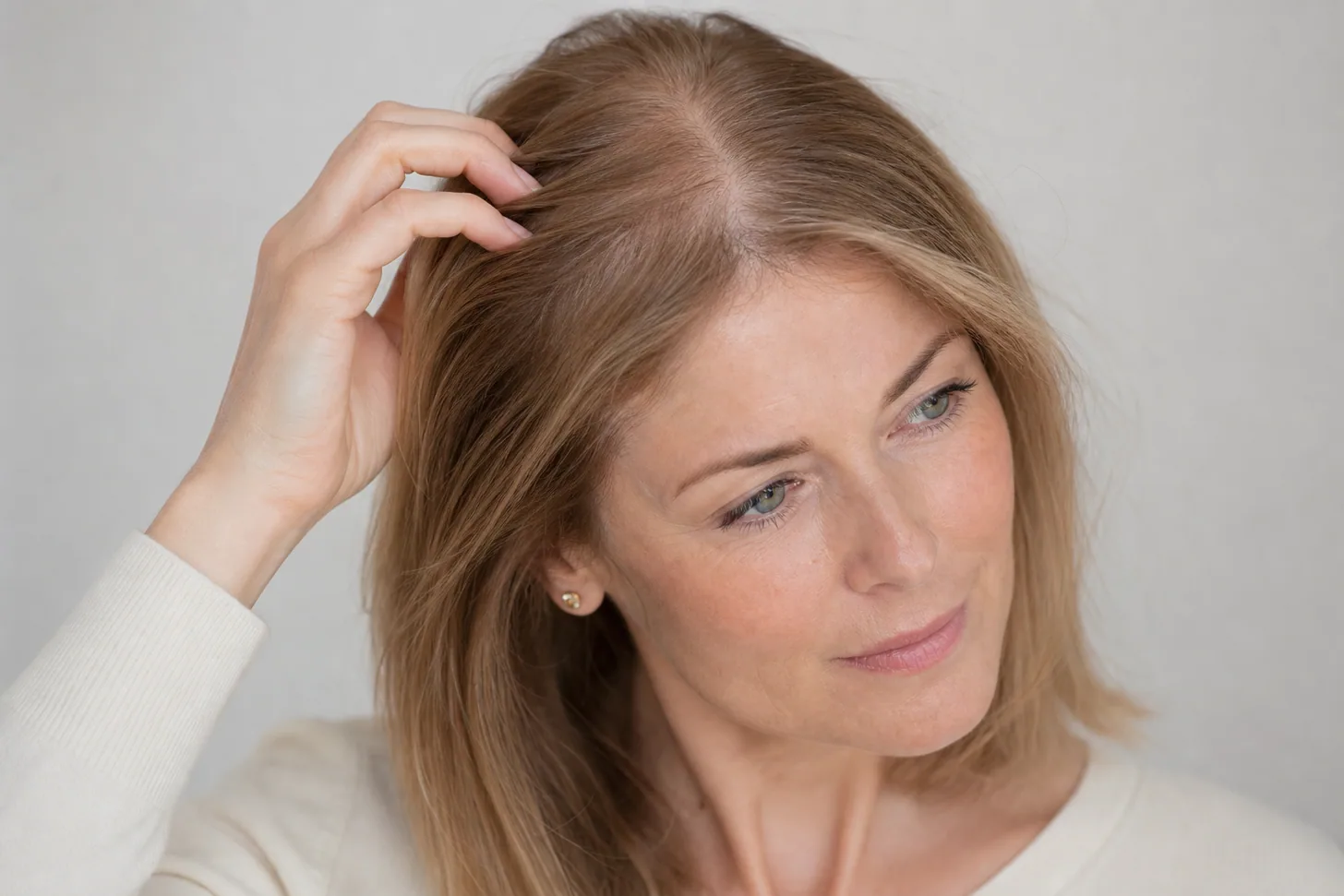
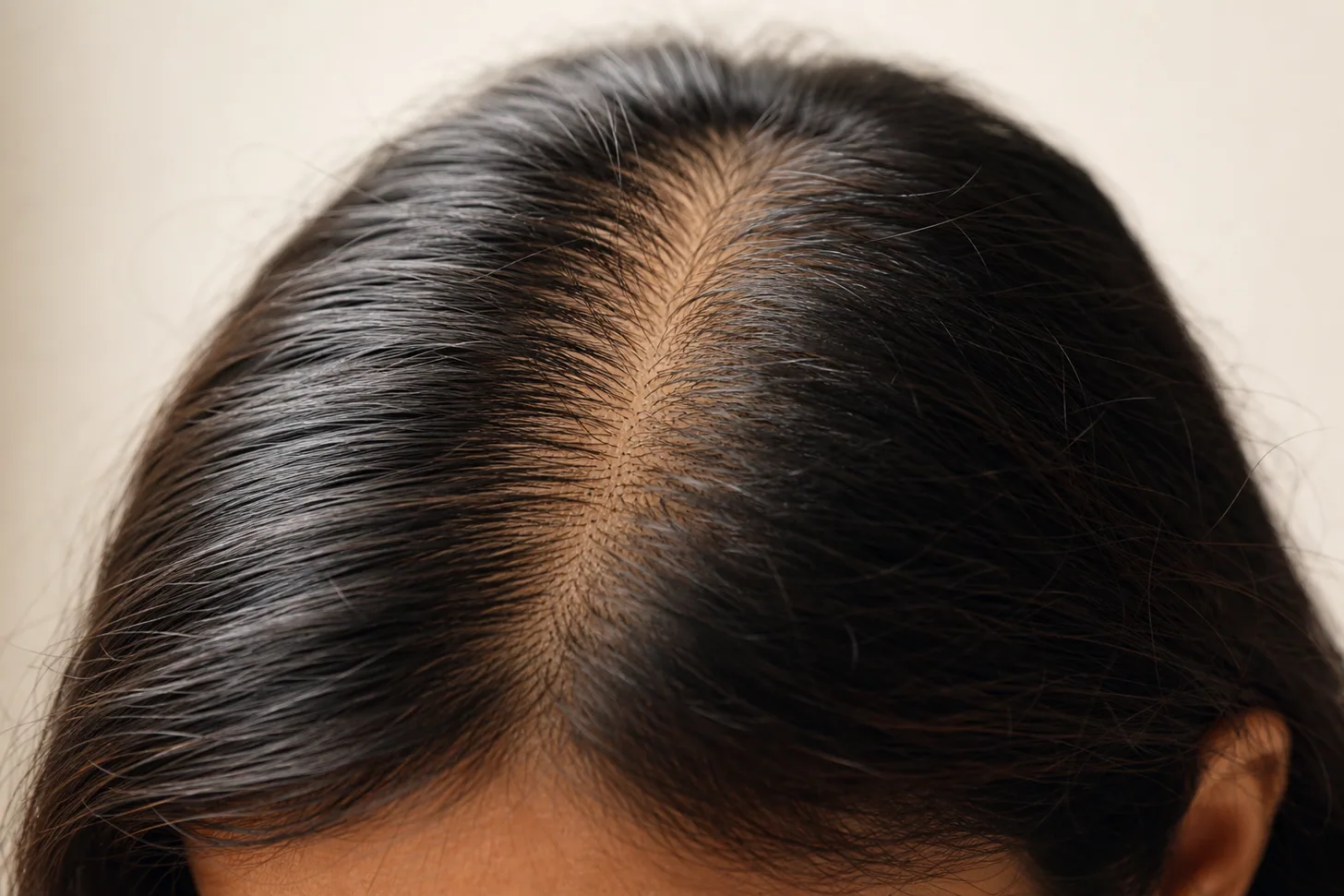
Which means the word rules things out without ruling anything in — and it is being used, across most of the internet, for two situations that need opposite responses. Female pattern hair loss is called diffuse thinning because it is spread rather than patchy; it is also concentrated on the top while the back of the head is largely spared. A true all-over shed is not concentrated anywhere. Same word, different maps, different outcomes.
The check that separates them takes two photographs and costs nothing, because the back of your own head is the control sample. Below: what the word actually covers, the front-versus-back test and what to look for in each shot, why fine hair reaches visible thinning at a smaller absolute loss than anyone else, the timeline that identifies a shed, and what to bring to the appointment so a borderline picture becomes legible.
The same part, the same light, once a month. It outperforms every adjective you could bring to an appointment.
"Diffuse" describes where the loss is, not what is causing it
Start with what the word buys you, because it does buy something. Hair loss splits first into patchy and spread-out, and that split is the one clinicians make before any other — patchy loss opens a different list entirely, including the scarring conditions that need urgent attention. If your thinning is genuinely spread across the scalp, that list is closed and a shorter one opens.
Shedding means hairs leaving the head — visibly, in the brush, in the drain, on the pillow. The follicle is intact and the hair has been pushed out of its growing phase early. The best-known version is telogen effluvium.
Thinning means the hairs staying put but getting narrower with each cycle, a process called miniaturisation. Nothing dramatic appears in the shower. The head simply carries less hair-substance than it did, and the part widens. This is female pattern hair loss.
One of them mostly resolves. The other is progressive and needs treating to stop. They are not variations on a theme, and the reason so much writing on this topic reads as vague is that it is trying to describe both under one heading. This is also the layer above whether your hair is fine or thinning at all — that page answers whether anything is changing; this one assumes something is, and asks which kind.
Scale, for context: DermNet describes diffuse alopecia as "common, affecting up to 50% of men and women". Whatever you are looking at, it is not rare and it is not evidence of having done something wrong.
The word does two jobs, which is why the advice you find contradicts itself
Here is the specific confusion, because once you see it the search results stop being frustrating.
Female pattern hair loss is almost always introduced as diffuse thinning over the top of the scalp. That phrasing is correct — it is spread out, not patchy, so "diffuse" is the right technical word. But readers understand "diffuse" to mean evenly, everywhere, and pattern loss is emphatically not that.
It has a map: the top and the mid-part line thin while the frontal hairline usually holds, and the back of the head stays comparatively dense. That map is the diagnosis.
So two readers arrive at the same phrase carrying opposite situations, get the same generic answer, and one of them is sent away reassured when she should not have been. The fix is to stop asking "is my thinning diffuse" and start asking "is it even". Those are different questions and only the second one is answerable at home.
Chair-side note
Nobody looks at the back of their own head, and it is the most informative square inch on the subject. I have had women describe six months of misery at the crown who had never once parted the hair above their nape to compare — and the comparison is genuinely reassuring in one direction and clarifying in the other. Do it with a phone on self-timer propped on a shelf, or ask someone.
Two photographs, thirty seconds. Then keep them somewhere dated, because the value of the first pair is small and the value of the third pair, six months later, is enormous. Almost everything that goes wrong in a fifteen-minute appointment about hair goes wrong because there is nothing to compare against, and a photograph is the one piece of evidence a patient can supply that a clinician genuinely cannot.
MH
— Megan Holloway, Editor-in-Chief
The front-versus-back check is the one test worth doing at home
Your occiput — the back of the head, above the nape — is the control. In pattern loss it is the region that holds while the top gives way, so comparing the two tells you whether you are looking at a pattern or at a general loss. It is the same comparison a dermatologist makes with a dermatoscope; you are doing a coarser version of it, but the signal is the same signal.
That the signal is real is well documented. In a comparison of dermoscopic findings in female androgenetic alopecia, telogen effluvium and controls, the regional split in pattern loss was stark: single-hair units made up "79.6±16%" of the frontal field but only "29± 14.3%" at the occiput in the same women.
Yellow dots followed the same map — "67.7 percent" frontally against "9.6 percent" at the back. Front and back are measurably different heads in pattern loss, and measurably the same head in a shed.
Take two photographs, not one
Do it on dry hair, in daylight, on a day you have not just washed — freshly washed fine hair sits flatter and reads thinner, for the reasons in why hair looks so thin when it is wet. If the check says pattern, the shopping list starts with minoxidil rather than the shampoo aisle — best shampoo for thinning hair explains why the bottle is step three.
Shot one: part your hair down the middle at the crown and photograph from directly overhead.
Shot two: make the same middle part low at the back of your head, an inch or two above the nape, and photograph it the same way.
Compare the width of the two scalp lines, not how you feel about either one.
Uneven strand thickness is the pattern-loss signature
The other thing to look for in the crown shot is variation. Miniaturisation does not switch follicles off in unison; it narrows them at different rates, so the affected area carries thick strands, medium strands and near-invisible wispy ones side by side.
The everyday version: run your fingers through the hair at your crown and then at your nape. Pattern loss feels like two different textures on one head. A shed feels like less of the same hair.
A caution about the second signature that study reports — vellus hairs, present frontally in "All patients (31/31) in the FAGA group". Short fine hairs around the hairline are also just regrowth, and regrowth is good news. Do not try to read that one at home; it needs magnification and context.
What you observe
Points toward a shed
Points toward pattern loss
Crown part vs nape part
Both look similar; the back is thinner too
Crown noticeably wider; the nape stays narrow
Strand thickness in the affected area
Uniform — fewer hairs, same hairs
Mixed thick, medium and wispy side by side
Hair in the brush and drain
Markedly increased, often alarming
Often normal — the hair is narrowing, not leaving
Onset
Fairly sudden, traceable to a season
Gradual over years; hard to date
A trigger 2–4 months earlier
Usually findable once you look back
Usually none
Frontal hairline
Thins with everything else
Usually spared
Course over a year
Peaks, then tapers back
Slowly continues without treatment
Read the table as a balance of evidence rather than a scorecard. Rows disagreeing with each other is itself common, and usually means both things are happening — which is the situation the next section covers.
Fine hair reaches visible thinning at a smaller loss than anyone else
This is the part a general dermatology page has no reason to tell you, and it is why this page sits on a fine-hair site.
What hides your scalp is not the number of hairs but the overlap between them. A wide strand shades more skin than a narrow one, so at identical density a fine head already sits closer to the point where skin shows through. Take the same proportional loss off both heads and the fine one crosses that line first — at the part before anywhere else, because the part is where the margin was thinnest to start with.
Set that against how much loss is normally required to become visible. In telogen effluvium, DermNet notes that "Up to 30–50% of scalp hair may be lost". On dense hair a good part of that range is genuinely invisible to everyone but its owner, which is why "it looks completely fine to me" is such a common and such an unhelpful response. On fine hair the same fraction is not invisible at all.
Two consequences follow, and both are practical. The first is that your perception is running ahead of anything measurable, so you are likely to be sitting in a consulting room at the point where ferritin is low-normal, TSH is inside the range and the scalp looks unremarkable to someone seeing it for the first time.
That is an argument for arriving with evidence, not for distrusting the doctor — which blood tests actually matter covers what to request and why a "normal" ferritin can still be the answer.
The second is that coverage tactics work unusually well on exactly this situation, because there is still hair present to work with. That is a separate job from diagnosis, and it is covered in the coverage playbook for thinning fine hair. Do both. Neither substitutes for the other.
The timeline identifies a shed more reliably than the mirror does
Telogen effluvium has a shape in time, and that shape is the most dependable thing about it.
The lag comes first. Hairs pushed early into their resting phase do not fall immediately; they sit in place for months and then release together. DermNet puts it at "2 to 4 months after the triggering event". So the honest question is never "what changed when the shedding started" — it is what was happening one season before.
Illness, surgery, a high fever, childbirth, a rapid weight loss, a new medication, a bereavement. Shedding after weight loss works through that delay in detail, and postpartum shedding is the same mechanism on a schedule everyone recognises.
Chronic shedding is not something to wait out, partly because the differential widens and partly because it is one of the situations in which a pattern loss underneath gets discovered late. Hair also cycles seasonally, which is a real effect rather than folklore — how the growth cycle works covers why an autumn shed can be entirely ordinary.
Both at once is common, and it explains the confusing histories
The two conditions coexist often enough that telling them apart is treated as one of the central difficulties in assessing diffuse loss. The usual sequence: a head that was quietly miniaturising at the top takes a shed on top of that, and the shed is what finally makes the pattern visible.
What that produces is the history that sounds contradictory. There was a clear trigger about three months back. The heavy fall did settle. And the part never went back to the width it used to be.
That residue is not you failing to move on — it is the thing worth having examined. Around midlife the overlap is especially common, since the hormonal shift and the life events that trigger sheds arrive in the same decade; fine hair through menopause and perimenopausal thinning cover that ground.
When this is not a question to work through at home
Everything above assumes spread-out thinning with no other symptoms. Book an appointment rather than observing if any of the following apply — the first two especially, because scarring conditions destroy the follicle permanently and are treated urgently for that reason.
The loss is patchy — defined bare areas, a smooth shiny patch, a receding edge in one place.
Any scalp symptom: pain, burning, itching, tenderness, redness, scaling, pustules.
Sudden onset, or hair coming out in handfuls.
Eyebrows, lashes or body hair affected as well.
Heavy shedding past about six months with no identifiable trigger.
New coarse facial hair, acne or irregular periods alongside the thinning — that combination points at a hormonal cause worth investigating, and PCOS and hair loss covers it.
None of this is a reason to panic about ordinary thinning. It is a list of the situations where waiting costs something.
What to bring, and the sentences that make the appointment work
A fifteen-minute appointment about hair is genuinely hard for the clinician, because the interesting evidence is historical and the patient is the only one who has it. Arriving with it changes the conversation more than any question you could ask.
The two photographs — crown part and nape part, same day, daylight. Then repeat monthly. This is the single most useful document you can produce.
A date. When did it change? A month, if you can manage one, rather than "gradually".
What was happening three months before that date. Write it down before you go; it is surprisingly hard to recall on the spot.
A ponytail measurement. Circumference in inches, with a tape. Unglamorous, reproducible, and better than memory.
Your full supplement list, including gummies and collagen blends — several contain enough biotin to distort thyroid results, which is covered in the blood tests guide.
And three sentences worth using, because they move the appointment from impressions to findings:
"Is the thinning even across my scalp, or is the back less affected than the top?" — this asks directly for the finding that separates the two families.
"Can you tell me the actual numbers rather than whether they're normal?" — a number can be compared next year; the word "normal" cannot.
"If this is a shed, when should I expect it to settle — and what should I do if it hasn't by then?" — this sets a review point, which is what stops a chronic shed from drifting unexamined.
One last thing that is easy to get wrong while you wait for answers: do not respond to thinning by handling the hair harder. Tight styles, aggressive brushing and daily heat all remove hair that had not planned on leaving, and on fine hair that loss stacks on top of whatever the underlying process is doing. The honest fine-hair routine is the low-risk baseline to hold to in the meantime.
FAQ
It describes where hair is being lost, not why. DermNet's definition is that alopecia is diffuse if it affects the scalp in a general distribution, in contrast to localised or focal alopecia, which is characterised by patchy hair loss. So diffuse is one half of a two-way split — spread out rather than in patches — and it is the half that covers almost everything women experience. Saying your thinning is diffuse rules out the patchy conditions and rules in a shorter list, but it is not itself a diagnosis and no treatment follows from the word alone. The useful question is the next one down: is the loss genuinely even across the whole head, or is it concentrated on the top while the back stays dense?
No, and this is the single most common confusion on the subject. Female pattern hair loss is routinely described as diffuse thinning over the top of the scalp — which is accurate, because it is spread out rather than patchy — but it is not evenly spread. It concentrates on the top and front while the back of the head is comparatively spared, which is precisely what makes it a pattern. A true all-over loss, where the back thins as much as the top, points somewhere else, usually toward a shed. The word diffuse is being used for both situations across most of the internet, which is why the advice you find contradicts itself.
Compare your own front to your own back, because the back of your head is the control sample. Part your hair down the middle at the crown, photograph it from overhead in daylight, then make the same part low at the back of your head, just above the nape, and photograph that. In pattern loss the two look different: the crown part reads wider and the strands vary noticeably in thickness, while the nape part stays narrow with uniform strands. Dermoscopy studies find that difference formally — one comparison recorded single-hair units in 79.6 percent of the frontal field but only 29 percent at the occiput in female pattern loss. In a shed the two parts look alike, because a shed does not respect a map.
It depends entirely on which of the two families you are in, which is why the distinction is worth the effort. Telogen effluvium — a shed triggered by illness, surgery, childbirth, a crash diet, a medication change or severe stress — is self-limiting in most cases. Hair fall is typically noticed two to four months after the trigger, and once the trigger has passed the shedding tapers back to normal over roughly six to nine months. Female pattern hair loss is the other kind: progressive, driven by follicles miniaturising rather than falling, and it does not reverse on its own, though it responds to treatment. You can also have both at once, which is common and is one reason a shed that never quite settles is worth having assessed.
Far more than most people expect, and the number is the reason this is so often dismissed. In telogen effluvium, DermNet notes that up to 30 to 50 percent of scalp hair may be lost. Losing a third of your hair and having a friend tell you it looks fine to them is an ordinary experience, not a sign you are imagining it — what covers the scalp is the overlap between hairs, and dense hair carries enough surplus overlap to absorb a large loss invisibly. Fine, low-density hair has no such surplus, which is why the same proportional loss becomes visible sooner. It is also why a fine-haired woman often arrives at a doctor's appointment while every measurable finding is still borderline.
Because coverage is a function of overlap, not of hair count, and fine hair starts with less overlap to spend. A narrow strand shades less scalp than a wide one, so at identical density the fine head is already closer to the point where skin shows through. Reduce the count on both heads by the same proportion and the fine head crosses that threshold first, at the part before anywhere else, because the part is where the margin was thinnest to begin with. Two practical consequences follow. Your own perception is running ahead of anything a clinician can measure, so bring photographs rather than adjectives. And the word normal, applied to a borderline blood result, means the result is inside the reference range — not that your observation was wrong.
Yes, and it is common enough that dermatology literature treats telling them apart as one of the central problems in evaluating diffuse hair loss, precisely because they coexist. The usual sequence is that a shed removes hair from a head that was already quietly miniaturising at the top, so the shed is what makes an underlying pattern visible for the first time. That produces a confusing history: a clear trigger about three months back, heavy fall that does settle, but a part that never returns to the width it used to be. If your shed has resolved and the crown has not recovered, that residue is the part worth having examined, and it is not evidence that the shed was imagined.
Book an appointment rather than watching if the loss is patchy rather than spread out, if there is any scalp symptom — pain, itching, burning, redness, scaling or a smooth shiny area — if the hair loss came on suddenly, if your eyebrows, lashes or body hair are affected too, or if heavy shedding has continued beyond about six months with no trigger you can identify. Patchy loss and scalp symptoms are the two that matter most, because scarring conditions destroy the follicle permanently and are treated as urgent for that reason. Everything else on this page is a self-observation exercise designed to make that appointment more productive, not to replace it.
Fourteen years across the chair and the page, with a particular interest in the hair problems that hide inside explanations people have already accepted. Megan's rule for an appointment: bring a photograph and leave with a number.
This article is for general education and is not medical advice. It does not diagnose any condition and is not a substitute for assessment by a clinician. If you are experiencing sudden or patchy hair loss, scalp pain, itching, redness or scarring, see a board-certified dermatologist.
Images in this article are AI-generated illustrations, not photographs of real clients or results. See our image policy.
Results vary with hair type, density, and growth patterns. This guide is educational and not a substitute for an in-person consultation with a licensed stylist or physician.
Get the good hair intel
One honest, stylist-written guide in your inbox each week. No hype.

 MH
MH