Why the part carries more weight on fine hair
On dense hair a part is a line. On fine hair it's a window.
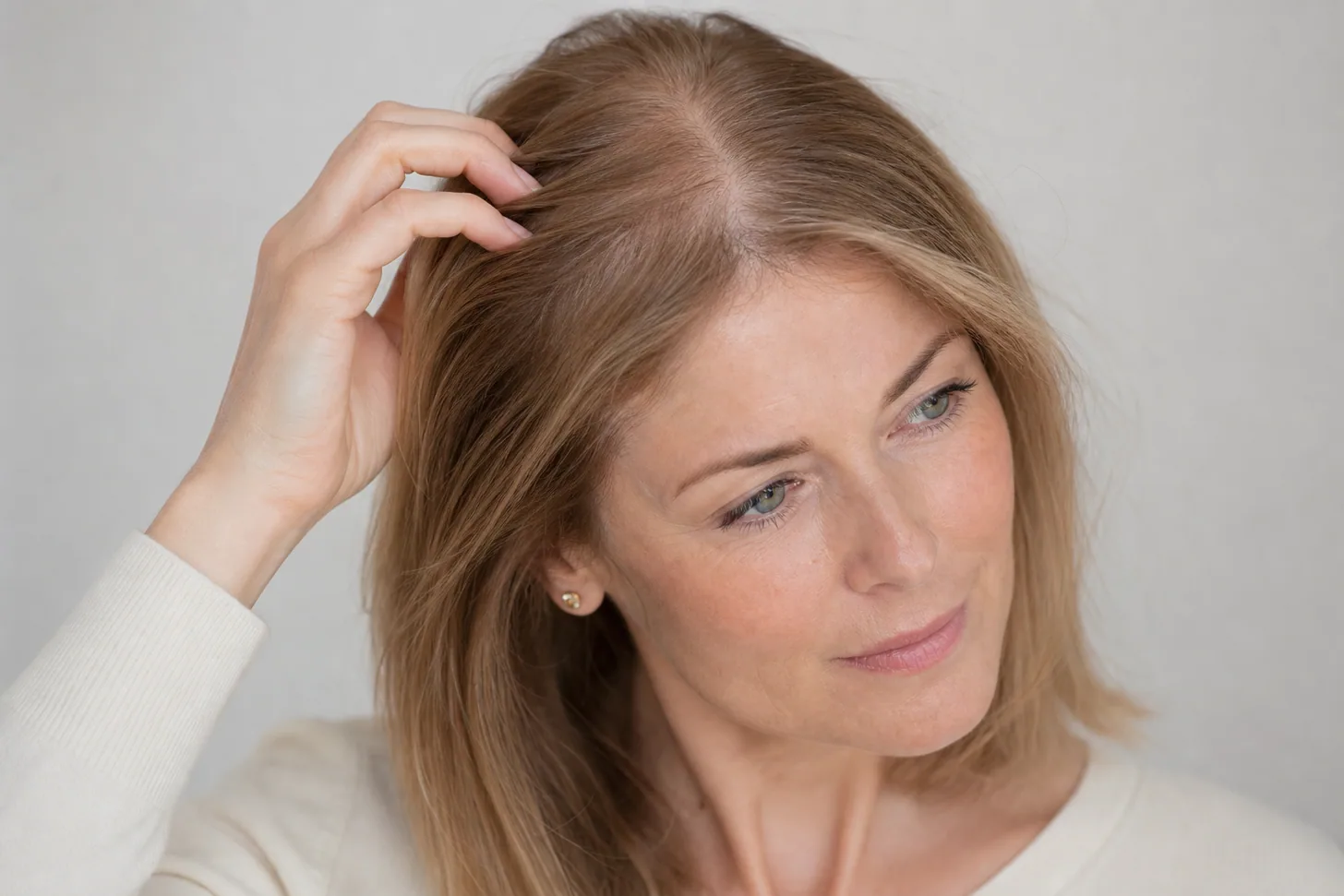
The mechanics are the same on everyone: a part is the seam where hair growing in one direction meets hair growing in another, and there's a narrow strip along that seam where no hair is lying flat over the scalp.
What differs is what happens next. Dense hair sends enough strands in from both sides that they lean over the strip and close it visually. Fine hair — fewer strands, each of them narrower — sends in less, so the strip stays a strip.
That single fact explains most of the frustration. It's why your part looks fine in the mirror at eye level and alarming in a photograph taken from above. It's why the same part on your friend with thick hair reads as a styling choice and on you reads as a symptom. And it's why the standard advice — switch your part for volume — is only half of what you need, because it optimizes for lift while ignoring the channel.
There's a third factor that's purely optical and worth naming because it's the easiest to fix: contrast. A part looks wider when dark roots sit against pale scalp. The same width of exposed scalp under a lighter root shade more or less disappears. That's a colour lever rather than a styling one, and it's covered in colour ideas for fine hair — but it's the reason two people with identical density can have very different feelings about their parting.
Side, middle, or off-center: what each one does
The honest framing is that no part is universally best for fine hair. Each trades lift against exposure differently, and which trade suits you depends on where your hair is flattest and where your scalp shows most.
The deep side part gives fine hair the most lift and holds it the least
It's the part everyone reaches for, and on fine hair it has a specific, predictable failure mode that's worth understanding before you blame your products.
A deep side part works by asking the largest possible panel of hair to travel across the head against the slant of its own follicles. That's why the lift is dramatic in the first ten minutes — you've stood a lot of hair up.
It's also why it drops. The force holding that panel up is nothing but the set you gave it, and fine strands have very little stiffness of their own to help. A coarse strand pushed into an unnatural direction has enough body to stay there; a fine one has the mass of a thread.
So: use it, but use it knowing it's an occasion part rather than a Tuesday part, and give it the two things that make it hold. Set it while the hair is genuinely wet rather than damp, and finish the roots with cool air.
If you need it to last through an evening, a light root-lift product at the parting itself — not through the lengths — is the one product that meaningfully changes the outcome. The full method is in how to get root volume in fine hair.
Chair-side note
When someone tells me their hair is flat and they've tried everything, the first thing I do is put my fingers in and move their part two centimetres. Not as a trick — as a diagnostic. If the roots stand up straight away, the flatness was a habit rather than a hair problem, and we've just saved her a conversation about products.
If the roots barely respond, we're looking at something else: weight in the cut, buildup at the scalp, or genuinely reduced density. It takes five seconds and it tells me which of three completely different appointments we're having. Try it on yourself in the mirror before you buy anything.

SB
How to actually move a part that has been in one place for years
The reason moving your part fails at 8am and works at 7am is the same reason a cowlick can only be set wet. Hair holds a temporary shape because water breaks the weak hydrogen bonds inside each strand, and those bonds re-form as it dries — a well-documented principle of hair science.
Hair that dries in a position stays in that position until it gets wet or humid again. Which means your part is decided in the first few minutes of drying, and combing it somewhere new once it's dry is borrowing an hour against a shape that's already locked.
The method, on soaking hair rather than towel-damp:
- Comb the whole top section straight back first. Don't go directly from old part to new part — go through neutral. You're erasing the existing direction before you impose another, and skipping this is why the old channel reappears by lunchtime.
- Draw the new part with the tail of a comb, not with the teeth. A tail traces a line; teeth carve a channel, and a carved channel is exactly the clean strip of scalp you're trying not to have.
- Dry the parting area first, before the lengths, while it holds the most water. If you dry the ends first the roots air-dry into their default position while you're busy, and the window has closed.
- Use tension at the roots. Fingers pulling the roots up and slightly past the new part line, dryer close and moving. You're overcorrecting on purpose, because it'll settle back a little as it cools.
- Finish cool. The bonds set as the hair cools, so a cool shot along the parting is what turns a morning into a day. This is the single most-skipped step and the one that changes the result most.
Repeat at every wash. After three or four weeks it stops feeling like a fight — not because the follicles moved, but because you've stopped reinforcing the old channel daily. Expect a full reversion the first time you air-dry without thinking about it, and don't read that as failure.
If you'd rather not use a dryer at all, clip the new part flat with two sectioning clips while it air-dries; the heatless methods for fine hair guide has the clip placements. Part-flipping is one of the few widely-shared tricks that genuinely works on fine hair; several of the others do not, and we tested them.
The zigzag part solves the problem most fine hair actually has
Ask a woman with fine hair what bothers her about her parting and she'll rarely say the position. She'll say she can see her scalp. Those are different problems and only one of them is solved by moving the line.
A zigzag part is traced — tail of a comb, shallow side-to-side, roughly a centimetre per zag — rather than combed. Hair from both sides interlocks across the seam instead of falling away from it, so there's no single clean channel for the eye to follow. On fine hair it's the highest-return thirty seconds in the whole routine, and it costs nothing.
Two rules keep it from looking like a technique. Keep the zags shallow and irregular — deep, even ones read as deliberate and pull attention straight back to the part. And do it dry, or at the end of drying, rather than wet; a zigzag set wet tends to dry into a wider, softer version of a straight part anyway.
It's also the correct answer for anyone whose part sits directly on a crown whorl and won't relocate, which is covered properly in cowlicks on fine hair.
When the part genuinely won't move
Sometimes it isn't habit. A part isn't a line you draw — it's the seam where two directions of follicle growth meet, and the whorl at your crown decides where that seam falls. That geometry is fixed: as one review of the trait puts it, "one is born with a specific hair-whorl rotation and the orientation does not change with age or by the direction in which hair is combed."
So if you've done the wet method properly for a month and the part still snaps home within an hour, you're not doing it wrong. You're asking a panel of hair to lie permanently against its own follicles, and it won't.
The honest options at that point are to accept the position and soften the channel — zigzag it, break it up, tint the root shade closer to your scalp — or to move it only for occasions and let it live where it grows the rest of the time. Both are better uses of your morning than the third option, which is fighting it daily and losing daily.
A part that looks wide and a part that is widening are different things
This is the part of the page that matters most, and it's the one a styling guide usually skips.
Everything above is about a part that looks wide: a narrow strip of scalp that's always been there, made more visible by flat roots, a clean comb line, overhead light, and dark roots against pale skin. All of that is cosmetic and all of it responds to the techniques on this page.
A part that's widening is a density question. The tells are different, and they're worth knowing precisely:
- It has widened along its whole length, gradually, over months — not just at the front where you comb it.
- Scalp is visible away from the part, in areas that have nothing to do with where you comb.
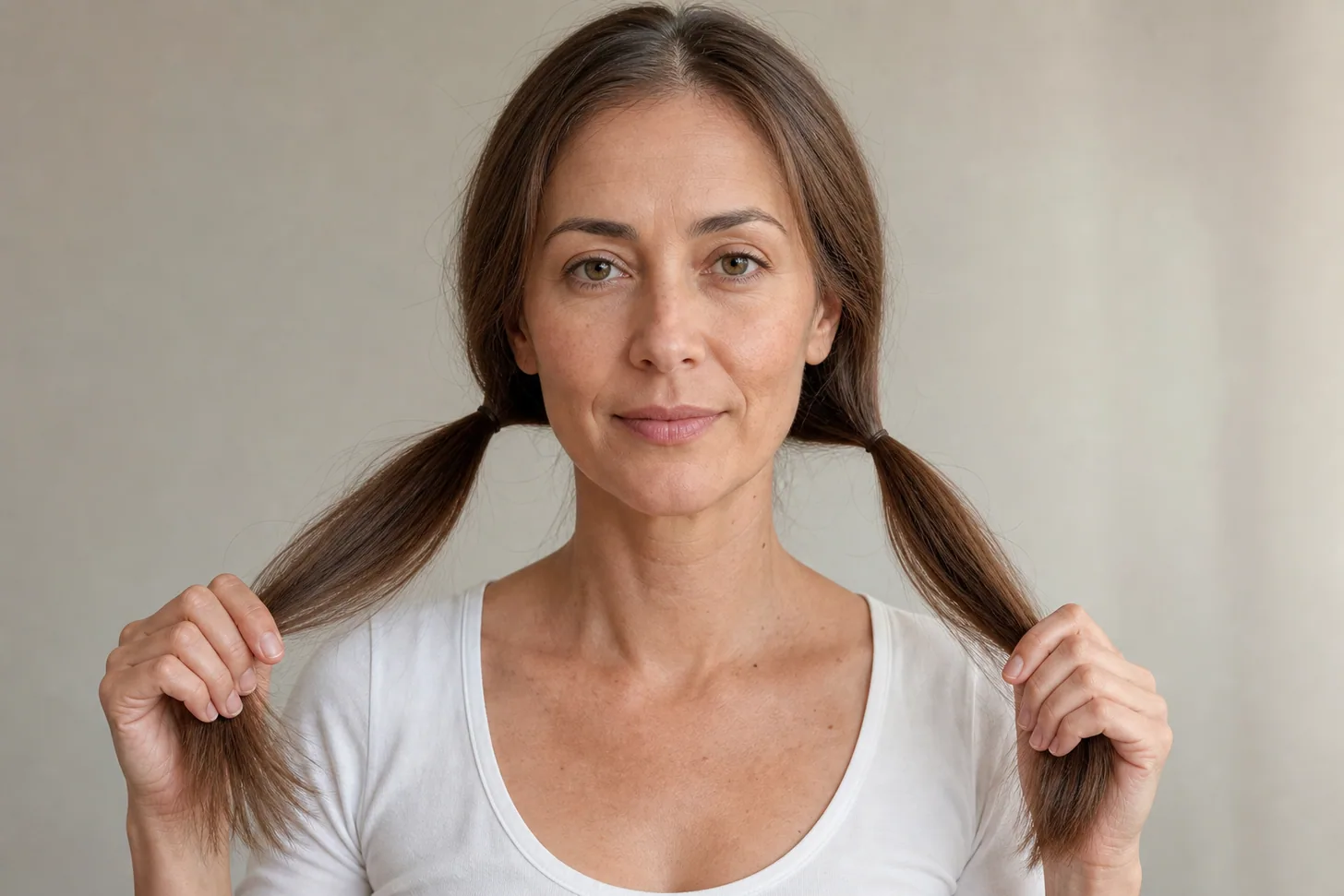
- Your ponytail feels thinner in your hand than it used to, or the elastic goes round an extra time.
- Moving the part doesn't help — the new position looks as open as the old one within a day.
Any of those, and the useful next page isn't this one. Start with fine hair or thinning?, which walks through the checks, and "I can see my scalp" for coverage strategy, with scalp concealers and root powders — or building fibers, if the thinning is diffuse rather than a line — as the same-day cosmetic fix while you sort the rest out.
Both being true at once — a genuinely fine head of hair with a genuinely widening part — is extremely common from the forties onward, and it isn't a contradiction. A widening part is also where the shampoo aisle overpromises most — best shampoo for thinning hair sorts the claims from the evidence.
Chair-side note
One thing I'd tell everyone with a long-standing part: photograph it. Overhead, in daylight, once every few months, same spot, same light. It sounds fussy and it takes ten seconds, and it's the single most useful thing you can bring to a stylist or a dermatologist. Nobody can remember what their part looked like eighteen months ago — we compare today against an idealised memory and lose every time.
A woman came to me convinced her part had doubled; she had photos, and it hadn't moved at all in two years. What had changed was that she'd started wearing her hair up, which exposed a part she'd previously covered. That's a five-minute conversation with evidence and a six-month spiral without it.
SB
Ask for a cut that suits your part, not the other way round
Most stylists cut to the part you walk in with, which means a part you've been meaning to change gets baked into the shape. Say it early:
- "I want to move my part to the left — can we cut it there rather than where it's sitting now?" Length distribution follows the part. Changing it after the cut is why one side suddenly seems too short.
- "Can you leave the pieces along my parting a little longer?" Short pieces at the seam stand up and widen the channel. Length there leans across and closes it.
- "No thinning shears near my part." Removing density at the one place scalp already shows is the worst trade available on fine hair — see over-thinned fine hair.
- "Does my crown want a part on this side?" A good stylist can see your growth pattern wet in about four seconds and will tell you if you're fighting it.
More on the whole conversation in what to ask your stylist. If you're growing out a fringe, the part interacts with it more than anything else you do — side-swept bangs live or die by the parting behind them.