Reviewed by Tara Sullivan · Updated August 2026 · 12 min read
This site tells you to ask for point-cut internal layers, no razor on more than sixty pages, and until now it has never explained either half. Here's the decoder — and the useful thing is that it collapses to one idea. Every cutting technique is a decision about weight: how much comes out, and from where.
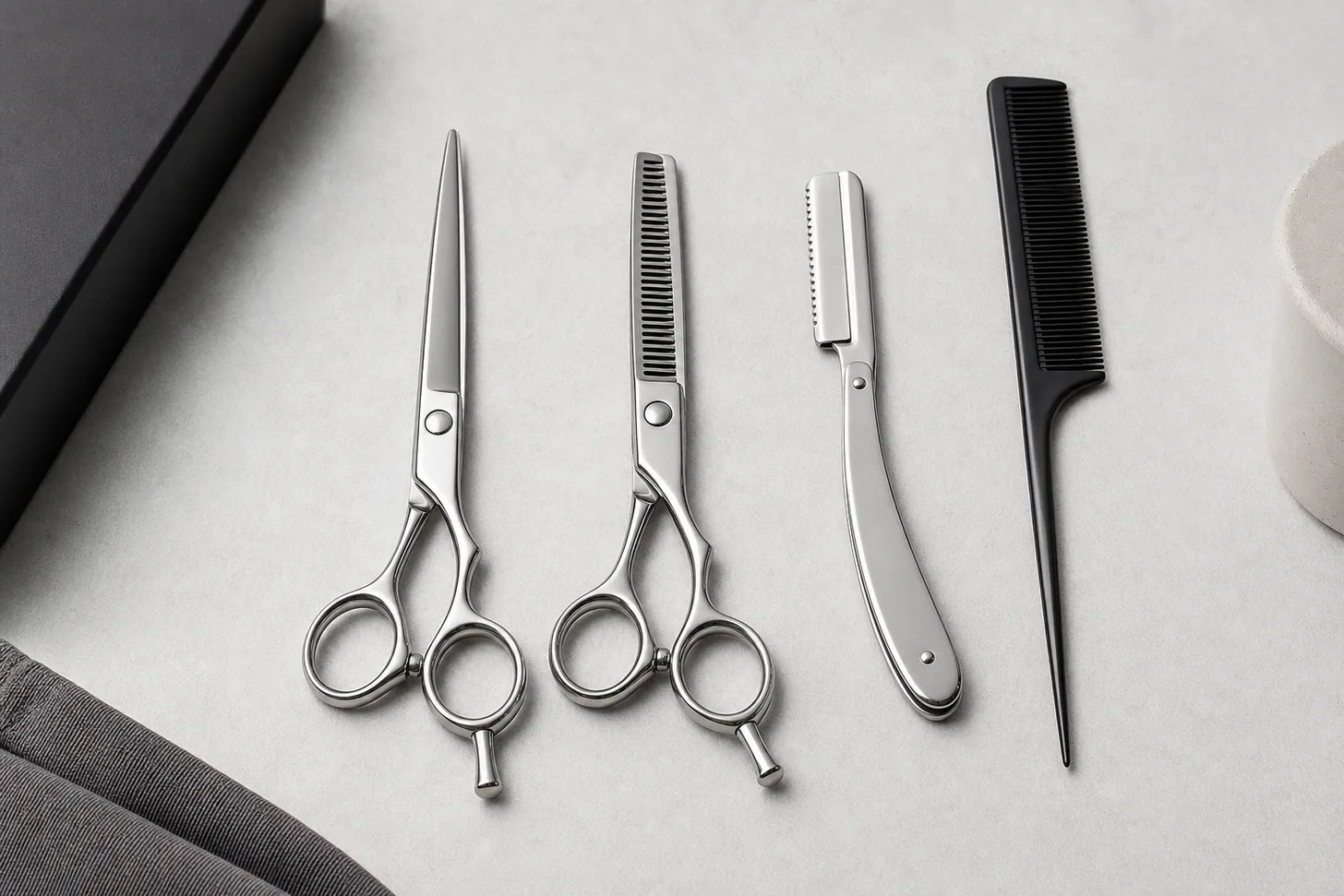
Blunt cutting keeps all of it at the outline. Point cutting softens the edge while removing almost none. Slide cutting takes a lot out along the length, fast. A razor thins the very tip of every strand.
Thinning shears remove density at a depth of the stylist's choosing. Graduation doesn't remove weight at all — it stacks it. Fine hair has very little weight to spend, so the techniques that suit it are the ones that redistribute rather than subtract, and the ones that hurt it are the ones designed to solve a problem you don't have: too much hair.
Below: each technique in plain terms, what it does to a fine head specifically, how to tell after the fact which one was used on you, and the exact sentences that get you the right one.
Three tools, three completely different decisions about your weight — and only one of them is usually right for fine hair.
One axis: it's all about weight
Salon vocabulary sounds like a list of unrelated skills. It isn't. Almost every technique is answering the same question — what happens to the weight? — and there are only three possible answers. The technique that keeps every bit of that weight at the outline has its own page — blunt cuts for thin hair.
Keep it. Blunt cutting, one-length cutting, a strong perimeter. The hair ends together, which is what makes an outline look solid.
Move it. Graduation, over-direction, layering. No density leaves the head; it's redistributed so that it piles up somewhere useful — usually the back or the crown, which is where fine hair collapses.
Remove it. Slide cutting, thinning shears, razoring, deep point cutting. Hair genuinely leaves. These exist because a lot of clients have too much hair and need it thinned down. Depth is what decides which category a cut falls into, and the choppy bob works that boundary in detail.
That third category is the whole problem. Most of the sophisticated-sounding techniques in a stylist's repertoire were developed to solve abundance, and a fine head of hair is the opposite brief. This isn't a criticism of the techniques — a razor in the right hands on the right head is a beautiful thing. It's that the default toolkit is calibrated for a client you aren't.
So when you hear a technique named, the only question worth asking is: does this keep my weight, move it, or take it away?
The techniques, one by one
Blunt cutting keeps every bit of weight at the outline
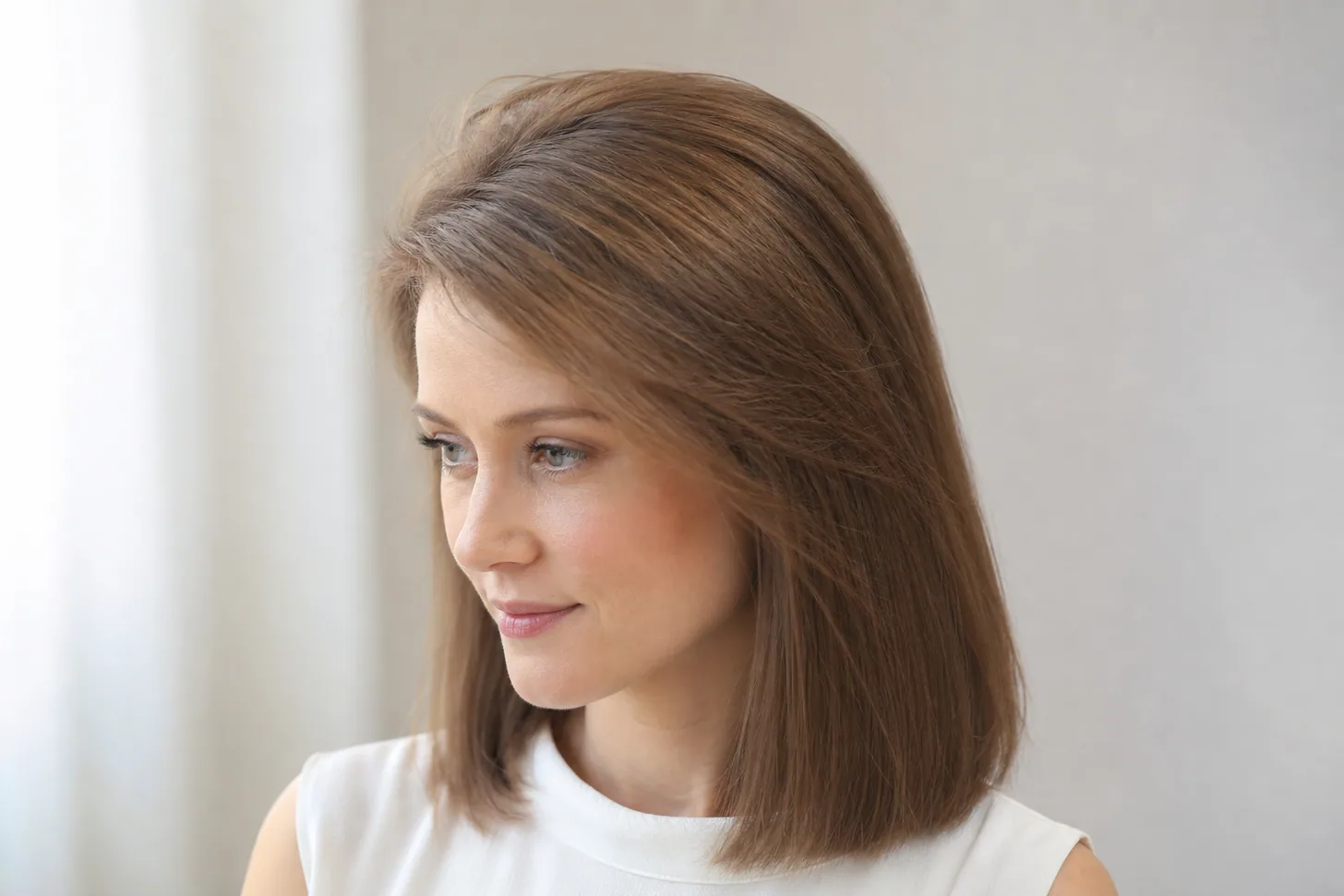
The scissors cross the section in a straight line, so every strand in that section ends at the same point. It's the simplest technique and the most flattering thing you can do to a fine perimeter, because a hard edge is read by the eye as thickness — all those ends finishing together create a visual density the individual hairs don't have.
The trade-off is that a fully blunt cut can look heavy or severe on some faces and needs a good trim schedule to stay crisp, since the line is the whole effect. It's the foundation of the bob for fine hair and of almost every good fine-hair shape.
Point cutting softens the line without paying for it
Scissors held vertically, cutting small notches into the ends rather than straight across. What you get is a softened edge that has lost almost none of its thickness — which is precisely the trade fine hair wants, because the usual way to soften a line is to remove weight from it, and you can't afford that.
Depth is the whole thing. Shallow point cutting, a few millimeters into the ends, softens. Deep point cutting an inch or more up the strand is a different technique wearing the same name and starts removing real weight. If you're asking for point cutting, ask for it shallow and on the ends.
Notching is point cutting with a heavier hand
Bigger, more deliberate chunks taken out of the line, usually to create a deliberately broken or piecey edge. It's a styling choice rather than a structural one and it's fine in small amounts on fine hair — but a notched perimeter is a perimeter with gaps in it, and gaps read as sparse from a distance.
Slide cutting removes weight along the whole length — the risky one
Slightly opened blades run down the section, taking hair out continuously from top to bottom rather than at the tip. Sometimes called slithering. It produces gorgeous movement on thick hair and it removes interior weight very quickly.
On fine hair it's the technique most likely to cause the outcome nobody can name afterwards: hair that has gone soft and shapeless after a cut that felt gentle in the chair. Because it works along the length rather than at the ends, there's no trimming it out — you grow it out. If a stylist starts sliding the blades down your sections without discussing it, that's a fair moment to ask what they're doing.
Razor cutting thins the tip of every strand
A blade cuts at an angle across the hair, leaving a long tapered point instead of a squared end. On thick hair that taper is the soft, piecey texture people book a razor cut for.
On fine hair the strand is already narrow, so tapering the last section of it leaves an end thinner than the hair above it — which is exactly the see-through perimeter you're trying to avoid. The taper also creates more surface for friction and frays more readily, especially if the blade isn't fresh or the hair isn't properly wet.
There are stylists who use a razor beautifully on fine hair, for interior texture only, and if yours is one of them you'll know from the results. As an instruction to someone you don't know well, no razor is the safer default.
Thinning shears solve a problem fine hair doesn't have
Teeth on one blade mean each closing removes only a fraction of the hairs in the section. Their entire purpose is taking bulk out of hair that has too much. Used on a fine head they remove density you won't get back for months, usually in the mid-lengths where the hair was still holding together, and the result is short broken-looking pieces standing out of the length and an outline that won't sit.
The one narrow legitimate use is a small amount at a specific bulky point — a heavy fringe, a thick nape. Otherwise this is the tool to name explicitly when you book.
Graduation stacks weight instead of removing it
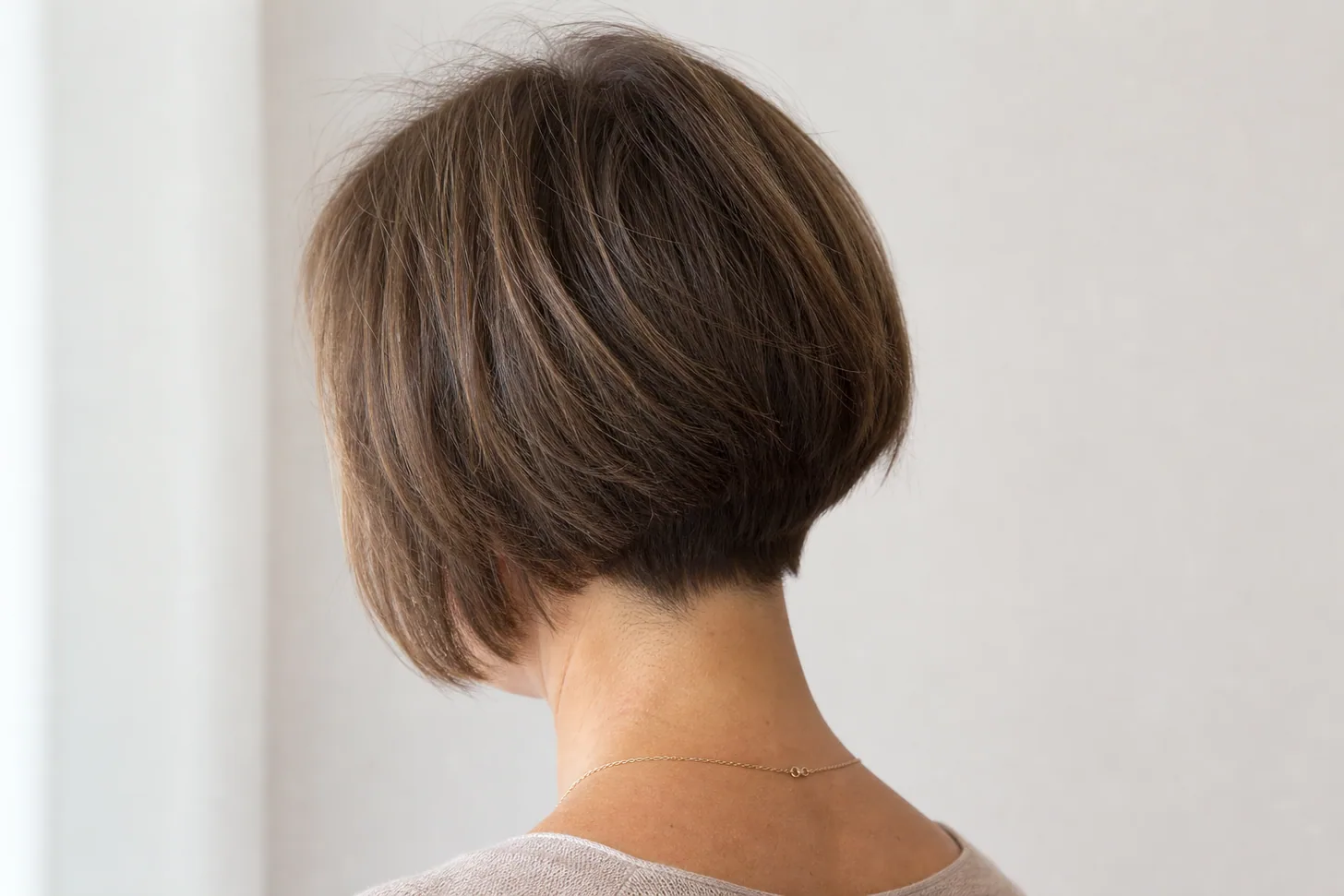
Cutting at an angle so layers pile on top of each other rather than falling past one another. It's how a graduated bob builds height at the back. Genuinely one of the best techniques available to fine hair, because it's one of the few that makes hair look like there's more of it.
Ask for soft graduation rather than stacked — steep graduation can look bulky on a small head and is much harder to grow out. See the stacked bob for thin hair for what it looks like taken further.
Layering moves weight up — and the placement is everything
Cutting sections shorter than the ones below so the hair has somewhere to sit. Layers themselves are neutral; where they're cut decides whether they help. Internal layers — short pieces hidden inside the shape — support the hair above them and lift the crown, which is the good version.
Perimeter layers take weight off the outline, which is the only place fine hair still looks solid. Do layers help or hurt fine hair? settles it in full, and ghost layers is the invisible-internal version.
Over-direction relocates length without cutting more off
The stylist pulls a section away from where it naturally falls before cutting, so it ends up longer than the sections around it. It's the quiet technique behind good face-framing and behind shapes that keep length at the front while shortening the back. Nothing extra is removed — it's pure redistribution, which makes it a fine-hair-friendly tool.
Dusting is a trim with a different intention
Taking a quarter to half an inch straight off the bottom, purely to remove worn ends and restore the line, with no change to the shape. It's the maintenance technique that keeps a fine perimeter looking honest between real cuts — see how often to trim fine hair.
Chair-side note
The thing I'd most like every fine-haired client to know is that "just take a bit of weight out" is the single most dangerous sentence you can say in a salon chair. You mean it feels heavy or it isn't moving. Your stylist hears a technical instruction to remove density, and the tools they reach for to do that are thinning shears and slide cutting — the two worst things for your hair.
I've spent whole appointments repairing a cut that started with a client saying exactly that and a stylist doing exactly what she was asked. If your hair feels heavy or lifeless, describe the symptom instead: it's flat at the crown, or the ends feel like a curtain. Those get you soft graduation and internal layers, which solve the same complaint by moving weight rather than removing it. Same problem, opposite tool.
SB
— Simone Baptiste, Senior Stylist
All of it, on one axis
Find the technique, check the second column, and you know most of what you need. Tapering the tips of the sections is what gets sold as a feather cut, which is worth reading separately because where the taper lands decides everything.
Technique
Weight
On fine hair
What to say
Blunt / one-length
Keeps it, all at the outline
The foundation — protect it
"Keep my perimeter blunt"
Point cutting (shallow)
Removes almost none
The default softener; safe
"Shallow point cutting on the ends only"
Notching
Removes a little, visibly
Fine in small amounts; gaps read as sparse
"Keep it subtle"
Slide cutting
Removes a lot, along the length
The one that quietly ruins fine shapes
"Please don't slide-cut my lengths"
Razor cutting
Thins the tip of every strand
Leaves a see-through perimeter
"No razor"
Thinning shears
Removes density at a chosen depth
Solves a problem you don't have
"No thinning shears, please"
Graduation
Moves it — stacks it up
One of the genuinely good ones
"Soft graduation at the back, not stacked"
Internal layers
Moves it — supports from inside
Good, when hidden and point-cut
"Take weight out from inside, not off the ends"
Over-direction
Moves it — relocates length
Good; pure redistribution
"Keep the front longer than the back"
Dusting
Removes worn ends only
Maintenance; keeps the line honest
"Just a dusting, straight across"
How to tell what was done to you
Worth doing on dry, unstyled hair in good light — and worth doing before your next appointment rather than after, because it tells you what to ask for and what to ask them not to repeat.
A clean line where the strands finish together. Blunt. This is the good news.
A softly broken edge, but the individual ends still look squared off close up. Point cutting, correctly done.
Wispy, tapered points; the perimeter looks translucent held against a window. Razor.
Short, blunt pieces at varying heights inside the length. Thinning shears. Run your fingers up a section against the grain — you'll feel stubble.
The length feels thinner in the middle than at the top, and the outline won't hold a line. Slide cutting.
A visible shelf or step rather than a blend. Layers cut too heavily or not blended, which is a different problem from technique choice — what to do about a bad haircut covers the triage.
One caveat before you conclude anything: if your ends look see-through and your ponytail also tapers to a point, that may be worn ends rather than the last cut. Fine hair thins at the perimeter naturally over months of handling, and that's a trim question rather than a technique question.
The sentences that get you the right technique
Take these with you. They work because they describe what should happen to your weight rather than naming a look, and weight is the thing the technique controls.
"Keep the perimeter blunt and take any weight out from inside." The single most useful sentence in this article, and the one most often assumed rather than said.
"Point-cut internal layers, please — no razor and no thinning shears." Names the technique you want and the two you don't, in one breath.
"Soft graduation at the back for body, not stacked." Asks for the good version of the useful technique.
"Shallow point cutting on the ends only." Softens the line without paying density for it.
"Please establish the shape wet, then check my ends dry before I leave." Where fine hair is actually won — wet versus dry cutting has the reasoning.
"Where is my density actually lowest?" Ask them to show you in the mirror. It's frequently not where you assume.
And the one to avoid: "just take some weight out." You mean it feels heavy. They hear an instruction to thin it. For the fuller conversation, the exact words to ask for a fuller-looking haircut is the complete script.
Chair-side note
None of this means you should narrate the haircut. There's a version of an informed client that makes a stylist's job impossible, and hovering over technique choices in real time is it. What works is doing it once, at the start: a thirty-second consultation where you say your hair is fine, you want to keep the perimeter, no razor and no thinning shears, and you'd like the ends checked dry.
Then let them work. A stylist who's good with fine hair will be relieved — you've just told them the three things they normally have to infer from a photo. And if the response to any of that is dismissive rather than curious, you've learned something useful in thirty seconds instead of at the end of the appointment.
Your ends have been see-through for months, through several cuts.Worn perimeter, not technique. Trims for fine hair is the fix.
Your part is widening or you can see scalp at the crown.No cutting technique addresses density loss. Start with fine hair or thinning?.
One section refuses to sit however it's cut.That's usually a growth pattern rather than a mistake — cowlicks on fine hair.
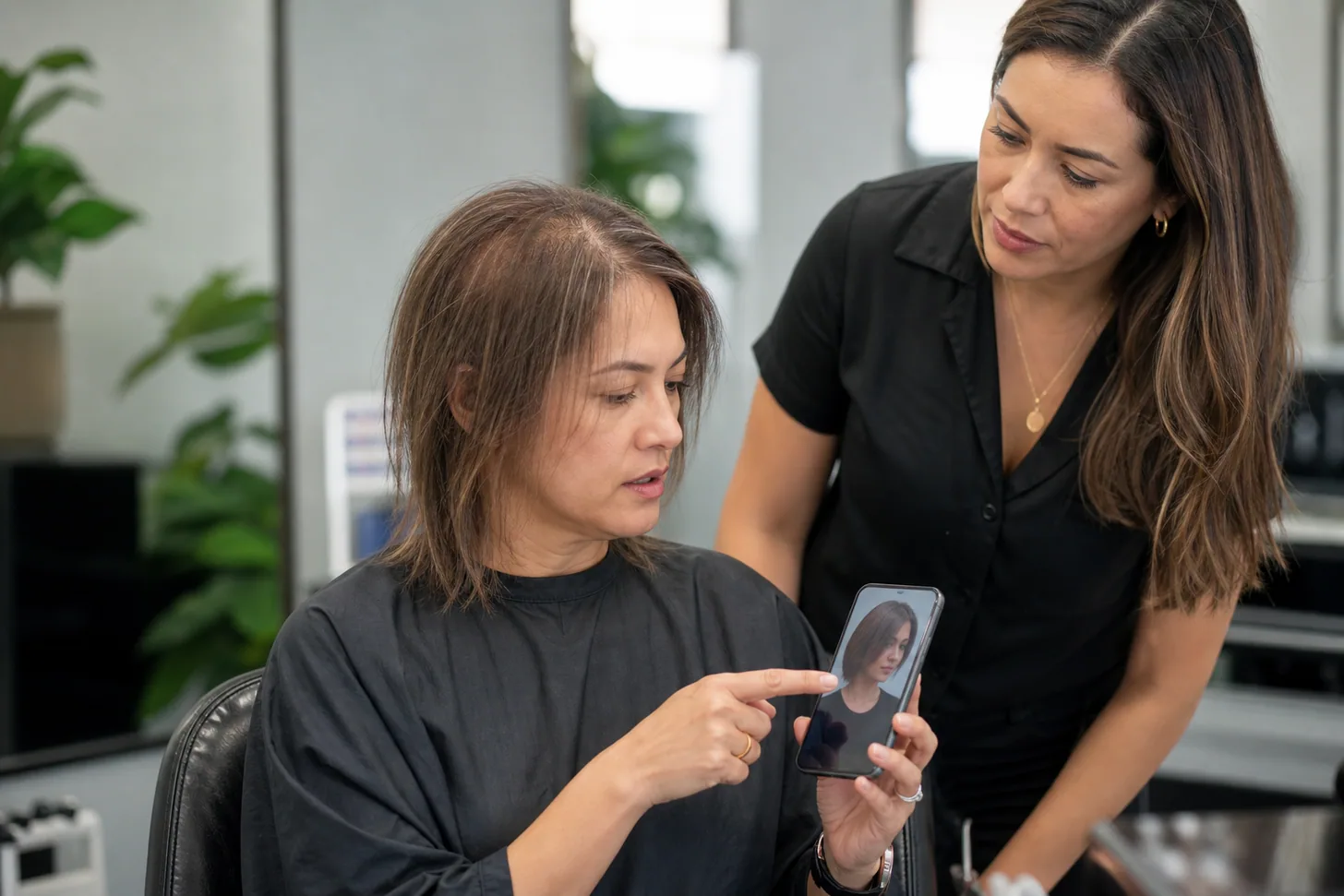
You brought a photo and got something different.Photos communicate a look, not a structure. That's the gap the salon script exists to close.
The cut is technically fine and you just don't like it.That's allowed, and it's a shape conversation rather than a technique one. The face-shape guide is a better starting point than a vocabulary list.
FAQ
Point cutting is cutting into the ends with the scissors held vertically, so the blades take small notches out of the hair rather than crossing it in a straight line. The result is a softened edge that still has most of its thickness, because very little hair is actually removed — exactly the trade fine hair wants. A hard blunt line can look severe, but a line softened by removing weight is a line that has lost the density it was relying on, and fine hair can't spare it. Point cutting gives the softness without the loss, which is why it's the default recommendation on this site. Depth matters: shallow point cutting, a few millimeters into the ends, softens; deep point cutting an inch up starts removing real weight and behaves like a different technique.
For most fine hair, yes, and the reason is mechanical rather than a matter of taste. A razor cuts at an angle across the strand, producing a long tapered tip instead of a squared-off end. On thick hair that taper creates the soft, piecey movement people book a razor cut for. On fine hair the strand is already narrow, so tapering the last portion leaves an end thinner than the hair above it — which reads as transparent, the opposite of what you want at the perimeter. The taper also creates more surface for friction and frays more readily, particularly if the razor isn't fresh or the hair isn't properly wet. There are stylists who use a razor beautifully on fine hair for interior texture only; as an instruction to someone you don't know well, "no razor" is safer.
Thinning shears — also called texturizing or blending shears — have teeth on one blade, so each closing removes only a fraction of the hair in the section rather than all of it. They exist to remove bulk from hair that has too much of it. Fine hair, almost by definition, doesn't. Used on fine hair they remove density you can't replace for months, typically in the mid-lengths where the hair was still holding together. The visible result is short broken-looking pieces sticking out of the length, an outline that won't sit, and often a puffy area where the shorter pieces push the longer ones up. The one narrow legitimate use is a small amount at a specific bulky point, such as a heavy fringe or a thick nape.
They look similar in the mirror and do very different things to your weight. Point cutting is vertical notching into the ends, removing a small amount to soften an edge. Slide cutting — sometimes called slithering — is running slightly open blades down the length of the section, removing weight continuously along the whole strand rather than at the tip. It creates a lot of movement and removes real interior weight quickly, which makes it excellent on thick hair and risky on fine hair. On a fine head it can take out the density that was holding the shape, and because it works along the length rather than at the ends the effect is difficult to correct except by growing it out. If your hair has gone soft and shapeless after a cut that felt gentle at the time, slide cutting is a likely explanation.
Graduation means cutting the hair at an angle so layers stack on top of one another rather than falling past each other, which builds height and weight in a specific place. It's the technique behind a graduated bob, where the back is shorter underneath and longer on top, so the hair piles up and creates fullness at the back of the head. On fine hair it's one of the genuinely useful techniques, because it's one of the few that makes hair look like there's more of it rather than less. Be specific about how much and where: soft graduation at the back builds body without changing the length you see in the mirror, while steep graduation creates a strong stacked shape that can look bulky on a small head and is much harder to grow out.
Both, in different parts of the same appointment — a stylist who does all of it one way is making it harder for themselves. Wet cutting is more precise and is right for establishing the outline and the internal structure, because wet hair is easy to control and section accurately. Dry finishing is where fine hair is actually won or lost, because only dry hair shows how the ends really sit, where a cowlick is pushing a section, and how much weight the perimeter genuinely has. The practical request is to establish the shape wet, then check and refine the ends dry — which is also when point cutting is best done, since you can see exactly how much softening the line is getting. Wet versus dry cutting has the full case.
Look at the ends and the outline in a mirror, on dry unstyled hair. A blunt cut ends in a clean line where the strands finish together. Point cutting leaves a softly broken edge, but the ends are still squared off individually when you look closely. Razor cutting leaves tapered, wispy points and the perimeter looks translucent held up to a window. Thinning shears leave short, blunt pieces at varying heights within the length — run your fingers up a section and feel for stubble. Slide cutting produces a length that feels thinner in the middle than at the top, with an outline that won't hold a line. Do this before your next appointment rather than after: it tells you what to ask for and what to ask them not to repeat.
Say what you want done to the weight rather than naming a look, because weight is what the technique controls. The core sentence is: "keep the perimeter blunt and take any weight out from inside." Follow it with "point-cut internal layers, please — no razor and no thinning shears." If your hair falls flat at the back, add "a little soft graduation at the back for body, not stacked." If you want the ends softened without losing thickness, say "shallow point cutting on the ends only." Then the two questions that matter more than any vocabulary: where is my density actually lowest, and will you check the ends dry before I leave? A stylist who's comfortable with fine hair will welcome all of it — you've just told them what they usually have to guess.
Eleven years cutting fine hair. Simone's rule for the chair: describe the symptom, not the solution — "it's flat at the crown" gets you a better cut than "take some weight out."
Images in this article are AI-generated illustrations, not photographs of real clients or results. See our image policy.
Results vary with hair type, density, and growth patterns. This guide is educational and not a substitute for an in-person consultation with a licensed stylist.
Get the good hair intel
One honest, stylist-written guide in your inbox each week. No hype.

 SB
SB