Reviewed by Tara Sullivan · Updated August 2026 · 10 min read
Search whether a feather cut suits thin hair and you'll be told confidently that feathering creates volume for fine hair — and, a page later, that feathered ends are the thing that makes fine hair look thinnest.
Both are true, about different cuts. Feathering is a taper at the tip of a section, and taper removes weight exactly where it lands. Put it in the surface layers and around the face and it buys you separation and movement while your outline stays solid. Put it in the perimeter and it tapers the one line that was carrying all your visible density.
Same technique, same word, opposite result — and no one tells you which one you're being sold. Below: what feathering actually is and how it differs from a layer, the depth to ask for in inches, 14 feather cuts for fine and thin hair from pixie to long, how the cut differs from a shag and a wolf cut, and the two versions to turn down.
Feathering at the front, a solid line at the bottom. That's the whole cut in one sentence.
A feather cut is a taper, and a taper is not a layer
The two words get used as if they were the same thing, and separating them is most of the reason this page exists.
A layer is a difference in length between sections. Lift a section, cut it shorter than the one below, and you've layered — the shorter piece now sits on top of the longer one and the weight is redistributed. That's the decision layers on fine hair is about.
Feathering is what happens at the tip of a section. Instead of stopping at a flat, blunt edge, the section is cut at an angle so it narrows to a point — thicker at the top of the taper, almost nothing at the very end. That produces the soft, drifting edge the cut is named for.
They usually arrive together, because a stylist who's layering will often taper the ends to blend one layer into the next. But they're separate choices, and on fine hair it's worth separating them out loud, because they cost you different things. Layers move weight around. Feathering removes it, at the most exposed inch of the strand.
Chair-side note
The word "feathered" is the least reliable instruction in a consultation, and it's not the client's fault. Every stylist calibrates it against whatever hair they've had in the chair that week, and for most of us that's average-to-thick hair, where feathering an inch and a half is nothing.
On fine hair an inch and a half is the difference between movement and the ends you can see the ceiling light through. So I've stopped treating it as a style word and started treating it as a measurement — I'll say "we're feathering, about an inch, front sections only, perimeter stays blunt" out loud before I start, and clients who've been burned before visibly relax when they hear a number.
SB
— Simone Baptiste, Senior Stylist
Where the feathering sits is what decides the outcome
Height on the strand is the whole variable. A taper an inch from the tip of a surface layer sits above the bottom edge and never shows in your outline. The identical taper applied to the bottom section is your outline.
That bottom edge does an enormous amount of work on fine hair. A solid perimeter is the single strongest visual cue that hair is dense, because the eye reads a hard line as mass and a soft, broken one as sparseness. It's why a blunt cut reads as thicker, and it's why the standard advice on fine hair is to protect the bottom line at almost any cost.
Where the taper lands
What it does
Verdict on fine hair
Face-framing pieces
Softens the hard edge next to the cheekbone and jaw; creates movement in the sections you actually see
The best place for it — flattering and costs no visible density
Surface layers, crown to mid-length
Separates the top sheet of hair into pieces, so light catches more surfaces
Good, kept shallow — this is where "fuller" comes from
Interior mid-lengths
Blends one layer into the next so the cut doesn't shelf
Fine in small amounts; invisible either way
The bottom perimeter
Tapers the outline itself; the ends narrow to points and light passes through them
No. This is the see-through-ends failure, and it only grows out
Underneath, below the perimeter
Removes weight you were never seeing, from hair that was supporting the layer above it
No. Costs density and buys nothing visible
There's a check you can run in the mirror at the end of the appointment, and it's the same one that catches over-layering: look at the very bottom edge of the dry hair. If it's a line you could nearly draw with a ruler, the feathering stayed where it belonged.
If it drifts off into separated, see-through pieces, the taper reached the perimeter — and no styling puts that back. Only growing it out and recutting will. Over-thinned fine hair covers what that grow-out actually looks like if you're already there.
One more variable moves all of this: wave. Any bend in the strand supplies its own separation, so fine wavy hair reaches a feathered look with roughly half the cutting straight fine hair needs. If your hair dries with even a soft S in it, ask for less than you think and add at the next appointment.
The number to ask for: about an inch, above the perimeter
Feathering is subjective and stylists calibrate it against the hair in front of them, which on most days isn't fine. Converting it into a measurement is the single most useful thing you can do in the consultation.
Roughly one inch of taper at the tip of an interior or surface section. On hair shorter than about four inches, halve it — an inch off a three-inch section is a third of the strand.
Nothing at all on the bottom perimeter section. That line stays blunt, or at most gets a light point-cut to soften the edge without tapering it. Point-cutting notches into the tip and removes a fraction of what a taper does; the two are not interchangeable, and the cutting-techniques glossary lays out the difference on a single axis.
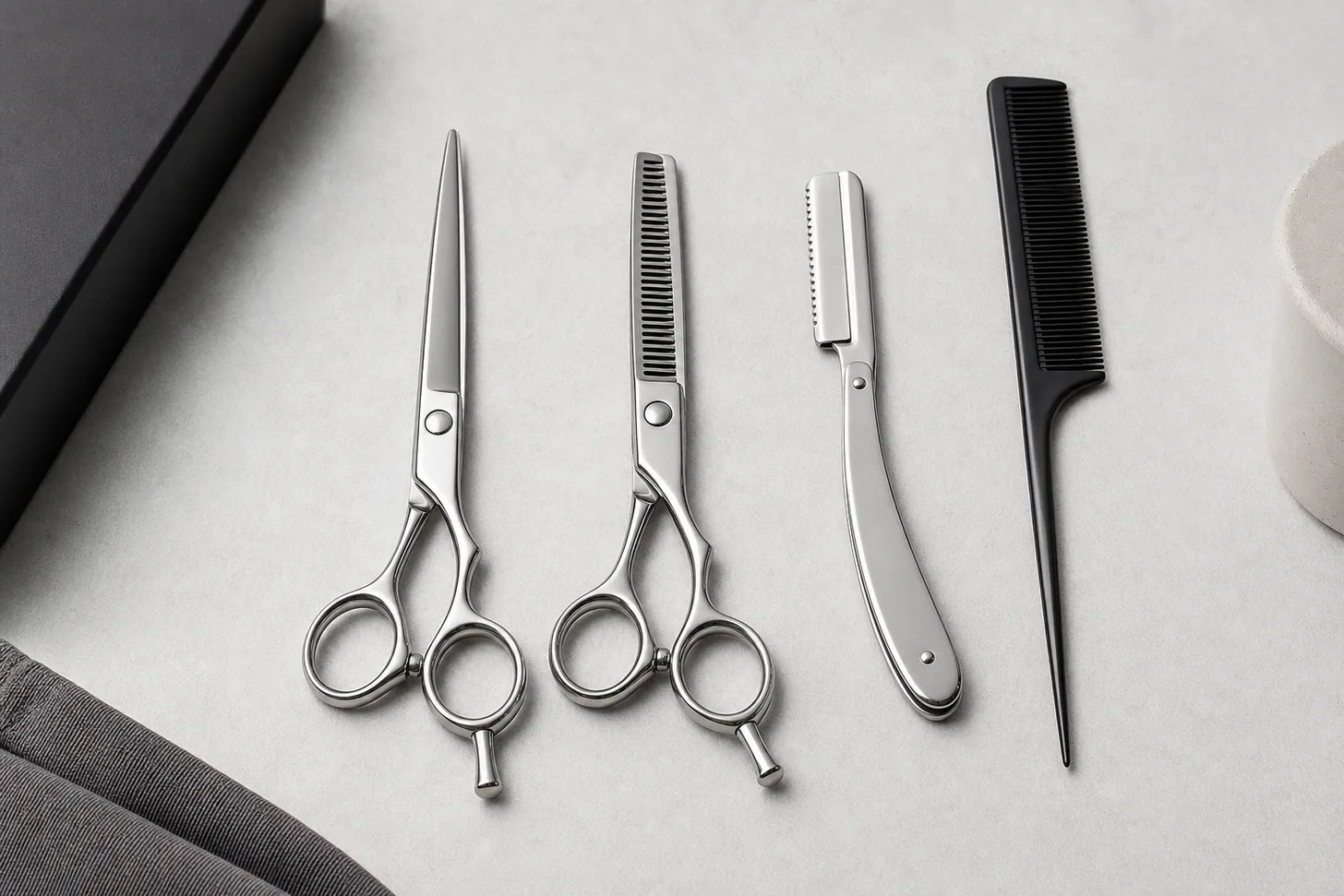
Scissors, not a razor. A razor tapers by slicing along the strand and is the fastest route to translucent ends on fine hair.
No thinning shears. They're a different tool with the same effect, and declining one doesn't decline the other — how thinning shears actually work explains why the tooth count matters more than the name.
Front-weighted. Concentrate the feathering in the sections that face the mirror. The back is where your density is read from and where you can least afford to spend it.
14 feather cuts for fine and thin hair
Ordered short to long. Every one of these keeps the perimeter intact — what changes between them is how high the feathering starts and how much of the head it covers.
Short feathered cuts — pixie to ear length
Softly feathered pixie on fine light brown hair with tapered pieces over the ears and a full crown, woman early 40s
1
The softly feathered pixie
Feathering earns its keep fastest at pixie length, because there's no perimeter to protect — the outline is the shape of your head, not a line at the bottom of your hair. The taper goes into the sides and the pieces over the ears so they lie against the head instead of shelfing out, while the crown is left long enough to lift. Ask for the top left alone entirely; that's where all the height in this cut comes from. Pixie cuts for fine hair has the full range.
Feathered crop with a long fringe swept to one side on fine blonde hair, cropped nape, woman late 30s
2
Feathered crop with a long side fringe
A short crop with all the taper concentrated in one long, sweeping front piece that falls from a deep side part to the cheekbone. The contrast does the work: everything behind the ear is compact and solid, and the one feathered section reads as movement precisely because nothing around it is doing the same thing. This is the version to choose if you like a short cut but find fully textured crops read as thin on you.
Feathered bixie cut on fine dark hair, longer than a pixie with soft tapered ends at the nape, woman early 30s
3
The feathered bixie
The bixie sits between a pixie and a bob, which makes it the shortest cut on this list where the perimeter starts to matter again — there's now a bottom line at the nape, and it should stay solid. Feather the sides and the top, leave the nape blunt, and you get a cut that moves at the front and holds a defined edge at the back. It suits fine hair that's dense enough to look heavy in a pixie. See the bixie on fine hair for the shape itself.
Ear-length feathered cut with wispy pieces around the temples on fine grey hair, woman in her sixties
4
Ear-length feathering for grey fine hair
Grey hair is usually wider in diameter than the pigmented hair it replaced, and more resistant, so it tends to stand away from the head in a short cut rather than lying down. A shallow feather through the sides settles it without removing bulk you can't spare. Keep the taper to half an inch and keep it above the ear line. Cuts for fine hair over 60 covers the wider question of what changes.
Feathered bobs and lobs
This is where the rule earns its money. A bob's whole effect comes from its bottom line, so the feathering has to stay above it — which is entirely possible, and produces a cut that swings and separates while still reading as solid from three feet away.
Chin-length feathered bob on fine blonde hair with a blunt bottom edge and tapered surface layers, woman mid 30s
5
The feathered chin bob
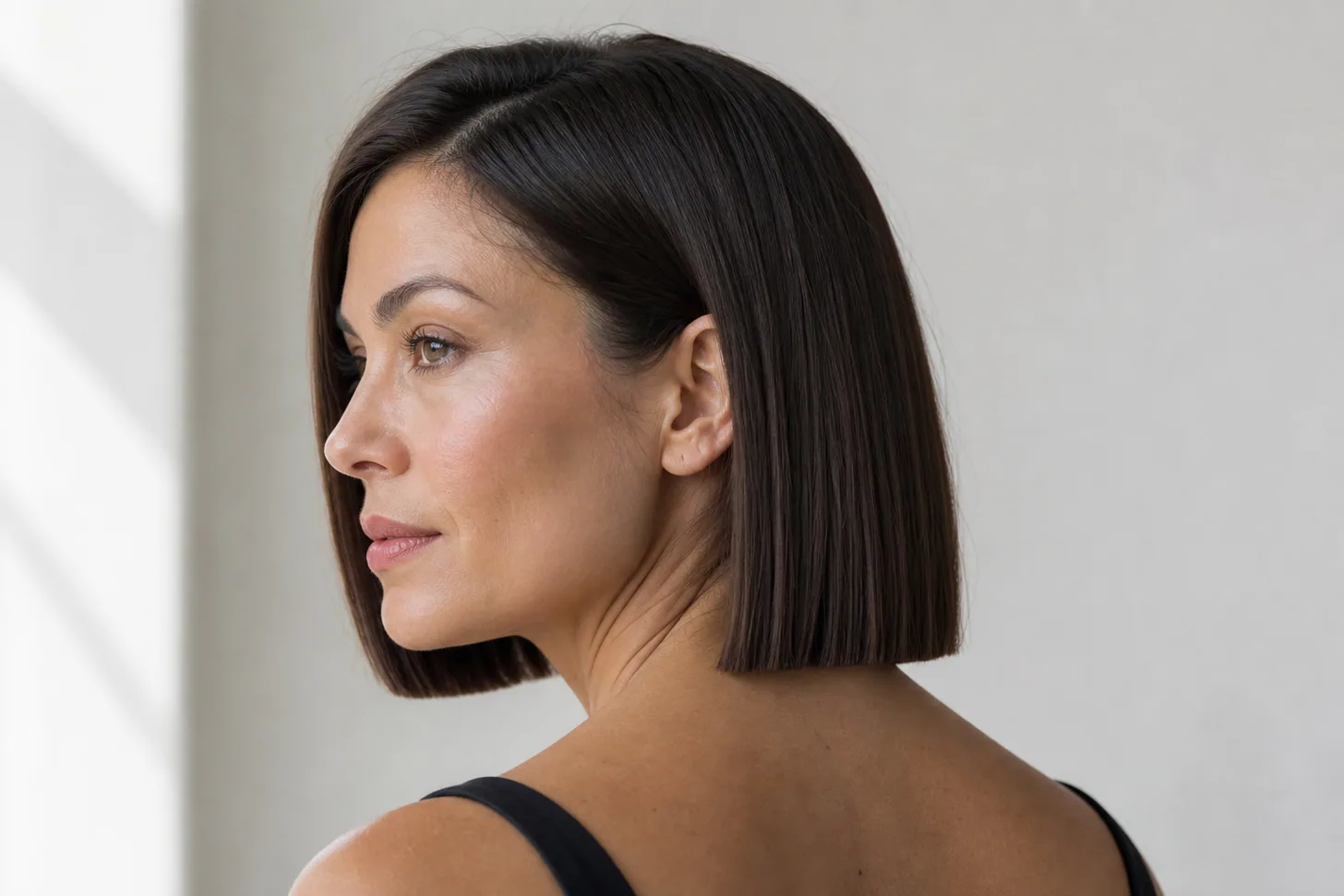
The most-requested version of this cut and the one most often ruined, because the obvious way to feather a bob is to taper the ends and that is exactly the thing not to do. Built correctly, the perimeter is cut blunt at the chin and the feathering goes into two or three surface layers above it, starting at cheekbone level. From the front you see separation and movement; from behind you see a solid line. The bob for fine hair is the parent cut.
Feathered lob just below the collarbone on fine mid-brown hair with face-framing taper, woman early 40s
6
The feathered lob
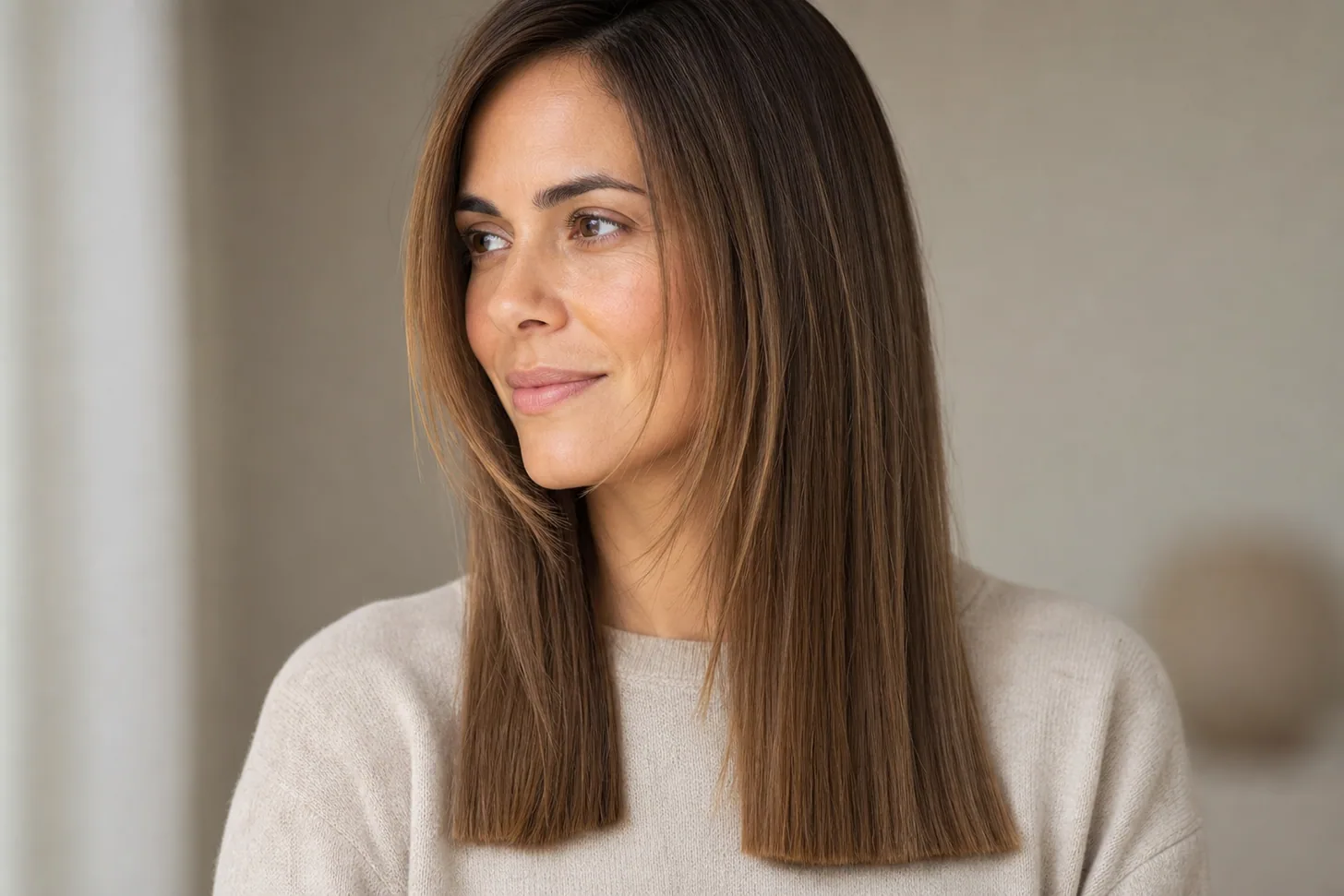
At collarbone length there's enough hair for the feathering to be visible without going anywhere near the ends. Ask for the taper to start at the jaw and stop about two inches above the perimeter — that gap is what keeps the bottom looking full. It's the most forgiving length on this page for a first feather cut, because if you decide you want less next time, you're growing out four inches rather than fourteen. Lob haircuts for fine hair has the length ladder.
Feathered bob with curtain bangs on fine dark blonde hair, soft centre-parted fringe, woman late 20s
7
Feathered bob with curtain bangs
The fringe and the cut are doing the same job here, which is why they read as one idea rather than two. A curtain fringe is feathered by definition — shortest at the nose, lengthening out to the cheekbones, with tapered tips so it drifts into the face-framing pieces rather than stopping dead. Extend the same taper into the front sections of the bob and the whole front of the head moves together. Curtain bangs on fine hair covers the fringe on its own.
Feathered A-line bob, shorter at the nape and longer at the front, fine chestnut hair, woman mid 40s
8
The feathered A-line bob
An A-line already builds weight at the back through graduation, which gives you something to spend at the front — so this is the one shape where slightly more feathering is affordable. Keep it in the two long front panels, where the angle carries the eye anyway, and leave the graduated back completely alone. A useful choice for fine hair that goes flat at the crown, since the stacked back supplies the height. Layered bobs for fine hair sits next door.
Mid-length and long feather cuts
Length works against fine hair — every extra inch is more weight pulling the roots flat — so at these lengths feathering is doing two jobs at once: creating movement, and shedding a little of the weight that's dragging the shape down. It still stays off the perimeter.
Shoulder-length feathered cut on fine straight hair with movement through the surface and a dense bottom line, woman early 30s
9
The shoulder-length feather cut
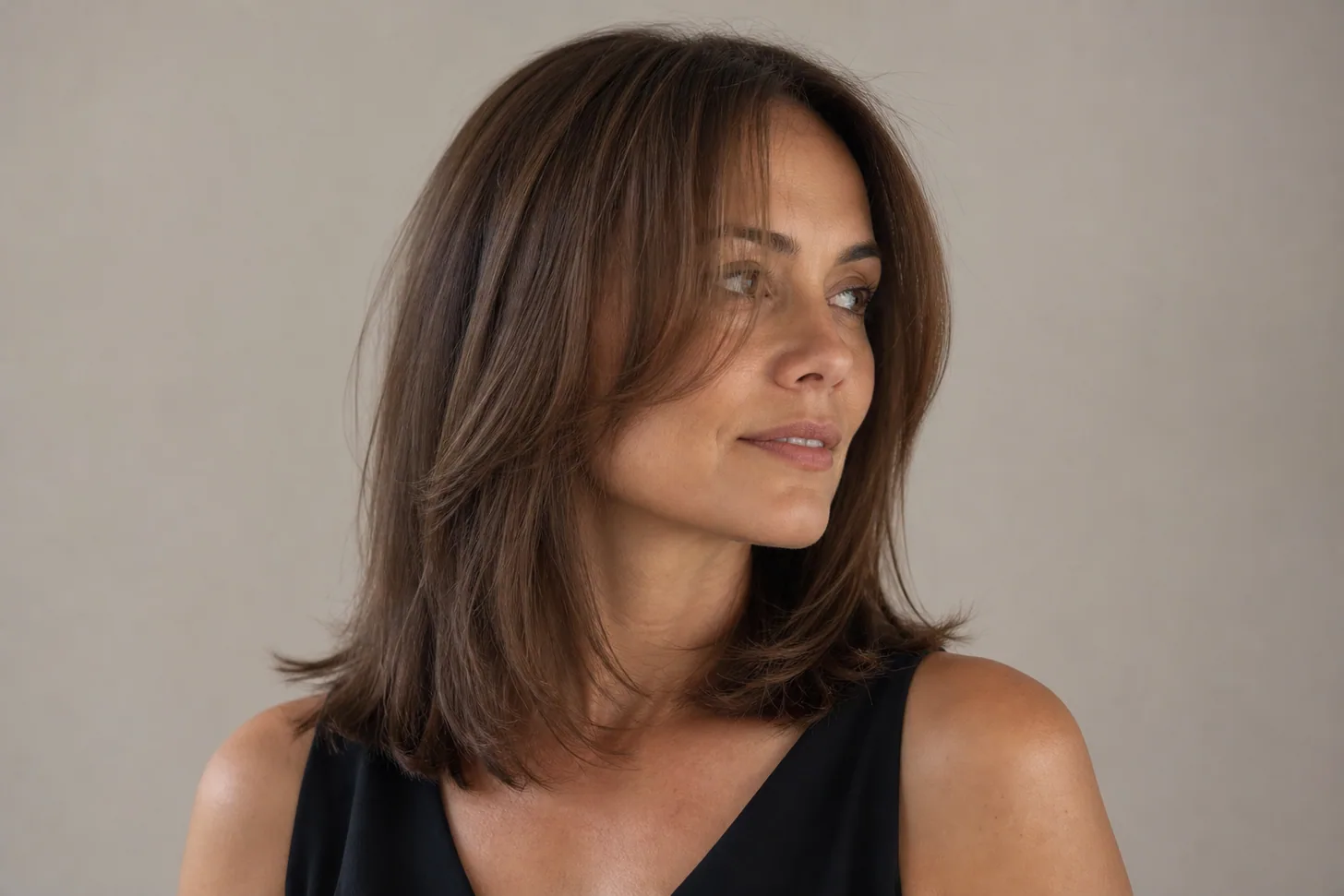
Shoulder length is where fine hair most often reports looking flat and stringy at once, and a shallow feather is a genuine fix for the second half of that. Two surface layers, tapered about an inch, starting at the jaw. Nothing underneath, nothing at the bottom. It won't add root lift — that's a styling problem, not a cutting one — but it stops the length reading as one flat sheet. Medium-length cuts for fine hair covers the length.
Long feathered cut with face-framing taper from cheekbone to collarbone on fine blonde hair, woman late 20s
10
Long hair with feathering only at the face
The most conservative feather cut there is, and the one I'd suggest to anyone nervous after a bad experience. The length stays entirely one length; the only tapered sections are the two pieces that frame the face, running from cheekbone to collarbone. You get the softness of the cut around the part of you people look at, and your outline is untouched. If it turns out you want more, that's a fifteen-minute conversation at the next appointment. Face-framing layers takes this further.
Long feathered cut with invisible internal layers on fine dark hair, solid perimeter, woman mid 30s
11
Long feathering hidden inside the length
The version where the feathering is deliberately invisible: the taper goes into interior sections that sit underneath the surface sheet, so it removes a little weight and lets the hair move without producing a single visible tapered end. It's the same logic as ghost layers, applied to the tips rather than to the lengths. Ask for it if long fine hair feels heavy and lifeless but you refuse to lose any visible density.
Long feathered cut with a middle part and soft tapered pieces beginning at the jaw, fine auburn hair, woman early 40s
12
Centre-parted long feathering
A centre part splits the front into two symmetrical panels and gives feathering an obvious place to start — right at the part line, tapering downward and outward from the jaw. The symmetry is what makes it read as deliberate rather than grown-out. Worth knowing that a centre part is the least forgiving on a fine or widening parting, so this suits fine hair with the density still intact at the top.
The retro versions, done carefully
The feather cut is a 1970s idea and the era's silhouette is back. The originals were cut on hair that was blow-dried into far more volume than most fine hair produces, so the versions worth asking for are the conservative ones.
Seventies-style feathered flick with front pieces curving away from the face, fine honey blonde hair, woman mid 30s
13
The '70s feathered flick, cut conservatively
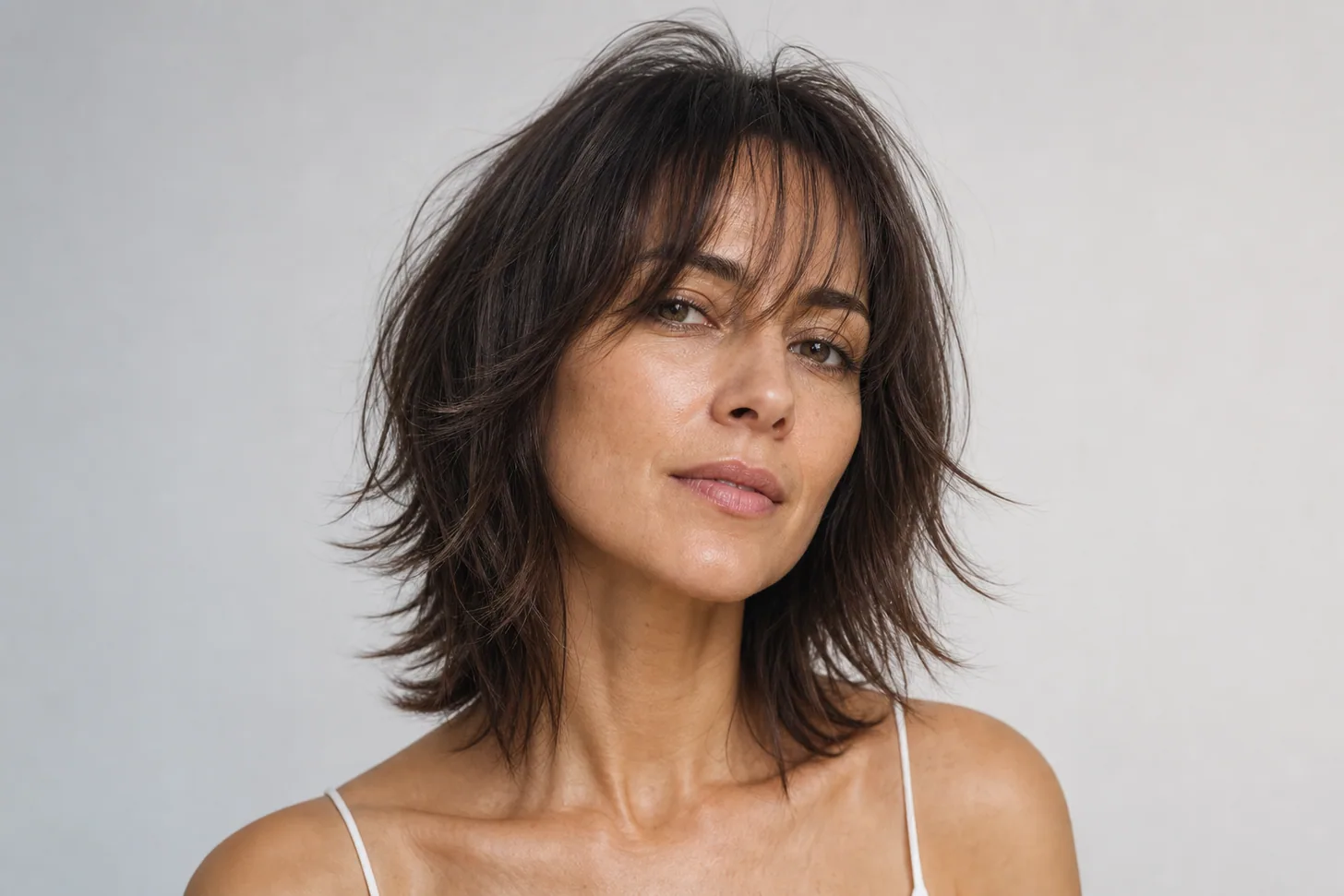
The Farrah shape, with the front sections tapered so they flick away from the face — but taken shallow, and only at the front, so fine hair keeps its weight everywhere else. The flick is a styling effect as much as a cutting one: it needs a round brush and a cool shot to set, which is about eight minutes every morning. Honest about it up front, because the cut looks unremarkable air-dried. The shag on fine hair covers the fully layered version of the same era.
Feathered fringe with long tapered ends melting into face-framing pieces, fine light brown hair, woman late 30s
14
The feathered fringe, on its own
You can buy the whole look with a fringe and nothing else. A feathered fringe is a wispy fringe taken slightly longer, with the ends tapered to fine points that drift into the pieces beside them — no blunt edge anywhere to expose how much hair is actually there. It's the lowest-commitment entry point on this page and it grows out into a curtain fringe rather than into a problem. Bangs for thin hair has all fourteen fringe types.
Feather cut vs shag vs wolf cut vs butterfly cut
These four names get used interchangeably online and they aren't the same thing. Three of them are shapes; one of them is a finish that can be applied to any shape, including the other three.
Cut
What it actually is
How it reads on fine hair
Feather cut
A finish — how the ends of the sections are tapered. Can be applied to a bob, a pixie, long hair or a shag
Good above the perimeter, bad at it. The most controllable option here
A shape — short face-framing layers over untouched long length, creating two apparent lengths
Kind to fine hair, because the long layer underneath is never cut into
The practical consequence: "a feather cut" isn't a shape you can point at, so bring a shape as well. Ask for a feathered bob, or a feathered lob, or long hair with feathered face-framing — a shape plus a finish. Asking for "a feather cut" alone leaves the shape entirely to your stylist's imagination.
The maintenance reality
A taper is the most fragile part of any haircut. The tip of a feathered section is the thinnest point on the strand, so it splits and frays before anything else does — and once it does, the effect stops reading as movement and starts reading as damage.
How much feathering
Trim cycle
What it looks like grown out
Face-framing only
10–12 weeks
Soft long layers. Genuinely fine to leave
Front sections and surface
8–10 weeks
Slightly shapeless at the front; still wearable
Worked through the whole head
6–8 weeks
Frayed tips before it loses shape — this is the one that dates badly
Short feathered cuts
5–6 weeks
Loses the shape entirely; it's a committed cut
Two styling notes that matter more on this cut than on most. Feathered ends show heat damage sooner than blunt ends do, because there's less mass to absorb it — so this is a cut that rewards a lower dryer temperature and a proper blow-dry method rather than more heat.
And a small amount of product on the tapered tips only, worked in with fingertips, is what makes the separation read as intentional; too much anywhere else and the whole thing goes limp.
What to ask your stylist
Bring the depth and the tools, in that order. Five sentences cover it.
"Feathered, but about an inch — and nothing on the bottom line."The measurement plus the exclusion. This is the whole page in one sentence, and it's the one that matters most.
"Point-cut with scissors. No razor."A razor is the fastest way to feather and the fastest way to translucent ends on fine hair.
"No thinning shears either."Say both. They're different tools with the same effect, and declining one doesn't decline the other.
"Keep it in the front sections — I'd rather not have it through the back."The front is where you see movement. The back is where your density is read from.
"Can we start conservative and add more if I want it?"Feathering can always be taken further at the next appointment. It cannot be undone at this one.
Your ends are already see-through or wispy. Feathering will deepen exactly the effect you're trying to fix. Grow the perimeter back to a solid line first — over-thinned fine hair has the timeline.
You have fine hair and low density together. There isn't enough hair for separation to read as movement; it reads as gaps. A blunt cut is doing the opposite job and will serve you better.
Your hair is fine but very dense. Then feathering will genuinely help, and you can afford more of it than this page allows — check which you are with the strand and density tests before you go conservative unnecessarily.
You want volume at the roots. Feathering happens at the ends and cannot lift a root. That's a volume question, and it's answered with cutting weight out higher up or with styling.
You can't get back to the salon inside three months. A frayed feather cut looks worse than no feathering at all. Take the face-framing-only version — it's the one that grows out gracefully.
You're being sold "feathering to add volume" without a depth or a plan for the perimeter. That's the phrase that precedes most of the recovery appointments I see. Ask where it's going before you agree.
FAQ
It depends entirely on where the feathering sits, and that's why you'll find the internet arguing about it. Feathering is a taper — the ends of a section are cut at an angle so they narrow to a point instead of stopping at a blunt edge. Applied to the surface layers, the face-framing pieces and the mid-lengths, it creates separation and movement while the bottom edge stays dense, and fine hair looks fuller for it. Applied to the perimeter itself, it tapers the one line that was carrying all your visible density, and the ends go see-through. Same technique, same name, opposite outcome. Ask for feathering above the perimeter and a blunt or point-cut bottom line.
A layer is a difference in length between sections; feathering is what happens at the tip of a section. You can have layers with blunt ends, and you can feather a one-length cut with no layers at all. They usually travel together because a stylist who's layering will often taper the ends of each layer to blend them, but they're separate decisions and on fine hair it's worth separating them out loud. Layers redistribute weight; feathering removes it at the very end of the strand. That's why the safe instruction on fine hair is conservative layers with feathering kept shallow, rather than a general request for a feather cut.
A shag is a shape and a feather cut is a finish. A shag has a defined architecture — a short, layered crown over a longer perimeter, usually with a fringe — and you'd recognise it in silhouette. Feathering describes how the ends of the sections are cut, and it can be applied to a bob, a lob, a pixie or a shag. The overlap is real, because the classic 1970s shag was feathered throughout, which is why the two words get used interchangeably. But you can ask for a feathered bob and be understood, and a bob is not a shag.
It can make hair look fuller, which isn't the same thing and is worth being precise about. Feathering above the perimeter creates separation between pieces, and separated pieces catch light on more surfaces, so the hair reads as having more body and movement. What it cannot do is add density — and if the taper reaches the bottom edge it will actively reduce the appearance of density, because a solid perimeter line is the strongest visual cue that hair is thick. So: fuller-looking through the mid-lengths, yes. Thicker at the ends, no, and attempting it there backfires.
About an inch of taper at the tip of an interior section, and none at all on the bottom perimeter section. That's the number worth bringing to the salon, because feathering is otherwise an entirely subjective word and stylists calibrate it against the hair in front of them, most of which isn't fine. Concentrate it where you see it — the front sections and the surface — rather than throughout, and keep the underneath and the perimeter untouched so the outline stays solid. If your hair has any natural wave, halve everything: a bend supplies its own separation, so wavy fine hair reaches a feathered look with considerably less cutting.
Scissors, and it's worth saying so explicitly because a razor is the fastest way to feather and many stylists reach for it by default. A razor tapers by slicing along the strand, which thins the last inch or two of every hair it touches and leaves fine ends translucent and prone to splitting. Point-cutting with scissors produces the same visual separation by notching into the tip and removing far less. The sentence to use is: feathered, but point-cut with scissors, no razor and no thinning shears.
Every eight to ten weeks if the feathering is shallow and concentrated at the front, and every six if it's worked through the whole head. The reason is that a taper is the most fragile part of any cut: the very tip of a feathered section is the thinnest part of the strand, so it splits and frays first, and once it does the effect stops reading as movement and starts reading as damage. A grown-out feather cut is a forgiving thing — it just becomes soft layers — but a frayed one isn't, and the difference is roughly two months.
Yes, and it's one of the better options, with one adjustment. Hair generally becomes finer with age and the face benefits from softness around it, which is exactly what feathering at the front supplies — it's why the softly feathered fringe and face frame are so common in cuts for women over sixty. The adjustment is that older fine hair is usually also lower in density, so the perimeter has to be protected even more carefully than usual. Feather the front, keep the bottom edge blunt, and let the movement live where it flatters the face rather than where it costs you fullness.
Eleven years behind the chair, cutting fine and thin hair into shapes that hold. Simone's rule on feathering is that it belongs everywhere except the one line people most want it on — and that any style word without a number attached is a word worth pinning down before the scissors open.
Images in this article are AI-generated illustrations, not photographs of real clients or results. See our image policy.
Results vary with hair type, density, and growth patterns. This guide is educational and not a substitute for an in-person consultation with a licensed stylist.
Get the good hair intel
One honest, stylist-written guide in your inbox each week. No hype.

 SB
SB