Reviewed by Tara Sullivan · Updated August 2026 · 11 min read
"Fine hair doesn't hold" gets repeated so often that it's treated as a property of the hair rather than something with a mechanism — and the mechanism is worth twenty seconds of your morning, because it's where nearly everyone loses the style.
A style is a temporary re-set of the hydrogen bonds inside the hair. Those bonds break when hair is wet or hot, and they re-form as it dries and cools — which means the shape is decided on the way down, not while the heat is on. Let a curl fall out of the iron and hang while it's still warm, and the bonds re-form in the shape of a straight strand hanging down: you have just used a curling iron to set your hair straight.
Fine hair loses this twice over. It heats and cools faster, so the window where the shape is still soft and settable is shorter and easier to miss — and it has less mass holding the new position, so anything half-set gives up sooner. Below: the four levers that decide whether it holds, a symptom table for working out which one you're missing, why humid days undo everything, and the honest shelf life nobody tells you about.
The part of the process that decides everything, and the part almost everyone skips.
A style is a bond, and bonds set on the way down
Inside each strand, keratin chains are held in position partly by hydrogen bonds — weak, temporary links that break easily and re-form just as easily. They're what makes hair styleable at all.
The shape happens when they re-form — and they re-form in whatever position the hair happens to be in at the moment it finishes drying and cooling. That's the whole trick. The heat is permission; the cooling is the decision.
Which reframes what a hot tool is actually for. You aren't "curling" hair with a curling iron. You're softening it so it can be wound into a shape, and then the shape is set — or lost — in the seconds after it leaves the barrel. The same is true of a round brush, a roller set, a wrap, a braid left in overnight. Every one of them is the same process: soften, position, and hold until cold.
And it's true in reverse, which is why humidity is a problem rather than an annoyance. More on that below.
Why fine hair loses this twice
Nothing above is specific to fine hair. What's specific is that fine hair is penalised at both ends of the process.
It heats and cools faster. A thinner strand has less mass to bring up to temperature and less mass to hold that temperature afterwards. The practical effect is a shorter working window: a section that would still be warm and settable on thick hair has already cooled — in the wrong shape — on yours. It's also why fine hair needs less heat, not more, which is covered properly in the temperature fine hair actually needs.
And it has less mass to hold the result. Whatever shape does set has to resist gravity, movement and moisture all day, with very little material doing the resisting. A half-set curl on thick hair still looks like a wave by evening. The same half-set curl on fine hair is gone by eleven.
The consequence is not that fine hair can't hold. It's that fine hair has no tolerance for a sloppy set. On thick hair, technique errors get absorbed. On fine hair they're the whole result — which is genuinely annoying, and also good news, because technique is free.
Chair-side note
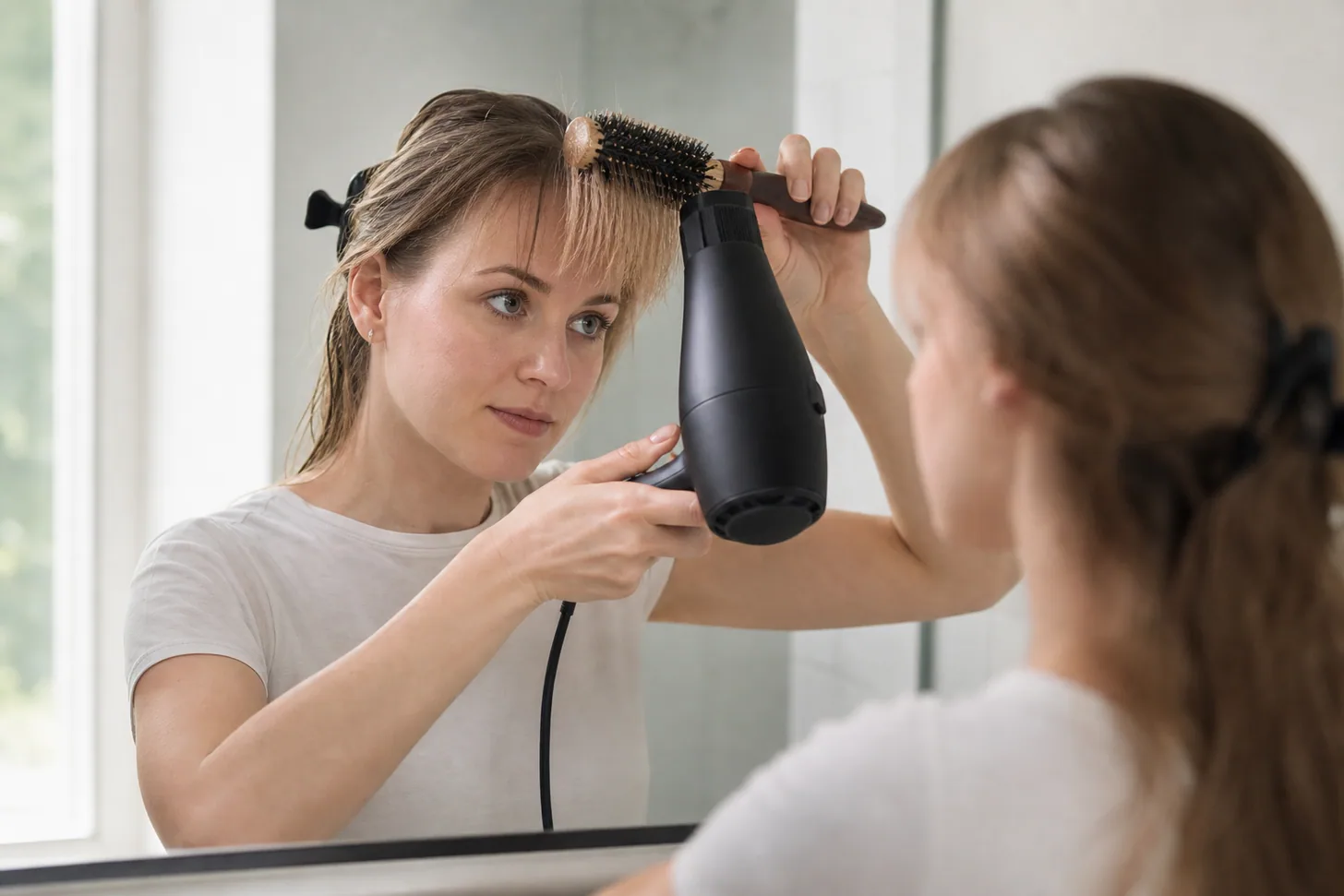
The reason a salon blow-dry lasts three days and yours lasts three hours usually isn't the dryer, the products or the stylist's wrist. It's that we don't let go. Watch a proper blow-out and you'll see the brush stay in the section after the dryer has stopped — sometimes for a full ten or fifteen seconds — while the hair cools around it. Then it gets pinned or clipped and left.
Nothing comes down until the whole head is cold. At home, people pull the brush out the second the section looks dry, and the hair falls into place warm and soft and resets in the position it landed in. I've had clients convinced they needed a new dryer who fixed it in one appointment by counting to fifteen. That's the entire difference, and it costs nothing but patience.
SB
— Simone Baptiste, Senior Stylist
The four levers, in order of how much they matter
1. Cool it completely before you let go
The biggest by a distance, and the one almost everyone skips. Whatever shape you want, the hair has to be held in it until it is genuinely cold — not "not hot", cold to the back of your hand.
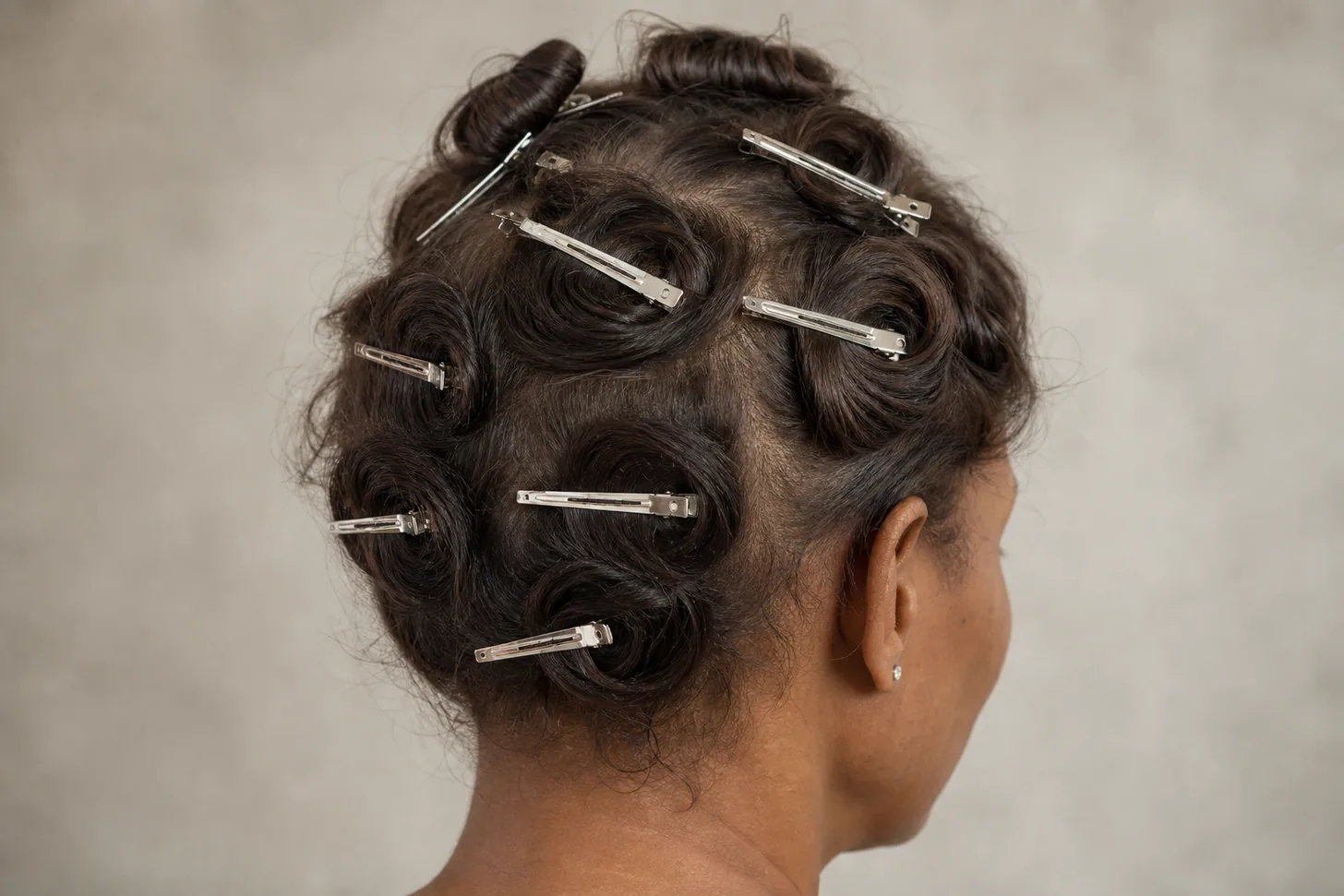
In practice that means: catch each curl in your palm as it leaves the iron and pin it flat to your head. Leave the round brush in the section for ten to fifteen seconds after the dryer stops. Use the cool shot, which isn't a gimmick — it's the fastest way to get through the setting phase. And with rollers, the rule is simply that you take them out when the hair is cold, never when it's merely dry.
Give it longer than feels reasonable. Ten minutes with everything pinned, while you do your makeup, is the highest-return ten minutes in this article.
2. Dry means dry, not nearly dry
Water in the hair means bonds that haven't re-formed yet. A style built on hair that's still slightly damp at the root is a style that is already half undone, and it will drop within the hour no matter what you spray on it.
Fine hair makes this easy to get wrong, because the surface dries long before the root does — it feels finished when the inner part of the section still isn't. Check the root of the section between your fingers, not the ends. And never put a hot tool on hair that isn't fully dry: the water flashes to steam inside the strand, which damages it and doesn't set it.
3. Give it something to grip
A style is held partly by friction between strands. A pinned curl, an updo, a backcombed root — all of them need the hairs to grab each other, and freshly washed fine hair is smooth, clean and slippery enough that they simply don't.
Two ways to fix it. Style on second-day hair, which is why stylists ask clients to arrive with day-old hair for an occasion. Or add grip on wash day with a texture spray or a light mousse at the root before drying. On very fine hair this lever is closer to essential than optional.
4. Splint it — last, and lightly
Hairspray dries into a thin polymer film that braces the strands mechanically. It's genuinely useful and it is not a substitute for the other three, because a splint holds whatever position you put it on. Spray a warm curl and you brace a shape that's halfway to falling out.
So: cold first, spray second. And lightly — a heavy application puts weight at the root and drags down the volume it was meant to protect. A light mist from about a foot away, over a cold set, holds better than a drenching, with a fraction of the weight.
The timing of the failure tells you which one, and they need different fixes.
What happens
What it means
The lever
Curls drop within an hour of leaving the house
The set never completed — released warm
Cool it completely (1)
Volume gone by mid-morning, hair looks clean
Roots dried in the direction they fall, or still damp
Dry properly, against the fall (1 and 2)
Updo or pinned style slips out
No friction — hair too clean and slippery
Grip (3)
Style holds shape but sits flat against the head
Weight — too much product, or too heavy a formula
Not a hold problem; use less
Fine on dry days, collapses when it's damp or raining
Moisture is re-breaking the bonds
Humidity — plan around it
Stiff and flat at the same time
Strong-hold product compensating for technique
Fix 1–3, then use less of (4)
Nothing holds, at any length, ever
Likely the cut rather than the styling
See the caveat below
Humid days, and why nothing is immune
If the mechanism above is right, humidity has to undo a style — and it does, by exactly the route you'd predict. The bonds you re-set while styling can be broken again by water, and damp air supplies water continuously over hours. As they release, the hair drifts back toward the shape it naturally takes: curls loosen, a blow-dry goes soft, a smooth surface roughens.
Fine hair shows it first, for the same mass reason as everything else on this page — there's less of it resisting the change.
What honestly helps: a polymer film buys real time, because a braced fiber resists moving even as the bonds let go. A style with some grip in it survives longer than a slippery one. And a shape that's meant to be soft — a wave, a tousle, a loose pin-up — degrades gracefully, while a sleek blow-dry has nowhere to go but frizzy.
What doesn't: more product, a hotter tool, or a stronger hold. On a genuinely humid day the correct move is to plan for a refresh rather than to fight it, and to pick the style on the weather rather than in spite of it. Taming frizz on fine hair and fine hair in summer both go further into this.
Chair-side note
Something I say to brides and never get to say often enough: the goal isn't a style that can't fall — it's a style that looks intentional at hour eight. Those are different design problems. A tight, smooth, perfectly uniform set has exactly one good state and everything after that reads as it collapsing.
A style built with a bit of texture and asymmetry in it has a whole range of acceptable states, and by the evening it just looks softer rather than undone. On fine hair especially, I'd rather set something loosely and let it relax than set it hard and watch it lose. If you have one event to get through, ask for the version that ages well, and pack two pins.
SB
— Simone Baptiste, Senior Stylist
The honest shelf life
Even done perfectly, a set on fine hair has a lifespan, and knowing roughly what it is stops you concluding you did something wrong.
A properly cooled curl set: a full day, softening as it goes, and often better on the second day than the first if you sleep on it carefully. Sleeping with fine hair covers how to keep it.
Root volume from a blow-dry: most of a day if the roots were dried against the fall and cooled. Half a day if they weren't.
A pinned updo on clean hair: a few hours. On day-two hair or with texture spray, all evening.
Anything on a genuinely humid day: discount everything above by roughly half.
If your expectation was "all day, every day, without touching it", that expectation is the thing to adjust rather than the products. Building a two-minute mid-day refresh into the plan is more effective than any purchase — and on fine hair it's what people who always look put-together are quietly doing.
Shape choice affects shelf life as much as technique does: a bend degrades gracefully where a coil collapses, which is the argument in curling fine hair with a flat iron.
It's flat straight out of the shower, before any styling.Different problem. Why fine hair falls flat works through the five real causes.
It feels coated or slightly tacky.That's product weight, not a failure to set, and more hold makes it worse. See the order to apply hair products.
Your hair is very long and very fine.Length is weight, and weight pulls a set out. Two inches off does more for hold than any product — trims for fine hair.
Your hair has recently been lightened or chemically treated.More porous hair takes and loses moisture faster, so sets both grab quicker and drop sooner. Adjust the timing rather than the product.
You're using heat on hair that isn't fully dry.That isn't a styling shortcut, it's damage — and it doesn't set. Heat protectants for fine hair covers the rest of the safety picture.
FAQ
Almost always because the style was released before it cooled. A style is a temporary re-set of the hydrogen bonds inside the hair, and those bonds break when hair is wet or hot and re-form as it dries and cools — so the shape is decided in the twenty or thirty seconds after the heat comes off, not while the heat is on. Let a curl drop out of the iron and hang while it's still warm and the bonds re-form in the shape of a straight strand hanging down: you've used a curling iron to set your hair straight. Fine hair loses this twice over. It heats and cools faster, so the window where the shape is still settable is shorter and easier to miss. And it has less mass holding the new shape, so anything half-set gives up sooner.
When it cools, and this is the single most useful fact in styling. Heat and water do the same job from opposite directions: both break the hydrogen bonds holding the hair in its current shape — which is why a hair cosmetics review describes straightening by saying the hair is remodeled straight because water breaks hydrogen bonds of the keratin molecule, as happens in a regular blow-dry. Breaking the bonds only makes the hair moldable. They then re-form in whatever position the hair is in at the moment it dries and cools, and that's the shape you get. So the heat is the permission and the cooling is the decision. Practically: hold the hair in the shape you want until it's genuinely cold to the touch, which is longer than it feels.
Catch each curl in your palm as it leaves the iron, pin it to your head, and leave every pin in until the whole head is cold. This one habit does more than any product. The curl comes off the barrel hot and soft, and if it's allowed to hang it stretches under its own weight and sets long and loose; pinned in a coil against the head, it cools in the shape you wound it in. Give it at least ten minutes, then take the pins out and separate with fingers rather than a brush. Two supporting details: style on day-two hair or add a texture spray first, because freshly washed fine hair is slippery and has nothing to grip; and keep the hairspray until after the pins come out. How to curl fine hair so it actually holds is the full method.
Usually one of three things, and they're easy to tell apart. If it looked good leaving the house and collapsed within an hour or two, the roots were dried in the direction they naturally fall, or the style was released warm — it was never properly set. If it goes flat gradually across the day and feels slightly coated, that's product weight rather than a holding failure, and the answer is fewer products rather than stronger ones. And if it drops on damp or rainy days specifically, that's humidity, which reverses the set by putting water back into the hair. The tell is timing: an hour means it never set, all day means weight, and weather means moisture. Buying a firmer hairspray only addresses the first, badly.
It holds a shape that has already set. It can't create one. A fixative dries into a thin polymer film across the hair, acting as a mechanical splint that braces the strands against gravity and movement. That's genuinely useful — but a splint holds whatever position you put it on, so spraying a curl while it's still warm and soft braces a shape that's halfway to falling out. Applied after the hair is cold, over a properly set shape, the same spray works far better and you need much less of it. On fine hair the amount matters as much as the timing: a heavy application adds weight at the root and pulls down the volume it was meant to protect. A light mist from about a foot away, over a cold set, is the version that works.
Because moisture in the air does the same thing to your hair that water in the shower does, only more slowly. The hydrogen bonds you re-set while styling can be broken again by water, and humid air supplies it continuously. As those bonds release, the hair drifts back toward the shape it naturally takes — which is why a curl loosens and a blow-dry falls flat on a damp day even though nothing touched it. Fine hair shows it first because there's less of it to resist the change. No product makes hair immune, though a polymer film buys real time by keeping the fiber braced. The honest strategy is to choose a style that fails gracefully, plan a mid-day refresh, and skip anything depending on a smooth surface staying smooth.
For holding a style, yes — and it isn't a myth or an excuse. Freshly washed fine hair is clean, smooth and slippery, and a style is held partly by friction between strands: a pinned curl or an updo needs the hairs to grip each other, and clean fine hair gives them almost nothing to grip on. A day of natural sebum, or a texture spray on wash day, changes the surface enough that shapes stay where you put them. It's why stylists ask clients to arrive with day-old hair for an occasion, and it's the easiest single change if your updos slip out. It isn't an argument for washing less in general, which is a separate question decided by your scalp — see how often to wash fine hair.
Almost never, and the instinct to reach for one is usually a sign that the technique rather than the product is the problem. Stronger hold formulas achieve it with more polymer, and more polymer means more weight, which on fine hair pulls down the very volume you were trying to keep — leaving hair that's simultaneously stiff and flat, the worst of both. Work through the sequence first: cool the style completely before releasing it, make sure the hair is fully dry rather than nearly dry, give it grip with day-two texture or a texture spray, and apply your fixative last, lightly, from a distance. If a style still won't hold after all four, the problem is more likely the cut or the length than the bottle.
Eleven years styling fine hair. Simone's rule for anything you want to last: don't let go until it's cold — that's the whole difference between a salon blow-dry and yours.
Images in this article are AI-generated illustrations, not photographs of real clients or results. See our image policy.
Results vary with hair type, density, and growth patterns. This guide is educational and not a substitute for an in-person consultation with a licensed stylist.
Get the good hair intel
One honest, stylist-written guide in your inbox each week. No hype.

 SB
SB