The one test that decides everything
Take the hair out of your brush, or off your shirt, or out of the drain, and put it on a white tissue where you can see it.
A shed hair is long and has a bulb. At one end there's a small, pale, very slightly swollen tip — the base of the root, released when the follicle finished that hair's cycle.
It's easier to feel than to see: run the strand between two fingers and the bulb end catches slightly. That hair reached the end of its life and let go. This is normal, and the American Academy of Dermatology puts the everyday figure at 50 to 100 hairs a day.
A broken hair is short and has no bulb. Both ends are tips. One may be blunt, one frayed, sometimes both look slightly whitened where the fiber pulled apart. It's often a third or a tenth of the length of the hair on your head, which is the giveaway — a hair that has been on your head for three years can't come out at two inches unless something cut it.
Do that once and you've answered the question that most of the internet answers badly. And it matters, because the two problems don't share a single solution. Nothing you do to your shampoo affects the follicle cycle. Nothing you do to your diet un-snaps a fiber that a hair tie already broke.
Chair-side note
I keep a strip of black card at my station for this, because on fine light hair you genuinely can't see a bulb against a pale surface. Clients arrive convinced they're losing their hair, we put a day's collection on the card, and about half the time it's forty long hairs with bulbs — normal — sitting next to a scatter of two-inch pieces that came from one patch above her right ear where the clip goes.
Those are two entirely different conversations, and until you separate them you can't have either one. The relief on someone's face when she realises the problem is her hair tie and not her thyroid is the reason I still keep the card.

MH
Why fine hair breaks first — the weakest link
A hair strand isn't a uniform cylinder. Its diameter rises and falls along its length, partly from the follicle's own rhythm and partly from wear, and it fails where it is thinnest.
That isn't a metaphor. When researchers stretched hair fibers to fracture and traced the break point back along the strand, they found that "in accordance with the weakest link theory, on extension hair fractured at the section where average mean diameter (or cross section) is the smallest" — with a correlation of 0.86 between the two. Hair breaks at its low point, reliably enough to predict.
Now apply that to a fiber that starts narrow everywhere. The low point on a fine strand is thinner in absolute terms than the low point on a coarse one, so it reaches its failure load sooner. The tug that a thick strand absorbs is the tug that snaps a fine one. This is the whole of it — fine hair isn't fragile in some mysterious way, it simply has less material at the place where the force concentrates.
Two things stack on top of that. Fine hair tangles more readily than coarse hair, and every tangle you work through is another loading event on the same fiber. And the cuticle is thin armour on any hair — around six to eight scale layers, per the International Journal of Trichology's review of hair cosmetics — but a fine strand has less cortex underneath it, so the same amount of surface abrasion removes a larger share of the whole fiber.
That review is also clear about what causes the abrasion: split ends "form more readily from the abrasion (friction) in combination with torsional deformations (grooming and styling)."
Where it breaks tells you what's breaking it
This is the part worth taking seriously, because breakage isn't random. Each cause leaves its damage at a characteristic height, and once you know the map you can usually name the culprit in a mirror in about a minute.
Part your hair, lift sections, and look for where the short pieces are concentrated. Then read across.
Three checks worth doing tonight
A fourth thing to look at tonight is what your head lands on — overnight friction is the least-noticed source of breakage on fine hair. See silk pillowcases for fine hair.
None of these needs anything you don't already own, and together they take about ten minutes.
The tissue sort separates shedding from breakage
Collect everything that comes out over one full day — brush, shower, pillow, shoulders — and lay it out on a tissue or a dark card, sorted roughly by length. You're not counting. You're looking at the distribution.
Mostly long hairs, mostly with bulbs, means shedding. A spread of short pieces with no bulbs means breakage. Both at once is common and simply means you have two things going on, which is worth knowing before you try to fix one of them.
The tip test tells regrowth from damage
Find one of the short hairs standing up at your crown and feel the free end between finger and thumb. New growth tapers to a soft point — it has never been cut and never been styled, and it feels soft, almost baby-fine.
A broken piece ends bluntly or frays, and it feels dry and coarse compared with the hair around it. The stiffness is the giveaway. Regrowth lies down; broken hair stands up because it's rough and has no weight below it.
The wet stretch tells you which way your hair is out of balance
Take one shed hair — not one still attached — wet it, and pull gently from both ends. Healthy hair has real give: the same review notes that virgin hair "can be stretched by 30% of their original length without damage", with irreversible change between 30 and 70 per cent.
A strand that snaps almost immediately with no stretch at all is brittle and usually wants moisture. A strand that stretches a long way and stays stretched, feeling slack and gummy, is over-conditioned and usually wants protein. Do it two or three times — one hair proves nothing.
Why breakage gets mistaken for thinning — and for regrowth
Both mistakes are extremely common on fine hair, and they pull in opposite directions.
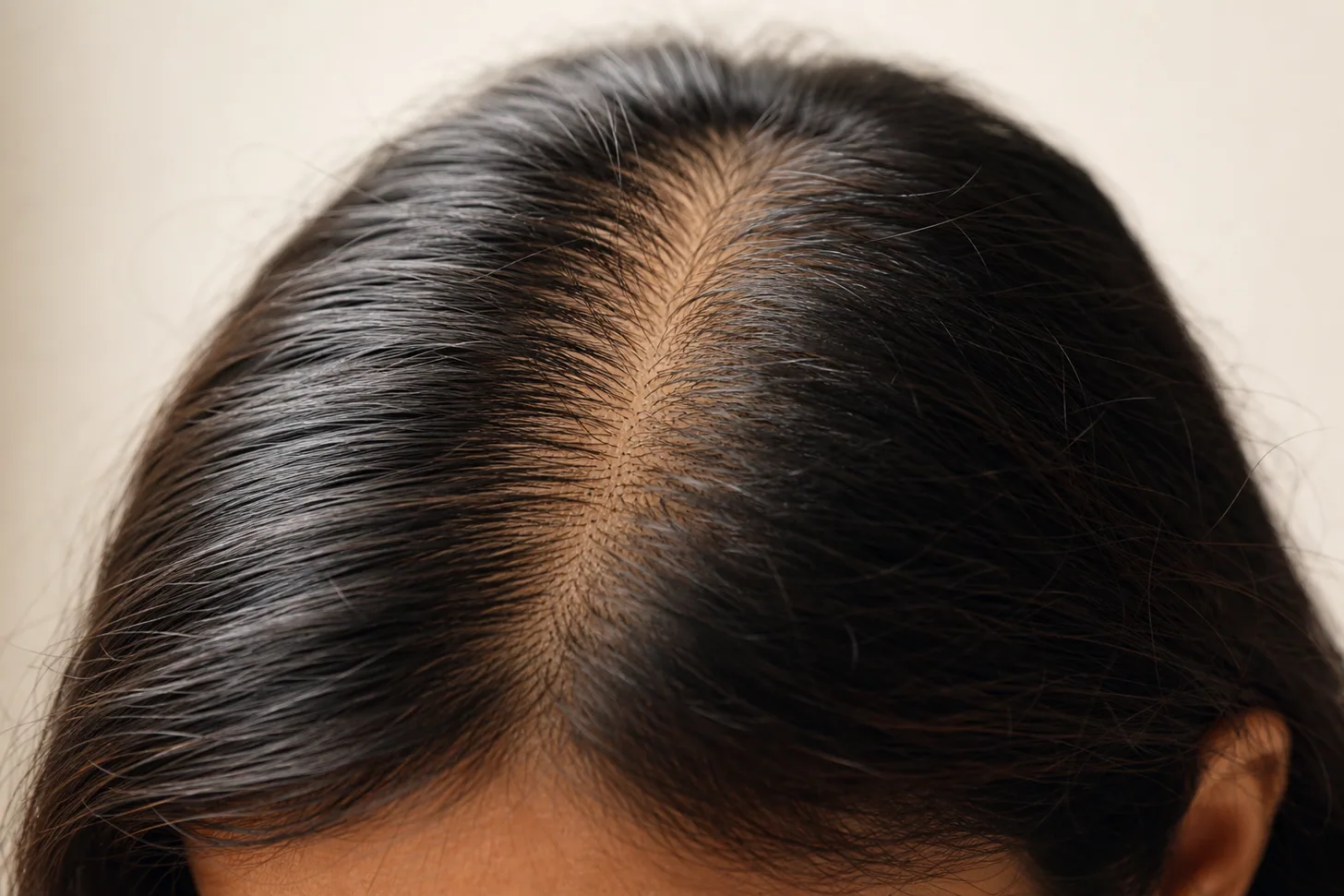
It looks like thinning because on fine hair you're working with a small total mass, so losing an inch off a few hundred strands at the crown removes a visible share of what was covering your scalp.
Density hasn't changed at all — the same number of follicles are producing the same number of hairs — but the hair that used to lie over the part is now two inches long and standing up instead. The distinction matters because the fix is completely different, and fine hair or thinning? is the page for working out which you have.
It looks like regrowth because hope is a powerful lens. Anyone who has been worried about their hair for a year and then notices a fringe of short hairs at the hairline reads it as recovery.
Sometimes it genuinely is — after a postpartum shed a halo of new growth at the temples is exactly what you'd expect around month nine. But the tip test settles it in five seconds, and it's worth doing before you credit a supplement with something a haircut did.
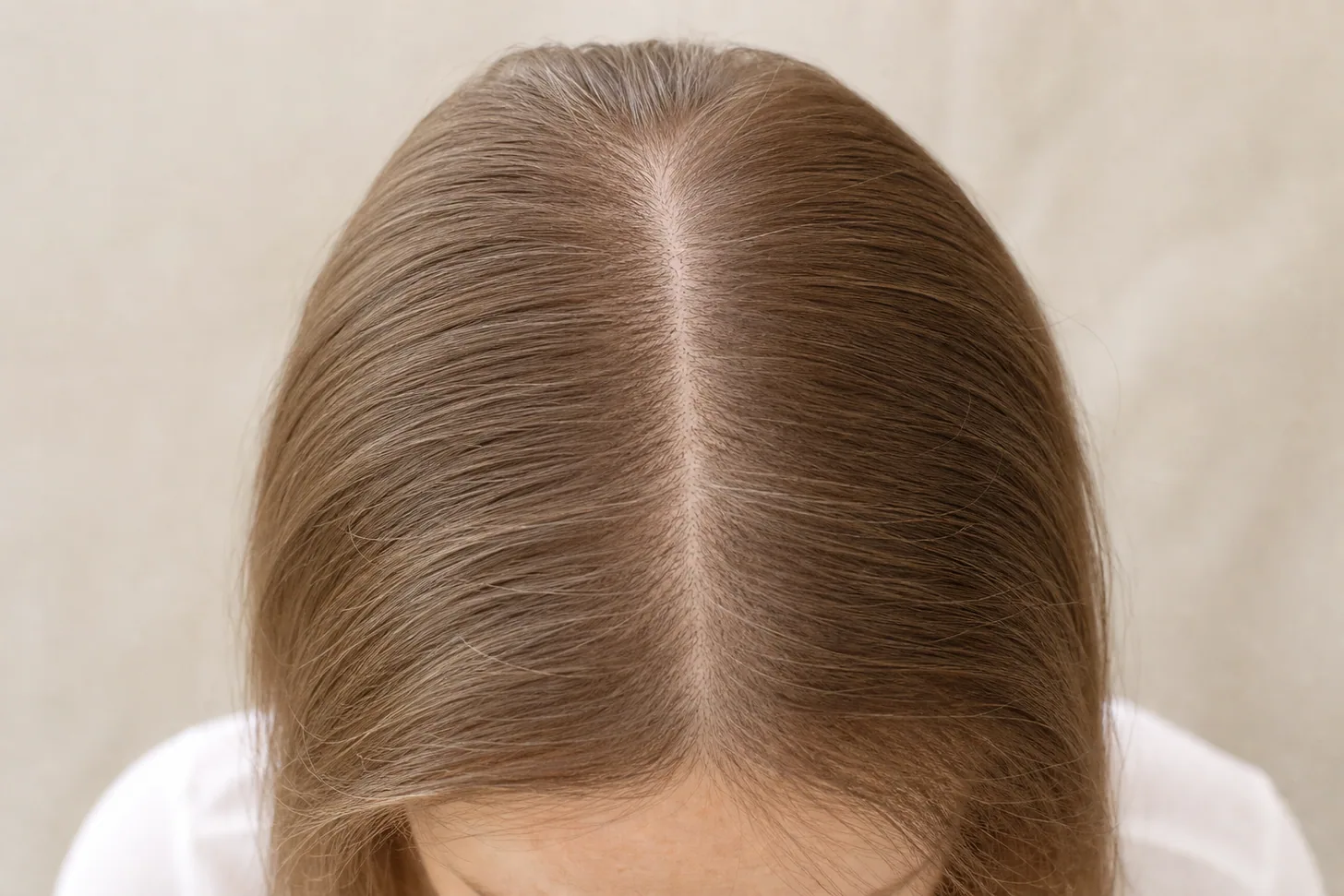
There's a third version specific to this hair type, and it's the one that sends people down the wrong road for years: breakage at the crown mimics the early pattern of density loss at the crown, because both show as scalp through the part.
Coverage for thinning on top covers the density version. If your short pieces are confined to one worked-hard patch and the rest of your part looks as it always did, damage is by far the likelier explanation.
What actually stops it
One category worth singling out, because it is where the same tension lands five times a week: gym and workout hair for fine hair covers the styles that hold without drawing a fracture line at one height.
One thing that mostly doesn't: a bond builder, unless your damage came from bleach or a chemical service. The distinction between broken hair and internally weakened hair is explained in bond builders for fine hair.
Ranked by how much they change, not by how satisfying they are to buy.
Reduce the number of force events, then the force in each one
Most breakage is arithmetic — small forces, many repetitions, on the same fibers. Every restyle is an event. Every dry brush-through before you leave the house is an event. Brushing to redistribute oil is an event with no upside on fine hair, and the AAD is blunt about the tradition behind it: "Brush and comb your hair only to style it. Hair never needs 100 brush strokes a day." Cutting your handling in half does more than any bottle.
Detangle from the ends, wet or damp, with a comb
Start at the ends, work up in short sections, and hold the hair above where you're combing so the force stops at your hand rather than travelling to the root.
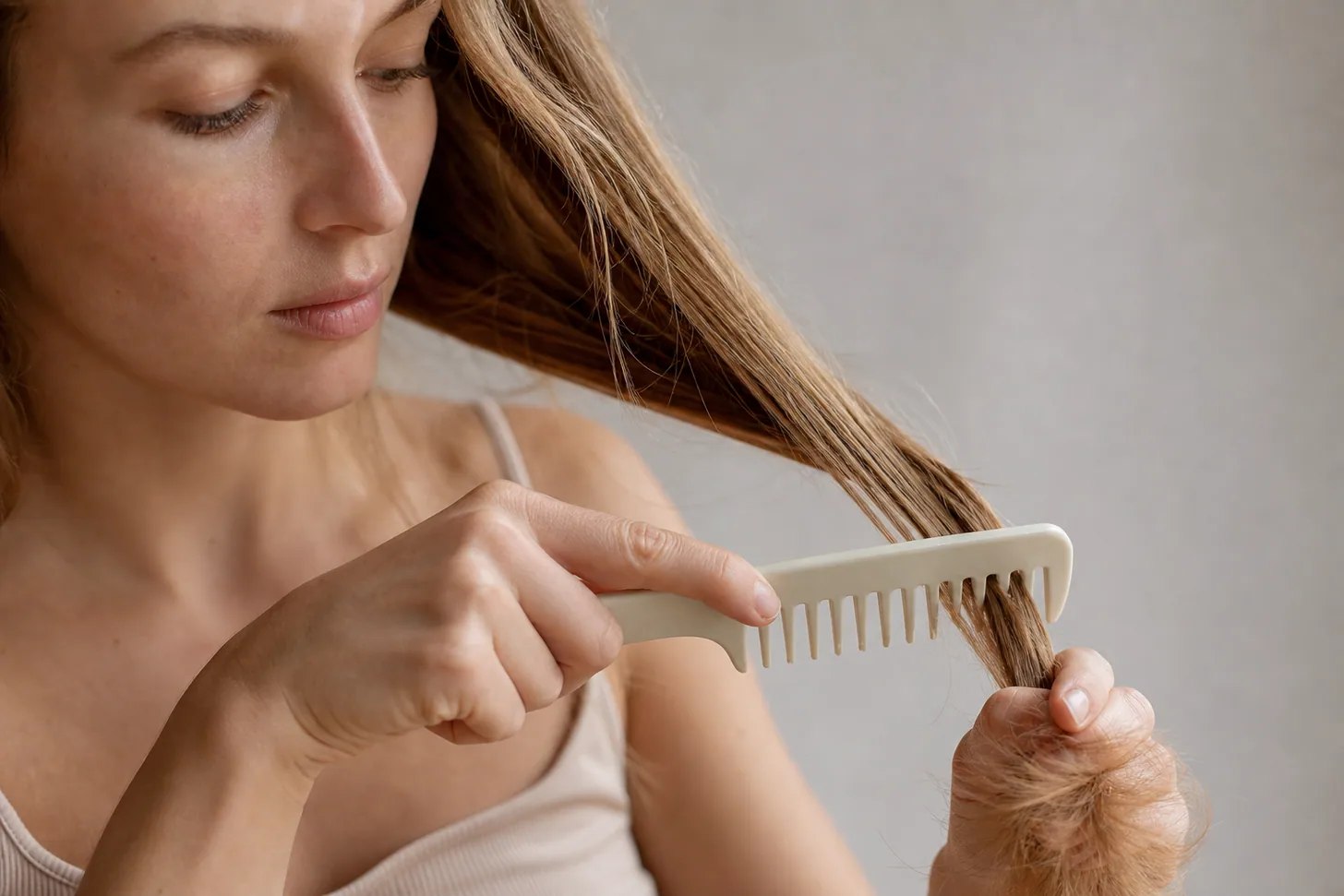
On straight fine hair the AAD's advice is to let it dry a little before gently combing with a wide-tooth comb — soaking-wet hair is at its most extensible and least forgiving. A wide-tooth comb beats a brush for this specific job. The full method is in how to keep fine hair from tangling.
Fix the two or three mechanical villains you actually have
Nearly everyone has a small number, and the table above usually names them: an elastic worn at one height, a towel turban that twists wet hair, a bag strap, a nightly bun, dry-brushing out a tease. Change those and the new breakage stops. The AAD's guidance is to wear hair loosely pulled back and to use covered bands made for styling hair rather than anything with a metal join.
Sleeping with fine hair covers the eight hours most people don't account for, and towel-drying fine hair covers the minute that does the most damage of any in the routine — wet combing fails a strand mid-shaft rather than at the tip, so it costs inches rather than split ends.
Add slip and heat protection, in that order
Conditioner's main job on this hair type isn't moisture, it's lubrication — it lowers the friction that causes the abrasion in the first place, which is why the AAD recommends conditioning after every wash and a leave-in or detangler afterwards. Keep the amounts small and keep them below the ears so you don't undo your volume. Then a heat protectant before any hot tool, every time, without exception on fine hair.
Cut past what's already broken
This one is unwelcome and unavoidable. A broken fiber is two pieces and nothing rejoins them. Bond builders and protein treatments make damaged hair feel and behave better and reduce the next break, which is worth doing, but the piece that snapped is gone. Where breakage has left ragged ends, trimming above them removes the roughest fibers, which are also the ones causing friction against their neighbours.
Chair-side note
When someone tells me she's tried everything, I ask her to show me how she takes her ponytail out. Nine times in ten she grips the elastic and drags it down through the length. You can hear it. Try this instead: work the elastic loose with two fingers at the loop, slide it along the ponytail rather than pulling it off the end, and use a spiral tie so there's nothing to grab.
That single change has cleared up more crown breakage in my chair than any product I've recommended, and it costs nothing. The reason it works is that the tie isn't damaging your hair while it sits there — it's damaging it on the way out.
MH
The honest timeline
Nobody publishes this, and it's the reason people give up on changes that were working.
Week one: the flyaway count drops, because you've stopped creating new breaks. Nothing else changes.
Weeks two to six: hair feels smoother and detangles faster. This is the conditioner and the reduced handling, not repair. It's genuine, but it's about the fibers you still have.
Weeks eight to twelve: the first point at which you can honestly judge. Scalp hair grows in the region of half an inch a month, so twelve weeks is roughly an inch and a half of new, undamaged fiber. Short pieces at the crown start to lie down as they gain a little weight.
Six months to a year: a crown halo blends back in. A band of breakage at ponytail height on long hair takes longer still, because those pieces have to catch up to a perimeter that's also growing.
Take a photo of the affected patch on day one, in the same light, and don't look at it again for eight weeks. Judging this daily in a bathroom mirror is how people conclude nothing works.