The real timeline, in centimetres rather than optimism
Growth rate is one of the few things about hair that isn't personal. Fine hair does not grow more slowly than coarse hair — diameter and speed are unrelated — and the published figures are consistent: 0.35 mm a day, 1 cm a month, 15 cm a year, a rate a review of hair-fiber properties puts at "about 1.0 cm/month" as well.
So measure your fringe rather than guessing at it. From where the shortest piece sits now, count centimetres to where you want it:
- Eyebrow to below the eyes: 3–4 cm, so 3–4 months. This is the milestone people mean when they say "three months" — it's the point where it stops interfering with your vision, not the point where it looks intentional.
- Eyebrow to cheekbone: 6–8 cm, so 6–8 months. The useful milestone. At cheekbone the panel can be split, swept, or tucked, and it starts behaving like a layer.
- Eyebrow to jaw or collarbone — genuinely blended: 12–18 cm, so a year to eighteen months.
That's the whole honest answer, and I'd rather give it than have you three months in wondering why it doesn't look like the before-and-after. What actually shortens the experience isn't growth, which you can't change. It's the shape you keep the panel in while it happens — which is entirely within your control and costs you nothing in length.
Why a fringe grows out worse on fine hair than on thick
Every head goes through the same geometry. Fine hair gets the harsher version of it for three reasons, and it's worth knowing all three because each has a different fix.
One: the panel can't merge. Blending is a density trick. When a short section is surrounded by lots of long hair, the long hair falls over it and the eye stops seeing a boundary. Fine hair doesn't have the surplus to fall over anything, so the short panel stays legible as a separate piece for far longer. Nothing is wrong with your hair; there just isn't enough of it in that square inch to hide a seam.
Two: the fringe was taken from your most exposed real estate. A fringe is cut out of the front of the top section — the same panel that leans over your parting and closes it visually. Remove it and the part reads wider immediately. Most women don't notice this when they get bangs, because the fringe itself covers the evidence.
They notice it in month four, when the fringe has moved sideways and the front of the part is suddenly bare. If this is where you are, read how to part fine hair before you read anything about thinning.
Three: the fringe is the section that breaks. It gets more heat, more brushing and more friction against a forehead than anything else on your head, and fine strands reach their breaking point sooner because there's less material where the fiber is narrowest.
A grow-out that appears to stall at one length usually isn't stalled — it's growing and snapping at roughly the same rate. Hair breakage on fine hair has the tip test that tells the two apart in about ten seconds.
Chair-side note
Somewhere around month four or five, I get a version of the same appointment several times a year: a woman who came in for a trim, sits down, and says quietly that she thinks she's losing hair at the front. She's mid-grow-out and nobody warned her. What she's seeing is real — her part is more open than it was — but the hair isn't gone, it's standing up in a short panel two inches away.
I part her hair the other way, flatten the panel across, and she can see it in the mirror in five seconds. If you take one thing from this page: a change that arrives with a fringe and is confined to the fringe area is a weight problem. A change that arrives gradually, across your whole part, over months, is a density question, and fine hair or thinning? is the page for it.
SB
The five stages, and what to ask for at each
The mistake is treating the grow-out as one long wait with a haircut at the end. It's five short shapes, and each has an ask.
Convert to curtain bangs at cheekbone — it's the shortcut
Stage three is the whole game, and most people arrive at it by accident several months late.
At roughly cheekbone length, a straight-across fringe can be re-cut into a center-split curtain shape without losing a single centimetre of the length you've been growing. The scissors only touch the inside corners and the very ends.
What you get back is disproportionate: a recognized, current shape instead of a transitional one, and — the fine-hair bonus — a split at the center, which means the panel now falls toward your part from both sides instead of leaving it exposed. The parting closes. That single change fixes the wide-part problem that makes the middle of a grow-out feel like thinning.
The technical asks, in the order that matters: shortest point at the outer corner of the eye, not the inner (inner reads as a curtain that's still a fringe); the ends point cut, never blunt, so the panel tapers into the length rather than stopping at a line; and the connection to the sides left long and unfinished — you want a soft slope, not a step.
Curtain bangs for fine hair has the full version of that conversation, and side-swept bangs is the alternative if your growth pattern won't accept a center split.
Don't let anyone put thinning shears in your fringe
Search how to grow out bangs and you'll be told, more than once, to have a stylist thin or texturize the fringe to reduce bulk so it blends. On thick hair that's reasonable. On fine hair it's the worst available trade, and it's worth being blunt about why.
Thinning shears remove density from inside a section by cutting some strands short and leaving others long. On a fine fringe there was barely any density to remove, so what you're left with is a scatter of short, bluntly-ended pieces — at the front of your part, standing up, in the one place your scalp already shows.
And the grow-out gets longer, because the pieces you now have to wait on are shorter than the ones you were waiting on this morning. The whole case is laid out in over-thinned fine hair.
The correct request is point cutting: the scissors go into the ends vertically and take small notches out of the tips, softening how the panel ends without removing any hair from inside it. Same softness, no density cost. If you're not sure how to say it, the exact words to ask your stylist covers the phrasing that gets you the right tool.
Don't cut layers to meet the fringe — let the fringe come to the layers
The other standard piece of advice is to have face-framing layers cut so the fringe has something to blend into. It works, and the cost is buried: to make the sides meet a panel that's currently at your cheekbone, the sides have to come up to your cheekbone.
On fine hair, that's spending density you can't replace for a year to solve a problem that resolves by itself in three months. You'll blend beautifully and then spend the next twelve months growing out two things instead of one.
Wait until stage four, when the fringe is at chin, and cut the softest possible face-framing layers to meet it there — losing two or three centimetres instead of ten. If your ends are looking thin while you wait, that's a separate question and how often fine hair needs a trim answers it honestly.
Styling it through the months that are actually hard
Everything above is the plan. This is the daily part, and it comes down to one mechanism: hair holds the direction it dried in until it's wet again, because water breaks the weak hydrogen bonds inside each strand and they re-form as it dries — a well-documented principle of hair science. So a fringe pushed sideways at 8am with dry hands is borrowing an hour. A fringe dried sideways at 7am is set for the day.
- Set it soaking, not damp. Comb the panel straight back first to erase the forward direction, then across. Dry the roots of the fringe before anything else on your head — it's the section with the least hair and it air-dries into its default position while you're busy with the lengths.
- Clip back from the hairline, not at it. A clip on the front edge crushes the roots flat and leaves a visible dent when you take it out. Two or three centimetres back, and the panel lifts instead. Clips that hold fine hair has the grip that doesn't slide.
- Dry shampoo the fringe on its own schedule. It sits on your forehead, so it goes oily a day or more before the rest of your hair — which is why grown-out bangs look stringy when your hair is otherwise fine. A puff at the fringe roots on day two is usually all it needs; how often to wash fine hair makes the case for not washing the whole head to fix one panel.
- Texture, not paste. A light mist of texture spray gives the short panel enough grip to sit with the length. Pomades and heavy creams do the opposite — they group fine strands into separate pieces, which is the exact look you're trying to lose.
- Headband behind the fringe, not in front of it. Worn in front, it crushes the panel forward and it springs out the moment you take it off. Sat behind the fringe, it tucks the ends and holds the redirect.
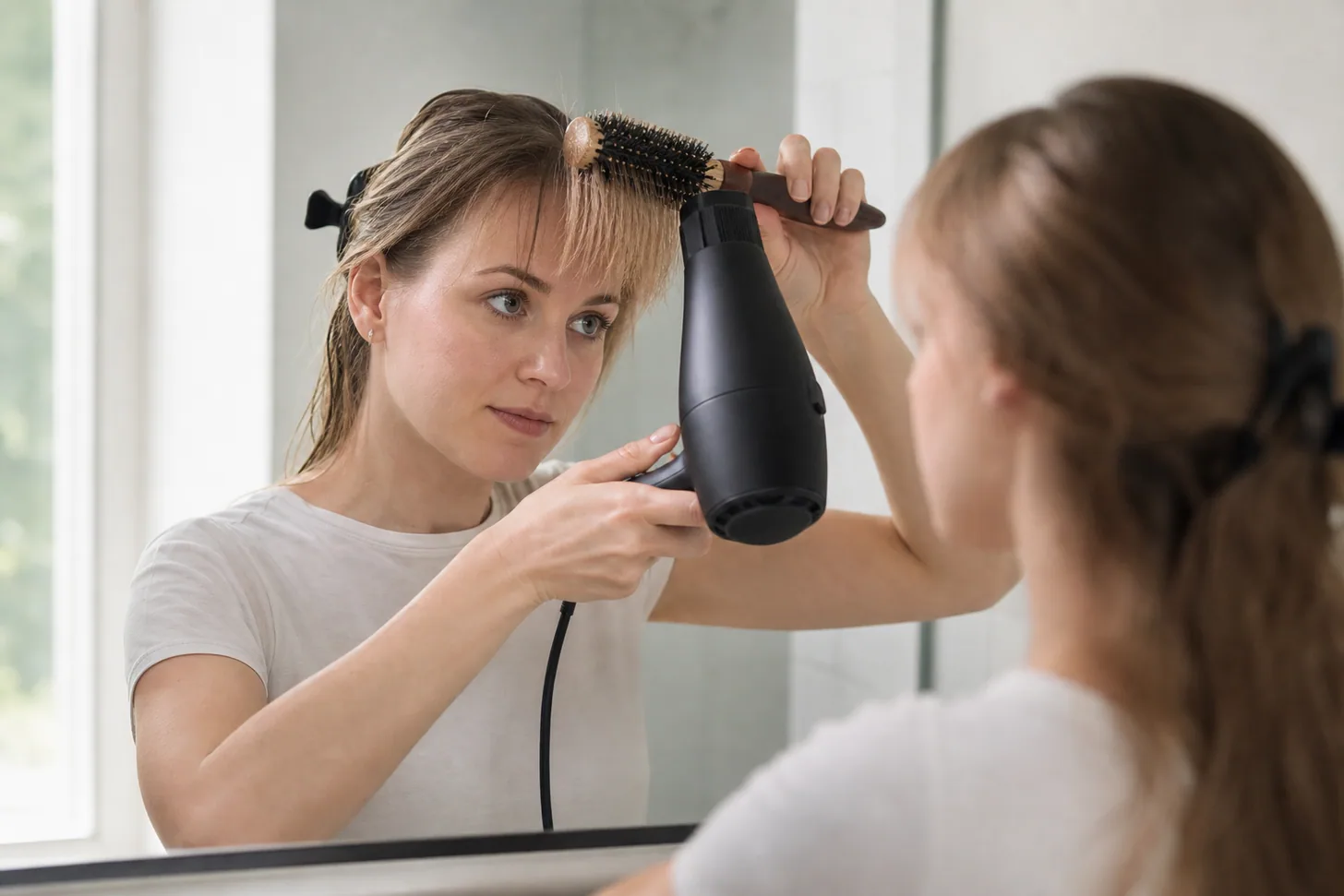
- Give the round brush a rest. The fringe is your most heat-exposed section, and stalled grow-outs are usually breakage. Heat protectant if you must, but a cool shot and a redirect will do most of it.
Chair-side note
The clients who get through a grow-out without hating it all have the same habit, and it isn't patience. They come in every six to eight weeks and let me spend four minutes on the corners. Not the length — I never touch the length — just the outer edges, angled down a little further each time, so the panel is always sloping toward the face rather than sitting as a shelf.
It's the cheapest appointment in the book and it's the difference between a year of "I'm growing out my bangs" and a year of nobody mentioning your hair at all. Book the trims. Tell whoever's holding the scissors: corners only, point cut, nothing off the center.
SB
Whether to grow them out at all
Worth asking before month three, because the answer isn't automatically yes. A fringe borrows its hair from the front of the top section, so on low-density hair it genuinely does make the lengths and the ponytail smaller — that trade is real. But it also covers the highest-contrast, most scalp-exposed part of a fine head of hair, and some people are trading a fuller ponytail for a wider part.
If the reason you want them gone is that they've gone stringy, greasy or separated, that's a fringe-maintenance problem rather than a fringe problem, and bangs for fine hair has the styling fix. If the reason is that a blunt fringe was too heavy for your density, the answer might be a lighter one rather than none — a wispy, see-through fringe costs a fraction of the hair.
Growing out is the right call when you want the hair back in your lengths, when the upkeep has stopped being worth it, or when you're heading toward a shape like a lob that wants all its weight in one place. If you are growing them out because they never covered enough, read bangs for thin hair and a big forehead before you cut another set.