Reviewed by Tara Sullivan · Updated August 2026 · 8 min read
Fine hair tangles more than coarse hair for a structural reason, not a care one: a strand's resistance to bending scales with the fourth power of its radius, so a hair half the diameter of another is roughly sixteen times easier to bend — and a strand that bends that readily loops around its neighbours instead of sliding past them.
Every loop is a knot waiting to happen. That's why adding more conditioner rarely fixes it and often makes it worse. Below: the six habits that stop tangles forming, a six-step detangling method that costs you the fewest strands, and how to read where the tangles sit to work out what's actually causing them.
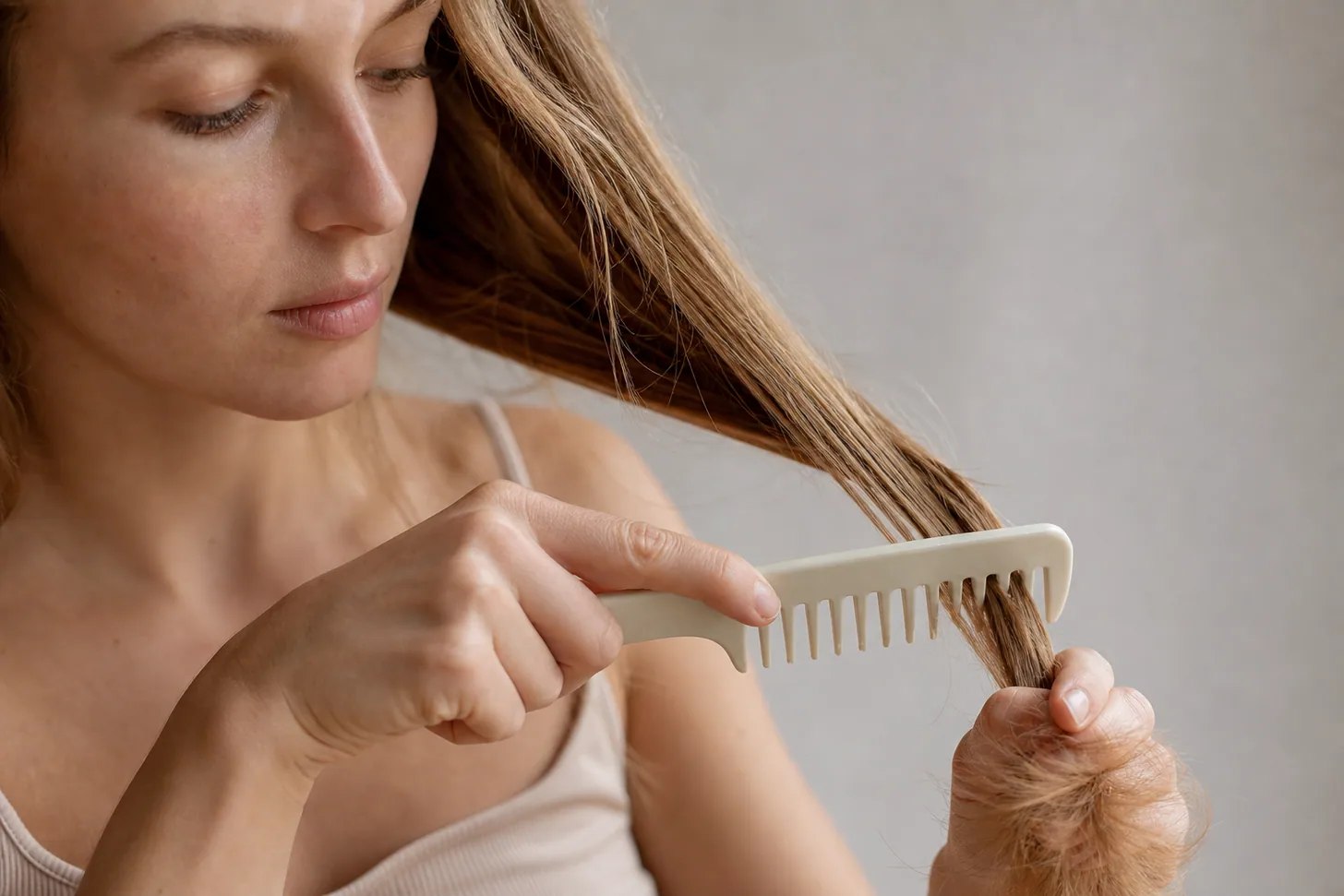
Ends first, always — and hold above the knot so your hand takes the tension.
Chair-side note
The thing that changes this for people isn't a product, it's the order of operations. Detangle before you get in the shower. That's it. Everyone I've ever suggested it to has come back and told me their hair feels different, and all that's happened is they stopped asking wet fine hair — which stretches, and then snaps — to do a job that dry hair does painlessly.
I can usually tell within thirty seconds of picking up a comb whether someone detangles dry or wet, because the wet ones have a fine layer of broken hairs standing up along the top of their head.
MH
— Megan Holloway, Editor-in-Chief
Why fine hair tangles more than coarse hair
There are three reasons, and none of them are about how well you look after your hair.
Flexibility. Bending stiffness depends on the fourth power of the strand's radius. That's a startling relationship: a modest reduction in diameter produces an enormous reduction in stiffness. A coarse hair pushed against its neighbour deflects slightly and slides past; a fine hair wraps around it. Multiply that by the tens of thousands of contacts happening every time you move your head, and fine hair is simply forming loops all day long.
A thinner cuticle. The cuticle is the overlapping scale layer on the outside of the strand, and a fine hair has fewer layers of it. There's less material between a smooth surface and a rough one, so heat, sun, bleach and mechanical wear show up as friction sooner than they would on a coarse hair. Rough surfaces catch on each other.
Density, if you have it. If you have a lot of fine hair, every strand simply has more neighbours to catch on. That combination has its own set of rules — see fine hair but a lot of it — and heavier detangling creams are the most common wrong turn taken there.
None of this is fixable at the strand level. What is fixable is friction, movement and the state of your ends — which is where the rest of this guide goes.
Where the tangles sit tells you what's causing them
Before changing anything, look at where the knots actually form. Different locations have different causes and different fixes. A band of knots at collar height is the seasonal one — that is coat and scarf friction, and it is covered in fine hair in winter.
Where the tangles are
Usual cause
What actually fixes it
Nape of the neck
Friction from collars, seatbelts, headrests, pillows; shorter hairs matting
Tie it up in the car, silk pillowcase, keep bare hair off wool collars
Ends only
Split or over-tapered ends acting as hooks
A trim — every 8–10 weeks for fine hair
Crown and top layer
Dry shampoo and styling-product buildup; backcombing
A sixth, if the tangles are worst in the morning: change what your hair spends eight hours rubbing against — silk pillowcases for fine hair.
In rough order of how much difference they make.
Detangling Before You Wash Prevents More Breakage Than Anything You Do After
Hair is at its most fragile wet. Water swells the strand and reduces its resistance to stretching, so a wet fine hair snaps under a pull that a dry one absorbs. Which means the standard sequence — get in the shower with knotty hair, then fight it — is exactly backwards. Comb it out dry first, and the shower becomes a rinse rather than a wrestling match. This one change accounts for most of the improvement people notice.
Fine Hair Is Combed From the Ends Upward, With a Wide-Tooth Comb
If you comb from the roots down, every knot you meet gets pushed ahead of the comb and merged into the knot below it, until you have one dense mat at the ends and no way through it. Start at the last two inches and work upward in stages. The American Academy of Dermatology's healthy-hair guidance makes the same two points: use a wide-tooth comb rather than a brush on wet hair, and comb the ends first before working higher.
Which comb matters more than most people expect — a moulded comb carries a ridge of plastic down every tooth, and that is exactly what a fine strand catches on. See the best comb for fine and thin hair. And what you do with the towel immediately beforehand decides how bad the tangle is in the first place — towel-drying fine hair.
Slip Comes From a Spray, Not a Cream
What you're after between washes is slip — a low-friction film on the surface so strands slide past each other instead of gripping. Fine hair gets that from a fine mist, not from a rich cream, because the cream delivers slip and weight in the same bottle and the weight is what flattens you by lunchtime.
Most tangling happens while your hair is moving freely against something else, and the two biggest windows are the eight hours you're asleep and any time you're outside in wind. A loose braid or a low, soft bun for bed removes almost all of the overnight friction — the emphasis on loose, because a tight elastic in the same spot every night causes its own problems.
A silk or satin pillowcase helps for the same reason: hair slides across it rather than catching. The overnight technique overlaps with heatless volume methods, so you can solve both at once.
Split, Over-Tapered Ends Are Where Most Knots Start
The end of a strand is its finest, oldest, most weathered point, and when it splits you effectively have two hooks where there should be one smooth tip. That's why tangles cluster in the bottom few inches and why no product fixes them.
Fine hair does best on an eight-to-ten-week trim cycle, and if your ends have been thinned or razored the tapering itself creates the problem — see do layers help or hurt fine hair for what to ask for instead. Heat is the other accelerant: cumulative heat damage roughens the cuticle permanently, which is why the AAD lists it among the habits that damage hair, and why a heat protectant earns its place in the routine.
How to detangle fine hair without breaking it
Six steps, about five minutes on shoulder-length hair. The fifth is the one that decides how much hair ends up in the sink — and if what's ending up there is short pieces rather than full-length strands, hair breakage on fine hair is the page that tells you which of your habits is doing it.
Do it before you wash. On dry hair, before anything gets wet. Every knot removed here is one that won't be fought at triple the fragility in the shower.
Mist the mid-lengths and ends. A few sprays of a light detangler or leave-in on the lower two-thirds. You're adding slip, not moisture — nothing goes near the roots.
Split into four sections. Two front, two back, clipped away. It's faster than working the whole head and it stops you dragging knots from one region into another.
Start at the very ends. Comb the last two inches until the comb passes through cleanly, then move up an inch and repeat. Never start higher than the knot you're trying to remove.
Hold above the knot. Grip the section between the tangle and your scalp so your hand takes the tension instead of your follicles. This is the whole difference between detangling and pulling hair out.
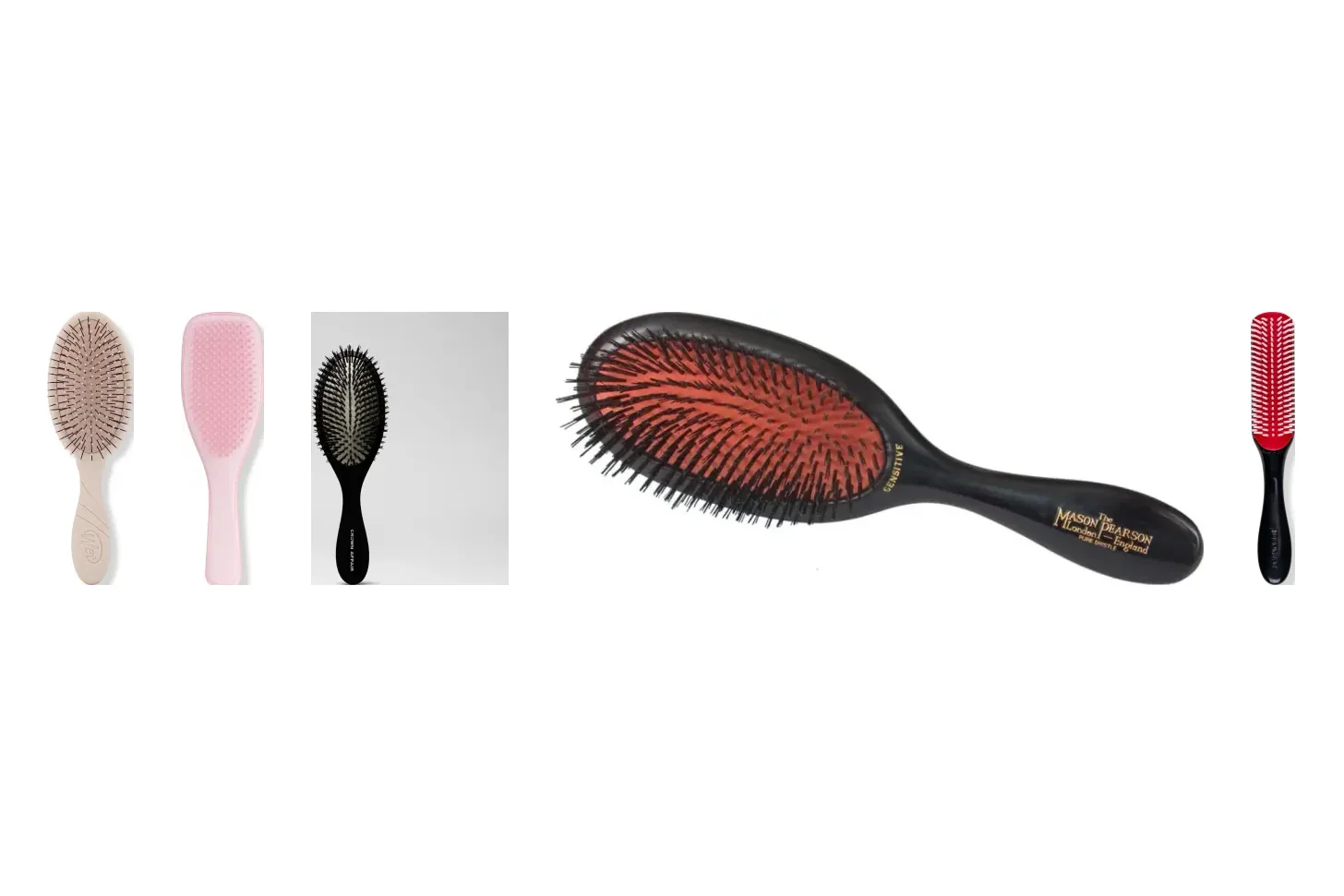
Finish with one brush pass. Once the comb runs clean, a single pass with a flexible-bristle brush smooths the cuticle and carries the scalp's own oil down the length — which is what keeps it from re-tangling by the afternoon. Bristle spacing matters more than material here; the reasoning is in our brush picks for fine hair.
One exception: a single-strand knot — one hair looped and tied around itself, usually near the end — cannot be combed out. Forcing it either tightens the knot or snaps the strand below it. Snip it off above the knot with sharp scissors and move on. On fine curls the slip belongs in the conditioner rather than the shampoo, for reasons set out in shampoo for fine curly hair.
When tangling is telling you something else
Your hair feels spongy or stretchy when wet and snaps when you pull it. That's structural damage, not a detangling problem. Stop all heat and read what actually repairs fine hair before changing anything else.
Short broken hairs are standing up all over the top of your head. Usually breakage from wet brushing or tight styling rather than new growth. It's worth ruling out — fine hair or thinning.
Tangling got dramatically worse after a colour appointment. Lightening raises the cuticle permanently. Ask your colourist about a bond treatment, and see porosity for fine hair.
Your hair is tangly, dull and feels coated. More conditioner will make this worse. Clarify first, then rebuild — the honest fine-hair routine.
You have hard water and everything is worse in the shower. Mineral deposits roughen the cuticle and are a genuine, under-recognised cause of tangling — what hard water actually does to fine hair has the chelating-versus-clarifying distinction that decides whether a product will help.
FAQ
Because a thin strand bends far more easily than a thick one. A strand's resistance to bending scales with the fourth power of its radius, so halving the diameter makes a hair roughly sixteen times easier to bend — which means fine hair loops around its neighbours instead of sliding past them, and those loops become knots. A fine strand also has fewer cuticle layers, so any roughness on the surface produces friction sooner. It's a structural property of the hair, not a sign that you're doing something wrong.
Dry first, then again in the shower with conditioner in. Wet hair stretches under tension and snaps at a load it would tolerate dry, so removing the worst knots before the hair gets wet prevents most of the breakage. If you do detangle wet, the American Academy of Dermatology's guidance is to use a wide-tooth comb rather than a brush, and to comb the ends first and work upward.
For removing knots, a wide-tooth comb or a flexible-bristle detangling brush with widely spaced pins. Bristle spacing matters more than bristle material on fine hair: densely packed bristles catch a fine strand and drag it rather than passing through. Save a boar-bristle or mixed-bristle brush for the smoothing pass after the knots are out, when its job is distributing oil rather than fighting tangles.
Some, but less than people expect, and past a certain point it makes things worse. Conditioner reduces friction while it's on the hair, which genuinely helps in the shower. What it doesn't do is prevent the looping that causes fine-hair knots in the first place — and a heavy conditioner leaves a residue that attracts more buildup, so the hair ends up coated, flat and, within a week or two, tangling more rather than less. Use it on the mid-lengths and ends only, and reach for a spray rather than a cream between washes.
Friction, almost always mechanical. The nape is where hair rubs against collars, coat seams, seatbelts, headrests and pillows all day, and the hairs there are often shorter and finer than the rest, so they mat rather than moving as a group. The fixes are physical rather than chemical: tie the hair up in the car, keep collars and scarves off bare hair where you can, and sleep on a silk or satin pillowcase, which lets hair slide instead of gripping — though the pillowcase is the weakest of the overnight levers, as sleeping with fine hair sets out.
A single-strand knot is one hair that has looped and tied itself, usually near the end where the strand is finest and most flexible. You can't brush one out — a comb will either force the knot tighter or snap the hair below it. Snip it off with sharp scissors just above the knot. If you're finding several every week, the ends are over-tapered or splitting, and a trim will do more than any product.
Every eight to ten weeks for most fine hair, and closer to eight if you're finding split ends or single-strand knots regularly. Tangles concentrate at the ends because that's where the strand is finest, oldest and most likely to be split — and a split end has, in effect, two hooks where there should be one smooth tip. Trimming doesn't make hair grow faster, but it removes the part of the hair that's generating most of the knots.
Fourteen years across the chair and the page, specialising in fine-hair care. Megan can tell whether a client detangles wet or dry within about thirty seconds of picking up a comb, and has opinions about it.
Results vary with hair type, density, and growth patterns. This guide is educational and not a substitute for an in-person consultation with a licensed stylist.
Hairstyle images in this guide are AI-generated illustrations, not photos of real clients or results. See our image policy.
Get the good hair intel
One honest, stylist-written guide in your inbox each week. No hype.

 MH
MH