Start with the arithmetic, because it settles most of this in one line. Your maximum hair length is your growth rate multiplied by how long your growing phase runs — and both numbers are known. Scalp hair grows at "a rate of about 0.35 mm/day, 1 cm/month", and the anagen phase is commonly given as "the normal 4 to 7 years".
Multiply them and the genuine ceiling for most people lands somewhere between 48 and 84 centimetres — 19 to 33 inches, or roughly between the bra line and the hip. Now hold that against the complaint. If your hair has sat at your shoulders for three years, you are at about 13 inches.
You are not at your ceiling. You are nowhere near it. Which means the length isn't failing to arrive — it's leaving at the other end, and on fine hair it leaves for reasons that are specific, countable, and mostly under your control. Below: the two numbers that set your real maximum, the trim ledger almost everyone is quietly losing, why fine hair looks finished long before it is, and the short list of cases where "it won't grow" is a medical question instead.
The ends of long hair are years old. That's the whole story of most length plateaus.
Your maximum length is a multiplication, and both numbers are genetic
There are only two variables in hair length, and neither of them is effort.
The first is growth rate, and it is remarkably consistent between people: about a centimetre a month. Nothing sold in a bottle changes it. (The same source also gives the annual figure as 15 cm a year, which is the optimistic reading of the same daily rate — a centimetre a month, or 12 cm, is the number worth planning with.)
The second is how long each hair keeps growing before it stops. Every follicle runs a cycle: anagen, when the hair is actively produced; a short catagen; then telogen, a rest that for scalp hair can last "nearly one year", after which the hair is pushed out and the follicle starts again.
A hair cannot get longer than the amount its own anagen phase produces, because at the end of anagen it stops, waits, and is shed. That's what "terminal length" means. It isn't a limit on your head; it's a limit on each individual hair.
So the ceiling is one sum:
If your anagen phase runs…
Each hair can reach…
In inches
Roughly where that falls
4 years(short end of normal)
48 cm
~19 in
Just past the armpit — the bra line
5 years
60 cm
~24 in
Mid-back
6 years
72 cm
~28 in
Waist
7 years(long end of normal)
84 cm
~33 in
Hip
1–2 years(short anagen syndrome — uncommon)
12–24 cm
~5–9 in
Chin at most, and it genuinely will not go further
Body landmarks are approximate and depend on your height and where the hair is measured from. Treat the column as a picture, not a promise.
Read the top four rows again, because the useful information is in how high they all are. Even the shortest normal anagen phase produces hair to the bra line. Shoulder-length is not anybody's terminal length. Neither is collarbone. If that's where your hair lives, the ceiling isn't what's holding it there.
What's actually holding it there: an equilibrium, not a ceiling
Hair length is a balance between two flows. New length arrives at the root at a centimetre a month. Old length leaves at the tip — through wear, through breakage, and through the scissors. Your hair stops changing length at the point where those two rates match.
That's an equilibrium, and it behaves nothing like a ceiling. A ceiling can't be moved. An equilibrium moves the moment you change either side of it, which is why the same head of hair can sit at the collarbone for four years and then, with nothing changed except the trim schedule, reach mid-back in two.
It also explains the specific frustration of a plateau. Your hair isn't standing still — it grew about five inches this year. You just lost five inches at the same time, in pieces small enough that you never noticed the transaction.
There are four things on the losing side of that ledger, and it's worth knowing which one is yours:
The scissors. Almost always the biggest one, and the only one you fully control. See the ledger below.
Wear at the ends. Weathering — the slow abrasion of the outer layers by washing, combing, drying, sun and friction. It doesn't cut hair off in one go; it thins and frays the last inch or two until you cut it off yourself.
Breakage. Mid-length snapping, which removes length invisibly because the broken pieces are short. If your ends look ragged rather than tapered, read is it breaking or shedding? — the tissue-sort test separates the two in about a minute.
A shed that resets the clock. After a telogen effluvium a cohort of new hairs starts again from zero, so a proportion of your length is genuinely two months old. This is the one that makes hair feel like it has "stopped growing" when it is in fact growing hard. Postpartum and weight-loss shedding both do this.
The trim ledger — the arithmetic most people are quietly losing
This is the section I'd read first if I only read one. Your hair grows about 0.4 inches a month. Now price your trim schedule against that.
What you take off
How often
Removed per month
Net change per year
½ inch
Every 16 weeks
0.13 in
+3.3 in — you gain
½ inch
Every 12 weeks
0.17 in
+2.8 in — you gain
½ inch
Every 8 weeks
0.25 in
+1.8 in — you gain slowly
1 inch
Every 8 weeks
0.50 in
−1.2 in — you lose
1 inch
Every 6 weeks
0.67 in
−3.2 in — you lose fast
Three things fall out of that table, and all three are worth sitting with.
The interval matters more than the amount. Half an inch every sixteen weeks and half an inch every eight weeks are the same haircut and a 1.5-inch-a-year difference in outcome. Stretching the interval is the cheapest length you will ever buy.
"Just a trim" is frequently a net loss. An inch every six to eight weeks is a perfectly normal thing to ask for and it is, arithmetically, a slow haircut. Nobody in the salon is doing anything wrong; the schedule is simply outrunning the follicle.
And what a stylist calls an inch and what you picture are rarely the same. Hair is cut under tension and often when damp, and damp hair is stretched — wet or dry cutting covers why the same instruction produces a shorter result on fine hair than on coarse. If you are growing length, say the number and then say it again in reference to a landmark: "half an inch, and I'd like it still to sit below my collarbone."
Chair-side note
The conversation I have most often about length isn't about growth at all. A client says her hair hasn't got any longer in two years, and she's right — and she's also been in every ten weeks for a trim, because her ends look thin and she wants them tidy.
Both halves are true and they cancel out. What I do now is put it in writing at the start: pick the length you want, work out from the ledger how long it will take at your current schedule, and if that number is longer than you're willing to wait, we change the schedule instead of the shampoo.
Usually that means longer gaps and a smaller amount, plus dusting the very ends in between rather than a full cut. And I'll be honest that the trade is real — the perimeter will look softer and less blunt while you grow it, because we're keeping length that has some wear on it. You can have length, or you can have a knife-sharp line at all times. On fine hair you generally cannot have both.
MH
— Megan Holloway, Editor-in-Chief
Why fine hair looks finished long before it is
Here is the correction that matters most on this site, because the belief it replaces sends people to the wrong shelf entirely.
Fine hair does not have a shorter growing phase. Diameter and cycle duration are independent — one describes how wide the fiber is, the other how long the follicle keeps producing it.
There is no good evidence that a fine-haired woman's anagen runs out sooner, and it's worth saying plainly because the assumption leads to years of growth serums aimed at a problem that isn't there. Fine hair's length problem is at the ends, not at the follicle. Fine versus thin hair sets out why these two measurements get confused in the first place.
What is different is the margin. Every hair tapers toward its tip, and every tip has years more wear on it than the root. On coarse hair there's enough diameter that the taper stays invisible for a long time. On fine hair there was no surplus, so the same taper crosses the threshold where the perimeter starts to look see-through much earlier — at a length where a coarse-haired friend's ends still look solid.
Which produces the trap. See-through ends read to the eye as thin hair overall, not as worn ends, so the whole head looks sparser than it is. The standard fix — cut back to a stronger, blunter line — is genuinely the right answer for how it looks.
It is also a length reset, and repeating it every couple of months is precisely the ledger above running at a loss. You are on a treadmill, and you chose it for a good reason. Knowing that is what makes it a decision instead of a mystery.
There is a middle route, and it's the one I'd push. Keep the length; put the weight where it reads as density. Layers on fine hair and long cuts for fine hair both cover the same principle — a strong internal weight line and a soft, slightly graduated perimeter looks fuller than a blunt line that's been cut back three times to stay blunt.
How old is the hair at your ends?
Do the sum on your own hair, because it reframes everything about how you handle it. Keeping length as the hair itself gets older is its own set of decisions, and they are worked through in long hairstyles for fine hair over 50.
At a centimetre a month, hair sitting 40 cm from your scalp is about 40 months old. Three and a half years.
In that time it has been washed perhaps 400 times, combed or brushed several thousand, blow-dried, slept on, rubbed against collars and seatbelts, and exposed to whatever sun and color you've given it — all concentrated on the same few inches, which have had every one of those exposures while the hair near your roots has had none of them.
Nothing else you own survives three and a half years of daily use and still looks new. And unlike skin, a hair fiber has no repair mechanism: past the scalp it isn't living tissue, so damage accumulates and never reverses. That's the honest ceiling on what any product can do — what repair ingredients actually do is the longer version, and the short one is that they improve how the fiber behaves without restoring what's gone.
So the whole game on long fine hair is slowing the rate of wear, and the largest contributors are ordinary:
Leaving it soaking wet for hours. Counter-intuitive, and well evidenced: in a comparison of drying methods, the cell membrane complex "was damaged only in the naturally dried group", because the hair shaft swells while it is in contact with water. Air-drying is not automatically the gentle option. Air-drying fine hair and diffusing both deal with the trade-off.
Heat, at the ends especially. Lowest setting that works, and stop clamping an iron over the last two inches; that's the oldest hair on your head. Heat protectant for fine hair.
Sleep friction. Eight hours a night of hair moving against cotton, for years. A smoother pillowcase and a loose low plait cost nothing — sleeping with fine hair.
What actually adds length on fine hair
Nothing on this list speeds growth up, because nothing can. All of it changes the subtraction side, which is where the length is.
Stretch the trim interval before you reduce the amount. The ledger says the interval is the bigger lever. Twelve to sixteen weeks, with the ends dusted in between if they need it — how often to trim fine hair has the two-clock version of this.
Give the salon a number and a landmark, not a feeling. "Half an inch, and it should still sit below my collarbone." The exact words to ask for.
Accept a softer perimeter while you grow. This is the actual price, and it's mostly aesthetic. A slightly graduated end looks fuller on fine hair than a blunt line does anyway.
Protect the last two inches as a separate job. A drop of a light oil or a leave-in on the ends only, nowhere near the roots — hair oil for fine hair, leave-in conditioner.
Fix the friction points, not the shampoo. Detangling method, towel, pillowcase, elastic position. Boring, cumulative, and the only things on this list with a measurable effect.
Deal with breakage as its own problem. If you have short broken pieces, a growth plan will not touch them. Breakage on fine hair maps where breakage sits and what causes it at each height.
Photograph it, same spot, once a month. Growth of 0.4 inches a month is invisible day to day and obvious across six photos. Memory will tell you nothing has changed even when three inches have.
And the thing to skip: supplements bought on the assumption that you're deficient. Correcting a genuine deficiency helps; adding nutrients you already have doesn't, and a couple of them do harm in excess. Can you grow fine hair thicker? covers what's evidenced and what's marketing, and which blood tests are worth asking for is how you find out which camp you're in.
When "it won't grow" is a density problem wearing a length problem's clothes
Everything above assumes your hair is arriving at the root normally and being lost at the tip. Sometimes that's not what's happening, and the tell is direction.
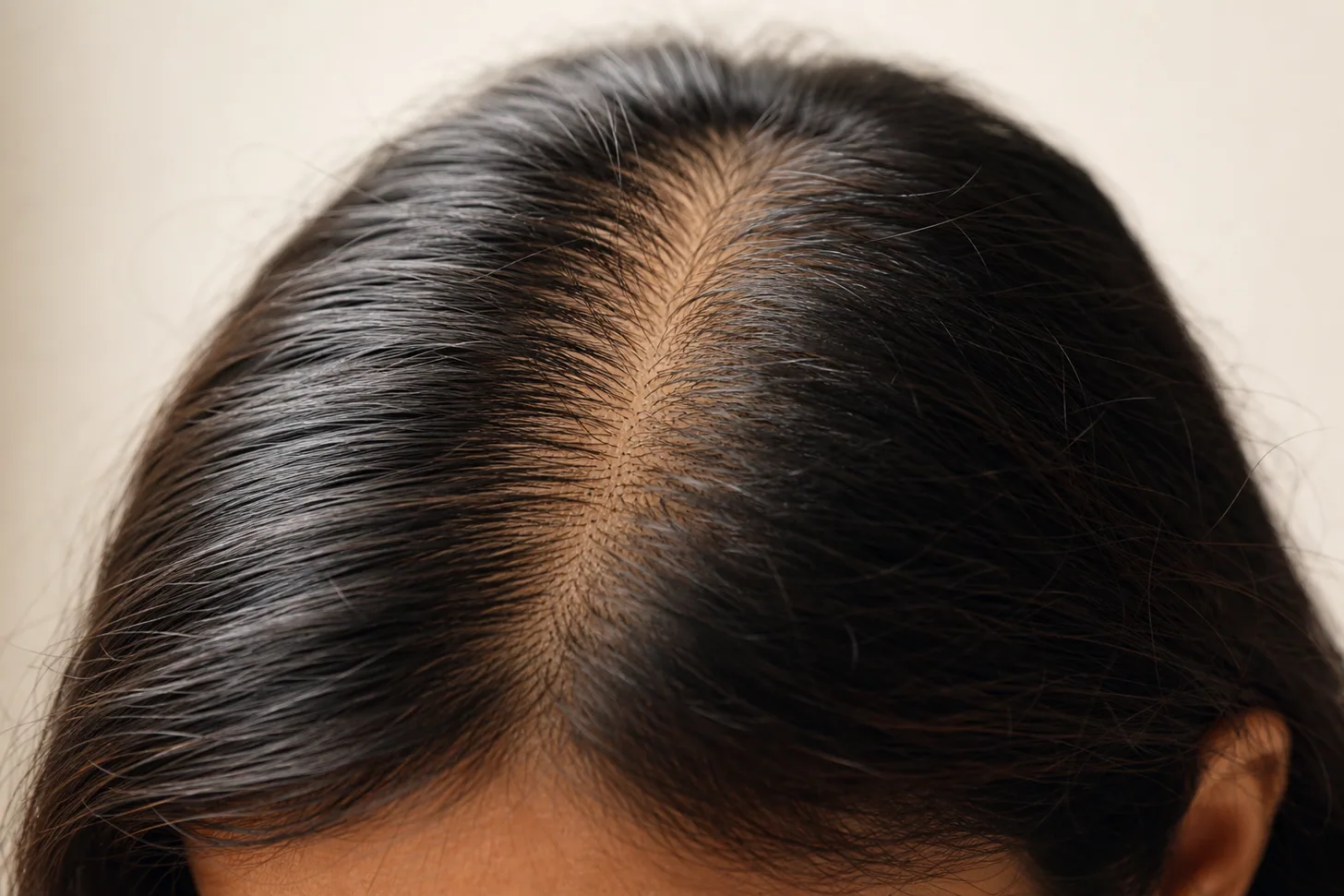
A length plateau is stable: same thickness, same ponytail circumference, ends that taper. A density change is a moving target: the part widens, the ponytail gets thinner, more hair in the drain. Those are different problems and they need different pages — fine hair or thinning? is the sorting question, "I can see my scalp" is the coverage one, and why hair looks thin when wet deals with the checks that mean something.
One genuine growth disorder is worth naming so you can rule it out.
When this isn't a length problem — get it looked at
Your part is widening or your ponytail is measurably thinner than a year ago. That's density, not length. Fine hair or thinning?, then a dermatologist.
The hairs you find are short and blunt or frayed at both ends, without a pale bulb. Breakage. A growth plan won't help; the location map will.
Shedding has stepped up noticeably and abruptly. That's an effluvium, and it has causes worth identifying — several of them treatable. Blood tests for hair loss.
You're also unusually tired or cold, or your periods have changed. Thyroid and iron are common, testable and treatable. Ask for blood work rather than a supplement.
Your hair has never grown past chin length, at any point in your life, and it isn't fragile. Worth raising short anagen syndrome specifically with a dermatologist.
There are defined patches of smooth, empty scalp. A different condition entirely. See a board-certified dermatologist promptly.
FAQ
In most cases it hasn't stopped growing — it's reached the length where the rate you lose from the ends equals the rate you gain at the roots. That's an equilibrium, not a ceiling, and it moves when you change either side of it. A true ceiling does exist: your maximum length is growth rate multiplied by how long your anagen phase runs, and scalp hair grows about a centimetre a month. With anagen commonly given as four to seven years, the arithmetic puts most people's genuine maximum between roughly 48 and 84 cm — 19 to 33 inches, or between the bra line and the hip. If your hair stops at your shoulders, around 13 inches, you're nowhere near that ceiling, so something is removing length rather than the follicle failing to make it.
There's no good reason to think so, and it matters because the belief sends people looking in the wrong place. Strand diameter and anagen duration are two independent measurements — one is how wide the fiber is, the other how long the follicle keeps producing it. Fine hair isn't a shorter-cycling hair; it's a thinner fiber with the same cycle. What genuinely differs is the other end. A fine strand has less material to lose before wear becomes visible, so the ends look sparse and see-through much earlier than a coarse strand's would, which is why fine hair spends more of its life being trimmed back. The length problem on fine hair sits at the ends, not at the follicle.
About a centimetre a month is the figure to plan with — roughly four and a half to five inches a year before any trimming. From a collarbone cut at about 14 inches to mid-back at about 24 inches is 10 inches, so a little over two years if you never cut it, and three to four years on a realistic trim schedule. The number people underestimate isn't the growth rate but the subtraction. Half an inch taken every eight weeks removes about a quarter of an inch a month, well over half of what you grew, and turns a two-year project into a five-year one. That arithmetic, not your follicles, is usually what's kept your hair the same length for the last three years.
No. Cutting the end of a hair can't change what the follicle at the other end is doing — there's no signalling between them, and hair beyond the scalp isn't living tissue. What trims genuinely do is remove damage before it travels, and stop splits from fraying further up the shaft, which protects length you'd otherwise lose in bigger pieces later. So the honest framing: trims don't speed growth up, but the right schedule lets you keep more of the growth you get. The wrong schedule — an inch every six to eight weeks on hair growing a centimetre a month — removes more than the follicle produces, and that's a haircut, not maintenance.
At about a centimetre a month, hair sitting 40 cm from your scalp is roughly 40 months old. That's more than three years of washing, combing, brushing, drying, sun, and friction against collars and pillowcases, all concentrated on the same few inches. Nothing else you wear survives three years of daily use and still looks new. It's why the ends of long hair are always in worse condition than the roots, why the taper at the bottom is normal rather than a sign of illness, and why no product reverses it — a hair fiber has no repair mechanism. It's also the strongest argument for protecting the ends now rather than trying to rescue them later.
Not past the real ceiling — that's set by how long your anagen phase runs, and nothing over the counter extends it. But almost nobody who says their hair won't grow is actually at that ceiling, so in practice the honest answer is yes, most people can gain length, by working the subtraction side rather than the growth side. Trim less at longer intervals, take the tension off, treat the last two inches as the fragile part they are, and stop asking a fine perimeter to look blunt when it no longer has the density to. If you've genuinely plateaued for years at a long length with healthy ends, that's your anagen duration, and it isn't a defect.
Yes, and it's the single most misread thing about long fine hair. Two ordinary facts stack. Individual hairs taper naturally toward the tip, and the ends have had years more wear than the roots — so on fine hair, where there was never much diameter to spare, the bottom two inches thin out visibly while the mid-lengths still look fine. That's weathering, not shedding, and it isn't evidence your hair is falling out. It does have a cosmetic cost, because see-through ends read as sparse hair overall, which is exactly why a stylist suggests cutting back to a stronger line. That advice is right about how it looks and expensive in length, and knowing which you care about more is the whole decision.
When the hair isn't reaching a plateau but visibly leaving — the part is widening, the ponytail is thinner than it was, shedding has stepped up, or the hairs coming out are short and blunt-ended rather than full length with a pale bulb. Those are density and breakage problems wearing a length problem's clothes, and none is solved by a growth schedule. Short anagen syndrome is a real if uncommon condition in which anagen runs only a year or two, so hair genuinely can't grow long, and it usually announces itself in childhood. And several ordinary causes of diffuse shedding are treatable once identified, which is the case for asking a doctor for blood work rather than buying another supplement.
Fourteen years across the chair and the page, with a particular interest in the hair problems that hide inside explanations people have already accepted. Megan's rule for length: do the arithmetic before you buy anything.
This article is for general education and is not medical advice. If you are experiencing sudden, patchy or prolonged hair loss, scalp pain, or other concerning symptoms, see a board-certified dermatologist.
Images in this article are AI-generated illustrations, not photographs of real clients or results. See our image policy.
Results vary with hair type, density, and growth patterns. This guide is educational and not a substitute for an in-person consultation with a licensed stylist or physician.
Get the good hair intel
One honest, stylist-written guide in your inbox each week. No hype.

 MH
MH