Chair-side note
I can usually tell who washes at night before they say a word, and it isn't from the ends — it's a band of shorter, broken pieces around the mid-lengths and a crown that won't hold anything. Then we talk about the routine and it's always the same shape: wash at ten, comb it out, go to bed, "it'll dry while I sleep." It does dry while you sleep.
It also spends four of those hours swollen and fragile with a head resting on it. The fix that has moved the needle most for my fine-haired clients isn't a product at all — it's three minutes of dryer on the roots before bed. Three minutes. It converts the worst drying method there is into an ordinary one.

MH
Three things happen to fine hair overnight, and only one is friction
The overnight conversation is almost entirely about rubbing, which is one of three mechanisms and arguably not the most consequential for this hair type.
Friction abrades the cuticle
Every time you turn over, hair is dragged across fabric. That mechanical wear lifts and chips the cuticle scales, and once the surface is rough, strands catch on each other and tangle, which causes more mechanical wear when you brush them out.
This is the mechanism the silk pillowcase is aimed at, and it's real. Fine hair shows it earlier than coarse hair for the reason fine hair shows everything earlier: there's less fiber, so there's less to abrade through before the strand fails.
Compression sets the shape — and this is the fine-hair one
Hair holds whatever shape it's in while it cools and dries. That's the whole principle behind a blow-dry, a roller set and an overnight braid. It's also what your pillow is doing to your crown for eight hours: a long, low-temperature set, in the flattest possible configuration, with the weight of your head as the pressing force.
It's the same mechanism that makes hat hair a set rather than a squash, discussed in fine hair in winter — except a hat is on for an hour and a pillow is on for eight.
Nothing about this is unique to fine hair. What's unique is the recovery. Dense hair springs back because strands prop each other up; coarse hair springs back because each fiber is stiff enough to. Fine, low-density hair has neither advantage, which is why it's the hair type that genuinely wakes up flatter than it went to bed.
Sebum migrates from scalp to root
Eight warm hours with a scalp in contact with hair moves oil onto the first inch of every strand. On coarse or dense hair that's mostly a good thing. On fine hair it lands precisely where weight is least affordable, which is a large part of why day-two hair is a day-two root problem rather than an all-over one — the rest of that story is in second-day fine hair.
The silk pillowcase, honestly
If you decide it's worth it, the specifications that genuinely vary — momme weight, closure, and where satin is enough — are compared in silk pillowcases for fine hair.
This deserves a straight answer, because it's the most-recommended hair purchase on the internet and the evidence behind it is thinner than anyone admits.
What we could not find: a search of PubMed — the US National Library of Medicine's index of biomedical literature — for "silk pillowcase hair" returns zero results. Not a weak study, not a small study. None. The "43% less breakage than cotton" figure that circulates constantly is attributed in dozens of places to a paper in a named dermatology journal; every one of those places sells silk, and the paper itself is not findable.
What is well established: friction damages the cuticle, and silk has a lower coefficient of friction than cotton. So the mechanism is sound and the direction of the effect is almost certainly correct. It just hasn't been measured on hair by anyone independent, and "plausible mechanism" is not the same claim as "43%."
Our position: buy one if you'd like. It's cheap, it lasts, it does no harm, and it very likely helps a little. But it is the third lever, not the first — and if you've bought a silk pillowcase and still go to bed with wet hair in a tight elastic, you've bought the accessory and skipped the fix.
Going to bed wet is the one genuinely damaging habit
If there's a single thing on this page to change, it's this one, and it's free.
Water swells the hair shaft and disrupts the hydrogen bonding that gives the fiber its rigidity. The International Journal of Trichology's review of hair cosmetics notes that "water absorption causes the hair shaft swelling," and that wet combing is associated with long-segment breaks — snapping mid-shaft — where dry combing produces short-segment ones. The AAD's healthy-hair guidance makes the same point from the other end: hair is delicate when wet, so use a wide-tooth comb rather than a brush.
Sleeping wet stacks that fragility on top of six to eight hours of friction and compression. The damage doesn't look like split ends — it looks like a band of shorter broken pieces through the mid-lengths and hair that seems to have stopped growing. And it sets the roots flat for the whole night, on the hair type least able to recover from that.
The fix is not "stop washing at night." It's three minutes: rough-dry the root area on medium heat with your head flipped forward, then let the lengths air-dry as normal.
That single change moves the worst drying method there is into the ordinary range — the full reasoning is in how to air-dry fine hair. A damp scalp under hair for eight hours is also worth avoiding on its own terms; prolonged moisture at the scalp isn't good for the skin there.
Protect the crown, not just the lengths
Almost every overnight hair routine you'll read is written to protect the lengths, because it's written for hair whose main problem is dryness and breakage at the ends. Fine hair's main overnight problem is a foot higher up.
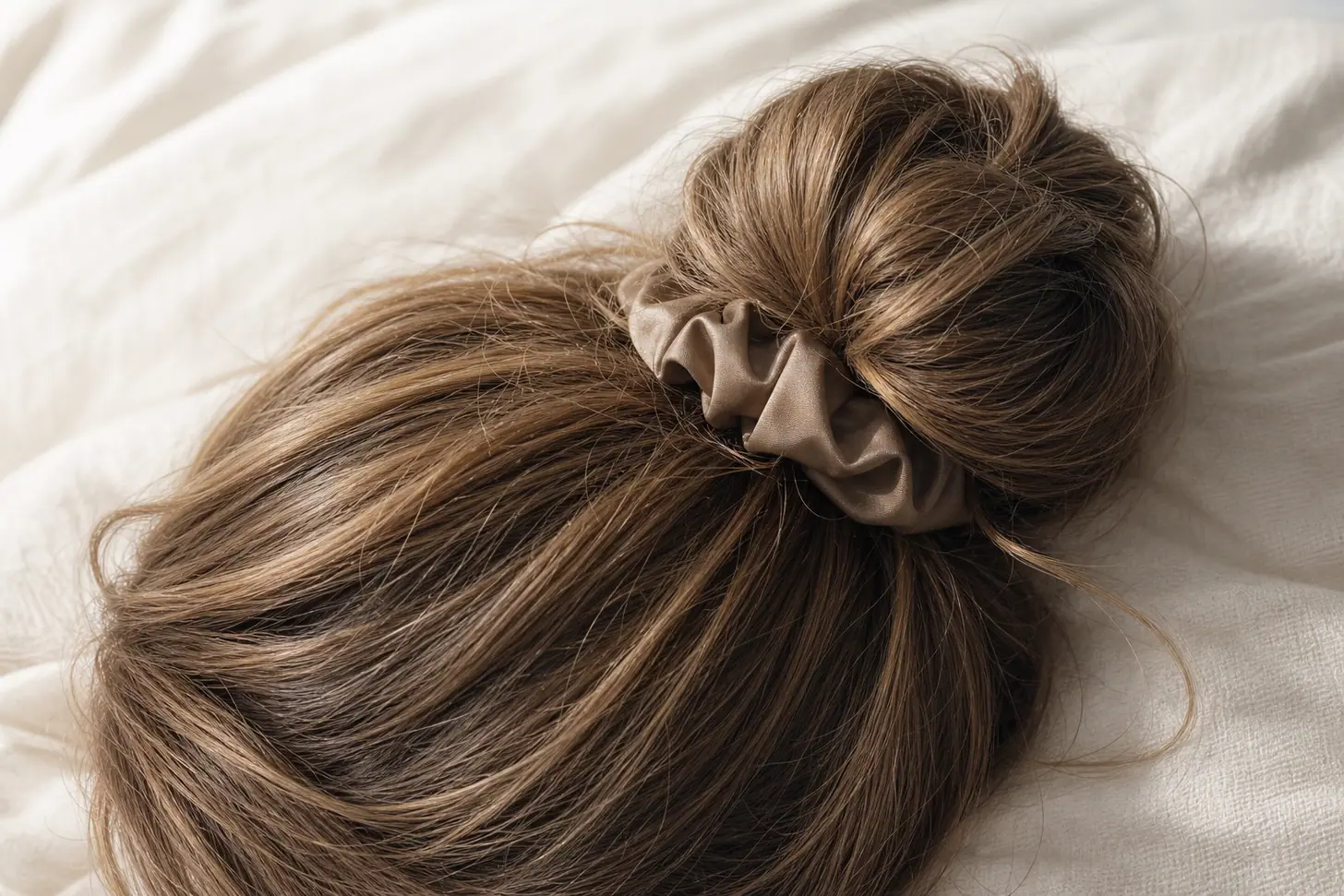
The single most useful overnight style for fine hair is a loose, high, soft bun — often called a pineapple — gathered near the top of the head with a silk or satin scrunchie.
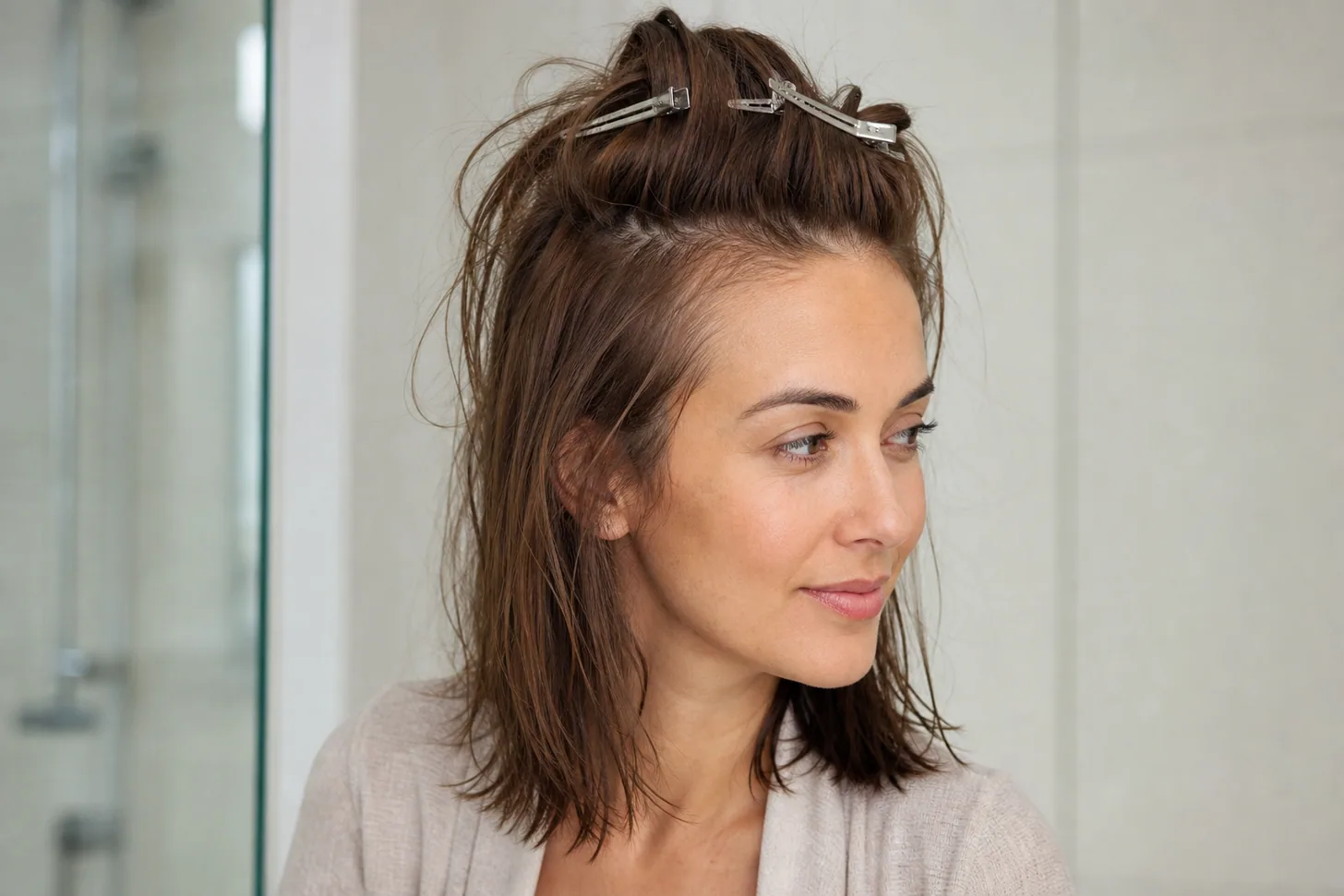
It does two things at once: it lifts the lengths off the pillow, and, more importantly, it holds the crown roots standing rather than pressed flat. You are effectively clipping your roots up for eight hours, which is the same principle that makes clips work in an air-dry.
Three rules make it work rather than backfire:
- Loose enough to pull out with one finger. If you can feel it, it's too tight, and you'll wake with a dent instead of lift.
- A scrunchie or a spiral coil, never a rubber band. A thin elastic concentrates all the tension into a narrow line, which on fine hair is how you get a band of breakage at one height.
- Move it an inch or two every night. Same tension, same spot, night after night is the pattern that causes damage — see the next section.
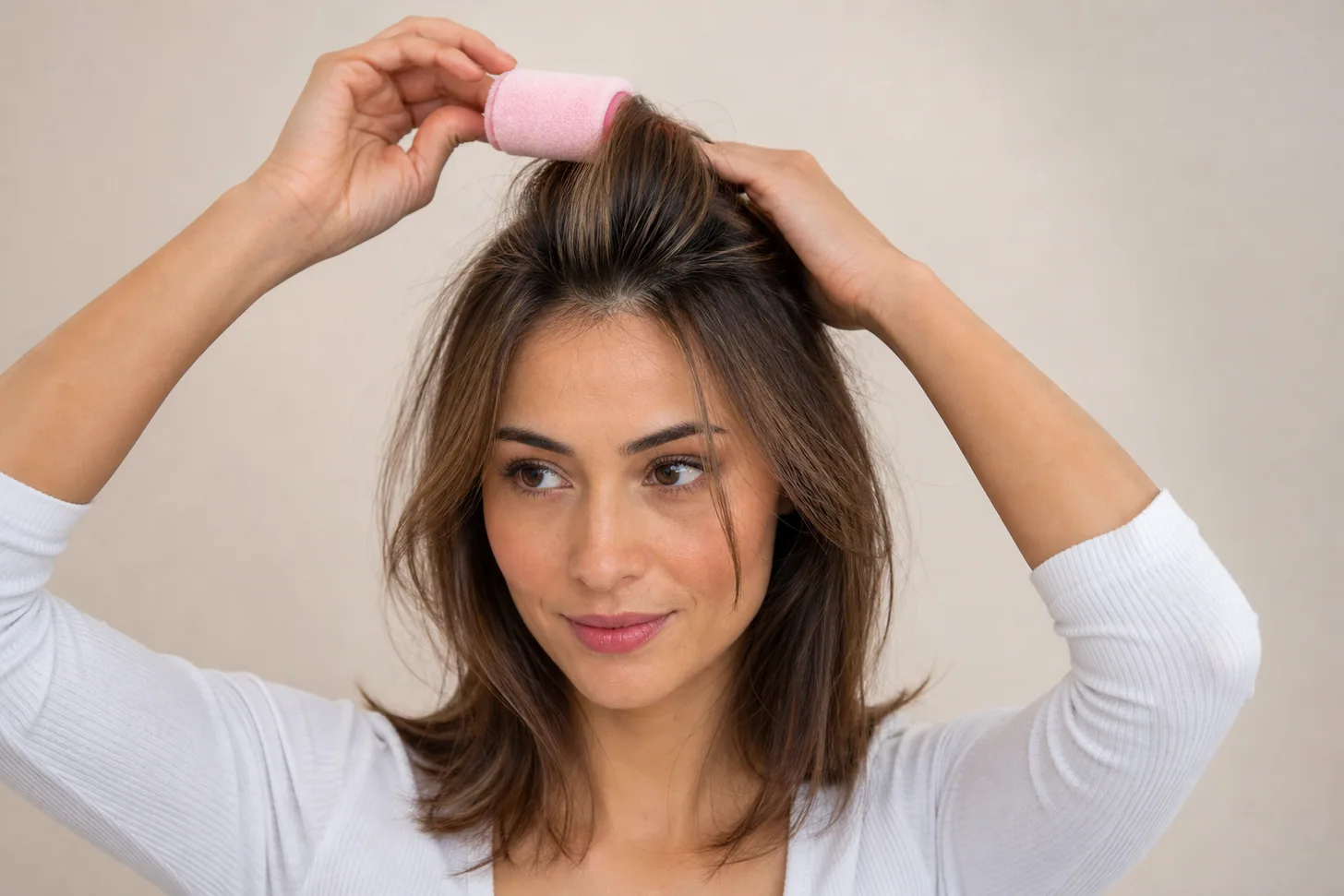
If you want the version that also produces a wave by morning, the overnight setting methods are in heatless volume for fine hair. This page is about protection; that page is about making the eight hours do some work for you. An itchy, flaking scalp disturbs sleep and shows more on fine hair — dandruff shampoo picks for fine hair covers the treatment side.
Where an overnight style becomes a medical question
This is short, but it's the part worth taking seriously. The same tension question during the day, and the loose clip-held styles that avoid it, is covered in easy updos for fine and thin hair.
Repeated pulling on the follicle causes traction alopecia. The American Academy of Dermatology is unambiguous that "anyone who wears tight hairstyles or puts repeated stress on their scalp can get traction alopecia," and that it "can be permanent the longer they go untreated." Nightly is repeated. A tight overnight ponytail worn in the same position for years is exactly the pattern.
Fine hair doesn't make the follicle more vulnerable to tension. It does mean any resulting loss becomes visible sooner, because you had less margin to begin with. The AAD's warning signs are worth memorising: pain from tightly pulled hair, stinging, small crusts on the scalp, and thinning around the hairline.
If any of those are present, loosen everything now and get it looked at — not next year. Fine hair or thinning? covers how to tell the difference between this and ordinary fine hair.
The overnight routine that's actually worth doing
Four minutes, in order of how much difference each step makes on fine hair.