There's a short list of blood tests worth asking for when your hair is thinning — ferritin, thyroid, a full blood count, vitamin D — and a shorter list worth skipping. But the thing that changes outcomes most isn't which boxes get ticked. It's this: the supplement you're probably taking for your hair can wreck the thyroid test you're having because of your hair.
Low TSH plus high thyroid hormones is the signature of an overactive thyroid — so a woman with normal thyroid function and a hair-and-nails gummy in her cupboard can hand her doctor a result that looks like something she doesn't have, while an underactive thyroid gets masked. The fix takes no effort and nobody mentions it: stop biotin at least 48 hours before the draw.
Below: the tests worth requesting, why a "normal" ferritin can still be your answer — a situation perimenopausal heavy bleeding produces routinely, what blood work genuinely cannot tell you, and why fine hair tends to arrive at this appointment early with a signal that's easy to wave off.
Ask for the numbers, not the word "normal". The numbers are what you compare next year.
The biotin problem: the supplement that hides the diagnosis
This goes first because it's the one that can invalidate everything else on the page, and because the people most likely to be affected are precisely the people reading this.
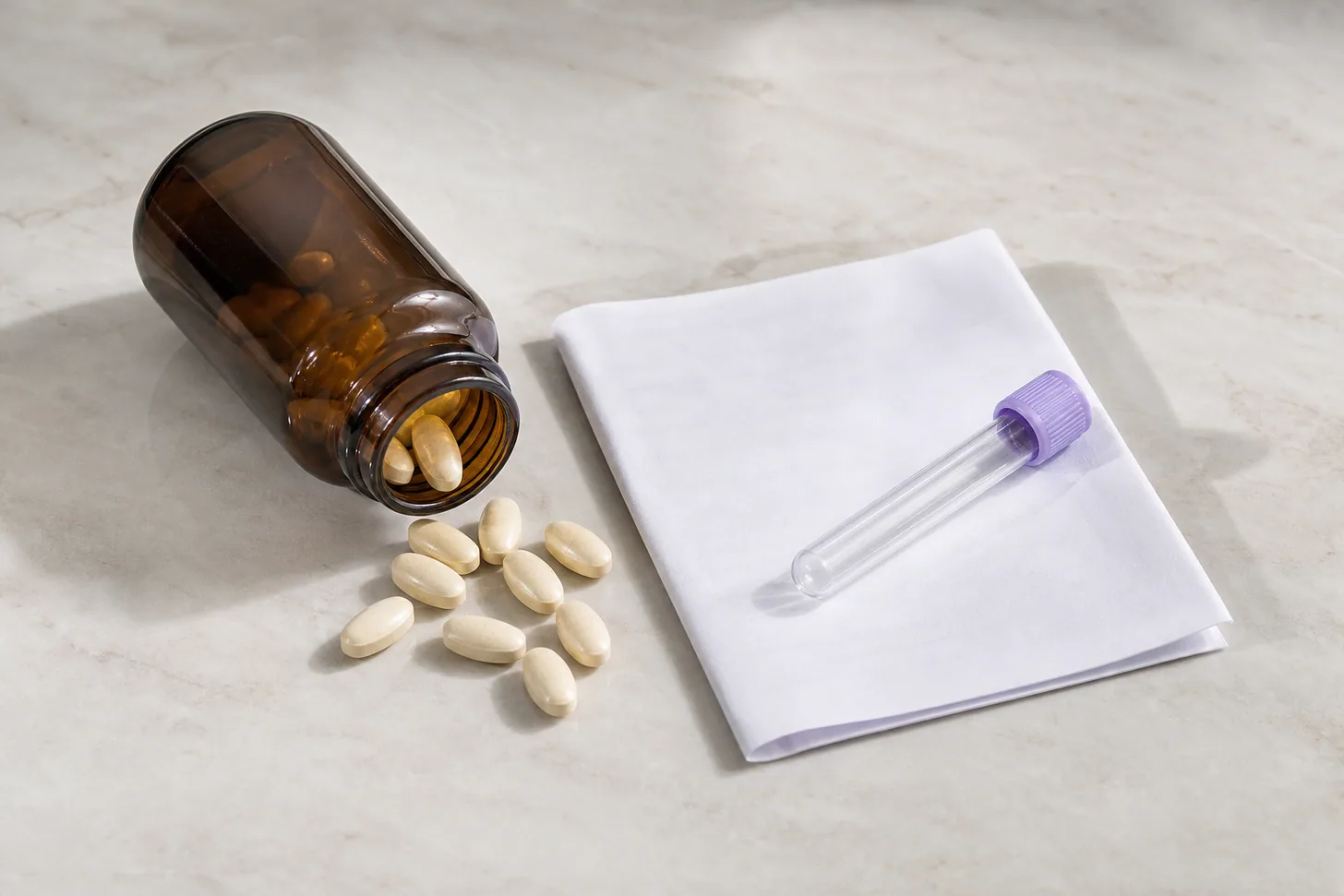
Months later, no better, you ask your doctor for blood work. Nobody asks what you're taking. And a large share of laboratory hormone tests are built on biotin-streptavidin chemistry, so the biotin circulating in your blood competes with the test's own machinery.
The interference isn't random — it has a direction that depends on the assay format, which is why the resulting picture can look so convincing:
TSH is a non-competitive (sandwich) assay. Excess biotin blocks the capture step, so the signal drops: "falsely low results".
Put those together and you get low TSH with high thyroid hormones — a textbook picture of hyperthyroidism, generated entirely by a supplement. It can send an investigation in the wrong direction.
Worse for our purposes, it can push a genuinely underactive thyroid's raised TSH back down into the normal range, so the one readily treatable cause of diffuse thinning gets missed. The same review notes how widespread the vulnerability is: it found no reproductive-endocrinology or thyroid assays that "meet the FDA's biotin threshold requirement".
Say it out loud anyway. Tell whoever takes the blood, and name the product. Multivitamins, collagen blends and gummies contain biotin without advertising it.
Check the cupboard, not your memory. Read the label. Doses in hair supplements are often 5,000–10,000 mcg, which is many multiples of what anybody needs.
Short, cheap, widely available, and between them they cover most of the reversible ground.
Test
What it's looking for
Worth it?
Ferritin(+ iron studies)
Iron stores, which can be low well before anemia appears
Yes — the highest-yield test on the list. Ask for the number
TSH(± free T4)
Thyroid function in both directions
Yes. Common, testable, and the hair improves with treatment
Full blood count
Anaemia and broader red flags
Yes. Routine, and it contextualises the ferritin
Vitamin D
A plausible but unsettled contributor
Reasonable — with honest expectations, see below
Zinc
A deficiency that's often assumed
No. Screening isn't recommended
Biotin level
A deficiency you almost certainly don't have
No. Stop taking it before the draw instead
Your doctor may add to this — hormone panels if there are other signs, an autoimmune screen if the pattern suggests it, or a scalp examination that tells them more than any of it. That's their call, and the point of arriving informed isn't to write your own request form. It's to make sure the two or three tests that matter don't get skipped.
Ferritin: why "normal" and "enough for hair" aren't the same number
If you take one thing from this page after the biotin section, take this one.
There is no agreed threshold for iron deficiency. A review of micronutrients in hair loss puts the disagreement plainly: the definition "has ranged from a serum ferritin concentration of ≤ 15 to < 70 μg/L". That's not a rounding difference. That's a fourfold spread in what counts as low.
And where hair specifically is concerned, the numbers suggested are at the top of that range, not the bottom — "some authors recommend maintaining serum ferritin at levels of > 40 ng/dL", others 70. Meanwhile a laboratory's printed reference range is generally built around detecting anemia, which is a later and more serious event than "iron stores too low to support hair growth comfortably".
Two practical rules follow. Ask for the number, not the word. "Normal" is a category; 18 is a fact you can compare against next year's 34. And don't start iron on your own — too much is its own problem, the dose and form matter, and if you are losing iron rather than not eating enough, the reason for that is the more important question.
One thing worth mentioning at the appointment: ferritin is an acute-phase protein, so it rises with infection and inflammation. A test taken during or just after an illness can read reassuringly while stores are genuinely low, which is part of why iron studies alongside ferritin are more informative than ferritin alone.
Chair-side note
I'm not a doctor and I don't interpret anyone's results — but I do see what women come back from these appointments carrying, and there's a pattern. The ones who get somewhere brought three things: an overhead photo of their part from six months ago, a date the change started, and one sentence about what was happening in their life three months before that date. The ones who come back deflated brought a feeling and left with the word "normal".
That's not a criticism of anyone's doctor — a fifteen-minute appointment about diffuse hair thinning is genuinely hard, and hair is one of the few complaints where the patient's own record is better evidence than anything measurable in the room.
So take the photograph today even if you never need it. Same spot, same light, overhead, once a month. It's free, it takes ten seconds, and it is the single most persuasive document you can put in front of a clinician.
MH
— Megan Holloway, Editor-in-Chief
Thyroid: both directions shed, and this is the one that gets better
The reason thyroid testing earns its place isn't that it's the most likely answer. It's that it's the most fixable one.
Which kills a common piece of self-triage. "It can't be my thyroid, I'm not exhausted" doesn't hold, because the other direction presents as the opposite. Neither does "my thyroid was checked years ago", since thyroid function changes over time — often around the same life stages that bring people to this site in the first place. Fine hair through menopause covers that overlap.
Why fine hair arrives at this appointment early — and gets waved off
This is the part a general medical page won't tell you, and it's the reason this page exists on a fine-hair site.
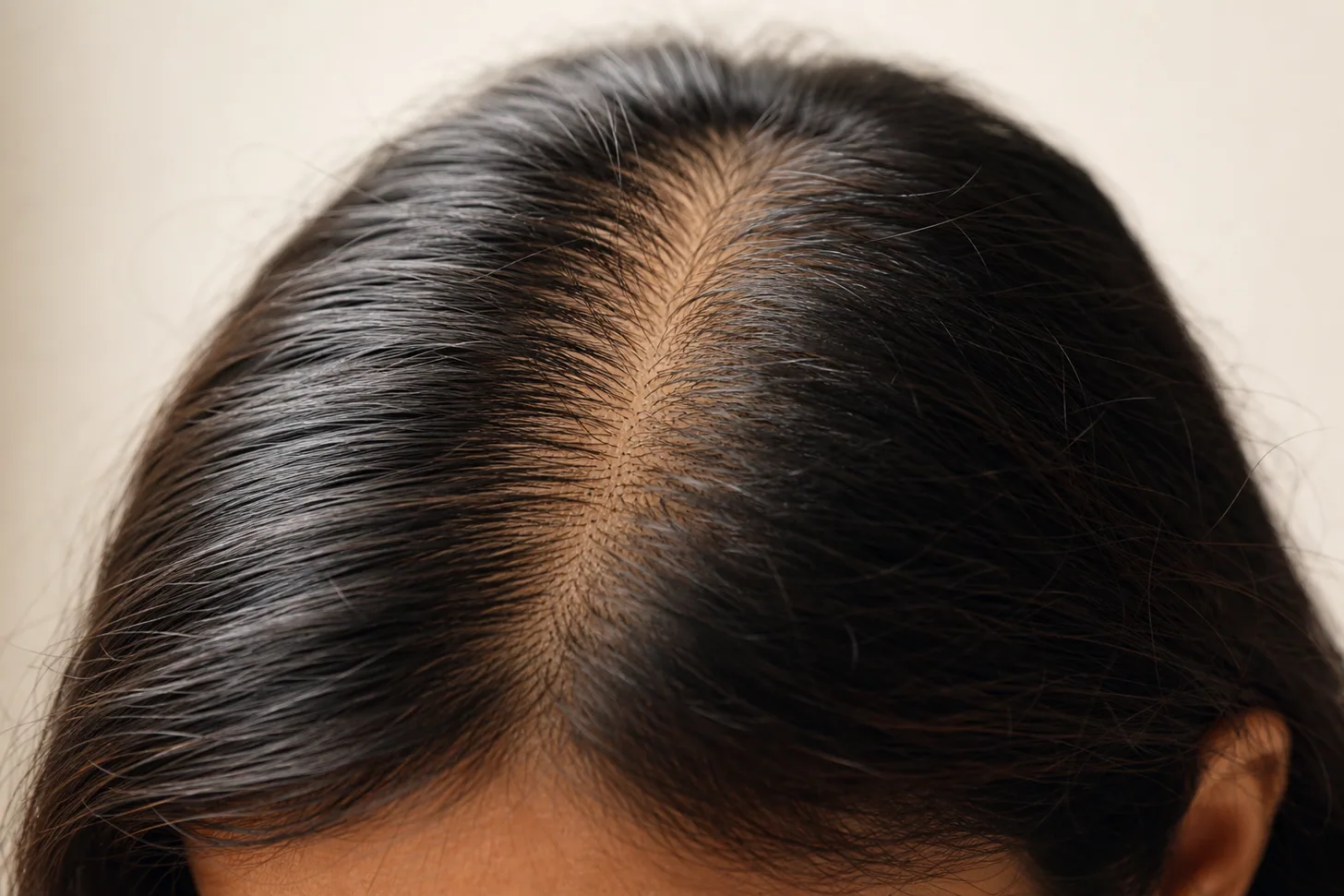
What covers your scalp isn't hairs; it's the overlap between them. Dense hair carries surplus overlap and can lose a substantial share while still looking unchanged. Fine, low-density hair never had that surplus, so the same proportional change crosses the threshold where skin becomes visible — at the part first, because that's where the margin was thinnest to begin with. Why hair looks thin when it's wet covers the same arithmetic from the other end.
The consequence is structural rather than anybody's fault. You are likely to notice, and seek help, at a smaller absolute change than a woman with coarse dense hair reporting the same complaint. Which puts you in the consulting room at exactly the moment when everything measurable is still borderline: ferritin in the low-normal range, TSH inside the reference interval, a scalp that looks unremarkable to someone who hasn't seen it before.
So the response isn't to distrust the doctor. It's to bring what makes a borderline picture legible: Age and cycle stage change what the results mean, which is why perimenopausal thinning is worth reading before you book the panel.
Photographs — overhead, daylight, same spot, ideally spanning months. This does more than any single test.
A date. When did it change? Not "gradually" — the month, if you can.
What happened three months before that date. Illness, surgery, a crash diet, a new medication, a bereavement, childbirth. A shed lags its trigger by about a season, so the useful question points backwards. Shedding after weight loss explains the delay.
A number, if you have one. Ponytail circumference measured with a tape. Unglamorous, reproducible, and far better than memory.
The actual results, in writing. Ask for a copy. Next year's comparison is only possible if you kept this year's numbers.
What blood tests can't tell you
They also can't settle PCOS on their own — that diagnosis runs on cycle history and imaging as well as androgen levels, and scalp thinning in isolation is weak evidence for it. The full picture is in PCOS and hair loss on fine hair.
Worth knowing before you go, so a normal panel doesn't read as a dead end.
There is no blood test for female-pattern hair loss — the most common cause of progressive thinning in women. It's diagnosed on pattern and history: a widening part, a thinning crown, the hairline usually spared, gradual over years. A perfectly normal panel is entirely compatible with it. "I can see my scalp" covers what that looks like and what helps.
Nor is there one for breakage, which isn't a follicle event at all. If the hairs you're finding are short, without a pale bulb, and blunt or frayed at the ends, nothing has left your scalp — it snapped. Breaking or shedding? has the one-minute test, and no laboratory can substitute for it.
Nor for tension damage at the temples and front edge, which is diagnosed by looking. Thinning at the hairline.
And no panel will name a drug for you. Drug-induced shedding is diagnosed on timing, not chemistry — it surfaces two to four months after a medication is started, stopped or changed, which is why the dated list you bring matters more than the bloods you leave with. Medications that cause hair shedding has the classes, the few published rates, and why the drug you suspect is usually the wrong one.
And a normal set of results is still useful information, even when it's disappointing. It closes off the reversible causes, which means the next conversation can be about what actually helps rather than what might be missing — and that next conversation has its own page: PRP, microneedling and laser caps, ranked by evidence per dollar rather than by how impressive they sound.
Hair coming out in defined patches with smooth, empty skin. A different condition entirely. See a board-certified dermatologist promptly.
Scalp pain, burning, itching, scaling or visible inflammation. Symptoms belong to the scalp's own diagnoses. Flakes and dandruff, and get pain or burning assessed.
Heavy shedding still going beyond six months. No longer a simple acute effluvium; it needs a diagnosis rather than more waiting.
Hair loss with new facial hair, acne, or irregular periods. Worth raising as a hormonal question in its own right, not just a hair one.
You've started iron, vitamin A or selenium on your own initiative. Say so. Two of those cause hair loss in excess, and iron shouldn't be taken untested.
You are taking any hair supplement and about to have blood taken. Stop the biotin 48 hours ahead and tell them, or the result may not be interpretable.
FAQ
A short list covers most of what's worth finding: ferritin plus iron studies, thyroid function starting with TSH, a full blood count, and vitamin D. Ferritin and thyroid are the two that most often change what happens next, because both are common in women and both are treatable once identified. A full blood count catches anemia and broader problems. Vitamin D is reasonable to include, with the honest caveat that the evidence linking it to hair loss is still contradictory. What isn't worth asking for is a zinc level — one micronutrient review states plainly that data correlating telogen effluvium and androgenetic alopecia with zinc are not homogenous and screening for zinc is not recommended — and there's no useful test for a biotin deficiency you almost certainly don't have.
Yes, and this is the single most useful thing to understand before the appointment. The threshold for iron deficiency isn't agreed on. A review of vitamins and minerals in hair loss notes the definition has ranged from a serum ferritin of 15 or less to under 70 μg/L, and that some authors recommend maintaining ferritin above 40, or above 70, in patients with hair loss. A lab's reference range is typically set to catch anemia, which is a lower bar than the level at which hair appears affected. So a result of 20 may be printed as normal, be entirely correct as a laboratory finding, and still be the most likely explanation on the page. Ask for the number rather than the word, and write it down for comparison later.
Yes, and this is the trap almost nobody is warned about: the supplement people take for their hair can distort the test used to investigate their hair. Many lab immunoassays rely on biotin-streptavidin binding, so extra biotin in the sample interferes. In non-competitive assays, of which TSH is one, excess biotin saturates the streptavidin binding sites and leads to falsely low results; in competitive assays, which include free T4 and free T3, it leads to falsely high results. A falsely low TSH alongside falsely high thyroid hormones is the pattern of an overactive thyroid, so a woman with normal thyroid function on a hair supplement can produce a confusing result — and an underactive thyroid can be masked. Guidance is that biotin should cease at least 48 hours before a blood draw, longer at very high doses. Tell whoever takes the blood what you're taking.
Yes, in both directions, which is why the assumption that you'd feel obviously unwell is unreliable. An underactive thyroid slows the cycle: a 2024 review states that hypothyroidism impedes epidermal and skin appendage cell division, decreasing anagen frequency, so fewer hairs are actively growing and the hair thins diffusely. An overactive thyroid does it by a different route, through oxidative damage, and the same review notes hair loss is observed in about 50% of hyperthyroid patients. The reason to test rather than guess is the outcome: hair loss caused by hypothyroidism usually improves within several months of treatment, which puts it in the small category of hair problems with an actual fix.
It can rule things in or out, but it can't diagnose the most common cause. Female-pattern hair loss is diagnosed on pattern and history — a widening part, a thinning crown, a gradual change over years — and there's no blood marker for it, so a completely normal panel is compatible with genuine progressive hair loss. Blood tests earn their place differently: they find the contributors that are reversible, a smaller list but a more actionable one. The best use of them is alongside two things a lab can't supply: a monthly overhead photograph of your part in daylight, and a timeline of when the change started and what else was happening in your life three months before that.
Because what covers your scalp is the overlap between hairs rather than the hairs themselves, and fine, low-density hair has no surplus overlap to spend. A dense head can lose a substantial share and still look unchanged; the same proportional loss on fine hair crosses the threshold where skin becomes visible. That has a specific consequence in a consulting room. You're likely to arrive earlier, with a smaller measurable change, than a woman with coarse dense hair complaining of the same thing — exactly the situation in which a borderline result gets described as normal and the visit ends. It isn't a reason to disbelieve the doctor. It's a reason to bring photographs, a date the change started, and a request for the actual numbers.
Fasting isn't usually required for ferritin or thyroid function, and your clinic will tell you if their protocol differs — but two practical points do affect the result. Stop biotin at least 48 hours beforehand — 72 if you take a high-dose hair supplement — since it interferes with many immunoassays including thyroid tests. And be aware that ferritin rises during infection and inflammation, because it's an acute-phase protein, so a test taken during or just after an illness can read reassuringly high while iron stores are genuinely low. If you were unwell in the fortnight before the draw, mention it — it's a reason a doctor may want iron studies alongside ferritin rather than ferritin alone.
Only if they're correcting something you're actually short of, and most aren't. On biotin specifically the evidence is unhelpful to the marketing: severe biotin deficiency in healthy individuals eating a normal diet has never been reported, and there are no evidence-based data that supplementing biotin promotes hair growth. Two ingredients also carry a real downside in excess — consuming too much vitamin A can cause hair loss, and selenium above 400 μg daily may cause toxicity, hair loss included. So the sequence that makes sense is test, then treat what the test found, rather than supplement and hope. And if you're already taking biotin, stop it before the blood draw, or the test you're relying on may not be readable.
Fourteen years across the chair and the page, with a particular interest in the hair problems that hide inside explanations people have already accepted. Megan's rule for an appointment: bring a photograph and leave with a number.
This article is for general education and is not medical advice. It does not recommend, interpret or replace any test, and nothing here is a reason to start, stop or change a supplement or prescribed medication without speaking to a clinician. If you are experiencing sudden, patchy or prolonged hair loss, scalp pain, or other concerning symptoms, see a board-certified dermatologist.
Images in this article are AI-generated illustrations, not photographs of real clients or results. See our image policy.
Results vary with hair type, density, and growth patterns. This guide is educational and not a substitute for an in-person consultation with a licensed stylist or physician.
Get the good hair intel
One honest, stylist-written guide in your inbox each week. No hype.

 MH
MH