Chair-side note
The consultation I have most often about extensions is the one after somebody else's. A client comes in unhappy with a set that is, technically, very well applied — the color is matched, the rows are level, the blend is good. What's wrong is that she can see the tabs, and so she has spent six weeks not wearing her hair up, not sitting under the light in a restaurant, and not enjoying the thing she paid for.
Nobody did anything careless. It's that the amount of hair she has lying over the row was never going to cover it, and that is knowable in about ninety seconds at the mirror before any money changes hands. I now do that check first, every time, and I've talked at least as many people out of extensions as into them.

SB
Two problems, and most guides only discuss one
Search this topic and nearly every result is published by a company that sells extensions. That doesn't make the information wrong, but it does shape which question gets answered — you'll find a great deal about which method is gentlest, and almost nothing about whether the result will look good on hair like yours.
The load problem: your hair is the anchor
Semi-permanent extensions hang from your own strands. Whatever the marketing, the weight ends up on a section of your hair, and how much that section can carry depends on two things fine hair is short of: how many strands are in it, and how thick each one is.
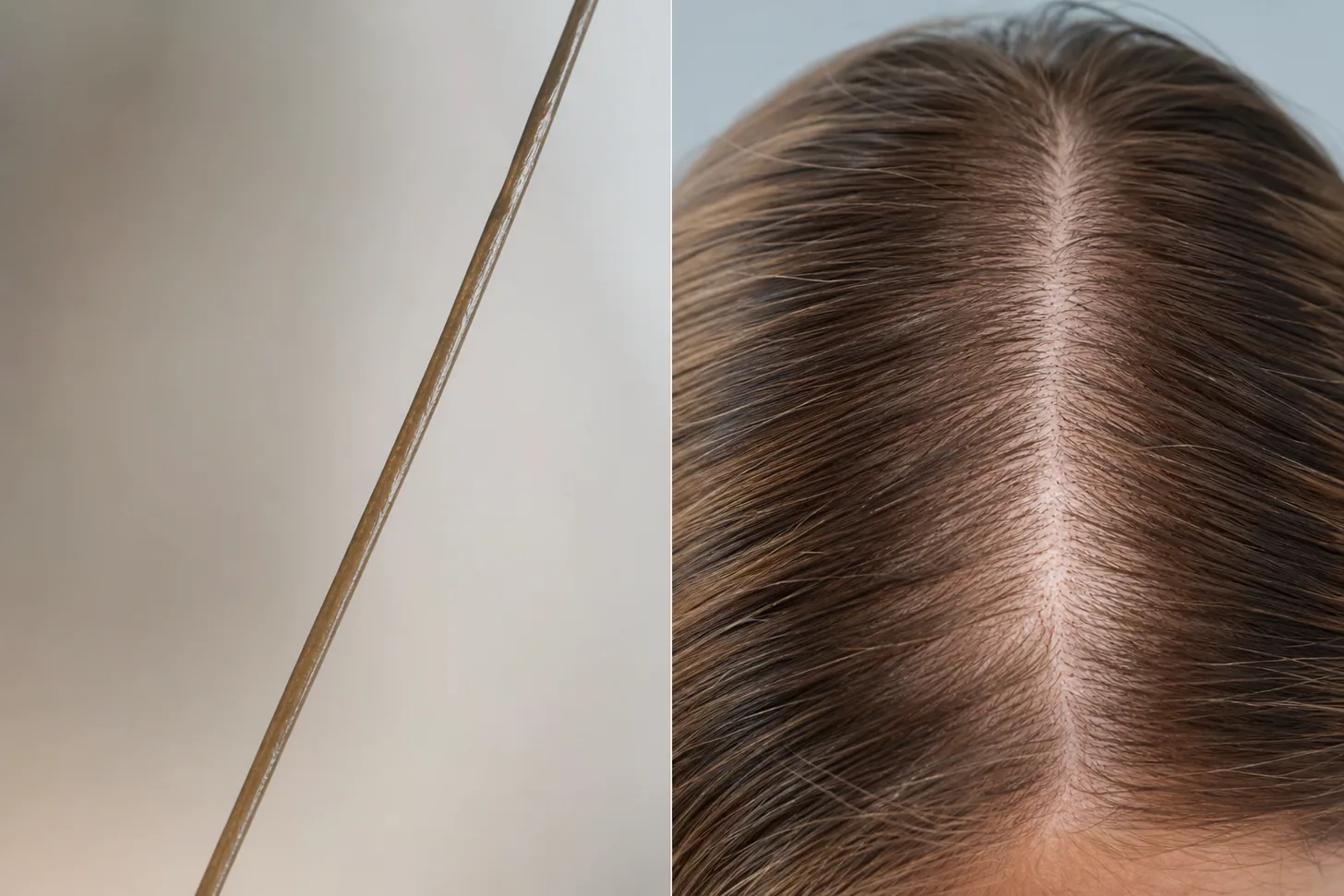
This is the point where the difference between fine and thin hair stops being academic — fine describes the diameter of each strand, thin describes how many you have, and extensions test both at once. Fine and thin is the hardest combination there is.
The coverage problem: fine hair can't hide the hardware
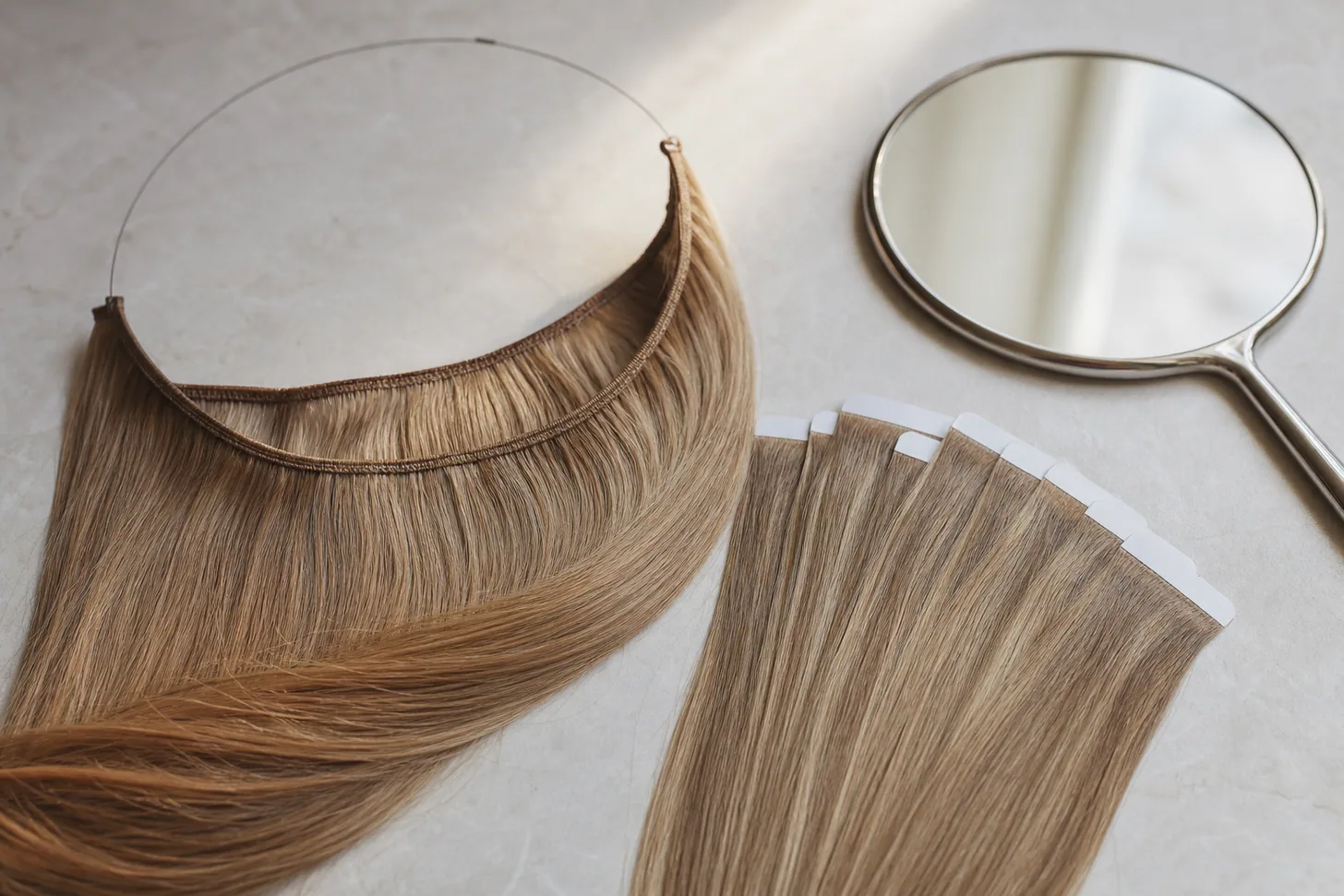
A tape tab is about an inch wide and completely opaque. A bead is small but shiny. Both are invisible under enough hair and obvious under too little — and the hair doing the hiding is the hair you already feel you don't have enough of.
In my experience this, not damage, is the reason most fine-haired clients end up disappointed. It's also the one that's easy to predict in advance, which is why the test below comes before everything else on this page.
The methods, ranked by what they ask of fine hair
Read the last column first. It's the only one that changes depending on your density.
The pattern is straightforward once you see it: the further a method spreads the weight, and the sooner you can take it off, the better it suits fine hair. That is close to the opposite of how the industry ranks them by price and by permanence.
What the research says about pulling
Traction alopecia is hair loss caused by sustained tension on the follicle, and extensions are named in the literature.
A 2018 review in Clinical, Cosmetic and Investigational Dermatology states that "the frequent use of tight buns or ponytails, the attachment of weaves or hair extensions, and tight braids (such as cornrows and dreadlocks) are believed to be the highest risk hairstyles," and that the risk rises when the hair has been chemically relaxed, because "chemical relaxation of the hair through interruption of disulfide bonds weakens the hair shaft."
Two things follow from that, and they're worth stating plainly. Any process that weakens the shaft — relaxing, bleaching, a lightening service taken too far — subtracts from the same margin the extensions are borrowing against.
And the same review is direct about the endpoint: "in its later stages, the disease may progress into an irreversible scarring alopecia if traumatic hairstyling continues without appropriate intervention." That last clause is the important one. Traction damage is a slow process with a long warning period, not a single mistake.
The American Academy of Dermatology's guidance on hairstyles that pull lists the warning signs to act on: "pain from tightly pulled hair, stinging on your scalp, crusts on your scalp, tenting (sections of your scalp pulled up like a tent)." Its extension-specific advice is to wear them for short periods, remove them immediately if they cause pain or irritate the scalp, and prefer sewn-in weaves over ones attached with bonding glue.
None of this means extensions are off the table. It means the tolerances are tighter on fine hair than on anything else, and that "it's a bit sore for the first few days" — the sentence I hear most — is not something to sit out.
The coverage test to do before you book
Ninety seconds, at home, in front of a mirror.
- Find where the row would go. Roughly two inches below the crown, and two finger-widths in from the hairline at the sides. Part your hair horizontally there and hold the top section up.
- Stand under an overhead light. Bathroom ceiling light, not a window. Overhead light is the unforgiving one, and it's what restaurant and office lighting mimics.
- Drop the top section and look. How much scalp shows along that part line? That is exactly how much tape tab or bead track will show once it's occupied.
- Then move. Tip your head forward and flick it back up, the way you do a hundred times a day. Hair that covers a row when styled and separates when you move is the commonest version of "I can see them."
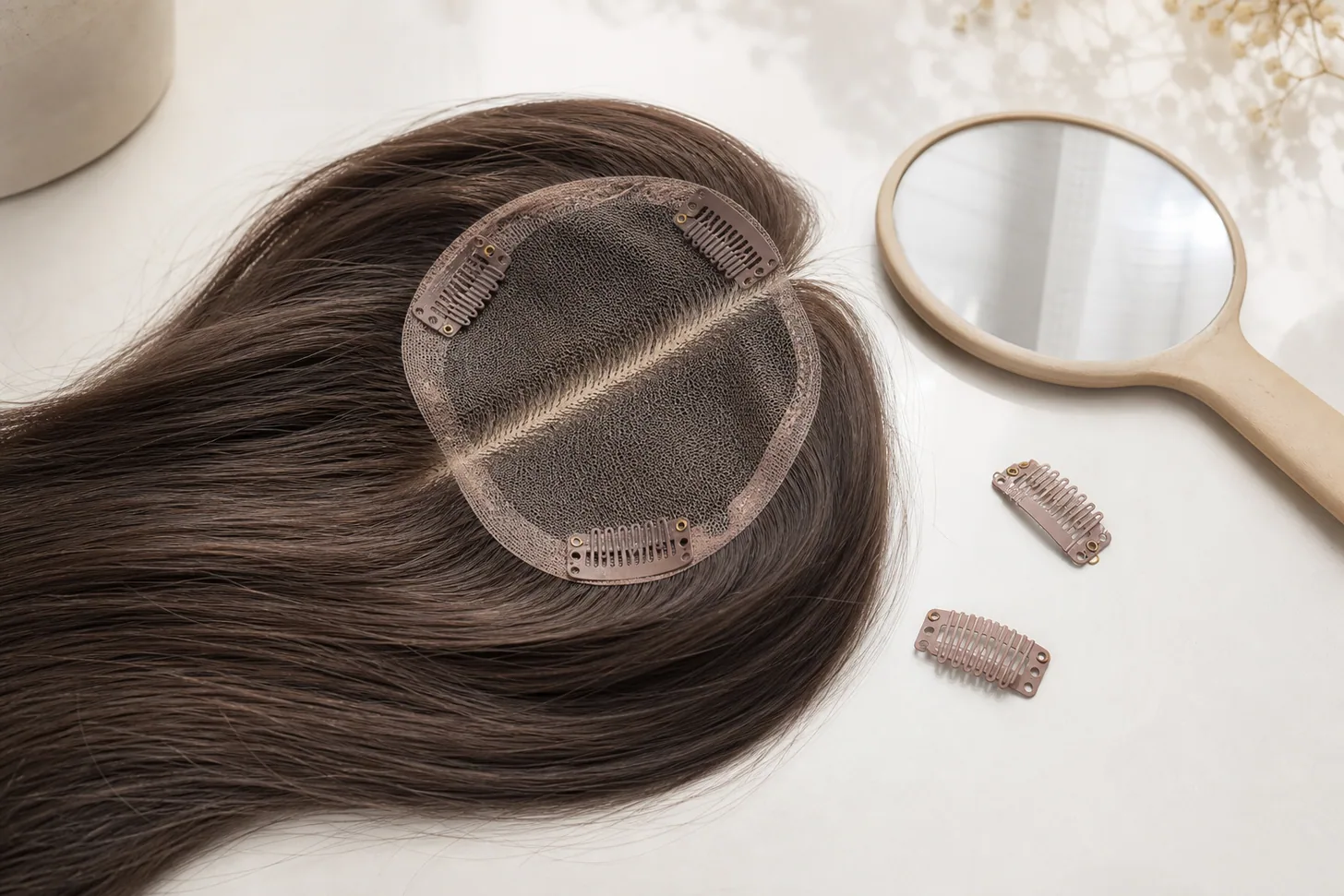
If the line stays covered, the coverage question is settled and you're down to load. If it doesn't, no stylist can fix it with placement — and this is the moment to consider a halo, which you take off, or to spend the same money on a cut that builds the shape you're after instead.
What a realistic before and after looks like on fine hair
Before-and-after photos are how extensions are sold, and they are worth reading carefully rather than dismissing, because the honest ones do show a real change. The problem is that in most pairs, the extensions are not the only thing that changed between the two frames. The "before" is typically unstyled, air-dried, parted flat and shot under overhead light — the least flattering version of anyone's hair.
The "after" has been blow-dried with a round brush, usually curled, often colour-matched with fresh gloss, and lit from the front. Two of those three would have improved the "before" hair on their own. When you look at a pair, cover the length with your thumb and compare only the root area: if the parting and the crown look identical, you are seeing a styling difference stacked on top of an extension difference.
Here is the part that decides whether you will be happy, and it is geometric rather than aesthetic. Extensions add hair below the point where they attach. That means length, body through the mid-lengths, and a ponytail that closes around itself instead of tapering to a wisp — all real, all achievable, and all genuinely transformative if that is what has been bothering you.
What does not change is everything above the attachment line: your parting is the same width, your crown has the same density, your temples are unchanged. A person whose complaint is "my hair is long but the ends are see-through" gets a dramatic before and after.
A person whose complaint is "I can see my scalp at the part" gets almost nothing visible, and has added tension to the hair around it. That is the same distinction the coverage test above is designed to settle.
On short fine hair, the before and after is usually about volume rather than length, and it is the case most likely to disappoint. There has to be enough length at the attachment row to cover the wefts — roughly chin length as a floor for tape-ins — or the join sits in open view every time the wind moves.
Below that, a halo worn under the top layer, or clip-ins for occasional wear, are the honest options, and the change they produce is real but temporary by design.
One more frame is worth asking for and almost never published: the eight-week photo, and the one taken the day they come out. Day one is the best the set will ever look. By week eight there is grow-out at the attachment row, the colour has usually drifted a shade, and the sections need moving up.
And at removal there is a shed — the hairs your head lost naturally over those weeks, held in place by the bond instead of falling out in the shower, all released at once. That handful is alarming and mostly normal, and telling the two apart is covered in the FAQ below. A stylist who will show you their own clients at week eight is telling you more than one who only shows day one.
A note on our own images: the photographs on this site are AI-generated illustrations, not client results, so we do not publish before-and-after pairs. We would rather explain what the change actually consists of than show you a comparison we did not create in a chair.
Weight: the question to ask, and the instrument to use
Sets are commonly sold somewhere between 100 and 160 grams. That figure is discussed as if it were a comfort preference; on fine hair it's the whole engineering problem, because the same grams are carried by fewer and thinner strands.
There's no published gram limit for a given density, and I'd distrust anyone who quotes you one. Use your own scalp as the instrument instead. By the end of the first day, you should be able to forget they're in.
A headache, a tender scalp, a pulling sensation at the temples, or the feeling of your hair being "held" when you lie down all mean the load is wrong for your hair — and per the AAD's advice above, that's a removal conversation, not a break-in period.
Two practical asks that reduce the load without reducing the look: split the same weight across more, narrower wefts, and start with less than you think you want. A stylist can add a weft at the next appointment. Taking one out early costs you the appointment.
Extensions add hair below the point where they attach. That's worth pausing on, because it decides whether they can solve your problem at all.
If what bothers you is length, or that your ends look thin and wispy, extensions address it directly. If what bothers you is a part that has widened, a crown you can see through, or a scalp showing in photographs, they do essentially nothing — the attachments sit below the area you're trying to cover, and you've added load to hair that's already producing finer strands.
That job belongs to a hair topper, which covers the exact zone extensions can't reach, or to the styling and coverage sequence in "I can see my scalp".
There's a second reason to sort this out first. Extensions hide a change while it's happening. If density is genuinely shifting — after a birth, around menopause, or for a reason nobody's identified yet — a year of covering it up is a year not spent finding out why, and pattern hair loss responds far better to treatment started early. How to tell fine hair from genuine thinning is the check to run before you book anything.
What to ask at the consultation
Bring these five. A good extension stylist will have answers ready and won't mind being asked; a defensive answer to any of them is information in itself.
- "Can you show me the row on me, in this light, before we book?" The coverage test, done in the chair. It's the question that prevents the disappointment.
- "What does the whole set weigh, and can we start lighter?" Establishes that weight is a variable you're choosing, not a fixed property of the service.
- "How far from my part and my hairline will the closest attachment sit?" The front hairline is where traction damage shows first and recovers worst. You want it kept well back.
- "What's the move-up interval, what does each one cost, and what happens if I'm late?" The recurring cost is the part people underestimate. Get the number before, not after.
- "How are they removed, and what does my hair look like the day they come out?" A straight answer includes the trapped shedding described below. An answer of "you won't notice anything" isn't one.
The honest maintenance picture
Semi-permanent sets need moving up every six to eight weeks as your hair grows and the attachment travels away from the scalp. Skipping that isn't a cosmetic compromise — the further the tab or bead sits from the root, the more leverage it has on the section holding it, and the more shed hair builds up and matts inside it.
Which brings up the removal appointment, and the thing worth knowing in advance so it doesn't frighten you. A healthy scalp sheds hair constantly, and per the StatPearls reference on hair anatomy, the resting telogen phase "lasts approximately three months" before those hairs release.
When a section is bound inside a tab, the hairs it sheds have nowhere to go — so eight weeks of perfectly ordinary shedding arrives in one handful at removal. That is expected. What isn't expected is a thinned patch at an attachment site, strands snapped mid-shaft rather than shed with a small pale bulb at the end, or soreness that lasted the whole wear.
Day to day, the wear itself is gentler than most people fear and fussier than they expect: a loop brush or a soft-bristled brush worked from the ends upward, hair braided loosely for sleep, conditioner kept off the attachment area, and no tight styles that add tension on top of the tension already there. Most of that is the routine in keeping fine hair from tangling, applied a little more carefully.