Chair-side note
Nearly every client who comes to me in a panic about this arrives at the same moment — somewhere between three and five months — and describes the same two things: the drain, and the shower floor. What almost none of them have been told is that the shedding is the end of a process, not the beginning of one.
Those hairs finished growing months ago. They've been sitting there quietly since delivery waiting for their release date, and the day it arrives feels like a catastrophe because thousands of them arrive together. When I explain the three-month lag, the whole conversation changes, because it reframes the question from "how do I stop this" — which you can't — to "how do I get through the next six months without hating my hair," which I can genuinely help with.

MH
What's actually happening
Hair doesn't grow continuously. Each follicle runs a cycle: a long growth phase, a brief transition, then a resting phase, after which the hair is released and a new one starts. Per the StatPearls reference on hair anatomy, somewhere between 85% and 90% of follicles are in the growth phase at any given time, and "the telogen phase is a resting phase that lasts approximately three months."
Normally those cycles are staggered, so you shed a small number of hairs every day and never notice. Pregnancy disrupts the stagger.
A study of 116 women that tracked the hair cycle with imaging across gestation and the first postpartum year — Gizlenti and Ekmekci, Journal of the European Academy of Dermatology and Venereology, 2014 — describes it plainly: in pregnancy, increased numbers of follicles remain in the growth phase for longer, and the sudden drop in hormone levels after delivery triggers the excessive shedding known as postpartum telogen effluvium.
Put the two facts together and the timeline explains itself. The hormonal drop at delivery pushes a large group of follicles into resting simultaneously. Resting lasts about three months. So around month three, that entire cohort is released at once — hairs that stopped growing back when you were still in hospital. Nothing new is going wrong in month three. You're watching something that finished happening in month zero.
This is why it's called shedding rather than loss, and the distinction isn't a euphemism. The follicles aren't damaged and they aren't gone; they're empty for a while, and then they refill.
The timeline, month by month
Individual variation is wide, so treat the months as a shape rather than a schedule.
The AAD's guidance for new mothers is worth reading for one sentence in particular: this is "not true hair loss," it's telogen effluvium — excessive hair shedding. Everything else on this page follows from that.
Why fine hair makes all of it look worse
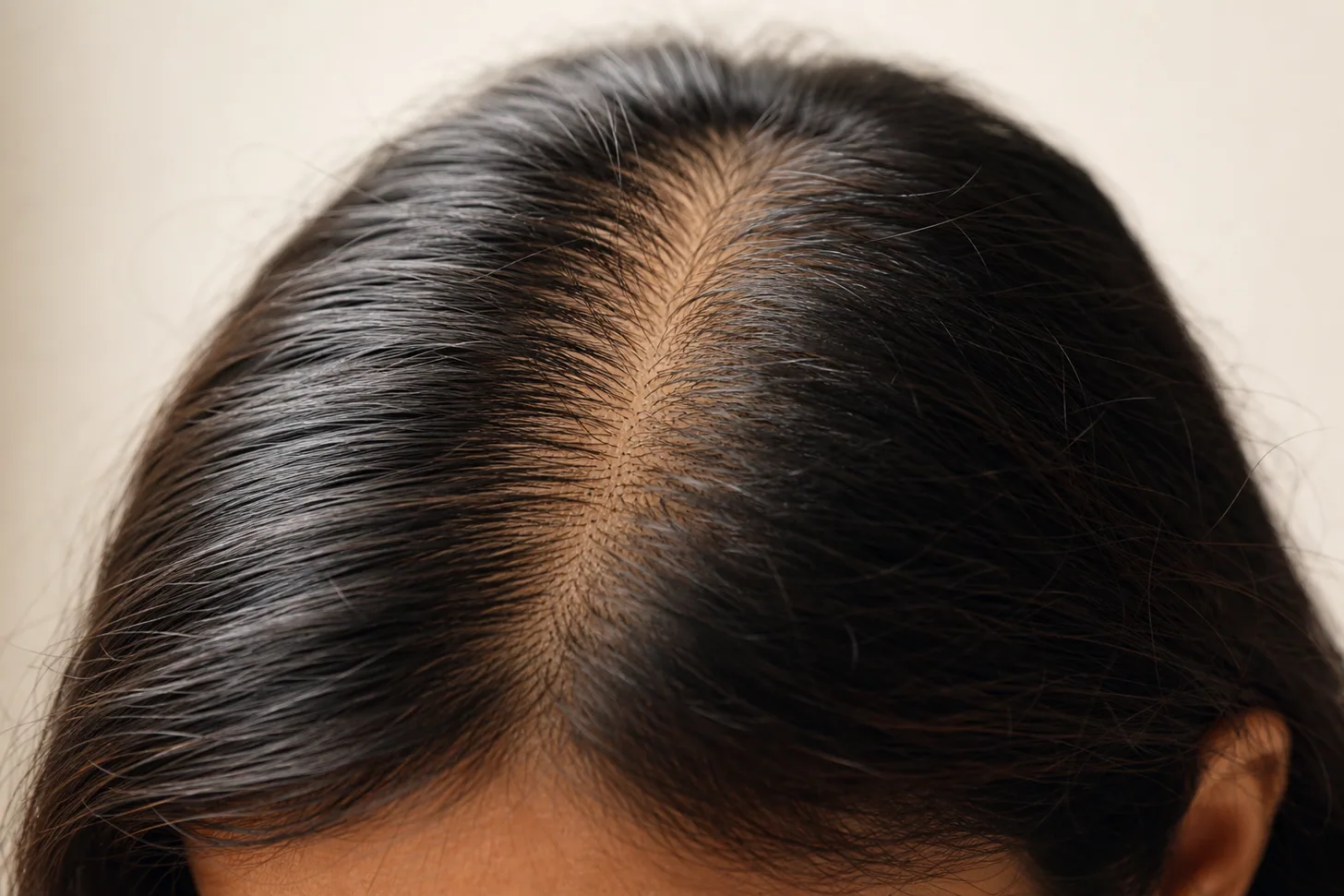
The shed itself is no heavier on fine hair than on thick. What differs is how visible each stage is, and it's worth knowing which of your alarming observations are real signal and which are artifacts.
The ponytail shrinks measurably, and it's the most reliable thing you'll notice
Fine, low-density hair starts from a smaller ponytail, so the same proportional shed produces a change you can feel between your fingers. This one is genuinely informative — it's a real measurement, and it's also the one that recovers. Photograph the elastic in the same place each month and you'll see it come back before you can see it in the mirror.
Wet hair in the shower is not a data point
Fine hair clumps and lies flat when wet, so the scalp shows through dramatically — during a shed, in the middle of the night, on four hours of sleep, this is the single most frightening thing a new mother sees.
It is also mostly an optical effect, and it happens to fine hair whether or not anything is wrong. We wrote a whole page on it: why your hair looks so thin when it's wet. Judge the situation dry, in daylight, once a week at most.
The regrowth reads as fluff rather than as hair
New hairs come in fine and taper to a point at the tip, and on someone whose hair is fine to begin with, an inch of new growth standing up at the hairline looks like frizz rather than like recovery. This is the stage that generates the "it never came back" belief — the hair did come back, it just spent six months being too short to count.
What actually helps, and what doesn't
Nothing shortens a synchronized shed — so aim at the part you can change
The hairs coming out have already finished growing. No product recalls them. Anything sold as stopping postpartum shedding is either selling you time you were going to get anyway, or selling to the tail of the process where things were improving regardless. The honest target is the six to nine months of looking thinner, and that's a styling and cutting problem, which is a solvable one.
Get iron checked rather than guessed
Low iron stores cause diffuse shedding on their own, and pregnancy, blood loss at delivery and breastfeeding all draw on them.
A shed that is dragging on well past the expected window is a good reason to ask for ferritin and thyroid bloods at a postnatal appointment rather than to start supplementing blind — which blood tests actually matter for hair loss has the short list and the reasons a "normal" result can still be the answer. Supplements fix deficiencies; they don't do anything measurable for people who aren't deficient, and iron in particular shouldn't be taken speculatively.
Cut for the hair you have during the shed, not the hair you had
This is the highest-return decision available and most people postpone it for a year. Length pulls fine hair flat and puts every strand's weight on a scalp that currently has fewer of them.
Taking two inches off and keeping a strong, blunt perimeter makes the same amount of hair read as denser immediately — and shorter is also the only haircut that survives being slept on for four hours a night. Low-maintenance cuts for fine hair is the relevant gallery; the principle behind it is in whether layers help or hurt fine hair.
Give the regrowth halo somewhere to belong
Fighting the short pieces with product and tension is the wrong instinct. A soft fringe or face-framing piece absorbs them into the shape instead of leaving them as strays — which is the entire trick — and a little light styling cream or a mist of hairspray on a soft brush, drawn over the hairline, settles the rest without adding weight. Avoid gel and avoid slicking; both make fine regrowth look sparser by comparison.
Stop pulling it back tightly, for real this time
The tight mom-bun is the most understandable habit in the world and the worst possible timing. Sustained tension at the hairline causes traction alopecia, and a 2018 review in Clinical, Cosmetic and Investigational Dermatology names "the frequent use of tight buns or ponytails" among the highest-risk styles.
Doing it every day for a year at exactly the moment your hairline is regrowing is how a temporary shed acquires a permanent souvenir. Loose, low, moved around, and a fabric-covered elastic rather than a hard band — the fine-hair ponytail guide covers the versions that hold without gripping. The same reasoning applies before you book anything that pulls: hair extensions for thin hair are a poor idea mid-shed.
When it isn't the postpartum shed
Most of the time it is, and it resolves. But three other things present at the same moment in a woman's life, and postpartum shedding is a convenient explanation that can delay identifying them. A fourth, if you've been losing weight quickly since the birth, is that rapid loss triggers the same mechanism on its own timetable — shedding after weight loss runs the arithmetic.
A fifth is the pill: restarting or stopping hormonal contraception after a birth is itself a listed trigger, on the same two-to-four-month delay, which puts it right on top of the postpartum window. Medications that cause hair shedding.
Thyroid. Postpartum thyroiditis is common, arrives in roughly the same window, and causes hair shedding along with fatigue, mood changes and temperature intolerance — all of which are easy to attribute to having a newborn. It's a blood test, and it's treatable.
Iron. As above. Diffuse, persistent, and worth measuring.
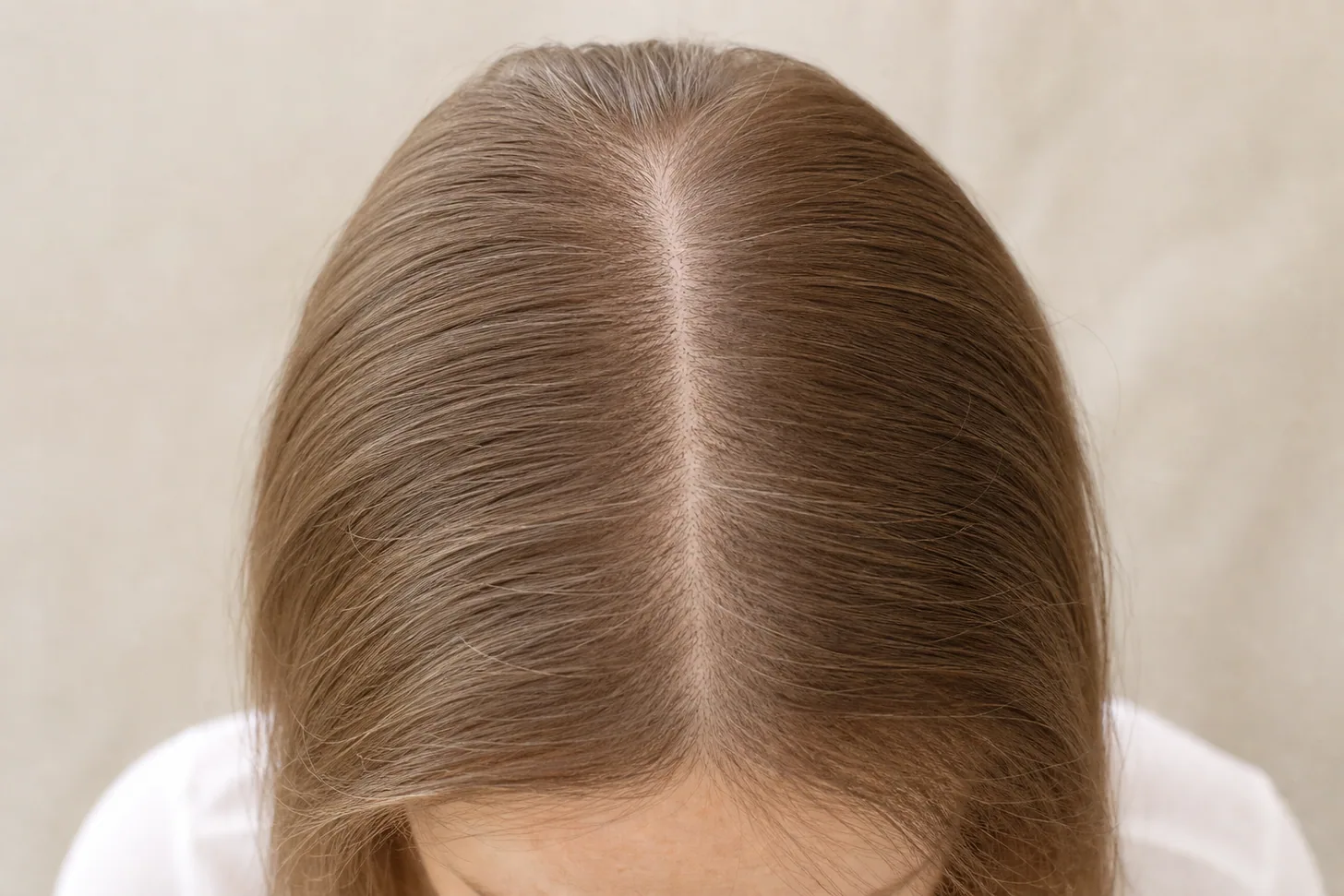
Pattern hair loss the shed has unmasked. Female pattern loss is gradual and easy to miss until a heavy shed removes the covering hair. If, once the shed has finished, your part is wider than it was pre-pregnancy while the back and sides look unchanged, that pattern — top-concentrated rather than diffuse — is worth having assessed properly.
Fine hair or thinning? covers the at-home checks, and what actually grows fine hair thicker covers what has evidence behind it. Treatments for pattern loss work considerably better started early, which is the reason not to file everything under "it's just the baby hair thing." If you are in your forties and the shedding never quite stopped, the other common explanation is perimenopause.