Reviewed by Tara Sullivan · Updated August 2026 · 9 min read
The sixty seconds after you step out of the shower are the highest-risk moment in your entire hair routine, and almost everyone spends them doing the roughest thing they will do to their hair all day. Wet hair is not just fragile — it is grippier."Friction is higher in wet than in dry hair", and the swollen endocuticle "has a more brittle structure", so scrubbing a towel over it is high force applied at the worst possible time.
A soaking-wet fine root cannot hold itself up, so whatever a towel presses it into is what it dries as. Below: the two-minute method, why the wet turban is a tension hairstyle, and how long to plop fine hair — which is about half as long as the internet tells you.
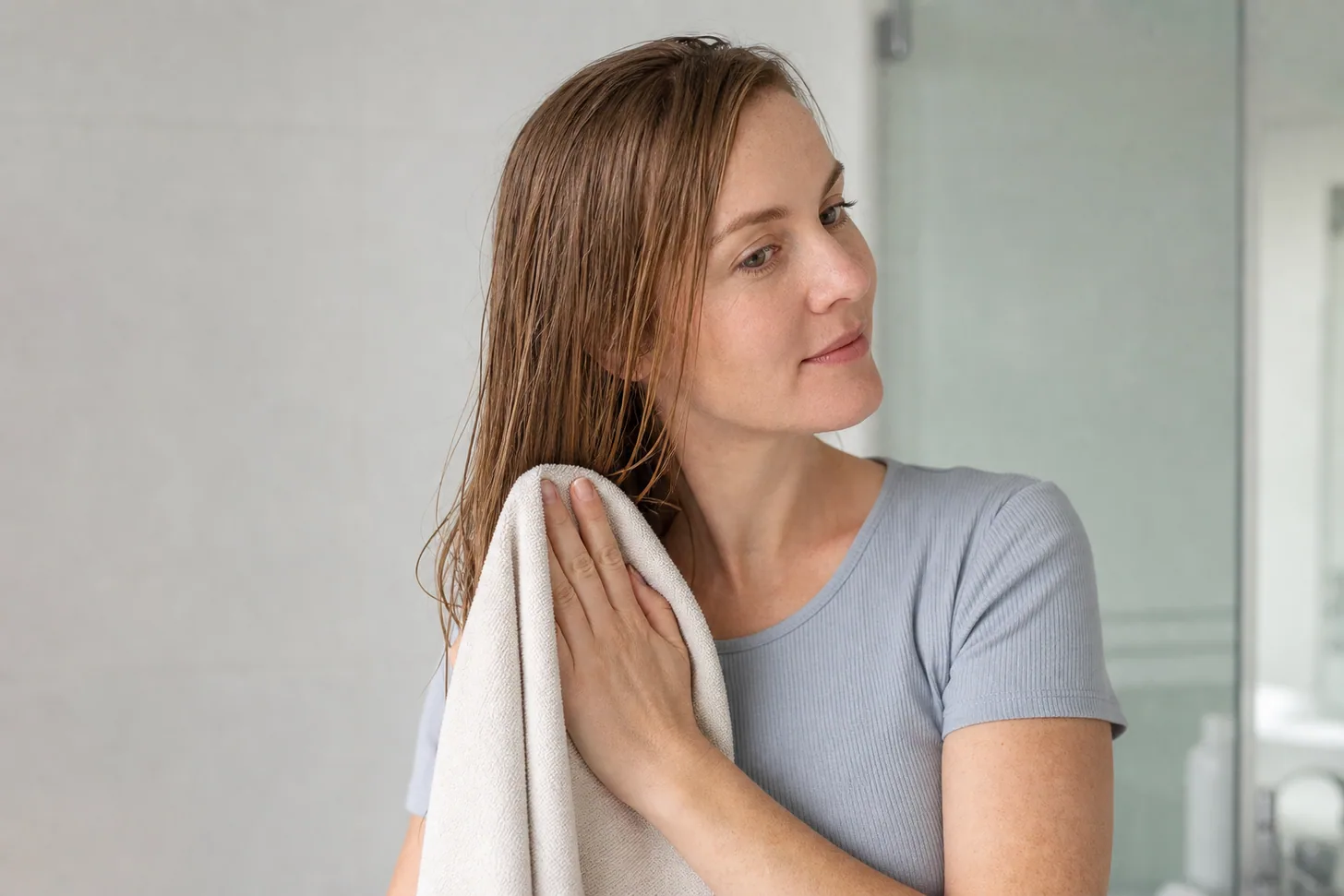
Press and lift. The towel should never travel across the hair.
Why wet hair punishes friction more than dry hair does
Three things happen to a hair fiber when it takes on water, and each one makes rubbing a worse idea than it looks.
It swells. Water is absorbed into the fiber, and that absorption is followed by a swelling in the hair. A swollen cuticle sits proud of the shaft rather than lying flat against it, which gives a moving fabric something to catch.
It grips. This is the one that matters here and the one nobody mentions. Friction goes up, not down, when hair is wet. So a towel dragged across wet hair transmits more force into each strand than the same towel dragged across dry hair — while the strand underneath is at its softest and most swollen.
Short segment breaks are split ends and tiny fragments. Long segment breaks are length. When you damage hair dry, you lose millimetres off the tips. When you damage it wet, the fiber fails somewhere in the middle and you lose the piece below the break.
That is why "my hair won't grow past my shoulders" so often turns out to be a wet-handling problem rather than a growth problem — a point the terminal length page makes with the arithmetic.
It is also why the ends of fine hair go see-through: you are not losing whole hairs so much as shortening a fraction of them every wash, and the ends thin out because a proportion of the strands that should be reaching them no longer do. Breakage on fine hair covers the diagnosis.
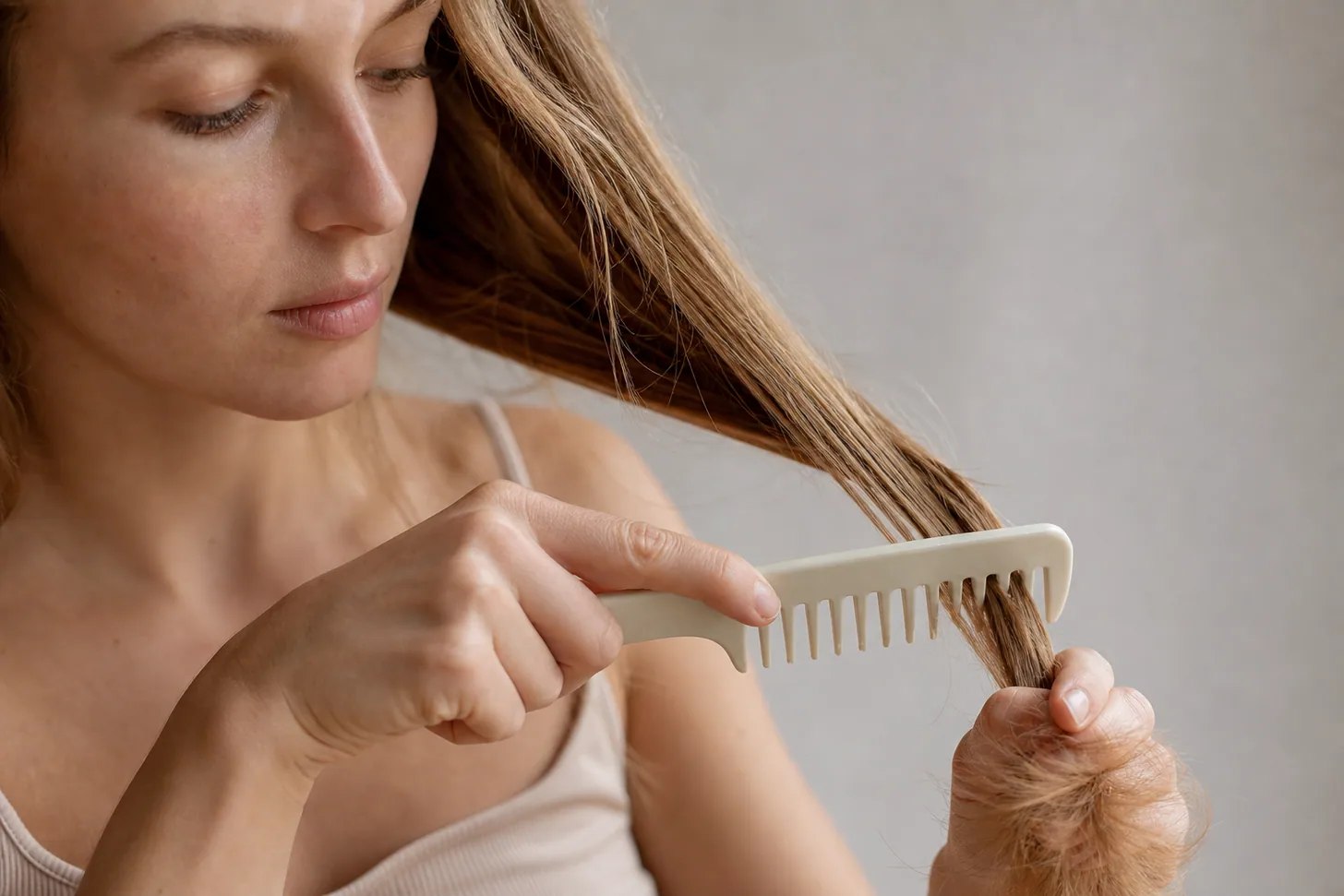
None of which means never comb wet. Leaving fine hair to dry in a tangle just relocates the problem. It means earning the right to: a leave-in first, a wide-tooth comb rather than a brush, and working upward from the last inch.
Chair-side note
I can usually tell how somebody dries their hair before they tell me, and the tell is a band of short, broken hairs about level with the ear — shorter than the regrowth halo at the hairline, blunt at the tip rather than tapered. That's a rubbing habit. The towel catches the mid-lengths, the hair fails somewhere along the shaft, and you're left with a layer you never asked for.
The fix I give people takes no extra time at all, which is why it sticks: keep your hands moving down the hair and the towel still. Squeeze the water out with your palms first, then lay the length inside the fabric and press.
If the towel is travelling across your head, you're sanding your hair. It also solves the frizz complaint on its own about half the time, because most of what people are treating as frizz on fine hair is just a lifted cuticle they created in the first minute of the routine.
SB
— Simone Baptiste, Senior Stylist
The method: about two minutes
Nine steps, but most of them are a few seconds. The order matters more than the effort.
Squeeze with your hands before any fabric touches your hair. Flat hand, root to tip, down each section. This removes a lot of water at zero friction cost and reduces how much work the towel has to do.
Blot and press — never rub. Lay the length between the folds of the fabric and press. Work in sections, top down. The towel does not travel.
Blot the roots separately, with your fingertips. Press the fabric to the scalp and lift straight off. Do not drag it across. This is the step that decides whether you have root volume today.
Stop at damp, not dry. Take out the free water and leave the rest. Chasing the last of it with fabric is all friction and no benefit.
Leave-in or detangler now, lengths only. Damp is when it works. Nothing conditioning above the ears — see leave-in conditioner for fine hair for the dosing problem.
If you're plopping, set a timer for 10–15 minutes. Details below.
No heavy wet turban. Details below. If you need your hands free, a lightweight microfiber wrap, for minutes.
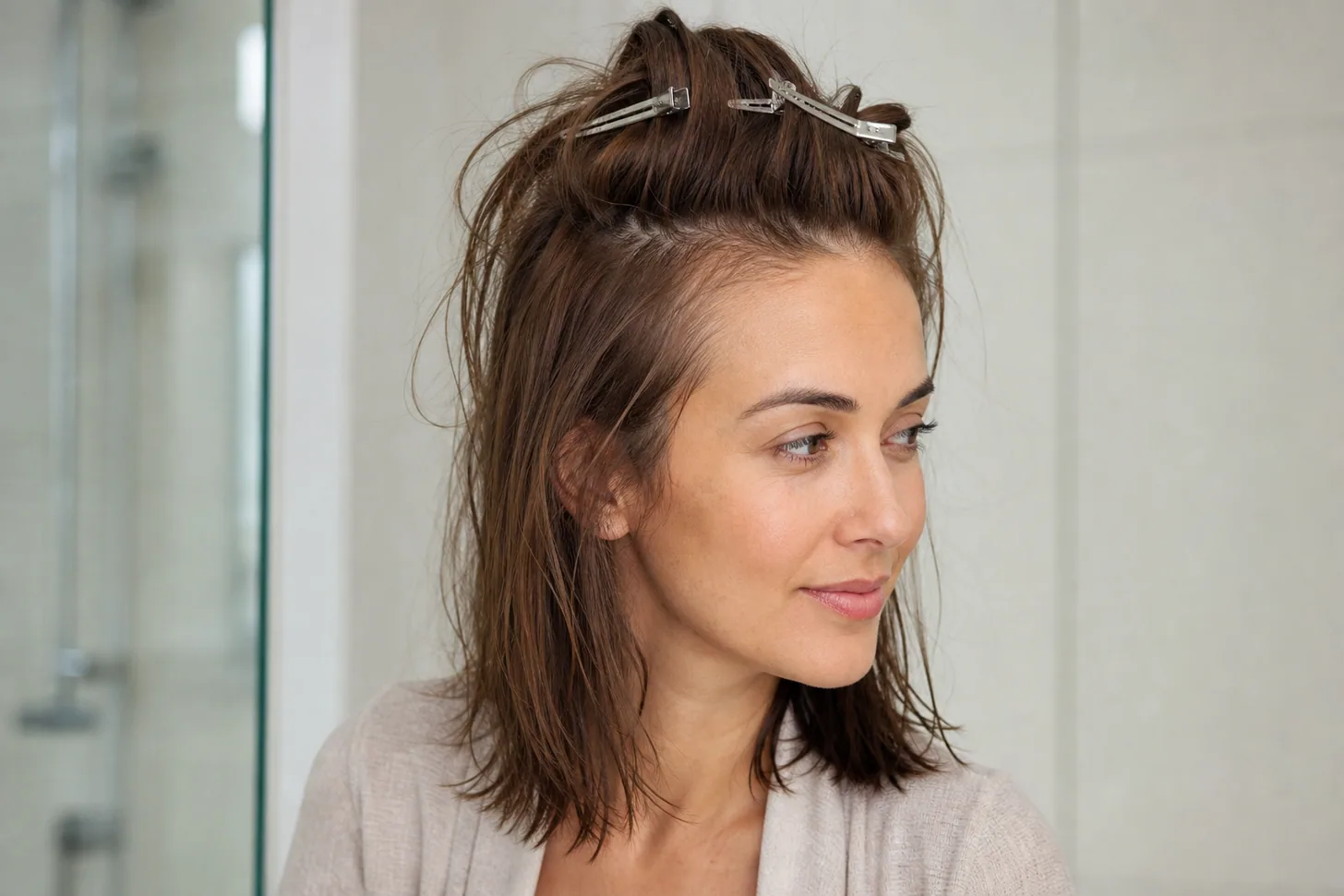
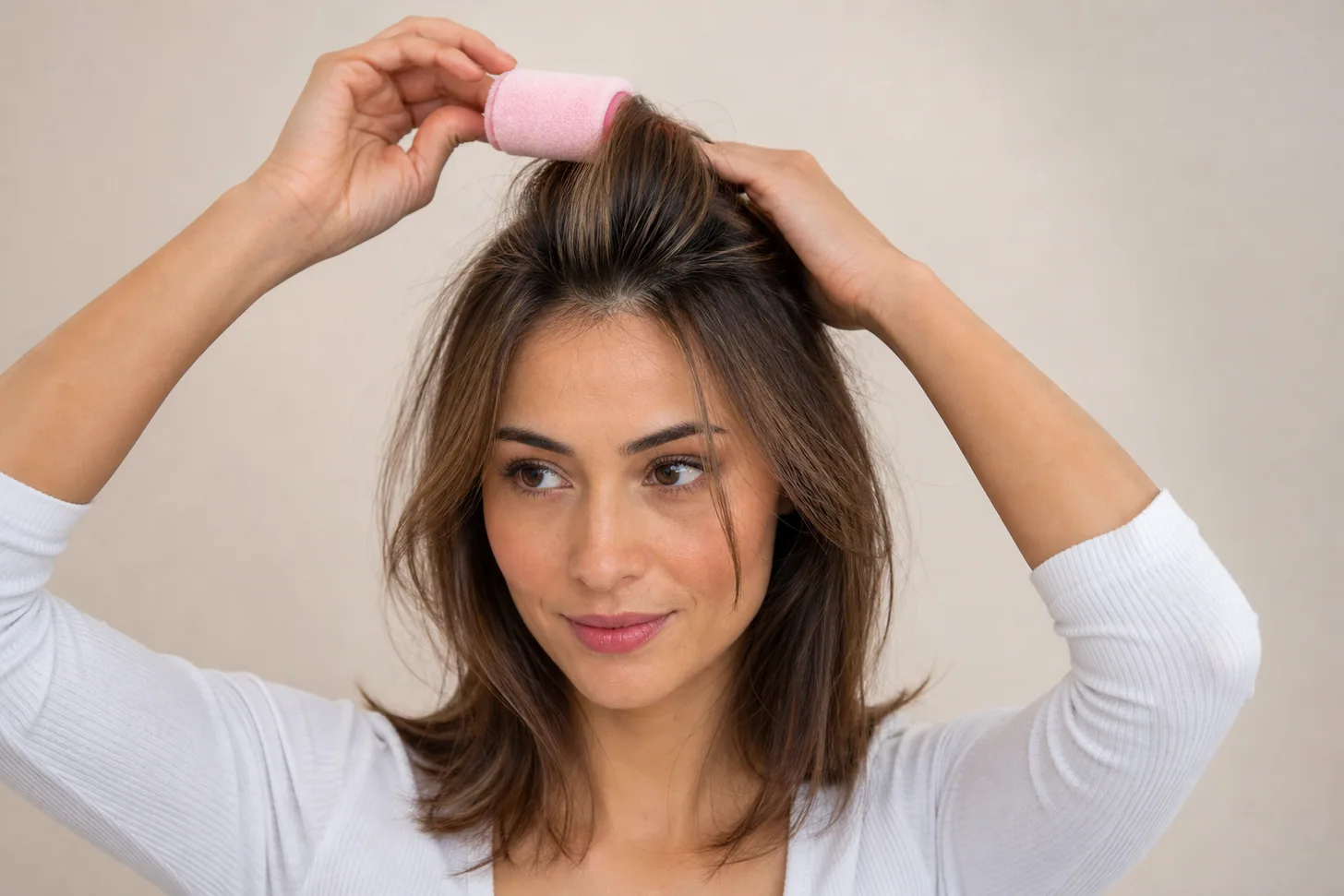
Lift the roots before you dry. Tip your head and shake your fingertips through the roots, or slide two clips in at the crown. This is the last moment the root position is negotiable. Root volume for fine hair.
Which towel — and why terry is the wrong one
The fabric matters less than the technique, but it is not nothing, and the reasoning is more useful than a shopping list.
Fabric
Surface
Weight when wet
Verdict for fine hair
Microfiber hair towel
Flat, dense, low-snag; very absorbent
Light
The best option. Absorbs fast so the vulnerable wet window is short, and light enough to wrap briefly without traction
Old cotton t-shirt
Flat jersey knit, smooth, no loops
Light
Nearly as good, and free. Less absorbent than microfiber, so it needs more blotting — but the surface is kind. The plopping standard
Terry bath towel
Thousands of raised loops designed to grab
Heavy
The default and the worst of the three. The loops catch individual fine strands; soaked, it's heavy enough to pull at the hairline
Waffle / linen towel
Textured but flat-woven, no pile
Medium
Acceptable. Better than terry, rougher than jersey. Fine if it's what you own
Turban-style twist wrap
Depends on the fabric
Depends — check it
The shape is the risk, not the fabric. See below
The wet turban is a tension hairstyle, and nobody calls it one
We are careful on this site about tight ponytails, slicked-back buns and anything that loads the hairline. The twisted towel turban gets a complete pass, and it should not, because it stacks three risk factors that we would flag immediately in any other context.
It is weighted. A soaked terry bath towel is genuinely heavy, and unlike a ponytail the load is not held by the whole head — it hangs forward off the front hairline and the temples, which is where fine hair is finest and where traction damage announces itself first.
It is twisted, which means it is tight. The twist is what keeps it on your head. That tension is applied at the roots, in a direction they do not normally sit in.
And the hair carrying it is wet, which is to say swollen, softened and stretchable to half again its length.
Worn for ninety seconds while you find your comb, this is a non-event. Worn for the forty minutes it takes to do your makeup and get dressed, several times a week, for years, it is a small persistent traction load in exactly the place you would least like one.
If you are seeing short broken hairs or thinning along your front hairline, this is worth eliminating before you spend money on anything — the thinning hairline page covers the mechanism and how long the reversible window lasts.
The replacement is not complicated: a lightweight microfiber wrap instead of a bath towel, and minutes instead of a routine. Or blot properly and skip the wrap entirely, which is what the method above assumes.
Plopping fine hair: half the time, and take the roots out of it
Plopping is a genuinely useful technique for fine, wavy hair, and it is one of the clearest examples on this site of curly-hair advice needing translation rather than adoption. Heatless volume covers where it sits among the other no-heat methods; this is the calibration.
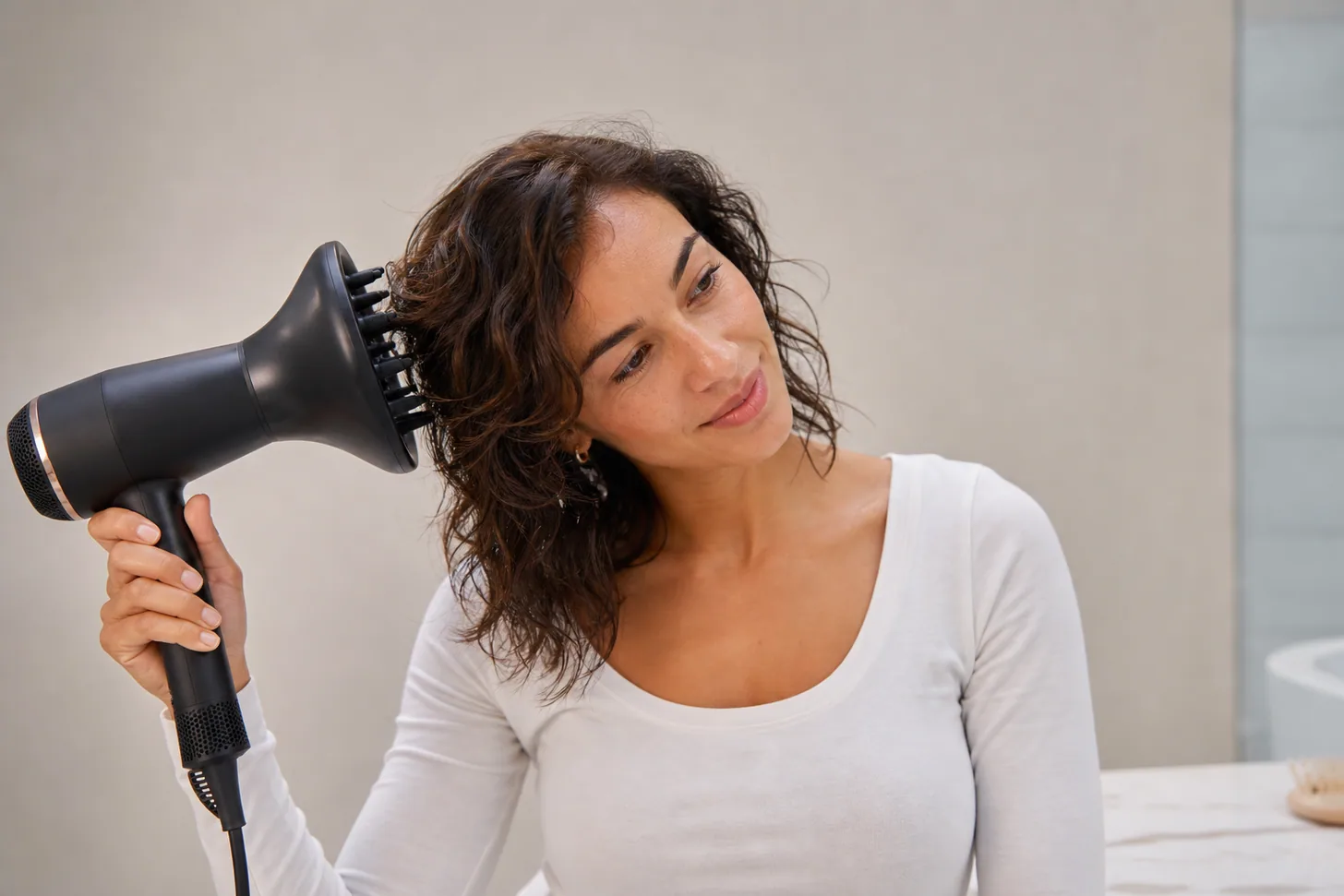
What it does: cupping wet waves up into a t-shirt or wrap holds them in a shortened, sprung position while they start to dry, instead of letting the weight of the wet length stretch the wave out. It is the same setting principle as a roller or a diffuser — hold the hair where you want it and let it dry there.
What changes on fine hair:
Ten to fifteen minutes, not thirty to sixty. Fine hair holds far less water, so it reaches the set much sooner. The extra time buys nothing and costs something.
The cost is the roots. The whole time the plop is on, the roots are pinned flat against the skull under the fabric. On dense hair that barely registers. On fine hair, where root position is the volume, a long plop is an hour spent building the exact flatness you were trying to avoid.
Take it down while the hair is still clearly damp, then tip your head over and shake your fingertips through the roots before it finishes drying. If the hair comes out of the plop nearly dry, you have missed the only window in which the roots could still be moved.
Use a t-shirt or microfiber, not a bath towel. Same reasoning as above, plus a lighter wrap is less likely to compress the wave into a flat sheet.
Skip it entirely if your fine hair is straight. There is no wave to set, and all you get from fifteen minutes under fabric is flatter roots. Fine straight hair has the alternative.
And no, dripping dry is not the gentle option
It is tempting to conclude from all of this that the safest thing is to touch wet hair as little as possible and let it drip. That does not follow, because water itself is not neutral.
The fiber swells for as long as it is wet, and a laboratory comparison of drying methods found that the cell membrane complex "was damaged only in the naturally dried group", proposing that "the hair shaft swells when in contact with water". Leaving fine hair sopping simply extends the window in which it is swollen, heavy and easy to damage — and the weight of all that retained water is also what drags the roots flat.
The trade that makes sense: get the free water out quickly and gently, then move on to whatever your drying method is. Air-drying fine hair and blow-drying for volume both start from the damp stage this page ends at.
When this method needs adjusting
Your fine hair is curly rather than wavy.The plopping timings here are calibrated for fine waves. Fine curls hold more water and can take a longer plop — start at 20 minutes and watch the roots. Fine, curly hair.
You have a scalp condition or heavy flaking.Blotting rather than rubbing is right, but leaving the scalp damp under a wrap is not. Dry the scalp properly. Dandruff on fine hair.
You go to bed with wet hair.No towel technique compensates for eight hours of friction against a pillow while the fiber is swollen. That's the habit to change first. Sleeping with fine hair.
Your hair is mid-recovery from a shed or a chemical service.Take the wet handling down further still: squeeze, blot, no comb until a leave-in is in, and no wrap at all. Breakage, keratin and protein treatments.
You genuinely don't have two minutes.Then do one thing: squeeze with your hands and stop rubbing. It's most of the benefit, and it costs nothing.
FAQ
Towel-drying isn't the problem; rubbing is. The American Academy of Dermatology's list of habits that damage hair includes drying your hair by rubbing it with a towel, and its replacement instruction is the whole technique in two sentences: wrap your hair in a towel to absorb the water, then let your hair air dry. The reason rubbing is singled out is mechanical. Friction is higher on wet hair than on dry hair, and a wet fiber has a swollen, softened cuticle that scuffs and lifts under exactly that kind of load. So the fabric doing the job matters far less than what you do with it. Blotting and pressing removes water at almost no friction cost; scrubbing your head with a towel does it by abrading the surface of every strand at the worst possible moment.
A microfiber hair towel or a smooth old cotton t-shirt, and the honest gap between them is smaller than the marketing suggests. What matters is the surface and the weight. A terry loop towel is made of thousands of raised loops, and on fine hair those loops catch individual strands and lift the cuticle when the fabric moves — the same property that makes terry good on skin makes it a poor choice for hair. A flat-woven surface has far less to snag on. Weight matters for a second reason specific to fine hair: a soaked terry bath towel wound into a turban is genuinely heavy, and all of that weight hangs off the hairline. A microfiber wrap or a t-shirt is a fraction of the mass. If you already own a microfiber towel, use it. If you don't, a t-shirt you already own will do most of the same job.
Ten to fifteen minutes, which is roughly half what curly-hair guidance recommends, and the reason is the same reason most curly advice needs translating for fine hair. Plopping works by cupping the wave up against the head so it dries in a shortened, sprung position rather than being stretched out by its own wet weight. Fine hair holds much less water, so it reaches that set sooner. Leave it in longer and two things go wrong: the roots spend the whole time compressed flat against the skull under the fabric, which is the exact shape you were trying to avoid, and the hair can dry too far inside the wrap, so there's no wet window left in which to lift the roots. Set a timer, take it down while the hair is still clearly damp, then tip your head and shake the roots out before it finishes drying.
Comb it, gently, with a wide-tooth comb, from the ends upward — and understand what you're risking, because the failure mode is worse than most people realize. Wet hair is more fragile than dry hair: the endocuticle swells, and it has a more brittle structure, which explains both breakage and scaling of threads if they're combed when they're still wet. The detail that should change your technique is what kind of breakage. A review of hair cosmetics puts it as combing dry hair being more related to short segment breaks, while wet combing is related to long segment breaks — in other words, wet damage takes inches, not split ends. On fine hair the alternative isn't appealing either, because leaving it to dry tangled means detangling something worse later. So the answer is to comb, but to earn the right to: a leave-in first, a wide-tooth comb, and work up from the last inch rather than dragging from the top.
A brief wrap doesn't. A heavy, tight, twisted turban worn for an hour is a different proposition, and it's worth naming for what it is: a tension hairstyle you're wearing on wet hair. Two things stack up badly. The weight of a soaked terry towel pulls, and the twist concentrates that pull at the hairline and temples — which is where fine hair is finest and where traction damage shows first. And the hair carrying that load is at its weakest, because it's swollen with water. The practical rule is that a wrap should be light and brief. Use a microfiber wrap or a t-shirt rather than a bath towel, keep it to minutes rather than the length of your makeup routine, and if you're noticing thinning or short broken hairs along your hairline, stop wrapping altogether and blot instead.
Because the root position was decided while you were doing it, and nothing later in the routine fully undoes that. A soaking-wet fine root has almost no ability to hold itself up, so whatever position it's put in while it's wet is the position it dries in. Dragging a towel down the head presses every root flat against the scalp and points them all the same way. A turban does the same thing and holds it there for an hour. So does a long plop. The fix is to stop moving fabric across the roots — press the towel against the scalp and lift it straight off instead — and then, before drying, to tip your head over and shake your fingertips through the roots, or slide two clips in at the crown. That takes about ten seconds and is the cheapest volume in the entire wash routine.
Only if it has genuine wave or curl. Plopping is a wave-setting technique, and on fine straight hair it does nothing useful — it holds the hair against the head for fifteen minutes and then you take it down with slightly flatter roots than you started with. If your hair is fine and straight, the useful post-shower move is the opposite: get the roots lifted and dried in a lifted position as early as possible. If your hair is fine and wavy, plopping is genuinely worth doing, with the shorter timing and the root shake-out afterwards. And if you're not sure which you have, the wave usually reveals itself when you stop stretching it out with a towel and a brush, so a couple of washes with this method is itself the test.
No, and this is one of the few places where the gentle-sounding option is the worse one. Water isn't inert while it sits in your hair — the fiber swells while it's in contact with water, and prolonged wetness has its own cost, which is why a laboratory comparison of drying methods found cell membrane complex damage only in the naturally dried group. Leaving fine hair dripping simply extends the period during which it's swollen, heavy and fragile, and the weight of the retained water is also what drags the roots flat. Getting the free water out quickly and gently, by squeezing and blotting, is the better trade: it shortens the vulnerable window without adding meaningful friction. What you shouldn't do is chase the last of the moisture with fabric — take out the water that comes easily, then move on to drying.
Eleven years behind the chair, most of it spent building volume into hair that doesn't want to hold any. Simone's rule for towels: hands move, towel stays still.
Images in this article are AI-generated illustrations, not photographs of real clients or results. See our image policy.
Results vary with hair type, density, and growth patterns. This guide is educational and not a substitute for an in-person consultation with a licensed stylist.
Get the good hair intel
One honest, stylist-written guide in your inbox each week. No hype.

 SB
SB