Reviewed by Tara Sullivan · Updated August 2026 · 10 min read
The gym does two things to fine hair, and sweat is the smaller one. The bigger problem is that the tightest styles of your week go into the weakest hair of your day — damp from sweat or straight out of the changing-room shower, scraped into a high ponytail because you're late.
Wet hair has far more friction between strands than dry hair, so pulling it hard while it's soaking combines maximum tension with maximum abrasion in the same twenty minutes, and on fine hair that shows up as short broken pieces at the hairline months later.
Sweat itself barely damages anything; what it does is mobilize the oil already on your scalp and carry it down the hair, which is why your roots are flat before you've reached the car. Below: eight styles that hold without pulling, the dry-shampoo timing that fixes the grease problem (it goes in before you train), whether you really need to wash after every session, and the five-minute reset that gets the volume back without one.
Low, distributed, and put in before the sweat starts — the three things that decide whether the gym costs you hair.
What a workout actually does to fine hair
Three separate things happen, they have different fixes, and lumping them together as "gym hair" is why people keep solving the wrong one.
Sweat redistributes oil, it doesn't create it. Your scalp isn't producing more sebum because you did intervals. What's happening is that the oil already sitting at the root gets mobilized by moisture and heat and carried down the hair shaft.
On fine hair, which has less surface area to spread it over and less body to resist being weighed down, that reads as flat, separated, greasy roots faster than it would on thick hair. This is why the same workout that leaves your friend's hair looking fine leaves yours looking two days unwashed.
Sweat is salt water, and the water leaves. When sweat dries in your hair, the water evaporates and the salt stays behind on the fiber. That's the stiff, rough, slightly crunchy feel afterwards, and it's why fine hair goes static and tangly post-workout. It's also the easiest thing on this page to fix, because plain water removes it — no shampoo required.
And the mechanical load is the one that costs you hair. Tension from the style, friction from movement, and hair that's damp for the whole session. Individually, none of these is a disaster. In combination, several times a week, for years, they're the reason so many regular exercisers have a thinning line right at the temples while the rest of their density is fine.
That third one is the only one with permanent consequences, so it gets its own section.
The one rule: never put a tight style into wet hair
If you take a single habit from this article, take this one.
"Long segment breaks" means you lose length, not split ends. The hair snaps somewhere along the shaft rather than fraying at the tip — which is exactly what people describe when they say their hair "won't grow past a certain point".
So the sequence to break is: shower, scrape damp hair into a tight bun, drive home, leave it in for another hour. Instead: rough-dry to roughly eighty percent first if you can, or clip it up loosely with a claw clip and let it dry down. If you have five minutes, use them here rather than anywhere else in this article.
Chair-side note
I can usually tell a five-day-a-week exerciser from behind, and it isn't the muscle. It's a horizontal line of short, blunt, upright pieces about two-thirds of the way down the length, all at the same height — the exact height her elastic sits at. Same spot, same tension, every session, on damp hair. The hair doesn't break all at once; it wears at that one point for eighteen months and then goes.
The fix costs nothing and takes no time: move the elastic. High one day, low the next, a braid the day after. And take the smallest tie that holds in two wraps — a tie you have to take round four times is loading one narrow band four times over.
And buy fabric-covered elastics or a coil rather than anything with a metal join, because the join is a blade on fine hair. I've had clients who changed nothing else about their training and stopped growing that broken fringe of pieces within a year.
SB
— Simone Baptiste, Senior Stylist
Eight workout styles that hold without pulling
Several of these are braids, and the versions that read full rather than thin on fine hair are worth getting right — braids for fine hair has the pancaking step that doubles their apparent width.
All eight go in before you start, on dry hair, and come out as soon as you finish. That timing is doing as much work as the shape.
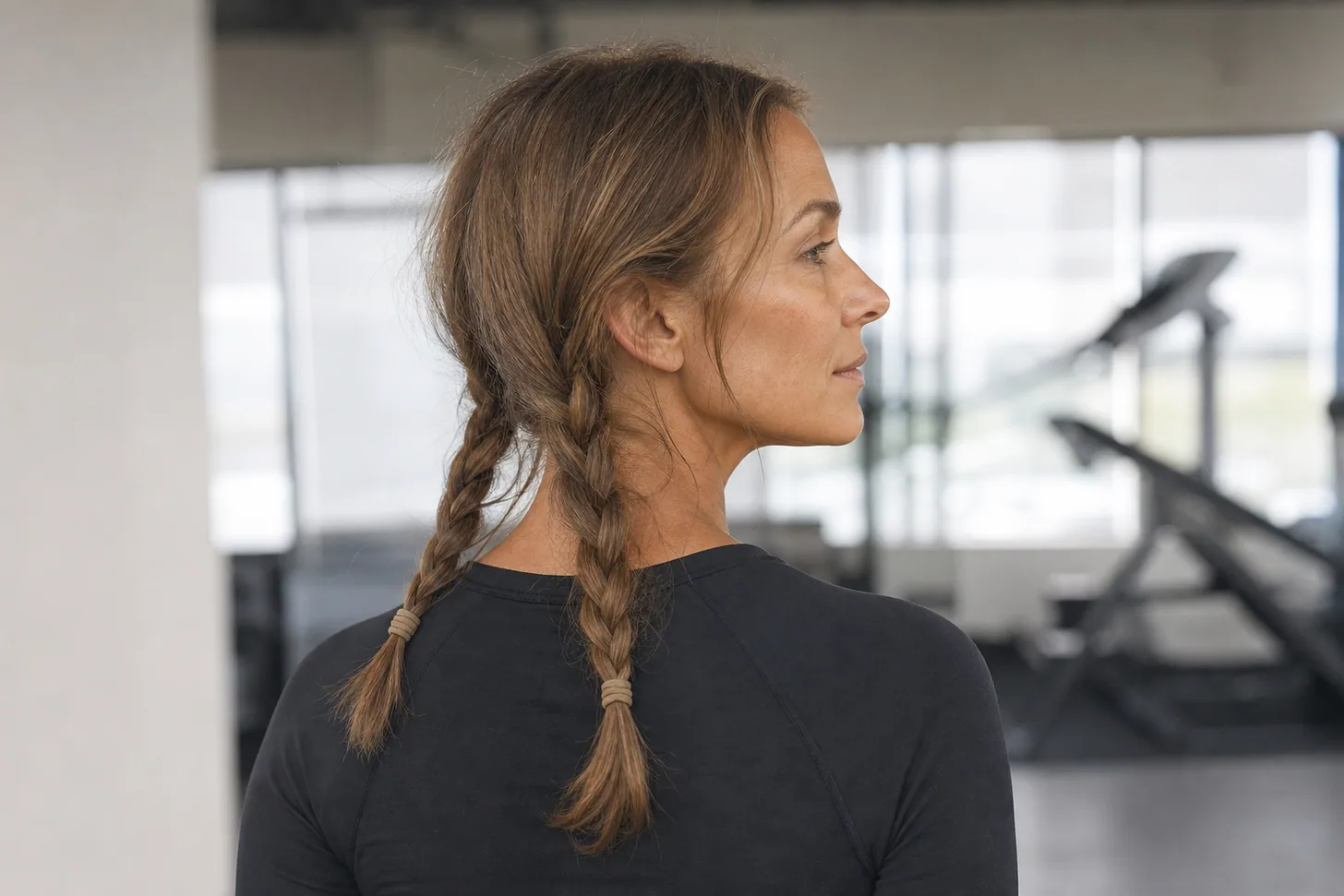
Woman with fine hair in two loose low braids for the gym, fabric-covered elastics
1
Two loose low braids
The best all-round option for fine hair, and it beats a ponytail for a structural reason rather than a stylistic one: a ponytail concentrates the whole load onto one small band at one point on the head, while a braid spreads the same load down the entire length. Two braids halve it again and keep the weight off the crown. Start them low, behind the ears, and leave them deliberately loose — you should be able to slide a finger under the first crossing.
Woman with fine hair in a low twisted bun secured with a claw clip, gym setting
2
The claw-clip low twist
No elastic at all, which removes the fracture-line problem entirely. Twist the length, fold it up against the nape and clip. The clip grips the hair against itself rather than binding it, so the pressure is spread and there's no single point taking the strain. It won't survive burpees, but for weights, spin, walking and most classes it holds perfectly well — and it comes down without a dent. More shapes in buns for fine hair.
Woman with fine hair in a low ponytail wrapped and secured mid-length with a second tie
3
The double-secured low ponytail
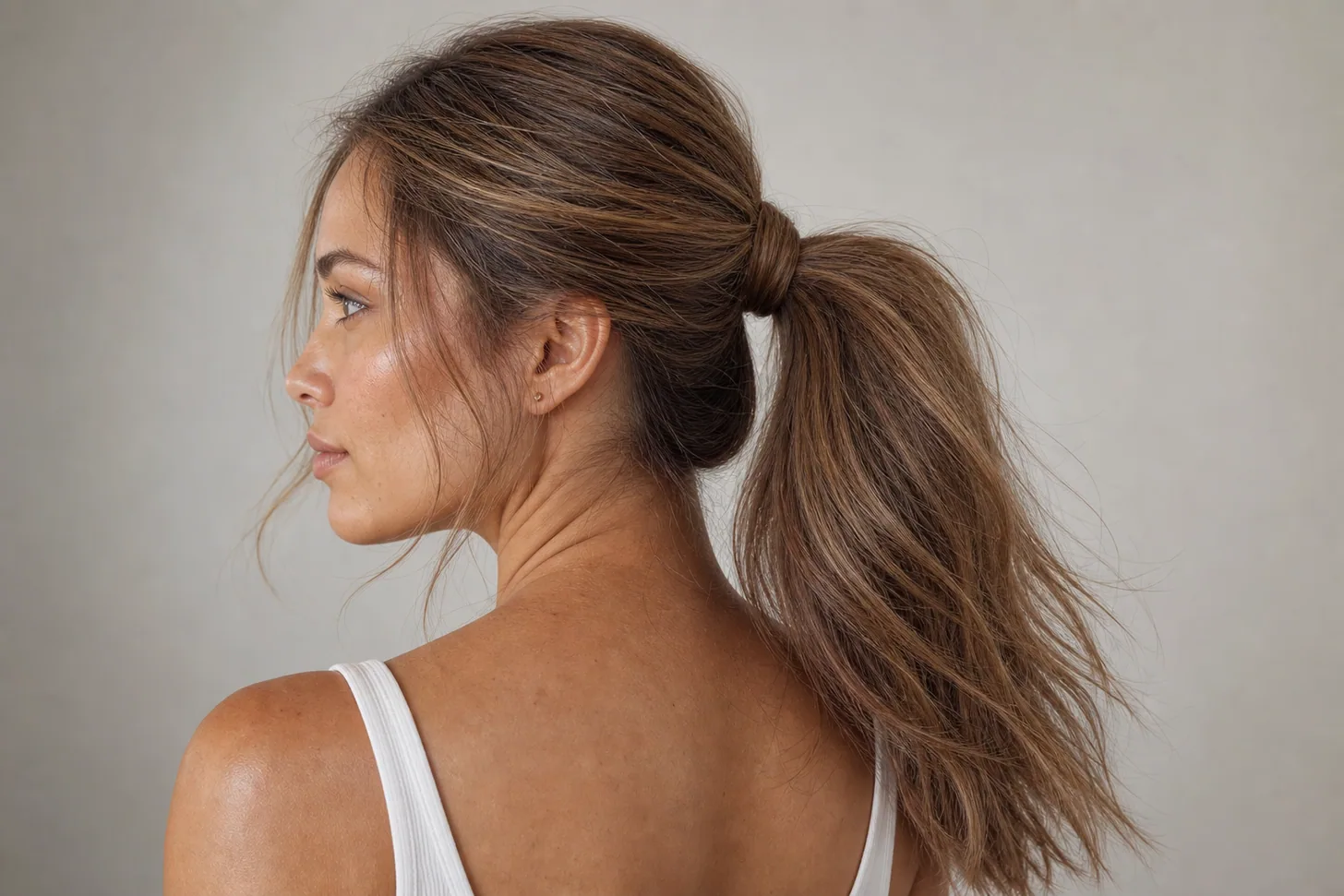
If you want a ponytail, do it this way. One soft elastic low at the nape, then a second one halfway down the length. The second tie stops the tail swinging, and it's the swinging that transmits load back to the first elastic with every stride — which is why running is harder on hair than lifting is. It also stops the ends whipping against your top, which is where the friction damage in a ponytail actually happens.
Woman with fine hair in a French braid starting at the crown, no visible tension at hairline
4
A loose French braid, started behind the hairline
The one that keeps hair off your face without a headband, which matters if your front hairline is already thinning. Start the braid about an inch back from the hairline rather than right at the edge, so the first sections aren't the most fragile hair you own. Kept loose it's genuinely gentle; pulled tight against the scalp it's one of the higher-tension styles there is. The test is whether it feels like anything at all when you raise your eyebrows.
Woman with short fine hair wearing a wide fabric headband pushed back, gym setting
5
A wide fabric band, for hair too short to tie
Width is the whole point. A narrow elasticated band sitting in one spot on the front hairline for an hour, four times a week, is sustained tension on your most fragile hair. A wide fabric band spreads the same pressure across several centimetres, and the pressure per strand drops accordingly. Move it slightly each session rather than settling it into the same groove, and take it off as soon as you're done rather than letting damp hair dry compressed underneath it.
Woman with fine hair in a half-up style with the lengths left down, outdoor run
6
Half-up, for anything that isn't cardio
Underrated for yoga, pilates, weights and walking. Only the top section is secured, so the load is spread across a much larger volume of hair than a full ponytail and none of it lands on the nape. It also keeps the crown lifted rather than pulling it flat, which is the one thing a ponytail always costs fine hair. Not for anything with jumping in it. Half-up styles for fine hair has the variations.
Woman with fine hair in a low bun with a silk scrunchie, hot yoga studio
7
The silk-scrunchie low bun, for hot rooms
Heat and humidity mean your hair will be genuinely wet rather than damp, so this is the session where the wet-hair rule bites hardest. A silk or satin scrunchie has a lower coefficient of friction than a cotton one and no join to cut into the hair, and a low bun keeps everything off your neck without a tight band. Take it out the moment you leave the room — hair left bound while it dries sets flat and keeps the sweat in.
Woman with fine hair in a low braided bun tucked at the nape under a cap
8
The braided bun under a cap, for outdoors
Braid first, coil the braid at the nape, then the cap. Braiding before coiling means the bun holds with far less tension than a twisted one needs, and the cap takes the wind and the sun off hair that's already been through a workout — worth doing if your color is lightened, since UV fades tone. The cap also sits on your skull rather than on your hair, so it adds no load at all. Just don't leave a damp one on for the drive home.
The dry-shampoo trick: it goes in before you train
This is the most useful thing on the page and almost nobody does it in the right order.
Dry shampoo works by absorbing oil. Applied to dry roots before a workout, it's sitting in position to absorb the sebum as heat and moisture mobilize it — which is exactly the moment it's needed. Applied afterwards, to roots that are already damp and already oily, it clumps, sits on the surface, and leaves the gray cast that makes people conclude the product doesn't work on them. Same product, opposite result, purely because of timing.
Do it properly: a light pass at the part and around the crown, on genuinely dry hair, ten minutes before you leave. Work it in with fingertips rather than leaving it sitting on top. If you're going straight from your desk, do it at your desk.
Two supporting habits do most of the rest. Don't touch or re-tie your hair mid-session — hands move oil, and the twenty times you tuck the same piece behind your ear is a genuine contributor. And don't let it dry while it's still bound, because hair compressed under a band as it dries sets in that shape and presses the oil back into the root.
No — and if you train most days, washing every time is likely to be making your flat-root problem worse rather than better. But there's a distinction that matters.
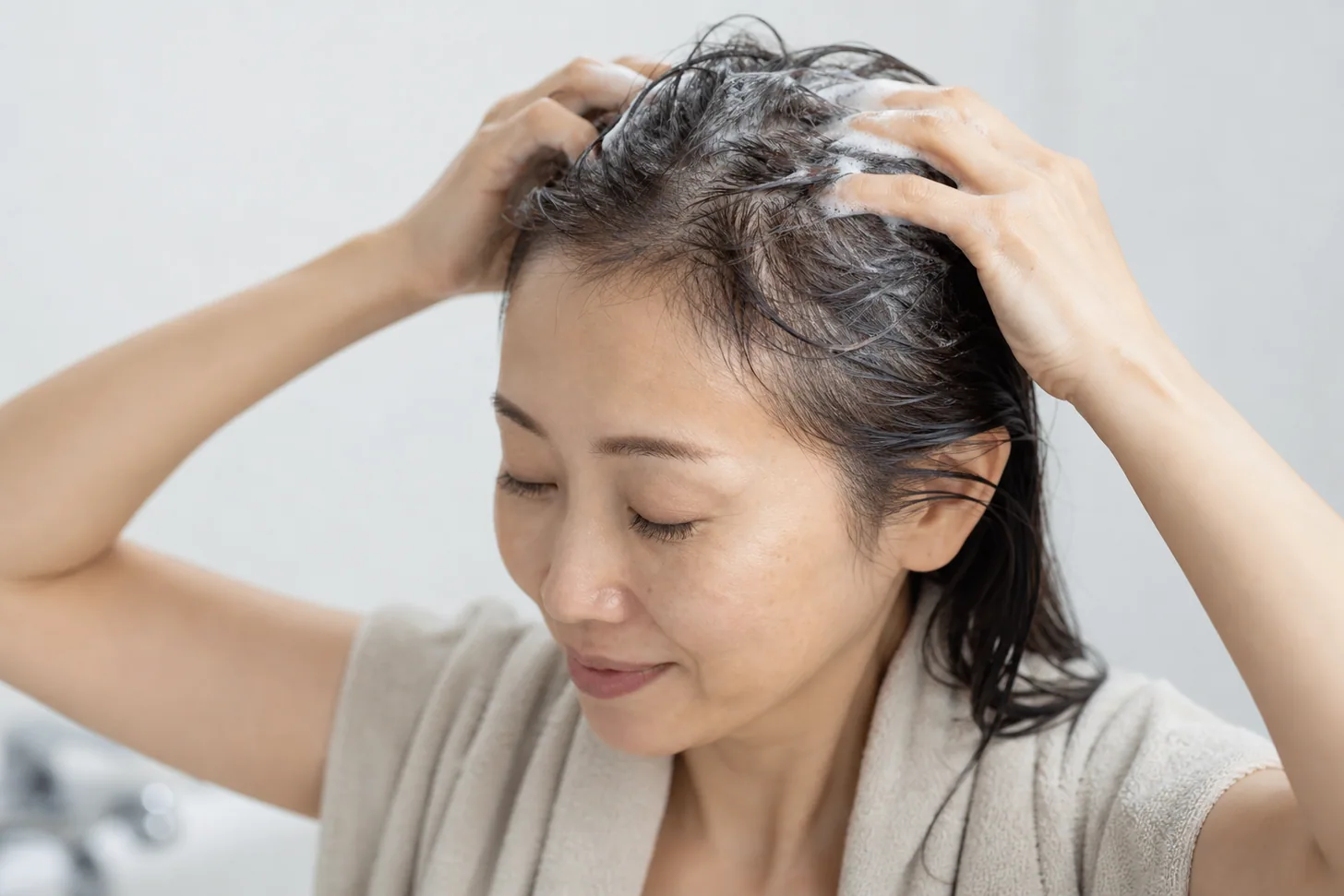
Your scalp needs rinsing. Your hair needs washing far less often. Sweat is mostly water and salt; when it dries, the water goes and the salt stays on the fiber, which is the stiff, rough, static feeling afterwards. Plain water removes that entirely. So the default after most sessions is: rinse thoroughly with water, conditioner on the mid-lengths and ends only, done.
Shampoo when the roots are genuinely oily, not when they're merely wet. On fine hair the over-washing loop is real — strip the scalp, the scalp compensates, the roots go flat sooner, so you wash again. If you train five days a week and shampoo each time, that's fifteen washes a fortnight, and how often to really wash fine hair explains why that's usually the wrong direction.
Session
Style
After
The fine-hair catch
Weights / gym floor
Claw-clip low twist, or half-up
Shake out, cool air at the roots
Least sweat, so don't wash out of habit
Running outdoors
Double-secured low ponytail or braid
Rinse; condition ends
The swing transmits load — secure the tail twice
Spin / HIIT
Two low braids
Rinse; dry shampoo once dry
Heaviest sweat at the hairline; keep bands off it
Hot yoga
Silk-scrunchie low bun
Rinse; rough-dry before tying anything
Hair is properly wet — the wet-hair rule matters most here
Swimming
Pre-wet, then a silicone cap
Rinse immediately; clarify weekly
Chlorine and copper dull fine hair and can tint blonde green
Walking / low intensity
Half-up or loose down
Usually nothing
No need to tie it at all — don't create a problem
The five-minute post-gym reset
The point of this is getting the volume back without a wash. Order matters more than products.
Take the style out immediately. Not at home, not after the coffee. Hair left compressed while it dries sets flat in that shape, and no amount of later effort fully undoes it.
Shake the roots out with your fingers. Bend forward, run your fingertips across the scalp in every direction, stand up. Ten seconds, and it separates roots that had been pressed into one direction for an hour.
Cool air at the roots for sixty seconds. Roots only, lifting each section up and away from the direction it usually falls. Cool rather than hot — heat on damp fine hair after a workout is unnecessary wear, and cool air sets the lift better anyway.
Dry shampoo at the part and crown, if you didn't do it before. Only once the hair is genuinely dry. Fingertips, not a comb.
Move your part. Free volume, five seconds, and it lifts hair that's been lying one way all session. See the part for fine hair.
Don't brush it. A brush flattens what you've just lifted and drags scalp oil down the lengths. Fingers or a wide comb through the ends only if you need to.
What to skip: mousse, hairspray, anything you'd call a product at the root. Fine hair coming off a workout is already carrying more than it wants there. If you need real lift for the rest of the day, root volume for fine hair covers the proper version, but it belongs on a wash day rather than on top of a session.
You wear the same style, at the same height, every single session.Repetition is the mechanism. Rotate braid, low pony, claw clip and down across the week.
The hair coming out is short and blunt at both ends.That's breakage, not loss, and it's a handling problem you can fix. Breakage on fine hair tells the two apart.
You've started training hard and eating much less at the same time.Diffuse shedding about three months into a big calorie deficit is a different mechanism entirely. See shedding after weight loss.
You're losing hair diffusely, all over, not at the edges.That isn't your ponytail. Get it looked at properly — fine hair or thinning? is the place to start.
FAQ
No, but your scalp does need rinsing — and those are two different jobs. Sweat is mostly water and salt, and if you let it dry in your hair the water leaves and the salt stays, which is what makes hair feel stiff, rough and static afterwards. A plain water rinse removes it, and on fine hair a rinse plus conditioner on the mid-lengths and ends is enough after most sessions. Shampoo is for when the roots are genuinely oily, not for when they're merely wet. The reason this matters on fine hair specifically is that over-washing drives the flat-by-lunchtime cycle in the first place. If you train five days a week and shampoo every one of them, that's fifteen washes a fortnight — see how often to wash fine hair.
A loose braid, or two, secured with a fabric-covered elastic and put in before you start rather than after you're damp. Braids beat ponytails on fine hair for a structural reason: a ponytail concentrates the whole load onto one small band at one point on the head, while a braid distributes it down the entire length. Two braids distribute it further and keep the weight off the crown, which is where fine hair flattens. Whatever you choose, the rule that matters more than the shape is height — put it lower than feels natural. A high tight ponytail is the single most damaging thing most people do to fine hair, and it does the damage at the hairline where you can least afford it.
Put dry shampoo in before you train, not after — this is the single most useful thing on this page and almost nobody does it in the right order. Sweating doesn't create oil, it mobilizes the oil already on your scalp and spreads it down the hair. Dry shampoo applied to dry roots beforehand is in position to absorb that oil as it arrives. Applied afterwards to damp, oily roots it clumps, sits on the surface and leaves a gray cast, which is why people conclude it doesn't work on them. Two other things help: don't touch or re-tie your hair mid-session, because hands move oil, and let your hair dry loose rather than leaving it bound, which presses the oil back into the root.
Repeatedly, in the same place, at the same tension — yes. The American Academy of Dermatology lists tightly pulled ponytails and buns among the styles that cause traction alopecia, and warns that when it advances far enough your hair cannot grow back. The warning signs are specific: broken hairs around the forehead, a receding hairline, patches of loss where hair is pulled tightly, plus pain, stinging or crusting on the scalp. Their prevention advice reads as though written for gym-goers — avoid frequently wearing hairstyles that pull, and switch up your hairstyle regularly so your hair can recover. The simplest test to remember in the changing room is theirs: if your hairstyle feels painful, the style is too tight.
That's the worst habit in this whole routine, and also the most common, because you're in a hurry and it gets the hair out of the way. Wet hair is weaker and more elastic than dry hair, and friction between wet strands is much higher — which is why a 2015 review of hair cosmetics identifies abrasion and friction as impactant factors that cause hair damage by protein loss, and notes that wet combing is related to long segment breaks. Long segment breaks means losing length, not split ends. Add a tight elastic and a twenty-minute commute and you've combined maximum friction with maximum tension on the weakest hair of your day. Rough-dry to about eighty percent first if you possibly can, or clip it loosely with a claw and let it dry down.
Cool air at the roots, then dry shampoo, then leave it alone — in that order. Take the style out as soon as you finish and shake the roots out with your fingers, because hair left compressed under a band while it dries sets flat in that shape. Aim a dryer on cool at the roots only for sixty seconds, lifting sections up and away from the direction they normally fall, which does most of the work. Then a light pass of dry shampoo at the part and crown, worked in with fingertips rather than left sitting on top. Skip the brush, which flattens what you've just lifted and drags oil down the lengths, and skip anything you'd call a product, because fine hair coming off a workout is already carrying more at the root than it wants.
Wet your hair with clean tap water before you get in, and rinse it immediately afterwards. Hair absorbs water, so hair that goes into a pool dry drinks in chlorinated water and holds it against the fiber for the whole session, while hair already saturated with tap water has far less capacity left. A silicone cap over pre-wetted hair is better again. Afterwards, rinse straight away rather than waiting until you get home — chlorine and copper left to dry on fine, porous hair produce the dull, straw-like feel and, on blonde hair, the green tint. If you swim regularly, a clarifying or chelating wash once a week handles the mineral side, which ordinary shampoo doesn't touch.
They're fine if they're loose and wide, and a problem if they're narrow, tight and always in the same position. The mechanism is the same as a tight ponytail, just distributed differently: a thin elasticated band sitting in one spot on the front hairline for an hour, several times a week, is sustained tension on the most fragile hair you own. A wide fabric band spreads the same pressure over a much larger area. A cap is generally kinder than a band, because the load sits on your skull rather than your hair — though a damp cap left on afterwards keeps the roots compressed and flat. The habit worth building is variety: move the band, or swap between a band, a cap and clips across the week.
This article is for general education and is not medical advice. If you have broken hairs along your hairline, a receding hairline, scalp pain, or hair loss that is spreading, see a board-certified dermatologist — traction damage can become permanent if it is left too long.
Images in this article are AI-generated illustrations, not photographs of real clients or results. See our image policy.
Results vary with hair type, density, and growth patterns. This guide is educational and not a substitute for an in-person consultation with a licensed stylist.
Get the good hair intel
One honest, stylist-written guide in your inbox each week. No hype.

 SB
SB