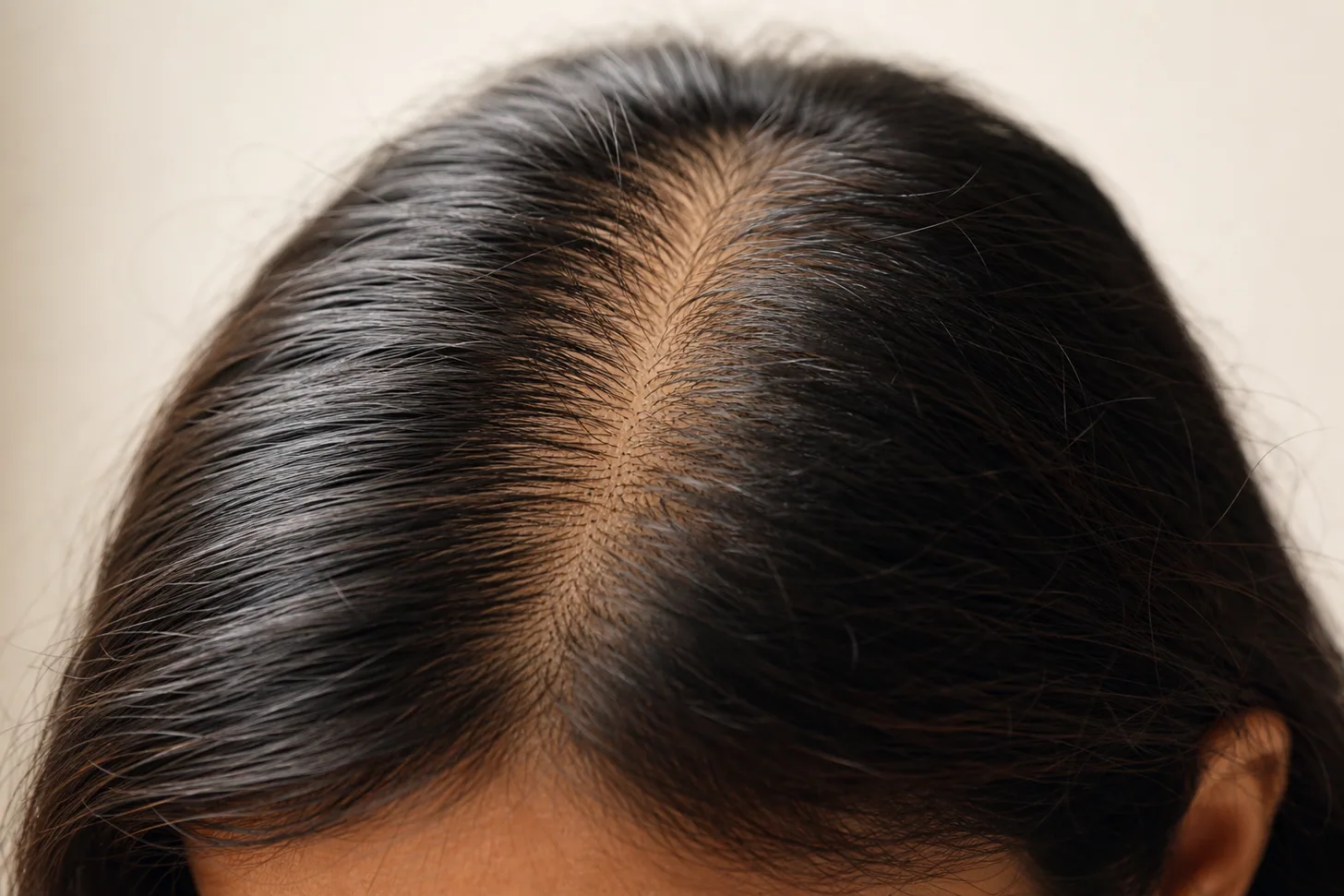
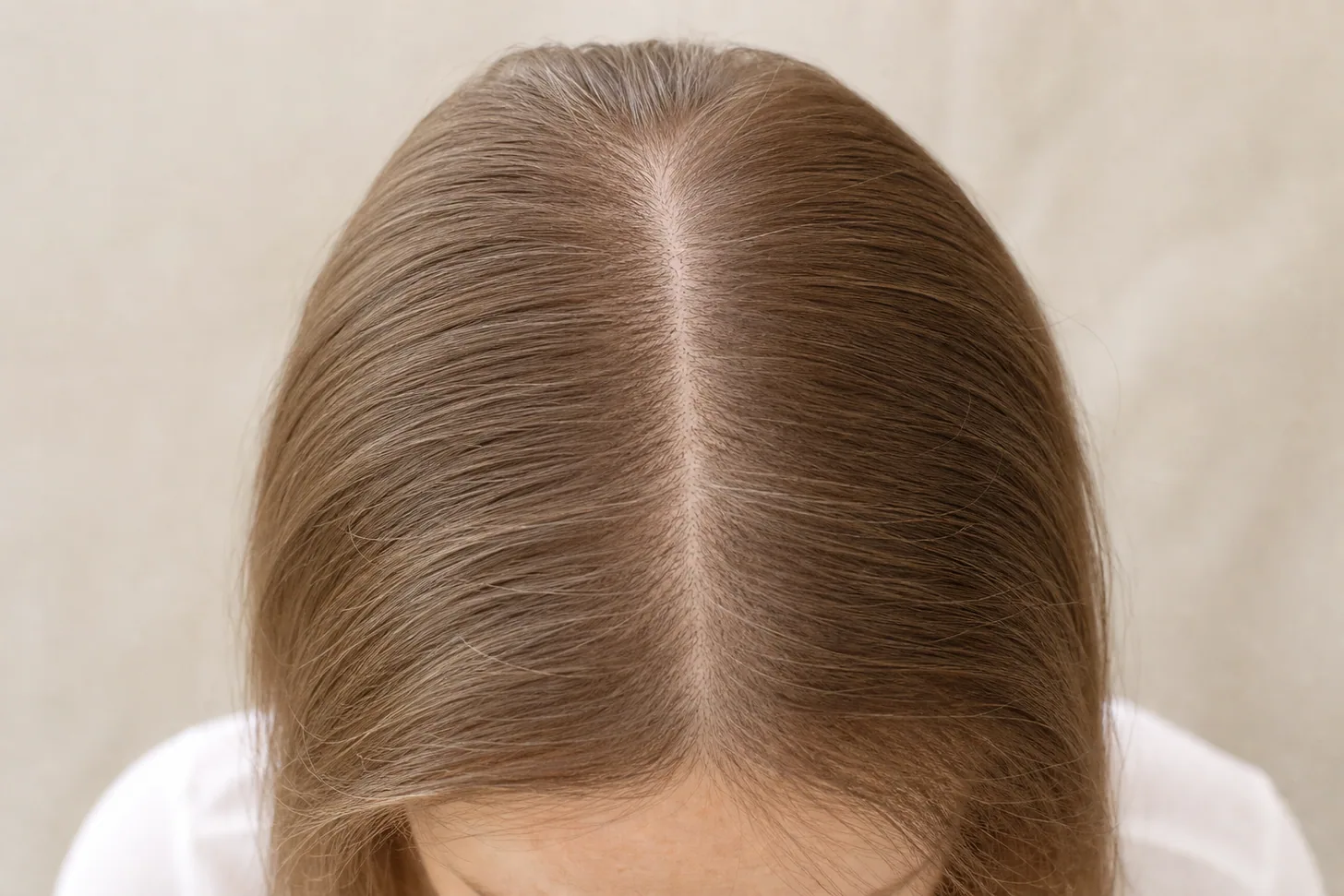
Here's the fact that reorganizes this whole worry: the shedding you're seeing this week is a receipt for something your body did about three months ago. That delay isn't incidental — it's the defining feature of telogen effluvium, the diffuse shed that follows metabolic stress. A stress pushes growing follicles into the resting phase early, and a resting hair stays anchored until the next one pushes it out, which takes roughly a season.
On fine hair it looks worse than it is, for a reason that's arithmetic rather than bad luck, and it recovers on a timeline nobody quotes accurately. Below: why fine hair crosses the visible line first, what the GLP-1 evidence actually says (less dramatic and less certain than the internet suggests), how to tell this apart from pattern loss, and the short list of things that genuinely change the outcome.
A weight-loss shed is self-limited. The hard part is the waiting, not the outcome.
What's actually happening: a cycle interrupted, not a follicle destroyed
The distinction that should come first, because it's the one that determines whether you need to worry: this kind of shedding doesn't damage the follicle. It reschedules it.
At any moment, a healthy scalp is running two populations at once — "about 85% is anagen hair, and 15% is telogen hair", growing and resting respectively. A significant physical stress — surgery, illness, childbirth, a sharp calorie deficit — pushes a chunk of that growing population into resting early.
Those newly-resting hairs then sit there for about three months before the next hair pushes them out. So the shed arrives as a batch, weeks or months after the event that caused it, and it stops as abruptly as it started once the batch has cleared.
The follicle underneath is intact and already growing its replacement. That's why the outlook here is genuinely good, and why the correct response is patience plus a couple of specific interventions rather than panic plus a shelf of products.
Why fine hair shows it first — and why that isn't the same as losing more
An effluvium takes a percentage, not a number. And a percentage of less is more visible.
Think about what covers your scalp: not individual hairs but the overlap between them. Dense hair has surplus overlap, so it can lose a substantial share and the remaining strands still close the gaps.
Fine, low-density hair was already running with no margin — the same page-one problem this site is built around — so the identical proportional shed crosses the threshold where skin becomes visible, and it crosses it at the part first, because the part is where the margin was thinnest to begin with.
Two practical consequences follow. First, you are not losing more hair than a friend who lost the same weight and barely noticed. You're seeing the same shed against a smaller reserve. Second, and more importantly, the shed may unmask something that was already quietly underway.
A gradual pattern loss that had been invisible for years can become obvious in the six weeks an effluvium removes its cover — and then, confusingly, only partly recede. If your part looked different before the weight came off, read fine hair or thinning? alongside this page; both being true at once is common rather than contradictory.
What the GLP-1 evidence actually says
This deserves a section of its own, and it deserves to be reported at its real size rather than at the size it has on social media.
A 2025 scoping review of alopecia associated with GLP-1 receptor agonists found reported cases at roughly "one to five cases per 1,000 treated patients", while noting the figure is probably an underestimate given how adverse events get reported.
So the useful reading is this. The signal is real and reported. The mechanism is most likely the weight loss rather than the molecule, which means the modifiable variable is the rate and the nutrition, not necessarily the prescription. And stopping is not established as a fix, so it shouldn't be assumed to be one. This is a conversation for the clinician who prescribed it — not a decision to make from a hairbrush.
Chair-side note
The thing I've watched cause the most unnecessary distress isn't the shedding. It's the second appointment, three or four months later, when a woman comes back convinced the treatment failed because her hair is still thin. It isn't still shedding — she stopped noticing hairs in the drain weeks ago. What she's looking at is the gap the shed left, which is a completely different problem, and it doesn't close with treatment.
It closes with growth, at about a centimetre a month, which means new hair takes months to reach a length where it contributes any coverage at all. If you're going to track this, track the shedding, not the fullness — count the hairs in the drain, not the width of your part. The fullness is the last thing to come back and the least useful thing to measure by.
MH
— Megan Holloway, Editor-in-Chief
The timeline, honestly — including the half nobody quotes
Two clocks run here and people only ever hear about the first one.
Phase
When
What you'll see
The trigger
Month 0
Nothing. Rapid loss begins, intake drops. Hair looks normal, which is why this window is missed by everyone
Onset of shedding
~3 months later (range 1–6)
A sudden, obvious increase in hairs on the pillow, in the brush and in the drain. Full-length hairs with a small pale bulb
The shed itself
Under 6 months, often much less
Heaviest early, then tapering. Acute telogen effluvium is described as self-limited
The gap
Overlapping and after
The part looks wider and the ponytail feels smaller. This is the phase mistaken for ongoing loss — it's the absence, not the process
Regaining fullness
6–9 months after shedding stops
The AAD's figure. You're waiting on growth at about 1 cm a month, so short regrowth appears long before it covers anything
Add those together and a shed that began in March can leave you back at your normal fullness somewhere in the following spring. That's a long time, and it's the reason people abandon a routine at month five convinced it isn't working. It isn't working yet, which is a different statement.
The one number to watch for: if heavy shedding is still going beyond six months, it's no longer a simple acute effluvium and warrants a dermatologist rather than more waiting.
The nutrition half — what genuinely helps, and what backfires
The metabolic stress of losing weight quickly can trigger a shed on its own. A restricted intake stacks a second mechanism on top, and this is the half you can actually act on.
Protein is the one to defend first. Hair is a protein fiber, and protein is also the intake that collapses hardest when appetite drops sharply — it's the least appealing food when you're barely hungry. This is the single most common gap I see in people on appetite-suppressing medication, and it's the most fixable.
Iron and ferritin are worth measuring, not guessing. Especially if you still menstruate. This is a blood test, and it's a reasonable thing to request — which blood tests actually matter covers what to ask for, why a result inside the reference range can still be low enough to matter, and why you should stop any biotin supplement 48 hours before the draw.
Slow the rate if you can. The trigger is the speed of the loss as much as the loss itself. A slower curve is the intervention that treats the cause rather than the symptom, and it's a legitimate thing to raise with a prescriber.
What it doesn't need is a repair routine. This isn't damaged hair — the fiber that's left is exactly as strong as it was. Protein masks and bond builders address a different problem entirely, and on fine hair they add weight you can't afford; what repair ingredients actually do sets out the distinction.
Telling this apart from pattern loss, and from breakage
Three things get confused here, and each has a different answer, so it's worth two minutes with the evidence in your hand.
Telogen effluvium (this page). Diffuse — from everywhere at once. A sudden, unmistakable increase in shed hairs. The hairs are full-length with a small pale bulb at the root. Starts a few months after an identifiable event, and stops.
Female-pattern hair loss. Localised — a widening part and a thinning crown, with the front hairline usually spared. Gradual over years. The shed count may be entirely normal. Covered in "I can see my scalp".
Breakage. Not a follicle event at all. The hairs are short, without a bulb, and blunt or frayed at the ends. Nothing has been lost from the scalp; it snapped mid-length. Hair breakage on fine hair has the tissue-sort test that separates it from a shed in about a minute.
If the loss is at your temples and front edge specifically rather than diffuse, that's a third pattern again, and usually tension rather than either of the above — thinning at the hairline and temples.
What to do with your hair while you wait
This is where a site about fine hair earns its keep, because the medical answer for the next six months is essentially "wait", and that isn't much to live on.
Move your part. The cheapest, fastest change available, and the one that most directly addresses the gap phase — a part is the place a shed shows first. How to part fine hair.
Ask for a shorter, blunter perimeter. Length is weight, and weight is exactly what a shed has taken. A cut that concentrates what's left at the ends buys back visible density in an afternoon. Bring the exact words to ask for.
Stop pulling it back tightly. A high, tight ponytail every day during a shed adds tension damage on top of an effluvium, at the hairline, where recovery is slowest. Loosen it, vary it, move the elastic's position.
Root lift, not thickening treatments. Lift at the root does more for apparent density than anything you can leave in the lengths. How to get root volume, and how to add volume to fine hair for the whole toolkit.
Be gentle mechanically. Wet hair is at its most fragile, brushing a shed does not slow it, and yanking through tangles converts a shedding problem into a breakage one. Detangling fine hair.
Photograph your part. Overhead, in daylight, once a month, same spot. Memory is a terrible instrument for this, and a photograph is the single most useful thing you can bring to a dermatologist.
When this isn't a simple weight-loss shed — see a doctor
Heavy shedding is still going after six months. Acute telogen effluvium is self-limited by definition. Beyond that window it needs a diagnosis, not more patience.
The hair is coming out in defined patches with smooth, empty skin. That's a different condition entirely and needs a board-certified dermatologist promptly.
The scalp is painful, burning, itching, scaling or visibly inflamed. Symptoms belong to the scalp's own diagnoses. See flakes and dandruff on fine hair, and get pain or burning looked at.
You're also unusually tired, cold, or your periods have changed. Thyroid and iron are both common, both testable and both treatable. Ask for blood work.
You're considering stopping a prescribed medication. Not a decision to make from a hairbrush, and stopping isn't established as a fix. Book the conversation with the prescriber.
The part has been widening since before the weight loss. Then the shed unmasked something rather than caused it — fine hair or thinning? and a dermatologist.
FAQ
Usually about three months, and that delay is the defining feature of this kind of shedding rather than a coincidence. In telogen effluvium, a stress on the body pushes growing follicles into the resting phase early, and a resting hair doesn't fall out immediately — it stays anchored until the next hair pushes it out, which takes roughly three months. Clinical practice puts the causative event at approximately three months before the shedding starts, with a range of one to six. The practical consequence: the shed you're seeing today is a receipt for what your body was doing in spring, which is why blaming this week's diet or this week's dose usually points at the wrong thing.
There's a real reported signal, and the honest description of it is smaller and less certain than social media suggests. A 2025 scoping review of alopecia associated with GLP-1 receptor agonists put reported cases at roughly one to five per 1,000 treated patients, noted that this is probably an underestimate, and identified telogen effluvium and androgenetic alopecia as the most frequently observed patterns. The proposed mechanism isn't the drug attacking the follicle: it's that rapid weight loss generates acute metabolic stress, which may trigger telogen effluvium, compounded by reduced intake. The same review is candid about its limits — most studies lacked dermatological diagnostic confirmation, and whether the shedding resolves after stopping treatment hasn't been established. Don't stop a prescribed medication over hair; raise it with the prescriber.
Because telogen effluvium removes a proportion rather than a fixed number, and the same proportion of a smaller total crosses the threshold where scalp becomes visible much sooner. On a normal scalp roughly 85% of hairs are growing and 15% resting; an effluvium shifts that balance for a few months. On a dense head the remaining hair still covers the scalp between strands, so a substantial shed can pass almost unnoticed. On fine, low-density hair there was no surplus doing that covering, so the same shift shows up at the part, in the ponytail and in photographs. The loss isn't worse. The margin was smaller.
In almost all cases, yes, because this type of shedding doesn't destroy the follicle — it interrupts the cycle. Acute telogen effluvium is described as a self-limited condition in which the shedding lasts less than six months and is often much shorter. Once it stops, the American Academy of Dermatology's guidance is that most people see their hair regain its normal fullness within six to nine months. That second half is the part people aren't told, and it's why recovery feels so slow: you're not waiting for repair, you're waiting for growth, at roughly one centimetre a month. If shedding is still heavy beyond six months, that's no longer a simple acute effluvium and is worth a dermatologist's assessment.
Often both, in sequence. The metabolic stress of losing weight quickly is enough on its own to trigger shedding, and a restricted intake on top of it adds a second mechanism. The bariatric surgery literature — the closest well-studied model for very rapid loss — implicates copper, essential fatty acids, iron, protein, selenium, several vitamins and zinc, and notes that nutritional deficiencies occur in about half of bariatric surgery patients. The distinction matters because only one of them is fixable with food: correcting a genuine deficiency helps, while supplementing nutrients you aren't short of doesn't, and taking large amounts of vitamin A or selenium is itself toxic and can cause hair loss. Ask for blood work rather than guessing at the supplement aisle.
It removes one of the causes rather than treating the shed, which is still the most useful thing you can do. Hair is essentially a protein fiber, and a body short on protein doesn't prioritize growing more of it. Protein is also the intake that falls furthest and fastest when appetite drops sharply, whether from a very low-calorie diet or from appetite-suppressing medication, because it's the least appealing thing to eat when you're barely hungry. Getting protein back to an adequate level won't stop a shed that was triggered three months ago — that hair is already committed to falling — but it protects the cycle that follows it, which is the one you're trying to get back.
By the pattern, the hairs themselves, and the timing. A telogen effluvium is diffuse: it comes from everywhere at once, you see far more hair in the brush and the drain, and the hairs are full-length with a small pale bulb at the root. Female-pattern loss is localised: it widens the part and thins the crown, the shed count may look normal, and the change is gradual over years rather than sudden over weeks. Timing is the clincher — an effluvium starts abruptly a few months after an identifiable event and stops. The two can also run together, and often do, because a shed can unmask a pattern loss that was already quietly in progress.
That's a decision for the clinician who prescribed it, and it's worth booking the conversation rather than making the change. Two things are worth bringing to that appointment. First, the shedding is usually self-limited, so stopping isn't the only route to regrowth. Second, the review evidence doesn't yet establish whether the alopecia resolves after discontinuation, which means stopping isn't a guaranteed fix either. What is reasonable to ask for is a check of the modifiable contributors — protein intake, iron and ferritin, and the rate of loss itself, since slowing it down is a lever that treats the trigger rather than the symptom.
Fourteen years across the chair and the page, with a particular interest in the hair problems that hide inside explanations people have already accepted. Megan's rule for a shed: track the shedding, not the fullness.
This article is for general education and is not medical advice, and nothing here is a reason to start, stop or change a prescribed medication. If you are experiencing sudden, patchy or prolonged hair loss, scalp pain, or other concerning symptoms, see a board-certified dermatologist.
Images in this article are AI-generated illustrations, not photographs of real clients or results. See our image policy.
Results vary with hair type, density, and growth patterns. This guide is educational and not a substitute for an in-person consultation with a licensed stylist or physician.
Get the good hair intel
One honest, stylist-written guide in your inbox each week. No hype.

 MH
MH