Reviewed by Dr. Rachel Kimura, MD · Updated August 2026 · 10 min read
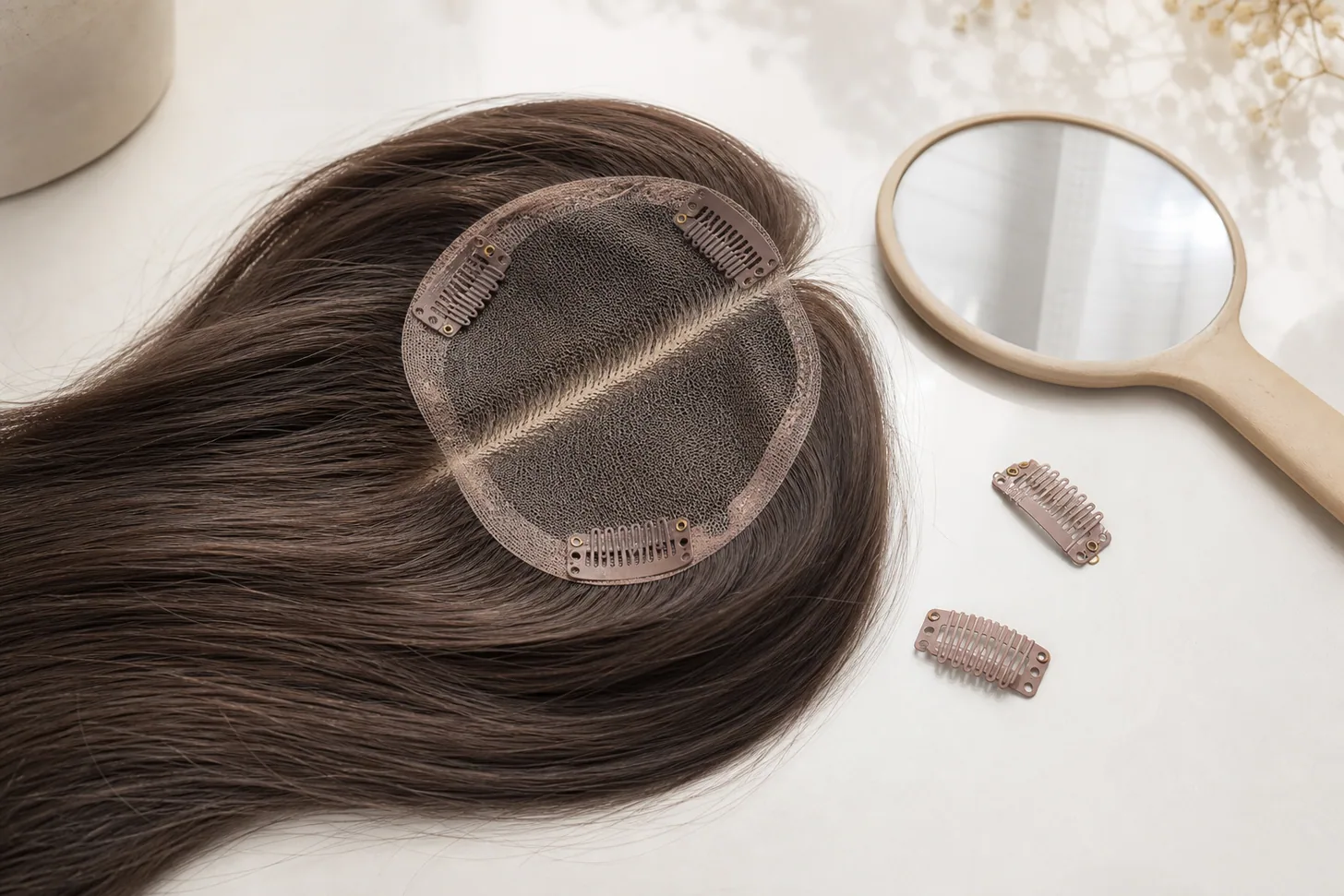
Nearly every guide to buying a hair topper talks about the topper. But a topper is held on by the hair you still have — it hangs from pressure clips biting into a ring of your own strands around the edge of the base — so the thing that decides whether it works isn't the piece you buy, it's the density at the clip line.
Get that right and a well-matched topper is genuinely undetectable and a real relief. Get it wrong and you have bought a heavy object that pulls on the most fragile hair you own, in the place least able to spare it. Below: the honest test for whether you're a candidate, the three measurements that matter, what each base type actually buys you, the clip-damage risk in plain terms, and the five situations where the answer is no.
The base and the clips do the work. The hair on top is the easy part.
Chair-side note
The first thing I do when someone brings a topper into the salon is take it off them and hold it. Nine times out of ten it is too dense — she bought 150% because more hair sounded like more coverage — and you can feel the weight in your palm. Then I part her hair and look at what's holding it: four small clips, on hair that is already the finest on her head.
I don't tell people not to wear toppers. I tell them to buy one grade lighter than they want to, and to move the clips. Those two habits are the difference between a topper you wear for years and a topper that costs you the hair you were trying to hide.
MH
— Megan Holloway, Editor-in-Chief
What a topper is — and what it isn't
A hair topper is a partial hairpiece: a base of a few square inches, hair attached to it, and small pressure clips around the edge. It sits over the crown or the parting, and your own hair is worn around and underneath it, which is what makes it blend.
It's the answer to a specific problem — thinning concentrated in one area while the sides and back are still reasonably full — and it's a poor answer to almost every other problem. It's also a cosmetic answer running in parallel to a medical one, not instead of it: a topper covers today while whatever treatment you're on works on a six-to-twelve-month timescale.
The category gets muddled with three other things it isn't:
Option
What it does
When it's the right call
Topper
Covers a defined area at the crown or part; clips to your own hair
Visible scalp in one region, decent density around it
Wig
Covers the whole head; replaces rather than supplements
Widespread loss, or wanting the styling question gone entirely
Extensions
Add length and thickness through the lengths, lower down
You want longer or fuller lengths; they do nothing for a parting
Fibres, powders & sprays
Colour the scalp or cling to existing strands to blur the gap
One thing worth saying at the outset, because the marketing tends not to: a topper is cosmetic. It covers; it does not treat, and it does not regrow anything.
That's not a criticism — makeup doesn't treat anything either, and nobody minds. But if part of the appeal is a hope that it will help the hair underneath recover, it won't, and if you're weighing what actually can change, can you really grow fine hair thicker? is the honest version of that answer.
It's also worth checking the cheaper option first: if the area is a widened part rather than a genuinely bare patch, a scalp concealer or root powder covers it for the price of a compact and no commitment at all — and if it's diffusely thin with hair still in it, building fibers are cheaper still.
The test: is there enough hair at the clip line?
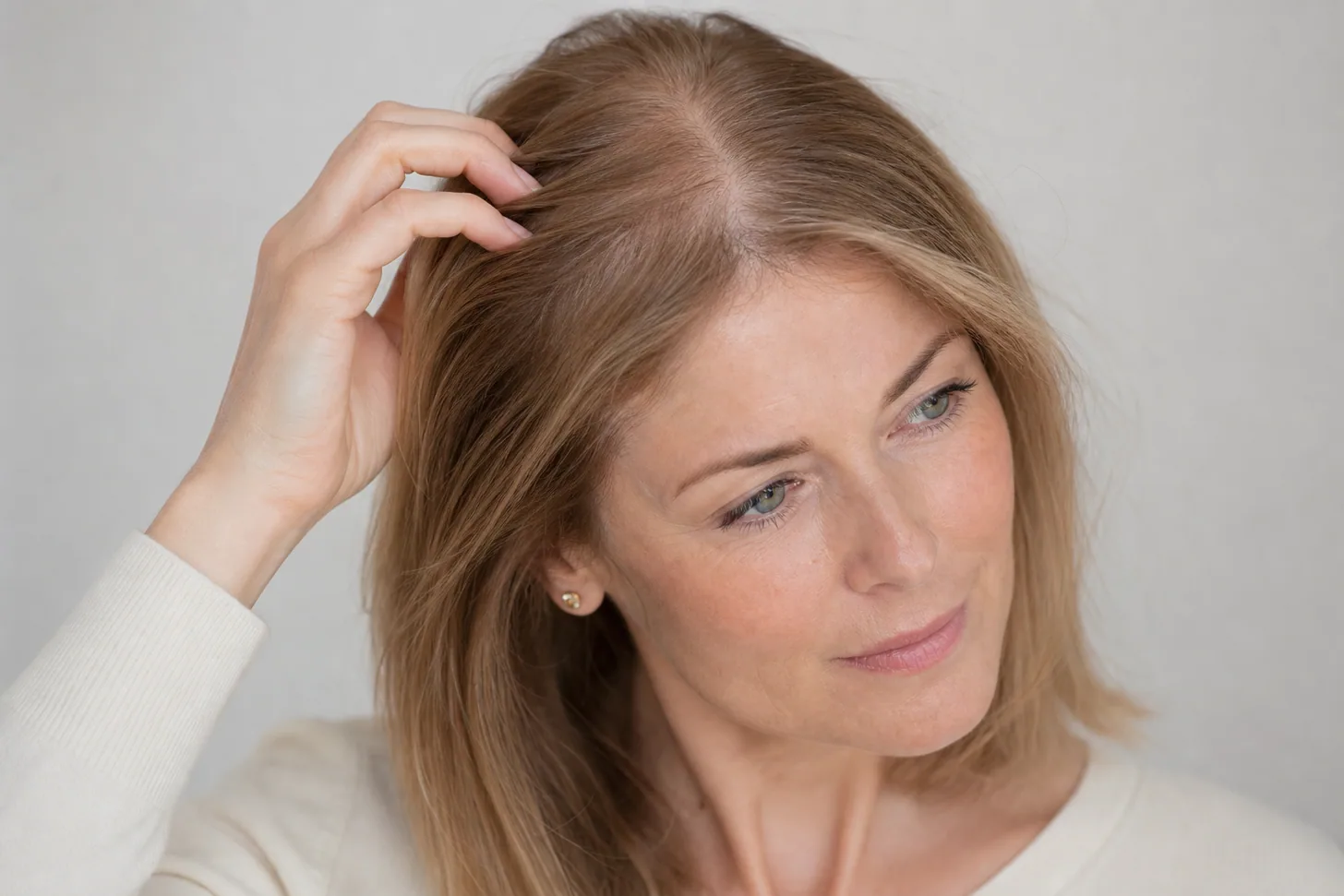
Forget the topper for a minute and look at your own head. Part your hair down the centre and then part it again about two inches to either side of the thin area. What you're looking for is a ring — front, back and both sides of the region you want covered — where the hair still feels reasonably dense between your fingers.
That ring is the anchor. Four small clips grip into it and carry the whole weight of the piece all day. If it's there, a topper is a legitimate and often excellent option.
If it isn't — if the thinning is diffuse and roughly even across the whole top of your head — then the clips have nothing solid to bite, the piece slides backward through the day, you tighten the clips to compensate, and you have created a slow tension injury on the hair you were trying to protect.
Two other checks worth doing honestly. Is the scalp calm — no soreness, tenderness, itching or flaking? And is the loss stable rather than actively progressing? Both of those matter more than any spec on a product page, and both are covered further down.
Toppers for a thinning crown, a widening part, or the front
Where the thinning sits changes the answer more than any product spec does, and the three common places are not equally good cases.
A thinning crown is the textbook one, and it is why most toppers are designed the way they are. Loss at the crown is usually surrounded on all four sides by hair that is still holding, which is exactly the ring the clips need — so the piece has somewhere solid to bite and the covered area sits where your own hair naturally falls over the join.
Size the base to the thin area plus about an inch in every direction, not to your head: a base larger than it needs to be adds weight and puts the clips out where the hair is finer, and one that is too small leaves an edge sitting in the middle of the sparse patch, which is the version everyone can see.
A widening part is the same problem in a narrower shape, and it is where the smaller bases earn their keep. A part that has opened up but has good density either side of it can often be covered by a piece only three or four inches across, which is dramatically lighter and easier to live with than a full crown base.
Before you buy for this one, it is worth being sure the part is genuinely widening rather than just looking wide, because they are different situations with different answers — our guide to the fine-hair part walks through telling them apart.
Thinning at the front or along the hairline is the hard case, and honesty is more useful here than a recommendation. The hairline is where hair is finest on almost everyone, so it is the worst place to anchor a clip and the most visible place for a base edge to sit.
A topper clipped forward to cover a receding front loads tension onto exactly the hair that is already going, and that is the mechanism behind traction loss rather than a way around it. If the front is your concern, look at a piece with a lace or silk front that can be worn further back, or at the non-clip options — and read what a thinning hairline actually means first, because the front responds to treatment more often than the crown does.
The three measurements
Everything else on a product listing is detail. These three decide the outcome.
Measurement
How to get it
The fine-hair rule
Base size
Measure the thin area front-to-back and side-to-side at its widest, in inches
Add about an inch each way, then round up to the nearest base. Bases run from roughly 3x5 to 7x9 inches
Length
Measure your own hair from the crown down
Equal to or slightly shorter than your own length, so your ends carry the blend rather than the topper's
Density
Usually given as a percentage, commonly 100–150%
Match your own or go one step lighter. Never heavier — this is the rule people break
The density rule deserves its own paragraph because it is counterintuitive and it costs people money. More hair on the topper does not read as more coverage; it reads as a different head of hair sitting on top of yours.
Fine hair has a particular look — light, mobile, slightly translucent at the ends — and a 150% piece next to it announces itself immediately, especially in daylight and especially from behind. The second problem is mechanical: every extra gram hangs from the same four clips.
Sizing down on the base is the other common false economy. A base that only just covers the thin patch has no margin, so the clips end up sitting inside the sparse area rather than outside it, and the perimeter of the base sits on visible scalp instead of on hair.
Base types, and what each one buys you
The base is the part you're really paying for, and it's the part that determines whether the "scalp" you're showing at the parting looks like skin.
Base
How it's built
On fine hair
Silk top
Knots hidden beneath a layer of silk, so no knots are visible at the part
The most convincing parting available. The premium option, and the one worth stretching for if the part is what bothers you
Monofilament
Hair hand-tied into a fine mesh; each strand moves individually
Very natural movement and a part you can move around. Small knots are visible up close; excellent value
French drawn
Hair drawn under a layer to hide the knots without a full silk top
A middle ground — better than mono at the part, cheaper than silk, slightly less flexible
Lace front
A sheer lace strip at the front hairline
Lets you wear the front off your face. Delicate, and it needs careful handling — it's usually an add-on to one of the above
Wefted / open base
Rows of machine-sewn wefts with gaps between them
Light and cool to wear, cheapest by a distance, but the parting doesn't hold up to close inspection
If your thinning is mainly a widening parting, spend on the base. If it's more of a general see-through-ness at the crown with the part still intact, a monofilament base does the job for considerably less.
The clip question, and why it's the real risk
This is the part of the topper conversation that gets left out of most buying guides, and it's the part a dermatologist would want said first.
Pressure clips work by concentrating force on a small bundle of strands. Worn for eight or ten hours a day, in the same spots, on hair that is fine to begin with and sitting at the perimeter of an area that's already thinning, that's a textbook set-up for traction.
The American Academy of Dermatology's page on hairstyles that pull lists hair extensions and weaves alongside tight braids and buns as causes of traction alopecia, and is direct about the stakes: if the pulling continues, hair can eventually stop growing back, and at that point it cannot be recovered. Caught early, with a change in how the hair is worn, it usually can be. The signs that tell you which side of that line you're on are in thinning at the hairline and temples.
None of that means don't wear a topper. It means wear one the way it should be worn:
Move the clips. Shift each clip half an inch to an inch between wears so the same follicles aren't loaded every day. This single habit does more than everything else on this list.
Off at night, always. Sleeping in a topper adds friction to tension. Take it off, and take it off before a long car journey or a workout too.
Nothing that hurts. Tenderness at a clip site, a headache after an hour, or a sore patch that evening all mean the same thing: it's too tight or the clip is holding too few strands. Pain is damage, not a break-in period.
Look at the clip line monthly. Part the hair where the clips sit and check for short broken pieces, a receding edge, or shiny skin. Photograph it — memory is a poor instrument for slow change.
Give it rest days. A day or two a week wearing your own hair, styled to cover, keeps the tension intermittent rather than constant.
Consider a wider clip base. Some pieces come with more clips, or larger ones, which spreads the same weight over more strands. If yours has four, a topper with six is worth the swap.
And a flag worth taking seriously: if you notice tenderness, itching, a burning sensation, or a patch of loss that is spreading rather than static, stop wearing the topper and see a board-certified dermatologist. Some causes of hair loss are progressive and treatable early, and a topper is very good at hiding the evidence you'd otherwise act on.
Human hair or synthetic
Neither is better; they suit different lives, and the honest framing is that you're choosing what you want to spend — money or time.
Synthetic
Heat-friendly synthetic
Human hair
Styling
Holds its set permanently; no styling needed
Limited heat, low settings only
Style it like your own; needs restyling after washing
Look on fine hair
Consistent sheen that can read artificial in daylight
Better, still uniform
Most convincing, especially at the ends
Colour
As sold; can't be coloured
As sold
Can be toned or rooted by a colourist to match
Lifespan (regular wear)
Roughly 3–6 months
Roughly 4–8 months
Roughly 6–12 months, longer if rotated
Cost tier
Budget
Mid
Premium — often several times the synthetic price
A reasonable path for a first purchase: buy a mid-density synthetic or heat-friendly synthetic in the smallest base that covers the area, wear it for two months, and find out whether you actually like wearing one before spending on human hair. A surprising number of people discover they wanted a different haircut rather than a hairpiece — and if that's you, the exact words to ask for a fuller-looking haircut costs nothing.
Colour and blending on fine hair
Three things decide whether it disappears.
Match to your mid-lengths, not your roots. The topper sits on top and is seen alongside the hair around it, which is your mid-length colour. Matching to root colour makes the piece read too dark.
Buy rooted if you have visible regrowth. A topper with a darker shadow at the base blends into hair with natural root depth far better than a solid, single-tone one — and it buys you longer between colour appointments.
Get it cut in. This is the step people skip and it matters more than the colour. A topper straight from the box has blunt, uniform ends that fine hair never has. Twenty minutes with a stylist point-cutting the ends and blending the perimeter into your own layers is the difference between "she has nice hair" and "is that a hairpiece". Take it to whoever cuts your hair — most will happily do it.
One practical note: toppers photograph darker and shinier than they look in the mirror. Check yours in daylight and in a photo before you commit to a colour. A cut can do a surprising amount at the front edge on its own — haircuts for a receding hairline covers what, before you commit to a piece.
Living with one
Wash it far less often than you wash your own hair — every ten to twenty wears is typical, because the base and clip stitching take mechanical strain every time. Cool water, gentle shampoo, no scrubbing at the seams, and dry it flat or on a stand rather than with heat. Store it on a stand or in its box, not squashed in a drawer, which crushes the base.
Between washes, treat it like fine hair: dry shampoo at the base rather than more washing, and as little product as possible — the fibre can't renew itself, so build-up is permanent until you wash it out. And your own hair underneath still needs looking after; it's spending its days flattened under a base, so give it a proper wash and a gentle comb-through on rest days.
When a topper isn't your best move
Your thinning is even across the whole head. There's no dense perimeter for the clips to hold, so the piece will slide and pull. A wig, or a styling-and-cut approach, is the safer route.
You're shedding heavily right now. Adding daily tension to follicles already under stress is the wrong order of operations. Find out what the shedding is first — start with fine hair or thinning? and a dermatologist.
Your scalp is sore, itchy, flaking or tender. That's a medical question and a topper will hide it. Get it looked at before you cover it up.
What you actually want is more volume. Volume is a styling problem with cheap solutions. Try root volume technique and the right layers before spending several hundred dollars.
You can't commit to rotating the clips and taking it off at night. Then the traction risk is real rather than theoretical, and the honest advice is to choose a different approach.
FAQ
They work when there's still enough hair at the perimeter of the thin area for the clips to grip, and they don't work when there isn't. That's the whole test, and it has nothing to do with the topper. A topper is anchored by pressure clips that bite into your own hair around the edge of the base, so a person with a thin crown and a reasonable ring of hair around it is a good candidate, while someone whose thinning is even across the whole head often isn't — the clips have nothing solid to hold and will slide, pull, and eventually damage the hair they're gripping.
Measure the area you actually want covered — front to back and side to side, at its widest — and add roughly an inch in each direction, then choose the nearest base size up. Bases are sold in dimensions such as 4x4, 5x5 or 6.5x7 inches. The margin matters for two reasons: the clips need to sit on hair that still has density, and the perimeter of the base needs somewhere to blend. Sizing down to save money is the most common mistake, and it produces a topper that shows its edges every time you move.
Yes, if it's worn in the same position every day or if the clips are gripping too few strands. Pressure clips concentrate tension on a small patch of hair at the perimeter of an already-thinning area, and repeated pulling on the same follicles is the mechanism behind traction alopecia — which the American Academy of Dermatology warns can become permanent if the pulling continues. The precautions are straightforward: shift the clip positions by half an inch or so between wears, never clip onto hair that's sore or tender, take the topper off at night, and give the hair rest days.
Match your own density or go one step lighter — never heavier. Brands usually express density as a percentage, commonly from around 100 to 150 percent, and the temptation is to buy the fullest one on the assumption that more hair means a better result. On fine hair it does the opposite twice over: an over-dense topper reads as obviously artificial next to your own hair, and every extra gram of it hangs from the same few clipped strands. A slightly under-dense topper blended into fine hair is close to undetectable.
A topper is a partial hairpiece that clips onto your own hair to add coverage over a specific area, usually the crown or the parting, and your own hair is worn around and under it. A wig covers the entire head and replaces your hair rather than supplementing it. Toppers suit thinning that's concentrated in one region while the sides and back are still reasonably full; wigs suit widespread loss, or anyone who wants to remove the styling problem entirely. Extensions are a third thing again — they add length and thickness lower down and do nothing for a visible parting.
Synthetic if you want to put it on and go, human hair if you want it to behave like your own. Synthetic fibre holds its style permanently, costs considerably less and needs no styling — but it can't take much heat, tends to have a consistent sheen that reads slightly artificial in bright light, and has a shorter working life. Human hair can be heat-styled and coloured to blend, moves more naturally and lasts longer, but it needs restyling after every wash and costs several times as much. Heat-friendly synthetic sits in between and is a reasonable first purchase.
With regular wear, roughly three to six months for a synthetic piece and around six to twelve months for human hair, though gentle handling and rotating between two pieces extends both considerably. What wears out first is usually not the hair but the base and the clip stitching, which take the mechanical strain. Wash less often than you think — every ten to twenty wears is typical — use cool water, avoid scrubbing the base seams, and dry it flat or on a stand rather than in a dryer.
There is no single best one, because the variable that decides it is your scalp rather than the product. The piece that works is the one whose base matches the shape of your thin area plus about an inch of margin, whose density is at or slightly below your own remaining density, and whose clips sit in hair that can still hold them. Get those three right in a mid-priced piece and it will look better than an expensive one that is too dense or too large. If you are choosing between construction types, a silk or mono top gives the most convincing scalp illusion at the part, and a lace front lets you wear it further back off a fragile hairline.
In ordinary use, yes — "hair piece" is the older and broader word, and most of the time someone searching for hair pieces for thinning hair on top is describing a topper. The distinction worth keeping is not between the two words but between clip-in pieces and full wigs. A topper or hair piece covers part of the head and is anchored to your own remaining hair, so it needs that hair to be there; a wig covers the whole head and needs nothing to grip. If your thinning is diffuse and even, the piece that needs an anchor is the wrong category, and the honest answer is a wig or a different approach altogether.
Measure the thin area at its widest point in two directions and add roughly an inch on each side, then buy the base closest to that. For a typical crown that lands somewhere around a 5x5 or 6x6 inch base; a part that has widened without much crown involvement is often covered by a 3x5. Bigger is not safer here. A base larger than the area it covers pushes the clips outward into finer hair, adds weight that the same finer hair then has to carry, and makes the piece harder to blend at the back edge. Measure with the hair parted where you actually wear it, because the shape of a thin area changes with the part.
Fourteen years across the chair and the page, specialising in fine-hair care. Megan's view on toppers is that they're a good product sold badly — almost every buying guide talks about the hair, and almost none of them talk about the four clips holding it up.
This article is for general education and is not medical advice. If you are experiencing sudden or patchy hair loss, scalp pain, or other concerning symptoms, see a board-certified dermatologist.
Results vary with hair type, density, and growth patterns. This guide is educational and not a substitute for an in-person consultation with a licensed stylist.
Hairstyle images in this guide are AI-generated illustrations, not photos of real clients or results. See our image policy.
Get the good hair intel
One honest, stylist-written guide in your inbox each week. No hype.

 MH
MH