Reviewed by Tara Sullivan · Updated August 2026 · 11 min read
A wash-and-wear cut for thin hair after 70 has to clear a higher bar than "easy": it has to look right with no heat, be finishable with one hand, and still read as a shape at week ten rather than week six.
Most galleries sort cuts by how flattering they are. That is the wrong axis here, because the reason women over 70 want wash-and-wear is rarely a shortage of time — it is shoulders that object to holding a dryer with both arms up, grip that is not what it was on a round brush, and salon trips that are harder to arrange than they used to be.
The 16 cuts below are sorted by how much work they actually take — zero-effort, two-minute, five-minute — with the trim cadence named on each, because a cut that needs a salon visit every five weeks is not a low-effort cut. It is a high-effort cut with the effort handed to someone else.
Sixteen cuts, sorted by effort rather than by length.
Chair-side note
When a client in her seventies says she wants something easy, I have learned to ask a second question: easy for your hands, or easy for your diary? They point at different cuts. If it is the hands — arthritis, a shoulder that will not stay raised, a dryer that has become too heavy to hold for four minutes — then the cut has to work with no heat at all, and I shape it wet and let it fall so I can see what she will actually see at home.
If it is the diary, the constraint is the grow-out, and I soften every edge I cut so the shape ages into something rather than out of something. Most women over 70 tell me both, and the cut that answers both is the same one: soft perimeter, height at the crown, nothing that needs a second hand.
SB
— Simone Baptiste, Senior Stylist
What "wash-and-wear" has to mean after 70
"Low-maintenance" is a soft word and salons use it generously. A cut can be called low-maintenance and still assume you will spend three minutes at the crown with a dryer in one hand and a brush in the other. That assumption is the whole problem, so it is worth replacing the soft word with three hard tests. Take these into the consultation and apply them to whatever your stylist proposes.
The test
What it means
How to check it in the chair
1. The no-heat test
The cut looks intentional straight out of a towel, with nothing but a little product.
Ask your stylist to cut it, comb it, and let it dry on its own before any styling. What you see then is what you get at home.
2. The one-hand test
You can finish it with one hand, in under two minutes, without raising both arms.
Ask: "Show me how you'd finish this using only your fingers." If the answer involves a round brush, it is not a wash-and-wear cut.
3. The week-ten test
It still reads as a deliberate shape at ten weeks, not just at two.
Ask: "What goes wrong first as this grows, and how obvious is it?" A soft-edged cut has a vague answer. A precision cut has a very specific one.
Test three is the one nobody writes about, and it is the one that quietly decides whether a cut is genuinely low-effort. It is also the one where age is on your side. The research on hair aging describes a shortened growing phase and a longer interval before a shed hair is replaced — meaning regrowth is slower after 70 than it was at 40.
Slower regrowth stretches the life of a soft shape considerably. What it does not do is rescue a hard one: a blunt line or a tight nape taper still looks wrong when it grows, it just takes a little longer to get there.
How each shape ages, and what that does to your trim cadence
Two cuts of identical length can want trims six weeks apart. The variable is the edge, not the inches. A hard perimeter is a line that regrowth breaks; a soft, point-cut perimeter is a texture that regrowth just extends. If getting to the salon is difficult, this table is the most useful thing on this page — choose from the bottom half.
Shape
Holds its line for
What goes first
Forgiving as it grows?
Precision blunt bob
5–6 weeks
The hem drops below the jaw and the whole cut reads heavy.
No — the line is the cut
Tightly tapered pixie nape
4–5 weeks
The nape thickens and pushes the shape outward at the neck.
No
Graduated bob, softened edge
9–11 weeks
Crown lift flattens gradually; the outline stays intact.
Yes
Soft point-cut pixie
10–12 weeks
Grows into a longer pixie, which is also a cut.
Yes — it grows into its neighbour
Collarbone lob, light internal layers
10–12 weeks
The ends soften; the shape is unchanged.
Yes
Soft shag
10–14 weeks
Nothing sharply — shags are built out of texture, not lines.
Yes — the most forgiving on this list
If you already know roughly what length you want and are looking for the flattery argument rather than the effort one, our broader gallery of hairstyles for fine hair over 70 sorts the same territory by shape, and short cuts for fine hair over 70 goes deeper on the shortest end.
This page assumes you have already decided that effort is the deciding factor. And if you want to keep length rather than trade it for ease, long hairstyles for fine hair over 70 is candid about the daily cost.
“Low-maintenance hairstyles for seniors” hides two different constraints
The phrase gets used as though it means one thing, and it does not — which is why so much of the advice under it misses. There are two separate costs in a haircut, and a cut can be cheap in one and expensive in the other.
Effort per day is the morning cost: how long you stand at the mirror, whether your arms have to stay up, whether it needs a dryer and a brush at the same time. Effort per trip is the salon cost: how often the shape has to be recut before it stops working, and what getting there involves — a lift, a taxi, a bus, or waiting for someone free to take you.
These pull in opposite directions, and that is the part nobody says out loud. The cuts with the lowest daily effort tend to have the highest trip cost. A crisp short crop is genuinely wash-and-walk-away at home, and it also stops looking like itself at about week five — so a cut sold as low-maintenance can quietly commit you to ten salon visits a year.
A softer, longer shape is the reverse: a few minutes more each morning, but it grows out into something wearable and will forgive twelve or fourteen weeks. So before you use the effort tiers below, decide which cost is the one you are actually trying to reduce.
If getting to a salon is the hard part, do not take the shortest cut on the list — take one from the five-minute tier and accept the brush. The grow-out behaviour of every shape here is set out in the section on how each one ages, and the age-and-shape question on its own terms is in hairstyles for fine hair over 70.
Zero-effort cuts: wash, towel, walk away
These six need nothing but a towel and, at most, a pea of product rubbed between the palms. No dryer, no brush, no raised arms. They are the shortest shapes on the page because short is where fine hair stops needing help to lift — once the weight is gone, the hair stands up on its own.
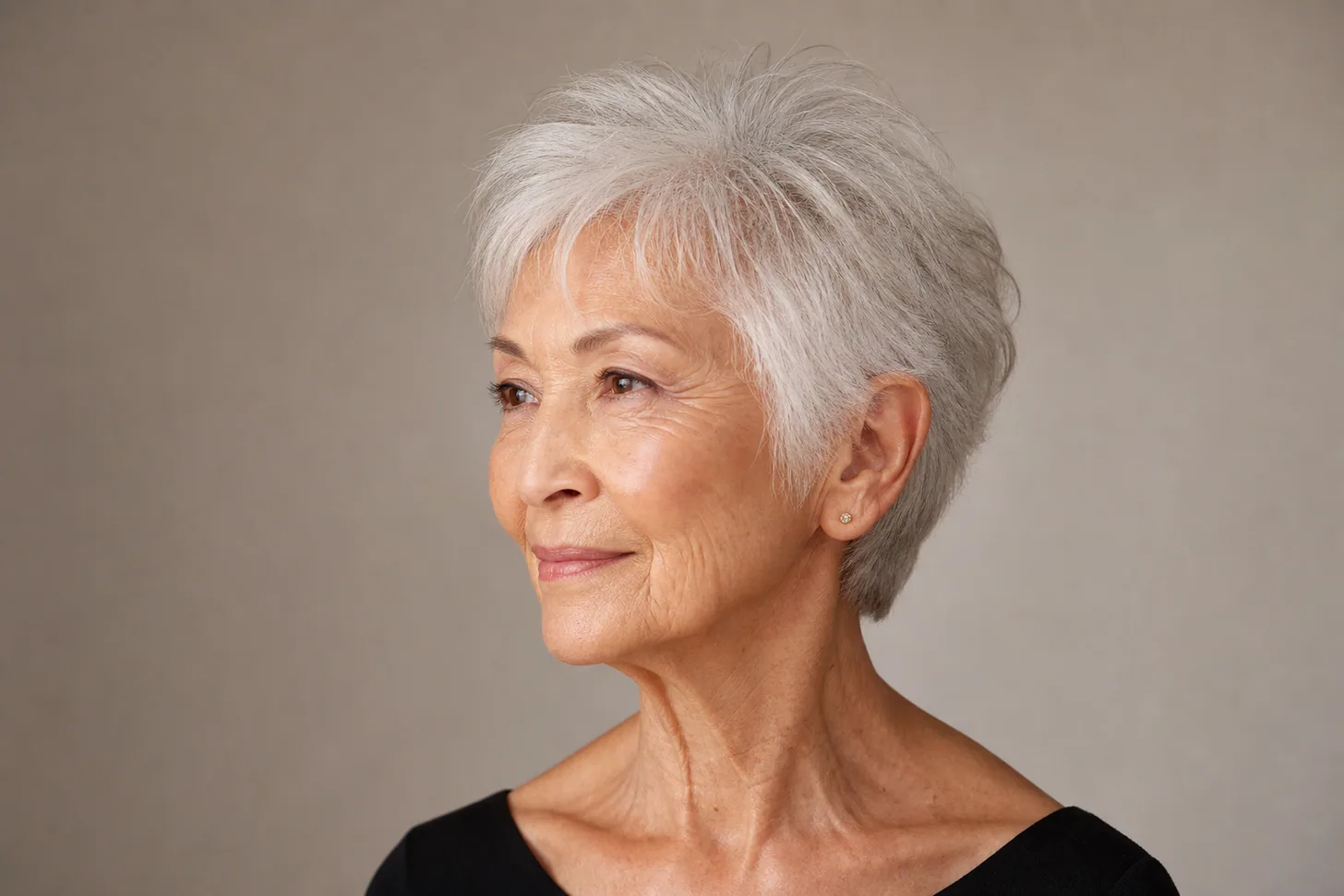
soft rounded pixie with airy crown on fine white hair, woman over 70, air-dried
1
Soft rounded pixie
Cut short all over with the crown left half an inch longer and point-cut so it stands rather than lies. On fine hair this is the shape with the highest fullness-per-effort ratio on the page: there is no weight left to pull the roots down, so the lift is structural rather than something you have to produce each morning. It air-dries into itself. Trim it every ten to twelve weeks and it simply becomes a longer pixie in between.
textured crop with longer top swept forward on fine silver hair, woman over 70
2
Textured crop with a longer top
The classic answer to the one-hand test. Sides and back are cut close, the top keeps two to three inches, and the whole thing is finished by pushing it forward with the fingertips of one hand. Ask for the top to be point-cut, not thinned — thinning shears on fine hair remove the density this cut depends on. Best on those who want to look put-together without ever touching a tool.
grown-out pixie with soft side sweep on fine gray hair, woman over 70
3
Grown-out pixie with a side sweep
Longer on top and through the fringe area, swept across a deep side part. The diagonal is doing two jobs: it covers a thinning temple, and it gives the hair somewhere to fall that is not straight down. It suits round and square faces particularly, because the sweep breaks the horizontal. This is also the most comfortable first short cut for anyone who has never gone above the jaw — see our guide to the pixie on fine hair for the full range.
short feathered shag with wispy layers on fine white hair, woman over 70
4
Short feathered shag
Short layers feathered through the crown and around the ears, with no defined perimeter anywhere. It is the single most forgiving cut on this page as it grows — there is no line to lose, so it can go twelve to fourteen weeks without looking neglected. The caveat is density: a shag needs enough hair to build texture from. On genuinely sparse hair it can read wispy rather than piecey, so ask your stylist for an honest read on your density first.
cropped bob at ear length with soft fringe on fine silver hair, woman over 70
5
Cropped bob with a soft fringe
A very short bob sitting at the earlobe, with a soft, slightly wispy fringe. The fringe earns its place here for a practical reason rather than a fashionable one: it is the only part of the cut that reliably needs no styling to look right, so it does a disproportionate share of the "put-together" work on a morning when you have done nothing at all. Ask for it cut a shade longer than you want, because fine hair springs up as it dries.
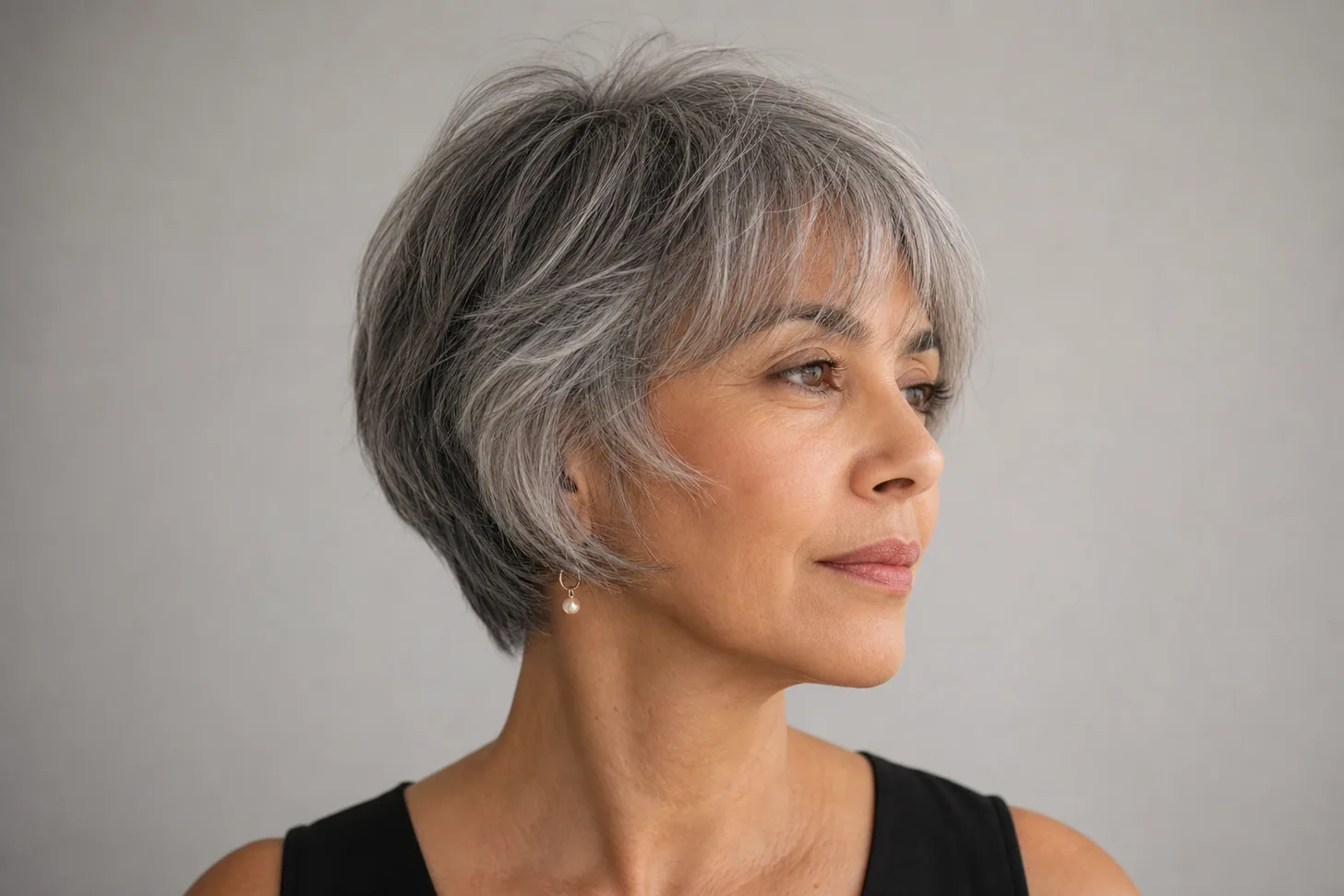
pixie bob with soft nape on fine gray hair, woman over 70, side view
6
Pixie bob with a soft nape
Halfway between the two — short like a pixie at the back, long enough at the sides to tuck. Say soft nape, not tapered nape, and mean it: a tight taper is the fastest-ageing detail in this whole list and will have you back in the chair in five weeks. Cut soft, the same shape holds for ten. It is a good choice if you like short hair but want something to hold on to around the face.
Chair-side note
One instruction changes almost every cut on this list, and it costs nothing: ask for the perimeter to be point-cut rather than cut to a blunt line. Stylists default to a clean line because it looks immaculate in the mirror at the end of the appointment — and it does. But on fine hair over 70 a blunt line has two costs.
It reads heavy at the bottom, which drags the eye down when you want it up at the crown. And it is a line, so regrowth breaks it visibly and quickly. Point-cutting the same length gives up a little of that day-one crispness and buys you five or six extra weeks of looking cut. If you can only get to a salon three or four times a year, that trade is not close.
SB
— Simone Baptiste, Senior Stylist
Two-minute cuts: one product, fingers only
These five want a little more than a towel — a pea of mousse at the roots, fingers, and about two minutes — but none of them needs a dryer to look right. They are the bobs, which is where most women over 70 land when a pixie feels like too much change.
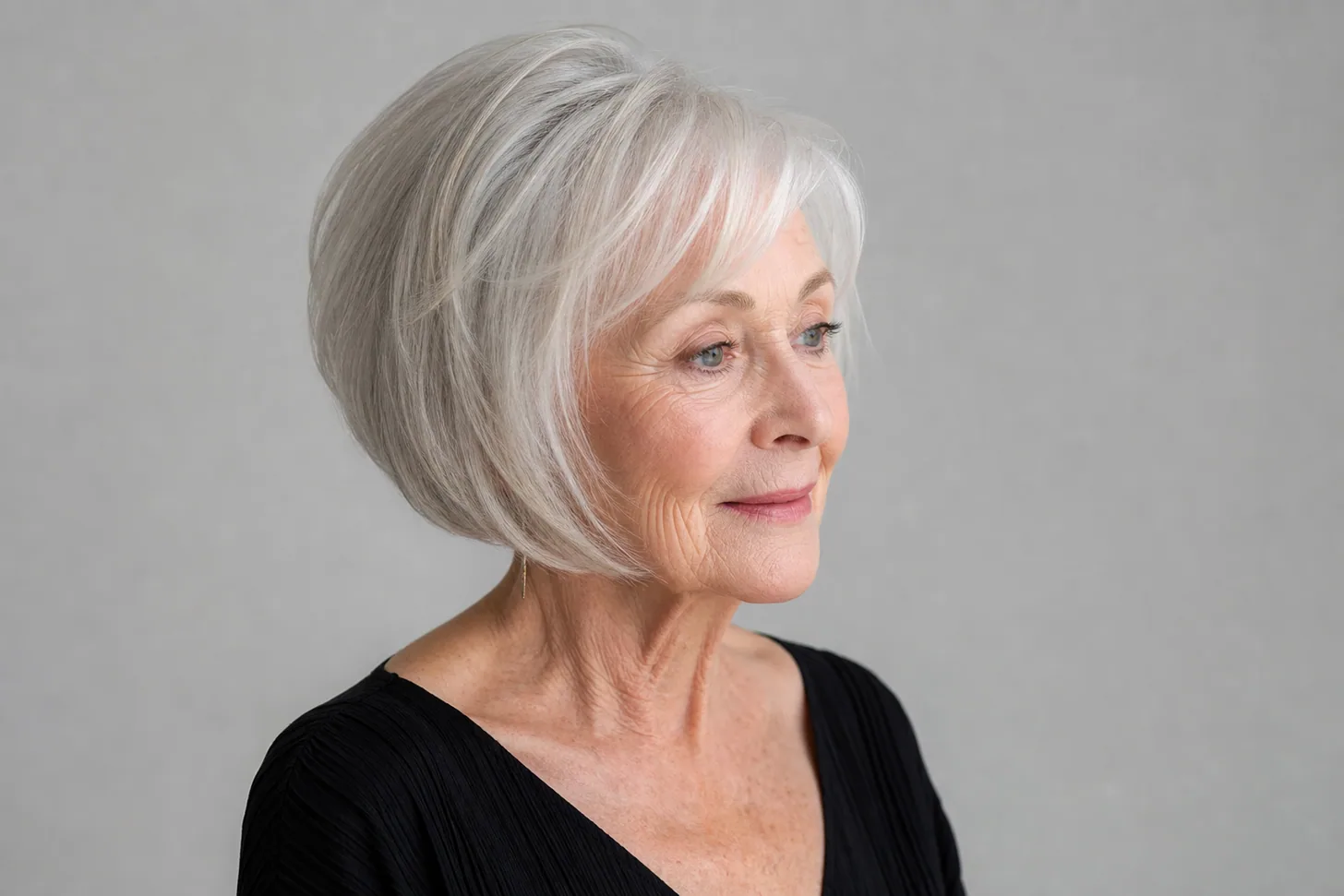
graduated bob with lifted crown and soft perimeter on fine white hair, woman over 70
7
Graduated bob with crown lift
Shorter at the nape, longer toward the front, with graduation building height through the back of the crown. The graduation is what does the work here — it stacks weight upward, so the hair holds a rounded shape without being told to. On fine hair this is the most reliable way to get fullness at the back of the head without heat. Trim every nine to eleven weeks, and specify a softened edge so it grows out evenly. Our full guide to stacked and graduated bobs for fine hair covers the variations.
chin-length bob with invisible internal layers on fine silver hair, woman over 70
8
Chin-length bob with ghost layers
Looks like a one-length bob, moves like a layered one. The layers are cut internally and never surface at the perimeter, so the ends stay dense while the interior loses just enough weight to lift. This is the compromise for anyone who has been told layers will make thin hair look thinner and has good reason to believe it — the technique is explained in our guide to ghost layers for thin hair. Suits square and heart-shaped faces well.
soft A-line bob slightly longer at front on fine gray hair, woman over 70
9
Soft A-line bob
A gentle forward slope — a little shorter at the back, a little longer at the front — with the angle kept subtle rather than dramatic. Two minutes of finger-drying at the roots and it falls into the slope on its own. The forward length is quietly flattering under a jaw that has softened, which is a thing very few galleries will say out loud but most women over 70 have already noticed in photographs.
short shag with curtain fringe on fine white hair, woman over 70
10
Short shag with a curtain fringe
The shag shape brought down to jaw length, with a soft centre-parted fringe falling either side of the face. Ask for the fringe to start no shorter than the cheekbone; higher than that and it needs coaxing every morning, which defeats the point. Everything else about the cut is texture rather than line, so it ages beautifully and takes nothing but a scrunch. See curtain bangs on fine and thin hair for the maintenance reality on the fringe itself.
jaw-length bob with wispy bangs on fine silver hair, woman over 70 wearing glasses
11
Jaw bob with wispy bangs
A jaw-length bob with a fine, see-through fringe that skims the brow. This is the cut to ask for if you wear glasses full-time — the wispy fringe sits above the frames instead of fighting them, and the jaw-length perimeter keeps a visual line below the lenses so the face is not divided in half by the frame. Our notes on cuts that work with glasses go further. Wispy bangs need a trim more often than the rest of the cut, roughly every four weeks — but a fringe trim is a ten-minute visit, not an appointment.
Five-minute cuts: keeping some length
Length costs effort on fine hair, and there is no way around it — weight pulls roots flat, so anything below the jaw needs a little help at the top. These five are the longest shapes that still pass the no-heat test, and the collarbone is where that stops being true.
collarbone lob with blunt hem on fine white hair, woman over 70
12
Collarbone lob with a blunt hem
The longest genuinely wash-and-wear length for fine hair after 70. The hem is kept dense — this is the one place on the page where weight at the perimeter is the right call, because at this length the ends are what read as thin. Light internal layers keep it from sitting like a curtain. Five minutes: mousse at the roots, tip forward, shake, air-dry. Our lob guide for fine hair has the full brief for your stylist.
layered lob worn with deep side part on fine gray hair, woman over 70
13
Layered lob with a deep side part
Same length, different weight distribution: layers begin around the jaw and the whole thing is worn off a deep side part. The part is the styling, and it is free — hair pushed against its habitual direction stands up at the root without product or heat. If your crown is where the scalp shows, this is the cut that covers it, and cuts for a thinning crown explains why coverage and lift are the same problem.
shoulder-length shag with soft layers on fine silver hair, woman over 70
14
Shoulder-length shag
Layers from the cheekbone down, no perimeter line to speak of, worn air-dried and undone. Of the five long options this is the one that tolerates the longest gap between appointments — three months is realistic. It is also the one that most depends on having enough hair to work with. If your density has dropped noticeably, take the lob at number 12 instead; the shag on fine hair is honest about where the line is.
soft mid-length cut with face-framing pieces on fine white hair, woman over 70
15
Soft mid-length with face-framing
A plain, unlayered mid-length with one addition: pieces cut shorter around the face, starting at the cheekbone. On fine hair those pieces are doing something specific — they are the only part of a long cut that is short enough to lift on its own, so they carry the impression of movement for the whole shape. Face-framing layers on fine hair covers where to start them. Ask for them point-cut so they blend rather than step.
in-between length bob mid grow-out on fine gray hair, woman over 70
16
The grown-in lob, for the in-between stage
Not a destination so much as a way of surviving one. If you are growing out a short cut, the awkward months are the ones between the ears and the shoulders, and the instinct — leave it alone until it gets there — is exactly wrong. Ask instead for the sides to be softened every ten weeks while the back is left to grow. It keeps a shape the whole way through, which is the difference between growing your hair and just having longer hair. Growing out short fine hair maps the full timeline.
The two-minute finish that keeps a wash-and-wear cut full
Every cut above assumes a finish, and the finish has to obey the same constraints as the cut: no raised arms for long, one hand where possible, no heat. Three moves, in order, all done on damp hair.
Move the part half an inch. A part worn in the same place for decades has trained the hair to lie flat in a channel, right where the scalp now shows. Shifting it makes every root lift against its habit. This is the highest-return thing on the list and it costs nothing — our guide to where to part fine hair explains how far to move it.
Product at the roots only, then shake. A pea of lightweight mousse or a few pumps of root lifter at the crown, then tip the head forward and shake rather than rub. Rubbing flattens; shaking separates. And keep conditioner off the crown entirely — on fine hair it undoes everything you just did.
Optional: two or three self-grip rollers. If you want more lift than air-drying gives you, set two or three rollers at the crown while the hair is damp and take them out when it is dry. That is fifteen seconds of arm work rather than four minutes, which is the entire argument for them — heatless volume methods for fine hair has the rest.
And one thing to stop doing: rubbing the hair dry with a terry towel. Fragile, fine, older hair snaps under that friction and it is a slow, invisible cost. Squeeze with a smooth cotton T-shirt instead — towel-drying fine hair covers the technique.
Effort narrows the field; face shape picks from what is left. Start here and confirm with your stylist — the full method is in our guide to finding your face shape.
Balanced proportions carry every length — choose purely on how much effort you want to spend.
Round
Textured crop (2) or layered lob (13)
Height at the crown and a vertical line lengthen; avoid a rounded chin-length bob.
Square
Chin bob with ghost layers (8) or short shag (10)
Softness and interior movement round off a strong jaw without adding width.
Heart
Soft A-line bob (9) or collarbone lob (12)
Weight lower down balances a wider forehead against a narrower chin.
Long / oblong
Jaw bob with wispy bangs (11) or cropped bob with fringe (5)
A fringe shortens the face; keep crown height moderate rather than maximal.
Wearing glasses full-time
Jaw bob with wispy bangs (11)
The fringe sits above the frames rather than competing with them.
What to ask your stylist
Lead with the constraint, not the picture. Say: "My hair is fine and thinner than it was. I want a cut I can wash and leave — no dryer, no round brush, finished with my fingers in two minutes. Please build height at the crown and point-cut the perimeter rather than cutting a blunt line, so it still looks cut at ten weeks." If salon trips are difficult, add the number out loud: "I can get here about four times a year — cut me something that grows out well."
If your hands or shoulders are part of the reason, say so plainly; it is useful information, not a complaint, and it changes what a good stylist puts in front of you. And if you are being talked into a blunt bob, ask the honest question: "What will this look like at week eight?" Our guide to what to ask your stylist about fine hair has more of this language.
When a wash-and-wear cut may not be your best move
You genuinely enjoy styling your hair. Wash-and-wear buys ease by giving up versatility — the same softened edge that survives ten weeks also means the cut has one setting and one look. If styling is a pleasure rather than a chore, a more structured shape will reward you more.
Your density has dropped sharply rather than gradually. The shags and heavily textured shapes here need hair to build texture from. Take the graduated bob or the collarbone lob instead, and read fine hair versus thinning to work out which you are dealing with.
You have a strong cowlick or an uneven growth pattern at the crown. Air-drying gives a cowlick free rein, so a wash-and-wear cut has to be shaped around it rather than against it — tell your stylist before they start, and see how to cut around a cowlick on fine hair.
You want a dramatic change and you want it to look sharp. Precision cuts are precise. If you want the blunt French bob, have it — just budget for the six-week trim rather than expecting it to behave like the cuts on this page.
FAQ
A soft, rounded pixie or a graduated bob with a softened perimeter. Both build height at the crown, where density drops first, and both are shaped so the hair falls into place as it dries rather than needing to be put into place. The detail that makes either genuinely wash-and-wear is the edge: ask for a point-cut perimeter, not a hard blunt line. A blunt line looks precise for two weeks and then announces every millimetre of regrowth — which turns a low-effort cut into one that needs a salon visit every five weeks. The same shape with a softened edge still reads deliberate at week ten.
A textured crop with a slightly longer top, because it can be finished with one hand in under a minute and does not depend on a dryer at all. That distinction matters more than it sounds. The real constraint on styling after 70 is usually not time but the physical work of holding a dryer in one hand and a round brush in the other with both arms raised — tiring for shoulders, awkward with reduced grip. Any cut whose good version requires that combination is not an easy cut, however short it is. Judge by whether it looks right with no heat and whether one hand can finish it.
Yes, up to about the collarbone. A collarbone lob with a dense hem and light internal layers air-dries acceptably on fine hair and takes a couple of minutes with fingers and a little mousse. Past the collarbone the arithmetic turns: fine, lower-density hair carries its own weight badly at that length, so the roots flatten, the ends look see-through, and the cut starts needing heat to look intentional. The collarbone is where wash-and-wear ends and daily styling begins, and it is worth deciding which you want before you book. If you are set on longer, our gallery of long hairstyles for fine hair over 70 is honest about what it costs.
It depends far more on how the shape was cut than on how short it is. A soft point-cut pixie or a graduated bob with a softened perimeter holds a recognisable shape for ten to twelve weeks, because there is no hard line for regrowth to spoil. A precision blunt bob or a tight nape taper looks its best at week two and visibly wrong by week six. Hair growth also slows with age, so slower regrowth works in your favour — but only on a shape that was forgiving to begin with. If salon trips are difficult, say so first: it changes which cut is right for you. Our guide to how often fine hair needs trimming covers the general case.
Three things, all on damp hair, none needing raised arms for long. Move your part half an inch from where it has sat for years, so the hair lifts against its trained direction instead of falling into a flattened channel. Put a small amount of lightweight mousse or root lifter at the roots only, then tip your head forward and shake rather than rub. And if you want more, set two or three self-grip rollers at the crown while you have your tea and remove them when dry — fifteen seconds of arm work for real root lift. Keep conditioner off the crown entirely; on fine hair it undoes all three.
They overlap but they are not the same, and the difference matters after 70. Low-maintenance usually means the cut does not need much daily styling. Wash-and-wear is stricter: it looks right with no heat and no tools at all, straight out of a towel. A cut can be low-maintenance in the first sense and still assume three minutes of round-brush work at the crown, which is a very different proposition if your shoulders object to holding a dryer. Use the stricter phrase with your stylist and define it out loud. Our broader gallery of low-maintenance haircuts for fine hair covers the looser sense at every age.
Short makes it easier but it is not the requirement. What makes a cut wash-and-wear on fine, lower-density hair is that the shape supplies what the hair cannot: lift at the crown, and a dense-reading edge so the ends do not go wispy. A well-cut collarbone lob delivers both and needs no heat. A badly cut pixie delivers neither and needs a dryer to look like anything. Choose the length you like the look of, then insist on those two structural details — they, not the number of inches, decide whether you can wash it and walk away.
That depends on which kind of maintenance you are trying to avoid, and the two kinds work against each other. If the daily effort is the problem — arms that tire, a shoulder that will not reach, no patience for a dryer — a soft rounded pixie or a textured crop is genuinely wash-and-walk-away, and the tiers on this page start there. But if the harder part is getting to a salon, the shortest cuts are the wrong answer, because they need recutting every five or six weeks to keep their shape. In that case take a chin-length bob with ghost layers or a collarbone lob with a blunt hem: a few minutes more each morning, but they grow out gracefully and will hold for twelve weeks or more.
They are the lowest daily effort available and among the highest trim cost, so they suit one situation very well and another badly. A soft pixie on fine hair needs almost nothing after a wash, stands up rather than lying flat, and gives the fullest-looking result of any length — which is why it is recommended so often. The catch is that a pixie is a shape held by its outline, and once the outline grows past about five or six weeks the whole cut reads shapeless rather than slightly longer. If regular salon trips are straightforward for you, it is an excellent choice. If they are not, a slightly longer cut will look better for more of the year.
Sources
Trüeb RM, Dutra Rezende H, Gavazzoni Dias MFR. A Comment on the Science of Hair Aging. International Journal of Trichology, 2018 — on the shortened growing phase, the longer interval before a shed hair is replaced, and the increased weathering sensitivity of gray hair.
Eleven years behind the chair, specializing in short shapes and fine-hair texture. Simone believes the best haircut is the one you can style yourself in ten minutes.
Results vary with hair type, density, and growth patterns. This guide is educational and not a substitute for an in-person consultation with a licensed stylist.
Hairstyle images in this guide are AI-generated illustrations, not photos of real clients or results. See our image policy.
Get the good hair intel
One honest, stylist-written guide in your inbox each week. No hype.

 SB
SB