Chair-side note
When a client tells me she's given up heat, I don't argue — I ask what she does in the twenty minutes after she gets out of the shower. Almost always the answer is "nothing, that's the point." And that's the whole problem in one sentence. She thinks she's chosen not to style her hair.
What she's actually done is hand the styling job to gravity, which has one idea and executes it perfectly every time. The clients who air-dry well are not the ones with better hair. They're the ones who do three small things while it's still wet and then genuinely leave it alone — and the leaving-alone is harder than the three things.
SB
Air-drying is a set, and gravity is doing the setting
Every wet style — a blow-dry, a roller set, an overnight braid — runs on the same mechanism, and understanding it is what separates a good air-dry from a bad one.
Water unlocks the shape; drying locks it again
Hair keeps its shape partly through hydrogen bonds between keratin chains. Water gets in between them and breaks them, which is exactly why wet hair is floppy and endlessly re-shapeable.
The International Journal of Trichology's review of hair cosmetics makes the point in passing while describing a blow-dry: hair is remodelled "because water breaks hydrogene bonds of the keratin molecule." As the water leaves, those bonds re-form — in new positions, holding the hair in whatever shape it was in at that moment.
So the shape is not decided by what you do to dry hair. It is decided during the crossing from wet to dry, and after that you are only rearranging a finished result.
With no heat and no tension, your hair's own weight is the only styling tool in the room
A blow-dry adds two forces: a brush that physically holds hair away from the head, and airflow that dries it while it's held there. Remove both and one force remains — the hair pulling down on its own roots. It dries lying against the scalp because that is where it is lying, and it stays there because the bonds set that way.
Fine hair loses this fight before it starts
Here's the part that's specific to fine hair, and it isn't the part most people assume. A wet strand carries a film of water on it, and that film weighs a great deal relative to the strand underneath it. On coarse hair the fiber is stiff enough and heavy enough that the water is a minor addition.
On fine hair the water can easily outweigh the hair it's clinging to — so a fine strand is being pressed flat to the scalp, at full load, for the entire drying window. By the time enough water has evaporated for the hair to have any chance of lifting, the roots underneath have already dried in the down position.
Low density compounds it in the usual way: fewer strands means fewer neighbours pushing against each other for support, so nothing props the crown up from underneath. If you're not sure which of those two you're working with, fine hair versus thin hair is worth five minutes — the answers on this page are the same, but the expectations aren't.
The finding that complicates "air-drying is gentler"
Air-drying is sold as the health-conscious choice, and mostly it is fine. But the best-known experiment on the question found something inconvenient, and it's worth knowing before you commit.
A 2011 study in Annals of Dermatology put hair through repeated cycles of washing and drying — at ambient temperature and at 47°C, 61°C and 95°C — and looked at the results under electron microscopy. Surface damage behaved exactly as you'd predict: the hotter the air, the rougher the cuticle, with the worst at 95°C. Then came the part the authors themselves flagged as unexpected.
The cell membrane complex — the lipid layer that glues cuticle cells to one another — was damaged only in the naturally dried group. Their conclusion, in their words, was that "using a hair dryer at a distance of 15 cm with continuous motion causes less damage than drying hair naturally."
Two honest caveats. It is one study, on a limited number of samples, and it does not make high heat safe — its own data shows 95°C wrecking the surface. What it does establish is that prolonged time spent swollen with water is not a free ride.
Water absorption swells the shaft, and a swollen shaft is a fragile one; the same review above notes plainly that "water absorption causes the hair shaft swelling," and that wet combing is associated with long-segment breaks rather than the short ones you get from combing dry.
The practical read for fine hair isn't "go back to heat." It's that the drying window is the thing to shorten, whichever method gets you there. Four hours of damp is worse than forty minutes of damp, and both are worse than a controlled few minutes of medium heat. If you want the heat version done properly, it's in how to blow-dry fine hair for volume.
The fine-hair air-dry, step by step
Air-drying is where the flat-root problem is worst, because gravity has the longest run at it. Clipping the crown roots up for the duration is the direct answer — root clips for fine hair.
Seven steps, about ninety seconds of actual work, and one instruction that's harder than the rest combined.
1. Squeeze the water out — never rub
Press the length between the folds of a microfiber towel or an old cotton t-shirt and squeeze downward. Rubbing roughs the cuticle at the exact moment the fiber is most swollen and least able to take it, and on fine hair that turns into visible frizz within the hour.
The AAD's own guidance on healthy hair puts it simply: wrap hair in a towel or t-shirt to absorb the moisture, because rough rubbing causes damage. This step is where more damage happens than anywhere else in the wash, and it deserves more than a line — how to towel-dry fine hair has the full method, which fabric to use, and why the wet turban is a tension hairstyle nobody calls one.
2. Root product at the root, length product on the length — and never the two together
A lightweight mousse or a root lifter goes into the root area only, worked in at the scalp with fingertips. A light leave-in or air-dry cream goes on the mid-lengths and ends only.
The most common single cause of a flat air-dry is a leave-in raked from scalp to ends, which deposits weight precisely where you can least afford it. Our picks are in mousses for fine hair and root lifters for fine hair. Skip oils altogether for air-drying — they read as sleek on damp hair and as unwashed by mid-afternoon.
3. Comb it through once, then put the comb down
One pass with a wide-tooth comb while the hair is still fully wet distributes product and clears tangles. Every pass after that pulls apart fibers that were drying against each other, which is the definition of frizz. This is also the only detangling window where fine hair is protected by slip rather than exposed by tension.
4. Part it on the wrong side
Move your part two inches to the opposite side, or flip your head forward and don't part it at all. Hair dries in the direction it's lying — so if it dries in the direction you wear it, it sets into the flattest possible version of your usual style. Setting it against its habit and flipping back later is free volume, and it's the same principle behind the part-flip in why fine hair goes flat.
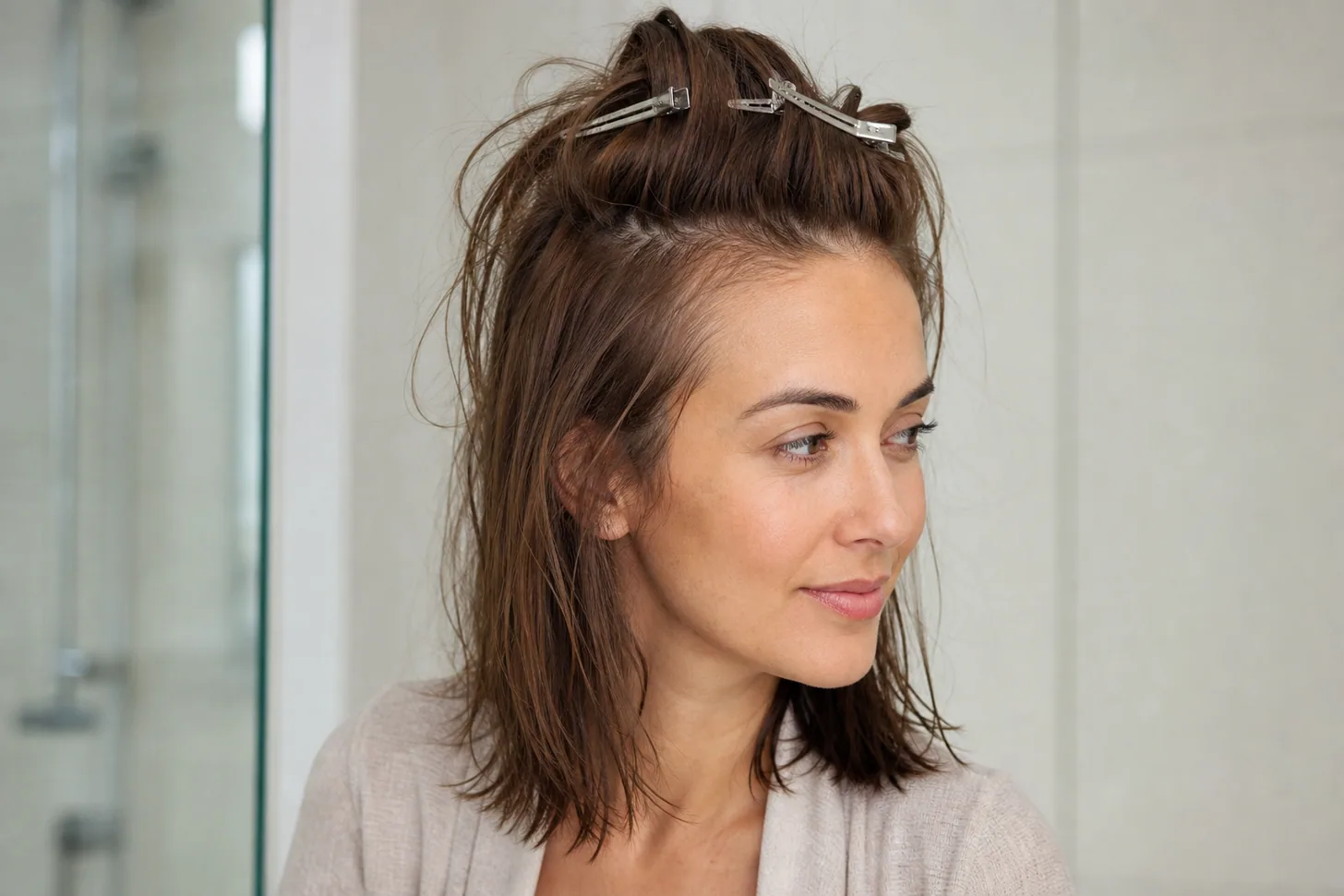
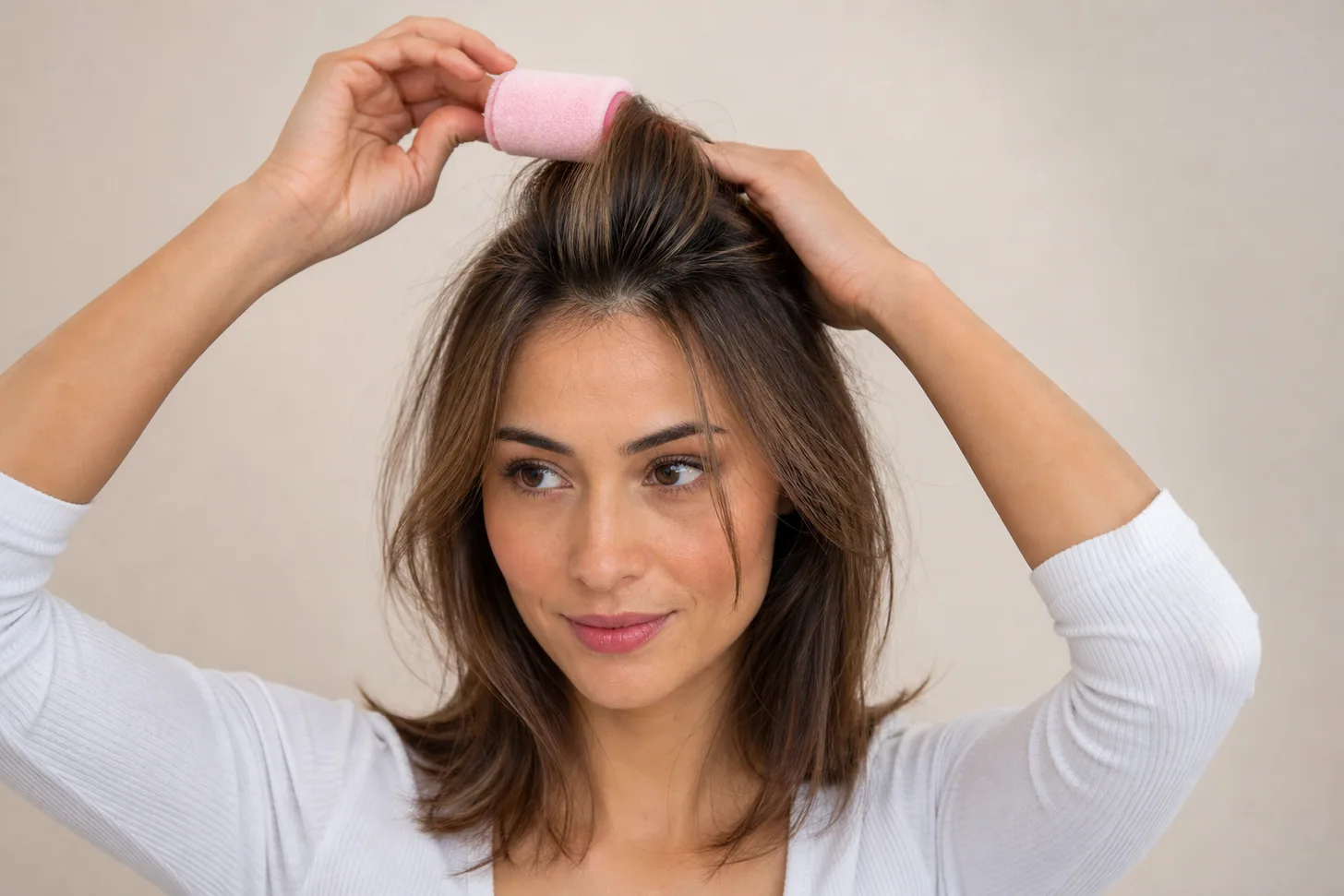
5. Clip the roots — this is the step that decides everything
Take three or four sections across the top of the head, lift each straight up, and lay a flat clip across the base so the root is held vertical against the head. You are not clipping the length; you are propping up the first inch. Those roots now dry standing, and the bonds set them standing. Flat duckbill or sectioning clips work best — round claw clips leave a dent. Options are in hair clips for fine hair.
6. Leave it completely alone for thirty minutes
No touching, no scrunching, no checking. This is the hard one, and it's where most air-dries are lost. The set is happening as the water leaves, and every touch resets a section of it. Get dressed, make coffee, leave the room.
7. Unclip at about eighty percent dry, and flip the part back
Take the clips out while there's still a little dampness left, move your part back to where you actually wear it, and let the last of it finish undisturbed. Flipping the part now drops the hair onto a root that has already dried standing up — which is exactly the effect you were engineering.
Chair-side note
The clips are the thing nobody does, and it took me years of saying "just clip the top" before I worked out why: I was describing the wrong action. People hear "clip your hair up" and put it in a claw on top of the head, which sets a dent and flattens everything underneath it.
What I actually mean is a flat clip laid across a lifted root, holding one inch of hair vertical and touching nothing else. Since I started demonstrating it with the clip in my hand instead of describing it, the number of clients who come back saying their air-dry finally works has gone up more than any product recommendation I've ever made.
SB
The honest verdict: the hybrid beats both
If you take one thing from this page, take this — and it is the thing the air-dry content on the internet mostly won't tell you, because "you don't need a dryer" is a better headline.
On fine hair, the best result comes from drying the roots with heat and air-drying the lengths. Three to five minutes with a dryer on medium, head flipped forward, fingers moving through the root area only, gets you past the point where gravity has already won.
Then clip, and let the rest happen on its own. You've spent five minutes instead of twenty-five, you've kept the ends out of the heat entirely, and you've shortened the total wet window — which the damage evidence above says matters more than the presence or absence of a dryer.
Purists will point out that this isn't really air-drying. It isn't. It's the method that gives fine hair the best hair, which is a different question and the more useful one.