A whorl is an angle, not a habit
Hair doesn't grow straight out of the scalp. Every follicle sits at a slant, and across most of your head those slants run roughly parallel to each other, which is why hair lies in a direction at all. A whorl is a patch where the slants rotate around a point instead of running parallel, so hair spirals outward from a center.
That geometry is fixed. The clearest statement of it in the literature is also the most useful thing to know: "one is born with a specific hair-whorl rotation and the orientation does not change with age or by the direction in which hair is combed." Combing it flat every day for forty years changes nothing about the follicle. It only changes what's sitting on top of it for a few hours.
Most people have one. The same review reports that "in over 95% of the US unselected subjects investigated, each person develops a single hair whorl that swirls either C or AC, and the remainder most often develop two whorls, usually one C and the other AC" — the double crown, in other words, is genuinely uncommon rather than merely inconvenient.
Whether the direction is inherited is contested in the research; that paper exists specifically to argue it isn't, at least in the population it studied. What isn't contested is that it's set early and permanent, and that's the part that matters in a mirror.
One finding is worth knowing before you compare your crown to anyone else's. When surgeons catalogued the whorls of 534 patients to standardize the terminology, they concluded that "white males have the most distinct whorls. Conversely, African Americans and women tend to have a diffusion pattern as opposed to a distinct whorl". If the cowlick belongs to a small child, toddler boy haircuts for thin hair shows how to cut with it rather than against it.
So a good many women don't have a tight, readable swirl at all — they have a crown where the hair radiates outward without a defined center. That pattern doesn't stick up; it goes flat and directionless, which is a different complaint with the same cause, and it's why so much cowlick advice written for men's barbering does nothing for you.
Why it matters more on fine hair
Three reasons, and they compound.
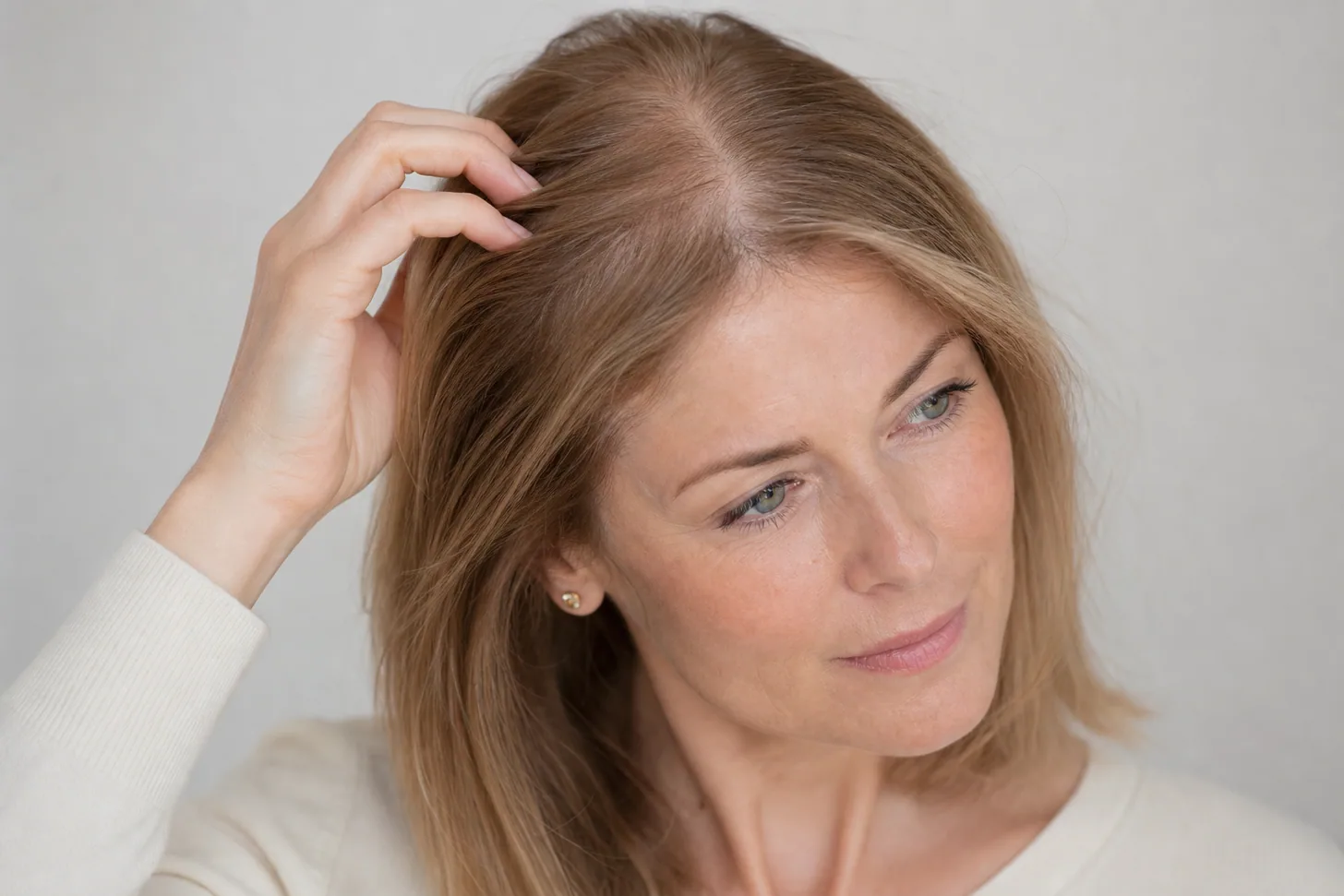
There's no surplus to cover the center. The exposed point at the middle of a whorl is roughly the same size on everyone. What differs is how much hair is arriving from around it to lie over the gap. Fine hair has fewer strands, each of them narrower, so the gap stays a gap.
Fine hair has no weight to overrule the angle. A coarse strand growing at an awkward slant is stiff enough to be pushed flat and heavy enough to stay there. A fine strand does what the follicle tells it, which is why the piece at the front of your hairline stands up by eleven in the morning no matter what you did to it at seven.
It sits precisely where you're already worried. The crown is the first place most women notice density change, so a whorl is showing scalp in the one location guaranteed to be read as thinning. That's the anxiety this page exists to defuse — and, where it isn't a whorl, to route properly.
Cowlick or thinning? Three checks
Do all three. Any one on its own can mislead.
A whorl has a center and a direction; thinning has neither
Take a photograph of your own crown in daylight — phone held above and behind, or ask someone. A whorl reads as a spiral: you can point at the center, and you can see which way the hair sweeps around it. Density loss doesn't organize itself around a point. It shows as scalp visible along the part and across a broad area, with no direction to it.
A whorl is in your childhood photographs
This is the strongest evidence you have and it costs nothing. Find a photo of yourself at eight or ten from above or behind. The whorl is there, in the same place, spinning the same way, because it was there at birth. If the swirl is visible in that photo and only bothers you now, what changed is coverage, not pattern.
Check the rest of your part
Part your hair in the middle and look along its whole length in a mirror, then do the same on both sides. If the exposed scalp is confined to the swirl and the part looks as it always did, that's a whorl.
If the part has widened along its length, or you can see scalp in areas that have nothing to do with the swirl, that's a density question and fine hair or thinning? is the page to read next. Both at once is entirely possible, and common after forty.
Chair-side note
The consultation I have most often about crowns starts with a photograph someone else took — at a wedding, from the balcony, in unforgiving overhead light — and it has ruined a fortnight. What I do is part the hair either side of the whorl with my fingers so she can see in the mirror that the hair is present and dense right up to the edge of the swirl, and that the scalp only shows in the two-centimetre eye of it.
That's a whorl. Real thinning doesn't have an edge you can find with your fingers; it fades out. It takes about thirty seconds and I've watched it change someone's whole week, so I'd rather you knew the test than took my word for it.
SB
The only window is while it's wet
Everything that works happens in the first few minutes of drying, and everything that doesn't work happens after that.
Hair holds a temporary shape because water breaks the weak hydrogen bonds inside each strand and they re-form as it dries — a well-documented principle in hair science — so hair that dries in a given position stays there until it gets wet or humid again.
Which means your cowlick is set the moment it's dry, and a dry brush and a can of hairspray at eight in the morning are fighting a shape that locked at seven. This is why cowlick advice so often fails: it's applied at the wrong point in the process.
The method, on hair that's genuinely wet rather than towel-damp:
- Dry the whorl area first, before anything else, while it holds the most water. If you dry the length first, the crown air-dries into its default position while you're busy and you've lost the window.
- Use your fingers at the root, not a brush. Push the roots flat against the scalp in the direction opposite to the way the hair wants to fall, with the dryer close and moving, for five or ten seconds.
- Then push them the other way for the same count. You're not imposing a direction — you're erasing the set the hair arrived with, which is the trick people miss. Two directions beat one.
- Then let it fall where it lands, and dry it there. A cowlick that's been broken up this way lies far flatter than one that has been argued with.
- Finish cool. The bonds set as the hair cools, so a cool shot on the crown before you move on is what makes it hold to the evening. The same principle drives everything in root volume for fine hair.
If you'd rather not use a dryer, the low-tech version is a clip: while the crown is wet, press the roots down flat in the corrected direction and hold them there with two flat sectioning clips until the hair is dry. It takes twenty minutes of doing something else, and it works for the same reason. More of these in heatless methods for fine hair.
The cut is the other lever — and the standard advice is wrong for fine hair
The conventional salon response to a stubborn whorl is to shorten the hair over it, or to texturize into it so it "sits down." Both are reasonable on thick hair. Both make fine hair worse, and it's worth knowing why so you can say so in the chair.
Shortening removes the weight that was holding it flat. The one force that reliably overrules a follicle's angle is gravity, and gravity works on length. Cut the hair over a whorl short and you've removed the only thing that was keeping it down — which is why so many people report their cowlick got dramatically worse after a cut that was meant to fix it.
Texturizing thins the exact spot where scalp already shows. Point-cutting or thinning shears through a whorl removes strands from the small area least able to spare them. It may make the hair sit lower on the day. It also makes the eye of the whorl wider for the next six months. On fine hair this is a bad trade in every direction, and layering on fine hair covers the general principle.
What works is the inversion: leave length and weight in the hair growing out of the whorl, and take weight out of the hair immediately around it, so nothing is pushing the whorl's hair upward. Longer over the crown, and the surrounding sections given movement rather than bulk. Ask for it in exactly those words.
The part that won't move
A part isn't a line you draw. It's the seam where two directions of growth meet, and the whorl is what decides where that seam falls. Which is why moving it feels like moving furniture uphill: you're asking a whole panel of hair to lie against the slant of its own follicles, and it will do that until it dries and then quietly go home.
There are two honest options and one very good one.
Move it wet. Comb the part into its new position on soaking hair and dry the roots there with tension. That buys you the day, and repeated over weeks the hair does get easier about it — not because the follicle changed, but because you're no longer reinforcing the old channel every morning.
Or stop fighting the line and break it. A zigzag part — traced with the tail of a comb rather than combed — scatters the seam so there's no single clean channel of exposed scalp. On fine hair that's very often the actual complaint. The part's position was never the problem; the visible strip of scalp along it was.
Worth flagging: switching your part is also the standard trick for crown volume, and it works for a different reason — hair lifts when it's asked to fall against its habit. That version is covered in how to add volume to fine hair.
Here we're talking about a part that won't move at all, which is a growth-pattern problem rather than a volume one. Everything else about choosing and relocating a parting is in how to part fine hair.
The fringe cowlick, briefly
A whorl at the front hairline is the one that ruins bangs, and the rule is short: cut the fringe wider and longer than the whorl, never shorter. Length gives weight, weight is the only thing that overrules the angle, and a fringe cut short enough to sit above the whorl's influence will split every single day.
If the whorl is strong, a side-swept fringe that works with the sweep direction is a far better bet than a blunt one that works across it, and curtain bangs are the most forgiving of all because they're parted where the whorl already wants to part. The longer treatment, including what to ask for, is in bangs for fine hair.
Chair-side note
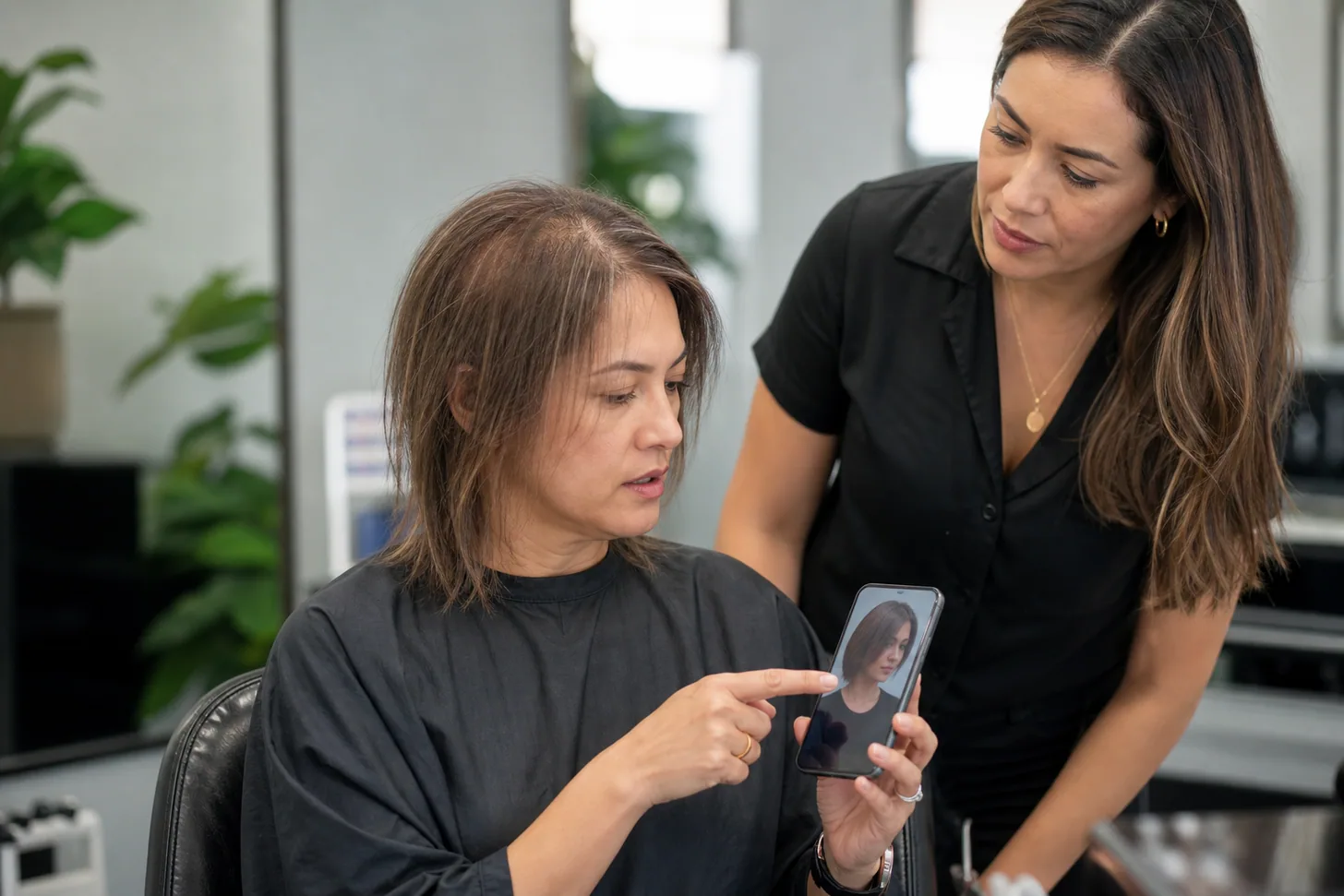
Bring a photograph of your crown to your consultation, taken from above in daylight. I know how that sounds. But your stylist works on your head wet, from behind and standing up, and the thing that's bothering you is what it looks like dry, from the angle other people see it.
I can't diagnose a whorl properly once the hair is soaked and combed — the pattern disappears the moment there's water in it. Thirty seconds with a photo before the gown goes on has saved more crown haircuts than any technique I know, and it's also how you get a stylist to take the "please don't texturize my crown" conversation seriously.
SB
What to ask for
- "Can you look at my crown dry, before we wash it, and tell me which way it spins?"
- "Please leave the weight in over the crown and take it out around it, rather than the other way round."
- "No thinning shears and no razor at the crown." The one instruction worth being firm about on fine hair.
- "Can you show me the drying direction on my own head while it's still wet?" This is the part that transfers home, and most stylists are glad to be asked.
- "If we cut a fringe, how will it sit with the whorl at my hairline in six weeks?" More on salon conversations in what to ask your stylist.