Reviewed by Tara Sullivan · Updated July 2026 · 8 min read
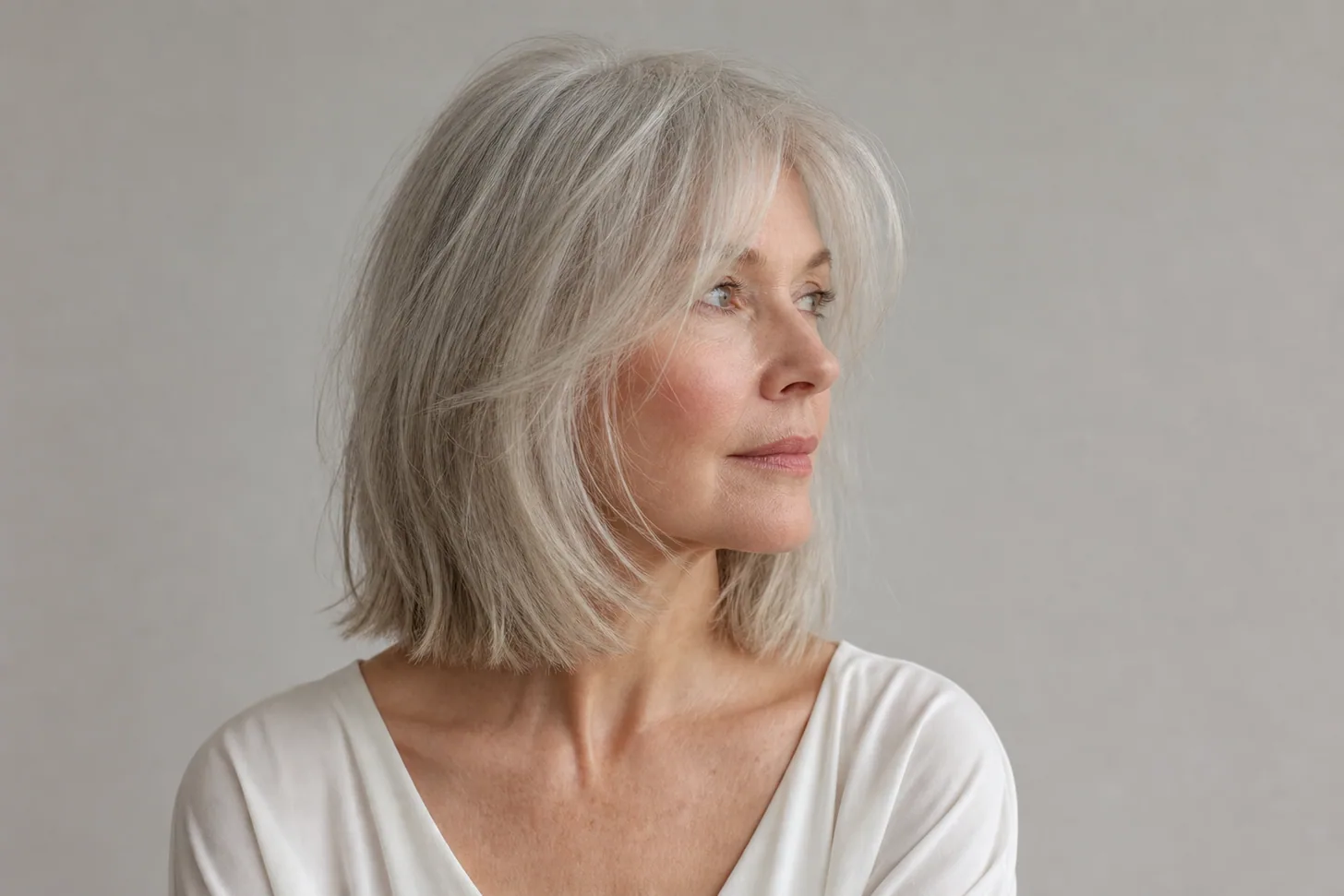
After 70, the short cuts that work for fine hair share one job: build height at the crown, keep the ends dense, and style in a few minutes — because at this age the fullest-looking cut and the easiest cut are usually the same cut. Short shapes remove the weight that drags fine hair flat, lift it off a scalp that shows through more than it used to, and take the daily blow-dry out of the equation.
Below are 16 salon-tested short cuts for fine and thin hair over 70, grouped by how much lift you want and how you live, each with who it suits and the exact words to bring your stylist. For all lengths, see our fuller guide to hairstyles for fine hair over 70.
Chair-side note
My older fine-haired clients often arrive apologizing for their hair — "there's nothing to work with." There's plenty to work with; it just needs a different approach than it did at 40. At 70-plus, three things change: density is genuinely lower, the scalp shows more at the crown, and the routine has to be easy on the hands and shoulders.
So I cut for height at the crown, a clean weight line at the perimeter so nothing looks stringy, and a shape that air-dries or takes ten seconds of finger-styling. I also never over-layer — thinning hair can't spare it. The goal is a cut that looks full the moment you get out of the shower, because that's the cut you'll actually be happy with every day.
SB
— Simone Baptiste, Senior Stylist
Why short works so well on fine hair after 70
Two things happen to hair with age that short cuts directly counter. First, density drops — you have fewer strands, and each tends to get finer — so long hair, weighed down by its own length, lies flat against the head and lets the scalp show through. A short cut removes that weight so the hair can lift and stand away from the head, which the eye reads as fullness.
Second, the crown thins first and most, so a cut that builds height right there does the most good. Short shapes with a little crown layering put volume exactly where it's lost. The bonus is effort: a short cut that's shaped well looks finished with minimal styling, which matters if holding a dryer for ten minutes isn't comfortable anymore.
If you're not sure whether you're dealing with fine strands, lower density, or genuine thinning, our guide to telling fine from thin hair helps you and your stylist plan the cut — and if you have concerns about the rate of thinning, see fine hair or thinning.
Pixies & crops: the most lift, the least effort
The shortest shapes give fine hair the most height and the easiest routine. These five are the wash-and-go workhorses; if effort rather than length is what you are choosing on, our wash-and-wear cuts for thin hair over 70 sort the whole range by how much work each one takes. Two decades earlier the same shapes carry a little more length — short hairstyles for thin hair over 50.
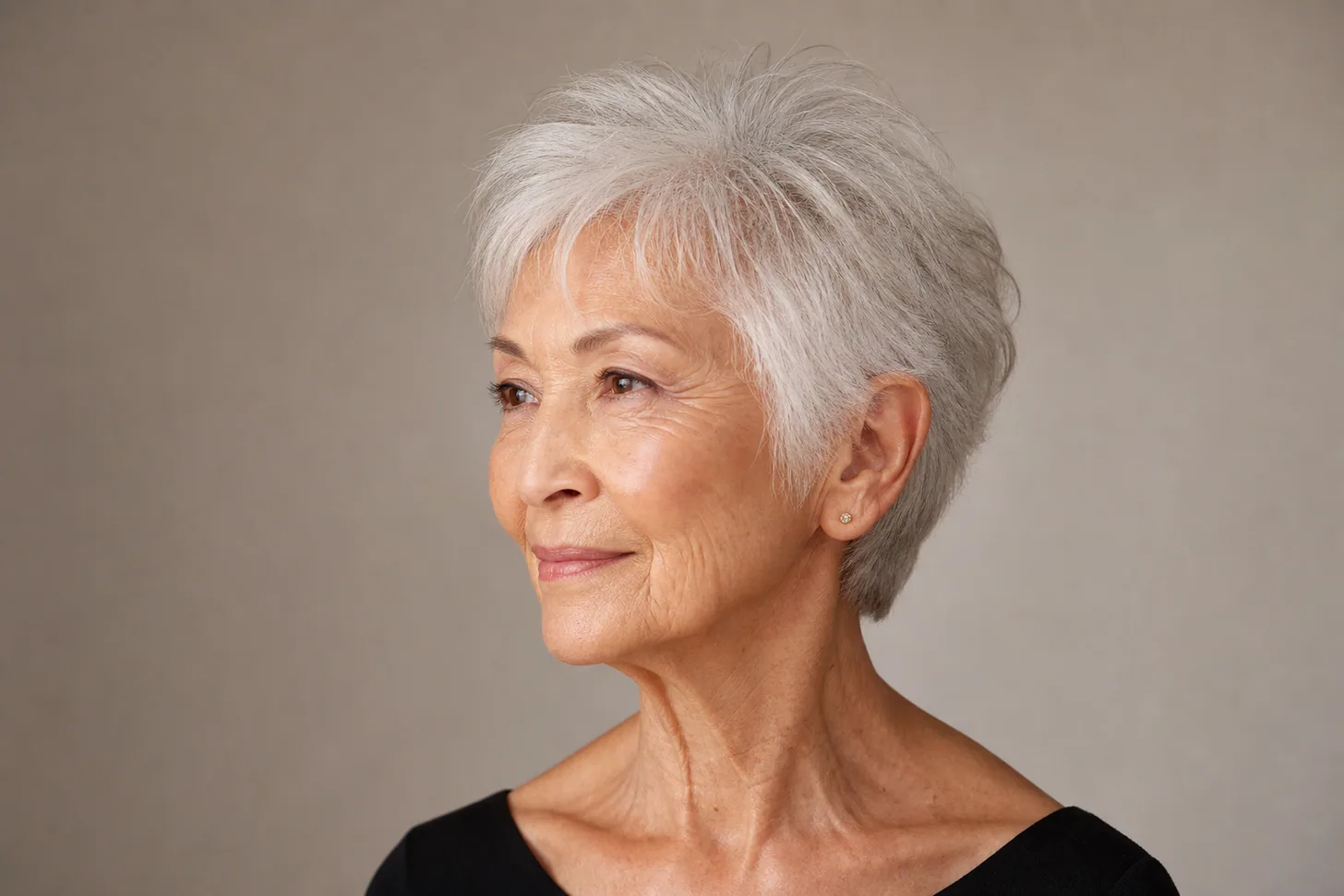
soft textured pixie with a lifted rounded crown on fine white hair, woman over 70
1
Soft textured pixie with a lifted crown
The most reliable cut on this list — short all over with a little point-cut texture at the crown for height. It lifts fine hair off the scalp where thinning shows and needs only a dab of root lifter to finish. Ask for softness around the face so it never looks severe.
tapered pixie with a clean neat nape on fine gray hair, woman over 70
2
Tapered pixie with a clean nape
Cut close and tapered at the nape and sides, with a little more length on top to style over the crown. The clean nape is comfortable, cool in warm weather, and grows out tidily. It's the neatest, most polished pixie and suits anyone who likes an ordered, put-together look.
long pixie with a side-swept top on fine silver hair, woman over 70
3
Long pixie with a side-swept top
A softer, slightly longer pixie with enough length on top to sweep to one side, which adds a diagonal line and a touch of glamour. The side sweep covers a thinning temple or forehead if that's a concern. It's the least severe pixie and the easiest step down from a bob.
choppy wash and go textured crop on fine gray hair, woman over 70
4
Choppy wash-and-go crop
A textured crop cut to look good the second it dries — piece-y, undone, and genuinely low-effort. The choppy texture creates separation that reads as volume on fine hair. Scrunch in a little product as it air-dries and you're done; this is the cut for anyone who wants zero fuss.
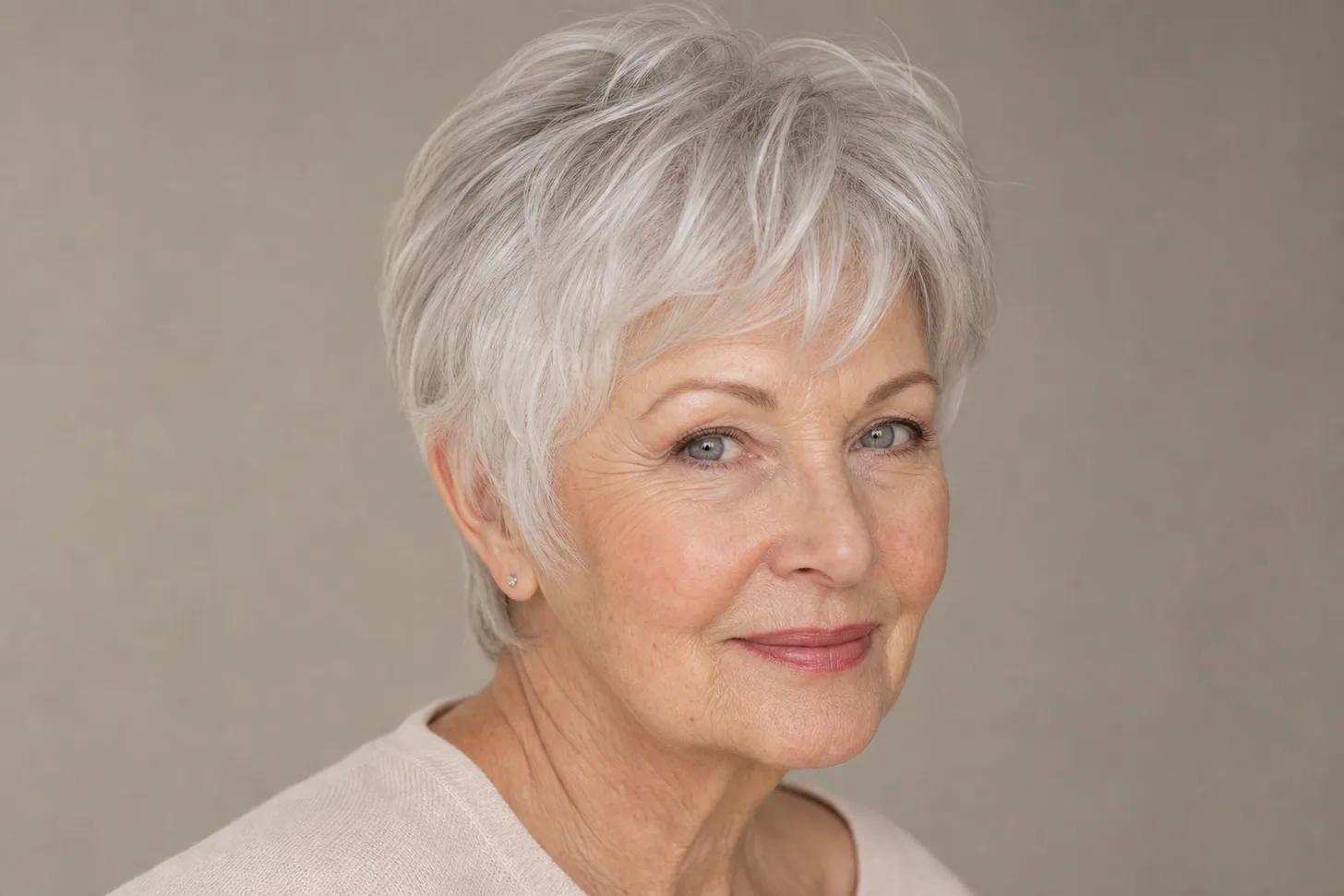
feathered crop with a soft wispy fringe on fine white hair, woman over 70
5
Feathered crop with a wispy fringe
A gently feathered crop finished with a soft, wispy fringe that covers a lined forehead and draws the eye up. The light fringe adds softness without the density a blunt one would need. It's flattering, feminine, and one of the most-requested shapes at this age.
Short bobs: soft, familiar, easy to wear
If very short isn't for you, a short bob keeps a little length while still lifting fine hair. These four sit chin-length and above.
blunt chin-length bob with dense ends on fine silver hair, woman over 70
6
Blunt chin-length bob
A blunt bob at the chin keeps the ends dense and heavy, which makes fine hair look thicker at the perimeter. The single length is the lowest-maintenance bob and grows out gracefully. Best for anyone whose density is still fairly even and who wants a classic, timeless shape.
stacked bob with crown graduation and rounded back on fine gray hair, woman over 70
7
Stacked bob with crown graduation
A short stacked bob with graduation at the back builds a rounded, lifted shape at the crown while keeping the front simple. The stack adds height where thinning shows and holds its shape with barely any styling. A smart pick if flat back-of-the-head hair is your main frustration.
short bob with a soft side-swept fringe on fine white hair, woman over 70
8
Short bob with a side-swept fringe
A chin bob softened with a side-swept fringe that frames the face and covers the forehead. The fringe adds interest and youth without much upkeep, and the bob length keeps it familiar. It's a gentle, flattering shape for anyone easing into shorter hair.
rounded soft bob following the head shape on fine gray hair, woman over 70
9
Soft rounded bob
A short bob cut to curve gently under and follow the head, giving a soft, polished silhouette. The rounded shape adds width and fullness through the sides and back. It suits a more traditional taste and takes just a quick blow-dry or a soft set to finish.
Short cuts that work with glasses
If you wear glasses full-time, the cut needs to sit comfortably around the frames. These three are designed to do that.
short pixie with clear temples worn with glasses on fine gray hair, woman over 70
10
Pixie with clear temples
A pixie cut a touch closer at the temples so the arms of your glasses sit flat without hair bunching around them. It keeps the sides neat and the top lifted for volume. The clearest, most comfortable short shape for full-time glasses wearers.
soft crop with feathered temple pieces framing glasses on fine white hair, woman over 70
11
Soft crop with feathered temples
A crop with lightly feathered pieces at the temples that soften the line where hair meets frames. The feathering adds a flattering frame around the face and glasses together. It reads soft and intentional rather than flat against the head.
chin bob cut to tuck behind the ears worn with glasses on fine gray hair, woman over 70
12
Chin bob cut to tuck
A short bob cut so the sides tuck cleanly behind the ears, keeping hair off the frames and out of the way. Tucked, it shows the face; down, it frames it — two looks from one cut. A practical, flexible choice for anyone in glasses all day.
For silver, white & thinning crowns
Gray and white fine hair has its own beauty, and a thinning crown needs a cut chosen with it in mind. These four are built for both. The wider collection built around those two things is short cuts for mature fine hair.
piece-y textured silver crop with light and movement on fine white hair, woman over 70
13
Piece-y silver crop
A short, textured crop that lets natural silver show its light and dimension — the piece-y finish gives white hair movement instead of a flat, uniform look. It's low-upkeep and celebrates gray rather than hiding it. Finish with a light texture product to keep the separation.
salt and pepper mini bob with soft dimension on fine gray hair, woman over 70
14
Salt-and-pepper mini bob
A very short bob that shows off blended salt-and-pepper tones, with the ends kept dense so the color has body to sit on. The natural dimension does the work of highlights for free. A flattering, dignified way to wear mixed gray at a short length.
crop with extra crown layering to lift a thinning top on fine white hair, woman over 70
15
Crown-layered crop for a thinning top
A crop with a little extra layering built into the crown specifically to lift a thinning top and stop the scalp catching the light. The height disguises sparseness where it shows most. Ask your stylist to concentrate the layering at the crown and keep the rest weightier.
short cut with soft side part sweeping over a sparse area on fine gray hair, woman over 70
16
Side-parted cover cut
A short cut worn with a deep side part so the fuller side sweeps over a sparser area — a simple, no-product way to add coverage and lift. Changing your part from the center to the side instantly gives more root height. The most effortless trick on this list for disguising a thinning top.
The five-minute styling that keeps short cuts full
A good cut does most of the work, but a few gentle habits keep fine hair over 70 looking its fullest — without the fatigue of a long routine. Start in the shower with a volumizing shampoo and conditioner used only on the mid-lengths and ends, never the roots, so the crown stays lifted.
Towel gently — fine, aging hair is fragile and snaps when rubbed. On damp hair, work a little root lifter or a lightweight mousse into the roots at the crown, then either let it air-dry while you scrunch it with your fingers, or give it a quick blow-dry with your head tipped forward so the roots lift as they dry.
If holding a dryer is tiring, a soft velcro roller set at the crown while you have coffee lifts the roots hands-free. Skip heavy oils and serums, which flatten fine hair, and finish with the lightest mist of hairspray at the crown to hold the height. If your hair goes flat by the afternoon, a touch of dry shampoo at the roots revives it without a wash.
Chair-side note
The one change I recommend most to clients over 70 costs nothing: move your part. Most people have worn the same center or same-side part for decades, and the hair has learned to lie flat there — often right where the scalp now shows.
Switch it to a deeper side part, or the opposite side, and you get instant root lift and coverage over the sparse spot, no product required. It feels strange for a day or two, then it looks completely natural. Pair that with a cut shaped for crown height and you've solved most of the flatness before you touch a styling product.
SB
— Simone Baptiste, Senior Stylist
What to ask your stylist
Bring your priorities, not just a photo — at this age, how the cut lives day to day matters as much as how it looks. Say: "I have fine hair that's thinner than it was, and I want a short cut that looks full on its own and takes me five minutes. Please build height at my crown, keep a clean weight line so my ends don't look stringy, and don't over-layer — I can't spare the density."
If effort is a concern, add: "I'd like a wash-and-go shape that air-dries well, because a long blow-dry is hard on my arms." And if the crown is your worry, say so directly: "My scalp shows at the crown — please cut for coverage and lift there." A good stylist will happily work to those constraints; they're the ones that make a cut you'll actually enjoy.
When short isn't the answer
You have a strong cowlick or very irregular growth at the crown. A very short crop can make it stick up; a slightly longer bob or a cut worked around the cowlick behaves better.
You love and rely on being able to tie your hair back. A short cut removes that option; a chin or collarbone length in our full over-70 guide keeps it.
Your face and neck feel exposed by very short hair. A longer pixie or a chin bob with a soft fringe gives coverage and framing while still lifting fine hair.
You're noticing rapid or patchy thinning, not just gradual fineness. A cut helps the look, but check the cause first — see our honest guide to fine hair versus thinning and speak to your doctor.
FAQ
There's no single best cut, but the winning formula is the same: short, with the length and layering concentrated to build height at the crown, and easy enough to style in a few minutes. A soft textured pixie or a short layered crop is the most reliable choice, because it lifts fine hair off the scalp where density is lowest and needs very little daily effort. A chin-length bob with some graduation at the back is the best option if you'd rather not go very short. The key at 70-plus is a cut that looks full on its own and doesn't depend on a long styling routine to hold.
Yes, short hair almost always looks fuller than long hair on fine, aging hair. Length adds weight that drags fine hair down flat against the head, exposing the scalp; cutting it short removes that weight so the hair can lift and stand away from the head, which reads as density. Short layers at the crown add height exactly where thinning shows most after 70. The effect is immediate and doesn't rely on product — the shape itself creates the fullness. It's the single most effective thing a cut can do for thinning fine hair at this age.
A soft, textured crop or wash-and-wear pixie is the easiest, because it's cut to look good with minimal work — often just a little root lifter and a few seconds of finger-styling as it dries. Cuts that need daily heat styling or a round-brush blowout to look right are harder to keep up, especially if arthritis or limited shoulder mobility makes holding a dryer tiring. Ask your stylist specifically for a wash-and-go shape that air-dries well. The goal is a cut that does the work so you don't have to.
Soft, wispy bangs can be very flattering after 70 — they cover a lined forehead if that's a concern, draw the eye up, and add softness around the face. The key is keeping them light and see-through rather than blunt and heavy, because a heavy fringe needs density that fine hair over 70 usually doesn't have. A side-swept or feathered fringe is the easiest to wear and to grow out. Avoid a thick, straight-across fringe, which looks sparse on fine hair and takes hair from an already-thin crown.
Start with the cut — a short shape with crown layers does most of the work. For styling, a lightweight root-lifting spray or mousse at the roots adds height without the heat damage that daily curling or hot rollers can cause on fragile, aging hair. A gentle blow-dry with the head tipped forward, or simply scrunching product in as it air-dries, lifts the roots. If you use heat, keep it low and always mist a light heat protectant first. Aging fine hair is more fragile, so the less heat and tension, the better it holds up over time.
Both work beautifully — it's a personal choice, though there are practical points. Natural silver or white hair often looks fuller than it is because gray strands tend to be slightly coarser and reflect light, and going gray removes the upkeep and the harsh regrowth line. If you prefer color, softer, dimensional tones are more flattering and lower-maintenance than a solid dark shade, which can look flat and emphasize a thinning scalp. A short cut suits either choice. If you're transitioning to gray, a short cut speeds up the process by cutting out colored lengths faster.
Eleven years behind the chair, specializing in short shapes and fine-hair texture. Simone believes the best haircut is the one you can style yourself in ten minutes.
Results vary with hair type, density, and growth patterns. This guide is educational and not a substitute for an in-person consultation with a licensed stylist.
Hairstyle images in this guide are AI-generated illustrations, not photos of real clients or results. See our image policy.
Get the good hair intel
One honest, stylist-written guide in your inbox each week. No hype.

 SB
SB