Reviewed by Tara Sullivan · Updated August 2026 · 10 min read
Nobody has to cut their hair off at seventy, and the rule that says otherwise was never about hair. But there is a real test, and it isn't your age — long hair is read from the crown down, so the eye reaches your part and your temples before it ever reaches your ends.
If the top still holds, length looks deliberate at any age. If the scalp shows at the part, the same length that suited you at sixty starts pointing at the thing you'd rather it didn't. The second test is more practical and is the one that actually ends most long hair: a shape that needs ten minutes with your arms above your head is the wrong shape, however much you like it.
Below are 14 long cuts built around both — shapes that keep weight in the perimeter where fine hair still looks solid, framing that sits below the cheekbone, the behind-the-ear detail that matters if you wear glasses or hearing aids, and two ways to wear it that cost nothing in volume.
Weight kept in the perimeter, lift kept at the crown — the two things long fine hair needs at any age.
What's actually different at 70 — and what each part needs
By this decade the changes people lump together as "aging hair" are four separate things, and they don't all want the same answer. Two decades earlier, fewer of these have arrived — long hairstyles for fine hair over 50.
Density drops fastest at the crown and the temples. Not evenly, and usually not at the back. That's why the perimeter can still look fine while the part has widened, and it's why length is judged from above rather than from the ends.
The strand itself often changes character. As pigment goes, hair frequently comes in coarser, wirier and more resistant than the hair around it — which is genuinely good news for volume and bad news for smoothness. Gray fine hair often has more natural body than the hair it replaced. It also has less oil reaching it, so it reads drier and catches static.
The scalp gets drier and more fragile. Less sebum, thinner skin, and hair that has been through decades of handling. This is the reason to be gentler about tension and heat now than you were at fifty, not vanity.
And the styling budget shrinks. Shoulders stiffen, grip weakens, standing for ten minutes with your arms up stops being free. This is the single most under-discussed factor in cutting hair for this decade, and it should shape the cut more than any face-shape rule.
If you're not sure whether what you're seeing is lifelong fine hair or a real change in density, fine hair or thinning? separates the two — and it changes the answer below, because thinning at the crown is the one thing that genuinely argues against keeping the length.
Chair-side note
The conversation I have most often in this decade starts with a daughter, not a client. She's brought her mother in and she'd like her to have "something easier", and her mother has said very little. So I ask the client one question with her daughter in the room: how long do you actually spend on it in the morning?
Nine times out of ten the answer is "about two minutes, I just brush it" — and that tells me she isn't struggling, she just likes it long.
Then we're not having a cutting conversation at all, we're having a maintenance conversation: a firmer perimeter, a trim booked every ten weeks, and rollers instead of a brush. I've had women in their eighties with beautiful long hair. What they had in common wasn't good density. It was a cut that asked nothing of them.
SB
— Simone Baptiste, Senior Stylist
Long shapes built to hold density
If you decide the effort is the deciding factor after all, our wash-and-wear cuts for thin hair over 70 sort the shorter options by exactly how much work each one takes. All five below keep weight in the perimeter, because the outline is the only place fine hair still reads as solid, and take what's removed from inside the shape instead.
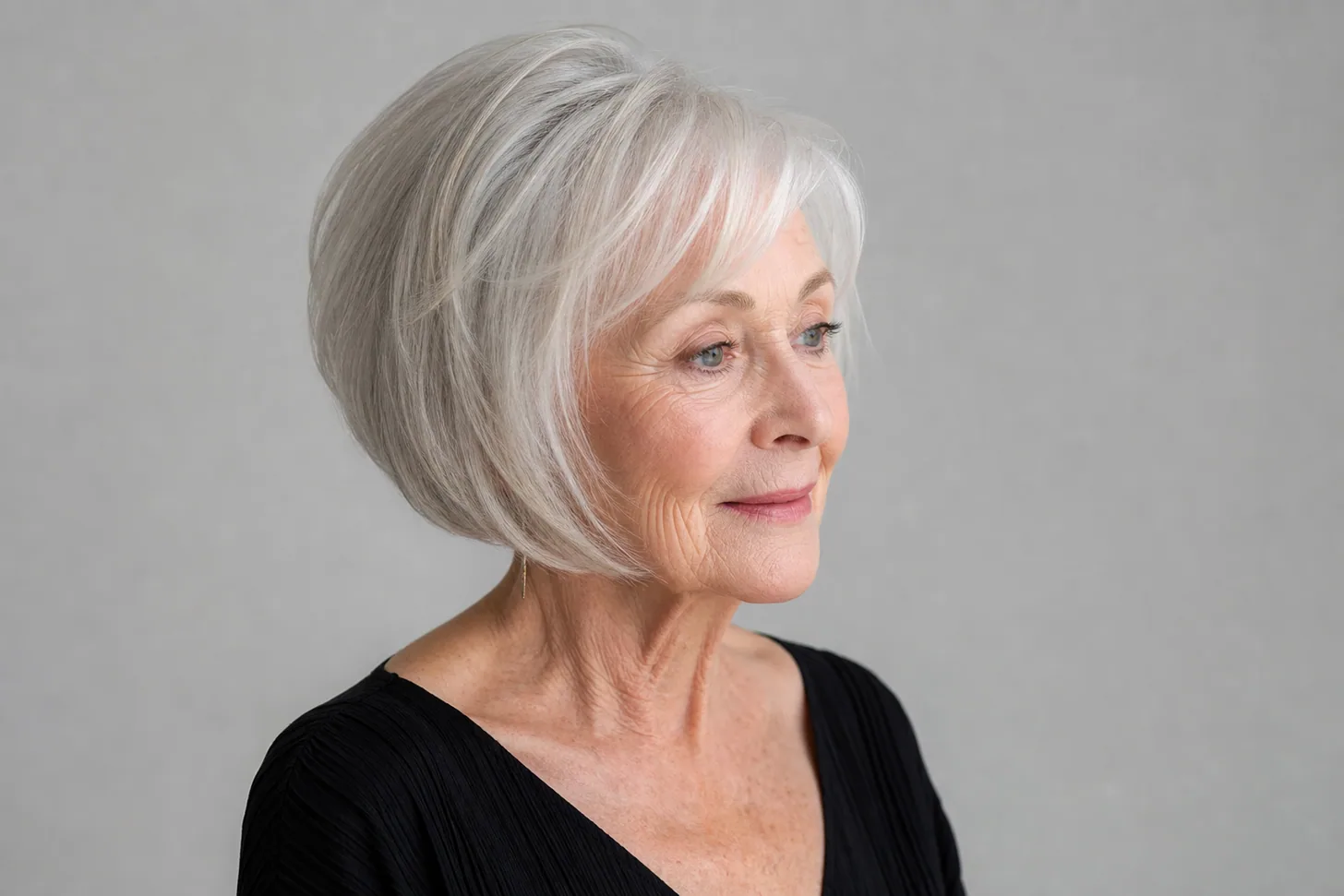
Woman over 70, blunt collarbone-length silver hair, one solid perimeter line, soft lift at crown
1
Blunt collarbone length
One clean line at the collarbone and nothing taken out of it. This is the most forgiving long shape there is on fine hair, because every strand ends in the same place and the eye reads that edge as thickness. It's also the easiest to maintain: a dusting straight across every ten weeks keeps it honest. Ask for it blunt and say you'd rather lose length than lose the line.
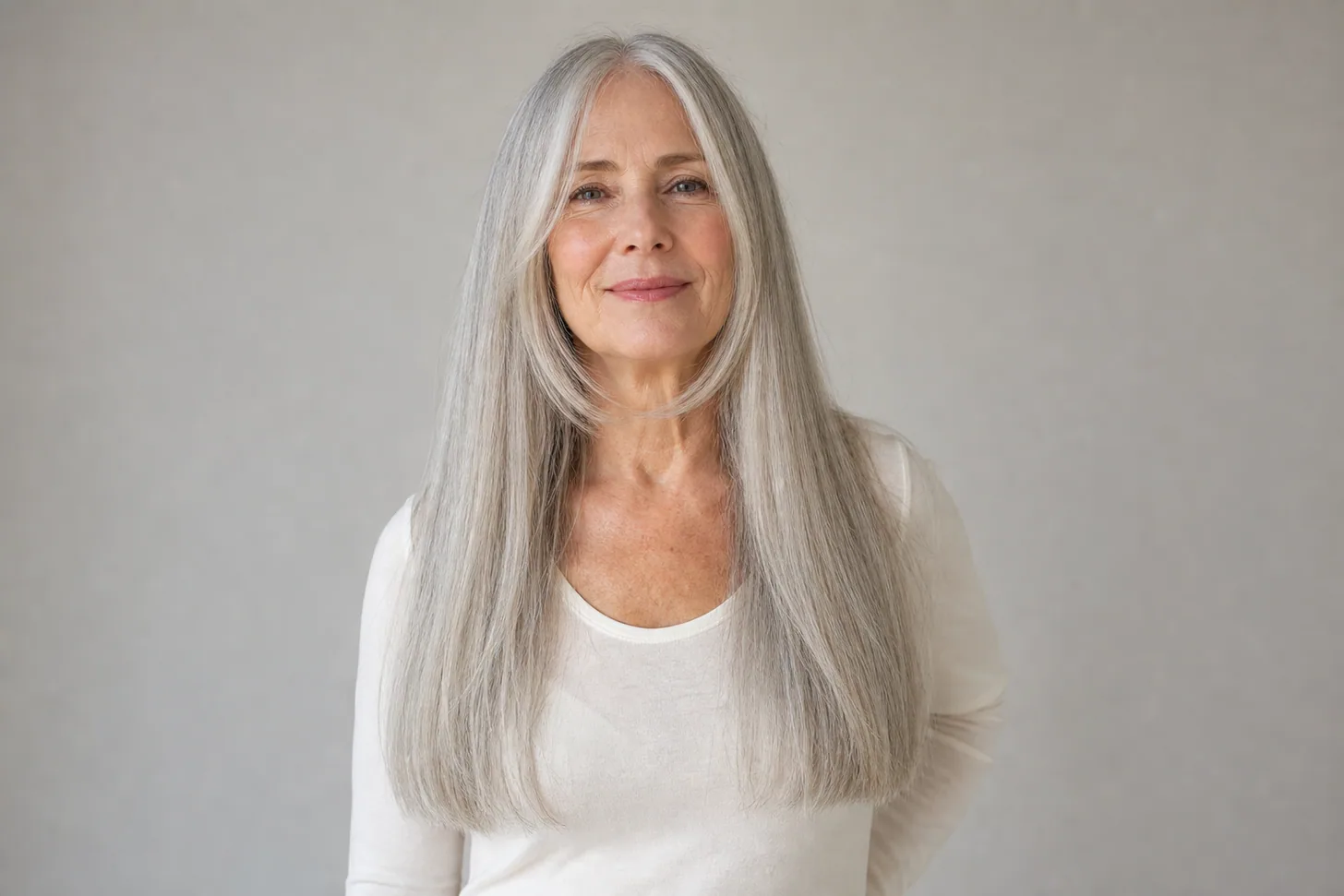
Woman over 70, mid-back length fine gray hair with hidden internal layers, ends still blunt
2
Mid-back with invisible internal layers
Length past the shoulder blade only works when the weight comes out from inside rather than off the outline. Your stylist cuts short pieces within the body of the hair to support what sits above them, and the perimeter stays untouched. The give-away that it's been done well is that you can't see where the layers are. If you can see them, they came off the outside, and that's the version that reads thin from behind.
Woman over 70, long hair with gentle U-shaped back outline, fuller sides
3
The shallow U-shape
A very slight curve to the back outline instead of a straight line across. It keeps more hair at the sides, where you see it in the mirror, while allowing the center back to sit a little longer, and it stops the perimeter looking severe on a smaller frame. Worth asking for if a blunt line has ever felt too heavy on you but a V made your hair look like it tapered to nothing.
Woman over 70, shoulder-length fine hair with softly graduated back building height
4
Long with a lightly graduated back
Graduation stacks hair on top of hair, which builds height in the back where fine hair collapses first. Kept subtle it doesn't shorten the look at all — the length reads the same and the back sits fuller. This is the shape to ask for if photographs of the back of your head have started surprising you. Two words for your stylist: soft graduation, not stacked.
Woman over 70, long fine hair with light crown texturizing lifting the top section
5
Long with a lifted crown section
The specific fix for the commonest problem in this decade: long, perfectly good lengths sitting under a flat top. A short, carefully placed section at the crown — three or four inches, point-cut, hidden underneath the surface hair — gives the top something to stand on. It's the only place on a long fine head where taking hair away makes it look like there's more. Done badly it sticks up; ask for it to be blended into the length rather than left as a shelf.
Woman over 70, long silver hair with face-framing pieces starting below the cheekbone
6
Face-framing that starts below the cheekbone
Higher framing takes width out of exactly the part of the shape that was holding the face, and on fine hair it leaves wispy pieces that won't sit. Starting below the cheekbone gives you the softening effect without the loss, and — the practical part — leaves the front pieces long enough to actually tuck behind an ear rather than springing forward again all day. See face-framing layers on fine hair for where the first cut should land.
Framing a face that has changed, without cutting into the shape
The front is where most long-hair-at-70 decisions go wrong, usually in the direction of taking too much. These four take almost nothing.
Woman over 70, long fine hair with soft curtain fringe parted at the center
7
A soft curtain fringe
The gentlest fringe available and the easiest to abandon if you change your mind, because it grows straight back into the length. It covers a forehead without committing you to a blunt line, and it takes very little hair out of the front — which matters when the temples are the second place density goes. Ask for it to be cut on dry hair so what you see in the chair is what you keep. Curtain bangs on fine hair has the full brief.
Woman over 70 with glasses, long fine hair tucked cleanly behind the ear, temple hair intact
8
Cut to live with glasses and hearing aids
Nobody plans for this and it changes the cut more than face shape does. Glasses arms and hearing aids share one narrow strip behind the ear, and hair that falls into it gets tucked twenty times a day — which is how the temple hairline wears thin. The fix is to leave the section directly above and behind the ear a little longer, so it lies over the arm rather than catching under it, and to alternate the side you tuck on. Fine-hair styles with glasses covers the frame-clearing detail.
Woman over 70, long fine hair with deep side part lifting the crown
9
The moved part
Not a cut at all, and the cheapest volume in this article. Hair that has fallen the same way for twenty years lies flat by habit, and a part moved half an inch has to stand up to get where it's going. It also drops a little more hair over the side of the crown, which is where scalp shows first. Move it slightly deeper than center rather than dramatically over — a hard side part on fine hair can leave the other side looking sparse. More on where it should sit in the part for fine hair.
Woman over 70, long fine hair with wispy translucent fringe over the forehead
10
A see-through fringe over a high forehead
The lightest fringe there is — enough to break up the forehead, sheer enough that you keep the height of the face. It suits this decade specifically because it costs almost no density at the front, which a full blunt fringe on fine hair very much does. The honest caveat: it needs a two-minute blow-out with a small brush most days to lie right, so it's a fringe for people who don't mind touching their hair, not for people who want to leave the house wet.
Silver and white hair, and the texture that comes with it
Long gray hair is a different material from long pigmented hair, and it wants slightly different handling. These three are built around what it does well.
Woman over 70, long uniform white hair with blunt ends and natural body
11
Long, fully white and left alone
White hair reflects far more light than pigmented hair, which does some of the work of looking full for you. The mistake is treating it as fragile and over-conditioning it — heavy masks flatten the natural body that came with the texture change. Keep conditioner to the mid-lengths and ends, keep the ends blunt, and let the light do the rest. If it has yellowed at the front, that's usually sun, minerals or styling product rather than the hair, and going gray with fine hair covers the difference.
Woman over 70, long salt-and-pepper hair with soft lowlights adding dimension
12
Long, half-gray, with dimension rather than coverage
The awkward middle stage, where solid all-over color reads flat and heavy against skin that has softened. A few soft, low-contrast pieces through the top give the hair depth so it doesn't look like one sheet, and they grow out without a line — which matters if getting to the salon every four weeks is a chore. Ask for dimension, not coverage, and keep the contrast gentle: strong highlights on fine hair over 70 tend to expose the scalp rather than brighten the hair.
Woman over 70, long silver hair with soft natural wave and defined texture
13
Long silver with the natural wave allowed back
A lot of hair develops a wave or a kink as it goes gray that it never had before, and most women spend years fighting it with a dryer. Worth trying the other direction for a month: wash, add a light mousse to damp roots, scrunch the mid-lengths and leave it. On fine hair the wave is worth more volume than any blow-dry, and it removes the arms-up problem entirely. Fine wavy hair covers the technique if it turns out you have more wave than you thought.
Woman over 70, long fine hair in a loose low bun with soft volume at the crown
14
The loose low bun, done without tension
The way to wear it up without paying for it. Two rules make it safe on hair at this age: use a claw clip or a fabric-covered elastic rather than anything with a tight band, and lift the crown out with your fingertips once the bun is secured, because a bun pulls the top flat as it goes on. Never pull it tight enough to feel it — the AAD is direct that "If your hairstyle feels painful, the style is too tight", and thin temple hair is the first casualty. More shapes in buns for fine hair.
The two-minute routine that keeps long hair looking intentional
This is the whole maintenance case for long hair in this decade, and it's shorter than most people expect.
What
When
Why it matters at 70
Time
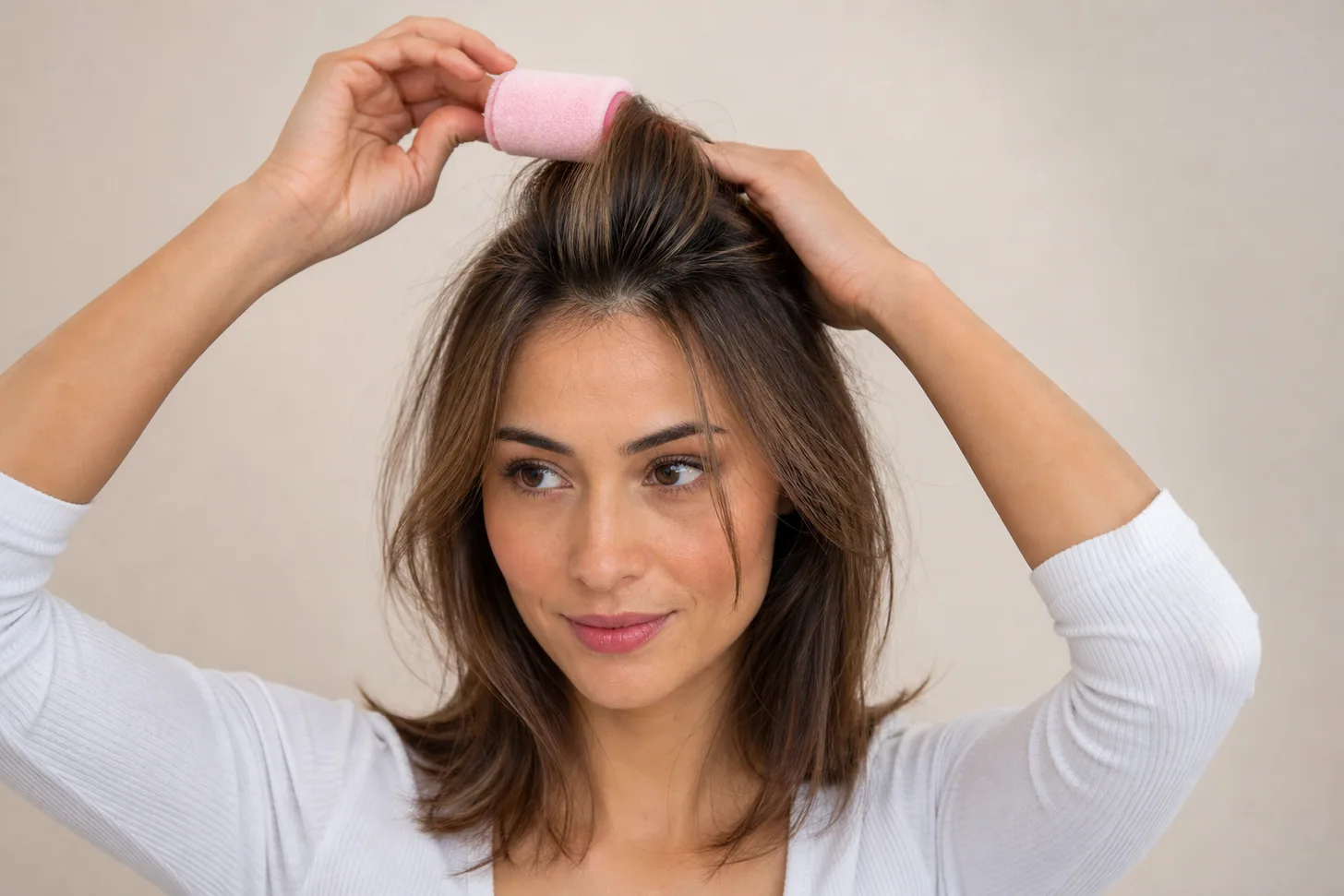
Self-grip rollers in damp roots
Wash days, while you have breakfast
Crown lift with no heat and no raised arms — beats a round brush on every count
1 min in, 20 out
Conditioner from the ears down
Every wash
Product at the root is the commonest cause of a flat crown, at any age
No extra time
A dusting of the ends
Every 10–12 weeks
See-through ends are what makes long hair read as sparse — not the length
A salon visit
Move the part
Whenever you think of it
Free volume, and it stops one line widening from constant exposure
5 seconds
Loose, low, no tension
Any time it's up
Temple and hairline hair is the most fragile you have; tension takes it first
No extra time
A silk or satin pillowcase
Nightly
Less friction on drier, more fragile hair over an eight-hour night
One purchase
If the roller step sounds like the useful one, it is — it's the single highest-return habit in this article. Heatless volume for fine hair covers placement, and root volume covers what to do on the days you do want the dryer.
When keeping the length isn't your best move
You can see scalp through the part in ordinary daylight.Length pulls the eye upward to exactly that spot. Thinning on top is the honest read, and a medium length usually serves that crown better.
Your ponytail tapers to a point you can see through.The ends have gone. Two inches off will make everything above them look denser — see trims for fine hair.
Raising your arms is genuinely difficult.This is a real constraint, not a small one. If washing and drying it has become a two-person job, a shorter shape built for over 70 gives you back the morning.
You've stopped washing it as often because it's a chore.Long hair that isn't looked after is what actually reads as aging. A length you'll maintain beats a length you won't, every time.
Someone else wants you to cut it.That's not a hair reason. If the cut works and you can manage it, it's your call — and it stays your call.
What to ask your stylist
Take these words with you. They're the difference between the cut you wanted and the cut that was easiest to give you.
"I want to keep the length. Take the weight out from inside, not off the ends." The single most important sentence, and the one most often assumed rather than said.
"Point-cut internal layers, please — no razor." Razor cutting thins the very ends and leaves fine hair transparent where you need it solid.
"Keep my perimeter blunt." The outline is the only place fine hair still reads as dense. Protect it explicitly.
"Start my face-framing below the cheekbone." Above it, and you lose width from exactly where the face was being held.
"Leave the section behind my ear long enough to sit over my glasses." Say it even if you only wear them for reading.
"Where is my density actually lowest?" Ask them to show you in the mirror. It's often not where you assume.
"How many minutes a day will this need?" The question that decides whether you still like this cut in six weeks.
Yes, and the thing that decides it isn't your age or your hair type. It's whether the top of your head still reads as full. Long hair is seen from the crown down, so the eye reaches the part and the temples before it reaches the ends. If the crown holds, length looks deliberate at any age. If the scalp shows through the part, length pulls the eye straight to it, and the same cut that flattered you at 60 stops working. The second condition is practical: the cut has to be one you can manage on the mornings your shoulders are stiff. A long shape that needs ten minutes of raised arms is the wrong cut however much you like it — and that's a far more common reason women give up long hair than anything to do with how it looks.
Length doesn't age anyone. Three specific things do, and all of them are fixable. Ends that have gone see-through and taper to a point read as neglect rather than as long hair — two inches off makes everything above them look denser. A flat crown next to long lengths reads as thinning even when the density is fine, because the eye reads the contrast rather than the hair. And a style that hasn't changed in twenty years reads as a decision made a long time ago, which is a different thing from an old-fashioned cut. Deal with those three and long hair at 75 looks like a choice. What genuinely does age long hair is stopping looking after it — which is why a shorter length you'll maintain beats a longer one you won't.
Collarbone to just below the shoulder blade is the range that works for most fine hair at this age, and past mid-back is where the trouble usually starts. The reason is weight, not fashion. Every extra inch adds pull at the root and takes width out of the perimeter, so very long fine hair tends to hang close to the head and taper — which reads thin from behind. Stopping at or just past the shoulder keeps enough hair in the perimeter for the ends to look blunt rather than wispy, and it's short enough to dry in a reasonable time and to put up without your arms above your head for long. If you want the feeling of long hair without the maintenance, collarbone with a strong blunt line is the most forgiving version of it.
Some, in the right place, cut the right way. The layers that help are internal and invisible: short pieces cut inside the shape that support the hair above them and give the crown somewhere to sit up. The layers that hurt are the ones that remove weight from the outline, because the perimeter is the only place fine hair still looks solid. Ask specifically for point-cut internal layers, and say the words "keep my ends blunt". What to avoid outright is razor cutting on fine hair, which thins the very ends and leaves them transparent, and heavy face-framing cut above the cheekbone, which takes width from exactly the part of the shape that was holding the face. Do layers help or hurt fine hair? settles it properly.
At the root, before it dries, with as little arm work as possible. The single highest-return thing is a set of self-grip rollers put into damp roots at the crown and left while you have breakfast: lift with no heat, no raised arms and no technique, and it beats a round brush on every count for this hair at this age. Two other things carry most of the rest. Move your part, because hair that has fallen the same way for years lies flat by habit and the new direction lifts on its own. And keep conditioner and oils to the mid-lengths and ends, because product at the root is the commonest cause of a flat crown at any age. Heatless volume has the roller placement.
Every ten to twelve weeks, and the goal is different from what most people assume. You're not cutting to keep it short — you're cutting to keep the perimeter honest, because thin, see-through ends are what makes long hair read as sparse. A dusting of half an inch, taken bluntly across the bottom, restores the line without costing you length. If you're growing it, you still need this: skipping trims to grow faster doesn't work, because the ends wear away from underneath and the hair gets longer in the middle and thinner at the bottom at the same time. If getting to the salon is difficult, book the trims and skip something else.
Yes, but the area behind the ear needs planning rather than luck, and almost nobody mentions it. Glasses arms and hearing aids sit in the same narrow strip, and hair that falls into it either catches on the device or gets tucked repeatedly — which is how the hairline at the temple wears thin. Two adjustments solve it. Ask your stylist to leave the section directly above and behind the ear slightly longer rather than layering into it, so it lies over the arm rather than under it. And take the face-framing pieces to below the cheekbone rather than above, so the front is long enough to tuck properly instead of springing forward. If you tuck constantly, alternate the side.
Use these words. "I want to keep the length, so please cut the ends blunt and take the weight out from inside." "Point-cut internal layers, no razor." "Keep the perimeter strong." "Start my face-framing below the cheekbone." "Leave the section behind my ear long enough to sit over my glasses." Then ask two questions before they start: where is my density actually lowest, and how many minutes a day will this shape need? The second matters more than all the rest. A cut that needs eight minutes of styling is only right if you'll happily spend eight minutes, and a good stylist will tell you the truth about that if you ask directly.
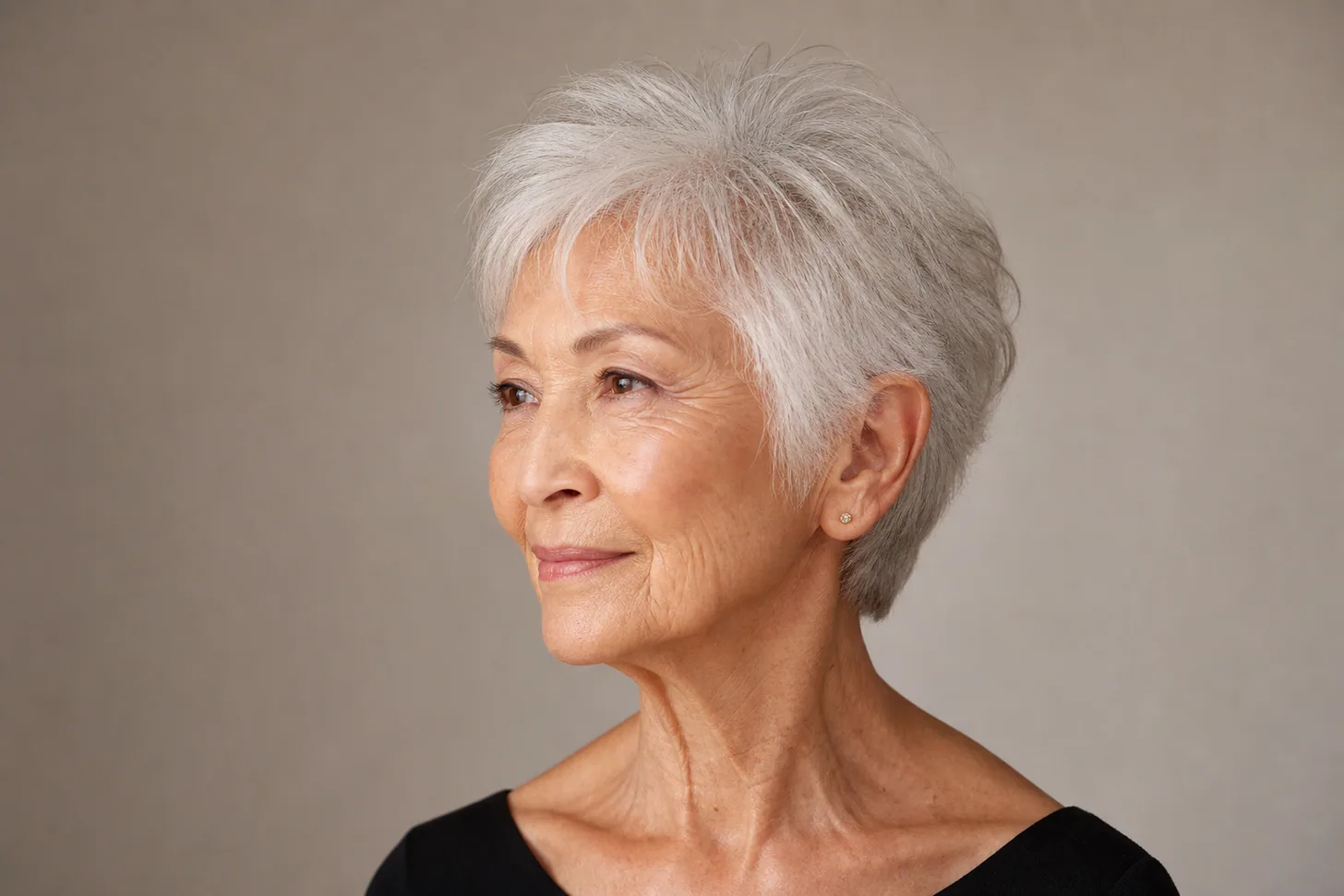
Images in this article are AI-generated illustrations, not photographs of real clients or results. See our image policy.
Results vary with hair type, density, and growth patterns. This guide is educational and not a substitute for an in-person consultation with a licensed stylist.
Get the good hair intel
One honest, stylist-written guide in your inbox each week. No hype.

 SB
SB