Reviewed by Tara Sullivan · Updated July 2026 · 9 min read
Glasses and fine hair are two things to dress at once, and one cut has to answer both. The styles that flatter here build height at the crown, keep the lengths around the ears soft and tuckable so the glasses arms sit flat, and frame the face with soft bangs that clear the frames rather than clash with them.
Crown lift balances the visual weight of the frames; a tuckable length keeps the sides from fighting the temples; and point-cut layers keep fine ends dense. What works against you is the opposite — volume built out at the temples, and heavy blunt bangs that land on the frame line.
Below are 16 salon-tested cuts for fine hair over 50 and 60 with glasses, grouped from easy short crops to longer framing shapes, each with who it suits and the exact words to bring your stylist. If you're weighing length more broadly, our galleries for fine hair over 50 and fine hair over 60 are the companion pieces to this one.
Chair-side note
When a client wears glasses every day, I ask her to keep them on for the whole consultation and the cut — not push them up into her hair while I work. Glasses change where the weight of a style should sit, and I can only see it if they're on her face.
The two things I'm watching: does the hair at the temple lie flat enough that the arm of the frame sits clean, and is there enough lift at the crown to balance the frame so the whole head doesn't read bottom-heavy. Almost every "my cut doesn't work with my glasses" problem is one of those two — sides too full at the temple, or a flat crown letting the frames dominate. Fix both in the chair, with the glasses on, and the style works the second you walk out.
SB
— Simone Baptiste, Senior Stylist
Why glasses change the brief for fine hair
Frames add a strong horizontal line across the middle of your face and a little visual weight at the temples. On fine hair that changes two things. First, the crown needs height — glasses draw the eye to the center of the face, and without lift up top a fine head can look bottom-heavy under the frames.
Second, the hair at the temples and around the ears needs to stay soft and tuckable, because that's exactly where the arms of the glasses sit; fullness styled out at the sides fights the frames and pushes them off your face.
The good news is that both of those goals line up with what fine hair wants anyway: volume up at the roots, not out at the sides, and a clean, uncluttered perimeter. So the cut that flatters glasses is usually the same cut that flatters fine hair. The one place they can argue is layering — heavy or razored layers thin fine ends until they go see-through, so keep the layers soft and point-cut over a strong bottom line.
If you're not sure whether you're working with finer strands or genuinely lower density, our guide to telling fine hair from thin hair helps you and your stylist decide how blunt to keep the ends, and if the change has felt fast rather than gradual, read fine hair or thinning first.
Short cuts that keep the glasses the focal point
Short shapes are the easiest match for glasses on fine hair: they carry their own root lift, there's nothing long enough to tangle with the frames, and they let the glasses be the statement. The rule is height on top, close and clean at the temples. These four are the wash-and-wear options. Several of these overlap with short cuts for mature fine hair, where frames and a thinning crown are assumed rather than treated as exceptions.
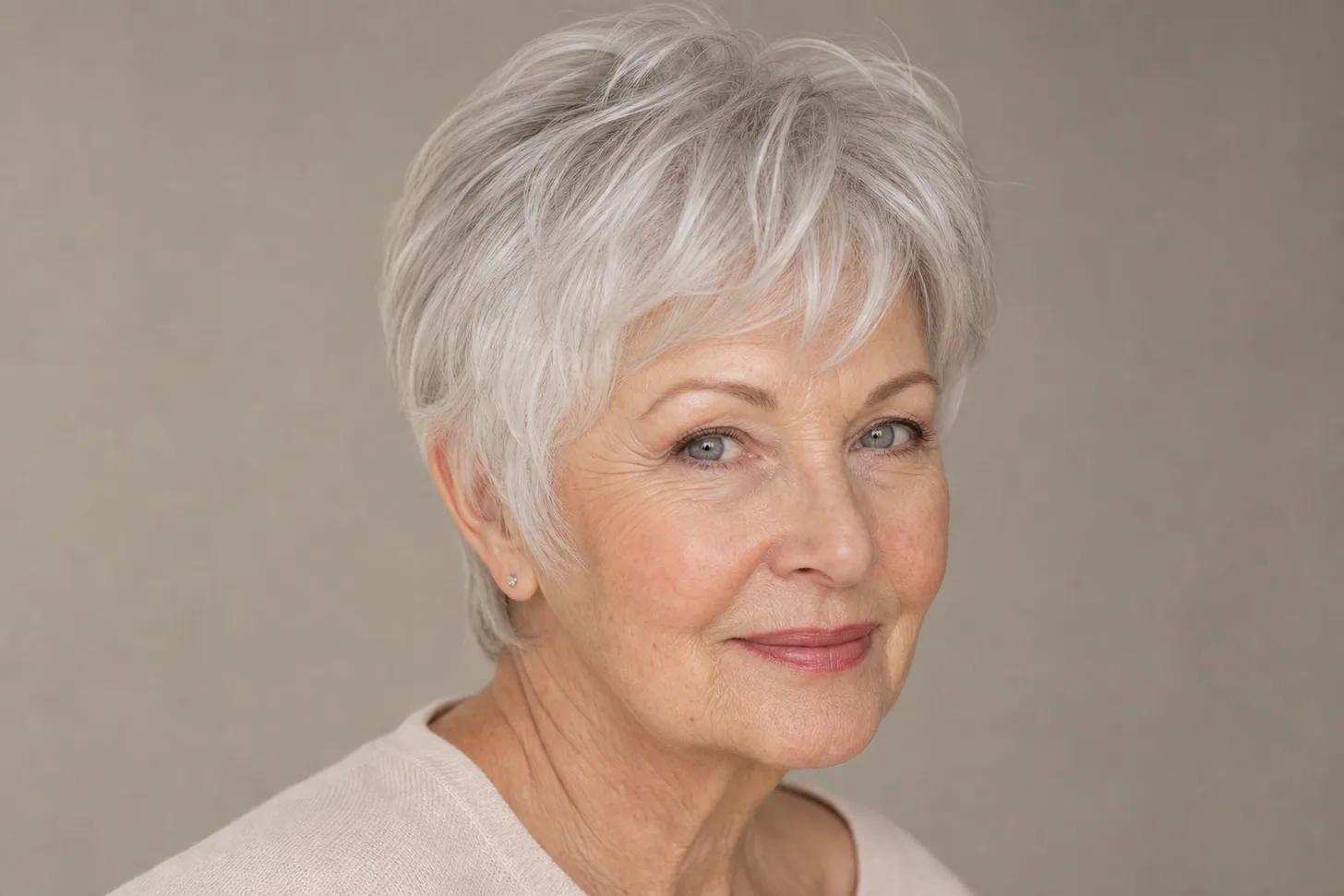
textured pixie with height and length on top, close tapered sides clearing the glasses arms, on fine grey hair, woman over 60 in glasses
1
The high-top textured pixie
A pixie built for glasses keeps length and lift on top and through the crown, tapered close at the sides so the frame arms rest flat against clean hair. That vertical height balances the frames while the close sides keep the temples uncluttered. It's the lowest-effort option here — short lengths hold root lift with almost no product, so it reads full on fine hair with a five-minute style.
soft layered crop with volume at the crown and side-swept front on fine light-brown hair, woman over 50 in glasses
2
The soft layered crop
A slightly longer, rounded crop with soft layers gives a little more coverage than a cropped pixie while keeping the frames the focal point. The layers add movement and body up top; the softly swept front sits above the glasses without a hard line. It suits anyone who wants short and easy but not severe, and it grows out gracefully between trims.
tucked short cut with lengths swept behind the ears where the glasses arms sit, crown lift, on fine silver hair, woman over 60 in glasses
3
The tuck-behind-the-ear crop
Cut a fraction longer at the sides so the hair can tuck cleanly behind the ear, this shape gives the glasses arms a tidy channel to sit in — no strands caught under the frame, no bulk at the temple. Ask for the sides "long enough to tuck, tapered underneath." It's a favorite for anyone who's ever fought hair getting trapped in their glasses hinge.
short piecey pixie with a longer side-swept fringe above the glasses on fine ash-blonde hair, woman over 50 in glasses
4
The pixie with a side-swept fringe
A longer pixie with a fringe swept to one side draws a soft diagonal across the forehead that sits above the frames, opening up the eyes behind the glasses. The sweep gives you a little front interest without a blunt line to compete with the frame top. Keep it point-cut and feathery so fine hair doesn't look sparse where the fringe thins out.
Bobs & lobs that frame the face around the frames
If you'd rather have length, the bob family is the sweet spot for glasses on fine hair — enough hair to frame the face, short enough to stay easy, and tuckable at the sides. Keep the crown lifted and the lengths clean around the ears. These four balance frames beautifully.
chin-length layered bob with crown volume and tuckable sides on fine straight silver-brown hair, woman over 60 in glasses
5
The chin-length layered bob
The workhorse cut for glasses on fine hair: a bob at chin length with soft internal layers for crown height and a perimeter that tucks behind the ear. The length frames the face on either side of the frames without crowding them, and the layers keep fine hair from hanging flat. Ask for it "chin length, lift built at the crown, sides long enough to tuck."
collarbone lob with a deep side part and soft face-framing on fine honey-blonde hair, woman over 50 in glasses
6
The soft collarbone lob
A lob at the collarbone on a deep side part gives you framing length and an off-center line that lifts the crown as the hair travels over the part. The face-framing falls beside the frames rather than on them, and the extra length reads elegant without much upkeep. A good bridge if a short cut feels like too big a change.
angled A-line bob longer at the front framing the jaw, tapered at the nape, on fine dark hair, woman over 60 in glasses
7
The angled A-line bob
An A-line bob that's a touch shorter at the back and longer at the front sends two clean vertical lines down past the jaw, framing the face on either side of the glasses. The graduation at the back builds crown height where fine hair falls flat. It keeps density in the forward pieces — exactly where fine hair shows most — and looks polished with a quick round-brush finish.
textured tucked bob with lengths tucked behind the ears and volume at the crown on fine grey hair, woman over 60 in glasses
8
The tucked textured bob
A softly textured bob designed to be worn tucked behind the ears keeps the sides completely clear for the glasses arms while the crown stays full. The texture reads as fullness on fine hair, and the tuck gives a neat, put-together line around the frames. Style it with a light texture spray and your fingers — no round brush required if you want it truly low-effort.
Bangs & fringe that play well with frames
Bangs and glasses can absolutely coexist — the trick is soft, and either above the frames or blended past them. Curtain and side-swept fringes frame the face without landing on the frame line; a blunt straight-across fringe is the one to skip. These four add softness at the front without crowding the glasses.
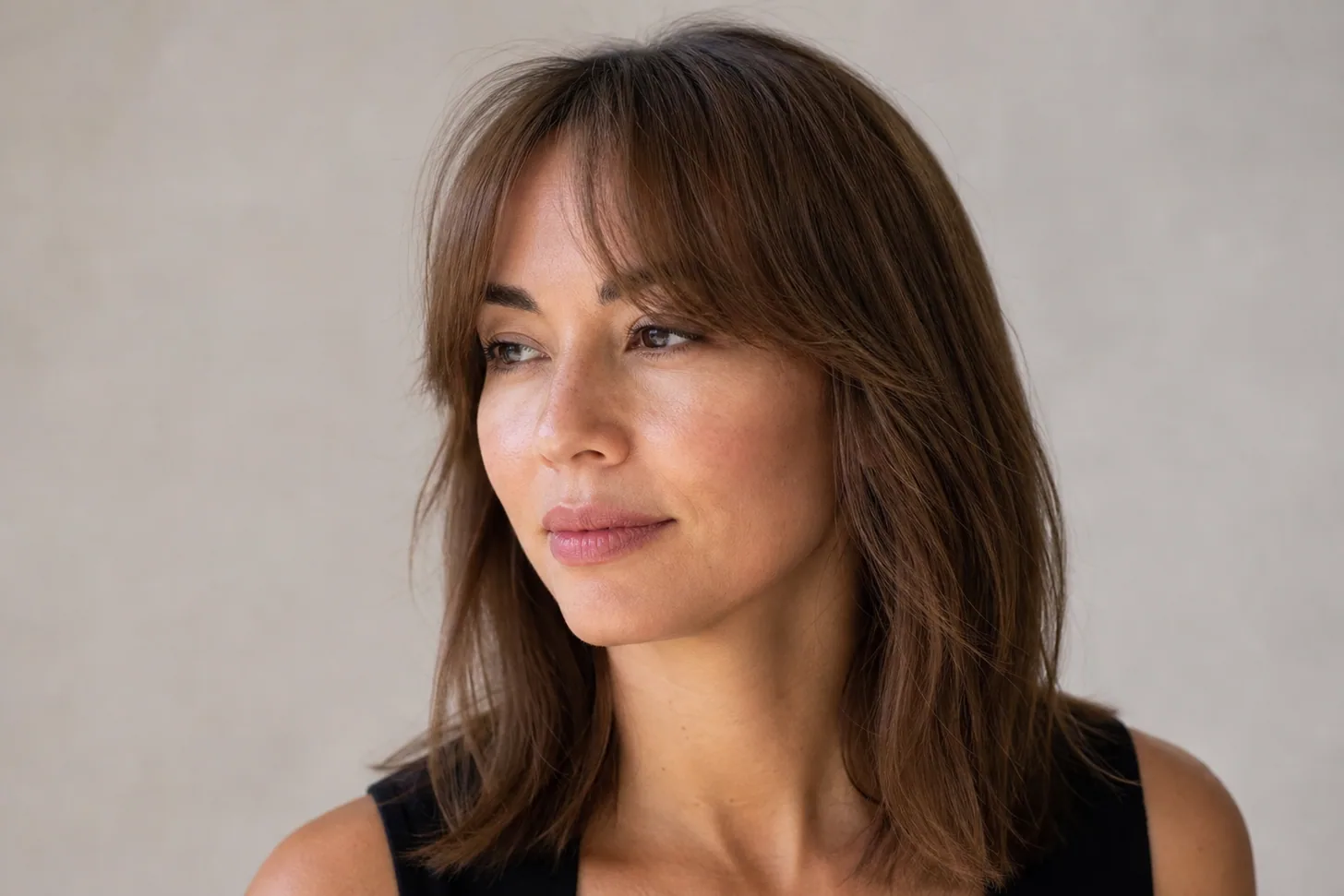
soft center-parted curtain bangs sweeping to the cheekbones around the glasses on fine straight brown hair, woman over 50 in glasses
9
The long curtain bangs
The most glasses-friendly fringe there is. Soft curtain bangs part in the middle and sweep out toward the cheekbones, framing the face on either side of the frames instead of sitting on them. They add a cushion of fullness at the front of fine hair without a hard line, and grow out cleanly. Ask for them long enough to blend into your face-framing and past the top of your glasses.
long side-swept fringe angling across the forehead above the frames on fine light-brown hair, woman over 60 in glasses
10
The long side-swept fringe
A longer fringe swept across the forehead on a deep side part sits cleanly above the frames and softens the forehead without a blunt line to clash with the glasses. It's low-maintenance and blends into the length, and it's a gentle first fringe if you've never had one. Keep it point-cut so it stays wispy rather than solid on fine hair.
wispy micro-fringe sitting just above the top of the glasses frames on fine straight hair, woman over 50 in glasses
11
The wispy above-the-frame fringe
A short, airy wispy fringe cut to sit just above the top of your frames gives a modern, youthful softness without the density a blunt fringe demands. Because it's see-through by design, it suits fine hair — it looks intentional rather than sparse. Have your stylist set the length against your actual glasses so it clears the frame top cleanly.
bob with soft blended bangs that merge into face-framing beside the glasses on fine silver hair, woman over 60 in glasses
12
The blended bang that melts into the frame
Rather than a defined fringe, this is a soft front section cut to blend down past the top of the frames into the face-framing, so there's no hard fringe line meeting the glasses at all. It's the most forgiving option if you find fringes fussy, and it keeps everything around the frames soft and continuous. Ask your stylist to "blend the front past my glasses, no blunt line."
Crown volume & longer options that balance the frames
Whatever the length, the crown carries the look when you wear glasses — height up top is what keeps a fine head from reading bottom-heavy under the frames. These four lean into crown lift, plus longer shapes for those who don't want to go short. The volume goes up, never out at the temples.
short cut with lifted crown volume and a defined quiff, close temples, on fine ash hair, woman over 60 in glasses
13
The crown-lifted short cut
Height built right at the top of the head — a soft quiff or lifted front piece — draws the eye up and balances the weight of the frames, which is the single most flattering move for glasses on fine hair. Keep the temples close so nothing competes with the arms. A touch of root lifter at the crown holds the height fine hair can't hold on its own; more on that in our guide to adding volume to fine hair.
collarbone cut with long layers and crown height, lengths tucked at the sides, on fine wavy brown hair, woman over 50 in glasses
14
The long layers with a lifted crown
For those who want to keep length, long layers work with glasses as long as the volume sits high and the sides stay tuckable. Ask your stylist to concentrate the lift at the crown and keep the layers long, then set the top on a couple of velcro rollers while you get ready. It's the longer answer to the same rule: height up top, clean at the temples.
mid-length cut worn on a deep side part lifting the crown, swept away from the temples, on fine straight hair, woman over 60 in glasses
15
The deep side part for height
Less a cut than the setting that makes every style here work with glasses. A deep side part throws volume to one side and lifts the roots at the crown as the hair travels over the part — free height exactly where frames need balancing. It also sweeps the front away from the temples so the glasses sit clean. The cheapest crown-lift trick there is on fine hair.
full temple volume styled out at the sides shown as the look to avoid, hair pushing against the glasses arms, on fine hair, woman in glasses
16
The full-at-the-temples style — the one to skip
Worth including so you know what to avoid. Volume styled out at the temples fights the arms of your glasses, pushes the frames off your face, and adds width right where fine hair reads sparse under the frame line. If your crown goes flat and you're tempted to build fullness at the sides to compensate, redirect it: lift the roots at the top of the head instead, and keep the temples soft. Up, never out.
Styling that keeps glasses and fine hair working together
The cut sets you up; a few habits keep it flattering all day. Build the volume at the crown, not the sides: on damp hair, work a light root lifter or volumizing spray into the roots at the top of the head, then blow-dry with your head tipped forward, or set the crown on a couple of velcro rollers while you get ready.
Keep the hair over your temples soft and tuckable so the frame arms sit flat — resist styling fullness there. A deep side part props up the height and sweeps the front cleanly away from the glasses for free.
Keep conditioner and any oils on the mid-lengths and ends so the crown stays lifted, and a light mist of dry shampoo at the roots revives the height by afternoon without a wash. If your frames leave a flat dent at the temple by lunch, a quick blast of cool air from the dryer and your fingers lifts it back — no restyle needed.
Chair-side note
A small thing that makes a big difference: bring your glasses cleaning cloth thinking, and pick a fringe length with your frames on. I've had clients fall in love with a photo of curtain bangs, then find the length lands right on the top rim of their glasses and catches every time they put them on.
Two millimeters longer and it sweeps past the frame and behaves. The only way to get that right is to cut and check with the actual glasses on the face — not the pair from three years ago, the ones you wear now. If you've changed to a bigger or bolder frame recently, treat it like a new brief; the hair that suited your old wire frames may need a little more crown height to balance a chunkier acetate.
SB
— Simone Baptiste, Senior Stylist
What to ask your stylist
Bring your glasses and wear them for the consultation and the cut — then name both jobs. Say: "I wear glasses every day and my hair is fine. I'd like crown height to balance the frames, the lengths around my ears long enough to tuck behind so the glasses arms sit flat, and soft face-framing or curtain bangs that clear the top of my frames — not a blunt fringe on the frame line or volume out at the temples. Please point-cut the layers so my ends stay dense."
If you want it truly low-maintenance, add: "Cut it so I can wear it with a root lifter and a rough blow-dry in five minutes." Those constraints turn a generic cut into one that flatters your hair and works with your glasses from the moment you leave.
When these glasses rules bend
You only wear glasses part of the time. Weight the cut toward the look you wear most, but keep the crown lift and tuckable sides — they flatter fine hair with or without frames, so you lose nothing.
Your density is very low and the scalp shows at the crown. Prioritize coverage and root lift over a dramatic quiff; a shorter cut with built-in volume gives more fullness where the frames draw the eye. See our guide to coverage for thinning on top.
You wear large, bold statement frames. Let the glasses lead — keep the hair simpler and softer around them and lean harder on crown height, so the two don't compete.
The change in your hair has been fast or patchy, not gradual. A flattering cut helps the look, but check the cause first — read our honest guide to fine hair or thinning and speak to your doctor.
If the priority is a cut you can wash and leave rather than one built around the frames, our wash-and-wear cuts for thin hair over 70 include a glasses-friendly pick.
FAQ
The most flattering choice is usually a chin-to-collarbone cut with crown volume, soft face-framing, and lengths that tuck cleanly behind the ear so the glasses arms sit flat. On fine hair over 60, height at the crown is what balances the visual weight of the frames, and a tuckable length keeps the sides from clashing with the temples. A layered bob, a soft lob, or a longer textured pixie all do this well. Keep any layers point-cut rather than razored so fine ends stay dense, and ask your stylist to build lift at the roots, not width at the sides.
Yes, if they're soft and either sit above the frames or blend past them. Curtain bangs and long side-swept fringes are the safest with glasses because they part or sweep away from the brow and don't collide with the top of the frame. What to avoid on fine hair is a heavy, straight-across blunt fringe that lands right on the glasses — it clashes with the frame line and borrows density a fine top can't spare. Keep any fringe wispy and point-cut, and have your stylist check the length against your actual glasses in the chair.
Either works — the deciding factors are crown volume and how the hair sits around your ears, not the overall length. Short cuts like a textured pixie or a layered crop are low-maintenance and keep the frames the focal point, which suits many women over 50 and 60. Longer bobs, lobs, and collarbone cuts flatter too, as long as the lengths tuck behind the ear so the glasses arms rest cleanly and the crown has lift. Choose by your styling time and density: shorter for wash-and-wear ease and built-in root lift, longer if you like the framing and don't mind a minute of volume work.
Build the volume up at the crown rather than out at the sides, and keep the hair over the temples soft and tuckable so the glasses arms have somewhere to sit. A little root lift at the top of the head draws the eye up and away from where the frames press the hair flat. Avoid styling fullness at the temples, which only fights the arms of the glasses. A light root lifter or volumizing spray at the crown, set with a blow-dry, holds the height where it counts and lets the sides lie clean under the frames.
A short, textured pixie or a soft, chin-length layered bob is the most wash-and-wear choice. Short lengths carry their own root lift, so fine hair looks fuller with less effort, and there's nothing long enough to tangle with the frames. Ask for a little length and lift left on top for crown height, tapered or tucked sides that clear the glasses arms, and point-cut ends so the shape holds as it grows. Styled with a quick root lifter and a rough blow-dry, it's a five-minute cut that keeps your glasses the star.
Curtain bangs are one of the best fringe choices for glasses. Because they part in the middle and sweep out toward the cheekbones, they frame the face on either side of the frames rather than sitting on top of them, so they read as soft and open rather than crowded. On fine hair they add a cushion of fullness at the front without a hard line. Ask for them cut long enough to blend into your face-framing and past the top of your frames, and point-cut so they stay feathery — then check them against your glasses before you leave the chair.
Eleven years behind the chair, specializing in short shapes and fine-hair texture. Simone cuts every client's fringe with their real glasses on, because the length only works against the frames you actually wear.
Results vary with hair type, density, and growth patterns. This guide is educational and not a substitute for an in-person consultation with a licensed stylist.
Hairstyle images in this guide are AI-generated illustrations, not photos of real clients or results. See our image policy.
Get the good hair intel
One honest, stylist-written guide in your inbox each week. No hype.

 SB
SB