What a shampoo can and cannot do for thinning hair
A shampoo is a rinse-off. It goes on the scalp, sits for one to three minutes, and leaves. The dermatology review of shampoo formulation in the Indian Journal of Dermatology describes the whole category as cleansing agents with, at most, conditioning agents left behind on the hair shaft — the hair shaft, not the follicle. Whatever a label promises about roots, follicles or growth has to survive that arithmetic: a minute of contact, then the drain.
That leaves three things a shampoo genuinely does for thinning hair, and it is worth naming them because the picks below are ranked on exactly these.
| What the bottle says | What is actually happening | Does it matter? |
|---|
| "Cleanses the scalp for healthy growth" | Removes sebum, flakes and product so the hair you have stands off the scalp instead of lying in it. On a thinning crown, a coated root reads as half a root. | Yes. The biggest visible win, and it is free with any decent shampoo. |
| "Thickens each strand" | Deposits polymers, proteins or humectants that swell or coat the fibre. Measurable, temporary, gone at the next wash. | Yes, cosmetically. About 10% at best, and it costs fine hair some root lift. |
| "Stimulates follicles" / "blocks DHT" / "reduces shedding" | An active with a minute of contact. Two actives have small trials; the rest have lab data, marketing, or nothing. | Barely. Modest at most, and only for ketoconazole and zinc pyrithione. |
| "Regrows hair" | Nothing. The AAD's position is that shampoos cannot regrow hair. | No. That job belongs to minoxidil and the tier above it. |
Read the table bottom-up and the order of purchase becomes obvious. If your hair is genuinely thinning, the shampoo is the third thing you buy, after a diagnosis and after the treatment. It is a good third thing. It is a poor first one.
First: is it thinning, or is it fine?
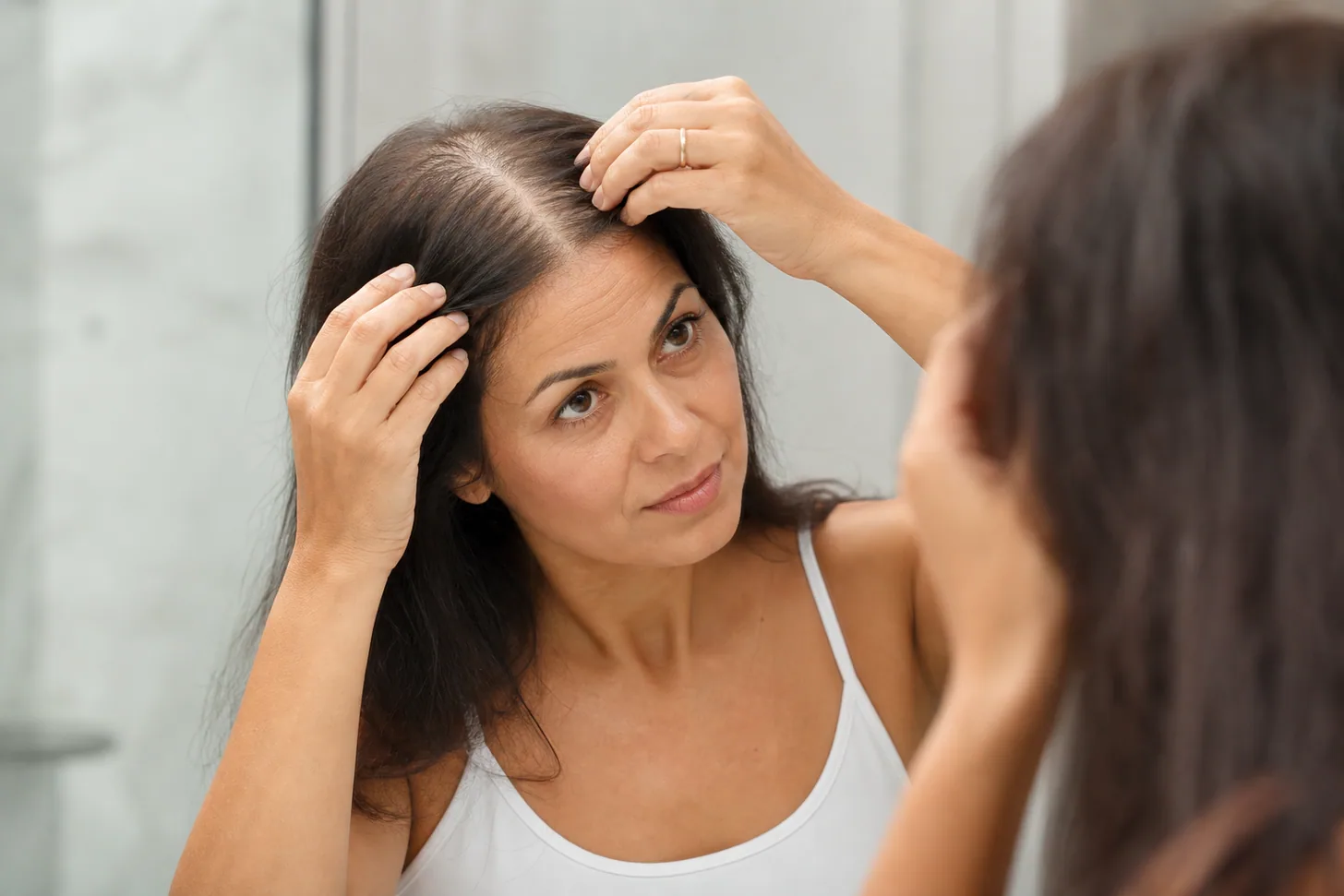
Half the people searching this term do not have thinning hair. They have fine hair — narrow strands, the same number of them as ever — and fine hair looks sparse at the part, shows scalp under bathroom lights, and goes flat by noon. None of that is loss. Fine versus thin is the distinction the entire aisle blurs, and it decides which half of this page you need.
The checks take a week and cost nothing. Is the part widening, or has it always looked like this? Has the ponytail circumference shrunk? Is the change happening at the crown and parting, which is where female pattern loss shows, or all over, which points to a shed?
Fine hair or thinning? walks the checks in order, and diffuse thinning on fine hair covers the harder case where the loss is everywhere at once. The AAD notes that female pattern hair loss is the most common cause of hair loss in women, that it usually begins in the forties, fifties or sixties, and that minoxidil is the most-recommended treatment for it — three facts that between them explain why the shampoo aisle is so crowded and so quiet about results.
If your checks say fine and stable, skip the actives entirely. You want the lightest clean-rinsing wash you can find, which is pick 2 below and the whole of our shampoo picks for fine hair. If your checks say thinning, keep reading, and hold onto the fact that the most useful thing on this page might be the paragraph telling you to book a dermatologist.
The two shampoo actives with real trials — and both come from the dandruff aisle
This is the part no roundup prints, because it makes the expensive bottles look bad. The only shampoo ingredients with human trials measuring hair density are antifungals sold for flaking. The likely reason is that a scalp with low-grade inflammation and an overgrowth of Malassezia yeast is a worse place to grow hair than a calm one, and the dandruff actives calm it.
Ketoconazole Has the Best Evidence Any Shampoo Active Has
A 1998 study in Dermatology compared a 2% ketoconazole shampoo with an unmedicated shampoo in men with pattern hair loss, used with or without 2% minoxidil, over roughly two years of two-to-four-times-weekly washing. The authors report that "hair density and size and proportion of anagen follicles were improved almost similarly by both KCZ and minoxidil regimens," that sebum output appeared to fall on ketoconazole, and — the line the marketing leaves out — that "the clinical significance of the results awaits further controlled study in a larger group of subjects."
Three cautions. The study used the 2% prescription strength; the over-the-counter Nizoral A-D label is 1%, indicated for dandruff, and directs use every three to four days. It was small. And it was in men.
Zinc Pyrithione Was Tested Head-to-Head With Minoxidil, and Lost Politely
The better-designed study is Berger and colleagues, 2003, in the British Journal of Dermatology: 200 men, six months, a 1% zinc pyrithione shampoo used daily against 5% minoxidil twice daily, a placebo shampoo, and the combination.
The shampoo produced what the authors call a modest and sustained improvement in hair count — slightly less than half the gain from minoxidil — and the improvement was picked up by the investigators' counts rather than noticed by the men themselves. That is the honest ceiling for a shampoo active: real, measurable, and not something you would see in the mirror.
Both actives are covered as dandruff treatments in our dandruff shampoo picks for fine hair, and the technique notes there — scalp only, contact time, alternate with a mild wash — are exactly the notes that apply here.
Chair-side note
The client I think of on this topic came in with a carrier bag. Eleven bottles, most of them half full, a year of "thinning" and "density" shampoos, and a receipt total she worked out in the chair at a little over four hundred dollars. Her part had widened the whole time. What she had never bought was the twenty-five-dollar box of minoxidil two shelves down, because it looked like a drug and the shampoos looked like hair care.
That is the trick the category plays: it sells the feeling of doing something at exactly the price point where you keep doing it. We kept two of the eleven — a ketoconazole wash for every third day and a light everyday bottle — sent her to a dermatologist, and she started minoxidil the same month. The shampoo did not change; the outcome did.

MH
Caffeine, biotin, saw palmetto, peptides: what the label is actually promising
Every other ingredient sold for thinning falls into one of two groups: something with laboratory or leave-on evidence being sold in a rinse-off, or something with no hair-density evidence at all. Here is the honest grade for each, in a wash.
| Ingredient | Best evidence | In a shampoo, on fine hair |
|---|
| Ketoconazole | Small human study; density "almost similar" to 2% minoxidil (2% strength, men) | Worth using, every 3–4 days, scalp only |
| Zinc pyrithione | 200-man RCT; modest hair-count gain, under half of minoxidil's | Worth using as the everyday medicated wash |
| Caffeine | Lab organ-culture data; follicular penetration after 2 minutes; one open-label trial of a leave-on liquid | Reasonable adjunct if you leave it on 2 minutes; check the base formula |
| Biotin | Helps only a true deficiency, which is rare; no rinse-off evidence | Marketing. Harmless in a shampoo; see supplements for fine hair for the oral question |
| Saw palmetto / "DHT blockers" | Weak oral data; no evidence that a rinse-off lowers scalp DHT | Marketing in a wash |
| Peptides, "growth complexes" | Brand studies, usually of a whole multi-product regimen, usually small | Unproven; read what the study actually tested |
| Rosemary oil | One small trial of a leave-on oil versus 2% minoxidil | Unproven in a rinse-off; viral hacks for fine hair reads the study |
| Panthenol, hydrolyzed protein, polymers | Measured cosmetic diameter gain (see below) | Real and temporary; costs root lift |
The Caffeine Story Is Real and Has Been Stretched
Caffeine deserves its own paragraph because it is the one ingredient here where the science is genuinely interesting and the marketing genuinely misleading. In laboratory cultures of human hair follicles, caffeine counteracts testosterone's suppression of hair growth — that is the Fischer finding summarised in the International Journal of Trichology review of caffeine in pattern hair loss.
The same review notes the 2007 penetration study showing that a two-minute contact with a caffeine shampoo puts caffeine into the follicles, where it is still detectable hours later. So a caffeine shampoo is not nonsense; the ingredient gets where it is going. What is missing is a trial showing that this changes hair density.
The study everyone cites, Dhurat and colleagues, 2017, found a 0.2% caffeine liquid non-inferior to 5% minoxidil in 210 men over six months — but it was a leave-on liquid rather than a shampoo, it was open-label, and the manufacturer's scientist is among the authors.
The review's own conclusion is that caffeine "appears to be a useful adjuvant" and that "further studies need to be done." Adjuvant is the right word. Leave it on for two minutes, and do not cancel the minoxidil.
Thickening shampoos: the 10% that is real, and where it lands
"Thickening" is the one claim on this shelf that is straightforwardly true, and it pays to know the size of the effect. The best-measured version is a leave-on combination of caffeine, niacinamide, panthenol, dimethicone and an acrylate polymer developed by the Procter & Gamble research group and published in the British Journal of Dermatology in 2011.
It increased the diameter of individual scalp hairs by 2 to 5 micrometres — roughly a 10% gain in cross-sectional area — and the thickened fibres were measurably stiffer and harder to break. That is a real, physical, cosmetic result. It is also a leave-on, so a thickening shampoo, which is rinsed, delivers less of it.
On fine hair there is a cost the label never mentions. Anything left on a strand to thicken it is also left on the roots, and deposition scales with surface area while weight scales with mass: a fine strand collects proportionally more deposit per gram of hair than a coarse one, for the same reason silicones build up faster on fine hair.
A rich thickening shampoo used daily can flatten the very hair it is plumping, which on a thinning crown means the part looks wider by four in the afternoon. The fix is not to avoid thickening formulas; it is to use them two or three times a week, rinse longer than feels necessary, keep conditioner below the ears, and clarify every couple of weeks so the deposit never accumulates.
What to look for on the label — and what to ignore
Look for a named active at a stated strength (ketoconazole 1%, pyrithione zinc 1%) if you want one at all; a mild-to-moderate detergent system near the top of the list — cocamidopropyl betaine, sodium cocoyl isethionate, sodium lauroyl sarcosinate, a sulfonate — because on a thinning scalp you want a real clean without stripping; small humectants (panthenol, glycerin) rather than butters and oils; and a short ingredient list, because what is absent decides how your roots look by evening.
Ignore the words growth, regrowth, anti-thinning, DHT-blocking and follicle-stimulating on the front of a bottle: none of them is a regulated claim, and none of them predicts what is inside. Read the asterisk instead. Several of the biggest anti-thinning brands qualify the claim in small type as "the appearance of thinning due to breakage" — which is a different problem from pattern loss, and which the shampoo below that carries the asterisk addresses honestly once you know that is what it means.
Ignore sulfate-free as a proxy for gentle or light; and ignore for women or for men as a proxy for anything, because the trials behind every active on this page were run in men and the chemistry does not check. For men, the best men's shampoo for thinning hair applies the same evidence to six bottles on the men's shelf.
The best shampoos for thinning hair, by job
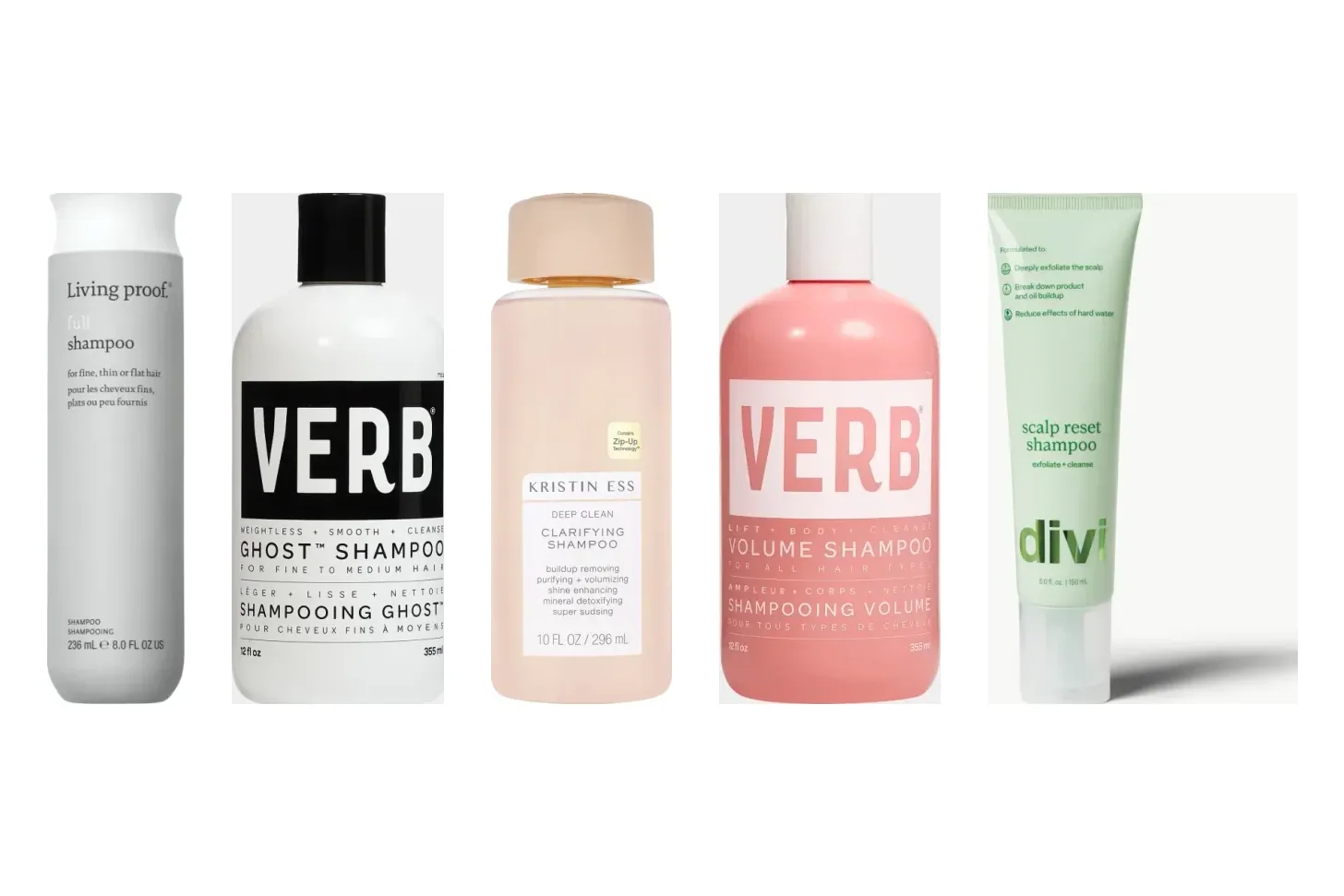
Six picks across six brands, ranked on the three jobs a shampoo can actually do — a clean scalp, a light base for fine roots, and honest cosmetic thickness — with the actives graded on the evidence above. Each names the reader it is for and one real limitation, because every bottle here is a compromise somewhere.