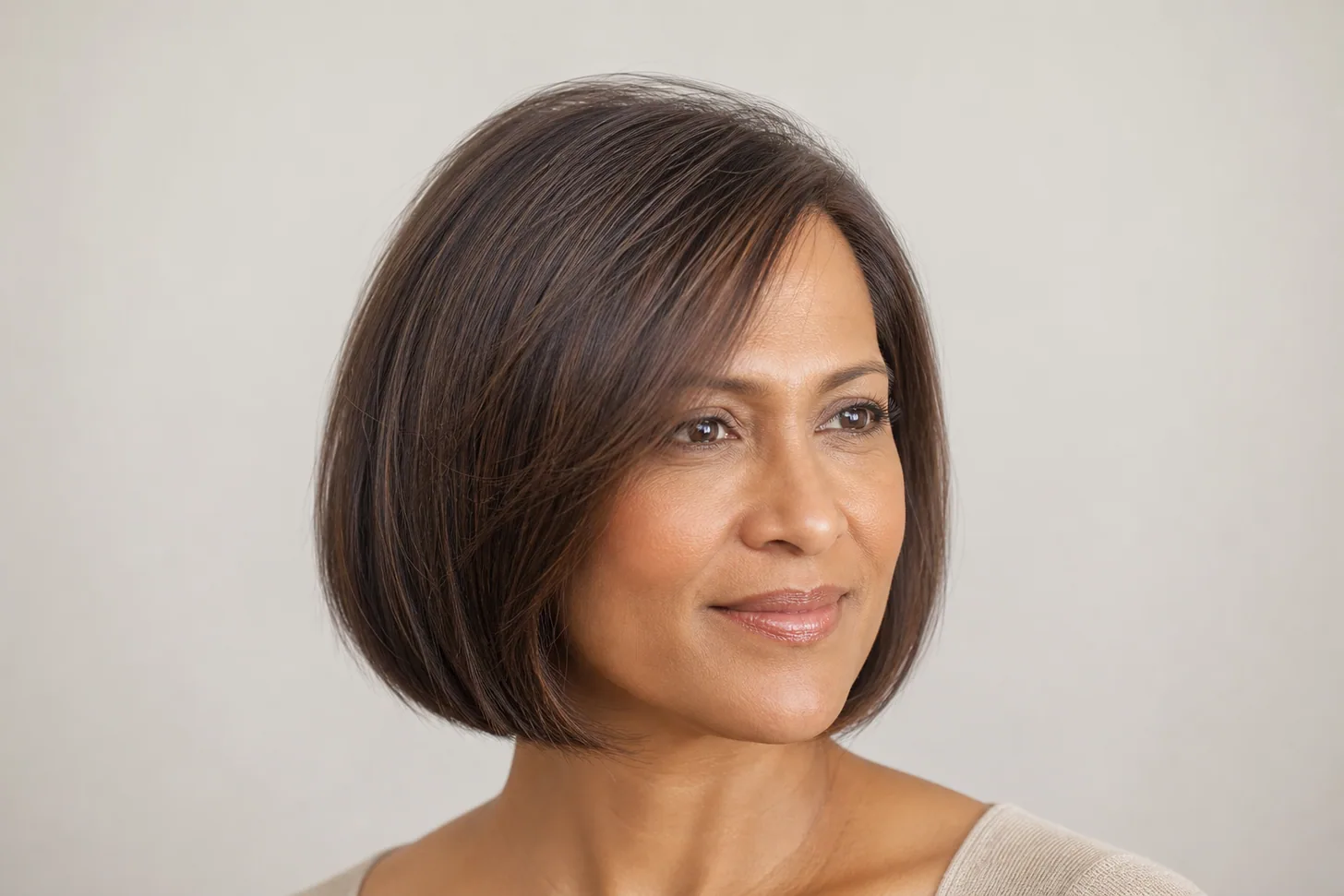
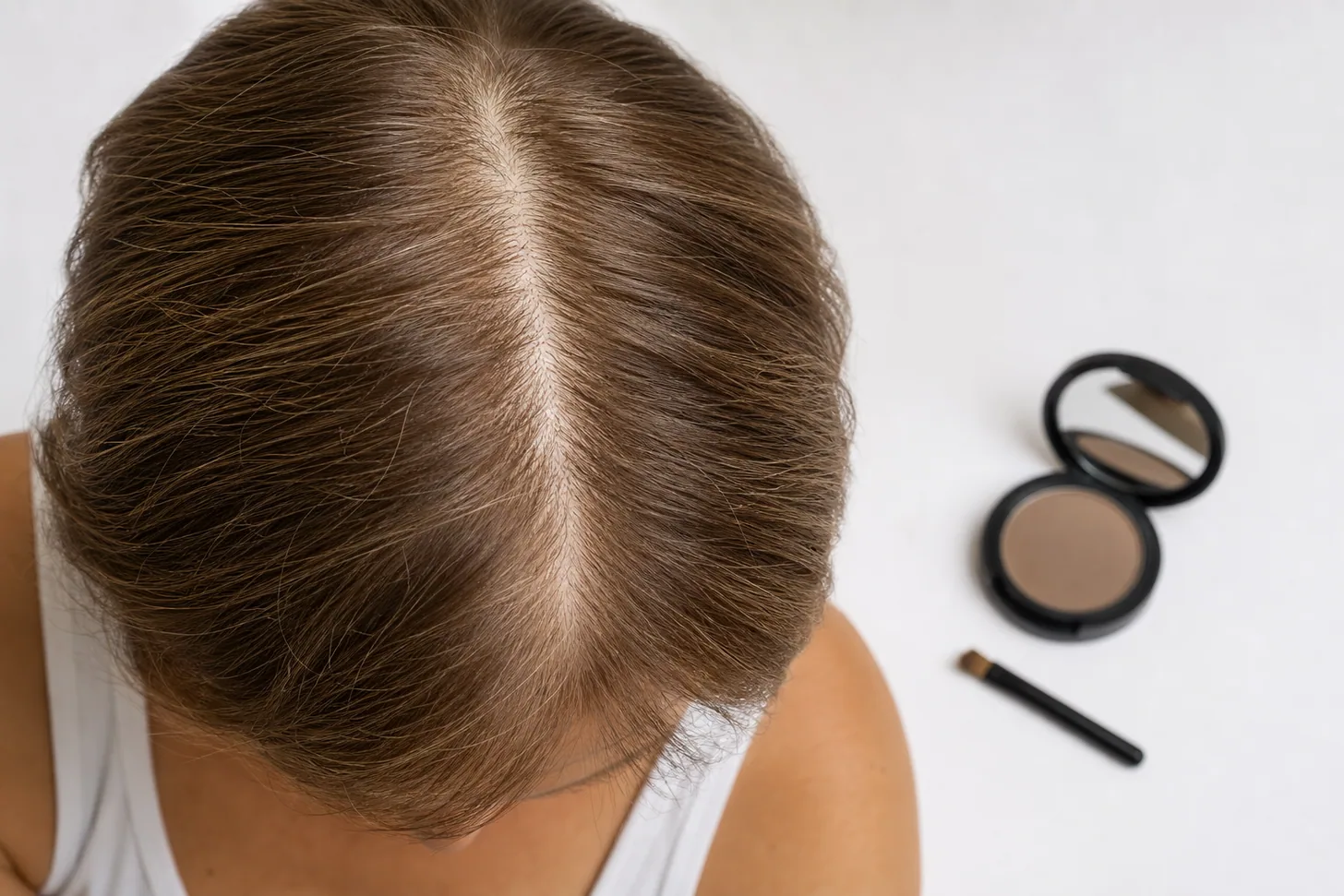
A cut cannot rebuild a hairline. What it can do is change what the eye reads — and at the front of the head that is a different problem from the one at the crown. A thinning crown is an area, and cuts treat it with coverage. A receded hairline is a line, and a sparse line reads as the boundary between your hair and your scalp.
So the cuts that work here do one of three things: they soften that line with texture, they cross it with a part that lays denser hair diagonally over the thin zone, or they move the eye's anchor point back so the mass of the haircut is what you notice first.
Below: the three causes worth telling apart before you book anything — one of them is time-sensitive — why a fringe is the instinct and usually the wrong answer, and 14 cuts grouped by which of the three jobs they do.
The front edge is a line, not an area — which changes what a cut can do about it.
Chair-side note
The consultation I have most often about a hairline starts with a client pulling her hair back to show me, and it is nearly always the wrong way round. Pulled back, every hairline looks sparse — the hair is under tension and lying flat against the scalp, which is the least flattering possible reading of it. What I actually need to see is the hair loose, dry, and parted where she normally parts it, because that is the version other people see.
Half the time the difference between those two pictures is the whole problem: the hairline is thinner than it was, but it is not thin in the way she has been imagining it, and the cut she needs is smaller than the one she came in asking for. The other half of the time I say what I say below — that this is a question for a doctor first and a chair second.
SB
— Simone Baptiste, Senior Stylist
Before the cut: three things move a hairline, and one of them is urgent
A stylist can tell you which cuts help. Only a dermatologist can tell you which of these you have — and with one of them, how soon you go matters more than which cut you choose. Read this section before the gallery, not after.
What it is
What it looks like at the front
What a cut can do
What to do first
Traction
Temples and front edge thin first; short broken hairs along the line; often worse on the side you sleep or pull toward.
A lot — and the cut has to be wearable loose, which is half the treatment.
A band of pale, slightly shiny skin running along the front and sides; the hairline looks like it has moved back in a clean line; eyebrows thinning or gone.
Cosmetic coverage only. It does not slow it.
See a dermatologist promptly. Scarred follicles do not regrow, and early treatment is the whole game.
Pattern hair loss reaching forward
Starts at the part and crown and widens toward the front; the frontal line itself often survives longest.
It is also the sign most likely to be put down to over-plucking in your twenties. If your hairline has moved back in a clean band and your brows have thinned, that combination is a dermatology appointment rather than a salon one — because once a follicle scars, it can no longer grow hair.
None of that means a cut is pointless. It means the cut is the cosmetic half of a two-part answer, and it works best when the other half is under way. If you are not yet sure whether what you are seeing is loss at all, fine hair or thinning is the page that sorts that out, and which blood tests are worth asking for covers what a workup usually involves.
Why a fringe is the instinct, and usually the wrong answer
Every search for this ends up at the same suggestion: get bangs. It is the obvious move and it is wrong more often than it is right, for a reason that has nothing to do with fashion.
A fringe is cut from a triangular section at the very front of the head, with its apex at your part. That section is your hairline.
On a hairline that has receded, it is the sparsest hair you own — so cutting a fringe means building the most visually demanding part of the haircut out of the least material available, and no technique compensates for a shortage of raw material. A fringe cut from thin ground looks thin, in a way that reads specifically as thinness rather than as a style.
It gets worse in wear. A fringe over a sparse hairline is pinned back, tucked and pushed aside all day, and that is repeated tension on the exact spot where tension is already a suspect.
The honest version of the advice is: a fringe is a good answer to a naturally high hairline and a poor answer to a receded one, and telling those apart is the first job. Our guide to bangs for thin hair and a big forehead works through that distinction in detail and is the right page if yours has always been high.
What works instead is a sweep rather than a fringe: hair taken from further back, where density is still normal, and laid across the front on the diagonal. It gives you the coverage a fringe promises using hair that can actually deliver it, and it costs nothing at the hairline. Most of the cuts below are built around that idea.
The three jobs a cut can do at the front edge
Because the problem is a line rather than an area, the levers are different from the ones that work at the crown. There are three, and every cut in the gallery below is doing at least one of them.
Job
What it means
The instruction to give your stylist
Soften the line
Break up the hard boundary between hair and skin, so there is no single edge for the eye to find.
"Leave the front edge soft and irregular — point-cut, nothing blunt across the front."
Cross the line
Lay denser hair diagonally over the sparse zone, so the eye travels along hair rather than stopping at scalp.
"Cut this to fall off a deep side part, and take the sweep from behind the thin area, not from it."
Move the anchor back
Put the visual weight of the haircut further from the front, so the mass is what registers first.
"Keep weight and length through the mid-lengths; start any framing at my cheekbone, not my hairline."
One rule cuts across all three, and it is the single most useful sentence to bring to an appointment: take nothing out of the front section.
On fine hair every shortened strand is one that no longer reaches the perimeter, and at a receded edge those strands are the ones you can least afford to lose. This is the same arithmetic that makes face-framing layers cheap elsewhere and expensive here — the technique is identical, but the hair it borrows from is not.
Cuts that soften the line
These five work by removing the hard edge. None of them adds hair; they change whether there is a visible boundary for the eye to land on, which on a fine, sparse front edge is most of the perceived problem.
soft textured lob with wispy irregular front edge on fine hair, woman in her forties, side-lit
1
Textured lob with a softened front edge
A collarbone lob where the only shaping at the front is a light point-cut through the first inch, so the edge sits irregular rather than in a line. It is the least invasive cut on this list and the one I recommend most often — nothing is removed, the shape does the work, and it grows out invisibly. Ask specifically for no blunt line across the front, which is the default a lot of stylists reach for without being asked.
soft shag with feathered face-framing pieces on fine hair, thinning temples, natural light
2
Soft shag, framed from the cheekbone down
The shag's whole logic is texture instead of line, which is exactly what a sparse front edge wants — there is nothing hard anywhere for the eye to catch on. The critical modification is where the framing starts: at the cheekbone, never at the hairline, so the shortest pieces are cut from hair that is still dense. Read the honest density caveat in our guide to shag haircuts for thin hair first, because a shag needs material to build texture from.
chin-length bob worn with soft waves through the mid-lengths on fine hair
3
Chin bob worn with a bend
A plain chin-length bob, but styled with a soft bend through the mid-lengths rather than left straight. The bend is doing something specific here: a wave breaks the sightline from the front edge down, so the eye stops reading the hairline as the start of a continuous flat plane. It also lifts the hair fractionally off the scalp at the sides. Two minutes with a flat iron does it — the method is in curling fine hair with a flat iron.
mid-length cut with soft crown texture and no fringe on fine hair, temples visible but softened
4
Mid-length with interior texture, no fringe
Length kept at the perimeter, with light interior texture through the crown only. The texture lifts the hair away from the scalp behind the hairline, which reduces the contrast between a sparse edge and the mass behind it — a large part of what makes a receded line obvious is that flat hair sits tight to the head right where the density drops.
soft pixie with longer irregular front piece on fine hair, woman in her fifties
5
Soft pixie with a longer, irregular front
The short option, and it works better than most people expect — short hair stands away from the scalp, which reduces the flat-against-the-head contrast that makes a thin edge obvious. Keep two to three inches at the front and have it point-cut into irregular lengths rather than a fringe. It is a real commitment, so read the pixie on fine hair before booking.
Chair-side note
There is one instruction I give more than any other for a thinning front edge, and it is not about cutting at all. Move your part, and move it a long way. Most people shift a part half an inch and call it done.
On a hairline that has opened at the temples you want to go much further — a genuinely deep side part, starting almost above the outer corner of the eyebrow — because the point is not root lift, it is that you now have several inches of dense hair travelling diagonally across the sparse zone instead of a straight line of scalp running back from it.
It costs nothing, it needs no appointment, and I have had clients cancel a cut after trying it in the mirror. The one caution: a part worn in the same new spot for years will eventually flatten too, so switch it back and forth rather than committing.
SB
— Simone Baptiste, Senior Stylist
Cuts that cross the line
These five are built around a deep side part or a diagonal sweep. All of them borrow density from where you still have it and lay it over where you do not — which is the fringe's promise, delivered without cutting into the thin zone.
collarbone cut worn off a deep side part with hair sweeping across the temple on fine hair
6
Collarbone cut off a deep side part
If you take one cut from this page, take this one. Collarbone length keeps enough weight to read as a mass of hair, and the deep part sends a wide diagonal panel across the temple. It suits nearly every face shape because the diagonal does the flattering rather than the length. Ask for the cut to be balanced for a side part rather than a centre one — a cut built for the middle never quite sits right pushed over.
side-swept long layers falling diagonally across the forehead on fine hair, no blunt fringe
7
The long side sweep, taken from behind the part
The nearest thing to bangs that a receded hairline should accept. The sweep is cut long — cheekbone to jaw — and taken from a section behind the part line, so every strand in it comes from dense hair. It lies across the forehead on the diagonal and can be tucked when you want it out of the way. Our guide to side-swept bangs on fine hair has the cutting brief; ask for the longer, non-fringe version of it.
asymmetric lob longer on one side worn off a deep part on fine hair
8
Asymmetric lob, longer on the heavier side
Thinning is often worse on one side — the side you sleep on, or the side a ponytail habitually pulled toward. An asymmetric lob answers that directly: the longer side carries the part and the sweep, the shorter side sits clean. If one of your temples is noticeably worse than the other, why hair thins on one side is worth reading before you decide which way round to cut it.
soft curtain shape parted deeply to one side rather than centre, on fine hair
9
The off-centre curtain
A curtain shape is normally centre-parted, which is the one part a receded hairline should avoid — a centre part draws a straight line of scalp back from the thinnest point. Cut the same shape but hang it off a part two or three inches to one side and the longer half becomes a sweep. It keeps the softness people want from curtain bangs without the centre line. Note the maintenance is a fringe's, not a haircut's: a trim every four to five weeks.
shoulder-length cut with deep side part and soft waves, fine hair, thinning temple covered
10
Shoulder-length with a waved diagonal
Same principle as number 6, one length longer and finished with a bend so the sweep holds its diagonal instead of sliding flat. On fine hair a wave is what stops swept hair from falling back into a straight line by mid-morning; a light mousse at the roots before drying gives it something to hold onto. This is the version to choose if you want the coverage but do not want to cut anything at all.
Cuts that move the anchor back
The last four work by relocating where the eye lands. If the visual weight of the haircut sits well behind the hairline, the front edge stops being the first thing anyone reads — including you, in the mirror.
blunt-hemmed lob with dense perimeter on fine hair, weight low, front edge soft
11
Blunt-hemmed lob with a soft front
A deliberate contradiction that works: keep the hem blunt and dense so the perimeter reads as the heaviest thing in the haircut, and keep the front edge soft. The weight sits low, the eye goes there first, and the hairline becomes a detail rather than the headline. The lob for fine hair covers how blunt is blunt enough without tipping into heavy.
graduated bob with height at the back of the crown on fine hair, front edge left soft
12
Graduated bob with crown height
Graduation stacks weight upward at the back, which builds a rounded silhouette behind the face. On a fine head of hair that silhouette is the strongest thing in the outline, and outlines are what people read from a few feet away. Useful too if pattern loss is part of your picture, since it puts fullness at the crown as well — graduated and stacked bobs has the technical brief.
long fine hair one-length below the shoulders with volume through the mid-lengths, no fringe
13
Long and one-length, volume in the middle
Length is not off the table, and being told to cut it short because of a hairline is advice worth pushing back on. What long hair needs here is volume placed through the mid-lengths rather than at the roots, so the widest part of the silhouette sits at cheek-to-jaw level, well below the front edge. Honest trade: this is the highest-effort option on the page, and long hairstyles for fine hair is candid about what it costs.
low loose half-up secured behind the ear on fine hair, no tension at the hairline
14
The cut built to be worn half-up, from behind the ear
Not a shape so much as a brief: enough length to gather, cut so it still looks finished when it is up. The point is that it has to be securable behind the ear rather than above it, because a half-up taken from the crown pulls directly on the front edge. Ask for the sides to be left long enough to reach a low clip without straining. Half-up styles for fine hair covers the low-tension versions.
Parting and styling that do more than the cut
At the hairline, more of the result comes from how you wear it than from what was cut. Four things, in order of how much they change.
Part deep, and switch it. Not half an inch — start the part almost above the outer corner of your eyebrow, so a wide panel of dense hair travels across the thin zone. Alternate between two positions rather than settling into one, since a part worn in the same place for years trains the hair flat. Our guide to where to part fine hair has the geometry.
Take the tension off everything at the front. Loose and low beats tight and high, every time and whatever the cause. A low ponytail gathered at the nape, a half-up clipped behind the ear, no clip-ins anchored at the hairline. Ponytails on fine hair covers the low-load versions, and the AAD's guidance on hairstyles that pull on the hair is worth ten minutes of your time.
Shadow the skin, don't try to bulk the hair. At a sparse edge there is little for a fiber product to cling to, so a pigment that darkens the scalp does more than a powder that bulks strands — this is exactly the split explained in scalp concealers versus fibers. Applied at the temple with a small brush, it is the fastest cosmetic improvement available.
Soften the contrast with color, carefully. Lightening the lengths a shade or two reduces the contrast between hair and scalp, which is most of what makes a thin edge visible. Keep the lightener away from the fragile front hairs themselves — highlights on fine hair covers placement.
What to ask your stylist
Lead with the constraint, and be specific about the front section — it is the instruction most likely to be overridden by habit. Say: "My hairline has thinned at the temples. Please take nothing out of the front section — no fringe, no face-framing starting at the hairline. I'd like this cut to fall off a deep side part, with any framing starting at my cheekbone, and a soft point-cut front edge rather than a blunt line."
Add the wearing constraint: "It needs to work worn loose — I'm keeping tension off the front." And if you have not yet seen a doctor, say so plainly; a good stylist will tell you if what they are looking at belongs in a dermatologist's office. More of this language is in what to ask your stylist about fine hair.
When these cuts aren't your best move
Your hairline has moved back in a clean band and your eyebrows have thinned. Book a dermatologist before a salon. That combination points at a scarring alopecia, where timing genuinely changes the outcome and a haircut changes nothing.
Your hairline has always been high and the density right at the edge is normal. This is the wrong page — you have a proportion question, not a density one, and a fringe is a legitimate answer. Go to bangs for thin hair and a big forehead.
The thinning is at your part and crown rather than the front. Different lever set entirely, and a better-developed one. Cuts for a thinning crown and widening part is the page.
You want a cut that will let you keep wearing a tight, high ponytail. No cut makes that safe at a thinning hairline. The style is the load, and the load is the part worth changing first.
FAQ
A collarbone-length cut with a deep side part and face-framing that starts at the cheekbone rather than at the hairline. That combination does all three things a cut can do at the front edge: the part lays denser hair diagonally across the sparse temple, the framing puts weight beside the thin zone instead of cutting length out of it, and the length gives the eye somewhere else to land. What it does not do is rebuild the hairline, and nothing cut with scissors does. The single most useful instruction to give a stylist is take nothing from the front section — that hair is the sparsest you own, and every piece shortened there is one that no longer reaches the mass of the haircut.
Usually not, and the reason is geometry rather than style. A fringe is cut from a triangular section at the very front of the head — precisely the hair a receded hairline has least of. That means building the most visually demanding part of your haircut out of the thinnest material you have, and no cutting technique compensates for that. It also gets pinned and tucked all day, which is repeated tension exactly where tension is already a suspect. A deep side sweep taken from behind the part gives you the same coverage using hair that can deliver it. A naturally high hairline is a different case entirely, and bangs work well there.
A high hairline has been where it is since childhood, follows a smooth even line, and has the same density right up to the edge. A receded hairline has moved: the temples have opened into a deeper V, the front edge is softer and wispier than the hair behind it, and photographs from a few years ago look different. The distinction decides everything, because a high hairline is a proportion question a fringe can answer and a receded one is a density question a fringe makes worse. If you are unsure, compare the hair right at the edge with the hair an inch behind it — same thickness means high, noticeably finer means it has moved.
It can change what the eye reads, which is not the same as hiding it but is worth more than people expect. The front of your hair is a line, and a sparse line reads as a boundary between hair and scalp. A cut has three ways to interfere: soften that line with texture so there is no hard edge, cross it with a part or sweep that lays denser hair over the thin zone, or move the eye's anchor back by putting the haircut's visual weight further from the front. What a cut cannot do is add density or restart a follicle. Treat it as the cosmetic half of the answer, with the cause as the other half.
Three explanations cover most cases, told apart by pattern rather than severity. Traction from tight ponytails, buns, braids and extensions pulls at the front edge and temples first and is reversible if caught early — the thinning hairline covers that window. Frontal fibrosing alopecia produces a band of pale, slightly shiny skin along the front and sides, usually after menopause, and the AAD reports that 80 to 95 percent of women diagnosed with it have lost some or all of their eyebrows; that combination warrants a prompt dermatology appointment, because scarred follicles do not regrow. Female pattern hair loss typically starts at the part and crown but can extend forward. A stylist can tell you which cuts help; only a doctor can tell you which of these it is.
Not on their own. The temples are one of the commonest places for tension damage to show first, and they are also where a normal mature hairline settles in some women without going further. What separates worrying from ordinary is movement and texture: hair the same fineness as the rest of yours, in a spot that has looked that way for years, is usually just your hairline. Hair at the temples that is visibly shorter, wispier and sparser than the hair behind it, in an area that has changed in the last year or two, is worth an appointment. Photographs are more reliable than memory — compare a picture from three years ago rather than trying to recall.
Anything that puts sustained pull on the front edge, and anything that draws a hard line across it. That rules out tight high ponytails, slicked-back buns, tight braids close to the hairline, and clip-in pieces anchored at the front. It also rules out a severe centre part on a hairline that has opened at the temples, since that sets a straight line of scalp running back from the thinnest point. Heavy heat and constant pinning at the front belong on the same list. The workable versions are loose, low and taken from further back: a ponytail gathered at the nape rather than the crown, a half-up secured behind the ear rather than above it, and a deep side part instead of a centre one.
Sources
American Academy of Dermatology. Frontal fibrosing alopecia: overview — on who it affects, the band of hair loss along the front and sides, eyebrow loss in 80–95% of diagnosed women, and the fact that a scarred follicle can no longer grow hair.
Eleven years behind the chair, specializing in short shapes and fine-hair texture. Simone believes the best haircut is the one you can style yourself in ten minutes.
This article is for general education and is not medical advice. A receding hairline can have several causes, some of them scarring and time-sensitive, and the cuts here are cosmetic coverage rather than treatment. If your hairline is moving, your eyebrows are thinning, your scalp is sore or itchy, or the shedding is ongoing, see a board-certified dermatologist.
Images in this article are AI-generated illustrations, not photographs of real clients or results. See our image policy.
Results vary with hair type, density, and growth patterns. This guide is educational and not a substitute for an in-person consultation with a licensed stylist or physician.
Get the good hair intel
One honest, stylist-written guide in your inbox each week. No hype.

 SB
SB