Once you have tried minoxidil, the next tier costs real money and the marketing gets much louder, so it is worth knowing where the evidence actually sits before you spend. Three things reframe this whole category.
Three, and this is the one that saves the most money: all of it treats density, none of it treats fineness. If your part has not widened and your ponytail has not thinned, this entire tier is aimed at a problem you do not have. Below: each option, what its best evidence really says, what it costs you indefinitely, and the order worth trying them in.
Reviewed by a board-certified dermatologist. This page describes treatments — it does not recommend one for you. That is a conversation with a doctor who has examined your scalp.
The order of operations matters more than the shortlist: diagnosis first, then the cheap options, then the expensive ones.
First: is this even your problem?
Everything on this page increases or preserves density — the number of hairs growing per square centimetre. Nothing on it increases diameter in hair that is simply fine.
That distinction is the founding subject of this site, and it decides whether any of what follows is relevant to you. Fine is a strand characteristic you were born with. Thinning is a change in how many strands you have.
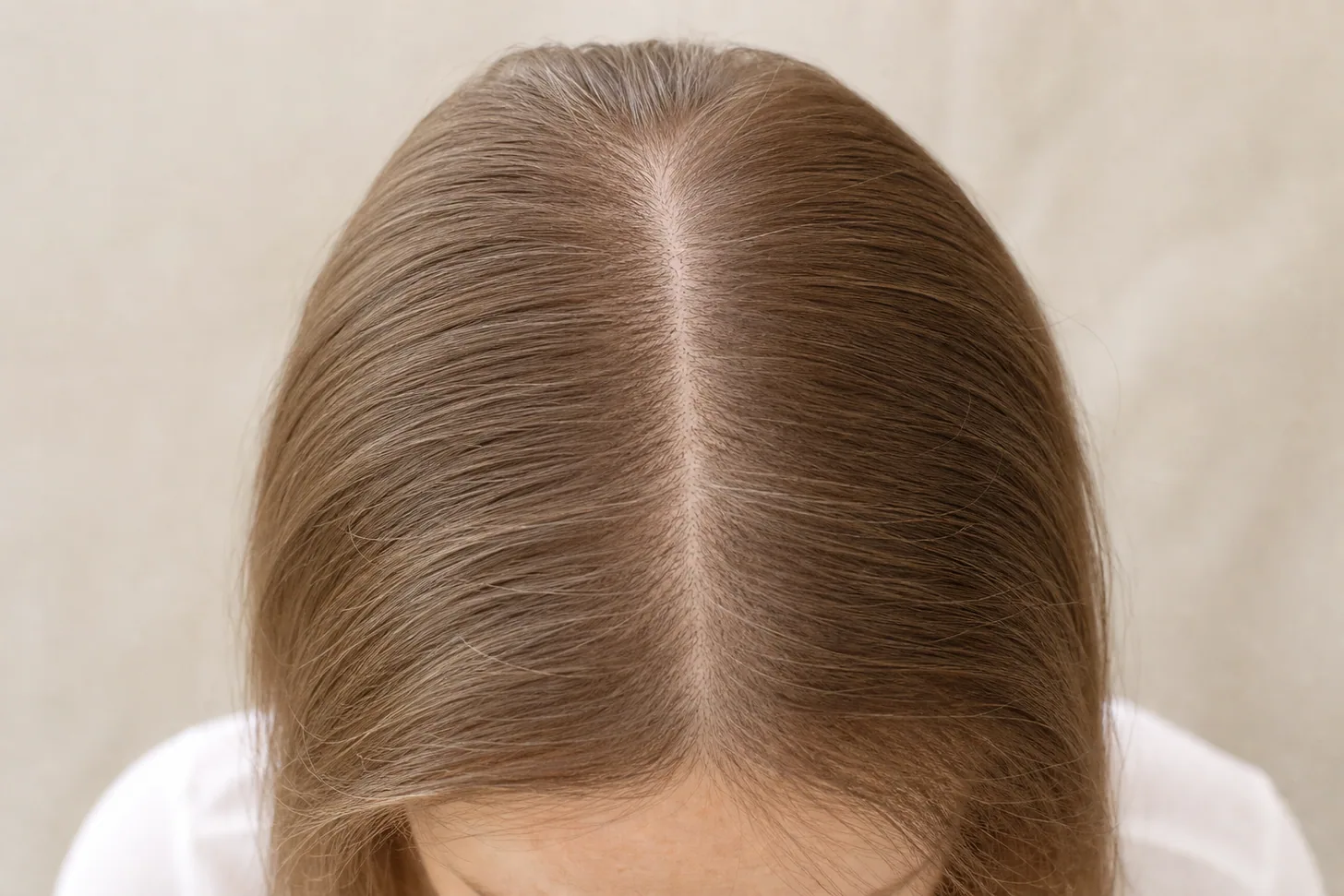
If your hair has always been fine, your part is the same width it was five years ago and your ponytail measures the same, then this tier of treatment is aimed at a condition you do not have, and the honest answer is cosmetic: the right cut, a blunt line that reads as density, color contrast, less product weight, more root lift. Fine vs thin hair settles which you have, and the three at-home checks take about ten minutes.
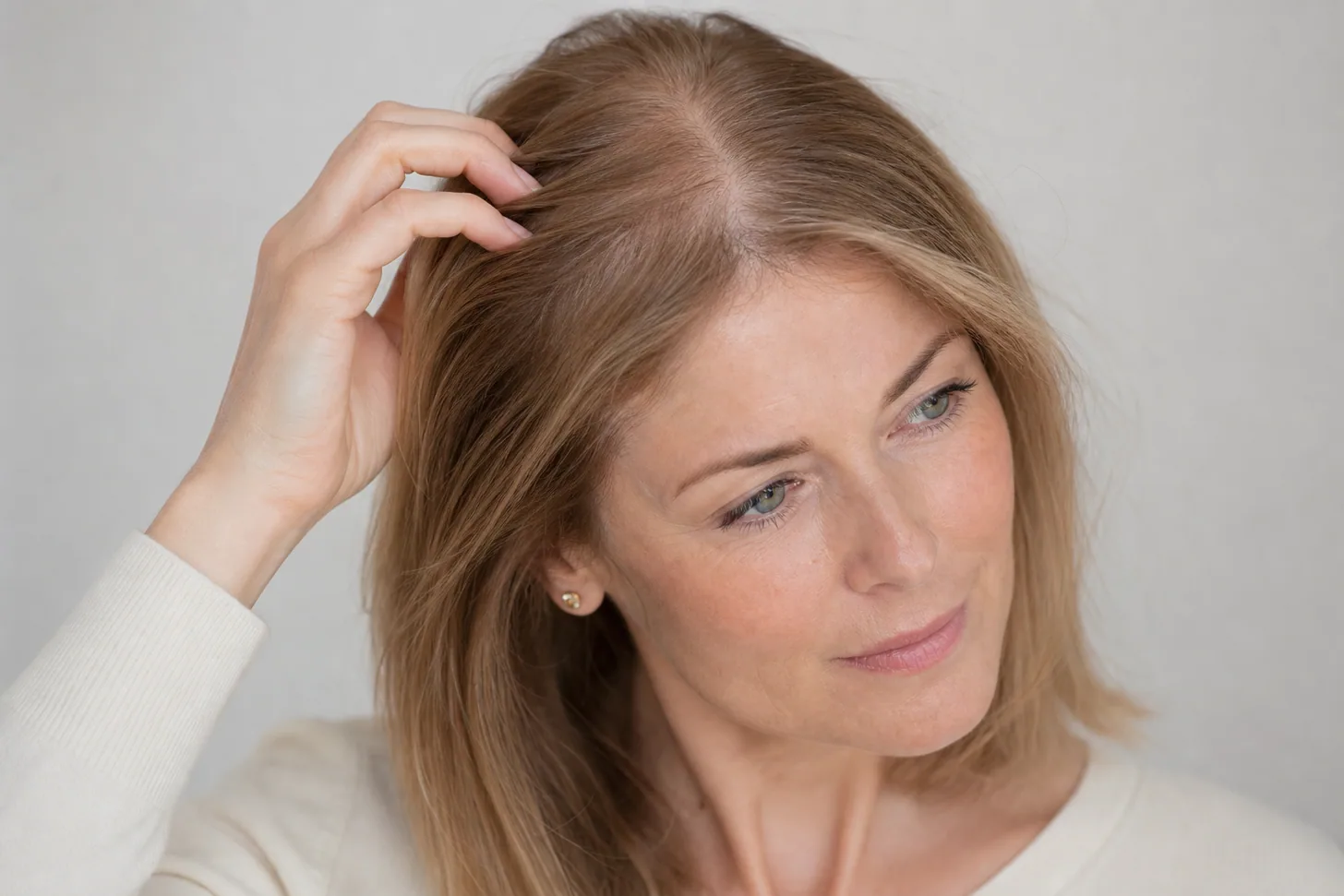
And if something has changed, the second question is what kind of change. Three different things present as "less hair" and only one of them responds to anything here:
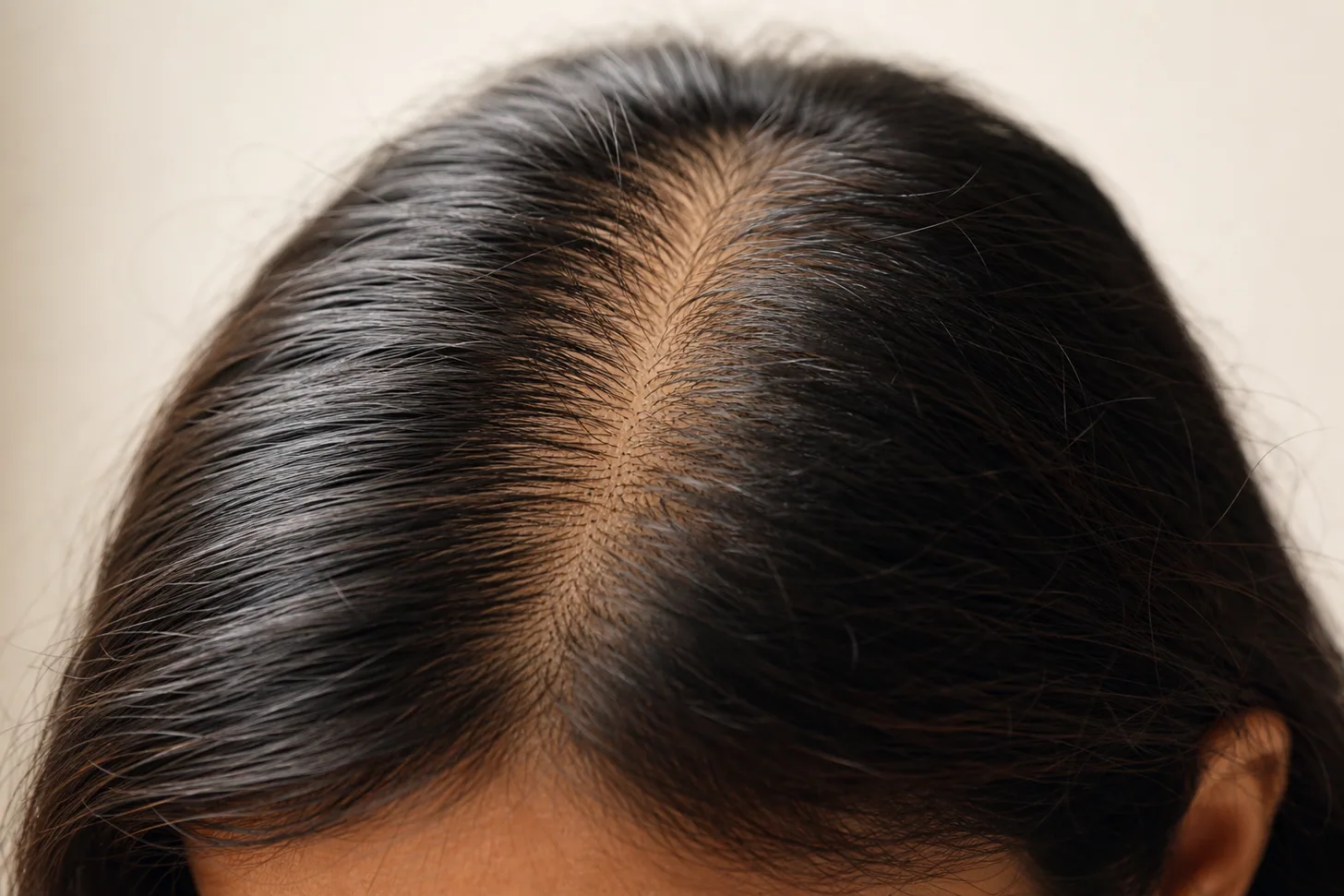
Pattern hair loss — gradual, concentrated at the part and crown, sparing the back. This is what the treatments below are for.
Telogen effluvium — an abrupt diffuse shed, dateable to a month, usually triggered two to four months earlier by illness, weight loss, childbirth or a medication change. It resolves on its own. PRP will not fix low ferritin.
Breakage — you are losing inches rather than hairs. A handling problem with a handling fix. Breakage on fine hair.
Which is why the cheapest, highest-yield first move is not a treatment at all: basic blood work and a medication review. Both are inexpensive, and both can change the answer entirely. Timing is part of that diagnosis: shedding that begins in the forties alongside cycle changes has its own explanation, covered in perimenopause and fine hair.
The baseline: topical minoxidil, and why it stays the reference point
This page assumes you have already met minoxidil — can you grow fine hair thicker? covers it properly. Two facts matter for what follows.
It is the only widely available option here with genuine FDA approval for female pattern hair loss rather than clearance or off-label use, and it is the cheapest thing on the list.
That makes it the yardstick: every more expensive option should be judged on what it adds to minoxidil, not on what it does in isolation. That includes the cheapest tier of all: best shampoo for thinning hair grades what a wash can add, which is less than the bottles claim.
And it is slow. The AAD's guidance on minoxidil is that "it takes time to see results, usually about 6 to 12 months". A great many people conclude minoxidil failed at month three and move on to something costing twenty times as much, which is the single most expensive mistake in this whole area.
Microneedling: the cheapest option, and the biggest single trial result
Microneedling rolls or stamps very fine needles through the scalp, creating micro-injuries that trigger a wound-healing response and — the part that matters practically — greatly increase how much topical product gets absorbed.
The trial behind it is Dhurat 2013, and it is worth reading carefully because almost every clinic page misdescribes what it compared. One hundred men with mild-to-moderate pattern loss were split into two groups. Both groups used 5% minoxidil twice daily. One group also had weekly microneedling. So the study is not microneedling versus minoxidil — it is minoxidil versus minoxidil-plus-microneedling.
The honest caveats: it was a pilot study, in men, evaluator-blinded rather than double-blinded, and it has not been replicated at scale. And the gap between a clinician's device and a cheap home roller is real — needle length, needle quality and sterility all vary, and a blunt roller dragged across a scalp is a way to injure skin rather than treat it.
This is worth doing under guidance rather than off a marketplace listing, and it is not for anyone with an active scalp condition.
What it means in practice: if minoxidil is doing something but not enough, this is the cheapest evidence-backed way to make it do more — and it should be discussed with the doctor managing your treatment, not started the week you read about it.
Chair-side note
The pattern I see over and over is someone who has spent four figures at the expensive end of this list and has never given the cheap end a fair run.
They tried minoxidil for eight or ten weeks, decided it wasn't working, stopped, and moved on to PRP — where the sessions come with an appointment, a practitioner and a plan, and therefore feel like proper treatment in a way that a bottle on the bathroom shelf never does. But six to twelve months is the actual timescale for minoxidil, and stopping at week ten is stopping before the thing has started.
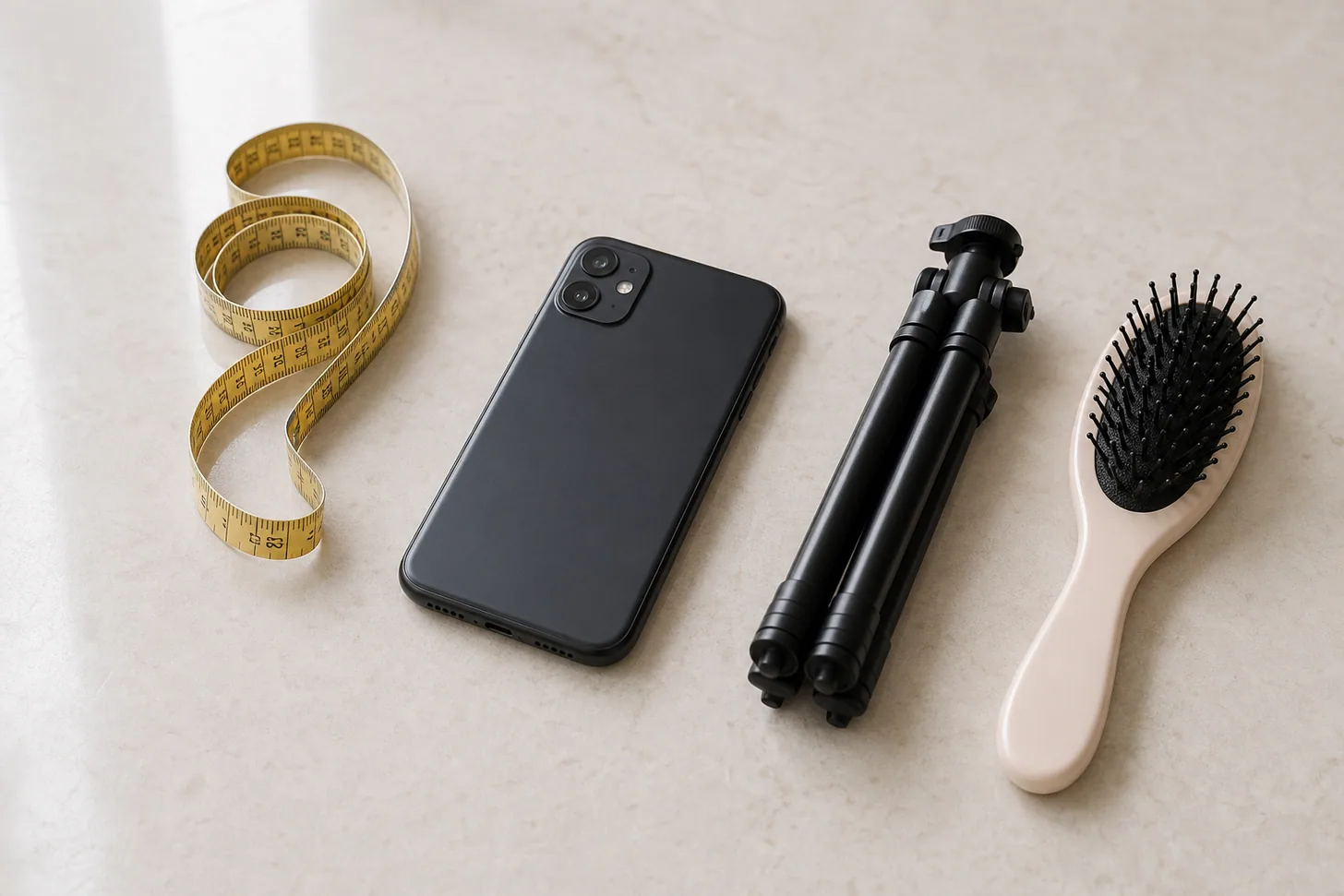
My advice when someone asks where to begin is unromantic: give the boring option a full year with a photograph at the start, taken in the same light with the same part, because you will not be able to judge it from memory. That photograph is worth more than any consultation, and it costs nothing. If the year genuinely produces nothing, you'll be having the next conversation with real information instead of an impression.
MH
— Megan Holloway, Editor-in-Chief
PRP: a real effect size wrapped in poor-quality evidence
The reason for the disagreement between studies is not mysterious: PRP is not a standardized product. Spin speed, spin time, platelet concentration, whether it is activated, injection depth and session spacing all differ between clinics. So "does PRP work" is not quite answerable — what a given clinic's PRP does is a narrower question than the literature can address.
What that means for you: it is plausible and it is the most expensive item here, sold as a course of sessions plus indefinite maintenance — the AAD notes it is not a permanent solution and that maintenance treatments help sustain results. If you are going to do it, ask the clinic for its specific protocol and how many sessions before a decision point, and go in with a baseline photograph.
Laser caps and combs: real trials, short follow-up, and a regulatory word game
Low-level laser therapy uses red light at low power, and it is the category where the marketing leans hardest on a regulatory term that does not mean what shoppers think.
The word game first. These devices are cleared, not approved. Clearance under the 510(k) route means a manufacturer showed its device is substantially equivalent to something already legally on the market. It is not a finding of efficacy.
Read together: six months of evidence, no basis for choosing between the thirty-plus devices on sale, nothing on advanced loss — supporting a large one-off outlay and a daily habit you are expected to keep for years. It is not a bad option. It is an option whose evidence stops well short of the commitment being asked for.
The prescription tier: low-dose oral minoxidil and spironolactone
Often the most useful thing a dermatologist offers is not a procedure but a prescription, and both of the common ones are used off-label for female pattern hair loss — meaning they are approved drugs being used for a purpose outside their licence, which is legal, routine, and something you should know you are agreeing to.
Low-dose oral minoxidil takes the same drug as the topical and gives it as a tablet at a fraction of the blood-pressure dose. It solves the compliance problem — nobody skips a tablet the way they skip a twice-daily scalp application — and it treats the whole scalp evenly.
A retrospective review of women on "LDOM (2.5 mg daily or less)" with ambulatory blood-pressure monitoring found "a mean change in SBP of −2.8 mmHg, in DBP of −1.4 mmHg, and in HR of +4.4 beats/min" after at least four months — small changes, which is the reassuring finding. The side effect that actually bothers people is hypertrichosis: hair growing where you did not want it, typically on the face. It is dose-related and reversible on stopping, and it is the commonest reason women discontinue.
Spironolactone is an anti-androgen, used where the pattern suggests androgen sensitivity. It requires monitoring, it is not compatible with pregnancy, and it is a conversation with a doctor rather than a thing to read about and request.
Both belong to the "ask about" list rather than the "buy" list, and both are relevant to hair changes around menopause, where the hormonal context changes what is worth considering.
Hair transplant: permanent, but not an exit
The AAD's position is that a transplant "can be an effective and permanent solution" for the right candidate. Two things temper that, and the second is specific to this audience.
It redistributes; it does not create, and it does not stop anything. Hair is moved from the back and sides to the top. Whatever process was thinning the untransplanted hair carries on afterwards, which is why people are generally advised to stay on medical treatment following surgery. A transplant is a graft on top of an ongoing condition, not a cure for it.
Fine hair changes the arithmetic. Coverage per graft depends on how much visual weight each hair carries, and a fine strand covers less scalp than a coarse one — so achieving the same apparent density takes more grafts from the same limited donor area.
Diffuse female thinning also frequently involves the donor region itself, which is exactly the candidacy question a careful surgeon raises first and a sales-led clinic does not. If a consultation does not spend serious time on your donor area, that tells you something about the consultation.
In the meantime, the cosmetic routes are not a consolation prize: toppers, scalp concealers and building fibers do a great deal, immediately, reversibly, and for a fraction of the money.
Ranked by evidence per dollar
Not by how impressive the treatment sounds. This is the table this page exists to print.
Option
Regulatory status (US, female pattern loss)
Best evidence
Ongoing cost
Where it belongs in the order
Topical minoxidil
FDA approved
The reference standard; slow — 6–12 months
Low, indefinite
First. Give it a full year and a baseline photo
Microneedling + minoxidil
Device; adjunct use
91.4 vs 22.2 hair count at 12 wks; 82% vs 4.5% self-rated >50% improvement (pilot, men)
Low, ongoing
Second, under guidance, if minoxidil alone underperforms
Low-dose oral minoxidil
Prescription, off-label
Small BP/HR changes at ≤2.5 mg; hypertrichosis is the limiting side effect
Low–moderate, indefinite
The conversation to have when topical fails or isn't used consistently
Spironolactone
Prescription, off-label
Anti-androgen; needs monitoring; not compatible with pregnancy
Low–moderate, indefinite
Where the pattern points to androgen sensitivity — doctor-led
Laser cap / comb
FDA cleared, not approved
SMD 1.27 (0.96–1.59), 7 RCTs, 607 participants — but ≤26-week follow-up, no head-to-head
High upfront, then daily use for years
Optional add-on once the cheap tier has had a real run
PRP
Procedure; not FDA approved for hair loss
MD 27.55 hairs/cm² (14.04–41.06) — but I² = 95.99% and clear publication bias
Highest; course plus indefinite maintenance
Last of the non-surgical options; ask the clinic for its protocol
Hair transplant
Surgical procedure
Permanent for the moved hair; doesn't halt the underlying loss
Large one-off, plus ongoing medical treatment
Only after diagnosis, stabilization, and a candid donor-area assessment
Six questions worth asking at the consultation
What is my diagnosis, and how did you reach it? "Thinning" is a description, not a diagnosis. Pattern loss, effluvium and breakage need different answers.
Is this treatment approved for this use, or off-label, or a cleared device? All three are legitimate. You should know which one you are buying.
What happens if I stop? For everything on this page, the answer is that you lose the benefit. Confirm it out loud.
How many sessions before we decide whether it is working, and how will we decide? A photograph protocol, or a hair count — not an impression at month three.
What is the total cost over two years? Session fees plus maintenance, not the price of the first appointment.
Have we ruled out the cheap causes? Ferritin, thyroid, a medication change. If those have not been checked, that is the appointment to have first.
When none of this is your answer
Your hair is fine but not thinning.These are density treatments; you have a diameter characteristic. The cut, the color and the product weight will do far more. Fine vs thin, cuts that read as fuller.
You are in an active shed you can date.Telogen effluvium resolves on its own and is usually triggered two to four months earlier. Find the trigger. Medications, weight-loss shedding, postpartum.
You are losing inches, not hairs.Breakage does not respond to growth treatment. Breakage, wet handling.
You haven't had blood work.Iron, ferritin and thyroid are cheap and they change the plan. Do this before spending on anything. Which tests matter.
The loss is patchy, sudden, or the scalp is painful, scaly or scarred.That is a different diagnosis and it needs a dermatologist now, not a treatment menu.
The measured effect is meaningful and the quality of the evidence behind it is poor, and both halves of that sentence are true at once. A 2024 systematic review and meta-analysis pooling 14 studies and 431 patients found a mean difference of 27.55 hairs per square centimetre in favour of PRP, with a confidence interval running from 14.04 to 41.06. Twenty-seven extra hairs per square centimetre would be visible on a part line. But the same paper reported heterogeneity of I² 95.99 percent and clear evidence of publication bias as shown by the asymmetry in the funnel plot, and its conclusion is deliberately hedged: highly heterogeneous studies with publication bias suggest PRP effectively increases hair density, so further high-quality randomized clinical trials are recommended. The practical reading is that PRP probably does something real, that nobody can tell you how much because clinics prepare it differently, and that it's the most expensive item on the list with the least settled evidence.
That's the wrong comparison, and getting it right is the most useful thing on this page. The trial everyone cites — Dhurat 2013, 100 patients — didn't compare microneedling against minoxidil. Both groups got twice-daily 5% minoxidil; one group also got weekly microneedling. So its result is evidence for microneedling as an add-on, not as a replacement. The result itself is striking: the mean change in hair count at week 12 was significantly greater for the microneedling group compared to the minoxidil group at 91.4 versus 22.2, and 41 of 50 patients in the microneedling group, 82 percent, reported more than 50 percent improvement against just 4.5 percent in the minoxidil-only group. It's also worth knowing it was a pilot study in men, evaluator-blinded rather than fully blinded, and that needle depth and technique vary enormously between what a clinic does and what a home roller does. Treat microneedling as the cheapest way to make minoxidil work harder, not as a way to avoid it.
There's real randomized evidence behind low-level laser therapy, and there's also a regulatory sleight of hand you should understand before spending several hundred dollars. A meta-analysis of home-use devices pooled seven randomized controlled trials with 607 participants and found a standardized mean difference against sham of 1.27, with a confidence interval of 0.96 to 1.59 — a substantial effect. Its limitations are as important: only a few RCTs were conducted, with a maximum follow-up of 26 weeks, no head-to-head studies comparing devices exist, and all participants had mild-to-moderate hair loss with no study conducted in severe cases. So the evidence is genuine but short, on a treatment you're expected to use indefinitely. The regulatory point: these devices are FDA cleared, not FDA approved, and as the American Academy of Dermatology puts it, the requirements for getting FDA cleared are much less stringent than for getting FDA approved. Clearance means a device resembles one already on the market. It is not a finding that it works.
Topical minoxidil, because it's the only one on the list with actual FDA approval for female pattern hair loss, and it costs less than any of the alternatives. If it works, everything else becomes optional. If it doesn't work well enough after a fair trial — and a fair trial is at least six months, since the AAD notes it takes time to see results, usually about 6 to 12 months — the cheapest next step with real supporting evidence is adding microneedling, and the next conversation after that is a prescription one about low-dose oral minoxidil or spironolactone. PRP and laser devices sit at the expensive end and are best considered once the cheap options have been given a genuine run. The one thing not to do is start at the expensive end because it feels more serious. Cost doesn't track evidence in this field, and in several places it runs the other way.
No, and this is the correction that saves the most money on this page. Everything described here is a density treatment: it aims to increase the number of hairs growing in a given area, or to keep the ones you have from miniaturizing. None of it addresses strand diameter in hair that is simply fine. If your hair has always been fine, your part hasn't widened, your ponytail hasn't thinned and you're not shedding more than usual, then you have a diameter characteristic rather than a density problem, and this entire tier of treatment is aimed at something you don't have. What genuinely changes how fine hair looks is cosmetic and structural — the right cut, blunt lines that read as density, color contrast, product weight, and root lift. That's a better use of both money and hope, and it works the same week rather than in six months.
Every treatment on this page is ongoing, without exception, and the ongoing part is the cost people underestimate. Topical minoxidil is a few dollars a month, indefinitely — stop it and the hair it maintained goes. Microneedling is the cost of a device plus the minoxidil it's amplifying, repeated weekly to fortnightly. Laser devices are a large one-off outlay for the cap or comb, then daily or near-daily sessions for years. Prescription options are the cost of the drug plus periodic reviews. PRP is a session fee, an induction course of several sessions, then maintenance sessions indefinitely — the AAD notes PRP is not a permanent solution and that maintenance treatments can help maintain results. Even a hair transplant isn't an exit: it relocates hair, it doesn't stop the underlying process, so most people stay on medical treatment afterwards to protect the hair that wasn't transplanted.
It can be, and it's more complicated on fine hair than the marketing suggests, for two reasons worth understanding before a consultation. The first applies to everyone: a transplant moves hair from the back and sides to the top. It doesn't create hair, and it doesn't stop whatever is causing the thinning — which is why people are usually advised to stay on medical treatment afterwards to protect the hair that wasn't moved. The second is specific to this audience. Coverage per graft depends on how much visual weight each transplanted hair carries, and a fine strand covers less scalp than a coarse one, so a fine-haired candidate needs more grafts to achieve the same apparent density from the same donor area. Diffuse female thinning also often involves the donor region itself, which is the ideal-candidate question a good surgeon will raise first. The AAD's framing is that a transplant can be an effective and permanent solution for the right candidate; establishing whether you are one is the whole consultation.
Get a diagnosis, because at least three different things produce the same complaint and only one of them responds to the treatments on this page. Female pattern hair loss, telogen effluvium and breakage all present as less hair, and PRP won't help a shed caused by low ferritin or a medication started three months ago. The sequence worth following is: basic blood work first, since it's cheap and it changes what happens next; a medication review, because drug-induced shedding shows up two to four months after a change and is entirely reversible; and a proper look at whether what you're losing is hairs or inches, since breakage is a handling problem rather than a follicle one. Only after those have been ruled in or out does the question of which growth treatment to spend money on become answerable.
Fourteen years in fine-hair care, eight of them behind the chair. Megan's rule for this tier: give the cheap option a full year and a baseline photograph before you spend at the expensive end.
This article is for general education and is not medical advice. It describes treatments; it does not recommend one for you, and it is not a substitute for examination and diagnosis by a board-certified dermatologist. Off-label prescribing, procedures and devices all carry risks that must be discussed with a qualified clinician. If you are experiencing sudden or patchy hair loss, scalp pain, scarring, or other concerning symptoms, seek medical care.
Images in this article are AI-generated illustrations, not photographs of real clients or results. See our image policy.
Results vary with hair type, density, and growth patterns. This guide is educational and not a substitute for an in-person consultation with a licensed stylist or physician.
Get the good hair intel
One honest, stylist-written guide in your inbox each week. No hype.

 MH
MH