Reviewed by Tara Sullivan · Updated July 2026 · 8 min read
You can absolutely keep long hair after 50 — but it's the hardest length to keep full on fine hair, so it has to be earned with the right cut, honest condition, and a plan for the ends. Long, flat, one-length hair is what reads thin and tired; long hair layered for movement, framed at the face, and kept glossy looks healthy and current.
Below are 14 salon-tested long cuts for fine and thin hair over 50, grouped from the body-building layered shapes to the softly styled ways to wear it — plus the honest sign it's time to come shorter. If your ends have gone wispy, a medium length over 50 will look fuller; this guide is for when the length is still working for you.
Chair-side note
When a client over 50 asks to keep her long hair, I don't say no on principle — I give her the honest test. I lift the very ends and we look together: are they still dense, or can we see through them? Healthy, dense ends earn the length. See-through, wispy ends mean the length is working against her, and no amount of product will fix it.
If the ends have gone, I'll suggest taking off an inch or two first — often that alone makes the whole length look fuller. Long hair after 50 is a condition question far more than an age question. Keep it healthy and layered, and it's beautiful. Let it go stringy, and that's what ages you.
SB
— Simone Baptiste, Senior Stylist
Why long is harder — and how to make it work over 50
Length is weight, and weight is the enemy of volume on fine hair. The longer it gets, the more the hair pulls itself down and drags the lift out of your roots — and after 50, when density drops and the ends run drier, that effect is stronger than it used to be. That's why the long hair that was effortless at 35 can start to look flat and thin now.
The answer isn't to give up the length automatically; it's to make the cut do the work. Strategic layers remove the dead weight that's dragging the shape down and put movement and volume around the crown and face, while a strong weight zone through the mid-lengths keeps the hair reading dense.
Condition is the other half: glossy, well-trimmed ends look thick, and see-through, split ends look thin no matter the cut. If you're unsure whether you're dealing with finer strands or genuinely lower density, our guide to telling fine hair from thin hair helps you plan — and if the change worries you, read fine hair or thinning first.
The layers are what make long hair work on fine hair over 50 — they take out the dead weight and put movement where the shape needs it. These four build body while keeping real length.
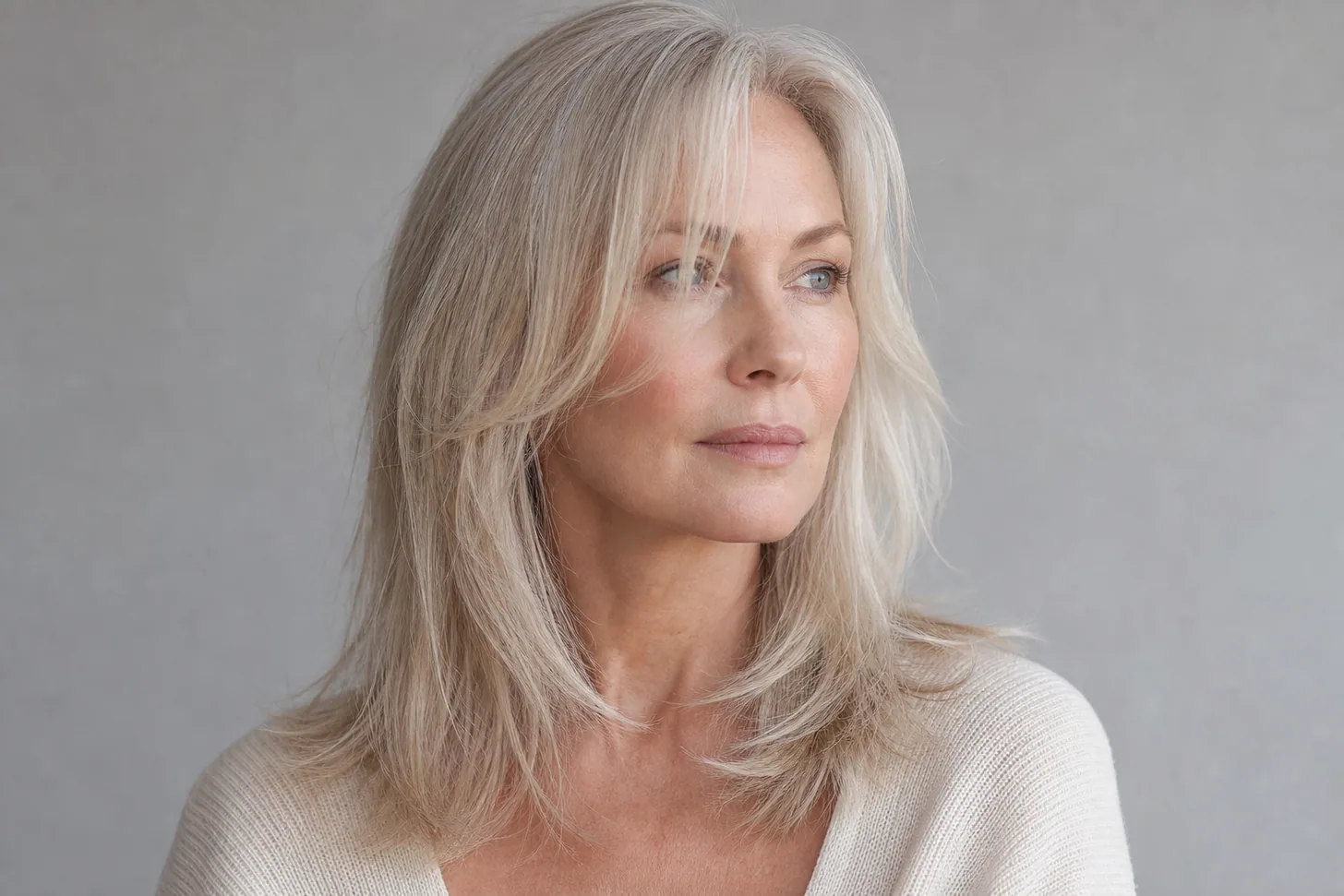
long layered cut with soft internal layers and a strong mid-length weight zone on fine straight silver-blonde hair, woman over 50
1
The soft long layered cut
The core long shape for fine hair over 50: gentle, point-cut internal layers that add movement, kept over a strong band of weight through the mid-lengths so the hair still reads dense. It's long, but it's not the flat, one-length curtain that ages you. Ask for "layers to add movement, but keep a strong weight line — don't scoop it out."
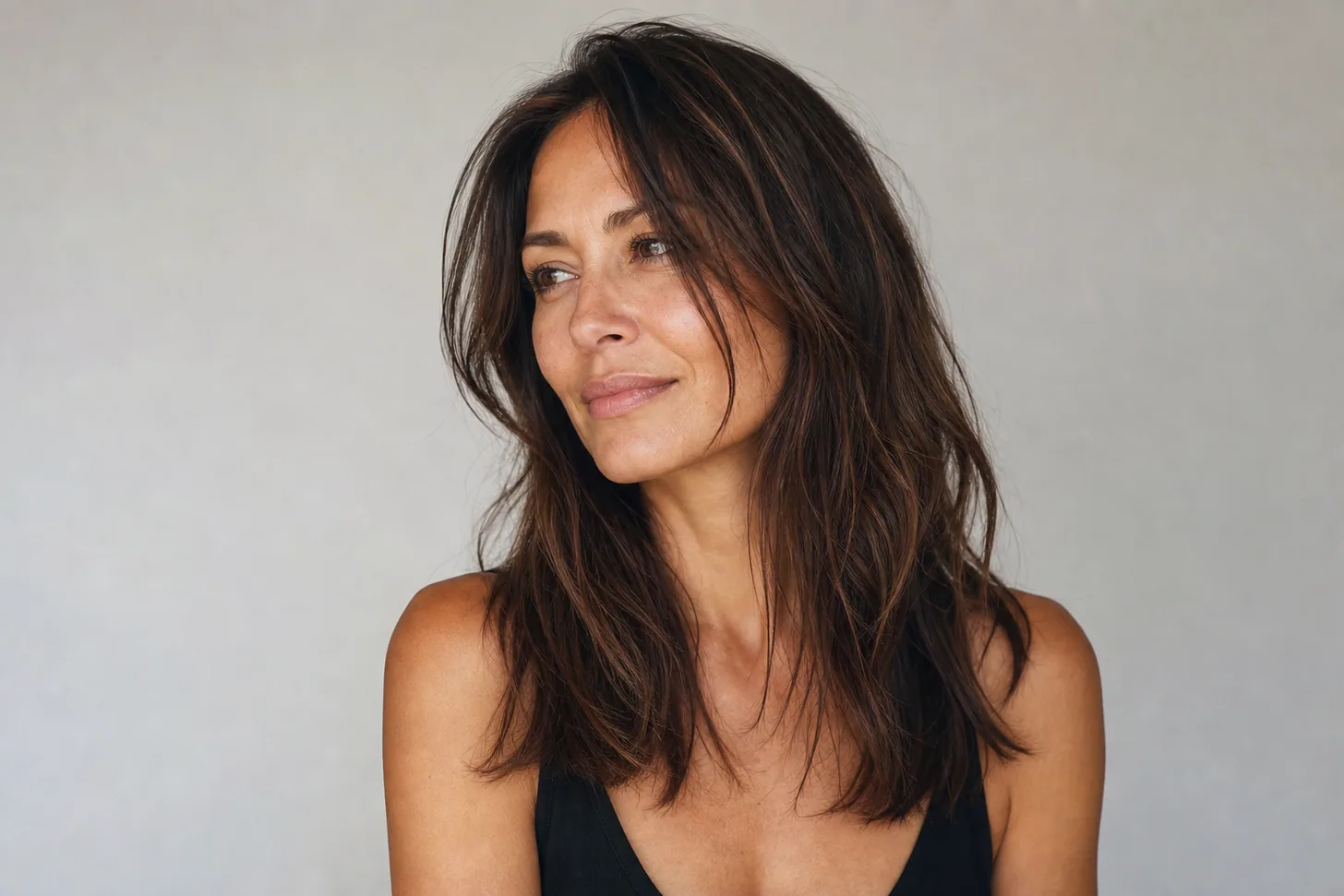
long shag with piece-y crown layers and long length on fine hair, woman over 50
2
The long shag
The shag at full length — piece-y layers concentrated at the crown and face to build volume up top, with the length left long below. The texture hides fine hair's flatness in plain sight, because there's no sleek surface to fall limp, and the shape reads cool rather than dated. Best if you'll work a little texture spray through it rather than blow it smooth.
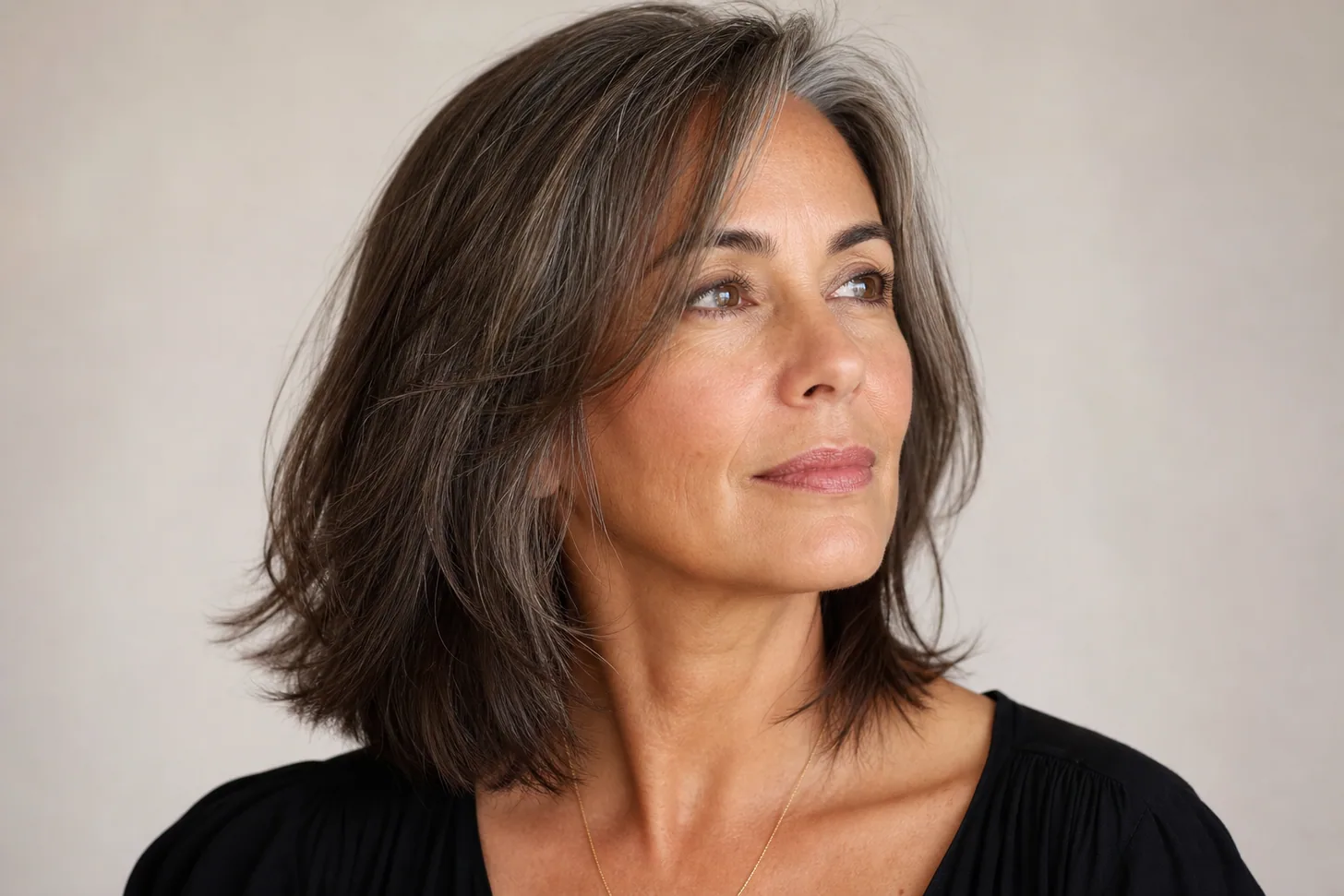
long butterfly cut with short face-framing layers over long length on fine hair, woman over 50
3
The long butterfly cut
The butterfly cut is built for exactly this problem: short face-framing layers stacked over long length, flicked back to create a band of fullness around the face while your length stays long behind. It's the most effective way to keep true length and still look full up top. Ask for the shortest layers around the chin, blended softly into the length.
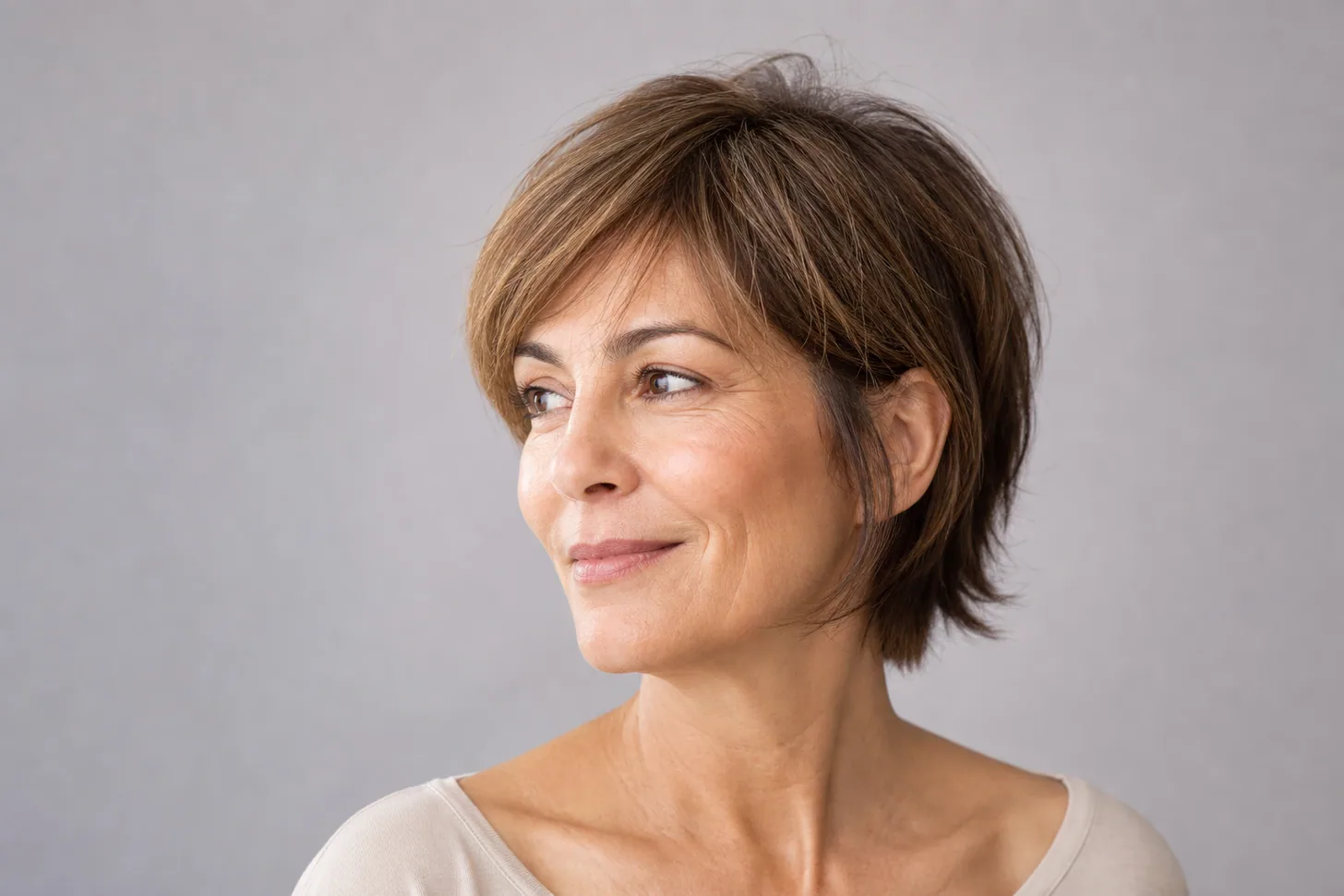
long cut with long invisible layers and a deep side part on fine straight hair, woman over 50
4
The deep-part long layers
Long, barely-there internal layers worn with a deep side part so the crown lifts and the length still swings as one piece. The deep part is doing double duty here — instant root height and coverage for a widening center line. It's the most understated long option, for someone who wants length and movement without an obviously "layered" look.
Long cuts with bangs & face-framing
With long hair, the face-framing is what keeps the length from dragging your features down. A soft fringe or framing pieces lift the face and add fullness exactly where fine hair benefits most. These four pair long length with the right frame.
long cut with soft center-parted curtain bangs sweeping to the cheekbones on fine hair, woman over 50
5
Long with curtain bangs
The most flattering long-hair pairing over 50. Soft, center-parted curtain bangs that sweep back along the cheekbones lift the face, add a cushion of fullness at the front, and stop long hair from reading like flat curtains. They grow out invisibly, so they're low-commitment. This is the single change that most often makes long hair look right again after 50.
long cut with cheekbone-length face-framing layers brightening the face on fine hair, woman over 50
6
Long with bright face-framing
No fringe, but shorter pieces cut around the face from the cheekbone down, so the front of the length lifts and brightens the face. On long hair this is essential rather than optional — it's what keeps the weight of the length from pulling everything down. It also gives you soft pieces to tuck or sweep. Say "frame my face from the cheekbone, keep the length."
long cut with a long side-swept fringe on fine dark blonde hair, woman over 50
7
Long with a side-swept fringe
A longer fringe swept to one side, grazing the brow and blending into the face-framing — a soft, glamorous line that covers a lined forehead without the upkeep of a full fringe. It suits a higher or wider forehead and grows out easily. Blow it across with a round brush for a few seconds and it sets the whole look.
long cut with a soft feathered '70s fringe and flicked layers on fine hair, woman over 50
8
Long with a feathered '70s fringe
A soft, feathered fringe blending into flicked-back layers, for a warm retro feel that's very current again. The feathering builds volume at the sides and crown where fine hair goes flat, and the whole shape is made for a bouncy round-brush finish. It's the most romantic long option here — keep the feathering to the top layers so it doesn't thin the perimeter.
Textured, wavy & softly styled long looks
Texture is long fine hair's best friend after 50 — a bend or a wave supplies built-in body that dead-straight length can't. And a few soft styled options let you wear the length up on the days it's flat. These six round out the edit.
long air-dried wavy cut with natural bend and body on fine wavy hair, woman over 50
9
The long air-dry wave
If your fine hair has kept any wave, lean into it — the bend falls into the length and supplies body that straight long hair can't, so you can skip the blow-dry. Scrunch a light mousse through damp hair and let it air-dry. It's the lowest-effort long look and reads fuller undone than blown smooth. Our guide to fine, wavy hair has the full method.
long cut with soft loose waves curled away from the face on fine hair, woman over 50
10
Long with soft blow-out waves
Loose waves curled away from the face with a large barrel or round brush — the wave adds diameter and movement, which reads as more hair. On fine hair the trick is a light hand and a heat protectant, so the waves have body without looking crunchy. It's the polished way to wear long hair for an occasion, and it flatters almost every face shape.
long cut styled glossy and sleek with a healthy shine on fine straight silver hair, woman over 50
11
The glossy sleek long
The exception to "always add texture": if your ends are genuinely healthy and dense, worn sleek and glossy with a strong weight line, long hair can look striking — especially on silver, where shine reads as vitality. This is the one long look that lives or dies on condition, so keep it well-trimmed and glazed. If the ends aren't there, choose a textured option instead.
long hair worn in a soft half-up style with a lifted crown on fine hair, woman over 50
12
The half-up lift
Taking the crown section up and back into a soft half-up instantly builds height and gets the flat top off your scalp, while the length stays down and long. It's the fastest way to make long fine hair look fuller on a flat day, and it reads polished rather than fussy. A little backcomb at the crown before you pin makes it even fuller.
long hair in a soft low twisted updo with face-framing pieces left out on fine hair, woman over 50
13
The soft low updo
One of long hair's real advantages is that you can put it up — a soft, low twisted style with a few face-framing pieces left out is elegant and hides a flat crown entirely. It's the reason many women keep the length: the versatility. Our guide to updos for fine hair that actually hold shows how to make it stay put on fine hair.
long hair worn in a full-looking low ponytail with a lifted crown on fine hair, woman over 50
14
The lifted low ponytail
A low ponytail with the crown loosened and lifted before you gather it, so the tail looks full rather than scraped-back and thin. Wrapping a small section of hair over the elastic hides it and adds polish. It's the everyday way long hair earns its keep — practical on a busy day and, done with a little crown height, genuinely flattering.
Keeping long fine hair full and healthy over 50
Long hair over 50 lives or dies on condition, so the routine matters as much as the cut. Shampoo at the scalp and keep conditioner on the mid-lengths and ends only, so the roots stay lifted while the length stays soft. Build volume at the root while damp with a root lifter or a lightweight mousse, blow the crown up and over, and set a deep side part for instant height.
Protect the length with a heat protectant before any hot tool, and keep the very ends healthy — a lightweight bond or gloss treatment and a trim every eight to ten weeks stop them going see-through, which is what makes long hair look thin.
The volume tricks in our guide to adding volume to fine hair all apply, and on flat days a mist of dry shampoo at the roots revives the lift. Above all, be honest about the ends: if a trim keeps them dense, keep the length; if they've gone wispy, taking off an inch or two makes the whole head look fuller.
Chair-side note
The most flattering thing I do for long hair over 50 usually happens at the color bar, not the cut: a gloss or glaze. Shine is what the eye reads as "healthy" and "thick," and fine hair over 50 loses shine as the cuticle roughens and the greys come in wiry.
A clear or tinted gloss every few visits lays that cuticle down, and suddenly the same length looks twice as expensive. If you're keeping long hair and it's looking a little tired, don't reach for the scissors first — reach for a gloss. It's the cheapest, fastest way to make long fine hair look thick and intentional again.
SB
— Simone Baptiste, Senior Stylist
What to ask your stylist
Bring a photo, but bring honesty about your ends too. Say: "I want to keep my length, but I have fine hair that's thinner than it used to be. Please add soft layers for movement and face-framing, but keep a strong weight line so the length still looks dense — don't razor it or scoop it out."
Ask them for the honest test: "Tell me truthfully whether my ends can carry this length, or whether I'd look fuller an inch or two shorter." A good stylist will lift the ends, look with you, and tell you straight. If you want the face lift without losing length, add: "Give me curtain bangs." And ask about a gloss — it's the finishing touch that makes long fine hair look healthy.
When it's time to let the length go
Your ends look see-through and wispy no matter how often you trim. The length has outrun your density — a medium length over 50 concentrates the weight higher up and looks immediately fuller.
You're tying it up most days because it looks flat and thin down. If the length is only working in a ponytail, a cut that looks full down will serve you better day to day.
Your part is widening and the length exposes the thinning rather than hiding it. Shorter, lifted shapes cover a sparse crown better; see our short cuts for fine hair over 50.
You're noticing rapid or patchy thinning, not gradual fineness. A cut helps the look, but check the cause first — read our honest guide to fine hair versus thinning and speak to your doctor.
FAQ
Yes, but it has to be earned. Long hair is the hardest length to keep full on fine hair, and after 50 lower density and drier ends make it harder still — the weight of the length drags the roots flat and thin ends fan out. It works when the hair is genuinely healthy, your density can support it, and the cut does the heavy lifting: layers to remove dead weight and add movement, face-framing to lift the face, and a plan to keep the ends strong. If your hair is truly sparse or the ends are see-through, a medium length will almost always look fuller. The honest test is whether your ends still look dense — if they've gone wispy, it's the length working against you.
A long cut with soft, strategically placed layers and face-framing is the best choice — long enough to feel like long hair, layered enough that the length isn't dragging the whole shape flat. A long shag or long butterfly builds movement and volume around the face; a long layered cut with a strong mid-length weight zone keeps the ends looking dense. Add curtain bangs to lift the face. What to avoid is very long, dead-straight, one-length hair with no layers, which is the shape that reads thin and ages you — and razored ends, which leave fine hair stringy.
Long hair doesn't age you — thin, flat, shapeless long hair does. The tired version is long, one-length, poorly conditioned hair that hangs like curtains and drags the face down. Long hair that's layered for movement, framed around the face, kept glossy, and worn with a bit of volume looks healthy and current at any age. The deciding factors are condition and shape, not length. If you keep your long hair in good condition and cut with movement, it can be genuinely flattering after 50; if it's become a security blanket that's thin and neglected, that's what reads old.
Concentrate the weight and treat the ends. Ask for layers that keep a strong band of weight through the mid-lengths so the hair reads dense there, rather than tapering it all to a thin point. Keep the ends trimmed every eight to ten weeks so they don't go see-through, and use a lightweight bond or gloss treatment to keep them healthy. Build root volume while damp with a mousse or root lifter, blow the crown up, and part deeply to the side. A glaze or gloss at the salon adds shine that makes any hair look thicker. And be honest about the very ends — if they've gone wispy, taking off an inch or two often makes the whole length look fuller.
On fine hair over 50, yes — but the right kind. Long fine hair needs layers to remove dead weight and add movement, or it hangs flat and drags the face down. The layers should be soft and point-cut, concentrated to build volume around the crown and face while keeping a strong weight zone through the mid-lengths so the length still looks dense. What long fine hair does not want is heavy, choppy, or razor-cut layering that thins already-sparse ends. Think layers for lift and framing, kept over a body of weight — not layers that scoop the hair out.
When the length has started working against you rather than for you. The signs: your ends look see-through and wispy no matter how you trim, your part is widening and the length exposes the thinning rather than hiding it, and you're relying on tying it up most days because it looks flat down. When that's the case, coming up to a medium length or a lob almost always looks immediately fuller, because it removes the weight that was dragging your roots flat. Going shorter isn't giving up — it's often the single most effective thing you can do to make fine hair look thicker. If you're torn, a medium length is the gentle step down before short.
Eleven years behind the chair, specializing in short shapes and fine-hair texture. Simone believes the best haircut is the one you can style yourself in ten minutes.
Results vary with hair type, density, and growth patterns. This guide is educational and not a substitute for an in-person consultation with a licensed stylist.
Hairstyle images in this guide are AI-generated illustrations, not photos of real clients or results. See our image policy.
Get the good hair intel
One honest, stylist-written guide in your inbox each week. No hype.

 SB
SB