Reviewed by Tara Sullivan · Updated August 2026 · 10 min read
Every diffusing tutorial you've watched was written for dense curls, and on fine hair the priority inverts. A diffuser isn't primarily a curl tool here — it's a root-volume tool that happens to define wave. The reason is mechanical: a wet fine root has almost no stiffness, so left to itself it dries in whatever flattened position gravity put it in, and once dry, that's the shape you're stuck with until the next wash.
A diffuser spreads the airflow gently enough that you can hold the hair somewhere else while it sets. Which reorders the whole routine — roots first, head tipped, in the first two minutes while they're still wet enough to move.
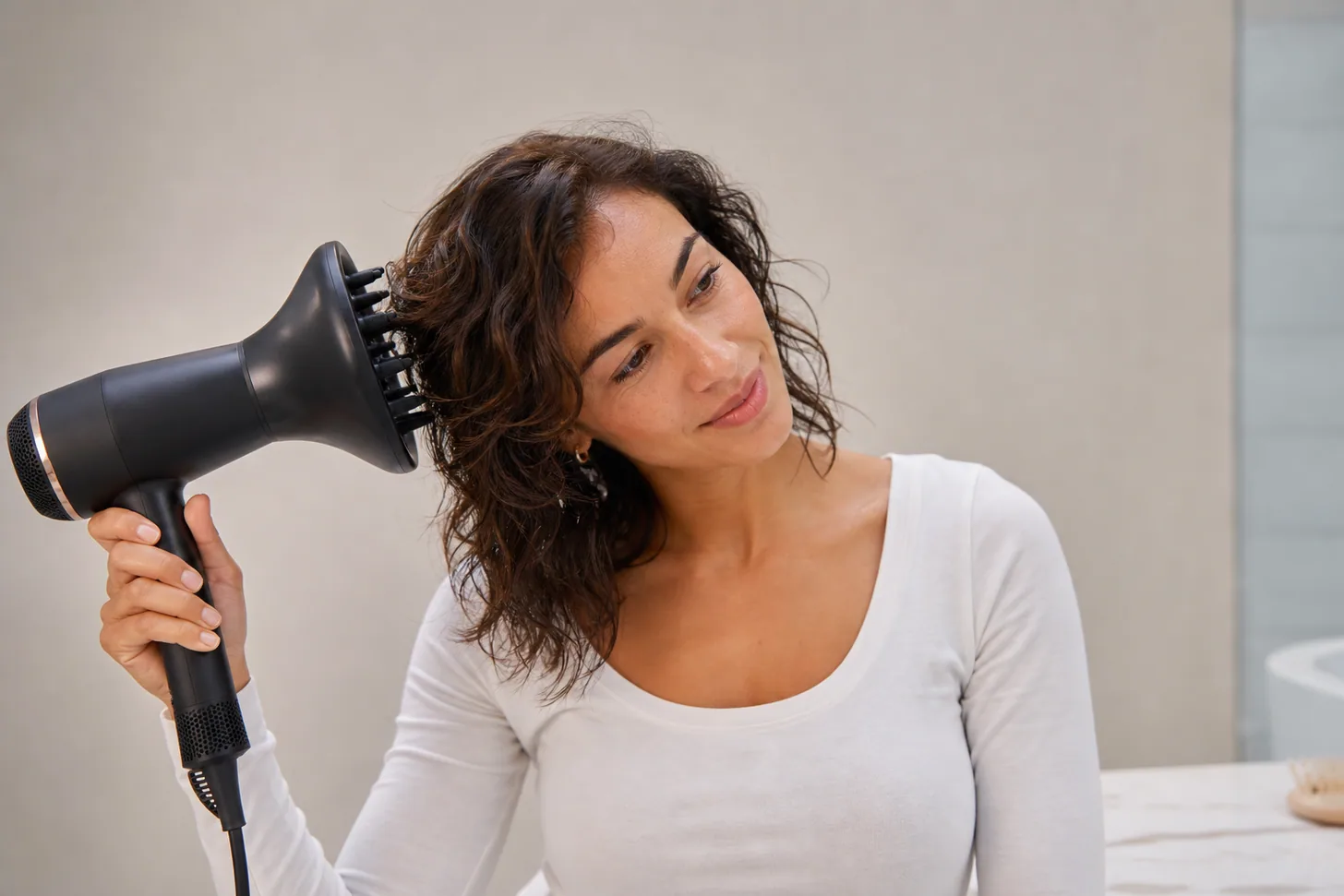
And it explains the one thing to stop doing immediately: pressing the bowl against your scalp, which is both the hottest, closest position you can put the dryer in and a direct compression of the root you're trying to lift. The distance to work at is about six inches, kept moving. Below: why the air-dry-is-gentler orthodoxy doesn't survive the evidence, the nine-step method, and the four reasons fine hair goes flat after diffusing.
Roots first, head tipped, a hand's width away. That's where the volume is decided.
What a diffuser actually does — and why that matters more on fine hair
A dryer nozzle concentrates air into a stream, which is why it can push hair into a new shape with a brush. A diffuser does the opposite: the prongs and the bowl scatter the airflow so it arrives at low pressure from many directions at once. The hair dries roughly where it already is.
On dense curly hair that's valued because it doesn't disturb the curl pattern. On fine hair the useful consequence is different and bigger: if the hair dries where it is, you get to decide where it is. That is also why fine wavy hair gets so much out of a diffuser, provided the wash step left the wave able to clump at all — shampoo for fine wavy hair covers that half.
Which is worth more on fine hair than on any other type, because fine hair is the type that can't hold its own roots up while wet.
Bending resistance falls away sharply as a strand gets thinner, so a soaking-wet fine root has essentially no ability to resist gravity — it lies down on the scalp and dries there. That's the mechanism behind the complaint that runs through this whole site: flat on top, and flat from the moment it dried, not flat by lunchtime.
So the diffuser is doing the same job as a heatless roller or a root clip, by the same physics: hold the hair in the shape you want, and let it dry there.
The air-dry orthodoxy, and the study that complicates it
Wavy-hair advice generally treats air-drying as the virtuous default and any dryer as a compromise. That's worth examining, because the evidence points the other way — and it points there for a reason that's specifically relevant to fine hair.
Two honest caveats. That was one laboratory comparison, not a settled consensus — and the same study found more surface damage from the dryer than from air-drying, so it's a trade between two different kinds of harm rather than a clean win. But the trade lands differently on fine hair, which holds less water, swells fast, and is often left damp for two hours because it "dries on its own anyway".
The practical reading: air-drying is a legitimate low-effort choice, not a virtuous one. If you like the result, carry on — air-drying fine hair has the method. Just don't diffuse with a guilty conscience.
Six inches, and keep it moving
The same study gives the most useful number in this article, because it tested distance and temperature together. Its three dryer conditions were 47 °C at 15 cm, 61 °C at 10 cm, and 95 °C at 5 cm — the temperature at the hair rising as the distance closed. And "hair surfaces tended to become more damaged as the temperature increased", with "punched-out cuticles" appearing only at the closest, hottest condition.
So distance is a heat setting, whatever the dial says. Fifteen centimetres is about six inches — roughly the span of a spread hand. That single fact reframes the most common diffusing habit there is: cupping the bowl against the scalp and holding it there parks you at the 5 cm end of that experiment, and does it on the roots, which is where you can least afford damage and where your part is on display.
What most tutorials say
What fine, low-density hair needs
Why
Cup the ends and press the bowl up to the scalp
Hover near the root; cradle the ends
Pressing compresses the root flat and puts the dryer at its hottest, closest position
Generous curl cream, raked through
A quarter of the dose, nothing above the ears
Fine hair has a small weight budget; creams are formulated for mass that isn't there
High speed to cut the drying time
Low speed, low-medium heat
A fine clump has too little mass to survive strong airflow — it separates into frizz
Dry however, then plop or clip
Roots first, head tipped, in the first two minutes
Root position is set while the hair is wettest; after that you're negotiating
Curl definition is the goal
Root lift is the goal; definition is the bonus
On low density, flat-on-top is the visible problem, not loose waves
Stop at 80% and let it finish
Take it to completely dry
A fine wave that finishes drying unsupported drops, and the lift goes with it
The method, step by step
If flatness at the crown is the specific complaint rather than undefined waves, pair this with root clips — the diffuser cuts the drying time and the clips hold the roots up through it.
Ten to fifteen minutes on shoulder-length fine hair. The order is the part that matters.
Squeeze the water out; don't rub it out. Cup sections in a microfiber towel or an old cotton t-shirt and press upward. Rubbing roughens the cuticle and breaks apart the wave clumps you're about to set. Damp, not dripping, before product.
Use about a quarter of the product a curly tutorial recommends. Emulsify a small amount of lightweight mousse in wet palms and press it upward into the mid-lengths and ends. Nothing above the ears. Product at the root is the number-one reason a diffused wave is flat by noon — mousse for fine hair and curl cream for fine hair both cover the dosing problem in detail.
Add a light gel over the top if you want the wave to last. Gel is the one styler that gives fine hair hold without weight, because the water leaves and only a thin polymer film stays. It'll dry crunchy; that cast is the point. Gel for fine hair.
Roots first. Tip your head over, hover about six inches away, keep the dryer moving. Forward, then each side. Two or three minutes here decides the outcome of the whole dry, because this is the only window in which the roots are wet enough to reposition.
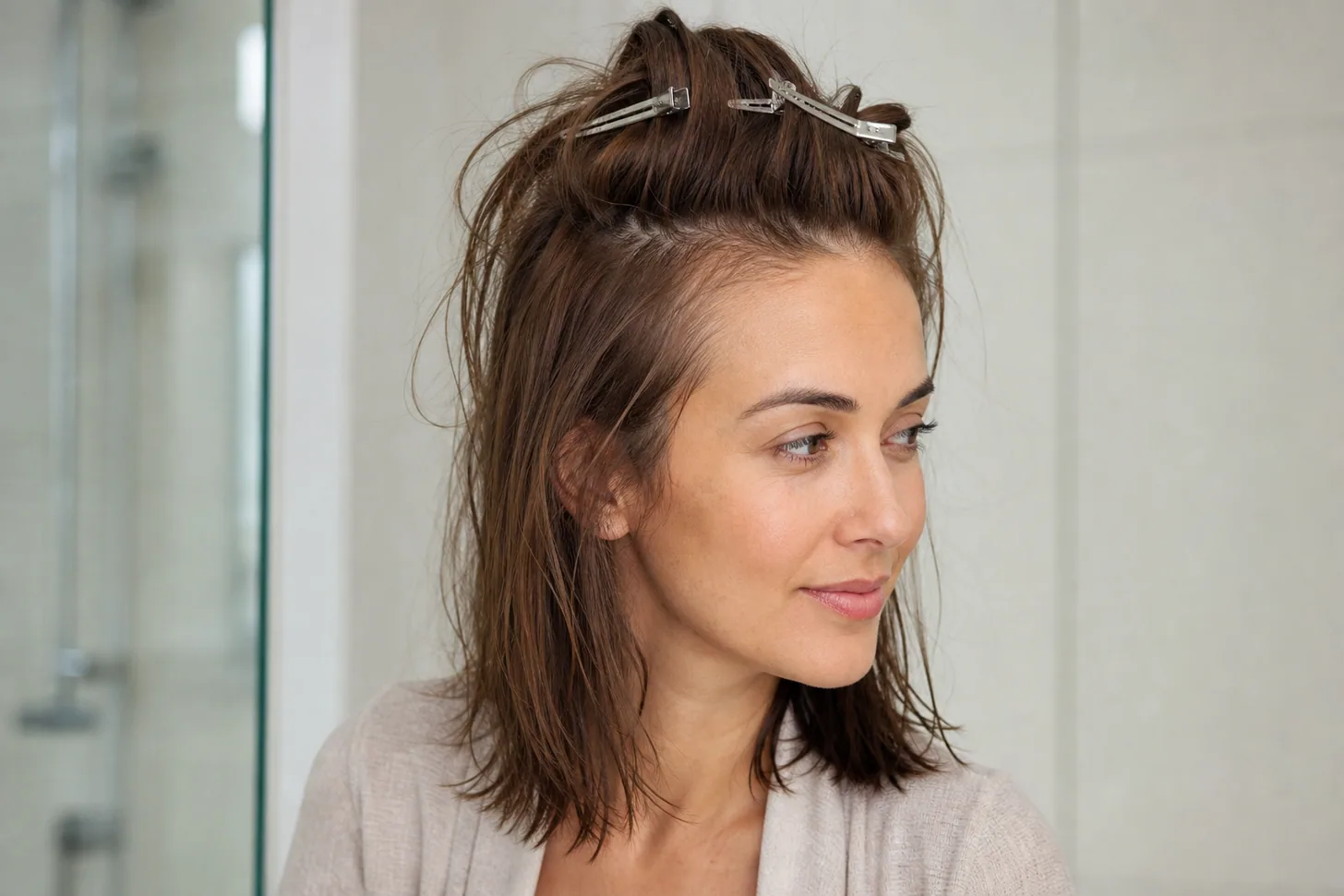
Clip the crown if the top runs flat. Two or three small metal clips slid in at the crown, lifting the roots off the scalp, left in for the rest of the dry. It's the cheapest volume in this article. Root volume for fine hair.
Then the lengths: lift a section into the bowl from underneath and hold it there. Twenty or thirty seconds, then lower it and move on. Cradle — don't press the bowl into your head.
Go all the way to dry, then stop touching it. Anything still damp will drop while it finishes. Handling it mid-dry is how frizz happens.
Cold and fully dry: scrunch the cast out, then lift the roots. A drop of light oil in the palms, scrunch upward through the lengths to break the gel, then push your fingertips into the roots and shake. Never a brush — that undoes every clump at once.
Chair-side note
When a client tells me diffusing doesn't work on her hair, I ask her to show me, and about eight times in ten the answer is visible in the first fifteen seconds: she's cupping the bowl and pushing it firmly against her head, because that's what she's seen in videos.
On a dense curly head that's right — you're supporting the weight of the hair so the curl can spring up into itself. On fine hair there's no weight to support. All you're doing is ironing the root flat with warm air while it dries, which is precisely the position you were trying to get out of.
The correction I give is physical rather than verbal: hold the diffuser a spread hand away from your scalp and pretend there's a pane of glass between the bowl and your head. Then keep it moving. Two washes of that and most people stop believing they have hair that can't be diffused.
SB
— Simone Baptiste, Senior Stylist
Why it went flat: the four culprits, in order of likelihood
If the result is limp rather than lifted, it's almost always one of these, and they're ranked by how often I see them.
Product at the roots. Anything conditioning applied above the ears. Mousse is fine at the root; a cream or a leave-in is not. Halve your quantity and move the application point down.
You pressed the bowl to your scalp. The single most consequential habit, and the easiest to fix.
You dried with your head upright. Gravity chose your root direction. Tip forward for the first two minutes.
You stopped while it was still slightly damp. The shape drops as it finishes. This is also why "diffuse for five minutes then air-dry the rest" gives such an inconsistent result.
A fifth, less obvious one: hair that's coated with buildup won't hold a set. If your waves have gradually stopped responding to a routine that used to work, that's usually a buildup story rather than a technique one — clarifying shampoo for fine hair, and hard water on fine hair if you're somewhere with heavy mineral content.
Short fine hair, and fine hair that's barely wavy
Two variations worth calling out, because the standard method assumes shoulder-length waves.
On a bob, a crop or a pixie, the diffuser is purely a volume tool — there isn't enough length for definition to be the point. Work head-upright, hover over the crown and sides without contact, and use your fingertips underneath to push the roots where you want them while the air sets them.
Dry the crown first and give it a second pass at the end. And on short hair you have an option the long-hair version doesn't: drying against the direction of growth, which builds more lift than any product. Very short cuts for fine hair, the pixie for fine hair.
On fine hair with only a faint bend — the 1C-to-2A territory where you're never quite sure whether you have waves — a diffuser is often the thing that settles the question, because it dries the bend in place instead of letting it stretch out.
Use less product still, and expect body rather than definition. Fine wavy hair is the fuller guide to that texture, and fine straight hair is where to go if the honest answer turns out to be no wave at all.
When a diffuser isn't your best move
Your fine hair is genuinely straight.There's no wave to set, and a diffuser will give you a soft, slightly undefined result you could get more efficiently from a nozzle and a round brush. Blow-drying fine hair for volume.
You want smooth and sleek.Diffusing works by not disturbing the hair, which is the opposite of smoothing. Nozzle, tension, round brush.
You're in a hurry.The low speed is not optional, and turning it up costs you the result. On a rushed morning a rough-dry at the roots is a better use of ten minutes.
Your hair is already fragile or mid-recovery.The distance rule matters more, not less. Six inches, moving, lowest setting that works — or air-dry that week and accept the flatter result. Breakage on fine hair.
You can't stop touching it while it dries.Honestly said: handling wet-to-dry hair is what creates frizz, and if you know you'll fiddle, plopping and air-drying will beat a half-attended diffuse.
FAQ
Yes, and on fine wavy hair it's arguably the most useful dryer attachment there is — but for a reason people rarely state. A diffuser spreads the airflow so it dries hair without blasting it into a different shape, which means the hair sets in whatever position you hold it in. On fine, low-density hair the position that matters is the root, because a wet fine root collapses flat under its own weight if it's left to dry where gravity puts it. Dry it lifted and it stays lifted. So the honest description of a diffuser on fine hair is a root-volume tool that also defines wave, rather than a curl accessory. On fine straight hair it's much less useful, and a nozzle with a round brush will do more.
Diffusing usually wins on both volume and, surprisingly, on damage. The volume half is straightforward: air-drying lets fine roots dry in whatever flattened position they land in, so it's the one method that guarantees no lift. The damage half is counter-intuitive. In a study comparing drying methods, the cell membrane complex was damaged only in the naturally dried group, because the hair shaft swells while in contact with water — and the authors concluded that using a dryer at 15 cm with continuous motion causes less damage than drying hair naturally. Fine hair sits wet for a long time and swells quickly, so the assumption that air-drying is automatically gentle doesn't hold. Air-drying is still fine as a low-effort option; it just isn't the virtuous one.
About six inches, and keep it moving — that's a specification, not a vague suggestion. The study that compared drying conditions tested a dryer at 15 cm, 10 cm and 5 cm from the hair, with the temperature at the hair rising as the distance closed, and found hair surfaces tended to become more damaged as the temperature increased, with visibly punched-out cuticles at the closest, hottest setting. Its conclusion favored 15 cm with continuous motion, which is almost exactly six inches. That's why pressing the diffuser bowl against your scalp and holding it there is the worst thing you can do with the attachment: it puts you at the hottest, closest condition and flattens the root at the same time.
Almost always one of four things, all fixable. Product at the roots, which is the commonest — anything conditioning applied above the ears weighs a fine root down before you've started. Pressing the diffuser bowl into your scalp, which compresses the root and sets the hair flat against the head. Drying with your head upright the whole time, so gravity decides where the roots sit. And stopping while the hair is still slightly damp, which lets the shape drop as it finishes drying. The order of the routine also matters more on fine hair than on dense hair: dry the roots first, while they're still wet enough to be moved, then deal with the lengths.
Low speed, and low to medium heat. Speed is the setting that matters most and the one most people get wrong, because the instinct with a slow attachment is to turn everything up. High airflow tears a fine wave apart: a fine clump has very little mass holding it together, so a strong stream separates the strands and you finish with frizz where you wanted definition. Dense curly hair tolerates high airflow because there's enough mass to keep the clump intact, which is why most diffusing tutorials read as if speed doesn't matter. On heat, the AAD's general position on styling tools is to use low or medium settings with a heat protectant, and there's no benefit in going hotter — the diffuser is slow by design and rushing it costs you the result.
Not to dry it, but you generally do to make the wave last, and gel is the one styling category that suits fine hair unusually well. The reason is what happens as it dries: the water leaves and a thin polymer film stays, so you get hold without the weight of a cream. That film holds the wave shape through the drying process and creates the crunchy cast, which you then break by scrunching once the hair is completely cold and dry. Skipping the gel is a legitimate choice if you want the softest possible result — expect a looser wave that drops by the afternoon. What fine hair genuinely can't carry is a rich curl cream at the doses curly-hair guidance suggests.
Ten to fifteen minutes for most shoulder-length fine hair — longer than a rough blow-dry, shorter than people fear. Fine hair holds less water than dense hair so it dries quickly, and the limiting factor is the low speed rather than the amount of hair. Budget the first two or three minutes for the roots with your head tipped, since that's where the result is decided, and the rest for the lengths. The mistake that makes it feel interminable is turning the speed up to hurry it along, which costs the definition and means going back over sections. Getting it fully dry matters more than getting it dry fast.
Yes, and on a short cut a diffuser is almost purely a volume tool, since there isn't enough length for wave definition to be the point. The technique changes accordingly: work head-upright, hover the bowl over the crown and sides without contact, and use your fingertips underneath to push the roots in the direction you want them to sit while the air does the setting. On a pixie or very short crop, dry the crown roots first and last — first while they're wettest and most movable, and a second pass at the end to lift anything that has dropped. A short cut also gives you an option longer hair doesn't: drying against the direction of growth, which builds more lift than any product will.
Eleven years behind the chair, most of it spent building volume into hair that doesn't want to hold any. Simone's rule for a diffuser: pretend there's a pane of glass between the bowl and your scalp.
Images in this article are AI-generated illustrations, not photographs of real clients or results. See our image policy.
Results vary with hair type, density, and growth patterns. This guide is educational and not a substitute for an in-person consultation with a licensed stylist.
Get the good hair intel
One honest, stylist-written guide in your inbox each week. No hype.

 SB
SB