Reviewed by Tara Sullivan · Updated July 2026 · 9 min read
Medium length is the sweet spot for fine hair — long enough to feel versatile, short enough that the ends still carry weight instead of dragging your roots flat. The catch is that a plain one-length medium goes limp fast; the fullness comes from a strong weight line plus a few internal layers, not from the length itself.
Below are 16 salon-tested medium-length cuts for fine and thin hair, grouped from the blunt density-builders to the layered, wavy, and low-maintenance takes, each with who it suits and the exact words to bring your stylist.
Chair-side note
The single most common request I turn down is "medium length with lots of long layers to make it look thicker." On fine hair that does the opposite — long, tapered layers fan the ends out into wisps and expose how little hair is actually there.
What I cut instead is a strong, near-blunt weight line at the collarbone with point-cut internal layers kept above it for movement. The blunt edge is what fakes density; the internal layers are what stop it going flat and heavy. If you take one sentence to your stylist, make it "keep my ends blunt, layer the inside."
SB
— Simone Baptiste, Senior Stylist
Why medium length works for fine hair
Length is weight, and weight is the enemy of volume on fine hair — the longer your hair, the more it pulls itself down and drags the lift out of your roots. Medium length, roughly collarbone to just below the shoulder, is the longest you can usually go before that happens.
It keeps enough hair in the ends to look dense, unlike a tapered long cut where the ends fan out and read wispy, while staying more versatile than a bob or a lob. If you love your length, this is the compromise that keeps most of it without surrendering all your body. Not sure whether your flatness is a diameter problem (fine strands) or a density problem (thin hair)?
The two-minute read on telling fine hair from thin hair is worth doing first, because it changes how blunt the cut should be — and it's the difference between a medium cut that looks full and one that hangs. Past 70 the trade-offs shift again — long hairstyles for fine hair over 70 covers keeping length at lower density.
Blunt & one-length medium cuts that fake density
If your hair reads thin at the ends, start here. A blunt or heavy weight line gathers the hair you have into a solid edge, and the eye reads that edge as fullness. These four are the density-builders. The full case for that edge, and the length at which it stops paying, is in blunt cuts for thin hair.
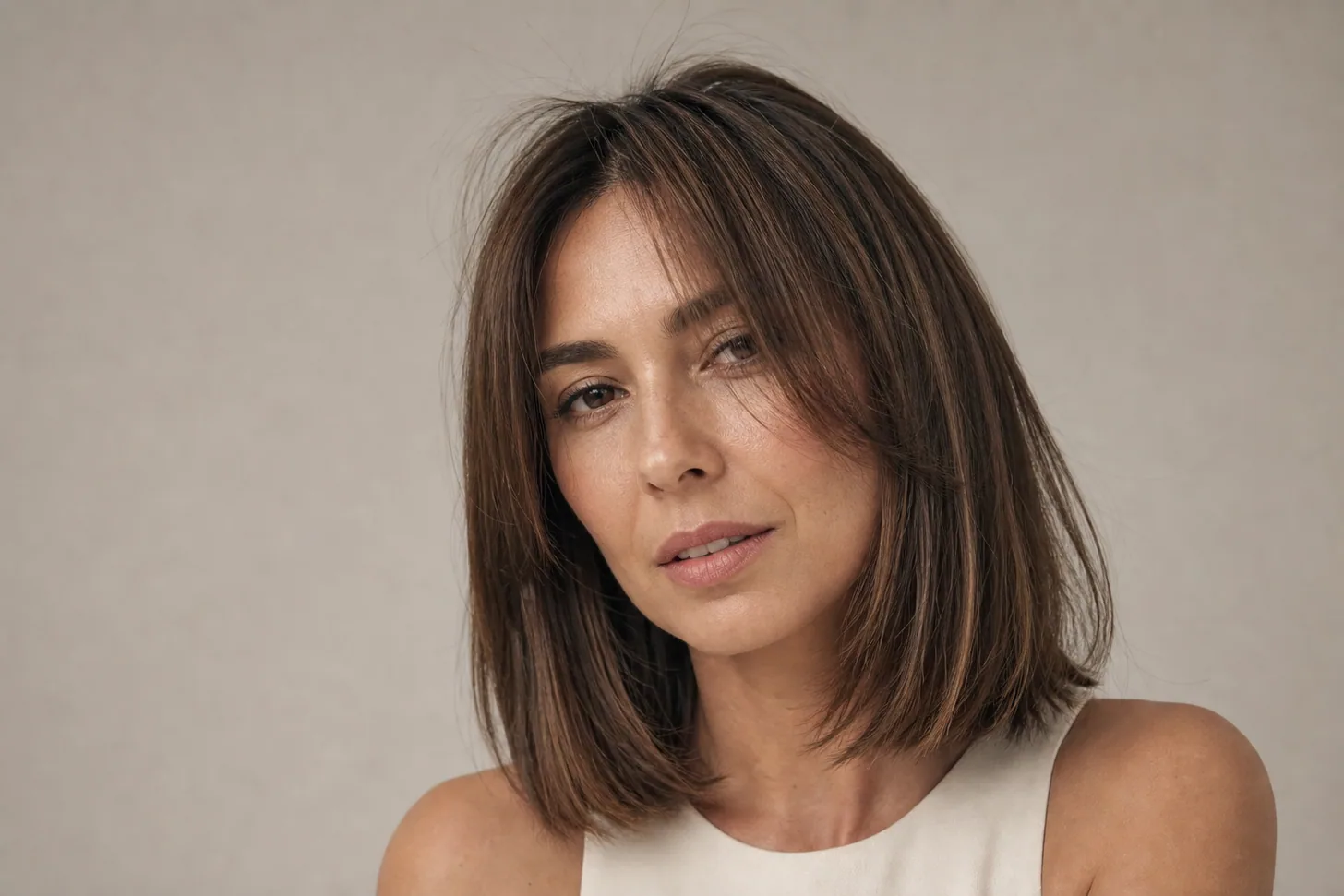
blunt collarbone-length cut with a heavy one-length weight line on fine straight hair
1
The blunt collarbone cut
The most reliable medium cut for fine hair: one clean length at the collarbone with the ends left blunt. All the weight sits in that bottom line, so the hair looks its densest exactly where fine hair usually looks thinnest. Best on straight-to-slightly-wavy hair, where the blunt edge stays crisp.
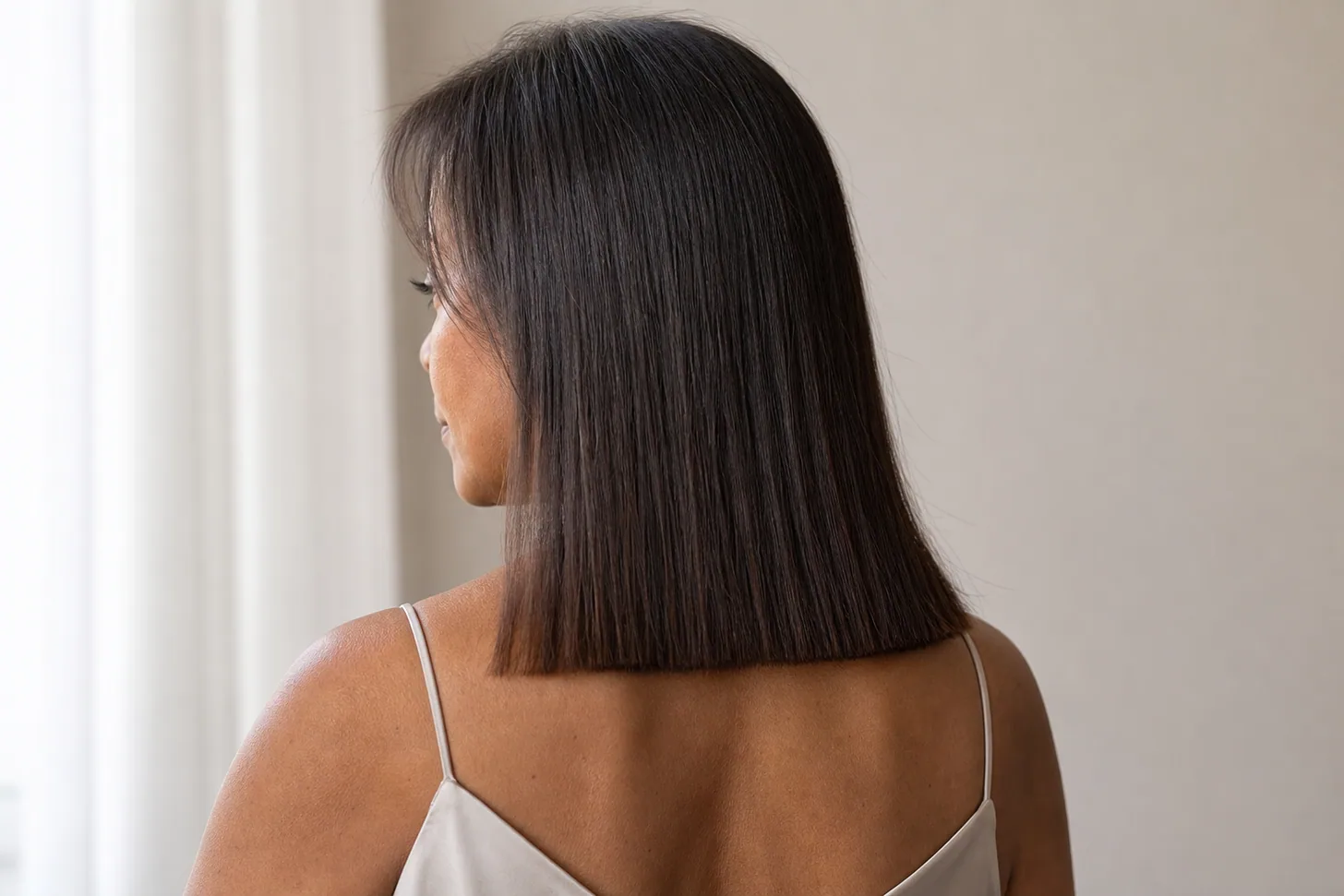
blunt lob with a heavy perimeter grazing the shoulders on fine hair
2
The heavy-perimeter medium lob
A touch shorter, grazing the shoulders, with a deliberately heavy perimeter. The extra weight up top on a shorter length means even less drag on the roots, so this holds volume longer through the day. Ask for it "one length with a strong bottom line, no layers through the ends."
medium cut with ends flipped under in a soft C-shape on fine hair
3
The C-shape flipped-under medium
The same blunt length, but the ends are blow-dried under in a soft C so the perimeter curves toward the neck. That inward bend piles the weight line on itself and reads even fuller — a retro, polished finish that suits round and heart shapes especially. It needs a round brush, so factor in a few minutes of styling.
one-length medium cut with a deep side part for root lift on fine hair
4
The deep-side-part medium
Not a different cut so much as a different part — taking a one-length medium and setting a deep side part instantly lifts the roots at the crown, because the hair has to travel over the part to fall. It's the cheapest volume trick there is on fine hair, and it turns a flat one-length cut into one with instant height on the days you need it.
Layered medium cuts that add movement
Blunt keeps density; layers add life. The trick on fine hair is soft, point-cut internal layers over that blunt line — never choppy or razored. These four bring movement without thinning the ends. The decade-specific versions of this start at medium length for fine hair over 40 and run up through the fifties and sixties.
medium cut with soft point-cut internal layers over a blunt line on fine hair
5
The soft internally-layered medium
The everyday workhorse: a blunt collarbone length with gentle internal layers point-cut into the mid-lengths. You get movement and swing up top while the perimeter stays dense — the balance most fine-haired clients are actually after. It's the version I cut most often, because it flatters nearly every face shape and grows out cleanly.
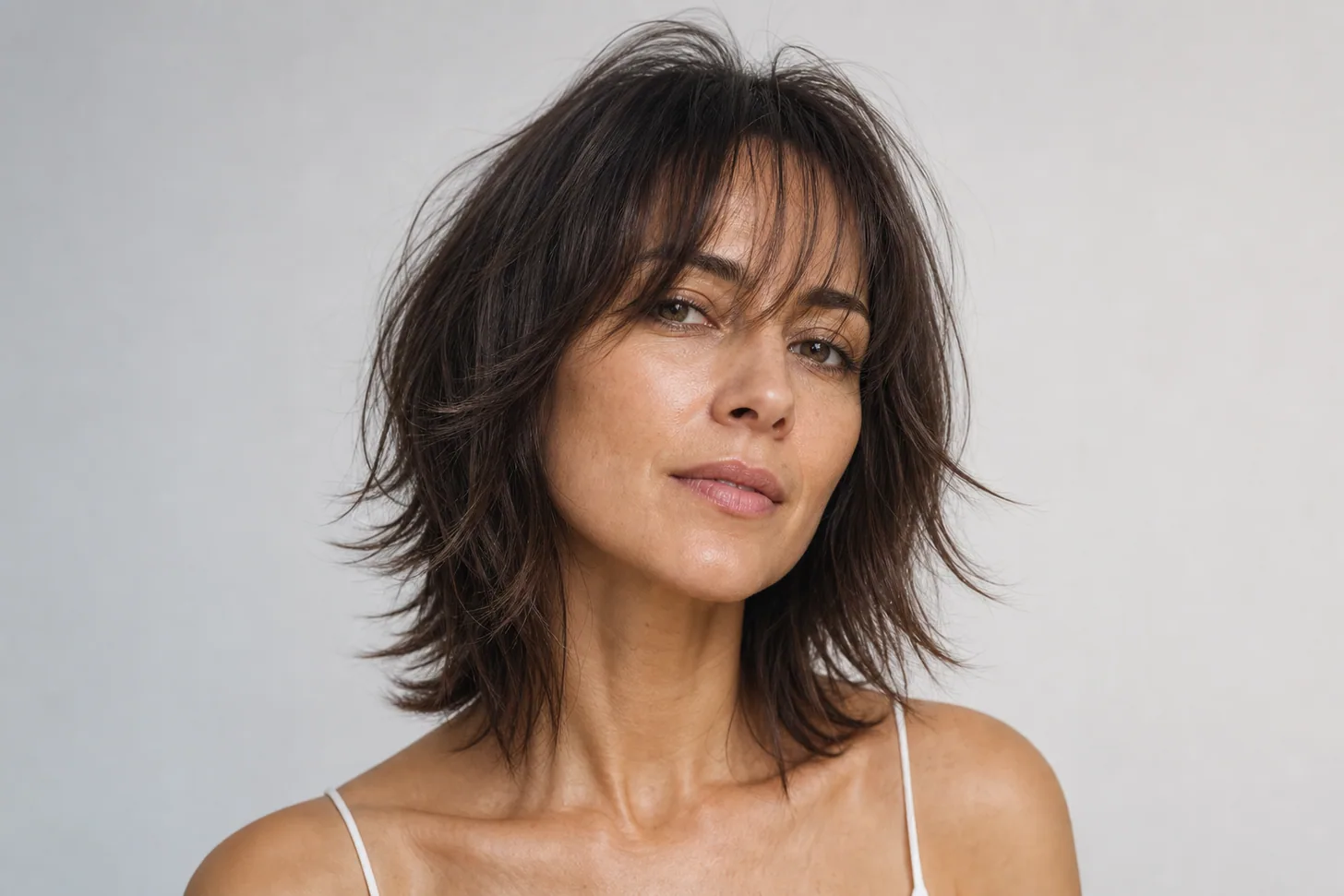
medium shag with choppy textured layers and a fringe on fine hair
6
The medium shag
The shag brought to a medium length — piece-y, textured layers that build volume around the crown and face and read fuller the messier they get. It hides fine hair's flatness in plain sight, because there's no sleek surface to fall limp. Best if you'll embrace texture spray and a lived-in finish rather than a smooth blowout.
medium butterfly cut with short face-framing layers over medium length on fine hair
7
The medium butterfly
A shorter take on the butterfly cut: short face-framing layers stacked over a medium length, flicked back to build a band of fullness around the face. At medium length it's lighter to style than the long version and more forgiving on very fine hair. Ask for the shortest layers to start around the chin.
seventies feathered medium cut with flicked-back layers on fine hair
8
The '70s feathered medium
Feathered layers flicked back from the face, Farrah-style, for soft retro movement. The feathering concentrates volume at the sides and crown where fine hair goes flat, and the whole shape is built for a bouncy round-brush finish. A little goes a long way on fine hair — ask for feathering only through the top layers, kept off the perimeter.
Medium cuts with bangs & face-framing
Bangs put weight and movement right at the face, which is exactly where fine hair benefits from it. Paired with a medium length, they add fullness at the hairline without you losing any length below.
medium cut with soft curtain bangs framing the face on fine hair
9
The medium with curtain bangs
The most popular pairing, and the easiest to grow out. Soft, center-parted curtain bangs flow into the length and add a cushion of fullness at the front. They break up a plain medium cut and draw the eye to your face rather than to the ends — flattering on almost everyone.
medium cut with a light wispy fringe on fine hair
10
The medium with a wispy fringe
A light, see-through fringe over a medium length — soft enough that it never looks heavy or blunt at the hairline, which is what makes it work on fine hair. It suits higher foreheads that want a little coverage without commitment. Ask for it point-cut and airy so it blends into the face-framing rather than sitting as a solid block.
medium cut with a side-swept fringe on fine hair
11
The medium with a side-swept fringe
A longer fringe swept to one side, blending straight into the face-framing layers. It's the lowest-maintenance fringe here — long enough to tuck behind an ear on the days you can't be bothered, and it grows out without an awkward stage. A good gateway if you've never had bangs and aren't sure.
medium cut with cheekbone-length face-framing layers on fine hair
12
The face-framing medium
No fringe, but shorter pieces cut around the face from the cheekbone down, so the front of the cut has extra movement and lift. Those face-framing layers are the single most flattering detail you can add to a medium cut on fine hair — they build fullness exactly where you see it. Switch a photo of this to your stylist and say "keep the length, frame my face."
Textured, wavy & low-maintenance medium cuts
If your fine hair has a natural bend, or you want the least daily effort, these lean into texture instead of fighting it — and a couple of them air-dry with almost no work.
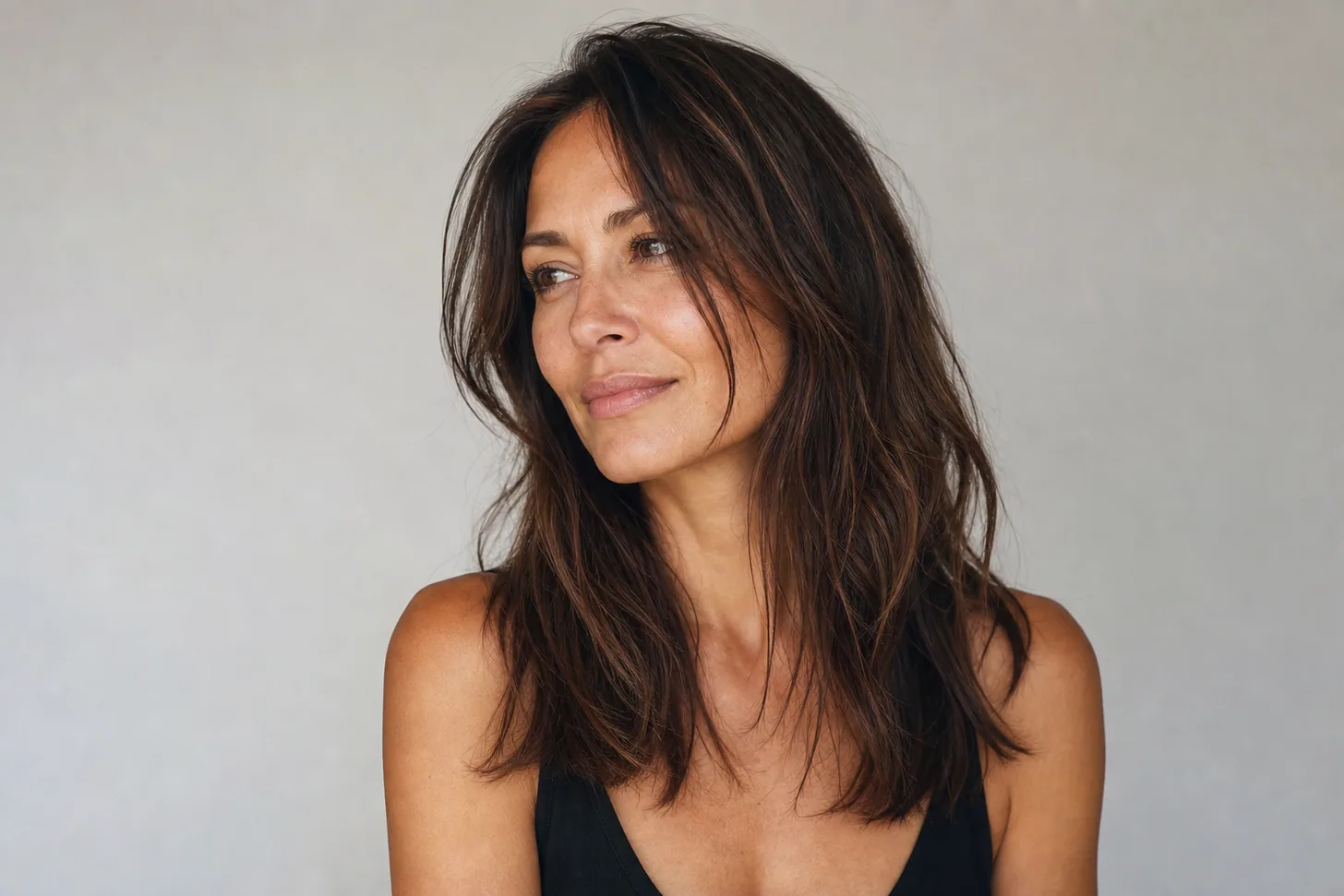
wavy medium cut air-dried with natural bend and body on fine hair
13
The wavy air-dry medium
If your fine hair waves at all, it's an asset here — the bend falls into the length and supplies built-in body, so you can often skip the blow-dry. Scrunch a light mousse through damp hair and let it air-dry. The lowest-effort medium cut for fine, wavy hair, and one that looks fuller undone than blown out.
tousled beachy medium cut with piece-y texture on fine hair
14
The tousled beachy medium
The undone, piece-y version — the same medium length worn roughed-up with a mist of texture spray for grip and separation. The rough finish is forgiving on day-two hair and hides flatness better than any sleek style. Think lived-in, not polished; it's the most low-maintenance way to wear movement.
blunt one-length clavicut at the collarbone worn simple on fine hair
15
The low-maintenance clavicut
The "clavicut" — a blunt one-length cut that hits right at the clavicle — is the medium cut for people who want to do the least. No layers to style, no fringe to trim; it holds its shape air-dried and just needs a trim every couple of months to keep the line clean. If your goal is wash-and-go, this and a low-maintenance shape are your shortlist.
grown-out medium cut transitioning from a bob with softened layers on fine hair
16
The grown-out transition medium
Medium length is where a growing-out bob looks its most intentional, so this is really a strategy as much as a cut. As the shape passes the shoulders, have your stylist soften the old layers and add a face-frame so it reads as a deliberate medium rather than an in-between stage. Trim only the front to keep the frame while the length catches up.
Choose your medium cut for your face shape
At medium length, where the weight sits and where the layers start decide how the cut flatters you. Use this as a starting point, then confirm with your stylist — the full method is in our guide to finding your face shape.
Balanced proportions carry a blunt line or layers equally well; take your pick.
Round
Layered medium with a side part
Length past the collarbone and off-center volume lengthen the face; skip a blunt chin-level line.
Square
C-shape or soft-layered medium
Rounded ends and face-framing soften a strong jaw.
Heart
Medium with curtain bangs
Fullness lower down and a soft fringe balance a wider forehead.
Long / oblong
Medium with a fringe
Bangs shorten the face; keep width and layers building at the sides.
What to ask your stylist
Bring the mechanics, not just a photo. For fine hair, say: "I want a medium length at my collarbone, but I need it to look full — please keep the ends blunt with a strong weight line, and point-cut some soft internal layers rather than razoring them."
If you want movement at the face, add: "Frame my face from the cheekbone down." And if your crown runs flat, the deep-side-part trick costs nothing — ask them to show you where to set it. That combination is what turns "medium length" from a limp default into a cut that actually holds body.
Chair-side note
Medium length is the trickiest zone to keep looking full, because it's right at the point where weight starts winning. If you find your cut going flat within a few weeks, the fix usually isn't more product — it's a trim every 8 to 10 weeks to keep the weight line strong, and a proper root-lifting blow-dry rather than a lazy one. Fine hair at medium length rewards a little technique; the method is all in how to add volume to thin hair, and it's ten minutes that changes how the whole cut sits.
SB
— Simone Baptiste, Senior Stylist
When a medium length may not be your best move
Your hair goes flat and lifeless the moment it passes your shoulders. The weight of even a medium length may be too much — a lob or bob concentrates density higher up and holds more volume.
You want true wash-and-go with zero styling. Most medium cuts want at least a quick root-dry; the clavicut or a low-maintenance cut come closest to effortless.
Your ends are dry or splitting. Medium length shows worn ends more than a short cut — trim and treat them first, or the length will look thinner than it is.
You're noticing real thinning or scalp showing through. Keep the length shorter and the weight line strong, and read our honest guide to fine hair versus thinning before committing.
FAQ
Yes, medium length is often the sweet spot for fine hair — but only when it's cut for body. Medium usually means collarbone to just below the shoulders, which is long enough to feel versatile yet short enough that the ends still carry weight and don't drag the roots flat the way long hair can. The mistake is asking for a plain one-length medium and expecting volume; on fine hair, the fullness comes from a strong, blunt-ish weight line plus a few internal layers, not from length alone. Cut that way, a medium length keeps more density at the ends than a long cut and more versatility than a bob.
For most fine hair, a blunt or near-blunt collarbone cut with soft internal layering is the best all-rounder. The blunt perimeter keeps the ends looking dense while the internal layers add just enough movement to stop it going flat and helmet-like. If you want more movement, a medium shag or a medium butterfly builds volume around the face; if you want the least upkeep, a one-length "clavicut" at the collarbone holds its shape air-dried. Avoid heavy, choppy layering and razored ends — both thin already-sparse ends and leave the bottom see-through.
It can, because medium length keeps weight in the ends where fine hair reads as thin. A blunt or graduated line at the collarbone concentrates the hair you have into a solid edge, which the eye reads as density — whereas long, tapered ends fan out and look wispy. Add a few internal layers for lift and blow-dry the roots up, and a medium cut looks noticeably fuller than the same hair worn long. The length that flatters fine hair is the one that keeps the ends blunt and the roots lifted.
Volume on medium-length fine hair is built at the root, not bought in a bottle. Rough-dry the roots first with your fingers to set lift, then round-brush the crown up and over, finishing each section with the cool shot so it holds. A dime of volumizing mousse on damp roots and a light mist of texture spray through the mid-lengths give fine hair the grip it lacks. A deep side part also props the roots up instantly on flat days. The full method is in our guide to adding volume to fine and thin hair.
Some, but the type matters more than the amount. Fine hair wants soft internal layers that are point-cut into the mid-lengths for movement, kept over a strong bottom weight line so the ends stay dense. What it does not want is heavy surface layering or razor-cut ends, which remove weight from already-sparse hair and leave it stringy. A good rule: layers to add lift and face-framing, a blunt-ish perimeter to keep density. If your density is very low, ask your stylist to keep the layering minimal and concentrated near the face.
Medium-length hair generally falls between the collarbone and just below the shoulders — longer than a lob (which sits at or above the shoulder) and shorter than long hair that reaches the mid-back. In practice, the collarbone is the anchor point most stylists mean by "medium." For fine hair it's a useful zone because it's the longest you can usually go before the weight of the length starts pulling volume out of the roots.
Eleven years behind the chair, specializing in short shapes and fine-hair texture. Simone believes the best haircut is the one you can style yourself in ten minutes.
Results vary with hair type, density, and growth patterns. This guide is educational and not a substitute for an in-person consultation with a licensed stylist.
Hairstyle images in this guide are AI-generated illustrations, not photos of real clients or results. See our image policy.
Get the good hair intel
One honest, stylist-written guide in your inbox each week. No hype.

 SB
SB