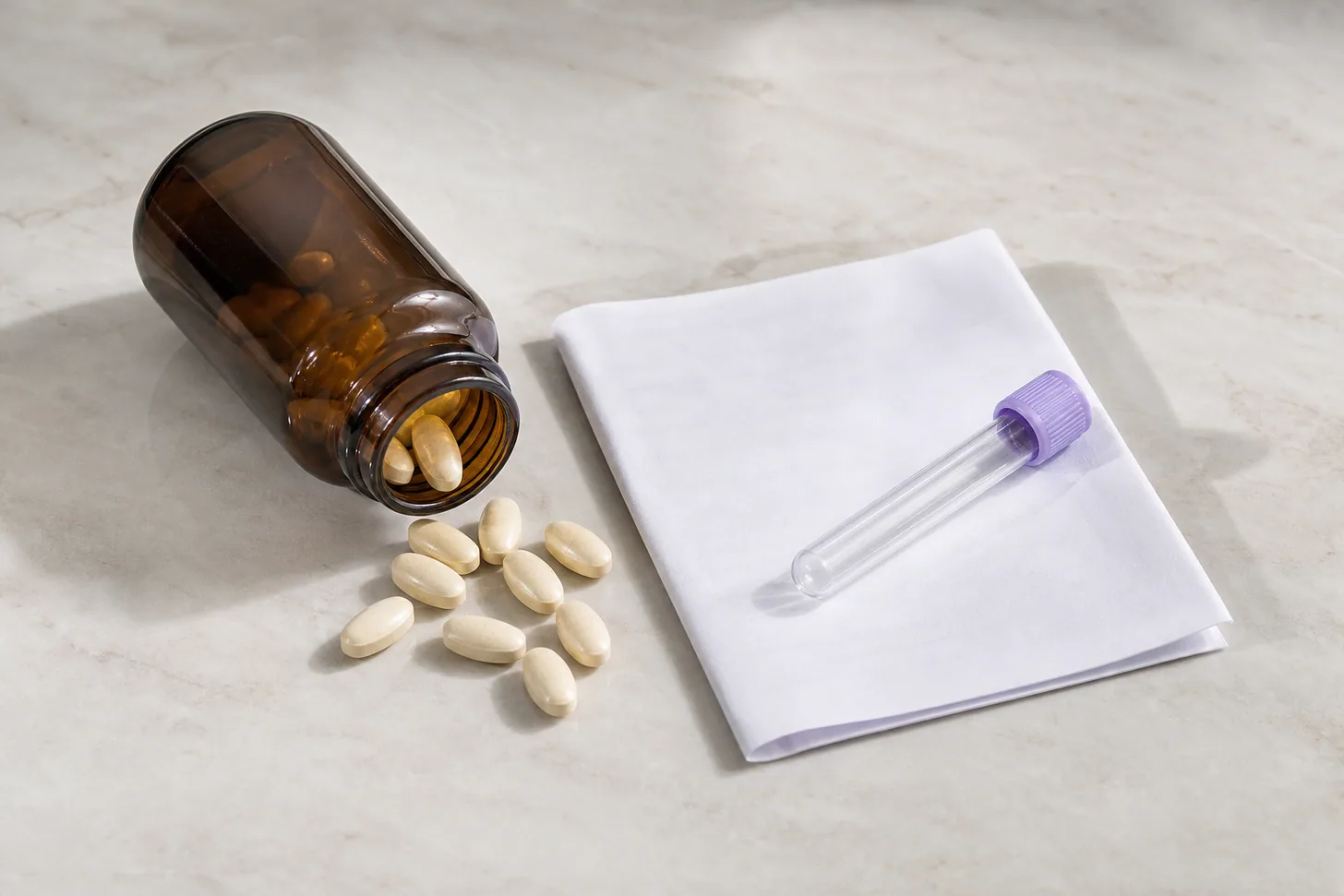
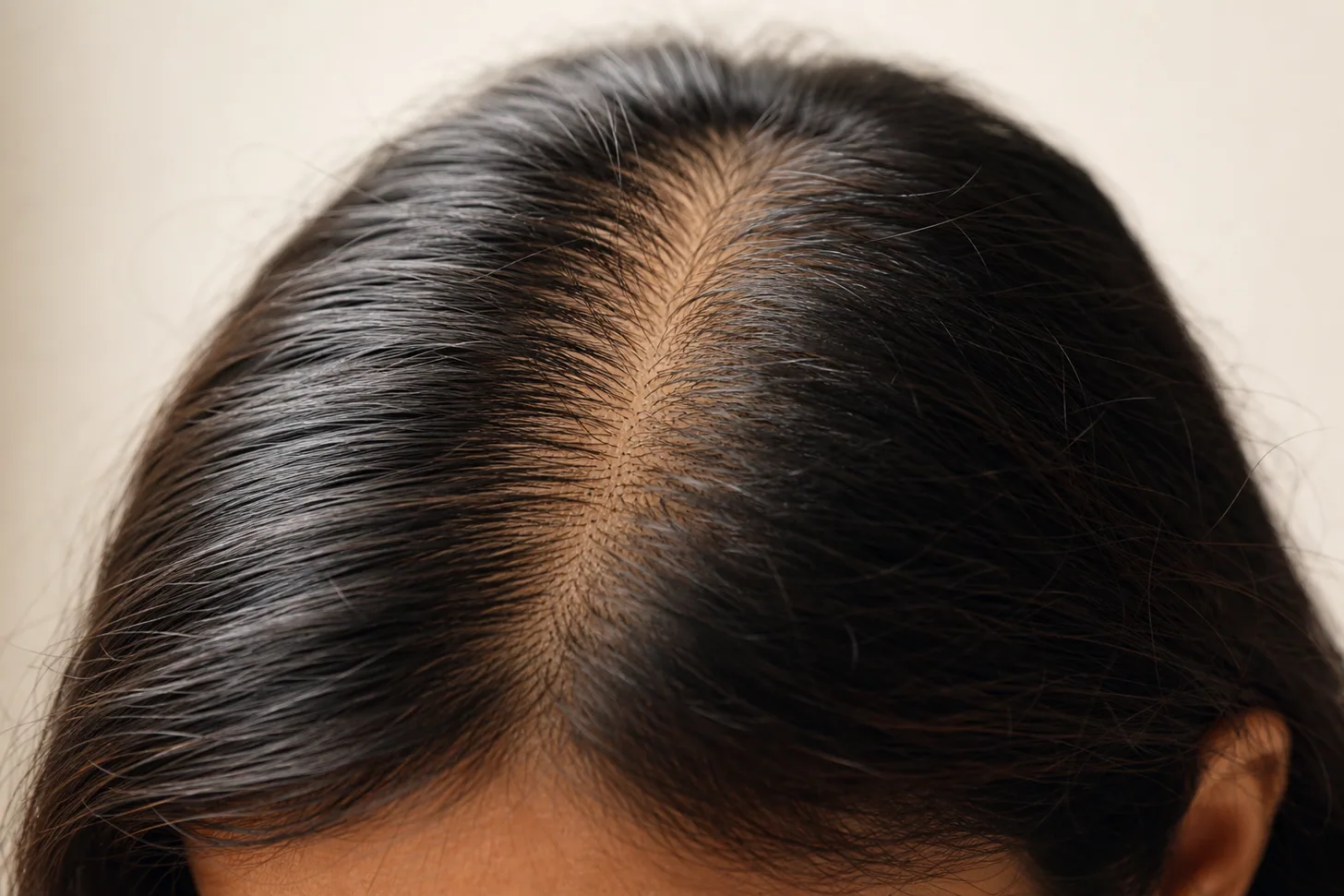
Hair supplements correct shortages. They don't add density to a head of hair that wasn't short of anything — and that one sentence explains almost every bottle that quietly stopped being taken around month four. If your ferritin is on the floor, if you've been through a crash diet, if pregnancy or illness emptied the tank, replacing what's missing can genuinely change how much hair you keep.
If your bloods are unremarkable and your hair is thinning because of genetics, age or hormones, there is nothing in the capsule for the capsule to fix. There's also a trap in here that nobody warns fine-haired women about, and it's the most useful thing on this page: the biotin in your hair supplement can corrupt the very blood tests used to find out why you're shedding — pushing ferritin and TSH falsely low and free T4 falsely high — so the thing you took to solve the problem can hide its cause.
Below: what the evidence shows ingredient by ingredient, what the two trials everyone cites really found (and who paid for them), the two nutrients that cause hair loss when you overdo them, and the order to do all of this in.
The order matters: the test comes before the capsule, not after it.
The answer depends entirely on which of two situations you're in
Almost all the confusion in this category comes from treating "do hair supplements work?" as one question. It's two questions, and they have different answers.
Situation one: something is genuinely missing. Low iron stores, a long stretch of undereating, a restrictive diet held for years, recovery from surgery or illness, rapid weight loss. Hair is metabolically expensive and biologically non-essential, so it's among the first things the body stops funding when supply is short. Replace what's short and the funding resumes. This is real, it's well recognized, and it's the entire legitimate case for supplementation.
Situation two: nothing is missing. You eat reasonably, your bloods came back unremarkable, and your hair is thinning anyway — because of the hormonal shift around menopause, because of inherited female-pattern thinning, or because you were born fine-haired and are now noticing what has always been true. Here a supplement has nothing to correct, and there's no mechanism by which topping up a nutrient you already have enough of adds hair.
And there's a limit specific to this site's readers. Nothing swallowed increases the number of follicles you were born with, and nothing swallowed has been shown to change strand diameter. If your hair is fine rather than thinning — and those are two different things — supplements are the wrong department entirely. So, mostly, is the shampoo aisle; best shampoo for thinning hair explains which two actives are the exception.
Chair-side note
The pattern I see most often isn't someone taking the wrong supplement. It's someone taking a supplement instead of finding out what's wrong. A woman comes in worried about her part, starts a hair vitamin because it's the thing you can do this week without an appointment, gives it six months, sees nothing, then finally gets bloods — and her ferritin is 12.
That's six months of shedding she didn't need to have, and it happened because the capsule felt like action. If your hair is genuinely coming out more than it used to, the supplement isn't the first move. It might be the third. The first is finding out whether anything is actually missing, and the second is dealing with whatever that turns up.
MH
— Megan Holloway, Editor-in-Chief
Biotin is the most-taken ingredient in the category and the least supported
Open any hair supplement and biotin is on the label, usually in enormous quantities. It's there because it's cheap, because it's safe at high doses, and because it has a story attached — biotin deficiency does cause hair loss, which is true and almost entirely beside the point, since biotin deficiency is rare in anyone eating a normal diet.
The definitive read on this is a 2017 review in Skin Appendage Disorders.
None of that makes biotin dangerous. It makes it inert for most of the people taking it — which would be a harmless waste of money, except for what comes next.
The biotin trap: it breaks the tests that would have found your real cause
This is the part that changes what you do, and it almost never appears on a supplement page.
A large number of routine laboratory assays are built on a biotin-streptavidin binding step. When there's a lot of biotin circulating in your blood, it competes with that step and the result comes out wrong — and, critically, wrong plausibly, not obviously. A published case report of exactly this problem sets out the two directions clearly.
Read that list again with a shedding reader in mind. Ferritin. TSH. Free T4. Those are precisely the tests ordered to find out why hair is falling out — and the hair supplement is the thing skewing them.
What the two supplements with real trials actually found
Two brands get cited constantly because, unlike almost everything else on the shelf, they have published randomized, double-blind, placebo-controlled trials. That genuinely counts for something. It's also worth seeing the studies at full size rather than at headline size.
Here's the fair reading, in both directions. These are proper trial designs and the results are what they are; dismissing them because a company was involved would be lazy, since almost nobody else funds this research at all.
But forty women in one and sixty in the other is small, ninety days is short, both enrolled women with self-perceived thinning rather than a diagnosis, and the outcome measured is hair counted in a marked patch of scalp — a real measure, but not the same thing as the ponytail feeling thicker.
What that means practically: these are the two products in the category with something behind them, they cost several times what a generic hair vitamin costs, and the honest expectation is a modest change in a subset of users over three to six months, not a transformation.
If you're going to spend money here, spend it on one of these rather than a cheaper bottle with nothing behind it at all — but spend it after the bloods, not instead of them.
Ingredient by ingredient, honestly rated
Most hair formulas are the same dozen ingredients in different proportions. Here's what each one is actually doing in there.
Ingredient
Evidence for hair
Who it genuinely helps
Honest note
Iron / ferritin
Strongest in the category
Women with low ferritin — heavy periods, vegetarian diets, post-partum
Test first. Iron accumulates and excess is harmful; never guess
Vitamin D
Plausible; deficiency common
Anyone measurably low, which in northern winters is a lot of people
Worth correcting for general health regardless of what it does for hair
Biotin
None in healthy people
The genuinely deficient, who are rare
Interferes with ferritin, thyroid and troponin assays — stop 72h before bloods
Zinc
Mixed and inconsistent
The deficient — malabsorption, restrictive eating
The 2019 review notes screening for zinc is not recommended
Marine protein complex
Two small manufacturer-linked RCTs
Women with self-perceived thinning, over 3–6 months
The best-evidenced branded option; still small studies
Saw palmetto
Weak — small studies, mostly in men
Unclear in women
Marketed on a DHT story borrowed from finasteride; not the same evidence
Collagen
None for hair specifically
People whose overall protein intake is low
Hair is keratin, not collagen — it's a protein-intake story, and food does it too
Vitamin A
Harmful in excess
Nobody, at supplement doses, without a documented reason
Over-supplementing causes hair loss — and it stacks across several bottles
Selenium
Harmful in excess
Nobody, without a documented deficiency
Hair loss is a listed symptom of selenium toxicity
Two ingredients that cause hair loss when you overdo them
This is the part of the category with an actual downside, and it's worth taking seriously because the failure mode is invisible: you're taking something for your hair, your hair gets worse, and you conclude you need a stronger formula.
The way people get there is stacking. Nobody takes a dangerous dose of vitamin A on purpose. They take a multivitamin, a hair-skin-nails formula and a greens powder, each containing a fraction of a large number, and nobody adds up the three labels. If you take more than one supplement, lay them out on the table and total the vitamin A and the selenium. It takes two minutes and it's the only way to catch this.
And if your shedding started or accelerated after you began supplementing, don't dismiss the timing. Take every bottle to the appointment.
Why "it's on the shelf, so someone must have checked" isn't true
People reasonably assume that a product making a growth claim has had that claim examined by somebody. In the United States, for dietary supplements, it hasn't.
That's not a scandal — it's the legal framework, and it's the same one that lets you buy vitamin C without a prescription. But it does mean three things when you're standing in the aisle. The claim on the box hasn't been verified by an outside body.
The dose can be far above any established requirement, because nobody had to justify it. And quality control is the manufacturer's own. A third-party testing mark such as USP or NSF is the closest thing to an independent check available to you — and note carefully what it does and doesn't tell you: it verifies that the bottle contains what the label says, not that what the label says will grow hair.
Your part is widening or you can see scalp at the crown.That's a pattern, and patterns have treatments that work. Read thinning on top and what actually treats hair loss before spending anything on capsules.
You already eat well and your bloods are normal.There's nothing for the supplement to correct. That money buys more hair as a cut that builds density, or as a treatment with evidence behind it.
It's breakage, not shedding.If the hairs coming out are short and blunt-ended rather than long with a bulb at the root, nothing swallowed will help — that's a handling problem. See breakage on fine hair.
You're pregnant, breastfeeding, or on regular medication.Supplements interact, and some are contraindicated. This is a conversation with a clinician, not a shelf decision.
The order to do this in
If you do nothing else on this page, do these in this sequence. The order is the whole point.
Establish what you're dealing with. Shedding (more hair coming out than usual) and thinning (the same hair getting sparser or finer over time) are different problems with different answers. Fine hair or thinning? separates them.
Get tested before you supplement, not after. Ferritin, full blood count, thyroid function, vitamin D. If you're already on a biotin-containing supplement, stop it 72 hours before the draw and say so at the appointment. The tests worth asking for covers what to request and why.
Fix what the tests found, at the dose you were advised to take. A targeted correction of a documented shortage is the one intervention in this whole category with a solid rationale. A general hair vitamin is not the same thing, and will usually contain too little of what you need and too much of what you don't.
Look for a trigger three months back. Diffuse shedding lags its cause by roughly twelve weeks. A crash diet, an illness, a new prescription, a surgery, a bereavement — check the calendar, not just the bottle.
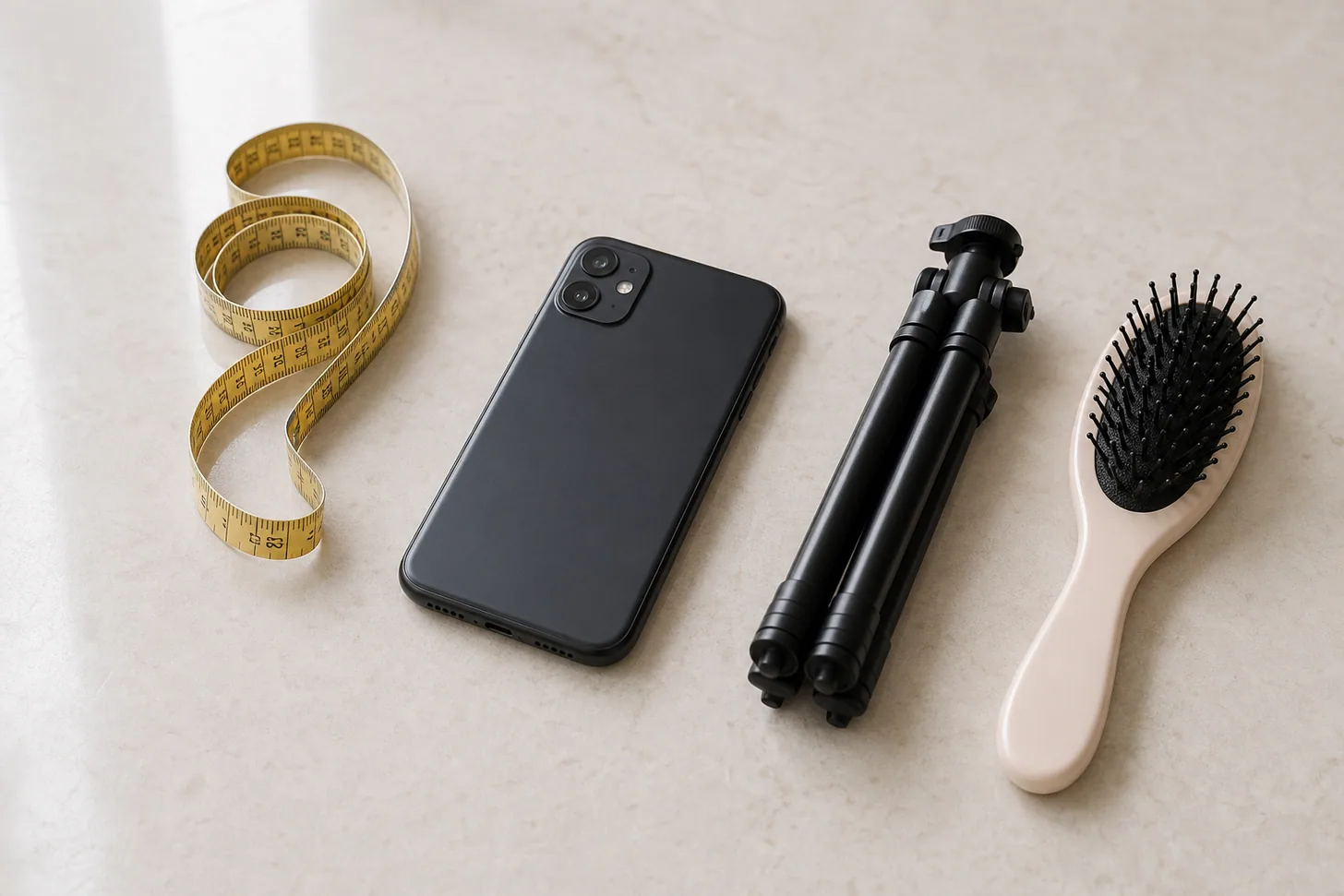
Only then consider a supplement, and only with a photo. Same light, same part, same day of your wash cycle, month zero and month six. Change one thing at a time or you'll never know what did it.
Run the cosmetic and treatment routes in parallel. They're faster and, for pattern thinning, better evidenced. Can you grow fine hair thicker? is the honest accounting of what actually moves.
Chair-side note
Something I say to every client who asks me to look at her hair vitamin: read the panel on the back, not the front. Almost every one of them is a large dose of biotin, a token amount of a dozen other things, and one or two ingredients that are actually doing the work in whichever trial the brand cites.
Then compare that panel to what your blood test said. Nine times in ten there's no overlap at all — the bottle is loaded with things you already have plenty of and contains nothing meaningful of the one thing you were low on.
That's not a conspiracy, it's just what a general-purpose formula looks like. But it's why the targeted correction your doctor recommends usually beats the prettier bottle, and why the bloods have to come first. If your shedding started in your forties alongside cycle changes, the cause is worth establishing before the shelf — see perimenopausal hair thinning.
MH
— Megan Holloway, Editor-in-Chief
FAQ
They work when they're correcting something that was missing. They do very little when nothing was missing, and that single distinction explains almost every disappointing result. If your ferritin is low, or you're recovering from a crash diet, or you've been vegetarian for years without watching iron, replacing what's short can genuinely change how much hair you keep. If your bloods are unremarkable and your hair is thinning because of genetics, age or hormones, a capsule of nutrients you already have enough of has nothing to correct. The 2019 review of vitamins and minerals in hair loss is careful about exactly this, concluding that large placebo-controlled trials are still required even in patients who have both a deficiency and hair loss. On fine hair there's a second limit: nothing taken by mouth increases the number of follicles you were born with, and nothing has been shown to change strand diameter.
Not unless you're deficient in it, which in the US is rare. A 2017 review in Skin Appendage Disorders looked at every reported case of biotin being used for hair and nail problems, found 18 cases of improvement, and noted that all of those patients had some underlying pathology for poor hair or nail growth. Their conclusion was that biotin has no proven efficacy in hair and nail growth of healthy individuals. Biotin is in almost every hair supplement because it's cheap, safe at high doses and has a plausible-sounding story attached — not because it has been shown to grow hair on people who eat normally.
Yes, and it's the most practical thing on this page. Many routine assays use a biotin-streptavidin binding step, and high circulating biotin interferes with it. In sandwich-format assays it drives results falsely low — TSH, parathyroid hormone, ferritin, troponin, PSA. In competitive-format assays it drives them falsely high — free and total T4 and T3, cortisol, vitamin D. The trap is specific: ferritin and thyroid tests are exactly the tests used to find out why hair is shedding, and the hair supplement is exactly the thing corrupting them. Quest Diagnostics advises drawing samples at least 8 hours after the last dose at recommended intakes, and at least 72 hours after mega-doses, which most hair supplements are. Stop for three days before bloods, and tell the lab you take it. Our guide to hair-loss blood tests covers what to ask for.
Both have published randomized, double-blind, placebo-controlled trials, which puts them ahead of nearly everything else in the category — and both are small and manufacturer-linked. The Viviscal trial randomized 30 women to the supplement and 30 to placebo for 90 days, reported terminal hair counts rising from 178.3 to 235.8 against essentially no change on placebo, and states plainly that it was sponsored and funded by a grant from Lifes2good, Inc., which makes it. The Nutrafol trial randomized 26 to active and 14 to placebo over six months and reported significant increases in terminal and vellus hairs, with one author affiliated to the manufacturer. Both enrolled women with self-perceived thinning rather than a diagnosis. None of that makes the results false — it means the evidence base is a handful of small industry-linked studies, which is a weaker thing than the marketing implies.
Two ingredients can, and both turn up in hair-and-nail formulas. The 2019 Almohanna review notes that consuming too much or over-supplementing vitamin A can cause hair loss, and lists hair loss among the symptoms of acute or chronic selenium toxicity. This matters more than it sounds because supplement-takers stack: a multivitamin, a hair formula and a greens powder can each contain vitamin A and selenium, and nobody adds up the labels. Lay the bottles on the table and total those two numbers. And if your shedding started or worsened after you began supplementing, bring every bottle to your appointment rather than assuming the timing is coincidence.
There's no good evidence that it does, and the mechanism usually offered doesn't hold up. Hair is made of keratin, not collagen, and ingested collagen is broken down into amino acids in the gut like any other protein rather than routed to the follicle. The honest version: if your overall protein intake is low — common after weight loss, in restrictive eating and in some older adults — then more protein of any kind may help, and a collagen powder is one way to get it. That's a protein-intake story, not a collagen story, and food does the same job. If protein has been low for you, shedding after weight loss is the more useful place to start.
Only after a test, and only on advice. Iron is the one nutrient where the link to shedding in women is taken seriously, and the 2019 review notes that most authors agree in supplementing iron in patients with iron deficiency or low ferritin. But iron accumulates, excess is genuinely harmful, and a normal hemoglobin can sit on top of a depleted ferritin — so guessing in either direction carries risk. Ask specifically for ferritin rather than a plain full blood count, and interpret the number with a clinician, because the level considered adequate for hair is higher than the level used to diagnose anemia.
Not the way people assume. Under the Dietary Supplement Health and Education Act, the FDA states plainly that it does not have the authority to approve dietary supplements before they are marketed, that generally a firm doesn't have to provide the agency with the evidence it relies on to substantiate safety, and that by law it does not approve dietary supplements or their labeling. Oversight is largely post-market. In practice: the claim on the box hasn't been checked by anyone before it reached you, the dose may be far above any established requirement, and quality assurance is the manufacturer's own. Third-party marks such as USP or NSF are the nearest thing to an independent check — and they verify contents, not effectiveness.
Three to six months, and only if you set up a way to tell. Hair grows slowly enough that nothing you take is visible before about three months — which is also long enough for a temporary shed to have resolved on its own, so people routinely credit a capsule for a recovery that was already under way. Two things make the judgment honest. Take a photo of your part and your ponytail on day one, in the same light, because memory is a poor instrument for a change this gradual. And change one thing at a time; starting a supplement, a new shampoo and a scalp serum in the same week guarantees you won't know which one did anything. If nothing has changed at six months, it isn't going to.
Fourteen years in fine-hair care, eight of them behind the chair. Megan's rule for supplements: test first, correct what's actually missing, and photograph your part before you start anything.
This article is for general education and is not medical advice, and nothing here is a recommendation to start, stop or change a supplement or a medication. Supplements interact with prescriptions and are not appropriate for everyone. If you are experiencing sudden, patchy or prolonged hair loss, scalp pain, or other concerning symptoms, see a board-certified dermatologist.
Images in this article are AI-generated illustrations, not photographs of real clients or results. See our image policy.
Results vary with hair type, density, and growth patterns. This guide is educational and not a substitute for an in-person consultation with a licensed stylist or physician.
Get the good hair intel
One honest, stylist-written guide in your inbox each week. No hype.

 MH
MH