Rice water: the study everyone cites is about something else
This is the most-asked and the most misunderstood, and the misunderstanding is specific enough to be worth spelling out.
There is a body of research, and it's reasonably encouraging. A systematic review of rice products for hair growth analyzed ten studies and concluded that "current literature is promising for RB promoting hair growth given its ability to increase expression of growth factors and molecular signals associated with maintaining anagen phase, decreasing inflammation, inhibiting 5α-reductase, and promoting melanogenesis."
Read what "RB" is, though. The review defines it at the outset: "Rice bran extracts (RB) derived from Oryza sativa are part of cultural skin and hair care practices in Asia." Rice bran extract is a concentrated, formulated cosmetic ingredient, and the work is largely at the level of growth factors and signalling pathways.
That is not the same substance, at anything like the same concentration, as the cloudy water left over from soaking rice in a bowl — and the review is a study of the ingredient, not a clinical trial of the rinse.
So the honest position: the ingredient is interesting, the rinse is unproven, and the gap between them is where most of the internet's confidence lives.
What it does on fine hair. Rice water behaves like a light protein treatment, and it does deposit a film that makes hair feel thicker for a wash or two. That's real, and it's also the problem.
Fine strands need far less protein than coarse ones to tip into overload — stiff, straw-like hair that snaps rather than stretches — which is covered properly in repair ingredients for fine hair. Fermenting it, as the popular version suggests, doesn't change that arithmetic.
If you want to try it: treat it as an occasional protein rinse — once a month, on lengths and ends, never the scalp, followed by a moisturizing conditioner. Stop immediately if the hair feels rough or brittle rather than smooth.
Slugging: right mechanism, wrong dose by a factor of ten
Of everything here, this has the strongest science behind it — and gets adapted for fine hair the least.
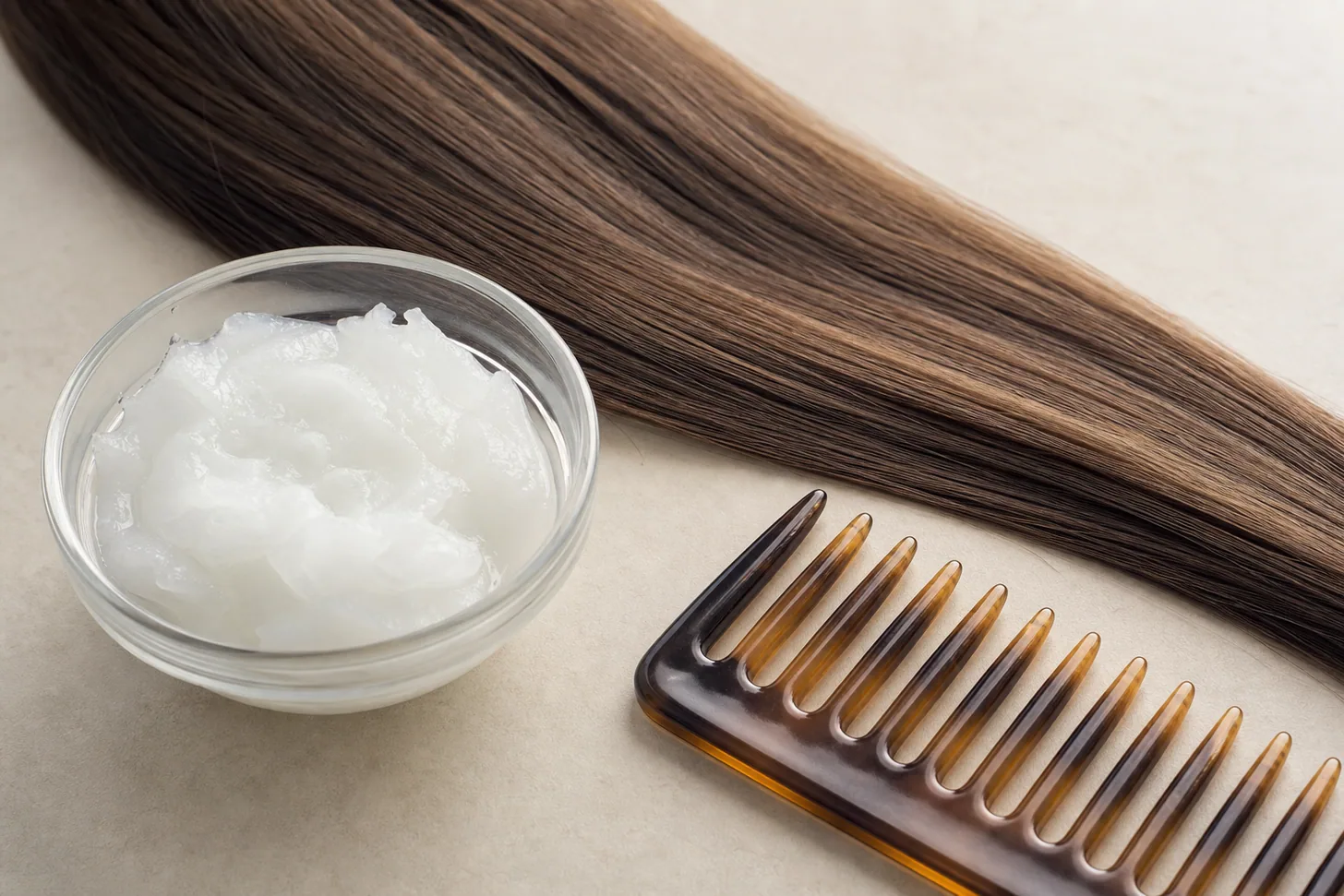
Oils genuinely protect the strand, and one in particular. Among the oils tested, "coconut oil was the only oil found to reduce the protein loss for both undamaged and damaged hair when used as a prewash and postwash grooming product. Both sunflower and mineral oils do not help in reducing the protein loss from hair." The reason is molecular: coconut oil's principal fatty acid is small and straight enough to penetrate into the shaft, where mineral oil simply sits on the surface.
So this isn't a wellness ritual with a nice feeling attached — it's one of the few home treatments with a demonstrated protective effect.
What it does on fine hair. The viral protocol — coat the lengths, sleep in it, wash it out in the morning — is a quantity designed for thick, coarse, dry hair. On fine hair it delivers days of limp, greasy roots and usually takes two washes to clear, at which point you've stripped everything and are back where you started. The oil didn't fail; the dose did.
The adaptation that works: two or three drops, on the last two inches only, an hour before you wash rather than overnight, once a week. Coconut oil for the protective effect, or a lighter dry oil if coconut feels heavy on you. Never at the scalp. The full treatment is in hair oiling for fine hair, and product-level picks are in the best hair oils for fine hair.
Chair-side note
The pattern I see with almost every viral treatment is not that people try the wrong thing — it's that they try the right thing at ten times the dose and then conclude it doesn't work for them. Someone will tell me oils are terrible on her hair, and when I ask how much she used, it's a palmful, overnight, from the roots down.
That's not a test of oil; that's a test of a palmful. Fine hair responds to almost every ingredient the rest of the world uses, at roughly a quarter of the quantity and half the frequency. If you take one habit from this page, take that one: try the fine-hair dose before you decide the ingredient is wrong for you.

MH
The apple cider vinegar rinse: sound idea, wild dosing
The principle here is real and it's the same principle your conditioner runs on. Hair carries "a low isoelectric point (pH - 3.67)", and acidic products help the cuticle lie flat against the shaft — which is why conditioners and finishing rinses are formulated acidic rather than neutral. A dilute vinegar rinse is doing a cruder version of the same job.
What it does on fine hair. Here it has one genuine advantage over a conditioner, and it's the reason I don't dismiss it: it adds no weight at all. It smooths without depositing anything, which is exactly the trade fine hair usually can't get. Expect less static, a bit more shine, and slightly better behaviour in humidity.
What it doesn't do: clarify buildup. That's the claim most often attached to it and the one it least supports — a mild acid doesn't remove silicone or styling polymer residue. If buildup is your actual problem, use a clarifying shampoo and stop asking vinegar to do a surfactant's job.
Dose: one tablespoon in a large cup of water, over the lengths after conditioning, rinsed or left. Most recipes online are several times stronger than that; undiluted vinegar is far more acidic than your scalp needs and can irritate it. If your scalp is at all sensitive or flaky, skip this and read flakes and dandruff on fine hair instead.
The cold-water rinse: no, but do it anyway
The claim is that cold water "closes" or "seals" the cuticle. That mechanism isn't supported, and it's worth being precise about why rather than just calling it a myth.
The cuticle is a layer of overlapping dead keratin scales. It has no muscle and no temperature-triggered mechanism, so it doesn't open and close in response to cold the way a pore is popularly imagined to. What genuinely governs whether it lies flat is pH — hence the section above — plus how the hair has been handled and dried.
But it isn't useless, and I'd not talk anyone out of it. Less hot water on fine hair means less swelling of the fiber while it's at its most fragile, a natural end point that stops people scrubbing at the scalp for another minute, and a genuinely pleasant finish. Do it for those reasons. Just don't expect it to be doing the thing it's advertised as doing, and don't skip a conditioner because you've rinsed cold.
"Training" your hair to be less oily: the one that suits fine hair worst
The premise is that shampoo strips the scalp, the scalp panics and overproduces, and if you endure a few greasy weeks the glands recalibrate. It's a satisfying story and there's no evidence for it.
A dermatology review of cleansing conditioners addresses exactly this claim and is unambiguous: "In theory, it can prevent hair breakage and regain balance of the sebum production by decreasing the overproduction of sebum and dryness that follow the deep cleansing, but there are no scientific data to prove it." It adds, on the wider method, that "there are no scientific data on how frequent the co-washing method should be used and how safe it is for the scalp health."
Sebaceous output is driven by hormones and gland size. What genuinely changes over a no-poo period is your tolerance for how your hair looks — which is a real adaptation, just not the one being promised.
Why fine hair fares worst. The same volume of sebum has less hair to coat, so it saturates and flattens roughly a day sooner than it would on dense hair. Fine hair is the type that can least afford a three-week greasy adjustment period that leads nowhere.
The genuinely useful version of this question — how far you can stretch between washes, and how to make day three work — is in how often to wash fine hair and second-day fine hair.
100 brush strokes a night: the one that causes damage
Every other item on this list is somewhere between useless and useful. This one has a cost.
A study of hair breakage during grooming found that "bleaching hair, a longer comb stroke, increasing fiber curvature, wet combing versus dry combing, and brushing versus combing all provide for an increase in long segment breaks and this ratio, with the largest effect produced by brushing." Long-segment breaks are the ones that cost visible length — not tidy little tip breaks, but hair snapping partway down.
The idea underneath the ritual isn't entirely wrong: brushing does move sebum from the scalp along the lengths, which is a mild conditioning effect and part of why a boar-bristle brush feels good. You simply don't need a hundred strokes to achieve it, and on fine hair every additional stroke is a transaction you're losing.
What to do instead: brush enough to detangle and no more, from the ends upward in sections, on dry or nearly-dry hair. Wet hair stretches much further before it breaks, so wet detangling wants a wide-tooth comb rather than a brush — combs for fine hair and brushes for fine hair cover the tools, and why fine hair tangles covers the underlying cause.
The inversion method and its relatives
Hanging your head upside down for a few minutes a day, usually with a scalp massage, to "increase blood flow to the follicles" and accelerate growth. There's no evidence it changes growth rate, and a reasonable physiological argument that it shouldn't: hair grows at roughly 0.35 mm a day, a rate set at the follicle, and the scalp is already well supplied with blood.
The wider family — castor oil, rosemary rinses, scalp massage devices, growth supplements — comes up constantly and deserves more than a dismissive line, so it's handled properly and at length in can you actually grow fine hair thicker?. The short version: aggressive daily scalp manipulation breaks fine strands faster than it helps anything. Rosemary and caffeine shampoos get the same honest grading in best shampoo for thinning hair.
Hair cycling: a marketing name for something reasonable
Rotating products across the week — clarifying one day, protein another, moisture another, a plain wash in between — rather than using the same routine every time. There's no research on "hair cycling" as such, because it isn't a technique so much as a name applied to sensible product rotation.
And on fine hair, rotation genuinely does suit the problem. This hair type sits between two failure modes: too much protein makes it brittle, too much conditioning makes it limp, and buildup flattens it faster than on any other type. Alternating rather than repeating keeps you off both extremes. So: harmless, mildly useful, and requires buying nothing new. Build it out of what you own — the structure is in the fine-hair care routine.
Reverse washing: the one that's genuinely made for fine hair
Condition first, then shampoo. It's the least viral thing on this list because it promises nothing dramatic, and it's the one I recommend most.
The method: condition the mid-lengths and ends as normal, leave it two or three minutes, then shampoo the scalp over the top and rinse everything out together.
Why it suits this hair type is straightforward. Conditioner works by depositing on the hair, and the residue that survives the final rinse is exactly what weighs fine hair down and kills root volume by the afternoon. Reverse washing lets the conditioning happen where it's needed — detangling and protecting the ends — and then removes the surplus with the shampoo. You get slip and protection at the ends and roots that are properly clean.
Who it suits: anyone whose hair goes flat within hours of washing, anyone who's concluded conditioner "doesn't work" for them, and anyone with fine, oily-at-the-root hair — see fine, oily hair. Who it doesn't: if your ends are genuinely dry or damaged, they may need the conditioner left on them, in which case condition ends normally and only reverse-wash the mid-lengths. More on getting this right in how to condition fine hair.
Chair-side note
I've stopped trying to talk people out of hacks, because it doesn't work and it isn't my business what someone does on a Sunday. What I ask instead is: what will you look for, and when will you decide? Almost every one of these is harmless enough to test, and the actual damage is usually the six months spent hoping rather than the rinse itself.
So pick one, give it four weeks, take a photo at the start, and be willing to conclude nothing happened. The women I see with the best hair are not the ones who avoided every trend — they're the ones who tried things and then stopped the ones that didn't do anything.
MH