No shampoo regrows hair lost to menopause, and the American Academy of Dermatology says so plainly. What the right shampoo can do is keep the scalp in good shape, make thinner hair look fuller, and stop a drier, more fragile fibre from breaking.
Below are six picks we checked on the brands' own pages, each chosen for one problem menopause brings: thinning at the part, a flaky scalp, dry lengths, or gray that turns yellow. We say what the evidence for each one actually is.
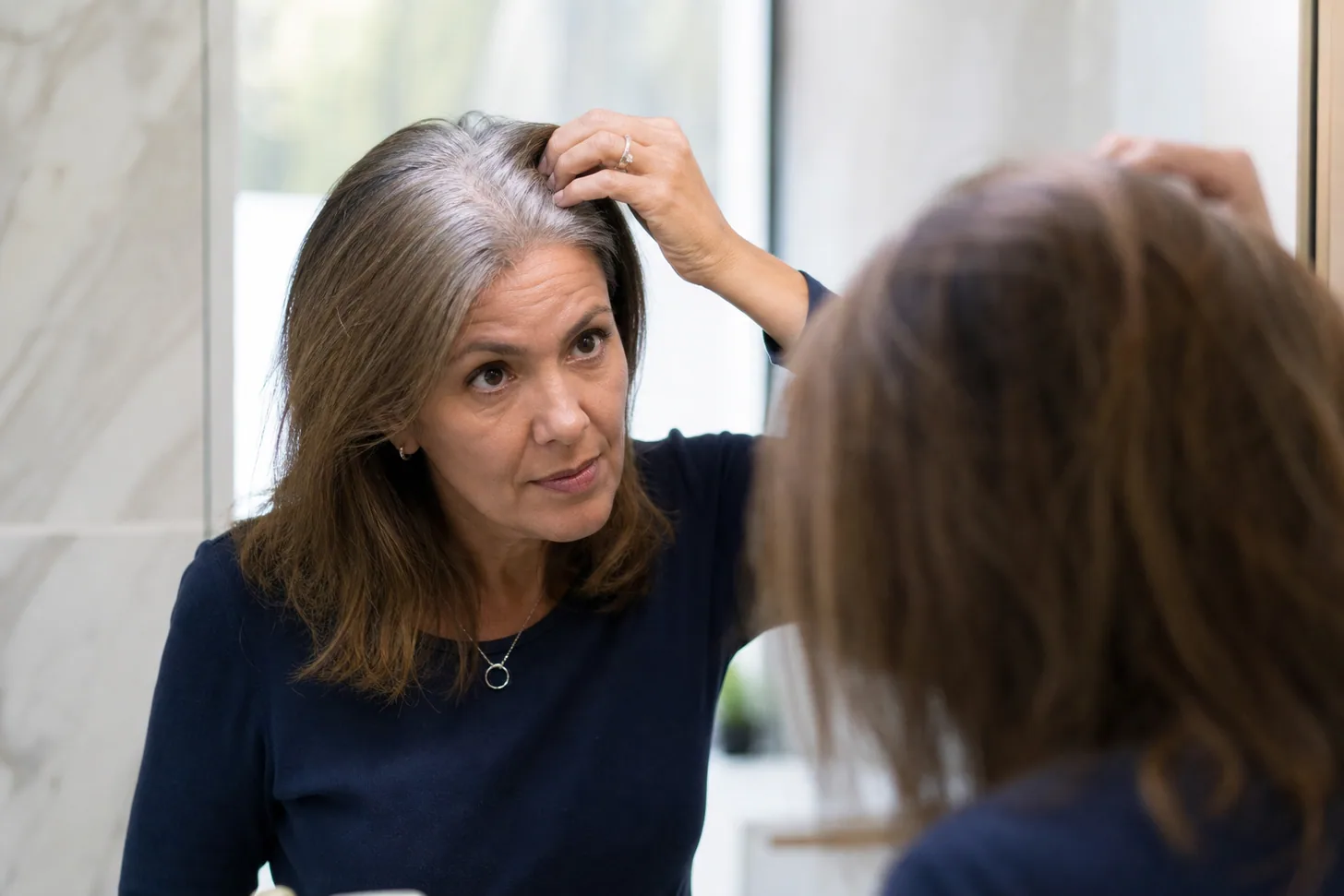
a woman in her mid-50s with fine shoulder-length hair going gray at the part, washing at a bathroom sink, soft daylight
These picks are independent and unpaid. Every size, price and claim below was checked on the brand's own product page in October 2026, and we link to the brands directly.
From the editor
Clients in menopause usually come in with two complaints at once. There is less hair at the part, and the hair that is left feels different: drier, wirier, sometimes grayer.
A shampoo built only for "thinning" often makes the second problem worse. Pick for the scalp first, then for the texture, and keep your expectations about regrowth honest.
MH
— Megan Holloway, Editor-in-Chief
What menopause does to hair, and why your shampoo should change
Estrogen is thought to keep hairs in their growing phase for longer. As it falls, more hairs rest and shed, new hairs can grow finer, and a 2022 review in Clinical and Experimental Dermatology notes that female pattern hair loss commonly shows up around menopause.
The fibre changes too. Hair gets drier and more fragile with age, and gray hair has a different texture from the pigmented hair around it. The full picture is in menopause and fine hair.
That means a good menopause shampoo has two jobs. It should clean the scalp well without stripping the lengths, and it should not add weight to hair that is already finer than it used to be.
The short verdict
Best for thinning at the part: Plantur 39 Phyto-Caffeine, the only pick marketed for menopause and backed by a placebo-controlled trial in women aged 40 to 70. Best evidence for the scalp: Nizoral, if you also have flakes or itch.
Best if dryness is the main problem: Davines Energizing, which is gentle enough to use daily. Best if your gray has gone yellow: Better Not Younger Silver Lining.
The best shampoos for menopause thinning hair
Plantur 39 Phyto-Caffeine Shampoo for fine brittle hair bottle, product packshot on white
1
Best for thinning at the part: Plantur 39 Phyto-Caffeine Shampoo for Fine, Brittle Hair
A caffeine shampoo with zinc, niacin and phyto-flavones, sold specifically for hair "weakened during menopause" and meant to sit on the scalp for two minutes. It is the one pick here built for this exact reader.
Its evidence is a randomised, double-blind, placebo-controlled trial of 140 women aged 40 to 70 over six months, which found less hair coming out on a pull test. Size: 500 ml, $29.99 (usually $34.99) from Plantur's US store. Honest limitation: it is one single-centre, brand-linked trial, it needs months of regular use, and the US page shows no full ingredient list.
Nizoral Anti-Dandruff Shampoo with 1 percent ketoconazole bottle, product packshot on white
2
Best evidence for the scalp: Nizoral Anti-Dandruff Shampoo (1% ketoconazole)
An over-the-counter antifungal for dandruff. A 2020 systematic review found ketoconazole increased hair shaft diameter in the human studies it pooled, and called it a promising add-on for pattern hair loss, while noting that better trials are still needed.
Use it twice a week, on the scalp only, as the brand directs. Size: 7 fl oz, sold at most US pharmacies. Honest limitation: it contains sodium laureth sulfate, which is drying on menopausal lengths, so condition the ends; and most hair-loss data comes from men and the 2% prescription strength.
Vegamour GRO Revitalizing Shampoo bottle, product packshot on white
3
Best peptide shampoo: Vegamour GRO Revitalizing Shampoo
A sulfate-free shampoo with Vegamour's peptide blend, caffeine, biotin, panthenol and ceramides. It is gentle on dry lengths and colour-safe, and the full ingredient list is on the page.
Size: 8 fl oz, $48 ($42 on subscription). Honest limitation: its only data is a swatch study of the shampoo and conditioner together, with no shedding data in people. It also contains fragrance and lemon peel oil, which can bother a sensitive scalp. Our Vegamour GRO review covers the serum in the same line.
Briogeo Destined for Density caffeine biotin peptide shampoo bottle, product packshot on white
4
Best caffeine shampoo for fine hair: Briogeo Destined for Density Peptide Shampoo
Caffeine, copper peptide, zinc, biotin and ginseng in a sulfate-free, silicone-free base. It cleans well without coating, which suits fine hair that goes flat easily.
Price: $32. Honest limitation: Briogeo mentions a clinical study but gives no details of who ran it or how, and a rinse-off shampoo only keeps caffeine on the scalp for seconds unless you leave it on.
Davines Naturaltech Energizing Shampoo bottle, product packshot on white
5
Best for a dry scalp and dry lengths: Davines Energizing Shampoo
A sulfate-free shampoo with caffeine and niacinamide that Davines makes for a fragile scalp and thin, fragile hair. It is mild enough for daily use and leaves fine hair light rather than coated.
Size: 250 ml, $40. Honest limitation: no efficacy data is published, so this is a comfort and texture pick, not a treatment. The peppermint and eucalyptus give a tingle that some dry scalps will not like.
Better Not Younger Silver Lining purple brightening shampoo bottle, product packshot on white
6
Best for yellowing gray: Better Not Younger Silver Lining Purple Brightening Shampoo
A purple shampoo made for gray and white hair over 40, with caffeine, niacin, panthenol and light oils. It cancels the yellow that gray hair picks up without the heaviness of many toning shampoos.
Use it two or three times a week, alternating with your regular shampoo. Size: 8.4 fl oz, $29. Honest limitation: it has no thinning evidence, and on very porous white hair the violet can leave a lilac tint. More options are in the best purple shampoo for fine hair.
Two shampoo actives have human trial data worth knowing about. Caffeine has the Plantur trial in women aged 40 to 70. Ketoconazole has a small body of studies, mostly in men, summarised in a 2020 systematic review.
Neither is a substitute for treatment. The AAD's page on female pattern hair loss says hair-loss shampoos can help hair hold moisture and break less, so it looks fuller, but cannot regrow hair or stop it progressing. Minoxidil is the main over-the-counter treatment; see thinning hair treatment for the options.
Peptides, biotin and botanicals in a rinse-off product have little independent evidence. They are not harmful, but do not pay extra for them expecting regrowth.
How to wash menopause thinning hair
Wash the scalp, not the lengths. Work the shampoo into the scalp with your fingertips and let the rinse clean the ends. Dry, older hair does not need a second lather.
Give caffeine time. If you use a caffeine shampoo, leave it on the scalp for two minutes, as Plantur directs; a ten-second wash does little. Condition the ends only, with a light formula; our best conditioner for thinning hair has picks.
Wash as often as your scalp needs. Washing does not cause shedding; hairs that come out in the shower were already resting and would have fallen anyway.
When a shampoo is not enough
See a doctor or dermatologist if shedding is sudden or heavy, if you see bald patches, or if your part keeps widening after three to six months. Thyroid problems and low iron are common at this age and look exactly like menopausal thinning.
Plantur 39 Phyto-Caffeine Shampoo is the only one marketed for menopause and backed by a placebo-controlled trial in women aged 40 to 70. If you also have flakes or itch, Nizoral (1% ketoconazole) twice a week is the other pick with real evidence.
No. The American Academy of Dermatology says hair-loss shampoos can make hair look fuller and break less, but cannot regrow hair or stop female pattern hair loss progressing. Minoxidil and other treatments are needed for that.
There is some evidence. A six-month, placebo-controlled trial of a caffeine shampoo in 140 women aged 40 to 70 found less hair coming out on a pull test. It was one brand-linked study, so treat it as promising rather than proven.
It can help as an add-on, especially if you have dandruff. A 2020 review found ketoconazole increased hair shaft diameter, but most studies were in men and used the 2% prescription strength. Use it on the scalp only, twice a week.
Usually yes, for the lengths. Menopausal hair tends to be drier and more fragile, so a gentle, sulfate-free shampoo helps. If you need a medicated shampoo with sulfates, apply it to the scalp only and condition the ends.
As often as your scalp needs. Washing does not cause hair loss; the hairs you see in the shower were already shedding. A clean scalp is better for thinning hair than a skipped wash.
Use a gentle shampoo for most washes and a purple shampoo such as Better Not Younger Silver Lining two or three times a week to stop gray turning yellow. Avoid heavy, coating formulas that flatten fine hair.
This article is general information, not medical advice. Sizes, prices and claims were checked on each brand’s official site in October 2026; formulas and prices change, so check the label before you buy. These picks are independent; no brand saw this article or paid for placement.
Images in this article are AI-generated illustrations, not photos of real clients or results. See our image policy.
Get the good hair intel
One honest, stylist-written guide in your inbox each week. No hype.

 MH