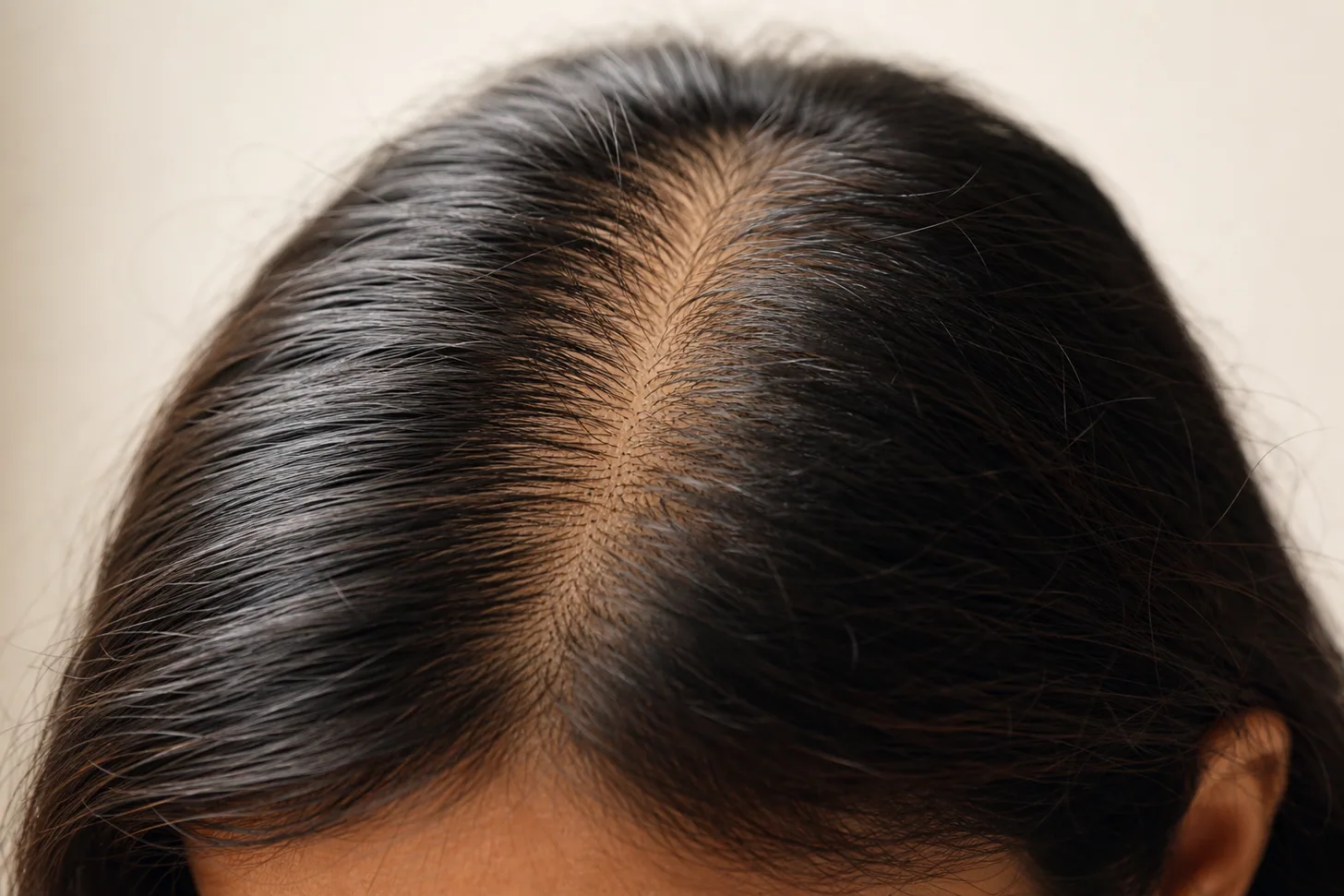
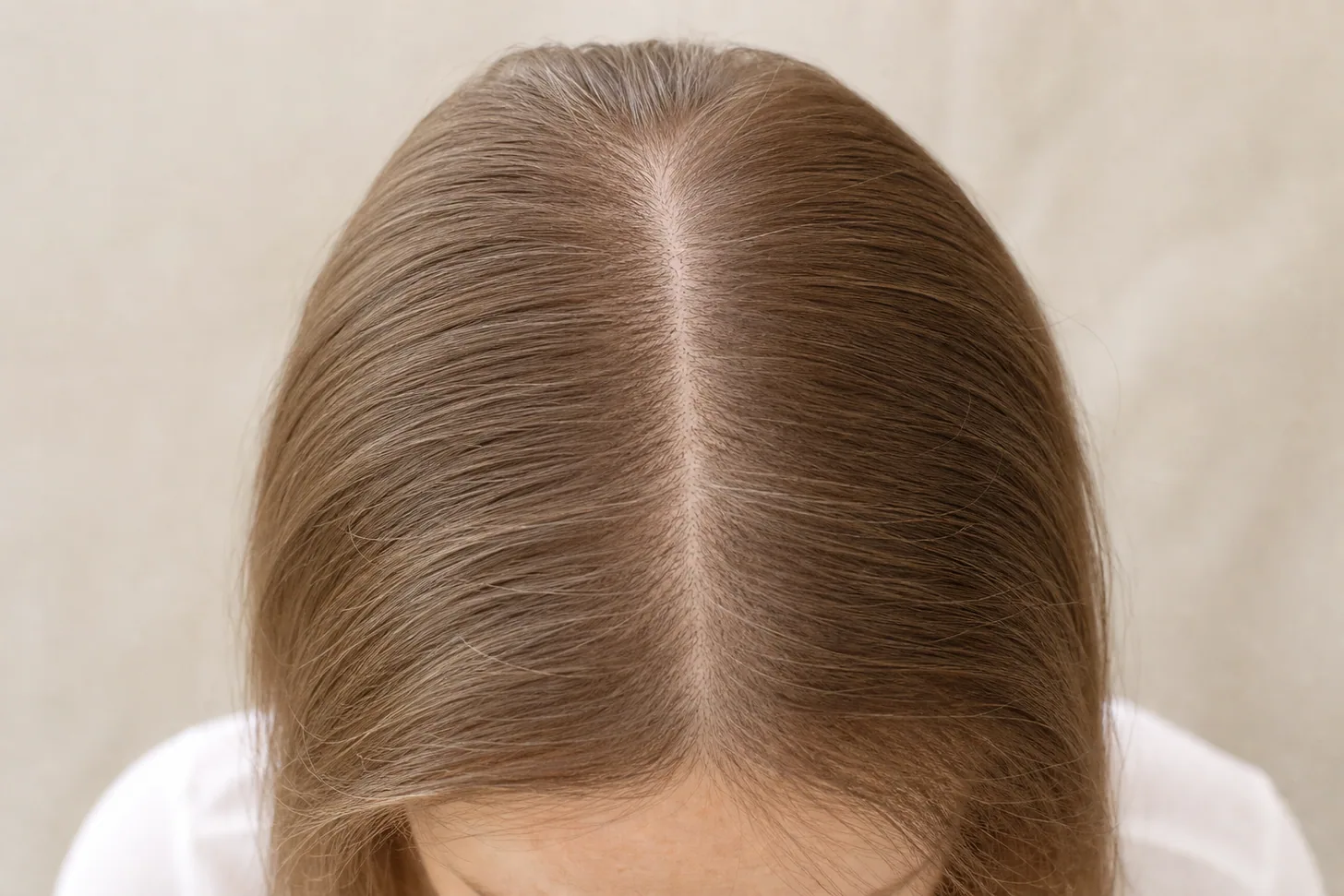
That single fact reorders the whole investigation, and it has a second edge to it: stopping a drug can shed you too, which is why coming off the pill and going on the pill both appear on the same list. Below: the classes worth knowing, the handful of drugs with a published rate attached (most have none), why fine hair registers the loss earlier than dense hair does, and the one thing not to do — stop a prescription on the strength of a web page.
Reviewed by a board-certified dermatologist. This page is educational and does not replace advice from the clinician who prescribed your medication.
The most useful thing you can bring to the appointment is a dated list of what changed.
There are two kinds of drug-induced hair loss, and only one of them is on your prescription list
Almost every drug that causes hair loss does it through telogen effluvium — it pushes a share of follicles out of their growing phase and into rest early. The hairs do not fall out at that moment. They sit in the follicle for weeks and then release together, which is why the shedding arrives so long after the cause. DermNet describes it as "the shedding of resting, or bulb hairs", triggered by most medications other than chemotherapy.
The other kind, anagen effluvium, is "the shedding of actively growing hairs", and it behaves nothing like the first: hair loss "may become obvious within days to weeks of starting chemotherapy", because the drugs damage the rapidly dividing cells of the hair matrix directly. That is chemotherapy territory, and if you are in it your oncology team is the right source — including on scalp cooling, which is the one intervention with a real effect there.
Everything else on this page is the first kind. Which means the whole exercise is a dating problem.
The three-month rule, and the deduction most people miss
Two independent sources give the same window. DermNet: 2–4 months. StatPearls: approximately 3 months, with a range it puts at one to six.
Run that backwards and two things follow, and the second one is the one nobody says out loud.
One: the suspect is the drug you started in month minus three. Not the drug you noticed on the shelf this morning. If the shedding began in August, the question is what changed in May.
Two: a drug you have taken steadily for years is a poor suspect. Telogen effluvium is a response to a change — a shove that knocks follicles out of phase. A stable dose you have tolerated for four years is not delivering a new shove, so it is very rarely the explanation for shedding that started six weeks ago.
This matters because the instinct when hair starts falling is to distrust every pill in the cupboard, and that instinct sends people to their doctor asking to stop the long-standing medication that is actually doing them the most good. Changes are what you are looking for: a new drug, a stopped drug, a dose increase, a switch of brand or formulation, a new supplement.
The exception worth naming: if a long-standing drug's dose went up, that counts as a change and the clock restarts from the increase.
Chair-side note
The version of this conversation I have most often starts with a client telling me she knows exactly what caused it, and naming something she started three weeks ago. When I ask what else changed earlier in the year, there is usually a pause, and then something considerably more plausible — a surgery in March, a course of something in April, a switch of pill in May.
It is not that people forget; it is that three months feels far too long ago to be connected to what is happening in the shower this morning. So I have started asking for it in writing. Go back through repeat prescriptions, pharmacy texts, the supplement drawer, and build a dated list covering the six months before the shedding started.
Bring that to your GP or dermatologist rather than a theory. A dated list is something a prescriber can actually work with, and it takes an appointment that would have gone nowhere and gives it a spine.
MH
— Megan Holloway, Editor-in-Chief
The drug classes worth knowing — and how likely each one actually is
Here is the part most articles get wrong. They print a list of thirty drugs, and the effect on the reader is that every medication looks equally guilty. In reality, published incidence figures exist for a handful of drugs and for nothing else, and where they do exist, they are usually smaller than the list format implies. The table below says so in the column where a number should be.
One of the most consistently named classes; also one you must never stop unilaterally
Anticonvulsants
Valproic acid, carbamazepine, phenytoin
Valproic acid 12–28%
The highest published figure on the list, and the best-characterised
Mood stabilizers
Lithium
Lithium 12–19%
Antidepressants sit in this group on the drug lists, but without comparable numbers
Antihypertensives
Beta-blockers, ACE inhibitors
Not reliably published
Beta-blockers are named among the most common causes; often a within-class switch is possible
Retinoids
Isotretinoin, acitretin, high-dose vitamin A
Not reliably published
Dose-related; excess vitamin A from supplements counts and is self-inflicted
Hormonal agents
Some oral contraceptives, HRT, androgens
Not reliably published
Starting and stopping both appear as triggers — see below
Antithyroid drugs
Propylthiouracil, carbimazole
Not reliably published
Confounded: the thyroid disease itself sheds hair, so untangling the two needs bloods
Lipid-lowering drugs
Statins, fibrates
Not reliably published
Widely prescribed, so widely blamed; the association is weak
Others named on the standard lists
Interferons, cimetidine, NSAIDs, vaccines
Not reliably published
Reported rather than quantified; being on a list is not a probability
Chemotherapy(different mechanism)
Antineoplastic agents
Common and expected
Anagen effluvium — days to weeks, not months. Your oncology team leads here
Rates and class lists from DermNet and StatPearls. Where the table says "not reliably published", that is the honest state of the literature, not an omission on our part.
The contraceptive trap: starting sheds, and so does stopping
This is the one that produces the most confusion, so it is worth being precise about the two separate mechanisms.
Starting or switching can matter because of the progestin. Progestins differ in how androgenic they are, and in a woman whose follicles are genetically sensitive to androgens, a more androgenic formulation can accelerate the pattern thinning she was already predisposed to.
That is not telogen effluvium — it is pattern hair loss being given a push, and it looks like a widening part rather than a sudden shed. Hormonal contraceptives sit on DermNet's list of drugs that cause alopecia for this reason.
Which is why the sequence so many women describe — came off the pill, hair fell out four months later, went back on it, hair fell out again four months after that — is not bad luck or a broken body. It is two different mechanisms with the same delay, and it is the strongest argument for making one change at a time and giving it six months before making another.
Why fine hair notices this first, and looks worse doing it
Dense, coarse hair has overlap to spare. Take a slice out of it and the remaining hairs still cover the scalp. Fine, low-density hair has no surplus — it is already close to the threshold at which scalp shows through at the part, so a proportional loss crosses that line while a denser head is still comfortably above it. This is the same margin problem that runs through fine hair vs thinning and "I can see my scalp".
There is a second, more practical difference: the evidence in the drain is unconvincing on fine hair. Fine strands are light, they do not clump into the dramatic hanks that coarse hair forms, and a genuinely significant shed can look like a modest amount of hair in the plughole.
So the diagnostic signs people are told to look for underreport what is happening, and the first thing a fine-haired woman usually notices is not the shedding at all — it is that her ponytail circumference has dropped and her part has widened. Both of which get filed under stress or age.
Date the onset. The month the shedding started, as precisely as you can. Photos help more than memory; look for one where your part is visible.
Build the dated list. Everything started, stopped, increased, decreased or switched in the six months before that month — prescriptions, over-the-counter drugs, supplements, hormonal contraception, HRT. Repeat-prescription records and pharmacy texts fill the gaps memory leaves.
Take it to the prescriber, not the pharmacist and not a forum. The question is "could any of these be contributing, and is there an alternative within the class?" — a question a prescriber can answer and a website cannot.
Ask about bloods at the same appointment. Iron, ferritin and thyroid are the ones that matter, they are cheap, and they change what happens next. Which blood tests actually matter covers what to ask for and why a "normal" ferritin can still be your answer.
Then wait, and protect what you have. Nothing you buy will speed up a telogen effluvium. What you can do is stop compounding it — see breakage on fine hair, because losing length to breakage on top of a shed is what turns a recoverable episode into a year of regret.
What recovery actually looks like
Drug-induced alopecia is "usually reversible", and that is the good news. The timeline is the part worth preparing for, because it runs in three stages and people expect two.
So: the shedding stops, then the regrowth starts, then — much later — it looks normal. The gap between the second and third stages is where people lose faith, because there is a long stretch during which the hair is genuinely recovering and looks no better.
On fine hair that stretch has a signature: a halo of short, soft new hairs at the hairline and part that stand up, will not lie flat, and read as frizz. They are the most encouraging thing on your head and they look like a problem. Taming frizz on fine hair and a light hairspray handle them cosmetically; do not cut them.
When medication is not the answer you are looking for
The shedding started more than six months after every change you can name.Outside the window, a drug becomes an unlikely explanation. Look at thyroid, iron and pattern loss instead. Blood tests.
Your part is widening but your daily shedding hasn't changed.That is the signature of pattern hair loss, not effluvium. Thinning on top, what genuinely helps.
The loss is patchy rather than diffuse.Distinct smooth bald patches are a different diagnosis entirely and need a dermatologist, not a medication review.
You have been on the drug, unchanged, for years.A stable dose is a poor suspect for a new shed. Look for what changed instead.
You are considering stopping the drug yourself.Don't. Anticoagulants, antihypertensives, anticonvulsants, thyroid drugs and lithium are all on this page and all are dangerous to stop abruptly. Bring the list to the prescriber and let them decide.
FAQ
For the ordinary kind of drug-induced shedding, two to four months. DermNet puts it plainly: the hair loss usually becomes evident after 2–4 months, and StatPearls describes the classic history as a causative event occurring approximately 3 months before the onset of the shedding. That lag is the single most useful fact on this page, because it means the drug you suspect is usually not the drug responsible. If your shedding started this week, look at what changed in the spring, not at what changed last Tuesday. The exception is anagen effluvium, which is chemotherapy territory and behaves completely differently: hair loss may become obvious within days to weeks of starting treatment, because those drugs damage the hair matrix cells while they're actively dividing rather than pushing follicles into rest.
The classes with the strongest and most consistently reported association are anticoagulants (heparin, warfarin and the newer agents), retinoids including high-dose vitamin A, beta-blockers and ACE inhibitors, antithyroid drugs, anticonvulsants and mood stabilizers — particularly valproic acid and lithium — hormonal agents including some oral contraceptives and HRT, cholesterol-lowering drugs, and interferons. StatPearls names beta-blockers, retinoids, anticoagulants, propylthiouracil and carbamazepine as the most common. Two things are worth holding onto. First, most antidepressants appear on these lists as a class rather than as individual high-risk drugs, and the association is far weaker than the internet suggests. Second, being on the list means it has been reported, not that it is likely — for the great majority of these drugs no reliable incidence figure has ever been published.
Both starting and stopping it can, which is the trap. Hormonal contraceptives appear on DermNet's list of drugs that cause alopecia, and the mechanism people usually mean is the progestin component: some progestins have more androgenic activity than others, and in a woman whose follicles are genetically sensitive to androgens that can accelerate pattern thinning. But discontinuing the pill is also a listed trigger for telogen effluvium in its own right, and the American Academy of Dermatology is explicit that stopping some types of birth control pills can cause a temporary hormonal imbalance and that women who develop a hormonal imbalance can develop thinning hair. So the honest answer is that a change in either direction can produce shedding two to four months later, and the fix is a conversation about which formulation you're on rather than a decision to come off it.
Not on your own, and not before you've talked to whoever prescribed it. This is the one piece of advice on the page that isn't negotiable. The AAD advises asking the prescribing doctor whether hair loss is a known side effect and warns against discontinuing medication without medical guidance, because abrupt cessation can create serious complications — and the drugs most often involved here are exactly the ones you can't stop casually: anticoagulants, blood-pressure medication, anticonvulsants, thyroid drugs, lithium. What you can do is bring the information. A dated list of every medication and supplement you started or stopped in the six months before the shedding began is genuinely useful to a prescriber, and it's the piece most people arrive without. From there the options are usually to switch within the class, adjust the dose, or wait it out — decisions that belong to the person who prescribed the drug.
Usually yes, and drug-induced alopecia is described as usually reversible — but the timeline is longer than most people expect and it's worth knowing before you start counting. DermNet's account of what happens after the causative drug is ceased is that hair shedding settles, although this may take up to 6 months, with evidence of regrowth appearing within 3 to 6 months but taking 12 to 18 months to recover cosmetically. StatPearls is similar on telogen effluvium generally: hair growth may take up to 6 months to restart and even longer for the growth to be appreciated by the patient. So the sequence is stop shedding, then regrow, then finally look normal, and the third step is the slow one. On fine hair the middle stage is conspicuous, because the regrowth arrives as a halo of short, soft, flyaway hairs at the hairline that won't lie down for months.
They can, and they appear on the standard drug lists, but the risk is smaller and much less well characterized than the volume of internet discussion implies. DermNet groups antidepressants and mood stabilizers together and the only figures it attaches are for lithium at 12 to 19 percent — a mood stabilizer rather than an antidepressant. For SSRIs and SNRIs specifically, most of the evidence is case reports rather than incidence data. Two things are worth weighing. The condition being treated is itself a trigger: significant psychological stress is a well-established cause of telogen effluvium, so shedding that begins a few months after starting an antidepressant may belong to the difficult period that led to the prescription rather than to the drug. And the drugs on this page are, almost without exception, treating something more consequential than hair. That's a real trade-off and it deserves a proper conversation, not a quiet decision to stop taking them.
Because there's no reserve to lose it from. Telogen effluvium is proportional — it shifts a percentage of follicles into the resting phase, and in a marked episode as many as 70 percent of anagen hairs can be pushed into telogen. Someone with dense, coarse hair loses the same proportion and still has enough overlap to hide the deficit; on fine, low-density hair the same percentage crosses the threshold where scalp becomes visible at the part. The other difference is what it looks like. On coarse hair a telogen effluvium announces itself as alarming quantities of hair in the drain and the brush. On fine hair the strands are light, they clump less, and the drain is unconvincing — so the first real sign tends to be that the ponytail has thinned and the part has widened, which is easy to attribute to age or stress rather than to something that started in a pharmacy three months ago.
Three features separate them and you can assess all three at home. Speed: telogen effluvium starts abruptly and you can usually name the month, while pattern loss is gradual enough that people date it in years. Distribution: telogen effluvium is diffuse and comes off the whole scalp evenly, including the back and sides, whereas female pattern loss concentrates at the part and the crown and spares the back. And shedding versus thinning: in telogen effluvium you're losing visibly more hair per day, so the drain, the brush and the pillow all change together — pattern loss can widen a part for years without any increase in daily shedding at all. The two also coexist, which is the case that confuses everyone: a telogen effluvium on top of early pattern loss unmasks thinning that was already there, and when the shedding stops the part doesn't go back to where it was.
Fourteen years in fine-hair care, eight of them behind the chair. Megan's rule for shedding: date it first, then look three months upstream of the date.
This article is for general education and is not medical advice. Never start, stop or change a prescribed medication on the basis of a web page — speak to the clinician who prescribed it. If you are experiencing sudden, patchy or prolonged hair loss, scalp pain, or other concerning symptoms, see a board-certified dermatologist.
Images in this article are AI-generated illustrations, not photographs of real clients or results. See our image policy.
Results vary with hair type, density, and growth patterns. This guide is educational and not a substitute for an in-person consultation with a licensed stylist or physician.
Get the good hair intel
One honest, stylist-written guide in your inbox each week. No hype.

 MH
MH