Reviewed by Dr. Rachel Kimura, MD · Updated August 2026 · 10 min read
"My hair changed at menopause" is one statement covering at least three different events, and they have different tells, different timelines and different answers. One is a temporary shed. One is miniaturization, where susceptible follicles produce a finer, shorter hair each cycle. And one nobody names: the growth phase itself shortens, so hair stops reaching the length it used to reach even though nothing is falling out.
Sorting out which you're dealing with is the whole job, because the shed recovers on its own, the miniaturization responds best if you catch it early, and the shortened growth phase isn't going to be fixed by any product — knowing that saves you both money and a year of blaming your routine. Below: what the research actually says, the check that separates them, and the one thing almost every article on this gets wrong.
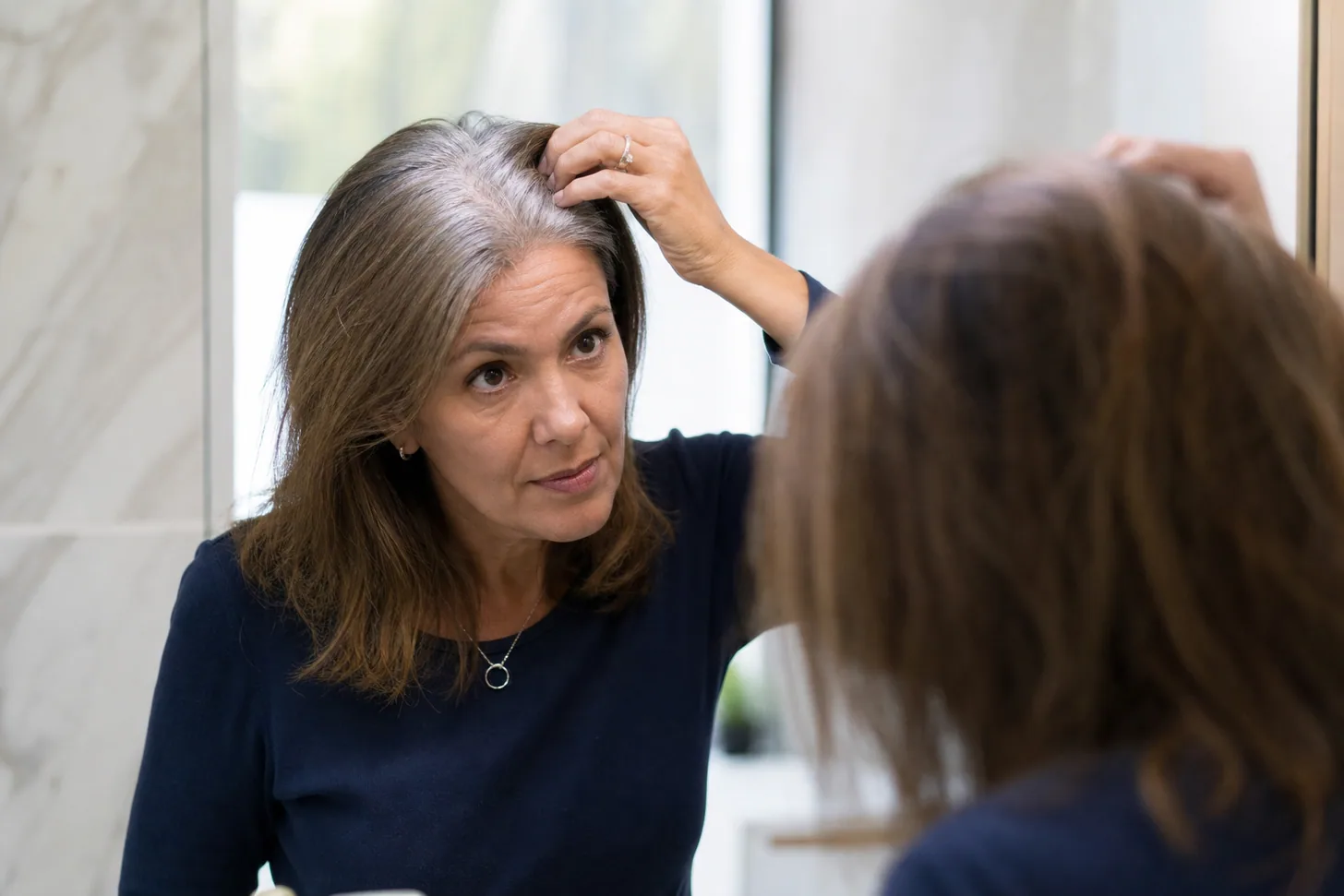
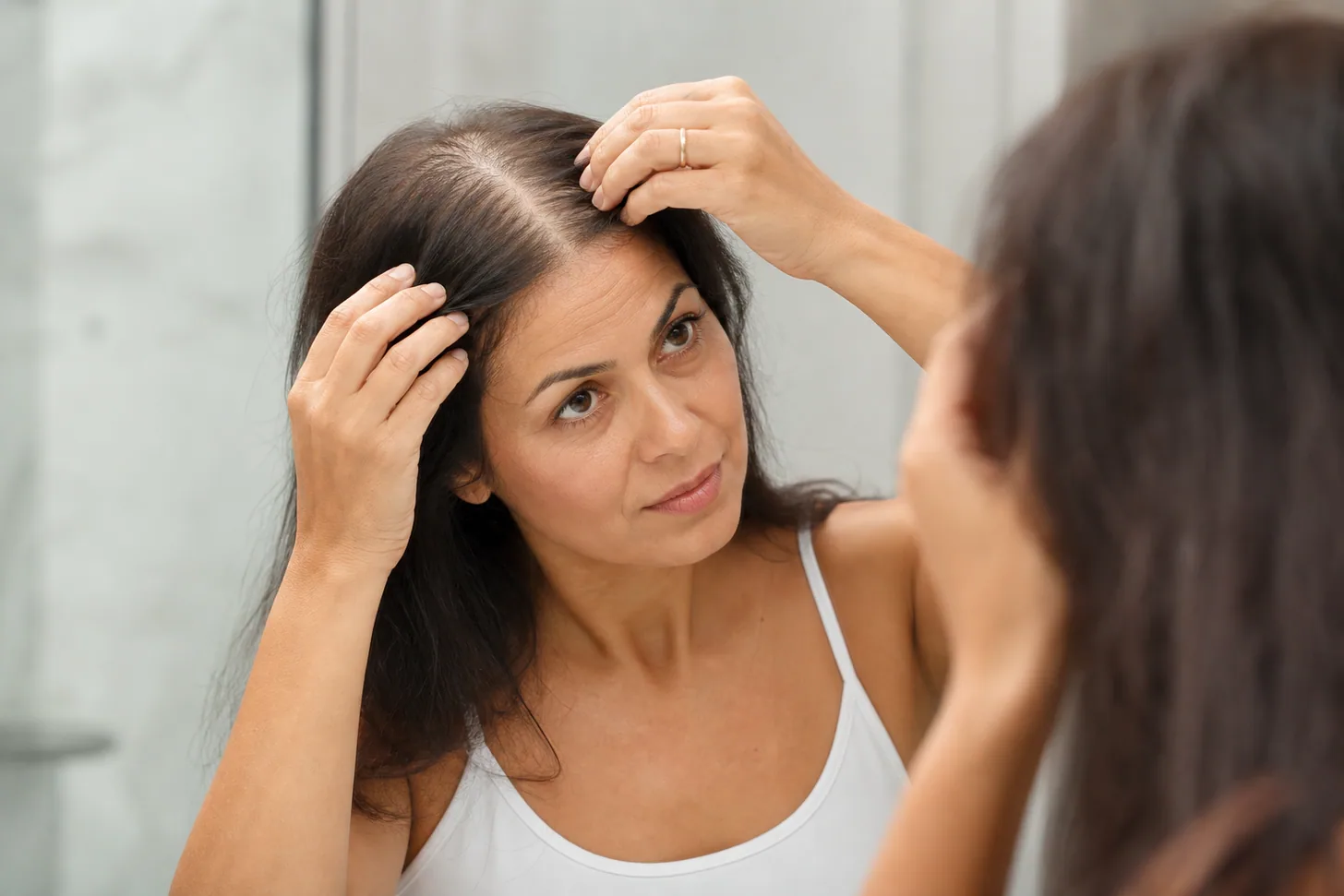
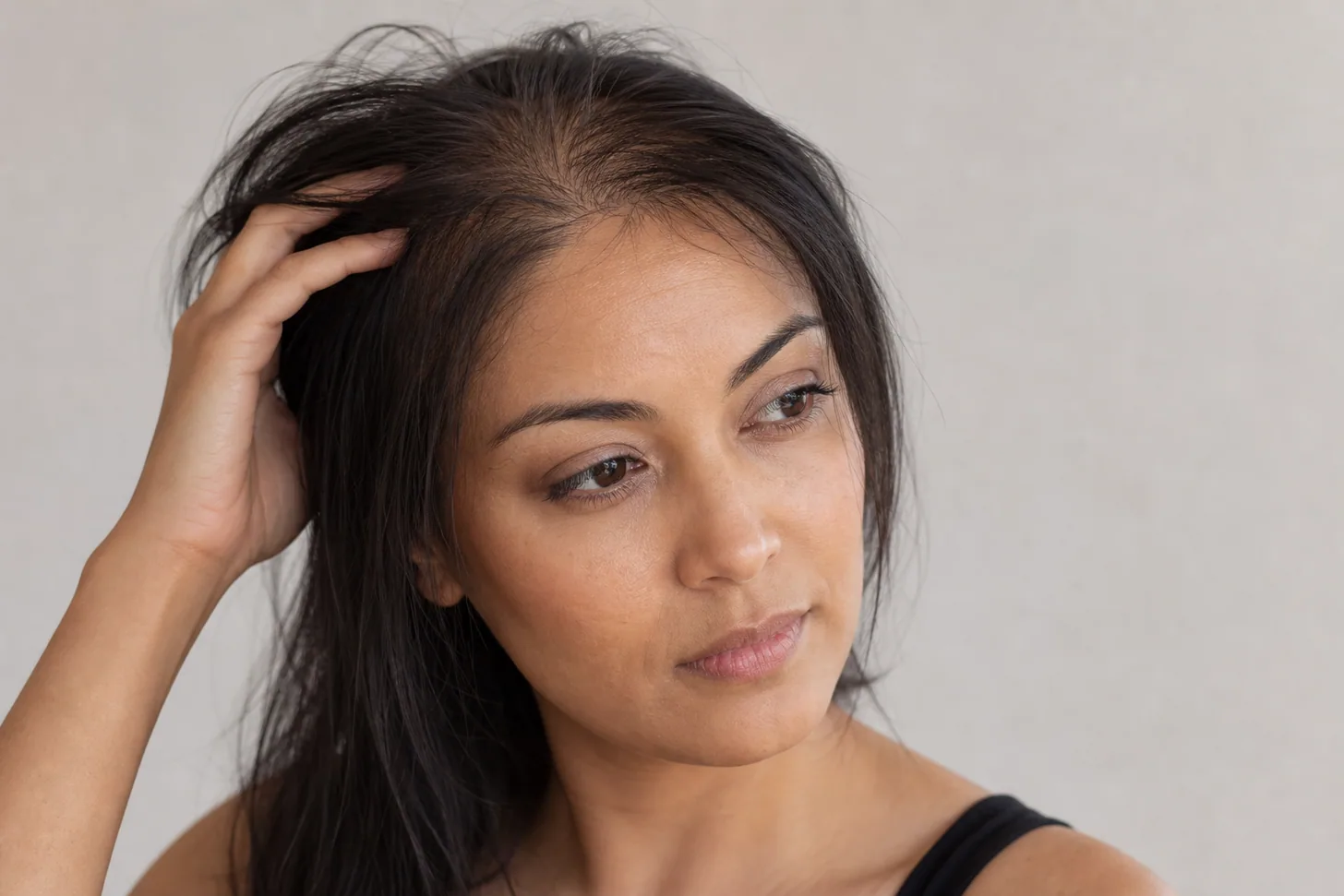
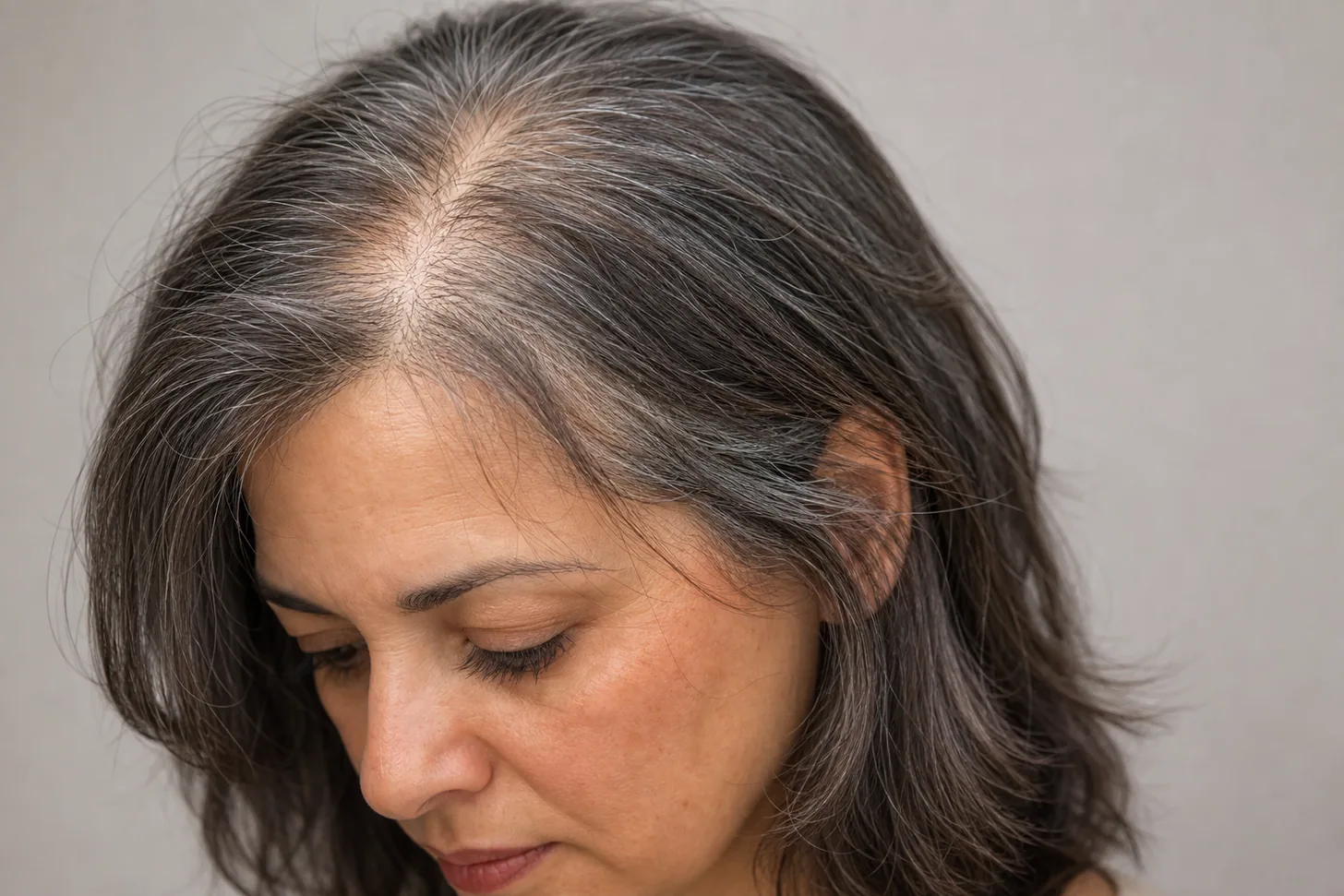
Three separate changes, one mirror. The part is where they show first.
Chair-side note
The question I'm asked most in this age group isn't about thinning at all — it's "why won't my hair grow any more?" Clients describe hair that used to reach the middle of their back and now stops at the shoulders no matter what they do, and they've usually spent a year on bond builders and trims trying to fix ends that were never the problem.
When I explain that the hair is being shed before it gets that far, because the growing phase is shorter than it was, the relief in the room is genuine. It isn't good news exactly. But it's a great deal better than believing you've been damaging your own hair for two years.
MH
— Megan Holloway, Editor-in-Chief
Three things change, not one
The growth phase shortens, so hair stops reaching its old length
Every hair grows for a set period — the anagen phase, which runs a few years — then rests and sheds. How long a hair can get is decided almost entirely by how long that phase lasts, not by how you treat the ends.
Estrogen helps extend anagen; the well-known thickening of hair during pregnancy is the same mechanism running in the other direction, and a 2022 review of hormones and hair growth in Cureus attributes that to the high circulating estrogen of pregnancy. When estrogen falls, the phase shortens. A review of hair follicle dynamics in women in BioMed Research International describes exactly this combination — "decreased anagen phase duration and regression of scalp hair to finer vellus hair."
The practical consequence is the complaint nobody connects to menopause: hair that used to grow past the shoulder blades now refuses to get past the collarbone. It isn't breakage, it isn't your heat tools, and no treatment on the market lengthens anagen.
Trimming won't change it and neither will a repair mask. What does help is choosing a shape built for the length you actually have rather than fighting for the one you used to — which is most of what medium-length cuts for fine hair over 50 is about.
Some follicles start producing a finer hair each cycle
This is miniaturization, and it's the process behind female pattern hair loss. Follicles that are sensitive to androgens produce a slightly shorter, slightly finer hair with each successive cycle, until what's growing there is a fine, near-invisible vellus hair instead of a full terminal one.
Nothing dramatic happens on any given day. The part widens over a year or two, the ponytail circumference shrinks, and photographs from five years ago look different in a way that's hard to pin down.
The BioMed Research International review notes that female pattern alopecia "often worsens during the perimenopause," which matches what shows up in the chair: the change is usually already underway before periods stop. What happens in those earlier years — when estrogen is swinging rather than low — is its own subject, covered in perimenopause and hair thinning.
This is the one to catch early, because treatments work on follicles that are still producing hair. Can you actually grow fine hair thicker covers what has evidence behind it and what doesn't.
The fibre itself changes as it goes gray
Not everything happening here is loss. Nonpigmented hair has a greater average diameter and a wider medulla than pigmented hair, and is described in the International Journal of Trichology as "coarser, stiffer, and harder to manage than darker hair."
So a woman graying and thinning at once has fewer strands and wider, stiffer ones — a genuinely different fibre from the one she had at thirty. Half of what feels like "my hair has gone weird" is a texture change, not a density change, and it wants close to the opposite handling: more moisture rather than less, and no volumizing products. That half has its own page: thin but coarse hair.
The thing most articles get wrong
The same follicle sensitivity, arriving decades earlier and from a different direction, is what sits behind PCOS and hair loss on fine hair — worth reading if your cycles were irregular long before perimenopause.
The dominant story online is that menopausal hair loss is an androgen problem — your testosterone rises, DHT attacks the follicle, block the DHT and you fix it. It's a tidy story, it sells supplements, and it doesn't match the literature.
The Cureus review is unambiguous: "the majority of females who experience frontal-central pattern hair loss do not have elevated levels of androgen." Testosterone hasn't gone up in most women; estrogen has come down, which changes the ratio, and individual follicles differ in how sensitive they are to the androgens that were always there. Sensitivity is largely inherited, which is why this runs in families and why two women with identical blood results can have very different hair.
Why it matters practically: if you go looking for a hormone to blame and your bloods come back normal — as they usually will — it's easy to conclude nothing is wrong and stop investigating. The absence of raised androgens doesn't mean the thinning isn't real or isn't treatable. It means the mechanism is sensitivity, not excess, and the treatments that work act at the follicle rather than on your hormone levels.
Shedding or miniaturization? The check
Do this before you buy anything. It takes a week of noticing.
What you notice
Points to a shed
Points to miniaturization
The fallen hairs
Full length, with a small pale bulb on the end
Not obviously increased; the change is in what's growing, not what's falling
The hairs growing in
Normal thickness, all one caliber
Noticeably finer and shorter than their neighbours, especially near the part
Timing
Started fairly suddenly, often 2–3 months after an event or illness
Crept up over a year or more; hard to date
Where
All over the head, fairly evenly
Concentrated at the part and the top; the back and sides hold up
What happens next
Settles over six to twelve months
Continues slowly unless treated
The two can run at once, which is why the picture is often muddy. A dermatologist settles it properly — the Cureus review notes that a reduction in the terminal-to-vellus hair ratio on the scalp is what distinguishes early female pattern hair loss from a shed, and that's an examination rather than a blood test.
Two of our existing pages go deeper on each half: fine hair or thinning for the at-home checks, and why your hair looks so thin when it's wet for the versions of this that turn out not to be loss at all. If you're in your forties and the shed followed a birth rather than a hormonal shift, the timeline is different and far more predictable — that one is postpartum shedding.
The timeline, honestly
Most of the change happens earlier than people expect. Perimenopause — the years of fluctuating hormones before periods stop, often starting in the mid-forties — is when pattern loss most commonly accelerates, which means the useful window is often several years before anyone would call themselves menopausal. That puts most of the decisions that matter squarely in the forties, which is the decade fine hair over 40 is written around.
Practically: if you're in your forties and your part looks different in photographs, that's the moment to get it looked at, not the moment to wait and see. Treatments for pattern loss preserve what's there far more reliably than they recover what's gone. Much of that change begins earlier than people expect, in the years before periods stop — perimenopause and fine hair covers that window.
What actually helps
Get the diagnosis before the routine
Everything else on this list depends on knowing which of the three changes you have. A shed needs patience and no purchases; miniaturization needs a treatment with evidence behind it; the shortened growth phase needs a different haircut. Guessing wrong costs a year. The American Academy of Dermatology's page on female pattern hair loss is a good briefing to take into an appointment.
Treat the density question with evidence, not supplements
There is one topical with solid evidence for female pattern hair loss and a small number of prescription options a dermatologist may raise. There is also an enormous market of supplements, scalp serums and "DHT blockers" with far less behind them. We keep the honest version of that list in can you actually grow fine hair thicker rather than repeating it here — it's the page to read before spending anything.
Change the cut to match the hair you have now
This is the highest-return change available and the one most people postpone. A shape built for the length and density you had at thirty-five will keep looking wrong however well you style it. Shorter, blunter, with the weight kept at the perimeter is the direction — hairstyles for mature fine hair is the overview, and the age-specific galleries sit under it.
Handle the texture change separately
If the fibre has gone coarse and wiry, stop reaching for volumizing products — they're built to strip weight off strands that collapse, and yours don't. Weight on the lengths, roots kept clean, moisture rather than lift. The full inversion is in thin but coarse hair.
Reduce the coverage problem while you deal with the cause
Cosmetic coverage — a scalp concealer at the part, or building fibers through diffusely thin areas — isn't a substitute for treatment, but it works immediately and it takes the daily sting out of a widening part.
Reducing the color contrast between hair and scalp does more than any powder, and a part moved an inch does more than most products. Coverage for thinning on top has the sequence. Where the change shows at the front edge rather than the crown, cuts for a receding hairline and thinning temples is the cutting brief.
What to raise with a doctor — and what this page won't answer
We're not going to tell you whether to take hormone therapy. That's a decision about menopausal symptoms as a whole, weighed against your own medical history, and it belongs with a doctor who knows it.
The evidence for hormone therapy's effect on scalp hair specifically is thinner than the evidence for treatments applied directly to the scalp, so hair is rarely a good enough reason on its own to start or avoid it — but it's entirely reasonable to raise as one item among several.
Worth mentioning at the same appointment: thyroid function and iron status, both of which cause diffuse thinning, are common in this age group, and are easy to check — which blood tests actually matter covers what to ask for, why a ferritin inside the reference range can still be low enough to affect hair, and the supplement to stop 48 hours before the draw because it skews thyroid results.
If you've also been losing weight quickly — deliberately or on medication — say so, because rapid loss triggers a shed of its own on a roughly three-month delay: shedding after weight loss and GLP-1 medications. Bring a dated list of any prescription changes too — medications that cause hair shedding — and if the conversation turns to treatment, PRP, microneedling and laser caps covers what's on offer, what the evidence for each actually says, and what it costs you indefinitely.
See a doctor rather than changing your routine
Hair is coming out in patches rather than diffusely. Patchy loss is a different set of conditions and needs assessing promptly.
Your scalp is sore, itchy, red, scaly, or has areas that look smooth and shiny. Scalp symptoms can indicate a scarring condition, where early treatment matters a great deal.
Heavy shedding has continued for more than three months. A shed that doesn't settle is worth investigating — thyroid, iron and medication changes are all treatable causes.
Your part is measurably wider than it was a year ago. That's the miniaturization picture, and treatment works better the earlier it starts.
You've started a new medication in the last six months. A number of common prescriptions cause shedding. Don't stop anything yourself — ask.
FAQ
For many women, yes — but by more than one route, and the routes need separating. Some experience a temporary shed, where hair comes out at full length with a small pale bulb and recovers over months. Others develop progressive miniaturization, where susceptible follicles produce a finer, shorter hair each cycle until the part widens. And separately, falling estrogen shortens the growth phase, so hair stops reaching the length it used to even if nothing is falling out. The three feel similar in the mirror and need different responses.
Because the growth phase itself has shortened, not because the ends are breaking. Each hair grows for a set number of years before it rests and sheds, and estrogen helps extend that phase — which is why hair often thickens in pregnancy. When estrogen falls, the phase shortens, so a hair is shed before it reaches the length it used to reach. That's why hair that once grew to mid-back now stops at the shoulders however carefully you treat it, and why trims and treatments don't change it.
Usually not, and this is the most common misunderstanding. A 2022 review in Cureus states plainly that the majority of women who experience frontal-central pattern hair loss do not have elevated levels of androgen. What changes at menopause is the balance — estrogen falls while androgen levels stay roughly where they were — and how sensitive individual follicles are to the androgens already present. So content promising to block DHT or rebalance your hormones is answering a question most women don't have.
Look at the hairs themselves and at your part. Shed hairs come out at full length with a small pale bulb on the end, arrive in noticeably increased numbers over a few weeks, and taper off. Miniaturization produces the opposite picture: no dramatic increase in fallen hair, but the hairs growing in are visibly shorter and finer than their neighbours, and the part slowly widens over a year or more. A dermatologist can distinguish them by the ratio of terminal to fine vellus hairs on the scalp.
A temporary shed usually does recover — most settle over six to twelve months. Miniaturization generally doesn't reverse on its own, which is why it's worth identifying early: treatments work better on follicles that are still producing hair than on ones that have stopped. And the shortened growth phase is a lasting change, so hair that no longer reaches its old length is unlikely to start again. That's not a counsel of despair — it's the reason to spend your effort on the parts that do respond.
That's a conversation for your doctor rather than a hair site, and it shouldn't be started or avoided on the basis of hair alone. Hormone therapy is prescribed for menopausal symptoms and has its own risks and benefits that need weighing against your personal medical history, and the evidence for its effect on scalp hair specifically is limited compared with the evidence for treatments applied to the scalp. Raise hair as one item among several with a doctor who knows your history.
No, and treating it as one problem is why routines stop working. Nonpigmented hair has a greater average diameter and a wider medulla than pigmented hair, and is coarser and stiffer to handle. So a woman who is graying and losing density at the same time genuinely has a different fibre than she had at thirty: fewer strands, each one wider and stiffer. The density needs one approach and the texture needs another, close to the opposite one — see thin but coarse hair.
Sooner than most people do. Book an appointment if your part is measurably wider than a year ago, if shedding has been heavy for more than three months, if there are patches rather than diffuse thinning, or if there's scalp pain, itching, redness or scarring. Sudden or patchy loss and any scalp symptom need assessing rather than managing at home, and treatments for pattern loss work best started early.
Fourteen years working with fine and thin hair, eight of them behind the chair. Megan's view is that the most useful thing anyone can do at this stage is find out which of the three changes they have, before buying a single thing.
This article is for general education and is not medical advice. It does not recommend for or against hormone therapy or any prescription treatment. If you are experiencing sudden or patchy hair loss, scalp pain, or other concerning symptoms, see a board-certified dermatologist.
Results vary with hair type, density, and growth patterns. This guide is educational and not a substitute for an in-person consultation with a licensed stylist.
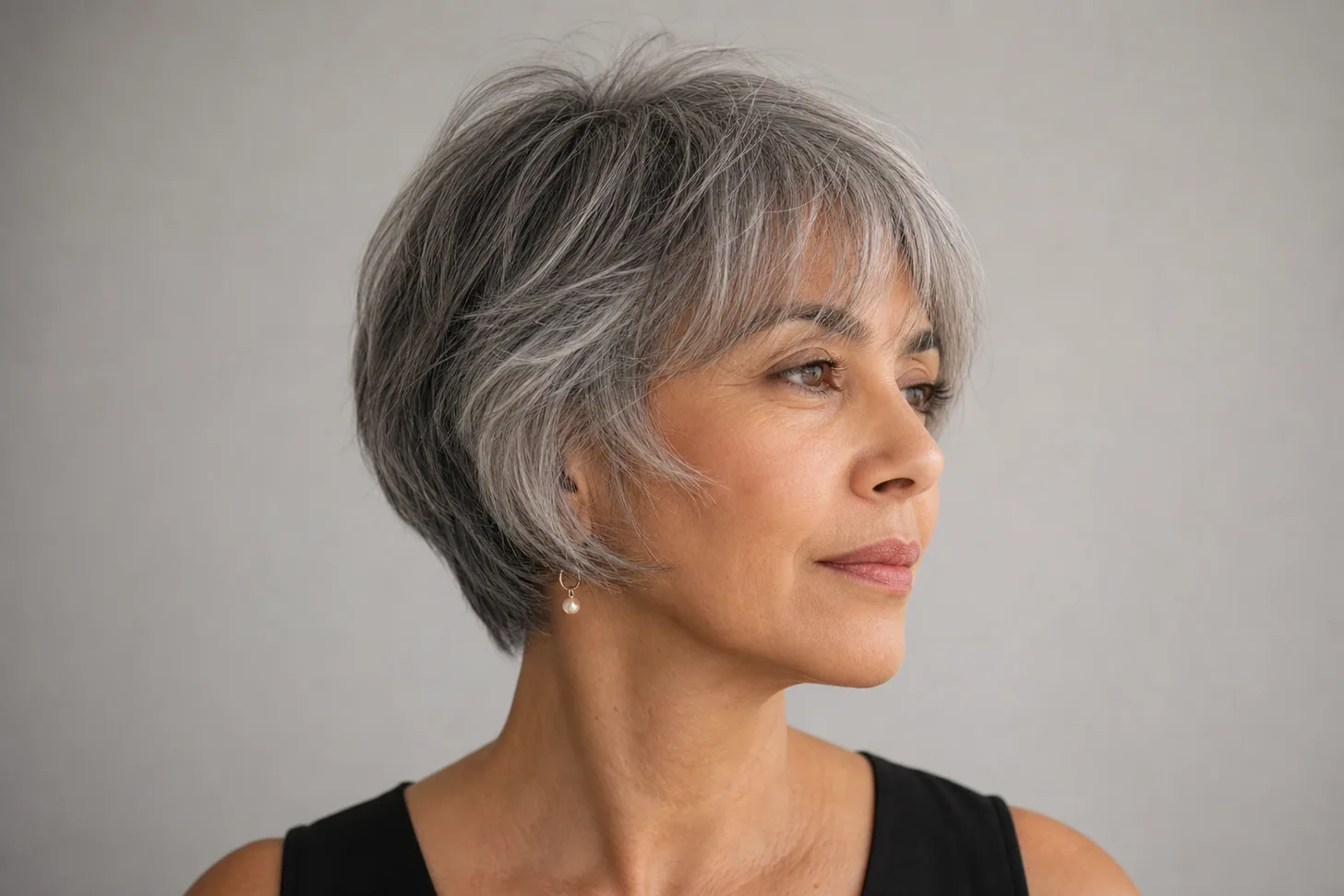
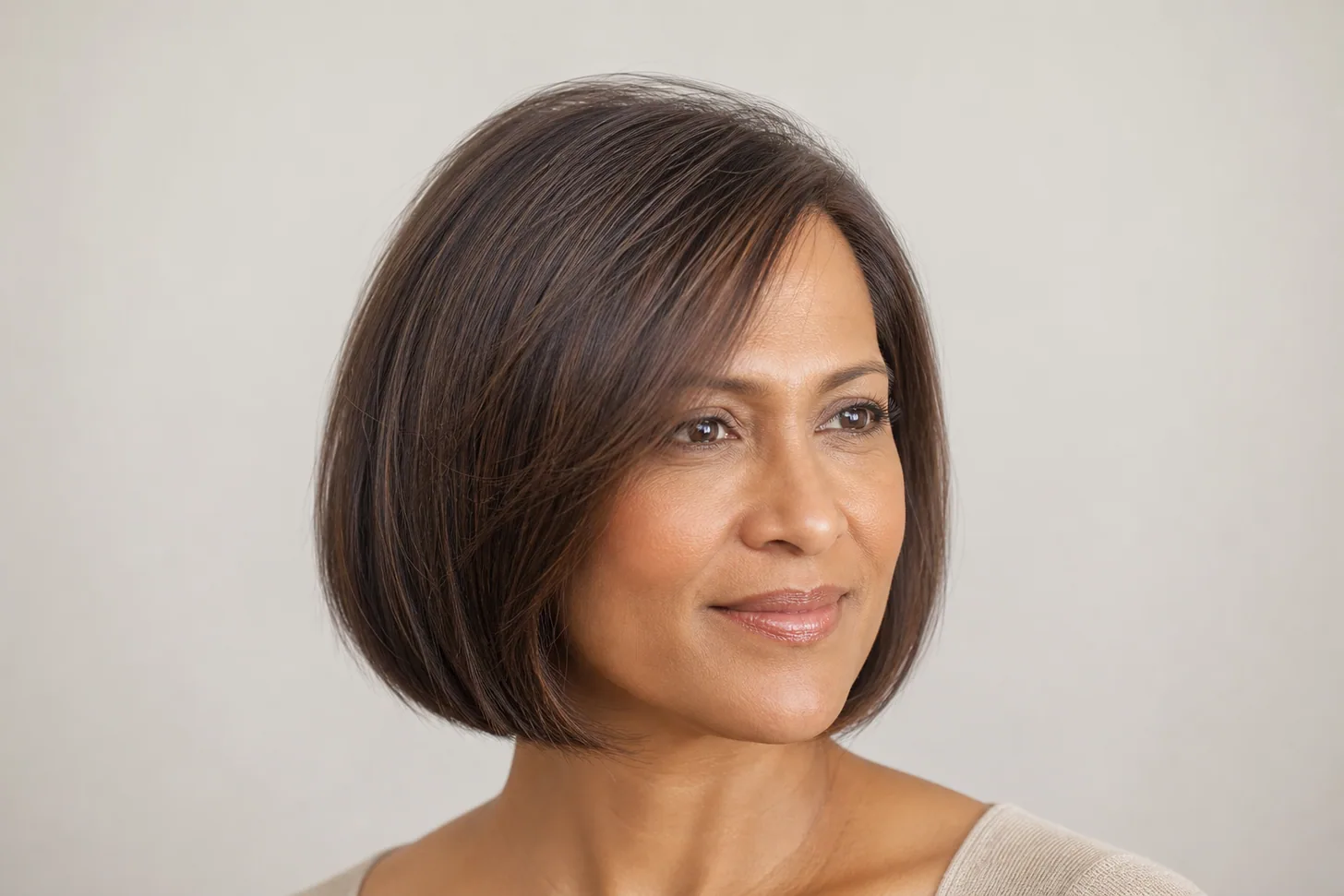
Hairstyle images in this guide are AI-generated illustrations, not photos of real clients or results. See our image policy.
Get the good hair intel
One honest, stylist-written guide in your inbox each week. No hype.

 MH
MH