Reviewed by Tara Sullivan · Updated August 2026 · 10 min read
There's a reason your fringe is limp by lunchtime while the rest of your head still looks fine, and it isn't that you have oily hair. A fringe is the only part of your hair that spends the entire day lying on skin — and not neutral skin, but skin you have deliberately covered in moisturizer, sunscreen and often makeup. So it's absorbing your skincare all day from underneath, on top of forehead sebum, on top of the twenty times you push it aside with your fingers.
Three inputs, on two inches of the thinnest hair you own. Once you see it that way the fix is obvious and slightly liberating: your fringe is on a different schedule from the rest of your hair, and it should be treated like a separate small head of hair — washed more often, dried first, refreshed mid-day.
That sounds like more work and it's less, because two inches of hair takes two minutes. Below: the routine, how to wash just your bangs, the mid-day rescue, and the one product rule that matters more than all the others.
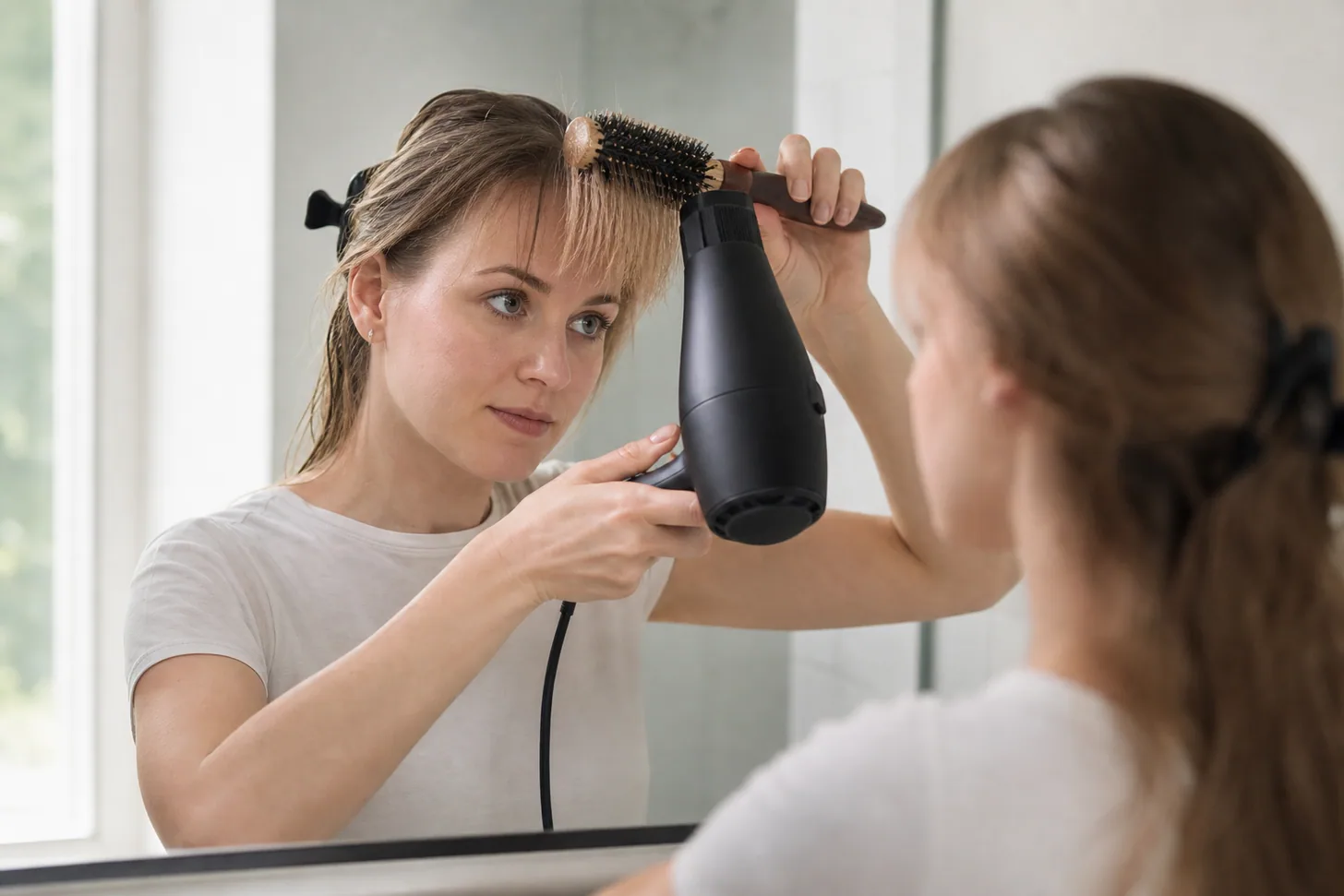
Dried first, while the rest is still wet — the step that decides how the whole day goes.
Why the fringe goes first — three inputs, not one
Everyone knows bangs get greasy. Almost nobody separates out why, which matters because the three causes have three different fixes.
1. Sebum, from underneath. The forehead is part of the face's oiliest zone, and your fringe is lying directly on it for sixteen hours a day. That's a supply of oil the rest of your hair simply doesn't have — your lengths are hanging in the air.
2. Skincare, which nobody mentions. This is the one that surprises people. The skin your fringe rests on is skin you have moisturized, applied SPF to, and possibly primed and foundationed. All of those are formulated to sit on skin and stay there, and over a day a meaningful amount transfers onto the hair lying across them. If your fringe went downhill when you started using a richer moisturizer or a heavier sunscreen, that's not a coincidence.
3. Your hands. A fringe gets touched more than any other section — pushed aside, tucked, checked in every reflective surface. Each touch moves oil onto it, and there's a second cost: a 2015 review of hair cosmetics notes that "Abrasion and friction are impactant factors that cause hair damage by protein loss", and constant handling of two inches of the finest hair on your head is exactly that.
And fine hair amplifies all three. A thin strand needs very little oil to look coated, and there are only a couple of inches of it, so there's nowhere for anything to disperse to. On thick hair, the same three inputs get absorbed into a much larger volume and go unnoticed.
The rule that fixes most of it
Your fringe is on its own schedule. That's the whole reframe, and everything practical follows from it.
Once you stop expecting a fringe to last as long as your lengths do, the routine stops feeling like failure. Your fringe needs washing perhaps twice as often as the rest of your hair, needs drying first rather than last, and will sometimes need a two-minute reset in the middle of the day.
None of that means you're doing something wrong — it means two inches of hair lying on your face is a different object from twelve inches hanging down your back, and it always was.
The practical payoff is that it's less work, not more. Washing a fringe is three minutes at the sink. Drying it is ninety seconds. Compare that with washing your whole head a day early because the fringe let you down, which is what most people do instead — and which costs your ends a wash they didn't need.
Chair-side note
The skincare thing is the one I get to tell people that genuinely changes their week. A client came in convinced her scalp had changed and she needed a different shampoo — her fringe was greasy by eleven and it had never been that bad.
Nothing about her hair had changed at all. She'd started using a richer moisturizer and a mineral sunscreen in the winter, both of which sit on the skin rather than absorbing quickly, and her fringe was resting in them for eight hours a day.
We didn't change a single hair product. She started applying moisturizer to her forehead last and thinly, giving it five minutes to settle before the fringe came down, and clipping the fringe back while she did her makeup. That was it. If your bangs suddenly got worse and your hair didn't, look at your face, not your shampoo.
SB
— Simone Baptiste, Senior Stylist
The wash-day routine: two minutes, and the fringe comes first
The order is the whole thing. A fringe is a couple of inches of fine hair, which means it air-dries in roughly ninety seconds — so if you work through your head in the usual order and reach it last, it has already dried flat against your forehead and you're now trying to argue it out of a shape it has already set into.
In the shower: shampoo the fringe, and keep conditioner off it entirely. The fringe has no old, worn ends to condition — it's all new hair. Conditioner on it is the fastest route to greasy by ten.
Blot the fringe, then dry it first — before anything else. Straight out of the shower, while the rest of your hair is still soaking. This is the step, and it's the one people skip.
Small round brush, lift at the root. Direct the section side to side rather than straight down as it dries, so it sets with movement rather than pasted flat. On a curtain fringe, dry each half away from the center.
Finish with the cool shot. Hair sets as it cools, not as it heats, so this is what makes it stay — why fine hair won't hold a style covers the mechanism.
Clip it back while you do the rest of your head and your makeup. Keeps it out of the moisturizer and stops you touching it. A flat clip leaves no dent.
Then leave it alone. No cream, no oil, no serum, no leave-in. Ever.
How to wash just your bangs
This is the habit that makes a fringe workable on fine hair, and most people have never been told it's an option.
Lean over the sink. Wet only the fringe — you can clip the rest back or just be careful. Use a very small amount of shampoo, less than a pea, worked into the roots. Rinse thoroughly, since residue is as flattening as oil. Skip conditioner completely. Blot with a towel, then dry immediately with the round brush as above.
Three minutes, start to finish, and your fringe is back to day one while your lengths keep the wash they already had. It's the difference between washing your whole head four times a week and washing it twice — which matters, because your ends are two years old and every wash costs them something.
When it's the right call: the fringe is flat and looks wet-ish, but the rest of your hair is fine. When it isn't: your roots everywhere are oily, in which case it's a full wash and the question is your wash cadence rather than your fringe.
The mid-day rescue, in ninety seconds
Ranked by how bad it's got.
Slightly flat, not greasy: flip the fringe up and away from your face with your fingers for thirty seconds, then let it fall. Often enough on its own.
Flat and a bit dull: one short burst of dry shampoo at the root of the fringe only, from further away than feels natural. Wait thirty seconds for it to absorb, then work it in with fingertips and brush through. Applied close and rubbed straight in, it cakes — and on a fringe that's very visible. Dry shampoo picks covers which ones don't cast gray.
Genuinely wet-looking: dry shampoo won't rescue this. Two minutes at a sink is faster and better.
Separating into ropes: a whisper of texture spray and finger-separate. If it's happening within hours of washing, the cause is product rather than oil — check what's reaching that section.
And the free one: stop touching it. Over a day, hands are a bigger contributor than most people believe. If you can't stop, keep a flat clip in your bag and pin it back for the afternoon.
What's actually wrong with your fringe
Symptom
Usual cause
Fix
Greasy by lunchtime, hair fine
Sebum plus skincare transfer plus hands
Wash the fringe separately; forehead skincare on last and thin
Greasy within hours of washing
Conditioner or a styling product reaching the section
Keep everything except shampoo off the fringe
Flat against the forehead all day
Air-dried, or dried last, so it set flat
Dry it first, lift at the root, finish cold
Splits in the same spot every day
A cowlick or whorl at the front hairline
A drying direction and a cut adjustment — see below
Splits in different places, days it's dirty
Oil clumping the strands together
Wash the fringe; dry shampoo between
Fine at home, wrecked outdoors
Humidity re-breaking the set
Cool-set properly; a light mist at a distance; soft shapes
Sits oddly, and it's been 4+ weeks
Length — a fringe stops working before it looks long
Trim it, dry, vertically, less than you think
One row on that table deserves a wider point: if you're doing everything here and the fringe still fights you every morning, the problem may be the fringe you were given rather than the routine.
Daily effort varies more by fringe type than by technique — a side-swept fringe is the lowest-effort shape fine hair can wear because it's designed to lie flat, so going limp barely changes it, while wispy bangs look best of all on fine hair but show oil sooner than anything else, because with so few strands even slight grease separates them visibly.
The honest minutes-per-day for every type sit in the verdict table on bangs for fine and thin hair. Switching type is sometimes a much better fix than switching product. If the fringe never covered as much as you hoped, the cause is often depth rather than styling — bangs for a big forehead gives the measurement.
Hats, workouts, humidity and cowlicks
Four things that undo a fringe faster than anything else, and what to do about each.
Hats and headbands press the fringe flat against a warm forehead, which is both a shape problem and an oil problem. If a hat is going on, clip the fringe back underneath it rather than letting it lie against the skin, and re-dry it when the hat comes off rather than trying to finger-fix it.
Workouts are the worst case: sweat on the forehead, straight into the fringe, then it dries flat in whatever position it was in. Pin the fringe back before you train — see gym and workout hair for fine hair — and rinse and re-dry just that section afterwards.
Humidity reverses the set, because water breaks the bonds you dried into place. The defences are a proper cool set, a light mist of hairspray at a distance to brace it, and choosing a soft shape: a curtain or side-swept fringe degrades into a different soft shape, while a blunt fringe has nowhere to go but frizzy. More in taming frizz on fine hair.
A cowlick at the front hairline is the one that isn't your fault and won't respond to any of the above. If your fringe splits in exactly the same place every day regardless of how clean it is, that's a growth pattern, and it's solved while the hair is wet and with a cut that works with the whorl rather than against it — cowlicks on fine hair has the method.
Chair-side note
Trimming your own fringe is on the short list of home-cutting jobs I actively encourage, because a fringe stops sitting properly around week three and most people can't get to a salon every three weeks. But do it the way we do it. Dry hair, always — fine hair stretches when it's wet and springs up shorter the moment it dries, which is how people end up an inch higher than they wanted and very unhappy.
Point the scissors up into the ends and snip vertically rather than cutting straight across, so any wobble disappears into the texture instead of becoming a hard line. And take it in two or three passes, checking in between. The only version I'd hand back to a professional is a heavy blunt fringe, where the whole effect is the straightness of the line and there's nowhere for a shaky hand to hide.
SB
— Simone Baptiste, Senior Stylist
The full safe-list for cutting your own hair — what's on it and what absolutely isn't — is in cutting fine hair at home. And if you've decided the fringe isn't working out at all, growing out bangs on fine hair is the stage-by-stage exit rather than a suffering-in-silence plan.
When the routine isn't the problem
The fringe was cut too short or too thick for your hair.No routine rescues a fringe taken from a section that was too wide or too far back. Bangs for fine hair covers which shapes suit, and it's worth reading before the next appointment.
Your hairline is receding or thinning at the temples.A fringe cut from thinning hair leaves the thin area thinner. Read thinning at the hairline first.
Your whole head is oily by lunchtime, not just the fringe.That's a scalp and cadence question — fine, oily hair and how often to wash.
The fringe is breaking rather than flat.Short broken pieces at the front usually mean heat or handling. Cut the touching, cut the tool temperature — breakage on fine hair.
You've had it four weeks and everything is a fight.It's probably just long. Trim it before you conclude anything else.
You genuinely don't want a daily two minutes.That's fair, and a fringe is the highest-maintenance thing you can do to fine hair. A face-framing layer gives some of the effect with none of the routine — see face-framing layers.
FAQ
Because a fringe is the only part of your hair that spends the whole day lying on skin, and it's picking up three things at once. The forehead is one of the oiliest areas of the face, so there's sebum arriving from underneath. There's skincare arriving from the same place — the skin your fringe rests on is skin you've deliberately covered in moisturizer, sunscreen and often makeup, and those transfer onto the hair over hours. And there are your hands, because a fringe gets pushed aside and tucked far more often than any other section. On fine hair the effect is amplified, since a thin strand needs very little oil to look coated. That's why the fringe goes limp by lunchtime while the rest of your head looks fine, and why treating it on the same schedule never works.
Yes, and for anyone with a fringe and fine hair it's one of the most useful habits available. Lean over the sink, wet only the fringe, use a very small amount of shampoo, rinse thoroughly and skip conditioner entirely on that section. Then dry it immediately with a small round brush, because a fringe left to air-dry sets flat against the forehead. The whole thing takes about three minutes. It works because the fringe and the rest of your hair are genuinely on different schedules — the fringe is exposed to sebum and skincare all day while your lengths aren't, so it needs washing perhaps twice as often. Doing it this way keeps the fringe fresh without stripping ends that are two years old and did nothing wrong.
Dry the fringe first, while the rest of your hair is still wet, and set the direction before it has a chance to dry flat. This is the single most important step and almost nobody does it, because the instinct is to work through the head in order and reach the fringe last — by which point it has already air-dried into whatever shape it fell in. A fringe is a couple of inches of hair and dries in about ninety seconds, so it's finished long before you get to it. Take a small round brush, lift the section at the root, direct it side to side rather than straight down as it dries, and finish with the cool shot so it sets. Then leave it alone. No cream, no oil, no serum, ever.
Almost nothing — and the list of what to avoid matters more than the list of what to use. Nothing rich, creamy or oily goes anywhere near a fringe on fine hair, which rules out styling creams, serums, oils and leave-in conditioners, and includes keeping ordinary conditioner off that section in the shower. Those make a fringe greasy fastest, because a couple of inches of thin hair needs a fraction of the product the rest of your head does and there's nowhere for the excess to go. What genuinely helps is a very small amount of dry shampoo at the roots between washes, and occasionally a whisper of texture spray if the fringe is clumping into strands. Both are dry products, which is the pattern to remember.
Dry shampoo at the roots of the fringe only, applied properly — or a two-minute rinse of just that section. For dry shampoo, hold the can further away than feels natural, use one short burst at the root, wait thirty seconds for it to absorb, then work it in with fingertips and brush through. Applied close and rubbed in immediately it cakes, which on a fringe is very visible. Don't spray it over the whole fringe, only the root. If the fringe is genuinely wet-looking rather than just flat, dry shampoo won't rescue it and a quick rinse at the sink is faster. And whatever you do, stop touching it — the oils from your fingers do more over a day than anything else on this list.
Usually oil, sometimes the cut, occasionally the growth pattern underneath. Oil is the common cause: as sebum and transferred skincare coat the hairs they stick together into visible ropes — the same clumping that happens to fine lengths when they're over-conditioned. If it happens within hours of washing, the cause is more likely product, so check whether conditioner or a styling cream is reaching that section. If the fringe splits in the same place every single day regardless of how clean it is, that's a cowlick or whorl at the front hairline pushing the hair in two directions, and it's a cutting and drying problem rather than a washing one. The test is whether the split moves: oil splits wander, a growth-pattern split appears in exactly the same spot every time.
Every three to four weeks is when a fringe stops sitting properly, and trimming it yourself between salon visits is one of the very few home-cutting jobs that's genuinely sensible. Three rules make it safe. Cut it dry, because fine hair stretches when wet and springs up shorter the moment it dries — which is how people end up with a fringe an inch higher than they wanted. Snip vertically into the ends rather than straight across, so unevenness is invisible rather than a hard line. And take less than you think, in two or three passes, because you can always remove more and you can't put it back. If your fringe is blunt and heavy rather than soft and wispy, leave it to your stylist — a blunt line is unforgiving of a shaky hand. See cutting fine hair at home.
Set the direction properly when it's dry, and accept that a fringe is the first thing weather will find. A style holds because hydrogen bonds re-form as hair cools and dries, and humid air breaks them again — so a fringe dried without a proper cool set drifts back to flat faster on a damp day. Getting the set right is the main defense: dry it first, direct it with a round brush, finish cold. Beyond that, a light mist of hairspray at a distance braces it mechanically and buys real time, and a side-swept or curtain shape survives humidity far better than a blunt fringe, because a soft shape degrades into a different soft shape while a smooth blunt line has nowhere to go but frizzy. On a genuinely humid day, plan to re-dry it.
Eleven years cutting fine hair and fringes. Simone's rule: the fringe is a separate small head of hair, and it gets washed, dried and refreshed on its own schedule.
Images in this article are AI-generated illustrations, not photographs of real clients or results. See our image policy.
Results vary with hair type, density, and growth patterns. This guide is educational and not a substitute for an in-person consultation with a licensed stylist.
Get the good hair intel
One honest, stylist-written guide in your inbox each week. No hype.

 SB
SB