Reviewed by Tara Sullivan · Updated November 2026 · 9 min read
Birkin bangs are a long, soft fringe that grazes the eyelashes, slightly parted in the middle and a little longer at the sides. They are named after the singer and actress Jane Birkin, who wore them with long, loose hair.
On thin hair they work well when the fringe section is kept narrow and the ends are point-cut, because they use less hair than a heavy blunt fringe. Here are 12 Birkin bangs for thin hair, how to ask for them and who should choose a different fringe.
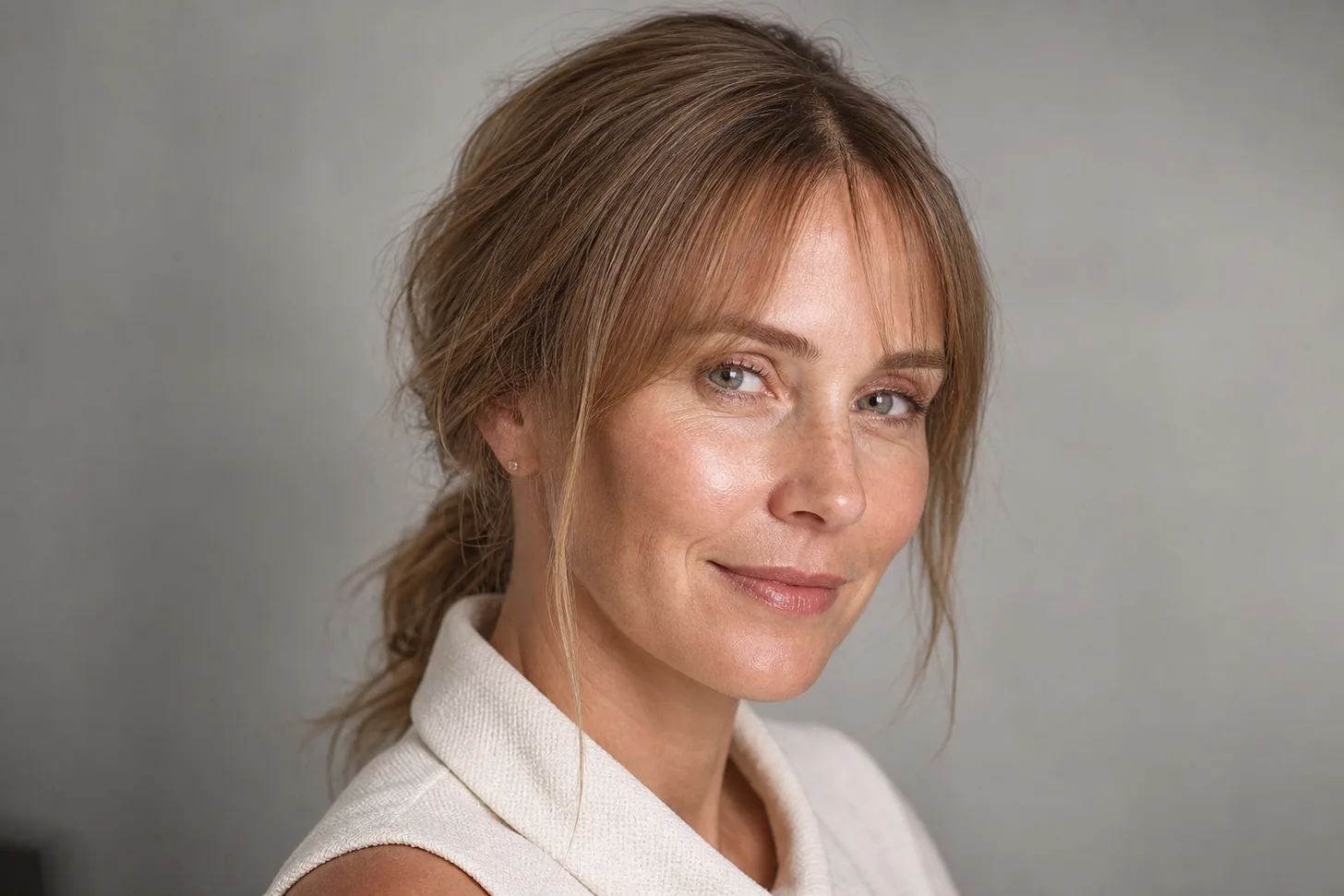
Birkin bangs on fine light-brown hair, a long soft fringe grazing the eyelashes with a slight center split and longer sides, worn with long straight layered hair, woman in her early 30s, front view
Chair-side note
Birkin bangs are one of the easier fringes to wear on fine hair, because they are long and soft. Most of the problems I see come from the section, not the length.
On thin hair I take a narrow, shallow triangle for the fringe and cut it dry with point-cut ends. If the section goes too far back, the hair behind it looks see-through, and you have traded a fringe for a sparse crown.
SB
— Simone Baptiste, Senior Stylist
What are Birkin bangs?
Birkin bangs are a long fringe that sits at or just below the brows and touches the lashes. The middle is slightly shorter or split, the sides are a little longer, and the ends are soft rather than blunt, so the fringe looks grown-in and relaxed.
Yes, on straight or slightly wavy fine hair. The long, point-cut ends blend into the face instead of drawing a hard line, and the soft middle split hides the gaps that show in a blunt fringe on thin hair.
The trade-offs are an oily forehead, which makes long bangs separate by midday, and a cowlick at the hairline, which splits the fringe. They need a trim every four to six weeks to stay out of your eyes.
Birkin bangs with long hair
The classic way to wear them: long, loose hair and a soft fringe.
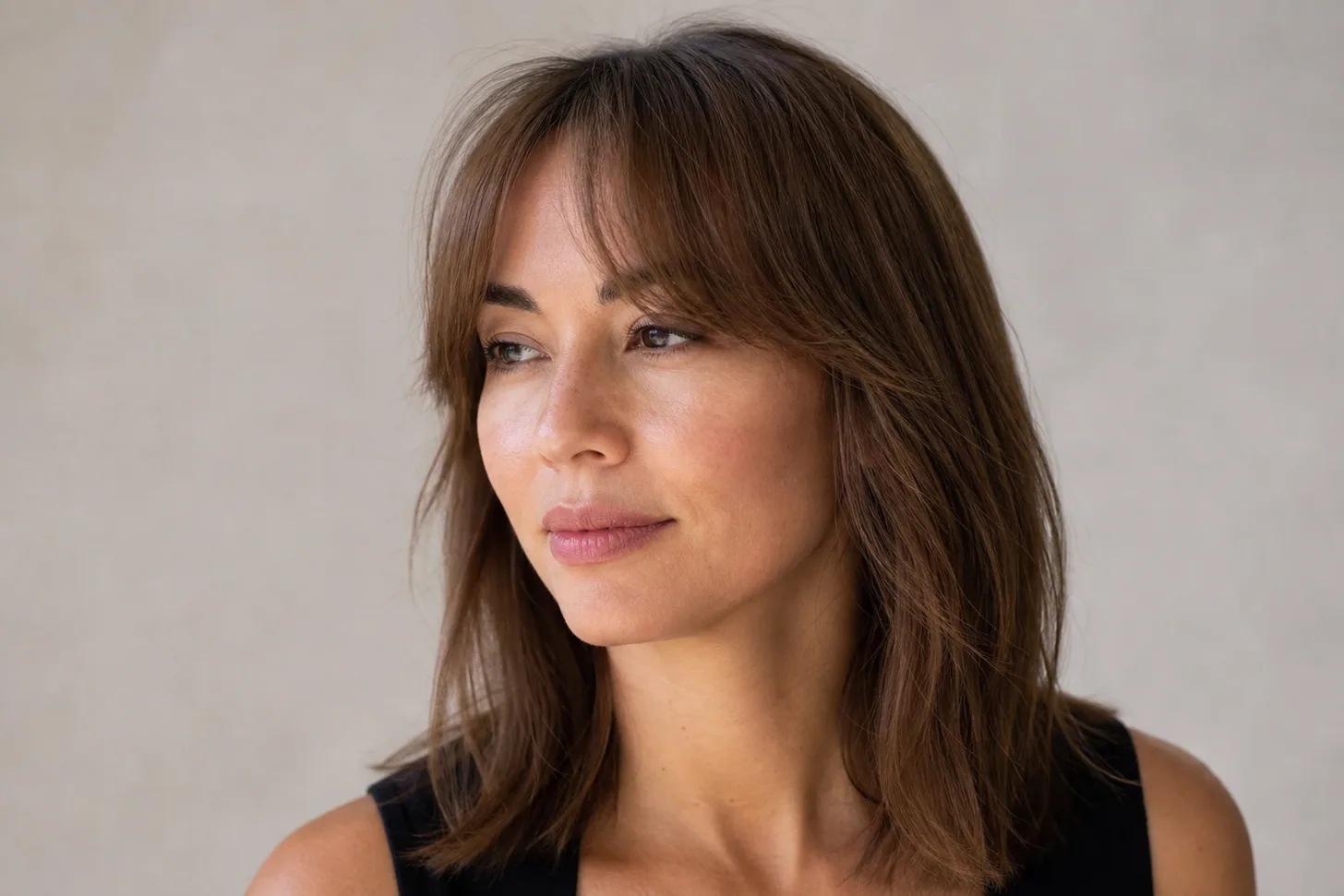
classic Birkin bangs on fine dark-brown hair, eyelash-grazing soft fringe with longer sides, long straight hair with a few long layers, woman in her late 20s, front view
1
Classic Birkin bangs with long layers
The original version: a long, soft fringe and long hair with a few long layers. The fringe adds body at the front of hair that would otherwise hang flat.
Keep the layers few and long so the ends don't thin.
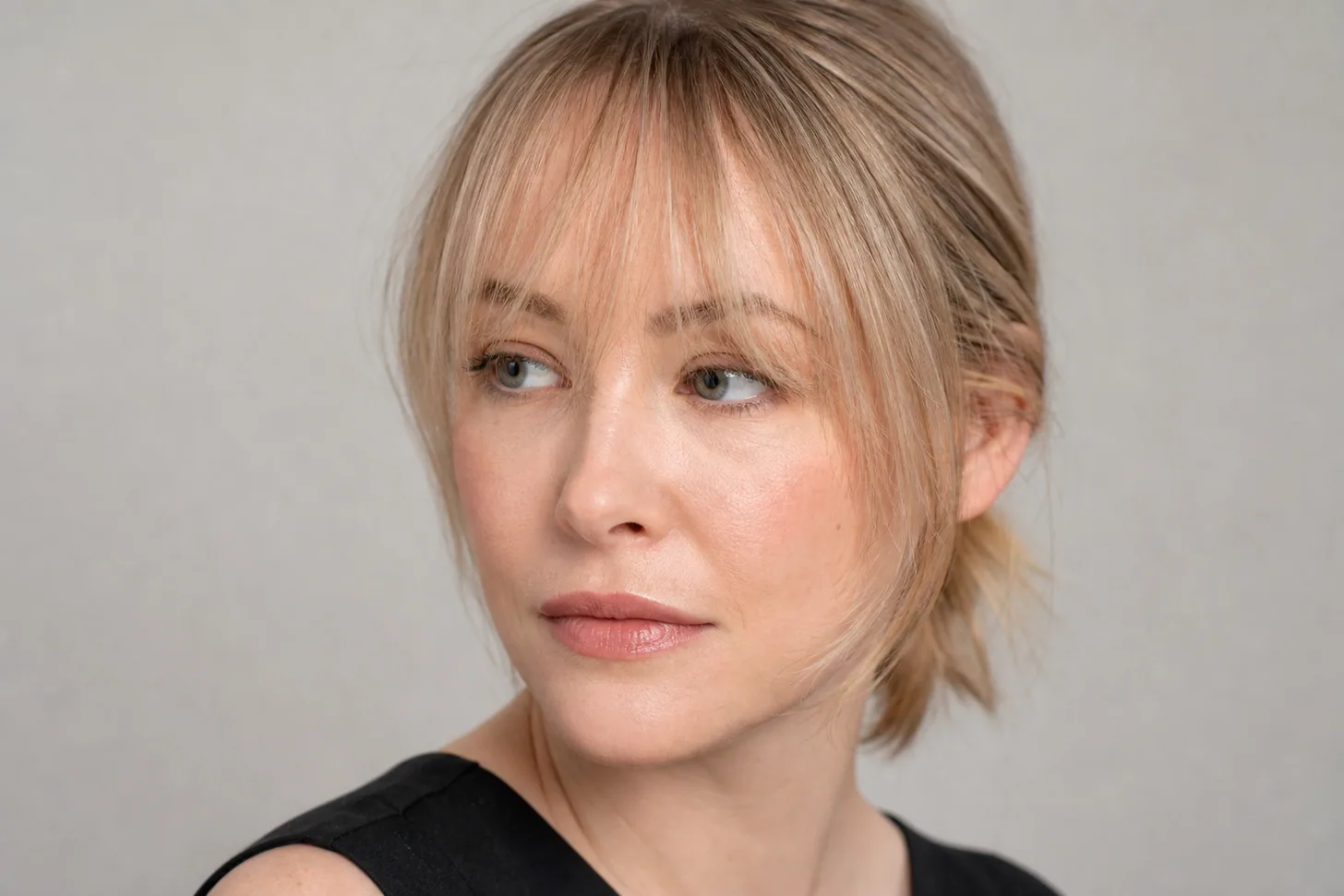
Birkin bangs on fine light-blond hair with a natural split in the center showing a little forehead, sides blending toward the cheekbones, long straight hair, woman in her early 30s, front view
2
Birkin bangs with a middle split
A small gap in the middle shows a little forehead and lets the fringe fall to each side. It is the most forgiving version for thin hair.
It also hides a cowlick at the center of the hairline.
Birkin bangs on fine wavy honey-brown hair with long loose waves, eyelash-length soft fringe, air-dried finish, woman in her mid 30s, front three-quarter view
3
Birkin bangs with long waves
A loose wave makes the fringe look fuller. Cut the fringe dry, because wavy fringes shrink up to an inch as they dry.
Birkin bangs on fine medium-brown hair pulled back into a loose low ponytail, soft eyelash-length fringe left out at the front, woman in her early 40s, front three-quarter view
4
Birkin bangs with a low ponytail
With the rest of the hair pulled back, the fringe frames the face, so a simple ponytail looks finished.
Birkin bangs on fine dark-blond hair with a collarbone-length lob, soft eyelash-length fringe and loose bent ends, woman in her mid 30s, front three-quarter view
6
Birkin bangs with a lob
A collarbone lob is long enough to tie back and short enough to stay full at the ends.
Birkin bangs on fine auburn hair with a soft shoulder-length shag, a few light layers around the face and a tousled finish, woman in her early 30s, front view
7
Birkin bangs with a soft shag
The 1970s pairing: a long fringe and a light shag. On thin hair, ask for only a few layers around the face.
A long, soft fringe draws attention to the eyes and is easier to live with than a short one.
Birkin bangs on fine light-brown hair with a shoulder-length cut and soft face-framing pieces, polished blow-dried finish, woman in her late 40s, front three-quarter view
9
Birkin bangs with a shoulder-length cut
A shoulder-length cut and a soft fringe, blow-dried smooth. It is the polished everyday version.
Birkin bangs on fine dark-blond hair sitting just above the frames of round glasses, long straight hair with a soft middle split, woman in her early 40s, front view
12
Birkin bangs with glasses
Ask for the fringe to stop just above your frames, or it will rest on the lenses and separate.
Say: "I'd like Birkin bangs that graze my lashes, slightly longer at the sides and soft in the middle. Please keep the section narrow and shallow, cut them dry and point-cut the ends, no thinning shears." Start a little long; you can always go shorter at the next trim.
How to style Birkin bangs on fine hair
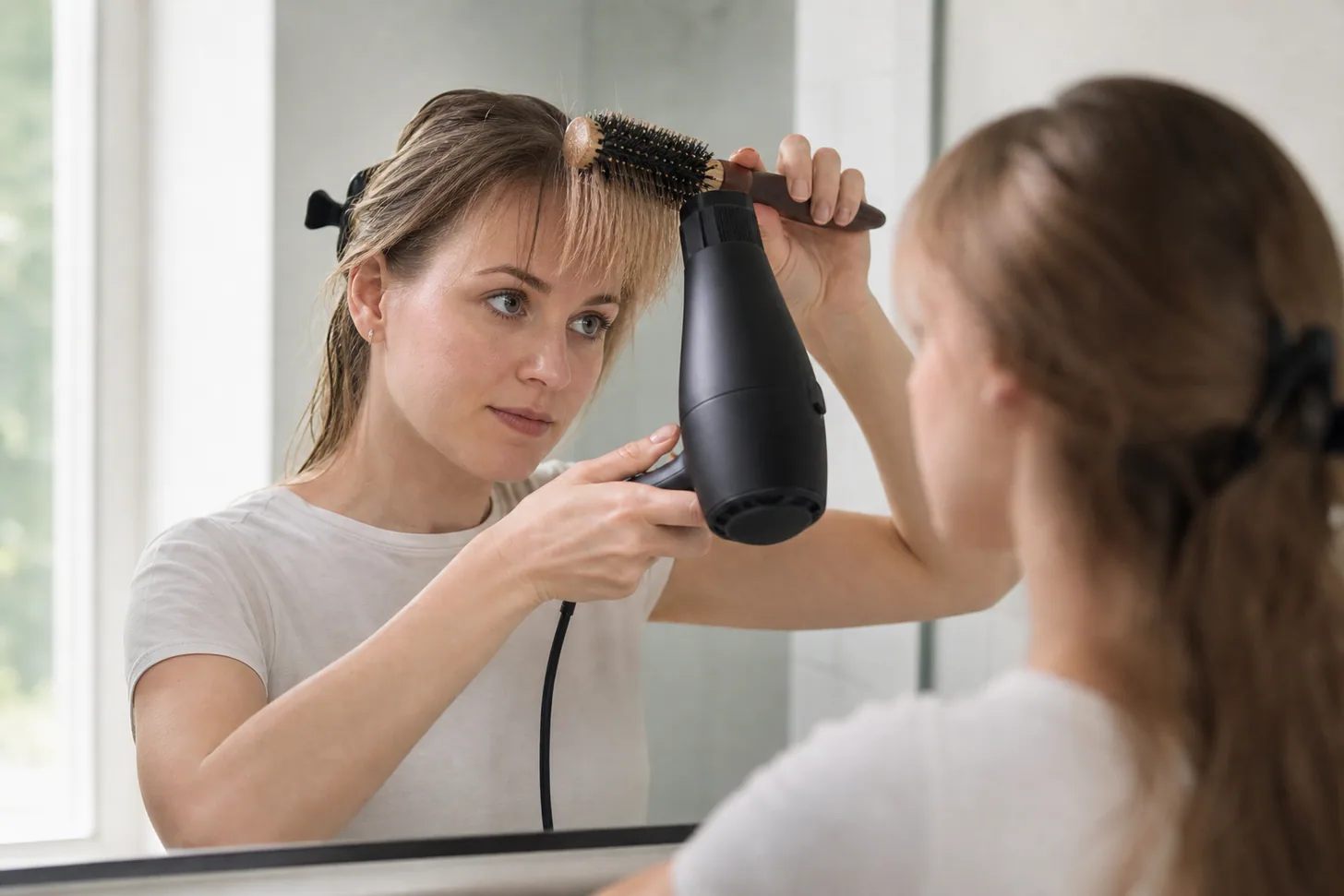
Wet the fringe first, even on a no-wash day. Blow-dry it with a small round brush, moving side to side across the forehead to flatten any cowlick, then roll the ends slightly under. A light mist of dry shampoo under the fringe keeps it from separating. Skip creams and oils near the fringe. For more fixes, see how to style bangs on fine hair.
Growing out Birkin bangs
They are among the easiest bangs to grow out, because they are already long. After about two months they become curtain bangs, then face-framing layers. See growing out bangs on fine hair.
Who should skip Birkin bangs
Your hair is very thin at the front hairline. Taking a fringe section leaves less hair to cover the top. Try curtain bangs or face-framing layers instead.
You have a strong cowlick at the front. A long fringe will split or stand up. Side-swept bangs work with a cowlick rather than against it.
Your forehead gets oily quickly. Long bangs separate by midday. A shorter, lighter fringe or no fringe is easier.
You do not want to touch the fringe every day. Birkin bangs need a minute with a dryer most mornings. Face-framing layers need none.
FAQ
A long, soft fringe that grazes the eyelashes, slightly split in the middle and a little longer at the sides. They are named after Jane Birkin, who wore them with long, loose hair.
Yes, on straight or slightly wavy fine hair. Keep the fringe section narrow and shallow, and have the ends point-cut, so the hair behind it still looks full.
Curtain bangs part fully in the middle and sweep to the sides. Birkin bangs cover more of the forehead, with only a slight split and a longer, fuller fringe.
Ask for a fringe that grazes the lashes, slightly longer at the sides, with a narrow section, cut dry and point-cut. Ask for no thinning shears.
Every four to six weeks. Many salons will trim a fringe between appointments.
Wet and blow-dry them each morning, mist a little dry shampoo underneath and keep heavy products away from the fringe.
Eleven years behind the chair, specializing in short shapes and fine-hair texture. Simone believes the best haircut is the one you can style yourself in ten minutes.
Results vary with hair type, density and growth patterns. Haircut guidance is not a substitute for an in-person consultation with a licensed stylist, and sudden or heavy hair loss is worth raising with a doctor.
Hairstyle images in this guide are AI-generated illustrations, not photos of real clients or results. See our image policy.
Get the good hair intel
One honest, stylist-written guide in your inbox each week. No hype.

 SB