Reviewed by Tara Sullivan · Updated August 2026 · 11 min read
A side-swept fringe is the only fringe that concentrates the density you already have, and that is the entire reason it flatters fine hair more reliably than any other shape. It takes hair from a wide section across the front and lays all of it in one direction over a narrower stretch of forehead — so strands per square inch goes up, and the fringe reads solid on hair that cannot make anything else read solid.
A curtain fringe splits the same hair into two and covers twice the area with it. The catch is what you borrow it from: the section comes off the top of your head, which is where fullness matters most, so on fine hair the depth of the section is the whole decision and it should be shallower than your stylist's default.
Below: 16 ways to wear it grouped by length and cut, the sectioning numbers to ask for, the face-shape logic, and two pieces of very common advice — thinning shears, and "side bangs are the safe first fringe" — that are wrong for this hair type.
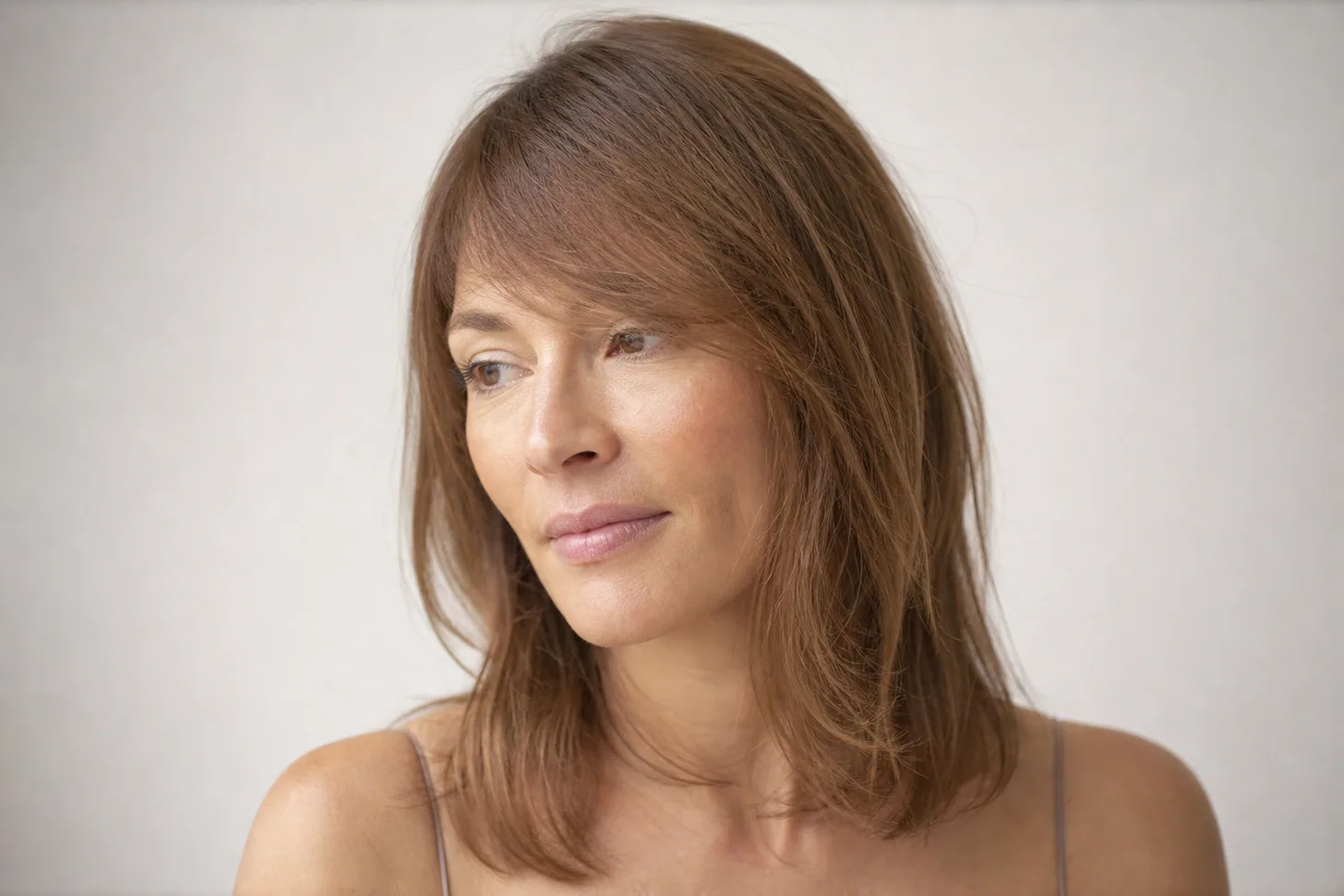
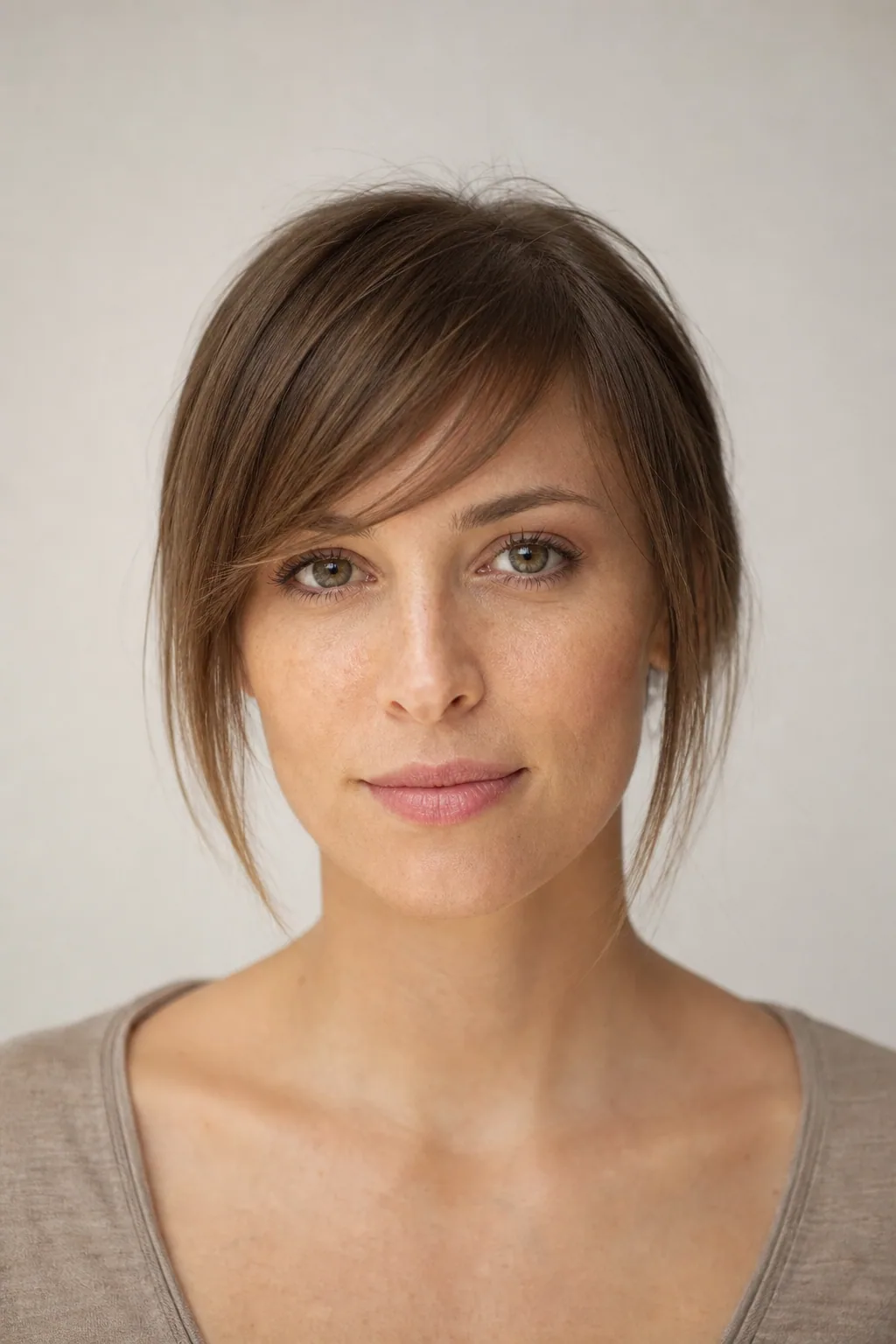
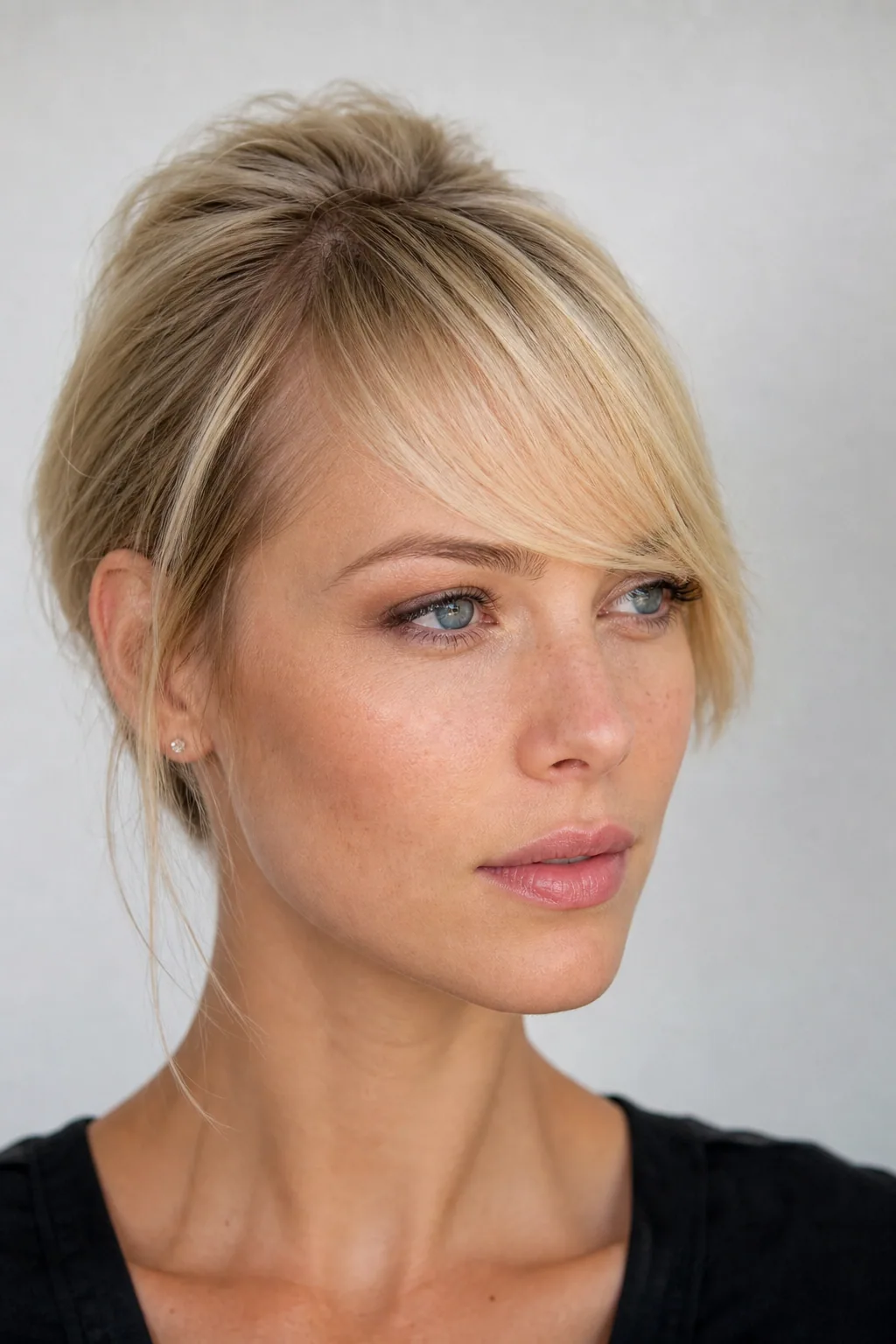
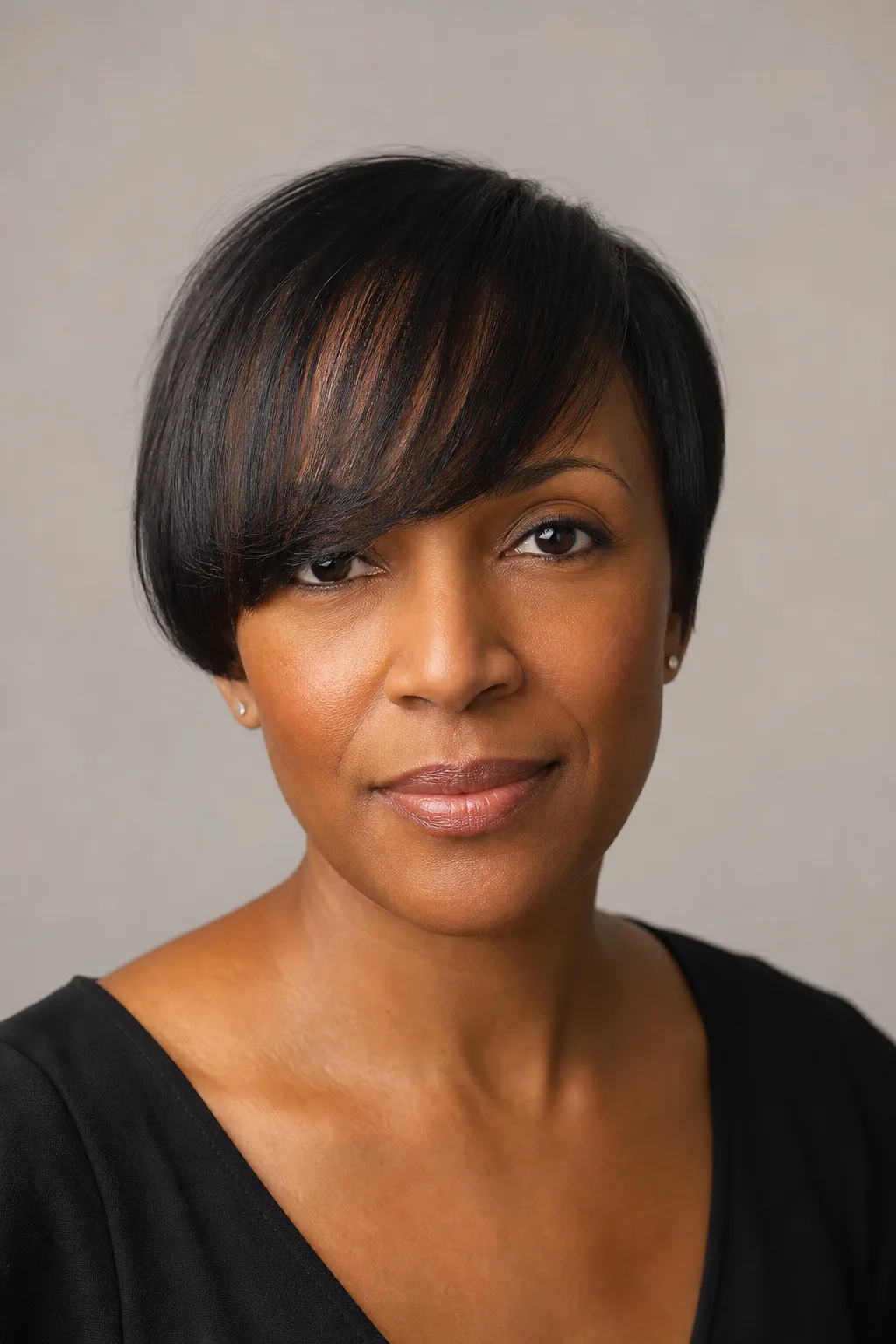
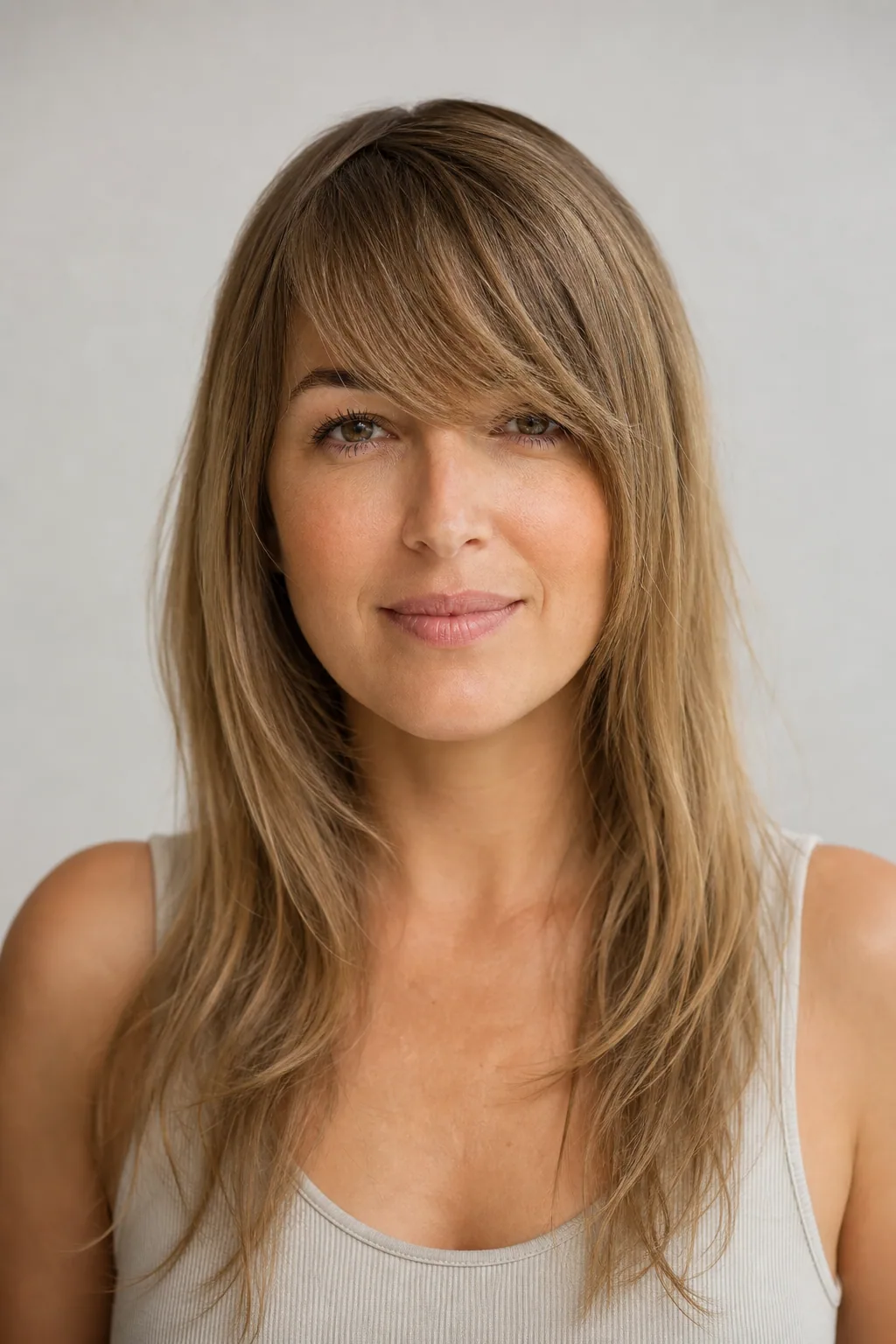
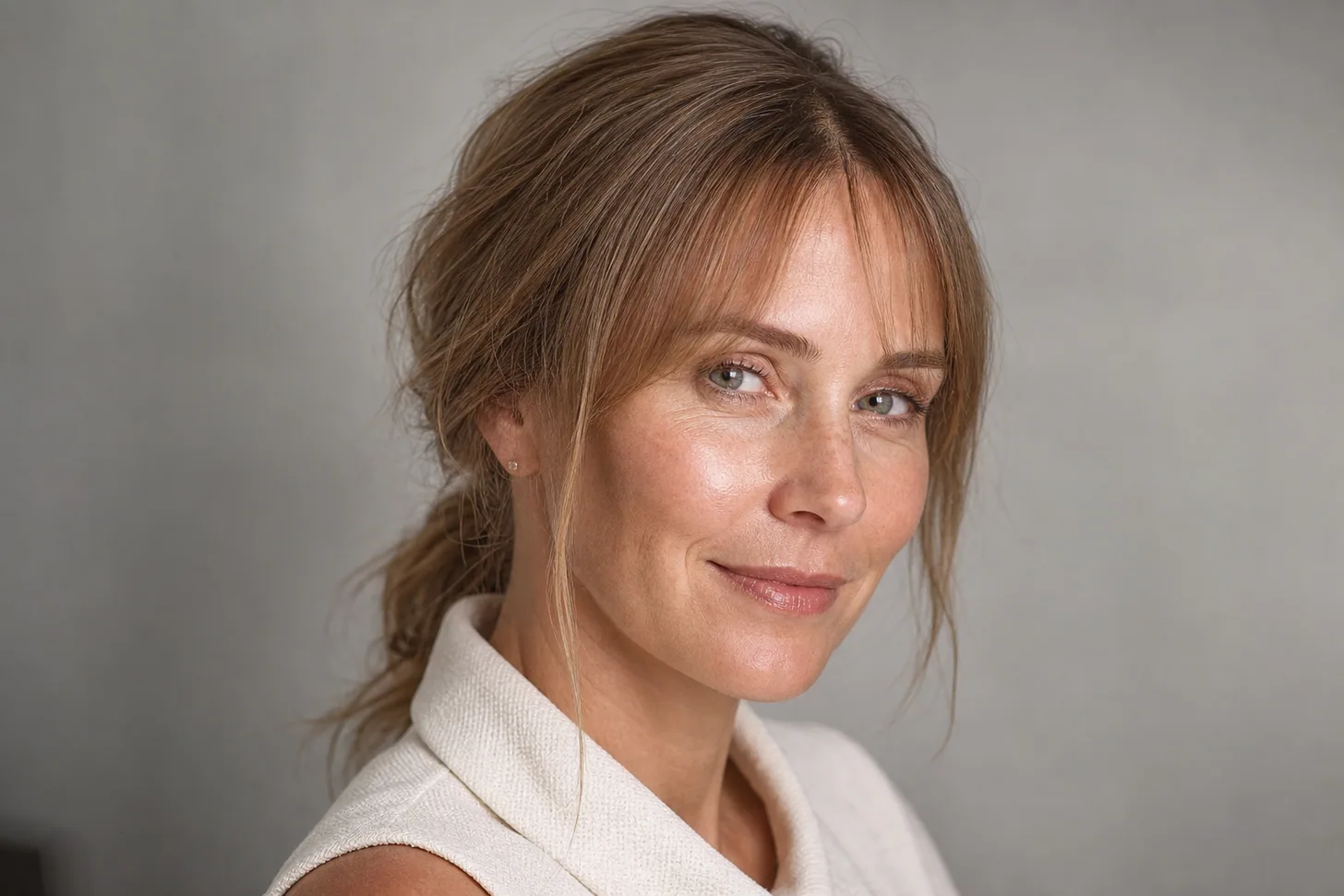
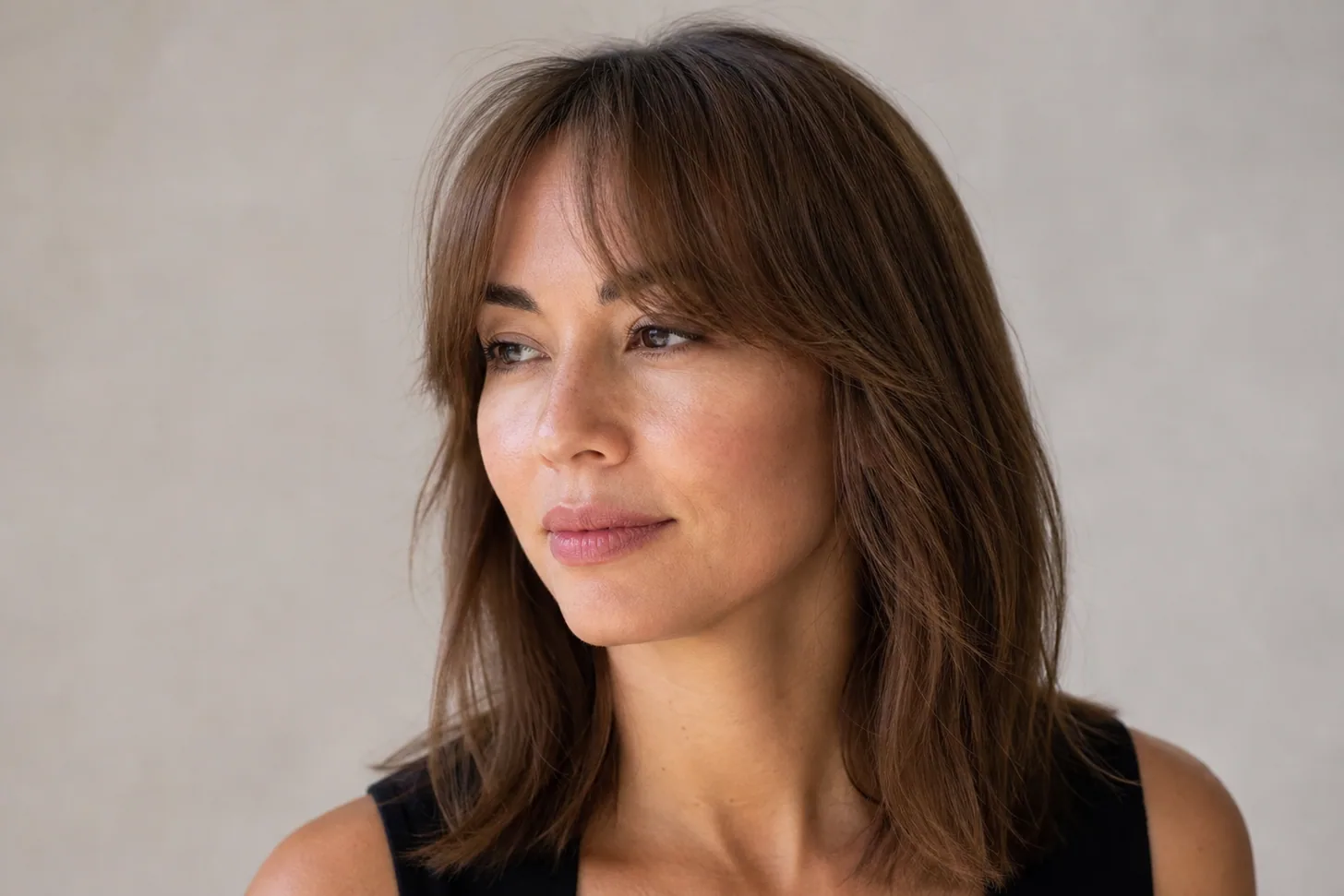
The diagonal is doing two jobs at once: concentrating density, and breaking the width of the face.
The honest maintenance verdict
2–3 minutes most morningsDay two: the most forgiving fringeTrim every 3–4 weeksThe direction has to be trained
Of the fringes fine hair can wear, this is the one that asks least of you — and unusually for this subject, that's a genuine structural advantage rather than marketing. A side-swept fringe is designed to lie flat and travel across the forehead, so when it goes limp it goes limp in roughly the shape it was already meant to be. A curtain fringe collapsing looks wrong; this one collapsing mostly just looks like itself.
What day two actually looks like: slightly flatter at the root and a little less swept, but wearable. A pass with dry shampoo at the root of the fringe only, then a brush in the sweep direction, buys most people a second day. That is a real claim and it is the only fringe on this site I'd make it about.
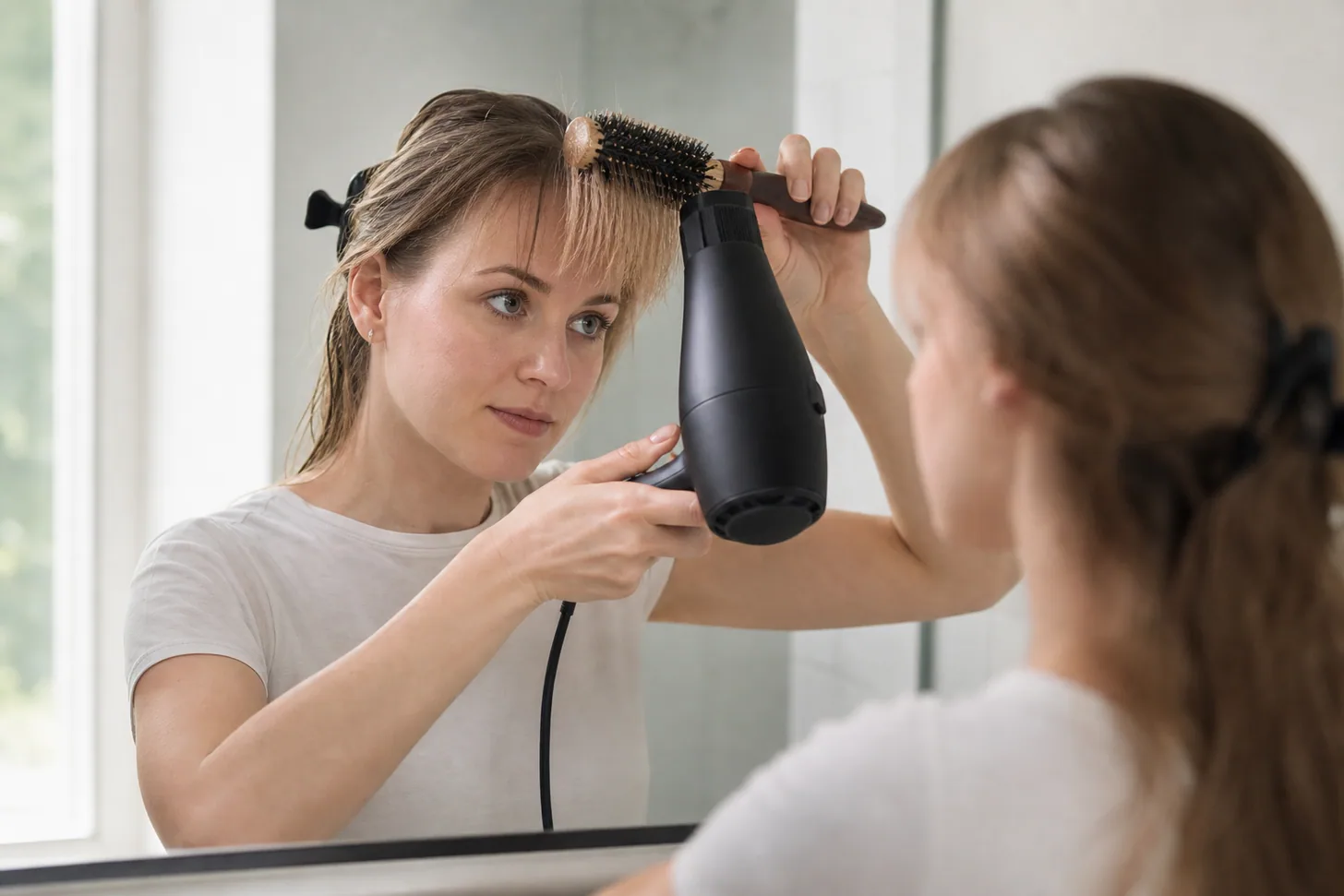
The catch is direction, and it's front-loaded. A side-swept fringe has to be trained to fall the way you want, which means drying it across the forehead — pointing the nozzle in the sweep direction and finishing with cool air — for the first few weeks.
Fine hair takes a set easily, which cuts both ways: train it properly and it stays; let it dry however it lands and it will pick its own direction and defend it. If your hairline has a whorl or a cowlick at the front, this is the fringe most affected by it, and cowlicks on fine hair covers working with one.
Trim cycle is short but the grow-out is the kindest of any fringe — because the shape is already an angle, growing it out just makes it a longer angle, which turns into face-framing without a bad stage. Growing out bangs on fine hair has the timeline, and the fringe comparison table puts these numbers next to every other type.
What actually makes a fringe side-swept
Three fringe names get used interchangeably and they don't mean the same thing, which is why people book one and leave with another.
Side-swept and curtain describe direction. Wispy describes density. A side-swept fringe is one continuous panel worn diagonally in a single direction, longest at the outer edge and shortest near the part. A curtain fringe is parted in the middle and falls away in two panels.
Wispy isn't a shape at all — it's a cutting approach that leaves the fringe deliberately sparse and separated, and it can be applied to either direction. You can have wispy side-swept bangs. You cannot have side-swept curtain bangs. If you want the whole map, the bangs guide for fine hair compares all of them side by side.
Why the side sweep reads thickest on the least hair
This is worth understanding because it tells you which of the 16 below is yours, and it explains why the same fringe looks great on one fine-haired person and thin on another.
Direction concentrates strands; splitting them spreads them out
Take a section of hair from the front of the head. Lay all of it across the forehead in one direction and it covers, say, two-thirds of the forehead's width. Split it down the middle and each half covers its own side. Same number of strands, twice the area — so half the coverage per square inch. On dense hair the difference is invisible. On fine hair it's the difference between a fringe and a suggestion of one.
The diagonal line does the face-shape work by itself
A blunt fringe draws a horizontal line across the face, which emphasises width. A side sweep draws a diagonal, and a diagonal breaks width and adds implied length. That's why it's the standard recommendation for a rounder face and for a strong jaw, and why it needs handling on a longer face, where you want the opposite effect.
What you're borrowing it from is the risk
The fringe hair is crown hair. Every strand in that fringe is a strand no longer contributing to the fullness of the top of your head — and on fine hair the top of the head is the least forgiving place to lose any. This is the entire reason section depth matters more here than on any other hair type, and it's covered properly below.
Chair-side note
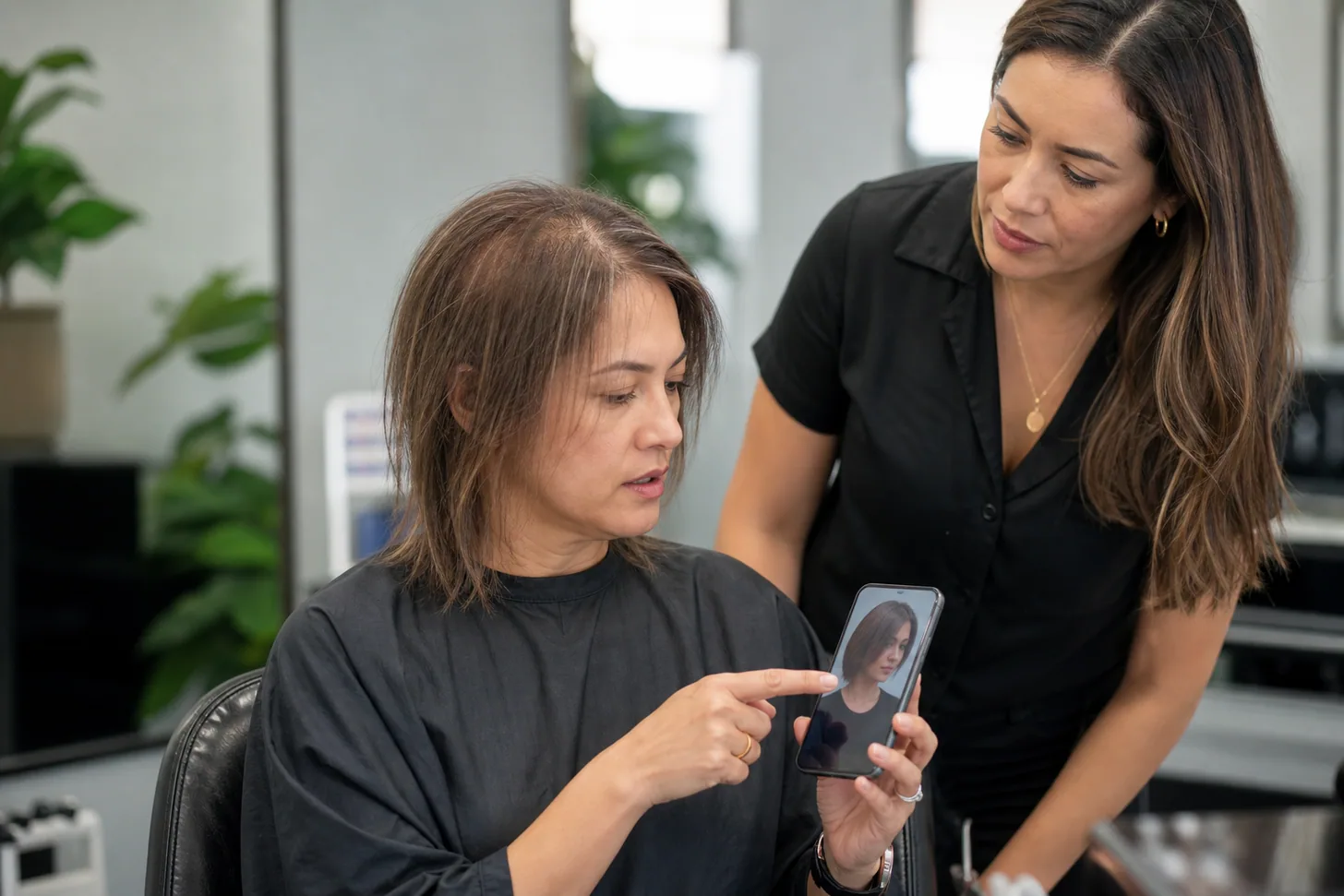
The consultation that saves a fringe takes about a minute and it isn't about the fringe. I part the hair where the client wears it, then I put two fingers flat on the top of her head, behind the hairline, and I say: this is what I'm going to take it from, and it isn't coming back for nine months.
Then I take a shallower section than she asked for. Nobody has ever come back and told me their fringe was too shallow. I have lost count of the people who came back at week six saying the fringe is lovely but their hair looks thinner on top — and it does, because it is, and the only cure is time.
SB
— Simone Baptiste, Senior Stylist
The sectioning is the decision — here are the numbers
Everything else about a side-swept fringe can be adjusted at the next appointment. The section cannot.
Depth: an inch and a half to two inches back from the front hairline at its deepest point. Most stylists default to two and a half or three on a fringe this shape, which is correct for average density and too much for fine.
Shape: a triangle, apex at the part. Not a rectangle and not a horseshoe. The apex sitting at your part is what lets the fringe start short and travel long, which is the whole side-swept effect.
Width: to the outer edge of the eyebrow on the sweep side, and barely past the inner corner of the eye on the short side.
Cut it dry. Fine hair stretches when wet and a fringe cut wet sits a half-inch higher than intended — the fastest way to end up with a fringe you didn't ask for.
The most useful length band for fine hair, because a fringe that ends near the brow still has enough weight in it to lie where you put it. Below the cheekbone it starts relying on styling to stay in place.
1
The eyebrow-skimming sweep
The baseline version and the one to ask for if you've never had a fringe: shortest at the part, travelling down to brush the outer eyebrow. It sits at the length where the hair still has enough of its own weight to stay put without product, which on fine hair is the difference between a fringe you wear and a fringe you manage.
2
The shallow-section sweep
Cut from a section only an inch and a half deep, which is the version that leaves your crown alone. It's a slightly lighter fringe than the photo in your head — and it's the one to choose if you already feel your part is wide or your top is where you're thinnest.
3
The blunt-edged sweep
Cut on the diagonal but left with a solid edge rather than feathered into wisps. This runs against the standard advice for fine hair and it's usually right: a clean line is the densest-looking thing you can put near your face, and feathering an already-fine fringe spends the only real advantage it had. Ask for the perimeter left blunt and only the last few millimetres point-cut.
4
The cheekbone drop
The same shape with its longest point extended to the cheekbone instead of the brow, which steepens the diagonal and does more face-shape work. Best on foreheads that are tall, and on anyone who wants the softening without committing to a fringe in their eyeline.
Long and face-framing
Past the cheekbone, a side sweep stops being a fringe and starts being the front layer of the haircut. That's not a downgrade — for a lot of fine hair it's the better version, because it borrows a shallower section and grows out invisibly.
5
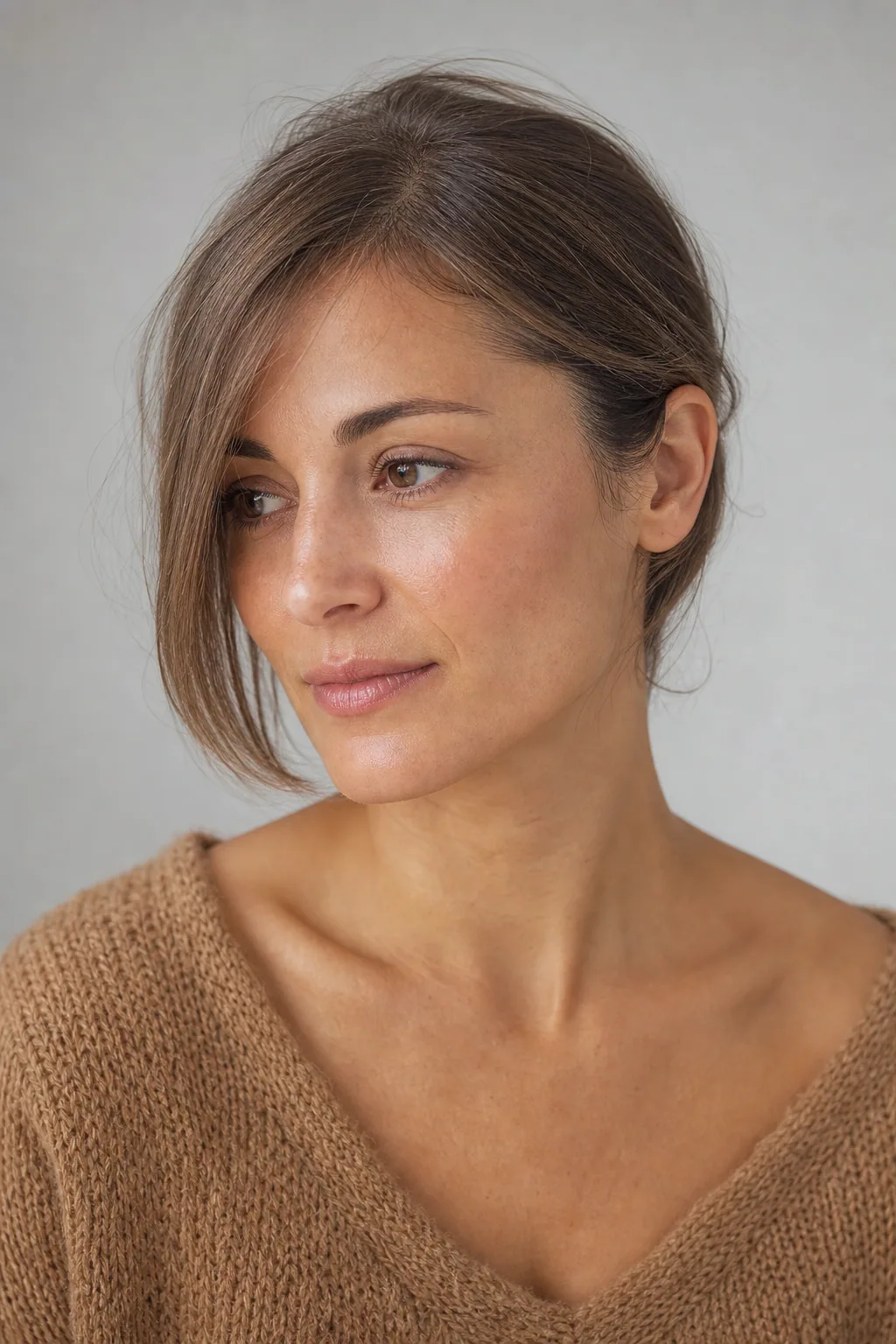
The sweep that merges into face-framing
Cut so the fringe has no visible end point — it travels from the part down past the cheekbone and blends into the front layers without a step. It reads as a haircut rather than a fringe, which is why it suits anyone who wants the effect without the commitment. The layering logic behind it is in layers for fine hair, and the front panel itself has its own guide in face-framing layers.
6
The deep-part sweep
Start the part almost above the outer edge of the eyebrow and let the fringe travel the full width of the forehead. The deep part is doing double duty: it lifts the hair off the scalp on the heavy side, which is free root volume, and it gives the sweep the longest possible run. This is the version that photographs best and takes the most styling.
7
The tuckable sweep
Cut deliberately long enough to reach behind the ear, so you have a fringe on the days you want one and none on the days you don't. It's the lowest-risk fringe on this page and the obvious first move if you've been talked out of bangs before. Pairs particularly well with glasses, where a fringe in the frame line is the usual complaint — more on that in fine-hair styles with glasses.
8
The untextured single panel
One panel, cut on the diagonal, with nothing removed from the interior at all. On fine straight hair this is the fringe that behaves best on day two, because there's no internal separation for sebum to exaggerate. Ask for it as "one clean panel, point-cut on the ends only, nothing taken out of the middle."
On short cuts — pixies, bobs and lobs
A side sweep is close to standard on short fine hair, and for good reason: the shorter the cut, the more of the total silhouette the fringe accounts for, so concentrating density at the front pays off twice.
9
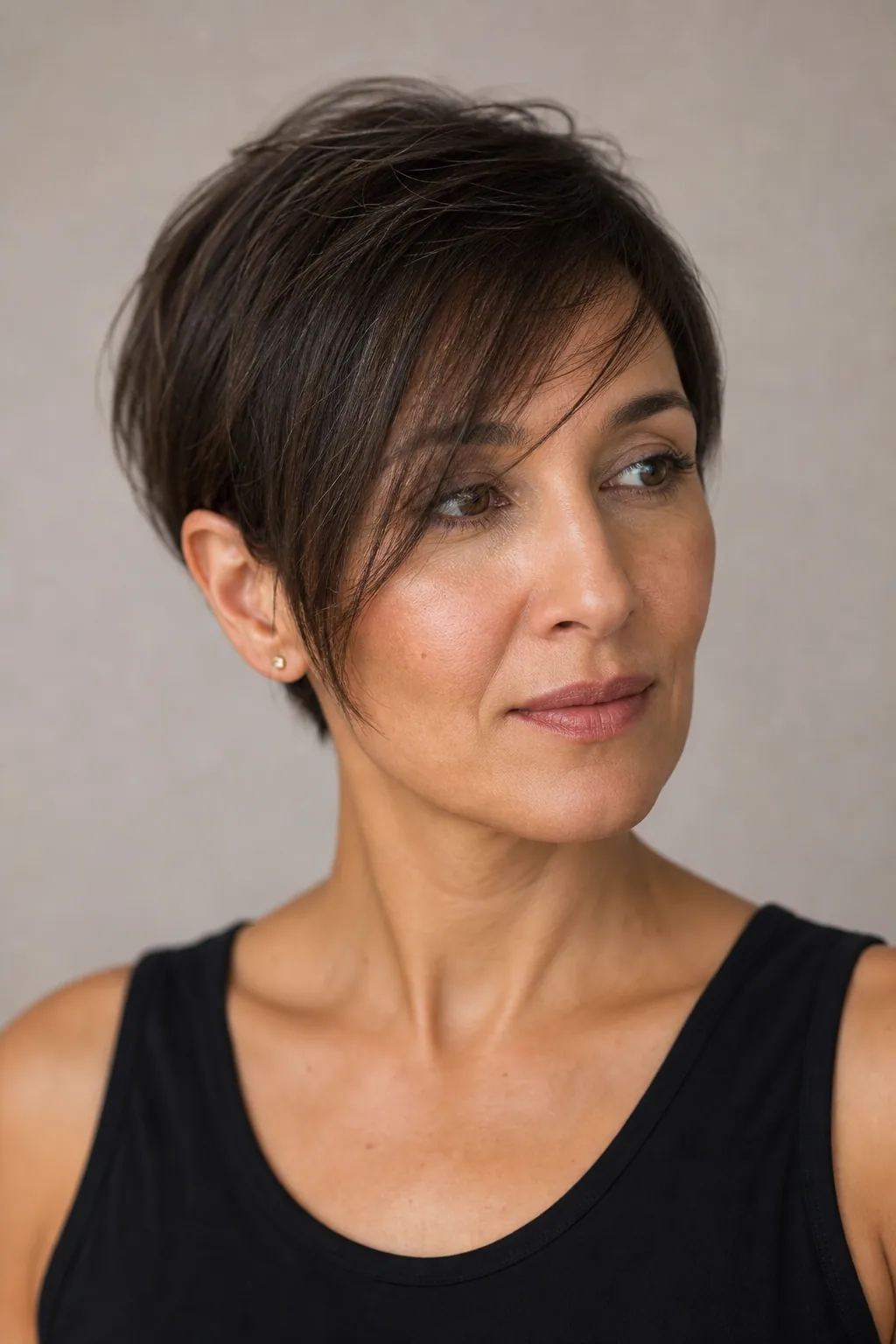
Pixie with a long swept top
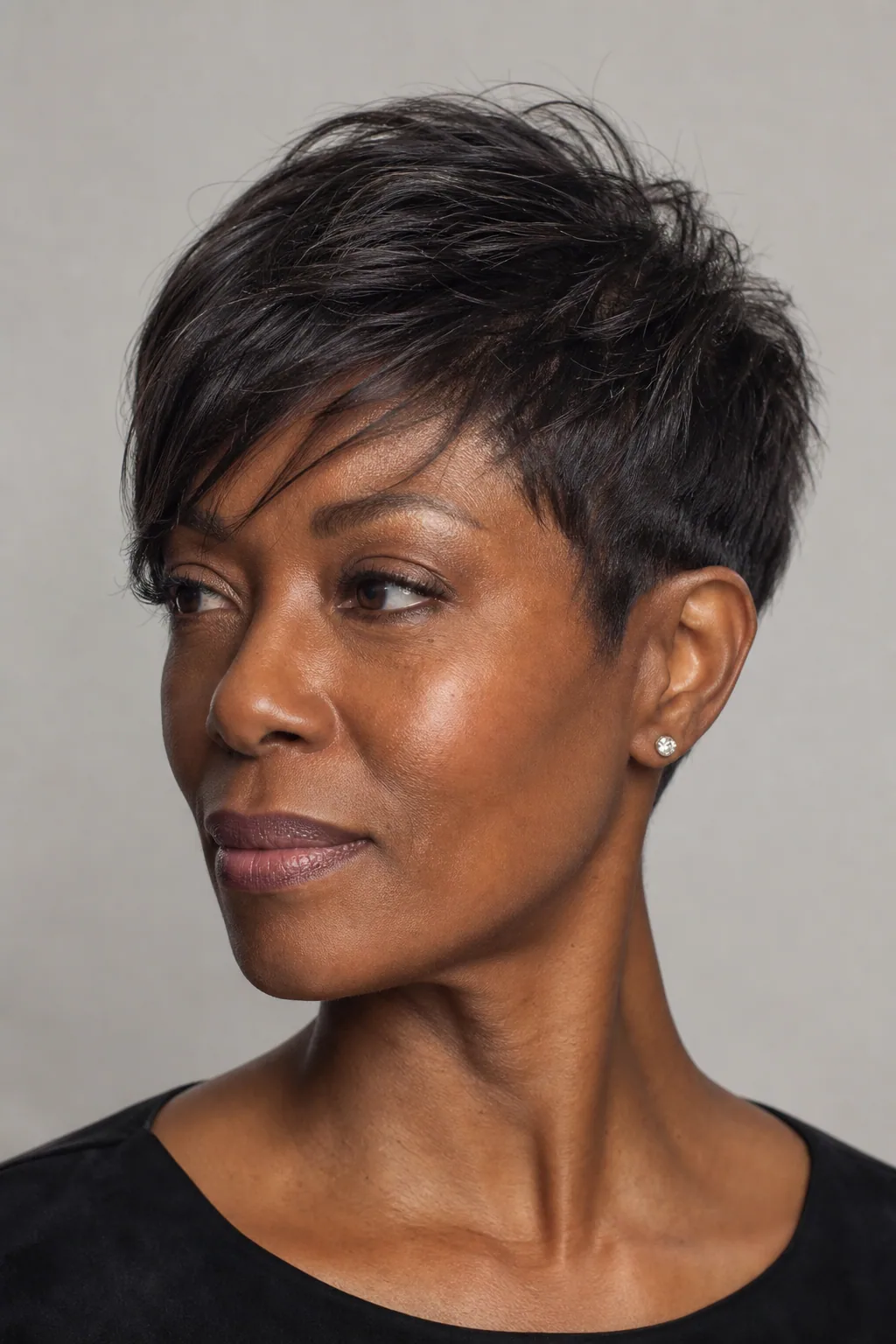
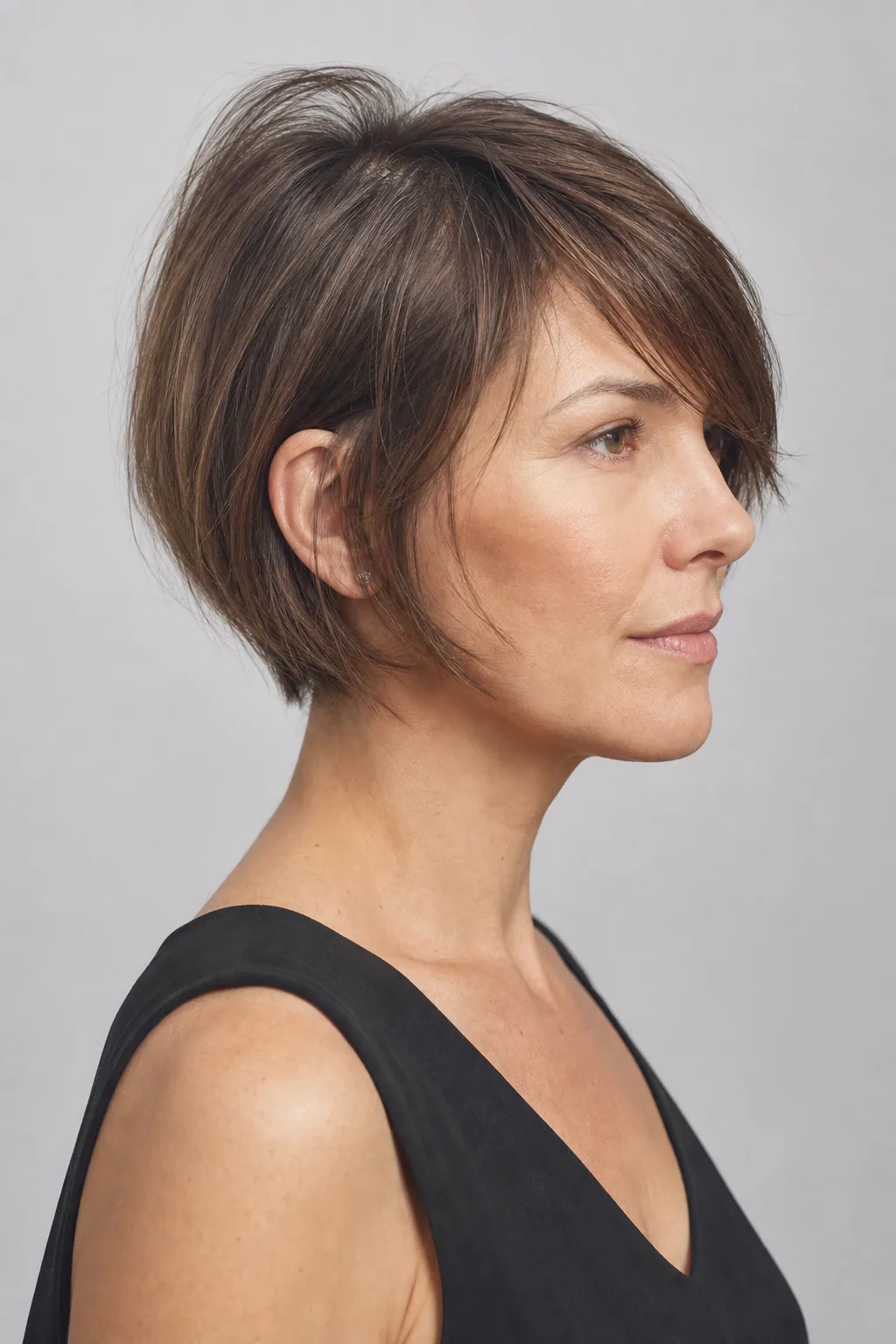
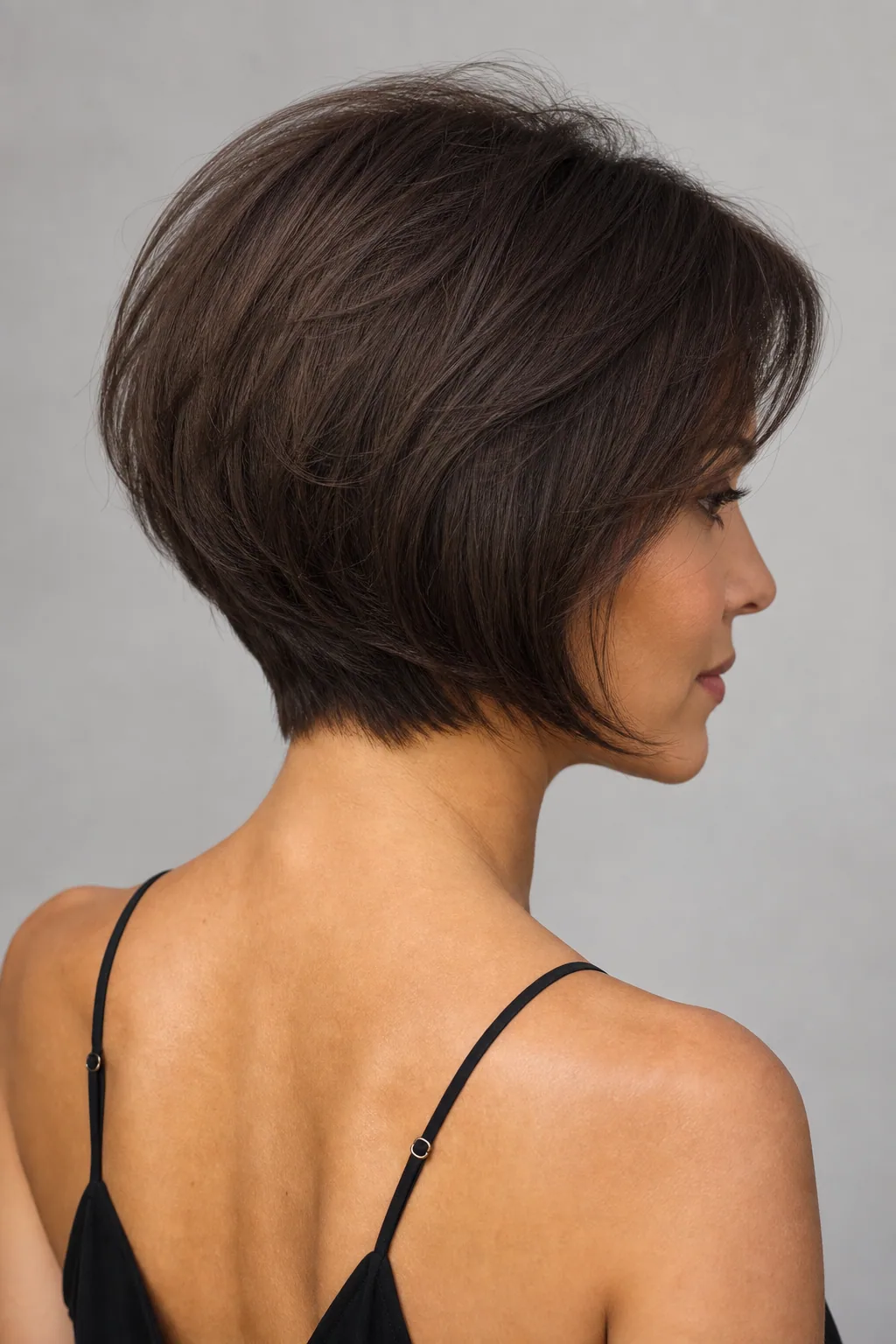
The top left long enough to travel across the forehead and sit at the opposite temple, sides kept close. On fine hair this is the pixie variation that avoids the flat-cap problem, because the swept length gives the crown something to lift over. See the full range in the pixie for fine hair.
10
French bob with a swept fringe
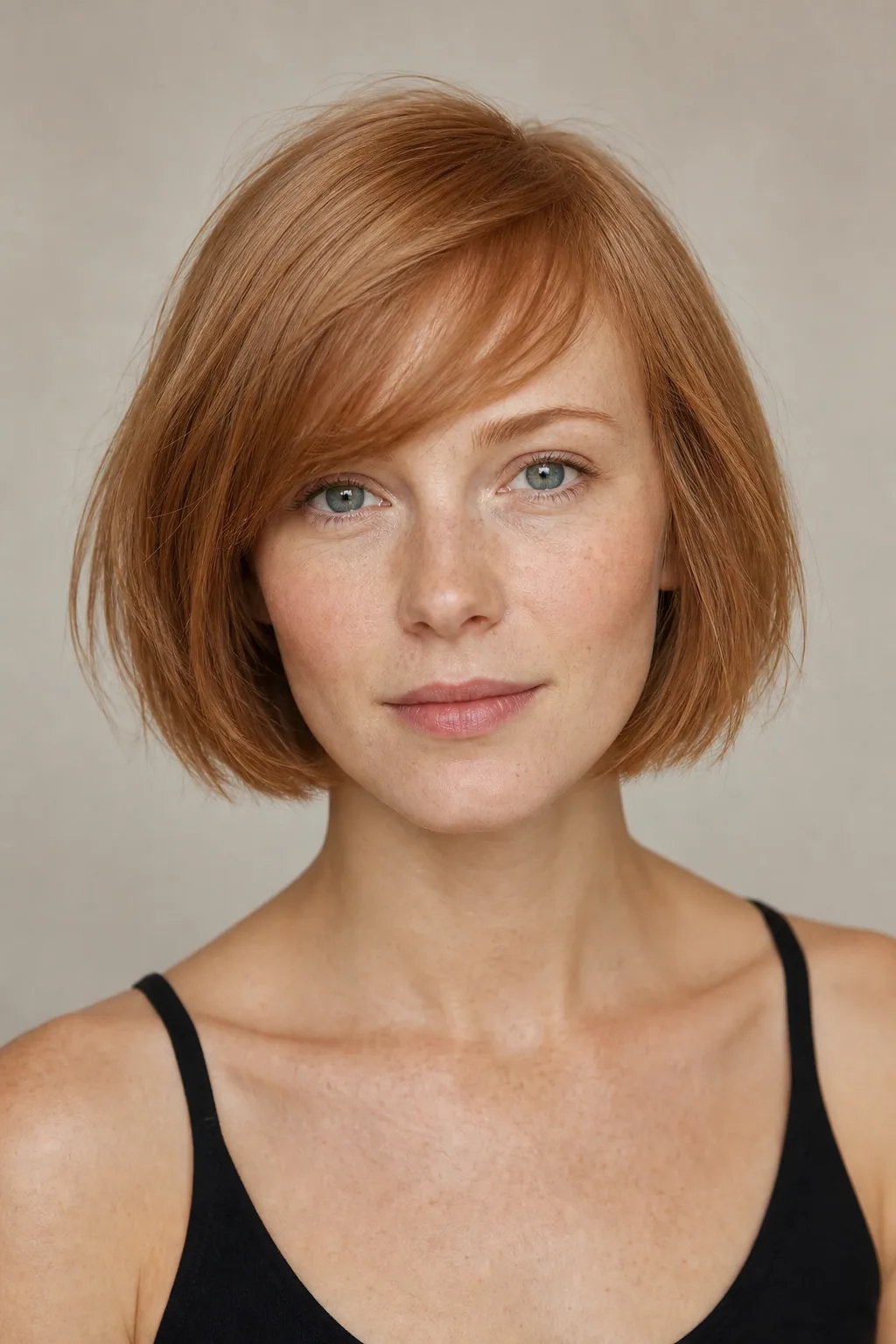
The blunt chin-length bob softened by a diagonal at the front. The pairing works because the two lines contradict each other usefully — the horizontal bob line adds visual weight at the jaw, the diagonal fringe stops the whole thing reading as a box. Details in the French bob for fine hair.
11
Jaw bob with a deep sweep
A heavier sweep than the French bob version, started from a deeper part and worn with the hair pushed up at the root on the heavy side. Good for square and strong-jawed faces, where the diagonal softens the corner of the jaw at exactly the height it needs it.
12
Graduated bob with a sweeping front
Built-up graduation at the back, one long diagonal at the front, and nothing much in between. The shape does the volume work behind and the fringe does the framing work in front, which means neither has to be over-styled. Ask for graduation kept to the occipital and the fringe cut as a separate panel, not blended into the sides.
On medium and long fine hair
The length band where a fringe earns its keep hardest, because long fine hair has the most trouble creating any visual interest near the face.
13
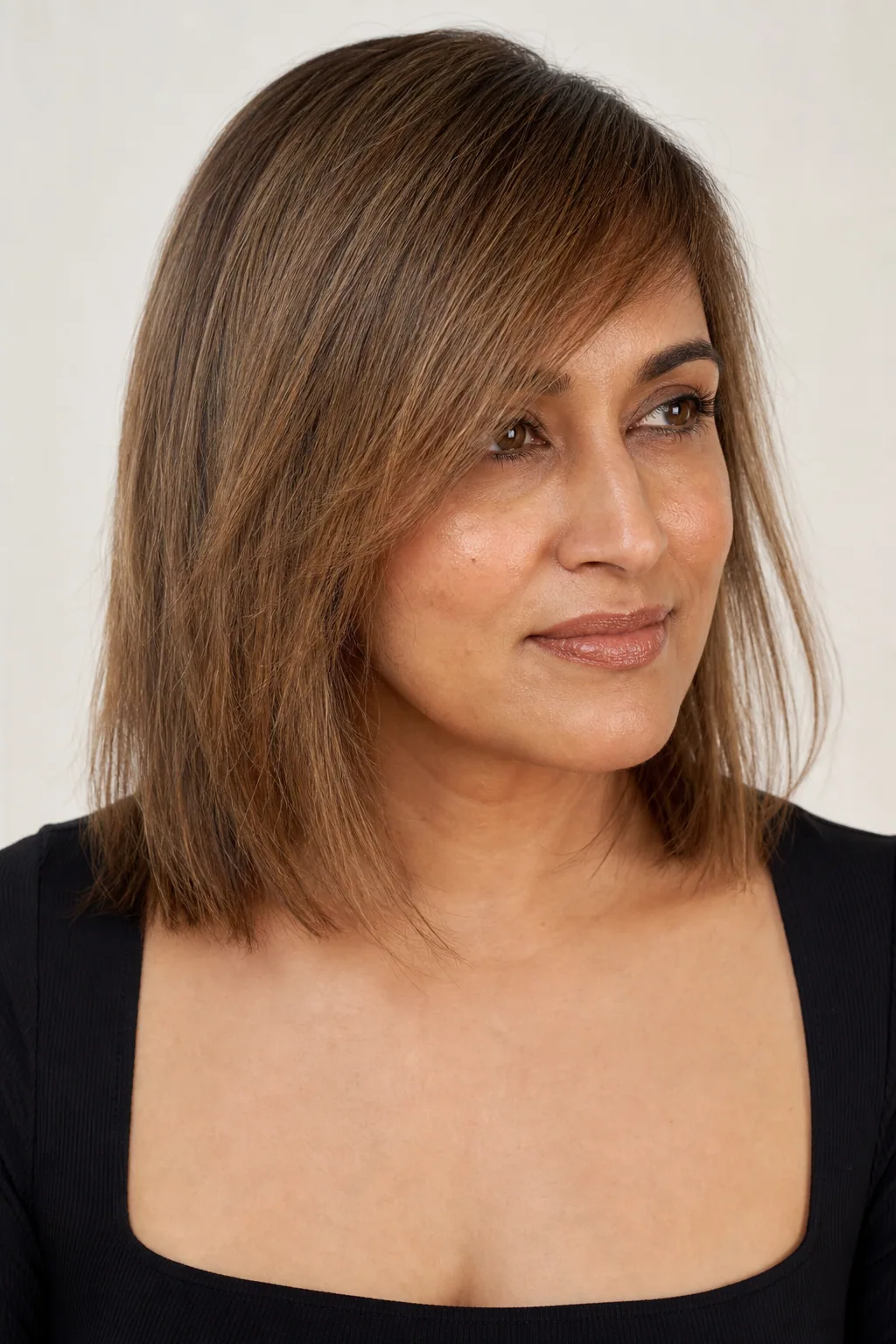
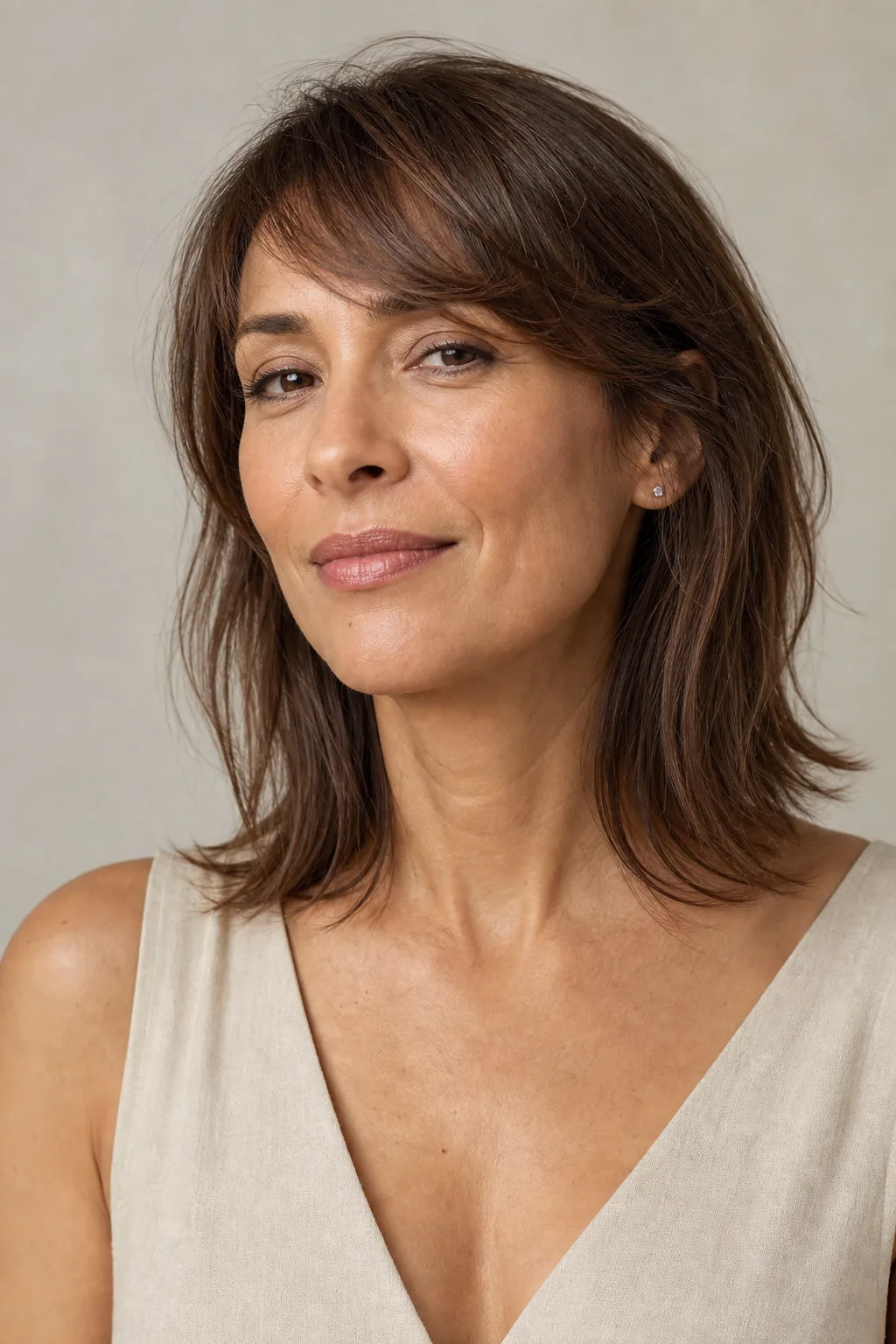
The shoulder-length soft sweep
Shoulder-length hair, one-length through the body, with a soft sweep at the front doing all the shaping. This is the highest-return fringe-to-effort ratio on the page: five minutes of drying, no layers needed elsewhere, and the whole cut reads intentional.
14
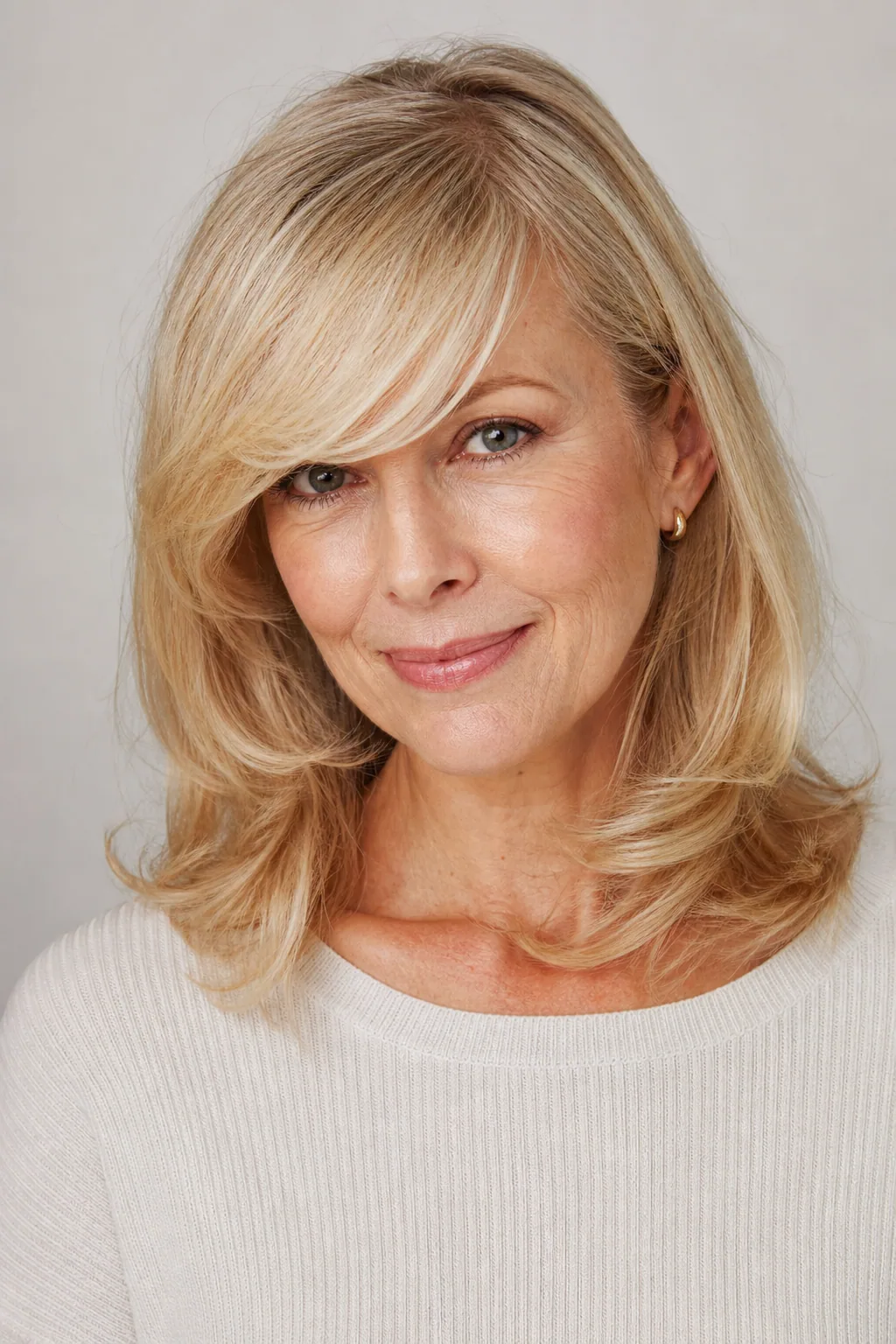
Long hair with a full sweep
A heavier, fuller fringe than the shapes above, worn with long one-length hair. Use it when the length is non-negotiable but the hair reads flat and shapeless — a fringe adds a horizon line to a silhouette that otherwise runs straight from crown to ends. Expect it to need the deepest section on this page, and weigh that against your crown accordingly.
15
The half-up with the sweep left out
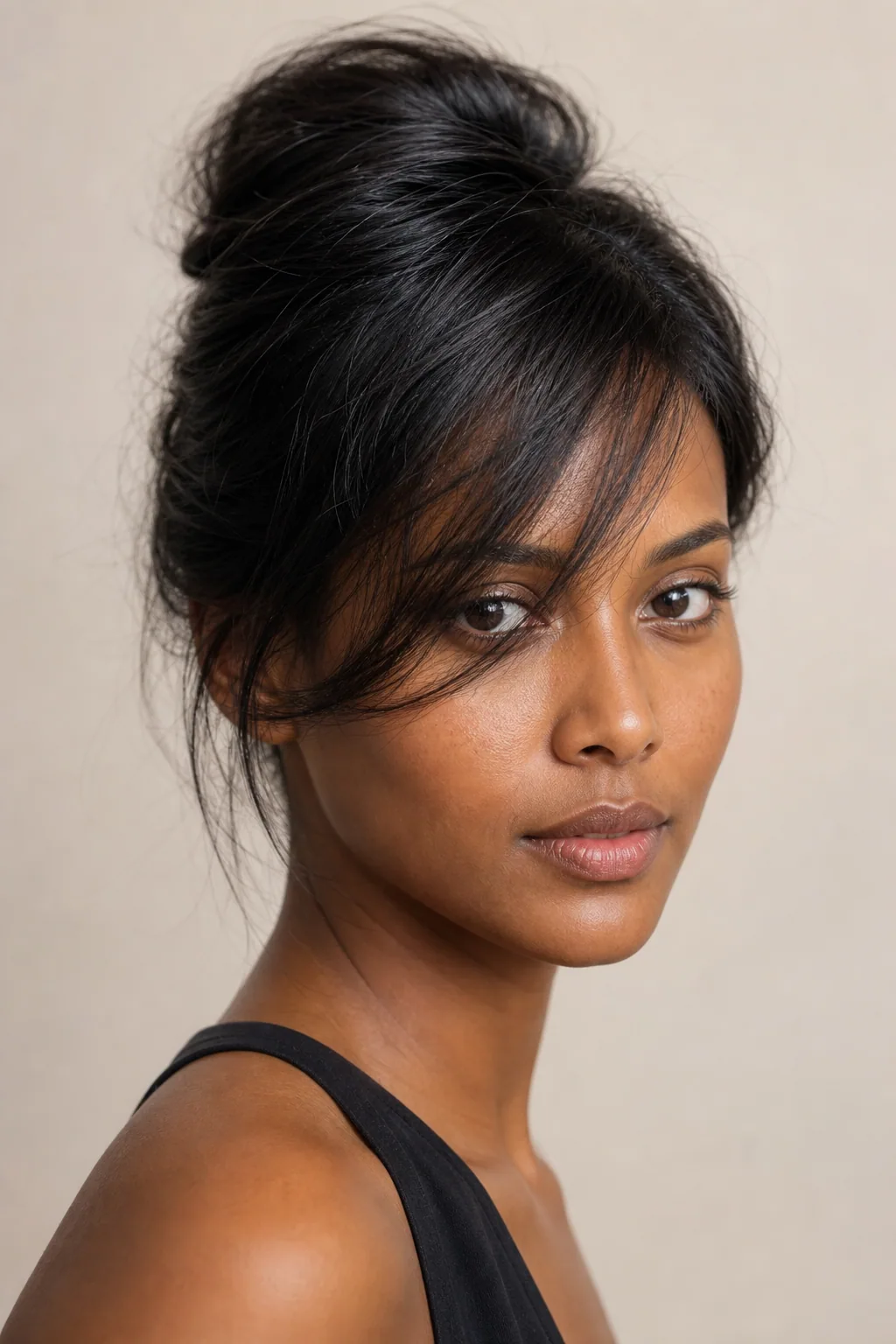
Not a cut so much as the reason to have one: a fringe is what stops a pulled-back style exposing the whole hairline, which is the thing fine hair least wants exposed. Take the half-up from behind the fringe section, never through it. More pulled-back options in half-up styles for fine hair.
16
The coverage sweep for a thinning front
Cut with slightly more depth on the sweep side only, so the panel that travels across the forehead is the fuller one and it lands over the area that's thinned. It is genuinely effective, and it comes with one honest condition: it works when the thinning is at the temples or the front hairline, and not when it's at the crown, where taking a fringe section makes things worse. The distinction and the alternatives are in coverage for thinning fine hair.
Which version suits which face
The diagonal is the variable. How steep it is, and where its longest point lands, is what changes the effect. For the specific case of a tall forehead, the sweep needs more depth than usual — see bangs for thin hair and a big forehead.
Face shape
Ask for
Avoid
Round
A steep diagonal with its longest point at or below the cheekbone — the strongest length-adding version
A short, shallow sweep that sits high and wide, which widens the top of the face
Square
A soft sweep landing level with the jaw corner, ends point-cut so the line isn't hard
A blunt-edged sweep, which adds a second strong horizontal to a face that already has one
Long / oblong
A shallow diagonal ending at the brow — it shortens the forehead, which is what you want
Anything that travels to the cheekbone; it adds vertical line to a face that doesn't need it
Heart
A wide sweep reaching the outer brow, softening the width at the temples
A narrow sweep that leaves the temples bare and emphasises the point of the chin
Any of them — choose on hair length and section depth instead
Over-depth. The section rule still applies whatever your face does
The thinning shears mistake
Search for fine-hair bangs and you will be told, repeatedly, to have them thinned. It is the most reliably bad advice in this whole category and it's worth knowing why so you can decline it in the chair.
Thinning shears remove a proportion of the strands throughout a section. That's a sensible way to reduce bulk in hair that has bulk to spare. Fine hair does not have bulk to spare — it has few strands of small diameter, which is the definition of the problem.
Take a quarter of them out of a fringe and the fringe goes translucent; you can see forehead through it in daylight. Worse, the removed hairs grow back, and they grow back short, so for the following four to six months you have a layer of two-inch fluff standing up inside your fringe.
What you want instead is point cutting: shears held vertically and cut into the ends, varying the length of the tips by a few millimetres. That produces separation and softness at the perimeter without removing a single strand from the interior. The instruction to give is short: "Point-cut the ends only. No thinning shears, no razor."
The cowlick problem nobody mentions
Side-swept bangs are recommended everywhere as the safe beginner fringe. For roughly a third of people that's true, and for the rest it's the opposite.
A side sweep asks the hair to lie in one chosen direction all day. A cowlick at the front hairline is a whorl of hair growing in a different direction with real force behind it. Coarse hair has enough weight and stiffness to be persuaded to lie over its own growth pattern once you've dried it that way.
Fine hair doesn't — there isn't enough mass to hold the override, so by mid-morning the fringe has quietly returned to its own opinion and split into two directions at the parting. Why the whorl wins, and the one window in which you can influence it, is in cowlicks on fine hair.
Check before you book: brush your dry fringe area straight back and look at where the hair at the very front hairline naturally points. If it goes right, cut the sweep going right. If there's a pronounced whorl or a widow's peak, either cut with the growth or choose a shape that doesn't fight it — a curtain fringe is the honest alternative, because it lets the hair fall where it wants to and calls it style.
The maintenance reality
Two things are true of every fine side-swept fringe and both are usually left out of the pitch.
It washes on a different schedule from the rest of your head. A fringe sits directly on the forehead, one of the oiliest patches of skin on the body, and a fine fringe has few enough strands that a modest amount of sebum separates it into strips.
The practical answer is the sink: rinse and dry the fringe alone on non-wash days, which takes about four minutes. Keep dry shampoo away from it — on a fringe it reads as dull and slightly grey rather than clean. If day-two is a general problem rather than a fringe one, second-day fine hair covers the rest.
It needs trimming every three to four weeks. A centimetre of growth is invisible in your lengths and very visible in a fringe. Most salons will do a fringe trim free or nearly free between appointments; it's worth asking at the time you book.
What to ask for
Six sentences, in this order, and cut dry:
"I'd like a side-swept fringe, swept to my [left/right] — that's the way my hairline grows."
"Take it from a shallow triangle, about an inch and a half deep, with the apex at my part. My hair is fine and I don't want to lose density on top."
"Longest point at my [outer eyebrow / cheekbone]."
"Point-cut the ends only. No thinning shears and no razor."
"Cut it dry, please — it stretches when it's wet."
"Show me how you're drying it before you finish, so I can copy it."
The last one matters more than it sounds. A fine fringe is dried across the forehead with a flat brush, sweeping back and forth from one side to the other while it's still damp — never pulled straight down toward the nose, which sets it flat and makes it look sparser than it is.
When a side-swept fringe isn't your best move
Your thinning is at the crown rather than the front. The fringe section comes off the top of your head, which is the last place you can afford to donate from. Face-framing layers give a similar effect without the withdrawal.
You have a strong cowlick or a pronounced widow's peak at the front hairline. Fine hair doesn't have the weight to hold a direction it doesn't want. Cut with the growth, or choose a curtain shape.
You wash your hair twice a week or less. A fringe on fine hair is a four-day fringe at best. If sink-washing it separately isn't going to happen, this will frustrate you.
Your hair is fine and curly. A diagonal cut into curl doesn't stay a diagonal — it springs into an arc. Thin curly hair has better fringe options.
You're growing out a previous fringe and you're nearly there. Nine to twelve months of work, undone in twenty minutes. Wait a season and decide then — growing out fine hair has the staging.
Someone has offered to thin it for you. Not a face-shape problem, but the most common reason a fine-hair fringe fails. Decline, and ask for point cutting.
FAQ
They're the fringe that flatters low density most reliably, and the reason is arithmetic rather than fashion. A side-swept fringe takes hair from a wide section across the front and lays all of it in one direction across a narrower area of forehead, so strands per square inch of visible fringe goes up. A curtain fringe splits the same hair into two panels and covers twice the area with it. That concentration is why a side sweep reads solid on hair that can't make anything else look solid. The catch is where the hair comes from — take the section too deep and you've moved crown density onto your forehead, which is a poor trade on fine hair.
Side-swept and curtain describe direction; wispy describes density. A side-swept fringe is one continuous panel worn diagonally in a single direction, longest at the outer edge. A curtain fringe is parted in the middle and falls away in two panels either side of the face. Wispy isn't a shape at all — it's a cut approach that leaves the fringe deliberately sparse and separated, and it can be applied to either direction. So you can have wispy side-swept bangs or wispy curtain bangs, but you can't have side-swept curtain bangs.
No, and this is the most common way a fine-hair fringe gets ruined. Thinning shears remove a proportion of the strands throughout a section, which is a sensible way to reduce bulk in hair that has bulk to spare. Fine hair doesn't. Remove a quarter of the strands from a fringe that was already low density and it goes translucent — and the removed hairs grow back short and stand up as fluff for months. What you want instead is point cutting: shears held vertically and cut into the ends, which varies the length of the tips and creates separation without taking any strand out of the middle. Ask for point cutting on the ends only, and say the words "no thinning shears."
Shallower than most people expect — roughly an inch and a half to two inches back from the front hairline at the deepest point, with the section shaped as a triangle whose apex sits at your part. On thick hair a deeper section simply makes a fuller fringe. On fine hair the fringe is being borrowed from the top of your head, and the top of your head is where fullness is most visible and hardest to fake. A fringe that looks wonderful on day one and leaves the crown looking sparse for the following nine months is a bad trade, and it's the most common regret after a first fringe.
They're the hardest fringe to wear with one, which is the opposite of the usual advice that side bangs are the safe beginner option. A side sweep asks the hair to lie in one chosen direction all day, and a cowlick at the front hairline is a whorl growing in a different direction with real force behind it. Coarse hair has enough weight and stiffness to be persuaded to lie flat over its own growth pattern. Fine hair doesn't — there isn't enough mass to hold the override. If you have a strong cowlick or a pronounced widow's peak, ask your stylist to cut the fringe going with the whorl rather than against it, or choose a curtain shape that lets the hair fall where it wants to.
Accept that the fringe washes on a different schedule from the rest of your hair. A fringe sits directly on the forehead, one of the oiliest areas of skin on the body, and a fine fringe has few enough strands that a small amount of sebum separates it into strips. The practical routine is to rinse and dry the fringe alone at the sink on non-wash days, which takes about four minutes, and to keep dry shampoo away from it unless you want it dulled and grey. Blow-dry it first, while the rest of your hair is still wet, using a flat brush and a back-and-forth sweep across the forehead rather than pulling it down toward the nose.
Around nine to twelve months to reach the jaw from an eyebrow-length start — and side-swept is the easiest fringe to grow out. Scalp hair grows at roughly 0.35 mm a day per the StatPearls hair anatomy reference, about a centimetre a month, so a fringe cut at the brow has roughly ten centimetres to travel. Because a side sweep is already cut on a diagonal, each stage of the grow-out is a shorter version of face-framing layers rather than an awkward shelf — you let it get longer and start tucking it behind the ear. Resist trimming it level, which resets the diagonal and adds months. The full stage-by-stage plan is in how to grow out bangs on fine hair.
The version from around 2010 is — a deep, heavily thinned sweep, flat-ironed hard and pinned behind the ear. What replaced it is softer and shallower: less depth taken from the crown, less product, ends point-cut so they separate slightly, worn with movement rather than ironed into a sheet. The shape itself isn't going anywhere, because a diagonal line across the forehead does something no other fringe does for a round or square face. Ask for a soft side-swept fringe with a shallow section and no thinning, and say you want it to move.
Eleven years cutting fine hair. Simone's rule on fringes: the section depth is the only irreversible decision in the whole appointment, so take it shallower than you think and grow into it.
Results vary with hair type, density, and growth patterns. This guide is educational and not a substitute for an in-person consultation with a licensed stylist.
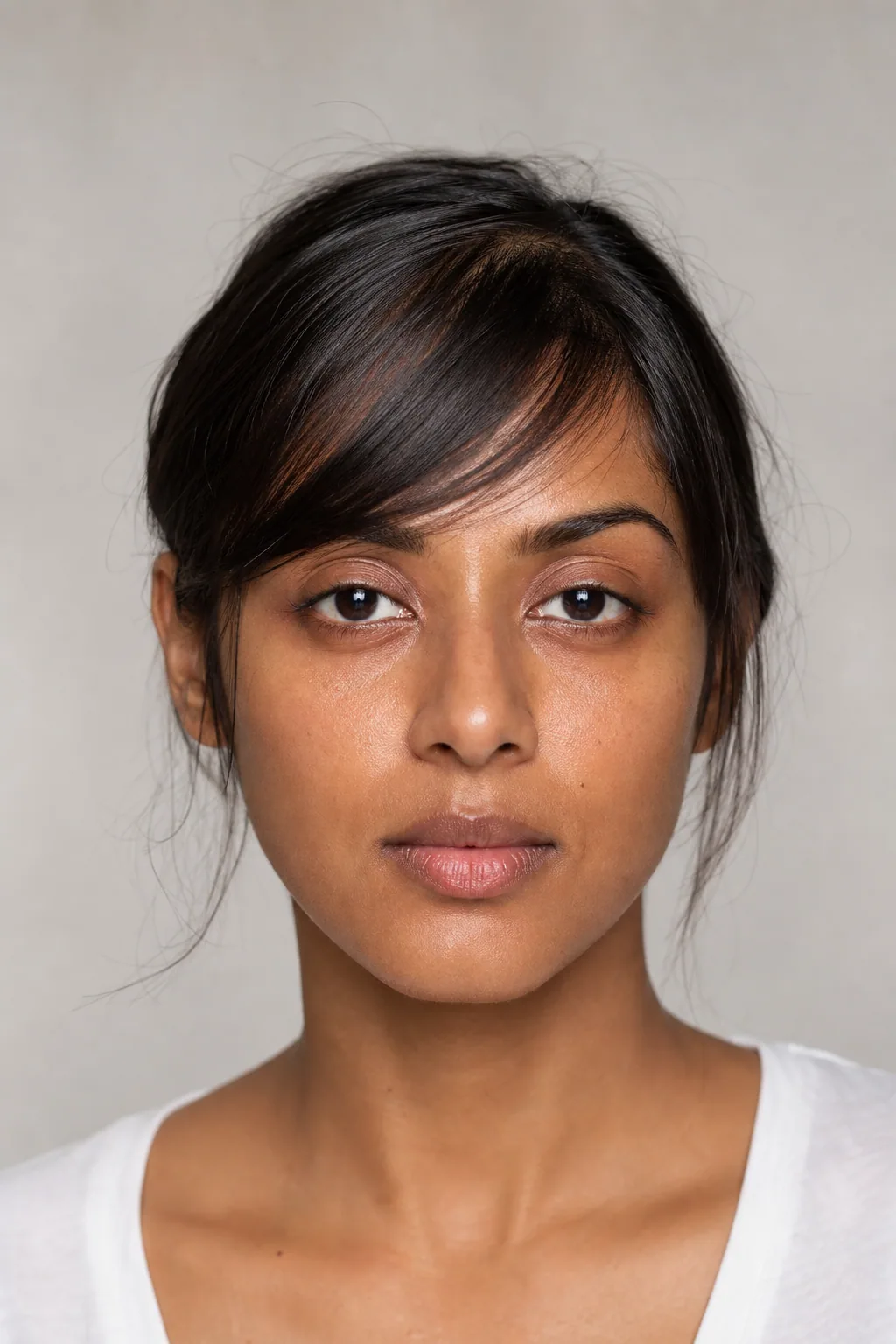
Hairstyle images in this guide are AI-generated illustrations, not photos of real clients or results. See our image policy.
Get the good hair intel
One honest, stylist-written guide in your inbox each week. No hype.

 SB
SB