Reviewed by Tara Sullivan · Updated August 2026 · 9 min read
Fine hair is the least forgiving hair type to cut yourself — and the reason has nothing to do with the technique being harder. It is that density hides mistakes and you don't have any. On thick hair, a line that dips a quarter of an inch disappears into the mass and nobody will ever see it.
On fine hair the perimeter is the style: it's the only solid edge you own, it's what makes the ends look like there's something there, and a quarter-inch dip in it is visible from across a room.
That single fact decides everything below. Four jobs are genuinely safe at home — dusting the ends of one-length hair, keeping a fringe honest between appointments, removing the occasional rogue strand, and running clippers over a very short crop. Five are not, and the most-recommended home method on the internet is on that list.
The tools matter less than knowing which three of them you should put down.
Chair-side note
I can spot a home haircut on fine hair from the doorway, and it is almost never the thing people are apologizing for. Nobody comes in with a dramatically crooked line — they come in because "the ends have gone stringy," and when I lift the hair the interior is full of short broken-looking pieces from a pair of thinning shears, or the crown is two inches shorter than the nape from a ponytail cut.
Both of those are invisible for about a fortnight, which is why the person sitting in front of me is convinced their hair changed on its own. The wobbly perimeter, honestly, is the easy one. I can fix a line in five minutes. What I can't do is put back the interior weight, and on fine hair that's the part holding the whole shape together.
SB
— Simone Baptiste, Senior Stylist
Why fine hair is the hardest hair to cut yourself
Three things stack up, and it's worth understanding them before you decide, because they also explain which jobs stay safe.
There is no density to absorb an error
Every haircut has some unevenness in it — professional ones included. Density is what forgives it: on a thick head, hairs from the layer above fall over the mistake and the eye reads an average. Fine, low-density hair has fewer strands sharing that job, so each one carries more visual responsibility and errors stay visible instead of being averaged away.
The perimeter is doing most of the work
On fine hair, the blunt outer line is the main source of apparent thickness. It's why we recommend blunt or barely-textured ends on almost every cut in our haircut guides for fine hair. Cut into that line badly and you don't just get an uneven edge — you get a thinner-looking head of hair, because the one solid thing about it has been broken up.
Fine hair behaves differently wet than dry
Fine strands stretch readily when wet and under tension, so a line cut wet, with your fingers pulling, will sit shorter than intended once everything dries and springs back.
Professionals compensate for this constantly and mostly unconsciously. It is the single most common reason a home trim ends up an inch above where it was aimed, and the same mechanism explains a good deal of what happens in a salon chair — wet or dry cutting for fine hair has the measurements.
The four jobs you can do at home
1. Dusting the ends of long, one-length hair
This is the only actual cutting job on the list, and it is deliberately minimal: a quarter of an inch, point-cut, on hair that is already one length. You are removing frayed ends, not making a shape.
Start dry and styled the way you wear it. No washing first, no damp comb-through. You want to see the real fall, including cowlicks.
Section into four — centre part front to nape, then ear to ear across the crown — and clip three away. Never cut hair you can't see.
Take a panel about an inch and a half wide from a lower back section, comb it straight down over the shoulder, and hold it with no tension pulling it out of its natural fall.
Point-cut into the very ends. Shears vertical, small snips into the end of the hair rather than a straight slice across. A quarter of an inch at most.
Guide off the panel you just cut — take a sliver of it with each new panel and match to it, rather than measuring.
Check the outline, not the ends, using a hand mirror against a wall mirror. If it's uneven, take a hair more off the long side. Chasing the short side is how home trims become bobs.
Point-cutting is the technique that makes this survivable: a softened line reads as intentional texture, where a blunt slice announces every wobble. This is also, incidentally, the argument for why point-cut is the word to use in a salon too — the full script is in what to ask your stylist when you have fine hair.
2. Maintaining a fringe between appointments
A fringe grows into your eyeline in about three weeks and it is unreasonable to book a salon visit for that. This is legitimate home territory, with the caveat that curtain and wispy fringes have their own rules and the difference matters more on fine hair than on any other type.
The one wiry hair that stands up at the part, the strand that's split halfway up, the piece that survived the last cut. Snipping those individually is harmless and takes ten seconds. Do it dry, do it one strand at a time, and resist the urge to turn it into a project — a "split-end search" that goes on for an hour ends with a visibly thinner head of hair.
4. Clipping a very short crop with a guard
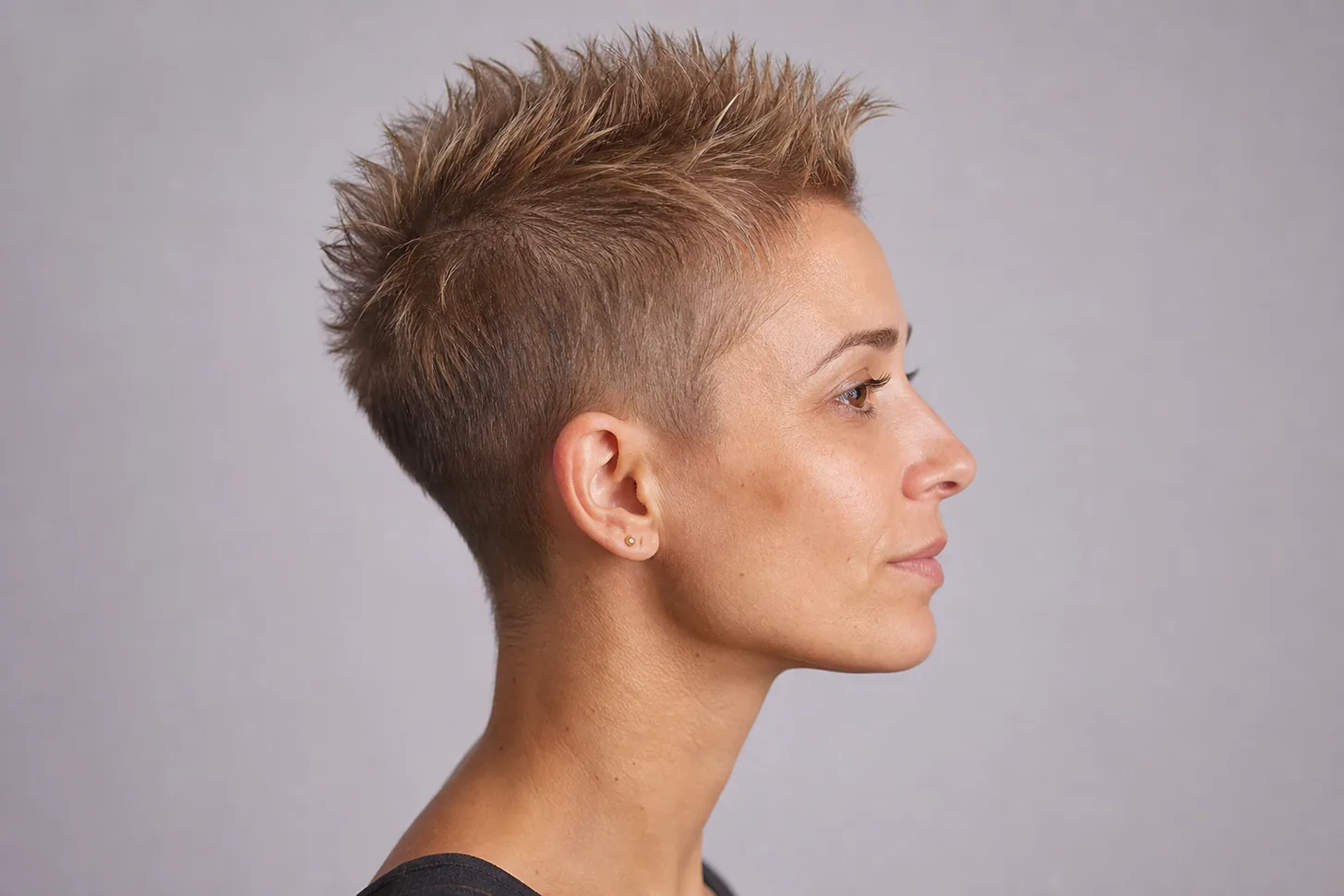
If you already wear a buzz, a crop or a shaved nape, clippers with a guard are genuinely maintainable at home, because a guard sets the length mechanically and you cannot cut a wobbly line with one.
What you still shouldn't do yourself is the blending between guard lengths, or the outline around the ears and neck if you can't see it. If you're considering going this short in the first place, the honest assessment for low density is in very short haircuts for fine hair.
The five you shouldn't
The job
Why it goes wrong on fine hair
What it costs to fix
Layers of any kind
Layers on fine hair have to be point-cut internally and placed against where the weight already sits. Cut blind, they remove the mid-length weight that holds the ends together
Nothing, until it grows — layers can't be un-cut. 6–18 months
A bob, lob or any line at the back
You cannot see the one thing that matters. A bob's whole quality is a level line, and hand mirrors reverse your corrections
One correction appointment, usually an inch shorter
Face-framing
It's cut with the head upright, against the face, following bone structure — none of which works when you're looking at a mirror image of yourself
Grows back into the shape over 3–6 months, awkwardly
Anything with thinning shears
They remove interior density, which is the thing fine hair has least of. See below — this is the worst one on the list
Genuinely unfixable. 12+ months of grow-out
Correcting a cut you dislike
Every correction chases the shortest piece. On fine hair, with no density to redistribute, that's a one-way ratchet
Two to four inches, in my experience, by the time it reaches me
The ponytail method is wrong for fine hair
You've seen it: gather all the hair into a high ponytail at the front of the head, slide the elastic down, cut straight across. It's the most-recommended home haircut on the internet and it produces a specific result that gets misdescribed as "just a trim."
Pull all your hair to one point above the forehead and you have gathered strands of wildly different lengths — the hair from the crown has a short journey, the hair from the nape has a long one.
Cut them level at that point and let them fall, and the crown hair is now dramatically shorter than the nape hair. That's long graduation. It's a heavily layered haircut, and you have just given yourself one whether or not you wanted one.
On thick hair that's often a welcome effect — it removes weight and gives movement. On fine hair it takes out exactly the interior weight that was holding your ends together, and the result is the "stringy ends" complaint that arrives about three weeks later, plus a shape that only time can undo. The related version with the head flipped forward does the same thing from the other direction.
If you want movement in fine hair without losing density at the ends, the technique is invisible internal layering, cut with the head upright by someone who can see the weight they're removing. That's what ghost layers are, and it's the opposite of a ponytail cut in both method and outcome. The general case is in layers for fine hair.
Thinning shears: the one tool to leave in the shop
Thinning and texturizing shears have one comb-like blade that removes a proportion of the hair inside a section — anywhere from 15% to 50% depending on the tooth count. They exist to reduce bulk. Fine hair's entire problem is that it doesn't have bulk.
Three specific things go wrong:
Short broken-looking pieces appear at the surface. The shears cut hairs at random points along the mid-length; those cut ends work their way to the surface as the hair moves, and read as frizz or breakage.
The interior hollows out. Remove density from the middle of the hair and the ends have nothing supporting them, so the perimeter goes transparent — the "see-through ends" that make people think their hair is falling out.
It's delayed. None of this shows for a week or two, which is exactly long enough to break the connection between cause and effect.
There is no home use for thinning shears on fine hair. If your hair genuinely feels bulky at the sides — which happens with fine but dense hair — that's a case for a stylist removing weight with a point-cut or a slide-cut in a specific place, not for a tool that removes it everywhere at once.
Tools, honestly
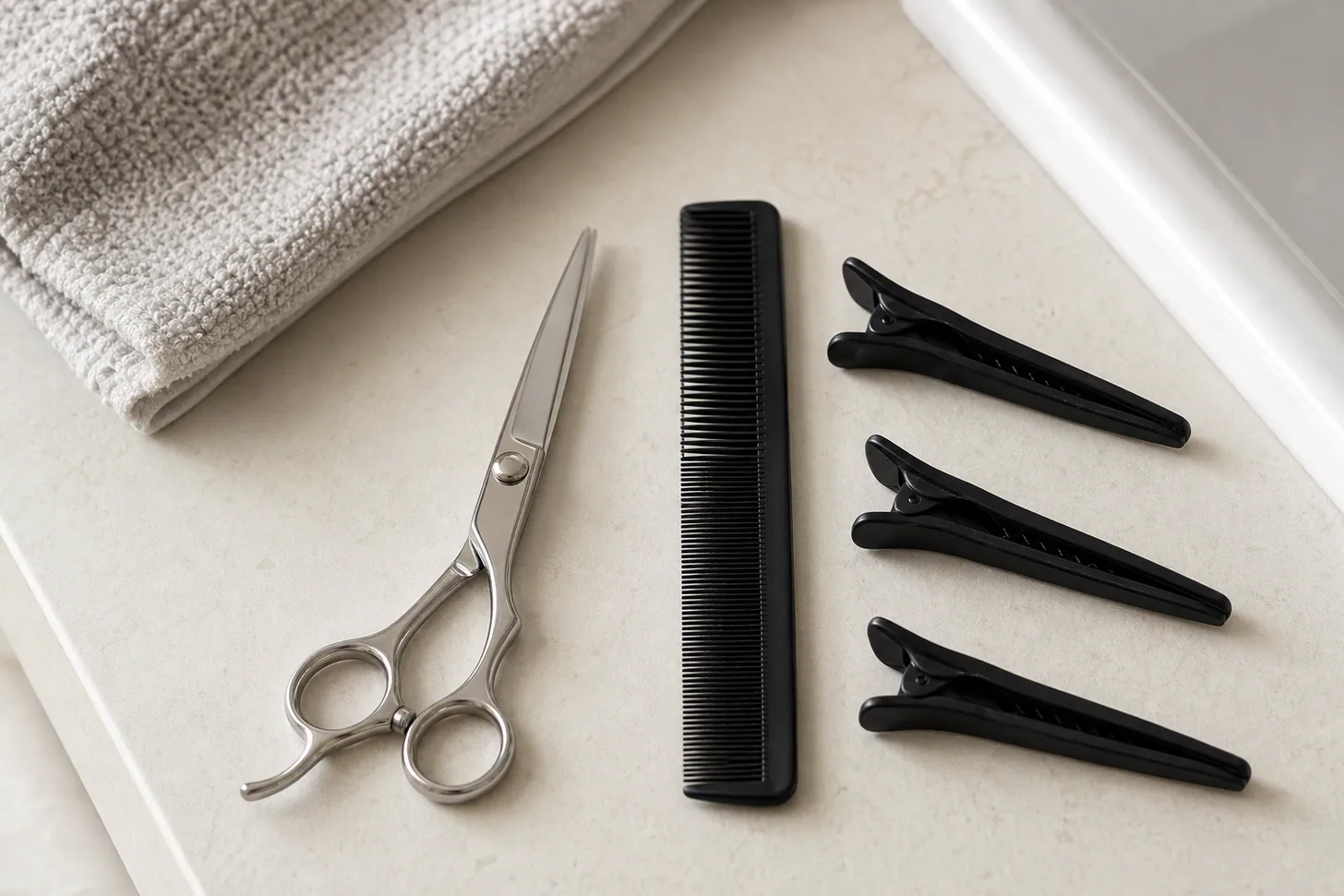
Shears matter more than skill for the one job you're doing. Kitchen, craft and paper scissors have blades geometrically designed to push material apart, so they bend and crush a strand rather than shearing it cleanly.
On fine hair, which has very little diameter to spare, a crushed end frays within weeks and you've manufactured the split ends you were trimming off. A modest pair of proper hair shears costs less than one salon visit, and they should never cut anything but hair — paper dulls an edge remarkably fast.
A fine-tooth comb and four clips do the rest. You do not need a cutting cape, a mannequin head, or a "self-cut kit."
Two mirrors, and good light from the front. Overhead bathroom light casts shadow exactly where you're trying to judge a line.
Three things that aren't true
"Trimming makes hair grow faster." Growth happens at the follicle, below the skin; the end of the hair has no vote. Scalp hair grows at about 0.35 mm per day per the StatPearls hair anatomy reference whether you trim it or not. What trimming does do is stop splits travelling upward and restore a clean edge — and on fine hair a clean blunt edge genuinely reads as thickness, which is why the myth persists.
"Trimming makes hair thicker." Same answer, one step further. Diameter is set at the follicle. A blunt end looks denser than a frayed one because it reflects light as a solid line, which is a real and useful effect — it just isn't a change to the hair.
"Search-and-destroy fixes split ends." Cutting individual split ends out of the mid-lengths is fine in moderation and counterproductive as a hobby. An hour of it removes a surprising amount of hair from random places, which on fine hair is a home-made texturizing job.
Most people who reach for the scissors aren't unhappy with their length — they're unhappy with how the hair is sitting. Before you cut:
If the ends look thin and stringy, try a lightweight styling cream on the last two inches and a smooth blow-dry finish before you decide there's something to cut off. Our picks are in styling creams for fine hair.
If it's the fringe specifically, that's the one thing on this page you have real permission to cut.
If you're growing it out, resist entirely. The staged plan in growing out short fine hair exists precisely because month five is when people cut.
When to stop and book the appointment
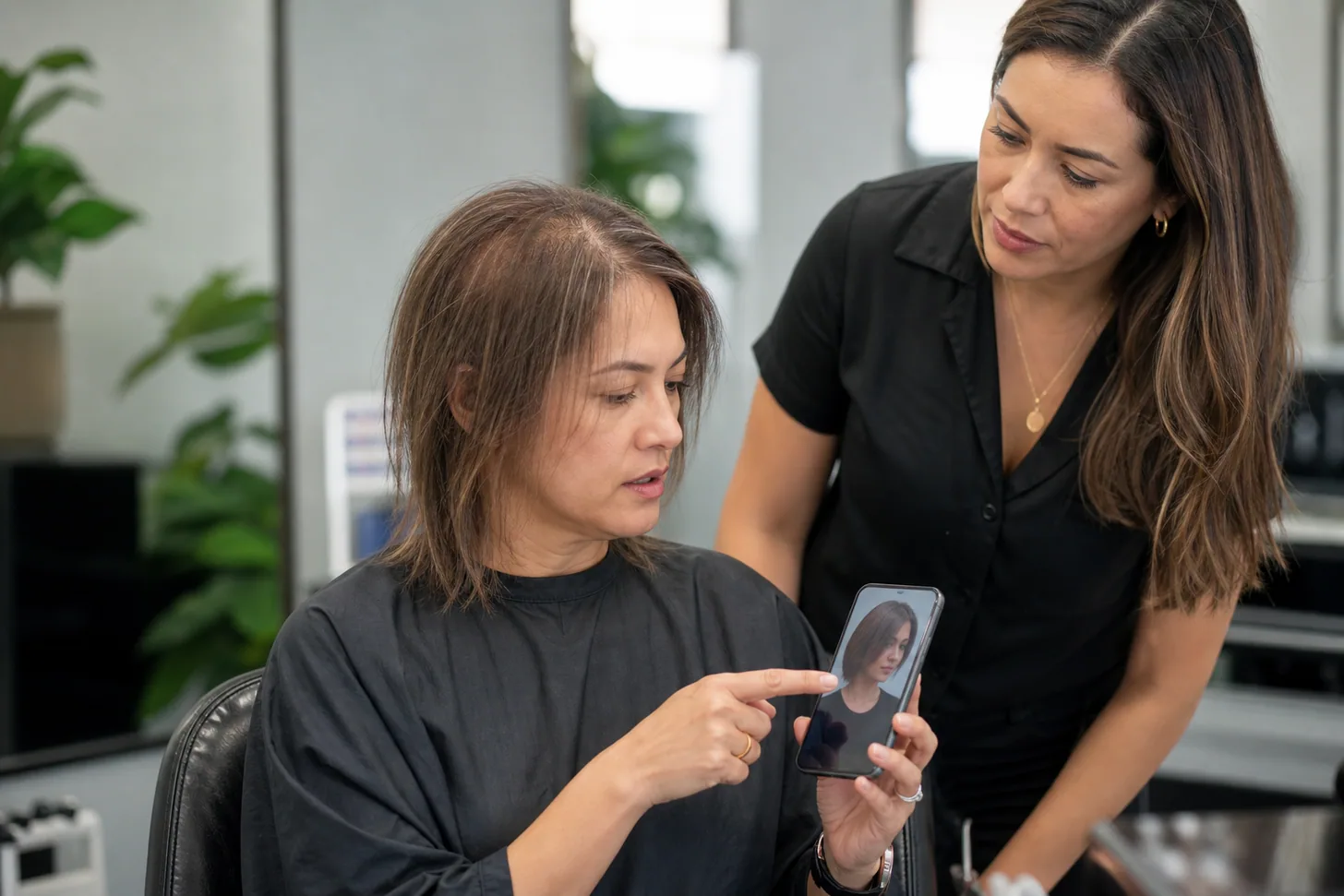
You want a different shape, not the same shape tidied. Every shape decision on fine hair is about where weight sits. That's a consultation, not a trim.
You've already cut once and it isn't level. Stop now. The second cut is the one that costs inches — go in with the hair unstyled so the real shape is visible.
Your hair is chemically treated or you've had a keratin or smoothing service. Treated fine hair behaves differently under tension and can look fine wet and wrong dry. See keratin on fine hair.
You're cutting because the ends look sparse and you suspect shedding. Length isn't the problem and cutting won't answer the question. Start with fine hair or thinning?
Anyone has suggested you use a razor comb. Razor cutting leaves a tapered, feathered end that goes transparent on fine hair. It's a bad idea in a salon and a worse one over a sink.
FAQ
Some of it, and less of it than with any other hair type. Fine hair is the least forgiving hair to cut yourself, not because the technique is harder but because there is no density to hide an error — on thick hair a wobbly line disappears into the mass, while on fine hair the perimeter is the entire style and a quarter-inch dip is visible across a room. What is genuinely safe at home: dusting the ends of one-length hair, maintaining a fringe between appointments, removing an occasional rogue strand, and running clippers with a guard over a very short crop. What is not: layers, any line at the back you cannot see directly, face-framing, and anything involving thinning shears.
Because they solve a problem fine hair does not have. Thinning or texturizing shears remove a percentage of the hair inside a section to reduce bulk, which is exactly right on dense hair and exactly wrong when the complaint is that there is not enough hair. On fine hair they leave short broken-looking pieces through the mid-lengths that stick out of the surface, and they hollow out the interior so the ends go transparent. Worse, the effect is invisible for about a fortnight and then arrives all at once, so most people do not connect it to the shears. There is no home use for them on fine hair.
No, and it is the most-recommended home method on the internet. Gathering all the hair into a high ponytail and cutting straight across creates long graduation: the hair from the crown ends up much shorter than the hair at the nape, which is a heavily layered shape whether or not you wanted layers. On thick hair that removes welcome weight. On fine hair it removes the interior weight that was holding the ends together, so you end up with wispy, transparent lengths and a shape that cannot be reversed except by growing it out. If you want layers on fine hair, they need to be point-cut internally by someone who can see what they are removing.
Dry, always, when you are doing it yourself. Wet hair stretches under the weight of the water and under any tension from your fingers, so a line cut wet sits noticeably shorter and often unevenly once it dries — the classic reason a home trim ends up an inch above where it was aimed. Cutting dry also lets you see the hair the way you actually wear it, including where it naturally parts, where a cowlick pushes it, and where the ends are genuinely frayed rather than just looking untidy while damp.
Yes, and it is the one purchase worth making before you try any of this. Kitchen, craft and paper scissors have blades set to push material apart rather than shear it, so they bend and crush the strand instead of slicing it cleanly. On fine hair, which has very little diameter to begin with, a crushed end frays and splits within weeks — you have created the exact problem you were trimming to fix. A modest pair of proper hair shears costs less than a single salon appointment, and they should be used for hair only, because cutting anything else on them dulls the edge quickly.
Neither. Growth happens at the follicle, well below the skin, and the end of the hair has no influence over it — scalp hair grows at roughly 0.35 mm per day per the StatPearls hair anatomy reference regardless of how recently it was cut. What trimming genuinely does is stop split ends travelling further up the shaft and restore a solid-looking perimeter, and on fine hair the second one matters a great deal because a clean blunt end reflects light and reads as density. So trims make fine hair look thicker at the ends without making a single strand thicker.
Every eight to twelve weeks for most fine hair, and closer to six for anything short enough to lose its shape quickly, such as a pixie or a French crop. Fine hair shows frayed ends sooner than coarse hair because there is less fiber to lose before the end looks thin, but it also cannot afford length taken repeatedly if you are growing it — so a small trim on schedule beats a large one when you finally notice. If you are growing it out, ask for a quarter of an inch and say the words out loud, because a stylist's default trim is often half an inch.
Stop cutting. The universal instinct is to even it up, and on fine hair that is how a small error becomes three inches shorter, because each correction chases the shortest piece. Book a correction and go in with unstyled hair so the stylist can see the real shape. Expect the fix to involve some length — corrections on fine hair almost always mean going a little shorter, since there is no density to redistribute — and expect it to be quick and undramatic. In the meantime, a wave or a bend through the lengths hides an uneven perimeter far better than straightening does.
Eleven years cutting fine and thin hair. Simone's shortcut on this one: if the tool has teeth on one blade, it isn't for you — put it down and cut a quarter inch off the ends instead.
Results vary with hair type, density, and growth patterns. This guide is educational and not a substitute for an in-person consultation with a licensed stylist.
Hairstyle images in this guide are AI-generated illustrations, not photos of real clients or results. See our image policy.
Get the good hair intel
One honest, stylist-written guide in your inbox each week. No hype.

 SB
SB