Reviewed by Tara Sullivan · Updated August 2026 · 10 min read
The instinct with a big forehead is to ask for a thick fringe, and on thin hair that is the one request that backfires. Here is why, in one sentence: a fringe isn't cut from your forehead, it's cut from the hair behind your hairline — so the more forehead you cover, the more hair you remove from the top of your head to do it.
On dense hair nobody notices. On thin hair a deep, heavy fringe leaves a see-through band sitting right behind it, and that band is far more visible than the forehead ever was. The good news is that the two things a fringe does are separable: length is what covers a forehead, density is what costs you.
Take all the length you want and keep the section shallow, and you get the coverage almost for free. This page has the depth rule in inches, a one-minute test that tells you whether you actually have a high forehead or a long face — they want opposite fringes — and ten fringes that work, plus the two that make it worse.
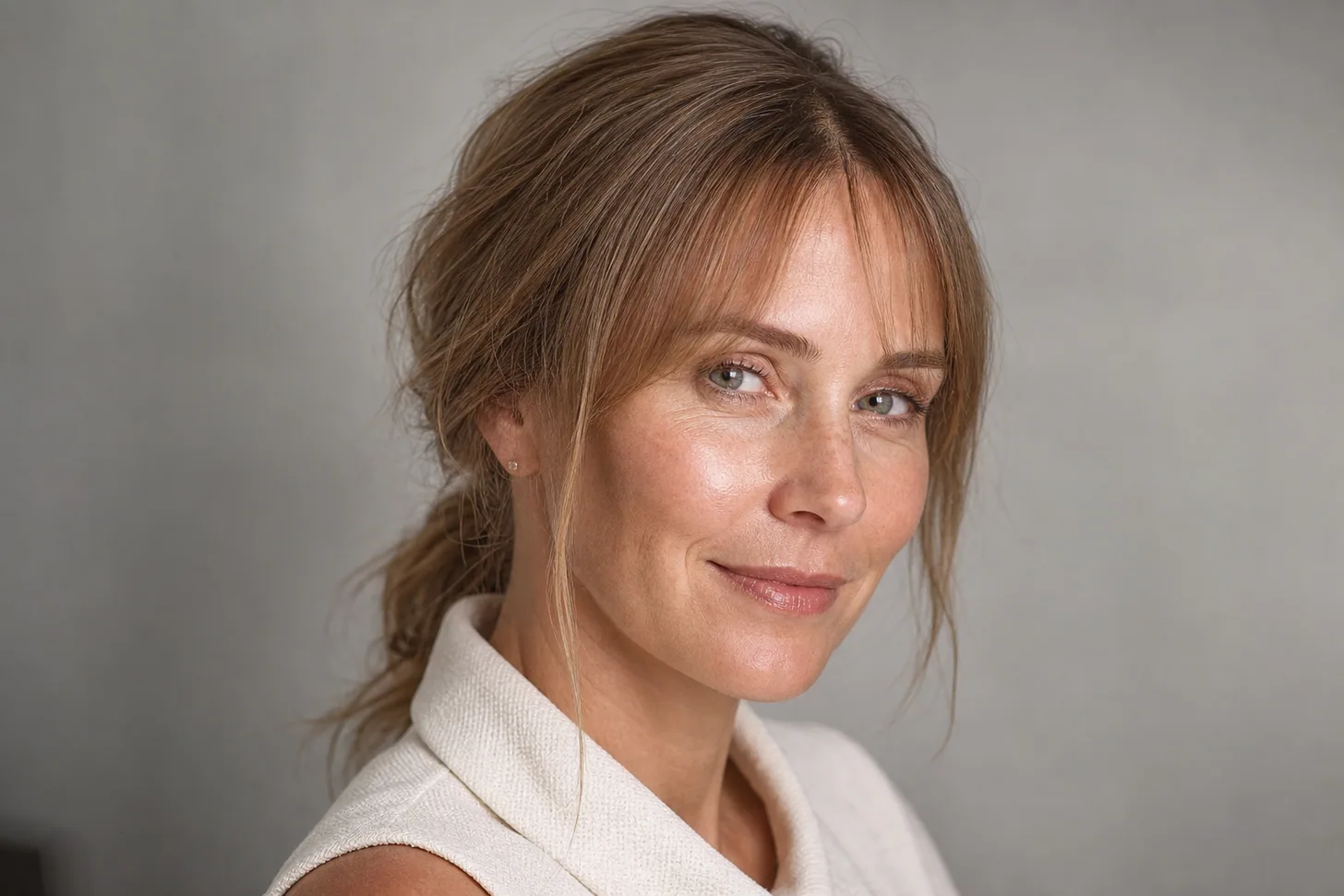
Maximum coverage for minimum hair: brow-length, see-through, and cut from a section barely an inch deep.
Three different things get called a big forehead, and they want different fringes
This is the step that gets skipped, and skipping it is why so many people end up with a fringe that doesn't do what they hoped. Work out which of these you have before you read anything else.
The test: divide your face into three
Hairline to eyebrows. Eyebrows to the base of your nose. Base of your nose to the bottom of your chin. On most faces those three sections are roughly the same length. Now compare:
Top third clearly longer, other two equal → a genuinely high hairline.This is what most people mean, and it is the straightforward case. You want maximum coverage for minimum hair, and the rest of this page is written for you.
All three thirds long → a long face, not a big forehead.Your forehead is in proportion; the whole face is elongated. A heavy full fringe here works, but a short one cuts the face into stacked segments and makes it look longer. You want width, not just coverage — haircuts for a long face with fine hair is the right page.
Top third long and the temples have opened up → a hairline that has moved.Different problem entirely. See below — this is the one that matters most on this site.
A high hairline and a receding hairline are not the same thing
A naturally high hairline has been where it is since you were a child. It follows a smooth, even line, and the hair density is the same right up to the edge. A hairline that has receded has moved: the temples have opened into a deeper V, the front edge is softer and wispier than the hair behind it, and photographs from a few years ago genuinely look different.
If yours has moved, a fringe cut from that ground is being built out of the sparsest hair you own, and it will look thin however it is cut — no technique fixes a shortage of raw material. Worse, a fringe over a receding hairline gets pinned and tucked constantly, and that adds daily tension to hair that is already under pressure.
The honest sequence is to find out what is happening at the hairline first and treat the fringe as the second question. The thinning hairline covers the mechanism and the reversible window, and fine hair or thinning? is the quicker triage if you are not sure which you have.
Chair-side note
I ask one question in this consultation before I pick up any scissors: how long has your hairline been where it is? Most people answer instantly — "always, my mum has the same one" — and then we can cut whatever they like. But every so often somebody pauses, and in that pause I can see them working out that they don't actually know, which is nearly always the answer.
Then I part the hair right at the front and look at the edge, because a hairline that has moved gives itself away: the first half-inch is finer and lighter than everything behind it, and the temples have gone soft. I've had to say "let's not cut a fringe today" more than once, and nobody has ever been pleased about it in the chair. Every one of them has been pleased about it a year later, because the alternative was cutting away the hair that was covering the problem.
SB
— Simone Baptiste, Senior Stylist
The depth rule — the number to bring to the salon
Every fringe is cut from a section that starts at your hairline and runs back toward the crown. How far back it runs is the single decision that determines whether a fringe flatters thin hair or thins it, and it is almost never discussed out loud. So say the number.
Your density
Maximum section depth
What you get
What to refuse
Low — ponytail thinner than a US quarter
About 1 inch
A genuinely see-through fringe. Covers the forehead; you'll see skin through it in bright light, and that's fine.
Anything described as "full". No thinning shears — a fringe cut from a shallow section is already light enough.
Medium
1 to 1.5 inches
A soft fringe with real presence that still lets light through. The best-looking version of this cut.
Depth past 1.5 inches. That's where the band behind it starts showing.
Fine strands, high density
Up to 2 inches
A proper full fringe. You have the hair to spend and this is the group that can spend it.
Nothing much — but ask for it point-cut rather than blunt so it doesn't sit as a solid block.
Two more rules that go with the depth, and they are cheap:
Keep the section narrow as well as shallow.A fringe that extends past the outer corner of your eyebrow is taking hair from your temples, which on fine hair is the second-sparsest ground after the hairline itself. Corner of the brow to corner of the brow is plenty.
Ask for it point-cut, not blunt.Point cutting lets light pass through the fringe so it reads soft rather than as a solid slab of hair that isn't quite solid enough. It is also what makes a shallow-section fringe look deliberate rather than sparse.
And the counterintuitive one on length: a shorter fringe shows more forehead, not less. Cut above the eyebrow, a fringe leaves a visible strip of forehead between itself and your eyes — which draws the eye to exactly the area you were shortening. Brow-length or a shade longer closes that gap.
Ten fringes that work on a big forehead and thin hair
Ordered from most coverage to least. All ten assume the shallow section above; that is what makes them viable rather than the shape.
Soft see-through brow-length fringe on fine light-brown hair, skin faintly visible through the fringe, high hairline covered, woman early 30s
1
The see-through brow-skimmer
The maximum-coverage option and the one to ask for if hiding the forehead is the whole goal. It runs the full width of the brows and finishes just at the eyebrow, but it is cut from a section barely an inch deep and point-cut so light passes through it. You will see a little skin through the fringe in bright light — that is the trade, and it is the right one. Trying to make this fringe opaque is exactly what puts a bald-looking band behind it.
Wispy fringe with separated piece-y strands falling just below the eyebrows on fine ash-blonde hair, woman late 20s
2
The wispy fringe, cut a shade longer
The standard wispy fringe with one adjustment for a high hairline: leave it half an inch longer than you normally would, so it sits just below the brow rather than above it. The separation does the work of making not-much-hair look intentional, and the extra length closes the forehead gap. This is the most forgiving fringe on fine hair generally, and wispy bangs for fine hair has the sectioning detail.
Arched fringe slightly longer at the outer edges than the centre, framing the temples, fine mid-brown hair, woman mid 30s
3
The arched fringe
Cut a fraction shorter through the centre and longer at the outer corners, so the bottom edge curves gently rather than running straight across. The arch matters on a high hairline because a flat horizontal line stacks another band across a face that already reads as segmented, while a curve follows the shape of the brow and softens it. Ask for "a soft arch, longest at the corners" — it is a small instruction that changes the whole result.
Long side-swept fringe crossing the forehead diagonally from a deep part on fine dark-blonde hair, woman early 40s
4
The deep-part side sweep
Genuinely the best value on this page. A deep side part sends a diagonal panel of hair across the top of the forehead, which shortens it visually while adding root height on the heavy side — two problems, one decision, and it needs less hair than a full fringe because the sweep concentrates strands into one direction. It also grows out with no awkward stage at all. Side-swept bangs for thin hair covers the sectioning.
Curtain bangs parting at the centre and sweeping to the cheekbones with a strip of forehead visible between, fine chestnut hair, woman mid 30s
5
Curtain bangs, cut shorter at the centre
Curtain bangs don't hide a forehead, they divide it — the centre strip stays visible while the sides are covered, which breaks a large area into smaller ones. That reads as a softer proportion without demanding much hair. Ask for the shortest point to sit at the bridge of the nose rather than the cheekbone; the standard long version leaves too much forehead open to help here. Curtain bangs for thin hair is the full treatment.
Fringe on a chin-length French bob covering a high hairline, fine dark hair, woman late 20s
6
The French bob fringe
Pairing the fringe with a short bob changes the arithmetic in your favour: at chin length there is very little weight pulling the roots down, so the hair behind the fringe stands away from the head and the shallow section stops being noticeable. This is the cut where a high hairline is easiest to handle on thin hair. The French bob on fine hair has the shape; the choppy bob is the softer-edged relative.
Long grown-out fringe blending into face-framing layers at the jaw on fine honey-blonde hair, woman early 40s
7
The bottleneck fringe
Short and closed through the centre, then flaring out and lengthening sharply at the sides to blend into face-framing pieces. It gives you real coverage where the forehead is widest and hands off into your length instead of ending in a hard line — so it never has the awkward grow-out stage that puts people off fringes. A good middle option if you want more than curtain bangs give but less commitment than a full fringe.
Fringe worn over a high hairline with soft waves through the mid-lengths adding width at the cheekbones, fine light-brown hair, woman mid 30s
8
The fringe with width built in below it
Less a fringe than a strategy: any of the shapes above, paired with deliberate width at cheekbone level from waves or face-framing layers. A forehead reads long partly because of what is below it — a narrow silhouette makes the top of the face the widest thing on the head. Add width at the cheekbone and the same forehead reads proportionate. Face-framing layers is where this gets built.
Pixie cut with a long swept fringe crossing the forehead and lifted crown on fine mid-brown hair, woman late 40s
9
The pixie with a long swept top
Counterintuitive, and it works. A pixie leaves the top section long enough to sweep across the forehead while everything else is short, so the fringe is the longest hair on your head and gets all the available density. The crown height a pixie gives you also changes the proportion — a lifted top makes a forehead look shorter, because the head no longer reads as flat above it. Pixie cuts for fine and thin hair has the range.
Micro baby fringe sitting high above the eyebrows on fine dark hair with a strong graphic look, woman late 20s
10
The baby fringe — as a choice, not a fix
Included honestly: a micro fringe sitting well above the brows does not hide a big forehead, it frames one. It is a deliberate, graphic look that says the forehead is a feature, and on fine hair it works because it needs almost no hair at all. If you have made peace with the forehead and want something striking, this is the one. If you came here for coverage, it is the wrong end of the page.
The two fringes that make it worse
The thick blunt fringe cut from a deep section
The most-requested version and the one that causes the most regret. It is the direct expression of the instinct — big forehead, so cover it completely — and on thin hair it fails twice over.
The fringe itself separates into strands and shows scalp through the gaps because there was never enough hair to build a solid block, and the deep section leaves a transparent band behind it that appears every time you move your head. If you love the look, ask for the illusion instead: brow-length, full width, shallow section, point-cut. It reads blunt from conversational distance and costs a fraction of the hair.
Any fringe achieved with thinning shears
Stylists sometimes reach for thinning shears to make a fringe "lighter" for a big forehead. On fine hair that is the wrong tool for the right goal: thinning shears cut a percentage of strands short in the middle of their length, so the fringe goes genuinely see-through within two months as those cut ends grow down at different lengths.
The lightness you want comes from a shallow section and point cutting, both of which leave every strand full length. Say "no thinning shears" out loud — see cutting techniques for fine hair for the vocabulary.
What works without cutting a fringe at all
All three of these are reversible, free, and worth two weeks of trying before you commit to something that takes eight months to grow out.
Move to a deep side part.The single highest-value change. It lays a diagonal across the top of the forehead and lifts the roots on the heavy side. How to part fine hair covers moving a part that has sat in one place for years.
Add face-framing pieces at cheekbone level.Pulls the eye down and sideways. It costs almost no density because the pieces come from the sides rather than the hairline.
Build height at the crown.A flat top lengthens a forehead by making it the widest thing on the head. Root volume in fine hair is the method, and teasing done properly is the two-minute version.
What to ask your stylist
"A soft fringe from a shallow section — no more than an inch and a half back."The number is the whole consultation. Everything else follows from it.
"Keep it between the outer corners of my eyebrows."Stops the fringe eating into your temples.
"Point-cut, please, and no thinning shears."Two different tools; declining one doesn't decline the other.
"Brow-length or a little below — I don't want a gap between the fringe and my eyes."Names the effect you're buying rather than a measurement that means different things wet and dry.
"Can you check my hairline first?"A reasonable, normal request, and the one that prevents the mistake that can't be undone.
Your hairline has moved.Cutting a fringe from receding ground removes the hair that was covering it. The thinning hairline first, fringe second.
Your whole face is long, not just the forehead.A short fringe segments a long face and lengthens it further. Cuts for a long face and fine hair is the right page.
You can't commit to a trim every two to three weeks.A fringe past your eyeline gets pinned back, and a pinned-back fringe covers nothing. Take the long side sweep instead.
Your scalp shows at the crown.A fringe moves hair from the top of your head forwards, which is the wrong direction. Cuts for a thinning crown first.
Your forehead is oily and your fringe is your main concern.A fringe sits on skin all day and shows it within hours on fine hair. How to style bangs on fine hair has the honest daily routine before you commit.
You've been talked out of a fringe before and are hoping for a different answer.If the reason was density at the front, it's still the reason. Try the deep side part for a fortnight — it's the same effect for none of the cost.
FAQ
A soft, see-through fringe cut from a shallow section, sitting at or just below the eyebrow. That combination covers the most forehead for the least hair, which is the trade that decides everything here. The instinct is the opposite — a big forehead feels like it needs a thick, solid fringe — but a fringe is built from a section starting at your hairline and running back over your head, so a deep, dense fringe removes hair from the top of your head to cover the front of it. On thin hair that leaves a transparent patch behind the fringe that's more noticeable than the forehead ever was. Length covers a forehead; density is what costs you.
Divide your face into three: hairline to eyebrows, eyebrows to the base of the nose, and the base of the nose to the bottom of your chin. On most faces those three are roughly equal. If the top third is visibly longer than the other two, you have a genuinely high hairline. If all three are long, what you have is a long face rather than a big forehead — and it wants a different fringe, one that shortens the face rather than one that maximises coverage. The two get treated as the same problem constantly, and the fringe that fixes one exaggerates the other, so measure before you book.
Yes, and the mechanism is section depth rather than the fringe itself. Every fringe is cut from a section that begins at your hairline and extends back toward your crown. The deeper it runs, the more hair goes into the fringe and the less remains immediately behind it. On dense hair that's invisible. On thin hair a section running more than about an inch and a half back leaves a see-through band behind the fringe that shows whenever your hair moves or the light is overhead. Ask for a shallow section — no more than an inch and a half, closer to an inch if your density is low — and the fringe costs you almost nothing.
No, and telling them apart changes the answer entirely. A naturally high hairline has been where it is since childhood, follows a smooth even line, and has the same density right up to the edge. A hairline that has receded has moved — the temples have opened up, the front edge is softer and wispier than the hair behind it, and old photographs look different. If yours has moved, a fringe cut from that ground is built out of the sparsest hair you own and will look thin however it's cut. It also means constant pinning and tucking, which adds tension to hair already under pressure. The thinning hairline is the page to read first.
At or just below the eyebrow, and rarely above it. A fringe cut above the brow leaves a visible strip of forehead between the fringe and your eyes, which draws attention to exactly the area you were trying to shorten — the shorter the fringe, the more forehead you're actually displaying. Brow-length or a little longer closes that gap, and the eye reads the fringe line as the top of the face. It's also more forgiving on fine hair, since a longer fringe blends into your length rather than sitting as a separate block, and it grows out gracefully instead of becoming an awkward shelf within three weeks.
Partially, and that's sometimes the better outcome. Curtain bangs part in the middle and sweep outward, so they cover the sides of the forehead and leave a strip visible down the centre. That breaks a wide forehead into smaller areas rather than hiding it, which softens the proportion without demanding much hair — and on thin hair, demanding little hair is the whole point. If you want maximum coverage they aren't the strongest option; a soft brow-length fringe is. If you want the forehead to read shorter while keeping a fringe you can grow out easily and style in four minutes, they're the most forgiving choice here.
Three things, and they cost nothing to try before committing to a fringe. A deep side part sends a diagonal sweep across the top of the forehead, which shortens it visually and adds root height at the same time. Face-framing pieces at cheekbone level pull the eye down and sideways, away from the top of the face. And volume at the crown changes the proportion from the other direction — a flat top makes a forehead look longer, because the head reads as narrow and the forehead as the widest thing on it. Try all three for a fortnight first; none of them requires growing anything back out.
Every two to three weeks, which is the honest cost of this specific fringe. A brow-length fringe reaches your eyeline in about three weeks of ordinary growth, and once it does you'll start pinning it back — which defeats the coverage you cut it for. Curtain and longer side-swept versions stretch to four or five weeks because they blend into the length rather than ending in a line. Many salons trim a fringe free between cuts, so ask when you book. If a three-week rhythm isn't realistic, take the longer, softer version rather than the fuller one — it degrades far more gracefully.
Eleven years cutting fine hair. Simone asks how long your hairline has been where it is before she picks up the scissors, because that one question decides the whole haircut.
Images in this article are AI-generated illustrations, not photographs of real clients or results. See our image policy.
Results vary with hair type, density, and growth patterns. This guide is educational and not a substitute for an in-person consultation with a licensed stylist.
Get the good hair intel
One honest, stylist-written guide in your inbox each week. No hype.

 SB
SB